REVIEW 2 major objections 3 minor 1 cited by
Automating Low-Risk Code Review at Meta: RADAR, Risk Calibration, and Review Efficiency
T0 review · 2 major / 3 minor · reviewed 2026-06-29 · grok-4.3
Pith's one-line read A multi-stage risk-aware system called RADAR automates review of over 300K low-risk diffs at Meta with revert rates one-third and incident rates one-fiftieth those of manual review.
desk verdict RADAR gives concrete deployment numbers on risk-based auto-review at Meta scale, but the safety claims are undercut by selection bias in the group comparisons. read the letter →
The pith
A machine-rendered reading of the paper's core claim, the machinery that carries it, and where it could break.
The reading
What carries the argument
The RADAR multi-stage funnel that classifies diffs by authorship and source, then applies eligibility gates, static heuristics, a machine-learned Diff Risk Score, LLM review, and deterministic validation to decide on automated landing.
What would settle it
A randomized assignment of eligible diffs to RADAR versus manual review, followed by measurement of revert rates and production incidents, would show whether the lower safety numbers are caused by the automation.
Extended reading notes
Core claim
RADAR classifies each diff by authorship and source type, applies eligibility gates, static heuristics, a machine-learned Diff Risk Score, LLM-based Automated Code Review, and deterministic validation before landing qualifying changes. It has reviewed 535K+ diffs and landed 331K+. Relaxing the Diff Risk Score threshold from the 25th to the 50th percentile increased the approve rate to 60.31 percent. The revert rate for RADAR-reviewed diffs is one-third that of non-RADAR diffs, and the Production Incident rate is one-fiftieth that of non-RADAR diffs. RADAR reduces median time to close by over 330 percent and median diff review wall time by 35 percent.
Load-bearing premise
The before-after comparisons and difference-in-differences analysis can separate the effect of RADAR from any systematic differences in the kinds of diffs that qualify for automated versus manual review.
Editorial extensions
If this is right
- Raising the Diff Risk Score threshold from the 25th to the 50th percentile lifts the approve rate to 60.31 percent.
- RADAR-reviewed diffs show a revert rate one-third that of non-RADAR diffs.
- Production incident rate for RADAR diffs is one-fiftieth that of non-RADAR diffs.
- The system shortens median time to close by more than 330 percent and median review wall time by 35 percent.
Reading between the lines
- Similar layered risk systems could be tested in other large codebases that face AI-driven volume growth.
- The separation between the risk model and the LLM reviewer step could allow separate tuning of each piece in follow-on work.
- Gradually raising the risk threshold while tracking incident rates would reveal the highest safe automation level.
Editorial analysis
A structured set of objections, weighed in public.
Referee Report
Summary. The manuscript describes RADAR (Risk Aware Diff Auto Review), a multi-stage funnel deployed at Meta that classifies diffs by authorship/source, applies eligibility gates, static heuristics, a machine-learned Diff Risk Score, LLM-based automated review, and deterministic validation to automate low-risk changes. Using telemetry on 535K+ RADAR-reviewed diffs (331K+ landed), observational before-after comparisons, and difference-in-differences analysis, it reports that relaxing the Diff Risk Score threshold from the 25th to 50th percentile raises the approve rate to 60.31%, that RADAR diffs exhibit 1/3 the revert rate and 1/50 the production incident rate of non-RADAR diffs, and that automation reduces median time-to-close by >330% and median review wall time by 35%. The central claim is that risk-aware layered automation can reduce review bottlenecks from AI-driven code growth without compromising production safety.
Significance. If the safety claims can be supported with controls that address selection, the work supplies large-scale empirical evidence on managing reviewer bandwidth shortages induced by AI coding tools. The scale (535K+ diffs), explicit risk-threshold calibration results, and reported efficiency gains would be of direct interest to practitioners and researchers studying automated code review in industrial settings.
major comments (2)
- [Abstract] Abstract: The reported revert rate (1/3) and production incident rate (1/50) for RADAR-reviewed diffs versus non-RADAR diffs confounds treatment with selection. RADAR eligibility explicitly incorporates authorship/source gates, static heuristics, and the Diff Risk Score to route only lower-risk diffs into automation; any unconditional comparison of outcomes between the selected group and the residual group is therefore mechanically predicted by the assignment rule itself and does not demonstrate that automation preserves safety.
- [Abstract and Evaluation section] Abstract and Evaluation section: The before-after comparisons and difference-in-differences analysis are described only as applying to “efficiency outcomes.” It is not stated whether these designs were also applied to the safety metrics, nor whether they incorporated risk-score matching, within-band comparisons, or other controls for the stratification variables that determine RADAR eligibility.
minor comments (3)
- Provide additional detail on the features, training data, and out-of-sample performance metrics for the machine-learned Diff Risk Score.
- Clarify the exact definition of the “non-RADAR” comparison group (e.g., all diffs, eligible-but-not-automated diffs, or a matched subset) used for the revert and incident rate calculations.
- The manuscript would benefit from a table or figure showing the distribution of Diff Risk Scores for RADAR versus non-RADAR diffs to illustrate the degree of separation induced by the selection rule.
Simulated Author's Rebuttal
We thank the referee for the thoughtful and precise comments on selection bias and the scope of our causal designs. The concerns are well-taken and highlight areas where the manuscript can be clarified. We respond to each major comment below and will revise the abstract, evaluation section, and add a limitations discussion to address them directly.
read point-by-point responses
-
Referee: [Abstract] Abstract: The reported revert rate (1/3) and production incident rate (1/50) for RADAR-reviewed diffs versus non-RADAR diffs confounds treatment with selection. RADAR eligibility explicitly incorporates authorship/source gates, static heuristics, and the Diff Risk Score to route only lower-risk diffs into automation; any unconditional comparison of outcomes between the selected group and the residual group is therefore mechanically predicted by the assignment rule itself and does not demonstrate that automation preserves safety.
Authors: We agree that the unconditional comparison confounds selection with treatment. The eligibility gates and Diff Risk Score are designed precisely to route lower-risk diffs to automation, so lower failure rates in that group are expected by construction. The manuscript presents the 1/3 and 1/50 figures as descriptive evidence that the selected population maintains low absolute revert and incident rates after automated review, rather than as a causal claim that automation itself preserves safety. We will revise the abstract to remove any implication of causal safety preservation from the relative rates, state the rates as conditional on the risk stratification, and add an explicit limitations paragraph noting that the safety comparison is observational and does not isolate the marginal effect of automation. revision: yes
-
Referee: [Abstract and Evaluation section] Abstract and Evaluation section: The before-after comparisons and difference-in-differences analysis are described only as applying to “efficiency outcomes.” It is not stated whether these designs were also applied to the safety metrics, nor whether they incorporated risk-score matching, within-band comparisons, or other controls for the stratification variables that determine RADAR eligibility.
Authors: The before-after and difference-in-differences analyses were applied only to efficiency outcomes (median time-to-close and review wall time), as stated in the Evaluation section. They were not applied to safety metrics because revert and incident tracking require extended post-landing observation windows, and the threshold relaxations primarily varied automation volume rather than providing clean within-band variation for safety. We will revise the Evaluation section to state explicitly that safety metrics are reported as raw rates within the RADAR-eligible population, note the absence of risk-score matching or within-band controls for safety, and discuss this as a limitation with suggestions for future matched analyses. revision: yes
Circularity Check
No circularity: claims rest on direct telemetry and observational analyses without self-referential derivations or fitted predictions.
full rationale
The paper reports empirical telemetry (535K+ diffs), raw revert/incident rates, before-after comparisons for policy changes, and DiD for efficiency outcomes. No equations, fitted parameters renamed as predictions, self-citations as load-bearing premises, or ansatzes appear in the provided text. The central safety claim is a direct group comparison from deployment data rather than a quantity derived by construction from the paper's own models or inputs. This matches the default expectation of non-circular empirical reporting.
Assumptions & free parameters
free parameters (1)
- Diff Risk Score threshold =
25th to 50th percentile
invented entities (1)
-
Diff Risk Score
Cite this review
Pith. "Pith review of Automating Low-Risk Code Review at Meta: RADAR, Risk Calibration, and Review Efficiency." pith.science (2026). https://pith.science/paper/3P7DGRWP
@misc{pith2026260530208,
  author       = {Pith},
  title        = {Pith review of: Automating Low-Risk Code Review at Meta: RADAR, Risk Calibration, and Review Efficiency},
  year         = {2026},
  howpublished = {\url{https://pith.science/paper/3P7DGRWP}},
  note         = {Machine review of arXiv:2605.30208}
}
read the original abstract
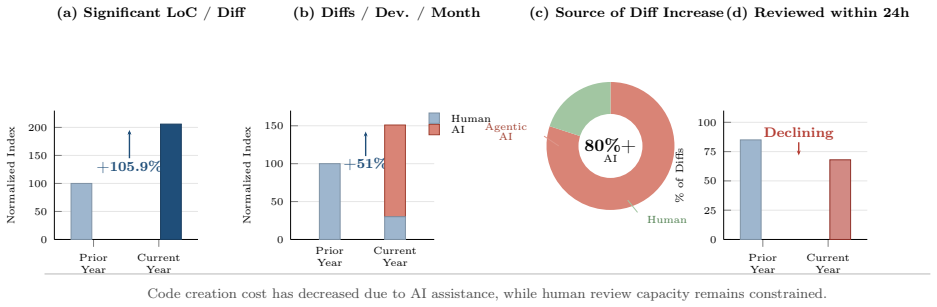
AI-assisted coding tools have altered software production. At Meta, significant lines of code per human-landed diff grew by 105.9% year over year and per-developer diff volume rose 51%, with agentic AI responsible for over 80% of that growth. Meanwhile, the share of diffs receiving timely review has declined, exposing a widening gap between code supply and reviewer bandwidth. We ask three questions that progress from feasibility through calibration to impact: (1) can risk-stratified automation operate at scale across diverse organizations, (2) how does tuning the risk threshold affect the trade-off between automation yield and safety, and (3) to what extent does automated review reduce end-to-end latency for AI-generated changes? We deployed RADAR (Risk Aware Diff Auto Review), a multi-stage funnel that classifies each diff by authorship and source type, applies eligibility gates, static heuristics, a machine-learned Diff Risk Score, LLM-based Automated Code Review, and deterministic validation before landing qualifying changes. We evaluate RADAR through telemetry covering 535K+ RADAR-reviewed diffs, observational before-after comparisons for policy changes, and difference-in-differences analysis of efficiency outcomes. RADAR has reviewed 535K+ diffs and landed 331K+. Relaxing the Diff Risk Score threshold from the 25th to the 50th percentile increased the approve rate to 60.31%. The revert rate for RADAR-reviewed diffs is 1/3 that of non-RADAR diffs, and the Production Incident rate is 1/50 that of non-RADAR diffs. RADAR reduces median time to close by over 330% and median diff review wall time by 35%. Risk-aware layered automation can materially reduce review bottlenecks created by AI-driven code growth without compromising production safety.
Figures


Figures from the paper (1 more)

Forward citations
Cited by 1 Pith paper
-
When Policies Change Probabilities: Modular Decision-Making for LLM Code Review
Swapping a 1:1 for a 10:1 false-accept policy shifted reported failure probabilities by 13.6 to 16.9 percentage points across four LLM reviewer systems, and the actions from the high-cost prompt were worse than reject...
Reference graph
Works this paper leans on
-
[1]
Sumit Asthana, Rahul Kumar, Ranjita Bhagwan, Christian Bird, Chetan Bansal, Chandra Maddila, Sonu Mehta, and B Ashok. 2019. WhoDo: automating reviewer suggestions at scale. InJoint European Software Engineering Conference and Symposium on the Foundations of Software Engineering. 937–945
2019
-
[2]
Alberto Bacchelli and Christian Bird. 2013. Expectations, outcomes, and chal- lenges of modern code review. InInternational Conference on Software Engineer- ing. 712–721
2013
-
[3]
Vipin Balachandran. 2013. Reducing human effort and improving quality in peer code reviews using automatic static analysis and reviewer recommendation. In International Conference on Software Engineering. 931–940
2013
-
[4]
Amiangshu Bosu and Jeffrey C Carver. 2013. Impact of peer code review on peer impression formation: A survey. InInternational Symposium on Empirical Software Engineering and Measurement. 133–142
2013
-
[5]
Amiangshu Bosu, Michaela Greiler, and Christian Bird. 2015. Characteristics of useful code reviews: An empirical study at microsoft. InInternational Working Conference on Mining Software Repositories. 146–156
2015
-
[6]
H Alperen Çetin, Emre Doğan, and Eray Tüzün. 2021. A review of code reviewer recommendation studies: Challenges and future directions.Science of Computer Programming(2021), 102652
2021
-
[7]
Mark Chen, Jerry Tworek, Heewoo Jun, Qiming Yuan, Henrique Ponde de Oliveira Pinto, Jared Kaplan, Harri Edwards, Yuri Burda, Nicholas Joseph, Greg Brockman, Alex Ray, Raul Puri, Gretchen Krueger, Michael Petrov, Heidy Khlaaf, Girish Sastry, Pamela Mishkin, Brooke Chan, Scott Gray, Nick Ryder, Mikhail Pavlov, Alethea Power, Lukasz Kaiser, Mohammad Bavarian...
work page Pith review arXiv 2021
-
[8]
T. L. Graves, A. F. Karr, J. S. Marron, and H. Siy. 2000. Predicting fault incidence using software change history.IEEE Transactions on Software Engineering26, 2 (2000)
2000
Show all 26 references
-
[9]
Yasutaka Kamei, Takafumi Fukushima, Shane McIntosh, Kazuhiro Yamashita, Naoyasu Ubayashi, and Ahmed E Hassan. 2016. Studying just-in-time defect prediction using cross-project models.Empirical Software Engineering21, 5 (2016), 2072–2106
2016
-
[10]
Oleksii Kononenko, Olga Baysal, Latifa Guerrouj, Yaxin Cao, and Michael W Godfrey. 2015. Investigating code review quality: Do people and participation matter?. InIEEE international conference on software maintenance and evolution (ICSME). 111–120
2015
-
[11]
Hao Li, Haoxiang Zhang, and Ahmed E. Hassan. 2025. The Rise of AI Team- mates in Software Engineering (SE) 3.0: How Autonomous Coding Agents Are Reshaping Software Engineering. arXiv:2507.15003 [cs.SE]
2025 arXiv
-
[12]
Junwei Liu, Kaixin Wang, Yixuan Chen, Xin Peng, Zhenpeng Chen, Lingming Zhang, and Yiling Lou. 2024. Large Language Model-Based Agents for Software Engineering: A Survey. arXiv:2409.02977 [cs.SE]
2024 arXiv
-
[13]
Shane McIntosh, Yasutaka Kamei, Bram Adams, and Ahmed E. Hassan. 2016. An Empirical Study of the Impact of Modern Code Review Practices on Software Quality.Empirical Software Engineering21, 5 (2016), 2146–2189
2016
-
[14]
Audris Mockus, Peter C Rigby, Rui Abreu, Anatoly Akkerman, Yogesh Bhootada, Payal Bhuptani, Gurnit Ghardhora, Lan Hoang Dao, Chris Hawley, Renzhi He, Sagar Krishnamoorthy, Sergei Krauze, Jianmin Li, Anton Lunov, Dragos Mar- tac, Francois Morin, Neil Mitchell, Venus Montes, Mah...
2025
-
[15]
Audris Mockus and David M. Weiss. 2000. Predicting Risk of Software Changes. Bell Labs Technical Journal5, 2 (April–June 2000), 169–180
2000
-
[16]
Sida Peng, Eirini Kalliamvakou, Peter Cihon, and Mert Demirer. 2023. The Impact of AI on Developer Productivity: Evidence from GitHub Copilot. InArxiv. https://arxiv.org/abs/2302.06590
2023 arXiv
-
[17]
Peter Rigby, Brendan Cleary, Frederic Painchaud, Margaret-Anne Storey, and Daniel German. 2012. Contemporary peer review in action: Lessons from open source development.IEEE software29 (2012), 56–61
2012
-
[18]
Peter C Rigby and Christian Bird. 2013. Convergent contemporary software peer review practices. InInternational Symposium on the Foundations of Software Engineering. 202–212
2013
-
[19]
Peter C Rigby, Daniel M German, Laura Cowen, and Margaret-Anne Storey. 2014. Peer review on open-source software projects: Parameters, statistical models, and theory.ACM Transactions on Software Engineering and Methodology (TOSEM) 23, 4 (2014), 35
2014
-
[20]
Rigby, Seth Rogers, Sadruddin Saleem, Parth Suresh, Daniel Suskin, Patrick Riggs, Chandra Maddila, Nachiappan Nagappan, and Audris Mockus
Peter C. Rigby, Seth Rogers, Sadruddin Saleem, Parth Suresh, Daniel Suskin, Patrick Riggs, Chandra Maddila, Nachiappan Nagappan, and Audris Mockus
-
[21]
Improving Code Reviewer Recommendation: Accuracy, Latency, Workload, and Bystanders.ACM Trans. Softw. Eng. Methodol.(May 2025). https://doi.org/ 10.1145/3736405
2025 doi
-
[22]
Caitlin Sadowski, Emma Söderberg, Luke Church, Michal Sipko, and Alberto Bacchelli. 2018. Modern code review: a case study at google. InProceedings of the 40th International Conference on Software Engineering: Software Engineering in Practice. ACM, 181–190
2018
-
[23]
Will Shackleton, Katriel Cohn-Gordon, Peter C Rigby, Rui Abreu, James Gill, Nachiappan Nagappan, Karim Nakad, Ioannis Papagiannis, Luke Petre, Giorgi Megreli, et al. 2023. Dead Code Removal at Meta: Automatically Deleting Millions of Lines of Code and Petabytes of Deprecated D...
2023
-
[24]
Rigby, and Nachiappan Nagappan
Qianhua Shan, David Sukhdeo, Qianying Huang, Seth Rogers, Lawrence Chen, Elise Paradis, Peter C. Rigby, and Nachiappan Nagappan. 2022. Using nudges to accelerate code reviews at scale. InProceedings of the 30th ACM Joint European Software Engineering Conference and Symposium o...
2022 doi
-
[25]
Yanlin Wang, Wanjun Zhong, Yanxian Huang, Ensheng Shi, Min Yang, Jiachi Chen, Hui Li, Yuchi Ma, Qianxiang Wang, and Zibin Zheng. 2025. Agents in software engineering: Survey, landscape, and vision.Automated Software Engineering32, 2 (2025), 1–36
2025
-
[26]
Jimenez, Alexander Wettig, Kilian Lieret, Shunyu Yao, Karthik Narasimhan, and Ofir Press
John Yang, Carlos E. Jimenez, Alexander Wettig, Kilian Lieret, Shunyu Yao, Karthik Narasimhan, and Ofir Press. 2024. SWE-agent: Agent-Computer Inter- faces Enable Automated Software Engineering. InAdvances in Neural Informa- tion Processing Systems, Vol. 37. Curran Associates,...
2024
Reviewed June 29, 2026 · model on record in the stance chip above.
Discussion (0). Sign in to comment.