REVIEW 3 major objections 32 references
A second-stage geometric-visual network cuts ship localization error by over 60% on average across standard VPR backbones.
Reviewed by Pith at T0; open to challenge. T0 means a machine referee read the full paper against a public rubric. the ladder, T0–T4 →
T0 review · grok-4.5
2026-07-12 12:34 UTC pith:3PE5EKPN
load-bearing objection Solid systems paper: real ship multi-floor data + a drop-in geometric second stage that cuts mean localization error ~60% across several VPR backbones; gains rest on always-available same-trajectory priors that are not ablated away. the 3 major comments →
From Open Waters to Enclosed Cabins: ProteusVPR for Cross-Scene Visual Place Recognition in Maritime Perception and Cabin Inspection
The pith
A machine-rendered reading of the paper's core claim, the machinery that carries it, and where it could break.
Core claim
On the XHZ multi-deck ship dataset, ProteusVPR’s geometric-visual estimation stage, which fuses a first-stage VPR retrieval with two temporally preceding frames under a local affine coordinate system, consistently improves localization accuracy for multiple standard VPR backbones and reduces mean Euclidean localization error by over 60 percent on average (reported as 61.22 percent across models and layers).
What carries the argument
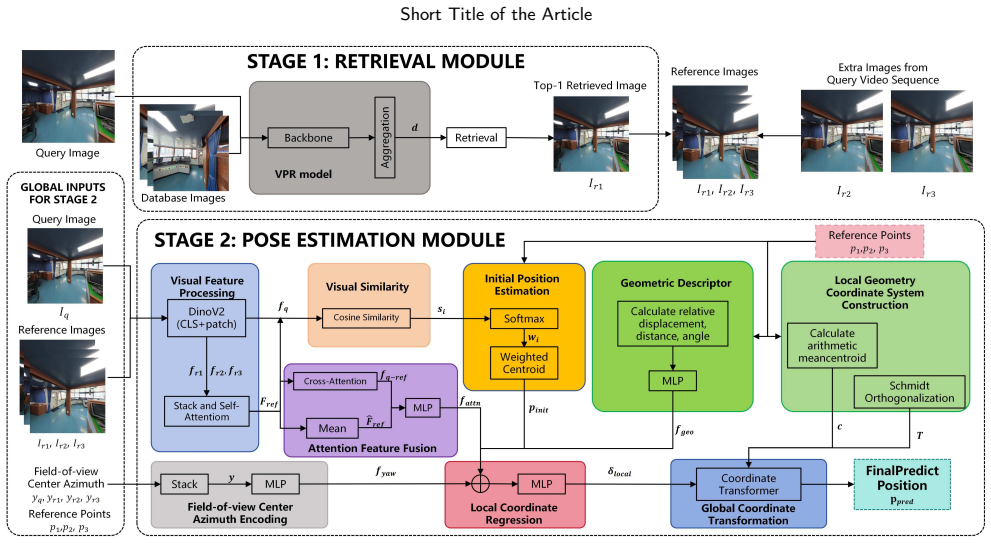
ProteusVPR second-stage geometric-visual estimation network: three reference points (retrieved image plus two preceding frames) define a centroid and a local orthonormal affine frame; geometric pair descriptors, visual attention features and azimuth encodings are fused to regress a local displacement that is then transformed back to global coordinates.
Load-bearing premise
The correction works only when the two preceding frames of continuous video almost always lie on the true deck, so their coordinates can pull the three-point centroid toward the right place even if the first-stage retrieval is wrong.
What would settle it
Remove or scramble the two temporally preceding frames (or force them onto wrong decks) while keeping Stage-1 retrieval fixed; if mean error reduction collapses below the reported ~60 percent, the central claim fails.
Editorial analysis
A structured set of objections, weighed in public.
Referee Report
Summary. The paper proposes ProteusVPR, a two-stage retrieval-refinement framework for maritime cross-scene visual place recognition between open decks and enclosed multi-floor cabins. Stage 1 uses any standard VPR backbone for nearest-neighbor retrieval; Stage 2 is a geometric-visual estimation network that fuses the retrieved image with two temporally preceding query frames, using DINOv2 features, inter/cross attention, geometric pair descriptors, a local affine coordinate system built from the three reference points, and camera azimuth encoding to regress a local displacement that is mapped back to global coordinates. The authors introduce the XHZ ship-borne panoramic dataset with multi-deck structure, chronological splits, and strict query-database separation. On XHZ, Stage 2 consistently reduces mean Euclidean localization error across six VPR backbones (pre-trained and fine-tuned), with a reported average reduction of about 61%, and ablations show that geometric descriptors and the local affine frame are the main contributors.
Significance. If the result holds under realistic operating conditions, the work is a useful systems contribution for autonomous ship inspection: a drop-in refinement module that upgrades existing VPR pipelines for repetitive cabin scenes, plus a new multi-floor maritime benchmark with careful geo-tagging and evaluation protocol. Strengths include multi-backbone evaluation (BoQ, CosPlace, EigenPlaces, MixVPR, SALAD, MutualVPR), both mean and 90% quantile errors per deck, qualitative cross-layer correction examples, and component ablations. The practical value is real for continuous onboard inspection trajectories; the main open question is how much of the headline gain depends on always-available same-trajectory priors rather than pure visual-geometric refinement of a single retrieval.
major comments (3)
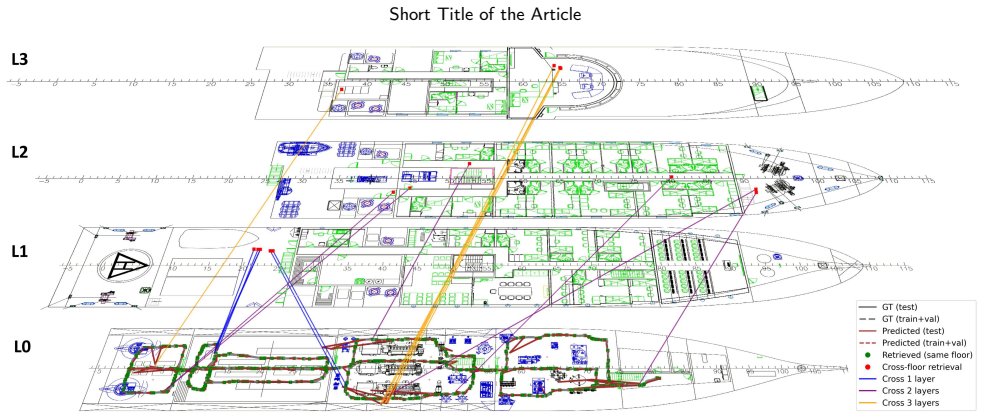
- The central claim of ~61% average mean-error reduction (Abstract; §5.5) is measured only under the Stage-2 protocol of §3.2 and §5.1.3: every sample is a same-layer, same-yaw, temporally adjacent 4-frame tuple, so I_r2 and I_r3 almost always lie on the correct deck and pull the three-point centroid (Eq. 8) and local affine basis (Eqs. 9–12) toward the true place even when Stage-1 retrieval is cross-layer (explicitly used in §5.3.2 and Fig. 5). No experiment reports Stage-2 error when the two preceding frames are dropped, replaced by random database images, or themselves wrong-layer. Without that ablation the headline average is conditional on continuous trajectory context that real cabin inspection may not guarantee; Limitations §7.i notes dependence on retrieval quality but does not quantify this temporal-context assumption that drives large mean reductions (e.g., MutualVPR tra L3 1.519
- Generalization claims for “cross-scene maritime environments” and “open waters to enclosed cabins” (title, Abstract, §1, §6) rest almost entirely on XHZ from a single vessel. Open-deck sparse-texture/illumination challenges are described but not isolated in the reported tables; results are per deck (L0–L3) on one ship under limited lighting/operational variation (§7.ii). At least one external indoor/outdoor VPR benchmark, or a held-out deck/transition split that does not share the same continuous trajectories, is needed to support the broader positioning beyond cabin-scale refinement on XHZ.
- Stage-2 training and evaluation use same-layer, same-angle, temporally adjacent tuples (§5.1.3), while the first-stage database mixes yaws and (for test) training+validation images. This is a reasonable continuous-inspection protocol, but it is not the same as refining an arbitrary single-image retrieval under viewpoint change. The paper should either (a) report Stage-2 performance when the two priors are not same-yaw / not adjacent, or (b) clearly scope the claim to sequence-aware refinement rather than a general second-stage upgrade for any VPR retrieval.
Circularity Check
Empirical systems paper with one non-load-bearing self-citation to MutualVPR (author overlap); central multi-backbone error reductions are measured on held-out geo-tagged splits, not forced by definition or fit.
specific steps
-
self citation load bearing
[§2.5 Summary and Positioning; also §3 intro and experiments using MutualVPR]
"MutualVPR [18], through its mutual learning framework that adaptively resolves supervision inconsistency, provides a foundation for this study. ... Building upon the first stage of MutualVPR, we introduce a two-stage estimation network..."
MutualVPR is prior work by overlapping authors (Gu, Zhao). It is invoked as the conceptual foundation and as one of the primary backbones whose Stage-1 errors are refined. However the central claim (consistent improvement across multiple independent VPR models, average 61% mean-error drop) does not reduce to this citation: identical Stage-2 gains appear for BoQ/CosPlace/SALAD/etc. with both pre-trained and fine-tuned weights, so the self-citation is present but not load-bearing for the reported result.
full rationale
ProteusVPR is a two-stage neural refinement (standard VPR retrieval + geometric-visual regression network using DINOv2 features, pair-wise geometric descriptors, local affine frame from three reference points, and azimuth MLP) trained with ordinary absolute + geometric-consistency losses and evaluated by Euclidean error on chronologically held-out XHZ queries against geo-tagged ground truth. The headline >60% mean-error reduction (explicitly averaged 61.22% over models/layers from Tables 1–2) is an empirical statistic, not a quantity recovered by construction from fitted parameters or self-referential definitions. Stage-2 inputs (retrieved image + two preceding frames) and the local-affine transform (Eqs. 8–18) are architectural choices whose benefit is measured, not assumed to equal the target. MutualVPR (Gu et al., overlapping co-authors) is cited as related work and used as one backbone among six (BoQ, CosPlace, EigenPlaces, MixVPR, SALAD, MutualVPR), with consistent Stage-2 gains reported for all; the self-citation therefore supplies neither uniqueness nor the sole support for the multi-backbone claim. No uniqueness theorem is imported, no ansatz is smuggled via prior work, and no known empirical pattern is merely renamed. The only minor circularity-adjacent element is the non-load-bearing self-citation; the derivation chain itself is ordinary supervised evaluation and scores low.
Axiom & Free-Parameter Ledger
free parameters (6)
- λ_abs, λ_geo (total loss weights) =
1.0, 0.2
- λ_cons, ρ (geometric consistency hinge) =
0.3, 0.1
- similarity temperature τ =
10
- Stage-2 training hyperparameters (lr, batch, epochs, warmup) =
lr=2e-5, bs=16, epochs=300
- Inter-deck Y-axis offsets for evaluation coordinates =
-75,-25,+25,+75 m
- Positive-pair distance threshold for Recall =
0.5 m
axioms (5)
- domain assumption Two immediately preceding frames of the query video are available at inference and share the query’s continuous trajectory (usually same deck).
- domain assumption Database images carry accurate 2D geo-tags (and FOV-center azimuths) derived from ship CAD with 80:1 scale mapping.
- domain assumption A frozen DINOv2 ViT-B/14 encoder plus learned attention/MLP heads is a sufficient visual front-end for relative displacement regression.
- standard math Standard cosine nearest-neighbor retrieval on global descriptors is an acceptable Stage-1 interface for any VPR backbone.
- ad hoc to paper Chronological 2/3–1/6–1/6 split with yaw=0 queries and other yaws as database prevents leakage and is a fair VPR protocol.
invented entities (2)
-
ProteusVPR two-stage geometric-visual estimation network
no independent evidence
-
XHZ (Xinhongzhuan Visual Dataset)
no independent evidence
read the original abstract
Autonomous robotic inspection in maritime environments presents unique challenges for Visual Place Recognition (VPR) due to cross-scene perceptual shifts. Robots navigating ship-borne environments must transition between visually distinct domains: open decks with sparse textures and severe illumination changes, and enclosed cabins with repetitive structures and high visual ambiguity. Existing VPR methods, designed primarily for urban or indoor scenes, fail to generalize reliably across these starkly different scenarios. To address this, we propose ProteusVPR, a two-stage retrieval-refinement framework. The first stage employs any standard VPR model for initial image retrieval. The second stage introduces a geometric-visual estimation network that fuses the retrieved image with two temporally preceding frames, incorporating geometric descriptors, a local affine coordinate system, and camera azimuth encoding to achieve precise localization. To support this task, we introduce the XHZ dataset, an 8K-panoramic ship-borne dataset collected from an operational vessel, featuring multi-floor cabin structures, deck transition zones, and strict query-database separation for rigorous evaluation. Extensive experiments on the XHZ dataset demonstrate that ProteusVPR consistently improves the localization accuracy across multiple VPR backbones, reducing mean localization error by over 60\% on average and that ProteusVPR offers an effective and robust solution for precise visual localization in challenging, cross-scene maritime environments.
Figures



Reference graph
Works this paper leans on
-
[1]
Place recognition meet multiple modalities: a comprehensive review, current challenges and future development
Li, Z., Shang, T., Xu, P., Deng, Z., 2025. Place recognition meet multiple modalities: a comprehensive review, current challenges and future development. Artificial Intelligence Review 58, 363
2025
-
[2]
Deep visual place recognition for waterborne domains, in: 2022 IEEE International Conference on Image Processing (ICIP), IEEE
Thomas, L., Edwards, M., Capsey, A., Rahat, A., Roach, M., 2022. Deep visual place recognition for waterborne domains, in: 2022 IEEE International Conference on Image Processing (ICIP), IEEE. pp. 3546–3550
2022
-
[3]
Netvlad:Cnnarchitectureforweaklysupervisedplacerecognition,in: Proceedings of the IEEE conference on computer vision and pattern recognition, pp
Arandjelovic, R., Gronat, P., Torii, A., Pajdla, T., Sivic, J., 2016. Netvlad:Cnnarchitectureforweaklysupervisedplacerecognition,in: Proceedings of the IEEE conference on computer vision and pattern recognition, pp. 5297–5307
2016
-
[4]
Rethinking visual geo-localization for large-scale applications, in: Proceedings of the IEEE/CVFConferenceonComputerVisionandPatternRecognition, pp
Berton, G., Masone, C., Caputo, B., 2022. Rethinking visual geo-localization for large-scale applications, in: Proceedings of the IEEE/CVFConferenceonComputerVisionandPatternRecognition, pp. 4878–4888
2022
-
[5]
Eigenplaces: Training viewpoint robust models for visual place recognition, in: ProceedingsoftheIEEE/CVFInternationalConferenceonComputer Vision, pp
Berton,G.,Trivigno,G.,Caputo,B.,Masone,C.,2023. Eigenplaces: Training viewpoint robust models for visual place recognition, in: ProceedingsoftheIEEE/CVFInternationalConferenceonComputer Vision, pp. 11080–11090
2023
-
[6]
Mixvpr: Feature mixingforvisualplacerecognition,in:ProceedingsoftheIEEE/CVF winterconferenceonapplicationsofcomputervision,pp.2998–3007
Ali-Bey, A., Chaib-Draa, B., Giguere, P., 2023. Mixvpr: Feature mixingforvisualplacerecognition,in:ProceedingsoftheIEEE/CVF winterconferenceonapplicationsofcomputervision,pp.2998–3007
2023
-
[7]
Optimal transport aggregation for visual place recognition, in: Proceedings of the ieee/cvf conference on computer vision and pattern recognition, pp
Izquierdo, S., Civera, J., 2024. Optimal transport aggregation for visual place recognition, in: Proceedings of the ieee/cvf conference on computer vision and pattern recognition, pp. 17658–17668
2024
-
[8]
Patch- netvlad: Multi-scale fusion of locally-global descriptors for place recognition, in: Proceedings of the IEEE/CVF conference on com- puter vision and pattern recognition, pp
Hausler, S., Garg, S., Xu, M., Milford, M., Fischer, T., 2021. Patch- netvlad: Multi-scale fusion of locally-global descriptors for place recognition, in: Proceedings of the IEEE/CVF conference on com- puter vision and pattern recognition, pp. 14141–14152
2021
-
[9]
Transvpr: Transformer-basedplacerecognitionwithmulti-levelattentionaggre- gation, in: Proceedings of the IEEE/CVF Conference on Computer Vision and Pattern Recognition, pp
Wang, R., Shen, Y., Zuo, W., Zhou, S., Zheng, N., 2022. Transvpr: Transformer-basedplacerecognitionwithmulti-levelattentionaggre- gation, in: Proceedings of the IEEE/CVF Conference on Computer Vision and Pattern Recognition, pp. 13648–13657
2022
-
[10]
Cricavpr: Cross-image correlation-aware representation learning for visualplacerecognition,in:ProceedingsoftheIEEE/CVFconference on computer vision and pattern recognition, pp
Lu, F., Lan, X., Zhang, L., Jiang, D., Wang, Y., Yuan, C., 2024. Cricavpr: Cross-image correlation-aware representation learning for visualplacerecognition,in:ProceedingsoftheIEEE/CVFconference on computer vision and pattern recognition, pp. 16772–16782
2024
-
[11]
Context-based visual-language place recognition
Woo, S., Kim, S.W., 2024. Context-based visual-language place recognition. arXiv preprint arXiv:2410.19341
Pith/arXiv arXiv 2024
-
[12]
Revisit anything: Visual place recognition via image segment re- trieval, in: European Conference on Computer Vision, Springer
Garg, K., Puligilla, S.S., Kolathaya, S., Krishna, M., Garg, S., 2024. Revisit anything: Visual place recognition via image segment re- trieval, in: European Conference on Computer Vision, Springer. pp. 326–343. First Author et al.:Preprint submitted to ElsevierPage 15 of 16 Short Title of the Article
2024
-
[13]
Structvpr++: distill structural and semantic knowledge with weight- ing samples for visual place recognition
Shen, Y., Zhou, S., Fu, J., Wang, R., Chen, S., Zheng, N., 2025. Structvpr++: distill structural and semantic knowledge with weight- ing samples for visual place recognition. IEEE Transactions on Pattern Analysis and Machine Intelligence
2025
-
[14]
Oquab,M.,Darcet,T.,Moutakanni,T.,Vo,H.,Szafraniec,M.,Khali- dov, V., Fernandez, P., Haziza, D., Massa, F., El-Nouby, A., et al.,
-
[15]
arXiv preprint arXiv:2304.07193
Dinov2: Learning robust visual features without supervision. arXiv preprint arXiv:2304.07193
-
[16]
Anyloc: Towards universal visual place recognition
Keetha,N.,Mishra,A.,Karhade,J.,Jatavallabhula,K.M.,Scherer,S., Krishna, M., Garg, S., 2023. Anyloc: Towards universal visual place recognition. IEEE Robotics and Automation Letters 9, 1286–1293
2023
-
[17]
Megaloc: One retrieval to place them all, in: Proceedings of the Computer Vision and Pattern Recognition Conference, pp
Berton, G., Masone, C., 2025. Megaloc: One retrieval to place them all, in: Proceedings of the Computer Vision and Pattern Recognition Conference, pp. 2861–2867
2025
-
[18]
Boq: A place is worth a bag of learnable queries, in: Proceedings of the IEEE/CVF conference on computer vision and pattern recognition, pp
Ali-Bey, A., Chaib-Draa, B., Giguere, P., 2024. Boq: A place is worth a bag of learnable queries, in: Proceedings of the IEEE/CVF conference on computer vision and pattern recognition, pp. 17794– 17803
2024
-
[19]
Mutualvpr: A mutual learning framework for resolving supervision inconsistencies via adaptive clustering
Gu, Q., Wang, X., Zhao, J., Tao, S., Feng, T., Wang, Z., Chen, G., 2026. Mutualvpr: A mutual learning framework for resolving supervision inconsistencies via adaptive clustering. Advances in Neural Information Processing Systems 38, 2899–2922
2026
-
[20]
R2former:Unifiedretrievalandrerankingtransformerforplacerecog- nition, in: Proceedings of the IEEE/CVF conference on computer vision and pattern recognition, pp
Zhu, S., Yang, L., Chen, C., Shah, M., Shen, X., Wang, H., 2023. R2former:Unifiedretrievalandrerankingtransformerforplacerecog- nition, in: Proceedings of the IEEE/CVF conference on computer vision and pattern recognition, pp. 19370–19380
2023
-
[21]
Pair-vpr: Place-aware pre-training and contrastive pair classification for visual place recognition with vision transformers
Hausler, S., Moghadam, P., 2025. Pair-vpr: Place-aware pre-training and contrastive pair classification for visual place recognition with vision transformers. IEEE Robotics and Automation Letters
2025
-
[22]
Progeo: Generatingpromptsthroughimage-textcontrastivelearningforvisual geo-localization, in: International Conference on Artificial Neural Networks, Springer
Hu, J., Mao, C., Tan, C., Li, H., Liu, H., Zheng, M., 2024. Progeo: Generatingpromptsthroughimage-textcontrastivelearningforvisual geo-localization, in: International Conference on Artificial Neural Networks, Springer. pp. 448–462
2024
-
[23]
Towards seamless adaptation of pre-trained models for visual place recognition
Lu, F., Zhang, L., Lan, X., Dong, S., Wang, Y., Yuan, C., 2024. Towards seamless adaptation of pre-trained models for visual place recognition. arXiv preprint arXiv:2402.14505
Pith/arXiv arXiv 2024
-
[24]
Effovpr:Effectivefoundationmodelutilizationforvisualplacerecog- nition
Tzachor, I., Lerner, B., Levy, M., Green, M., Shalev, T.B., Habib, G., Samuel, D., Zailer, N.K., Shimshi, O., Darshan, N., et al., 2024. Effovpr:Effectivefoundationmodelutilizationforvisualplacerecog- nition. arXiv preprint arXiv:2405.18065
arXiv 2024
-
[25]
Zuo, W., Liu, L., Li, Y., Shen, Y., Xiang, F., Xin, J., Zheng, N.,
-
[26]
Pattern Recognition 166, 111673
Prgs:patch-to-regiongraphsearchforvisualplacerecognition. Pattern Recognition 166, 111673
-
[27]
Unipr-3d: Towards universal visual place recogni- tion with visual geometry grounded transformer
Deng, T., Chen, X., Li, Z., Shen, H., Wang, D., Civera, J., Wang, H., 2025. Unipr-3d: Towards universal visual place recogni- tion with visual geometry grounded transformer. arXiv preprint arXiv:2512.21078
Pith/arXiv arXiv 2025
-
[28]
Casevpr: Correlation-aware sequential embedding for sequence-to- frame visual place recognition
Li, H., Peng, G., Zhang, J., Wen, M., Ma, Y., Wang, D., 2025. Casevpr: Correlation-aware sequential embedding for sequence-to- frame visual place recognition. IEEE Robotics and Automation Letters
2025
-
[29]
Imvpr: Implicitbev-enhancedmulti-viewaggregationforvisualplacerecog- nition, in: 2025 IEEE/RSJ International Conference on Intelligent Robots and Systems (IROS), IEEE
Cao, X., Zhang, C., Liu, Z., Zhong, X., Fang, H., 2025. Imvpr: Implicitbev-enhancedmulti-viewaggregationforvisualplacerecog- nition, in: 2025 IEEE/RSJ International Conference on Intelligent Robots and Systems (IROS), IEEE. pp. 9669–9676
2025
-
[30]
Vlad- buff:Burst-awarefastfeatureaggregationforvisualplacerecognition, in:EuropeanConferenceonComputerVision,Springer.pp.447–466
Khaliq, A., Xu, M., Hausler, S., Milford, M., Garg, S., 2024. Vlad- buff:Burst-awarefastfeatureaggregationforvisualplacerecognition, in:EuropeanConferenceonComputerVision,Springer.pp.447–466
2024
-
[31]
Visual place recognition for coastal scenes with semantic and sequential constraints
Zhou, R., Wang, Y., Gao, Y., Zhao, X., Xu, X., 2025. Visual place recognition for coastal scenes with semantic and sequential constraints. Measurement 256, 118071
2025
-
[32]
Mrs-vpr: a multi-resolution sampling based global visual place recognition method, in: 2019 International conference on robotics and automation (ICRA), IEEE
Yin, P., Srivatsan, R.A., Chen, Y., Li, X., Zhang, H., Xu, L., Li, L., Jia, Z., Ji, J., He, Y., 2019. Mrs-vpr: a multi-resolution sampling based global visual place recognition method, in: 2019 International conference on robotics and automation (ICRA), IEEE. pp. 7137– 7142. First Author et al.:Preprint submitted to ElsevierPage 16 of 16
2019
discussion (0)
Sign in with ORCID, Apple, or X to comment. Anyone can read and Pith papers without signing in.