REVIEW 4 major objections 5 minor 1 cited by
Physical Layer Key Generation in 5G Wireless Networks
T0 review · 4 major / 5 minor · reviewed 2026-08-14 · deepseek-v4-flash
Pith's one-line read 5G's own tools can fix its key-generation weaknesses
desk verdict A useful 5G-era survey of physical layer key generation, but its one new case study is under-specified and the paper's 'demonstrated' is too strong. read the letter →
The pith
A machine-rendered reading of the paper's core claim, the machinery that carries it, and where it could break.
The reading
What carries the argument
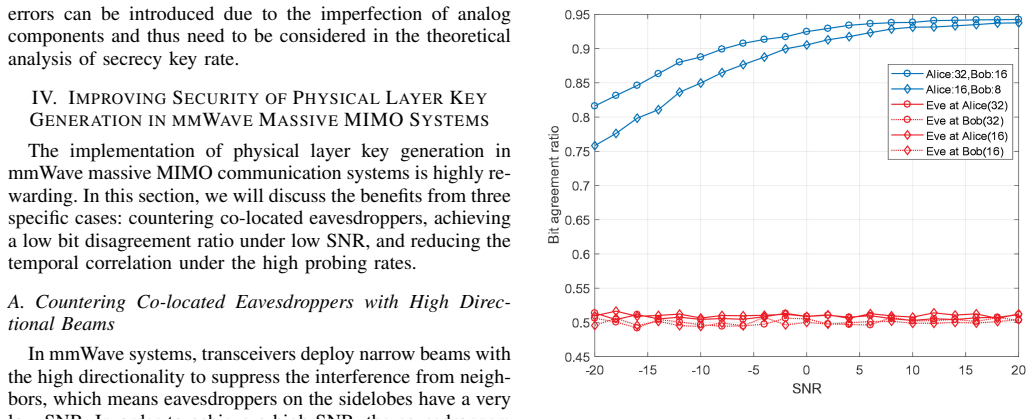
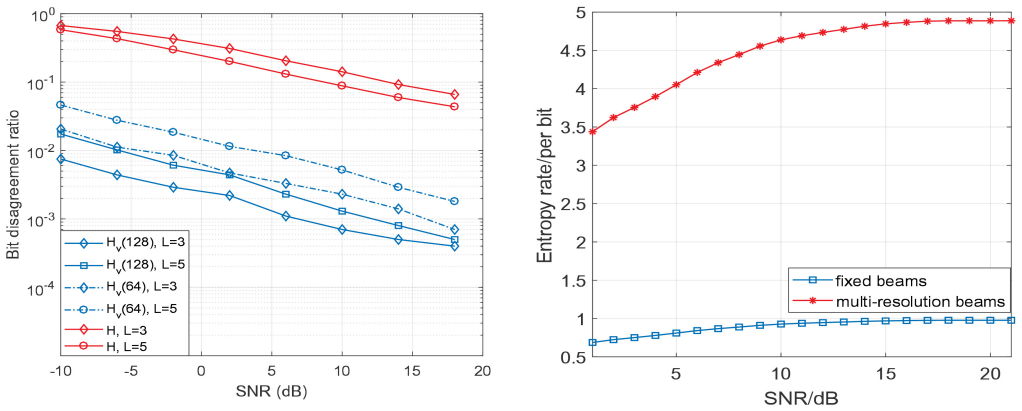
The argument runs through three mechanisms. First, the high directionality of massive-MIMO beams: small random perturbation angles on the beamforming vectors are used as the shared random source, and the XOR of the two sides' bits makes a co-located eavesdropper unable to reconstruct the key (bit agreement stays near 50%). Second, the sparsity of the mmWave channel in the virtual angle domain: after projecting the channel onto a unitary matrix, only entries aligned with physical angles of arrival/departure have large amplitudes, so estimating virtual AoAs and AoDs is noise-resistant and produces nearly identical estimates at both ends. Third, hybrid precoding with a hierarchical multi-resolution codebook: by changing beam resolution and steering angle from one probing round to the next, the weights on different multipath components change and temporal correlation drops, raising key entropy rate.
What would settle it
Run the virtual-AoA/AoD key generation scheme on measured 28 GHz urban channels with the LoS path blocked or with a strong reflector, quantize the same way at −10 dB SNR, and count mismatches between Alice and Bob; if the bit disagreement ratio stays above $10^{-2}$ instead of below it, the anti-noise claim fails. Similarly, a co-located eavesdropper who synchronizes to Alice's probing schedule and records both the perturbation directions and Alice's bits would test whether the XOR construction genuinely keeps eavesdropper agreement near 50%.
Extended reading notes
Core claim
The central claim, stated on the paper's own terms, is that 5G and beyond technologies offer a better solution to the challenges that remained in existing physical layer key generation schemes, and the three case studies demonstrate those benefits. The first case uses massive MIMO beamforming directionality: small random perturbation angles on the beamformer serve as the shared random source, and since the final key is an XOR of bits generated at Alice and Bob, a co-located eavesdropper who matches one side's beam cannot determine the other side's bits; the reported bit agreement of the eavesdropper stays near 50%. The second case exploits the sparsity of the mmWave channel in the virtual angle domain: by projecting the channel onto a unitary matrix and estimating virtual angles of arrival and departure, the scheme becomes anti-noise and achieves a bit disagreement ratio below $10^{-2}$ even at −10 dB SNR with 128 antennas and three multipath components. The third case uses hybrid precoding with a hierarchical multi-resolution codebook so that each probing round selects a beam with a different resolution or angle, decorrelating samples within the coherence time and yielding a key entropy rate approximately five times that of a fixed beam.
Load-bearing premise
The simulations all assume a sparse mmWave channel with channel reciprocity holding inside the coherence time, one line-of-sight path plus one non-line-of-sight path about 10 dB weaker, and the ability of multi-resolution probing to keep channel gain within a narrow range while switching beams; if those conditions fail in real 5G deployments, the reported gains in eavesdropper resistance, bit disagreement, and key entropy rate may not transfer.
Editorial extensions
If this is right
- In mmWave systems, key generation no longer needs to assume the eavesdropper is at least half a wavelength away; the narrow-beam plus XOR construction is claimed to hold even for co-located eavesdroppers.
- At low SNR, using virtual angle-domain parameters instead of raw channel estimates keeps reconciliation cost low; with 128 antennas and 3 paths the reported bit disagreement ratio is below 10^-2 at −10 dB SNR.
- High probing rates can still yield fresh key bits if each probing round uses a different beam resolution or angle; five selected beams give roughly five times the key entropy rate of a fixed beam.
- The same hybrid-precoding codebook used for channel estimation can be reused for the key-probing stage, so the added security comes without a separate hardware overhead.
- The identified correlations between 5G features and key-generation improvements give a concrete design direction: future schemes should exploit angle-domain sparsity and beam diversity rather than relying on raw channel samples alone.
Reading between the lines
- Editorial inference: the location-sensitive leakage of mmWave signals suggests physical-layer keys in 5G may be tied to physical position rather than just channel decorrelation, so key generation could double as a proximity or distance-bounding primitive—something the paper does not state.
- Editorial inference: because the case studies rely on simulated channels with perfect reciprocity and one LoS plus one weaker NLoS path, a natural next test is a measurement campaign at 28 GHz with real blockage and imperfect phase shifters; the paper itself flags blockage and precoding errors as open problems.
- Editorial inference: the XOR-of-perturbation idea could be extended to group key generation in multi-user massive MIMO, where the digital precoding layer gives extra freedom to suppress inter-user interference—the paper lists this as a future topic.
- Editorial inference: if multi-resolution probing reliably decorrelates samples within one coherence interval, then key generation rate may scale with the number of resolvable angle bins rather than with probing frequency, which would change how probing rates are set.
Signed reviews
Editorial analysis
A structured set of objections, weighed in public.
Referee Report
Summary. The paper argues that three 5G technologies—millimeter-wave (mmWave) communication, massive MIMO beamforming, and hybrid precoding—can overcome three limitations of traditional sub-6 GHz physical-layer key generation: vulnerability to co-located eavesdroppers, high bit disagreement ratio at low SNR, and high temporal correlation under high probing rates. It reviews the standard five-step key generation process, identifies these limitations, describes the corresponding 5G enablers, and presents three case studies with simulation figures: a beam-perturbation scheme to counter co-located eavesdroppers (Section IV-A), a virtual AoA/AoD based scheme for low-SNR operation (Section IV-B), and a multi-resolution beam probing scheme to increase key entropy rate (Section IV-C). The paper concludes that these case studies demonstrate the benefits of 5G technologies for physical-layer key generation and discusses future directions including mobility, multi-user massive MIMO, and backscatter communication.
Significance. If the technical claims are supported, the paper provides a timely and useful mapping between distinctive 5G physical-layer mechanisms and long-standing bottlenecks in physical-layer key generation. The survey component is well organized, the three challenges are clearly articulated, and the paper identifies genuinely open problems (mobility effects, multi-user group key generation, and backscatter-specific key extraction) that are not standard in the sub-6 GHz literature. A notable strength is that the authors are explicit about several limitations of their own proposals, such as the critical dependence of the multi-resolution scheme on maintaining channel gain within a certain range and the challenges of channel estimation overhead and analog component imperfections. The contribution, however, is primarily conceptual and illustrative: two of the three case studies are drawn from the authors' prior conference papers, the simulation figures lack error bars and complete parameter disclosure, and the only new case study is under-specified.
major comments (4)
- [Section IV-C, Fig. 4] The reported key entropy rate that is 'approximately 5 times' that of a fixed beam is obtained using beams that are 'carefully selected from the hierarchical codebook to maintain the channel gain within a certain range,' but the selection algorithm, the codebook structure, and the quantitative bounds on the channel-gain range are never specified. The paper itself concedes that 'how to maintain the channel gain in a certain range is critical because a big fluctuation of channel gain can affect the key generation rate.' As written, this result cannot be reproduced or independently evaluated, so the conclusion that this case study demonstrates the benefit of hybrid precoding is not fully supported. The authors should either provide the selection rule and gain bounds, or clearly label the result as an illustrative example and temper the corresponding conclusion.
- [Section IV-C, Fig. 4] The simulation description omits several parameters that are essential for evaluating the claimed gain: coherence time, probing rate, quantization level, SNR range, and the number of Monte Carlo trials. In addition, the only baseline is a fixed-beam case of the authors' own design, with no comparison to existing temporal-correlation reduction techniques such as random initial phase or dithering, despite the paper mentioning those alternatives. Without these details and baselines, the 'approximately 5 times' entropy-rate improvement is not verifiable.
- [Sections IV-A and IV-B] The security and performance claims rest on a narrow idealized channel model: a LoS path plus one NLoS path that is 10 dB weaker, perfect reciprocity within the coherence time, a sparse virtual channel, and specific antenna array sizes. The figures in Sections IV-A and IV-B are not accompanied by sensitivity analyses with respect to deviations from these assumptions, such as more multipath components, imperfect reciprocity, or blockage. This is acceptable for an illustrative tutorial, but the text should clearly mark these results as preliminary evidence under idealized conditions rather than general demonstrations.
- [Section VI and Section I] The introduction states that 5G technologies 'may offer a better solution' to existing challenges, while the conclusion asserts that the three case studies 'demonstrated the benefits' of 5G for physical-layer key generation. Given the under-specified beam-selection rule in Section IV-C and the idealized channel conditions in Sections IV-A and IV-B, the word 'demonstrated' overstates what the manuscript establishes. The conclusion should be revised to say that the case studies provide preliminary evidence or illustrative support for the proposed benefits, conditional on the stated channel assumptions.
minor comments (5)
- [Section II-B] The possessive in 'Jake's correlation model' should be 'Jakes' correlation model,' and the phrase 'has high probabilities to lose eavesdropping links' should be 'has a high probability of losing an eavesdropping link.'
- [Section III-C] The paragraph describing the proposed hybrid-precoding scheme would be clearer if it distinguished the new contribution from the general hybrid precoding concept introduced in reference [15]; the current wording could be read as implying the scheme itself is fully specified in this paper.
- [Fig. 4] The x-axis of Fig. 4 is labeled 'SNR' but the SNR range and units are not stated, and the y-axis label 'Key entropy rate' would benefit from a definition or formula explaining how the entropy rate is computed from the measured samples.
- [Section IV-B] The sentence 'The sparsity reflected in the virtual angle domain makes the estimation process of virtual AoAs/AoDs against noise' contains a grammatical error; it should read 'makes the estimation process ... robust against noise.'
- [Section V-C] The phrase 'a new physical key generation schemes' should be 'a new physical-layer key generation scheme' or 'new physical-layer key generation schemes.'
Circularity Check
No mechanically circular derivation: the paper is a survey with simulation-based case studies from published prior work and one under-specified but not definitionally circular new simulation.
full rationale
This magazine-style paper contains no derivation chain whose outputs are definitionally equal to its inputs, so there is no equation-level circularity. The three case studies are simulations: Sections IV-A and IV-B report results from the authors' own prior conference papers [10] and [6], but those are published peer-reviewed works with stated channel models (e.g., 28 GHz, LoS/NLoS with NLoS 10 dB weaker, UPA dimensions) that do not contain the reported bit-agreement or eavesdropper outcomes as assumptions; citing them is normal scientific practice, not a circular reduction. Section IV-C presents a new multi-resolution beam-probing simulation, but the beam-selection rule is left unspecified and the paper itself flags this limitation: 'the issue that how to maintain the channel gain in a certain range is critical because a big fluctuation of channel gain can affect the key generation rate.' That is an incompleteness and reproducibility weakness in the asserted 5x entropy-rate gain, not a circularity, because the gain is a simulated output of a proposed scheme rather than a parameter fitted from the same data. The conclusion that the cases 'demonstrated the benefits' is somewhat stronger than the evidence supports, but that is an overstatement of evidence, not a self-referential reduction.
Assumptions & free parameters
assumptions (4)
- domain assumption Channel reciprocity holds within the coherence time for legitimate users.
- domain assumption The mmWave channel is sparse with one LoS path and one NLoS path 10 dB weaker.
- domain assumption Multipath clusters scatter independently and carry independent statistical information.
- standard math An eavesdropper located more than half a wavelength away observes uncorrelated channel measurements.
Cite this review
Pith. "Pith review of Physical Layer Key Generation in 5G Wireless Networks." pith.science (2026). https://pith.science/paper/3Q5XLC2U
@misc{pith2026190810362,
  author       = {Pith},
  title        = {Pith review of: Physical Layer Key Generation in 5G Wireless Networks},
  year         = {2026},
  howpublished = {\url{https://pith.science/paper/3Q5XLC2U}},
  note         = {Machine review of arXiv:1908.10362}
}
read the original abstract
The bloom of the fifth generation (5G) communication and beyond serves as a catalyst for physical layer key generation techniques. In 5G communications systems, many challenges in traditional physical layer key generation schemes, such as co-located eavesdroppers, the high bit disagreement ratio, and high temporal correlation, could be overcome. This paper lists the key-enabler techniques in 5G wireless networks, which offer opportunities to address existing issues in physical layer key generation. We survey the existing key generation methods and introduce possible solutions for the existing issues. The new solutions include applying the high signal directionality in beamforming to resist co-located eavesdroppers, utilizing the sparsity of millimeter wave (mmWave) channel to achieve a low bit disagreement ratio under low signal-to-noise-ratio (SNR), and exploiting hybrid precoding to reduce the temporal correlation among measured samples. Finally, the future trends of physical layer key generation in 5G and beyond communications are discussed.
Figures

Forward citations
Cited by 1 Pith paper
-
Entropy Bootstrapping for Wireless Embedded Systems
A source-state-admitted multi-root boot entropy path for ESP32 IoT combines SRAM startup, public radio-burst local sampling, and asymmetric capsules, with measurements showing RF-disabled WDEV passes the same statisti...
Reference graph
Works this paper leans on
-
[1]
Safeguarding 5g wireless communication networks using physical layer security,
N. Yang, L. Wang, G. Geraci, M. Elkashlan, J. Yuan, and M. Di Renzo, “Safeguarding 5g wireless communication networks using physical layer security,” IEEE Communications Magazine , vol. 53, no. 4, pp. 20–27, 2015
work page 2015
-
[2]
Secret key agreement by public discussion from common information,
U. M. Maurer, “Secret key agreement by public discussion from common information,” IEEE transactions on information theory , vol. 39, no. 3, pp. 733–742, 1993
work page 1993
-
[3]
Delay analysis of physical-layer key generation in dynamic roadside-to-vehicle networks,
R. Jin, X. Du, K. Zeng, L. Huang, L. Xiao, and J. Xu, “Delay analysis of physical-layer key generation in dynamic roadside-to-vehicle networks,” IEEE Transactions on V ehicular Technology , vol. 66, no. 3, pp. 2526– 2535, March 2017
work page 2017
-
[4]
Physical layer key generation in wireless networks: challenges and opportunities,
K. Zeng, “Physical layer key generation in wireless networks: challenges and opportunities,” IEEE Communications Magazine , vol. 53, no. 6, pp. 33–39, 2015
work page 2015
-
[5]
Exploiting multiple- antenna diversity for shared secret key generation in wireless networks,
K. Zeng, D. Wu, A. Chan, and P. Mohapatra, “Exploiting multiple- antenna diversity for shared secret key generation in wireless networks,” in 2010 Proceedings IEEE INFOCOM . IEEE, 2010, pp. 1–9
work page 2010
-
[6]
Physical layer key generation using virtual aoa and aod of mmwave massive mimo channel,
L. Jiao, J. Tang, and K. Zeng, “Physical layer key generation using virtual aoa and aod of mmwave massive mimo channel,” in 2018 IEEE Conference on Communications and Network Security (CNS) . IEEE, 2018, pp. 1–9
work page 2018
-
[7]
Automatic secret keys from reciprocal mimo wireless channels: Measurement and analysis,
J. W. Wallace and R. K. Sharma, “Automatic secret keys from reciprocal mimo wireless channels: Measurement and analysis,” IEEE Transactions on Information F orensics and Security , vol. 5, no. 3, pp. 381–392, Sept 2010
work page 2010
-
[8]
T. S. Rappaport, F. Gutierrez, E. Ben-Dor, J. N. Murdock, Y . Qiao, and J. I. Tamir, “Broadband millimeter-wave propagation measurements and models using adaptive-beam antennas for outdoor urban cellular communications,” IEEE transactions on antennas and propagation , vol. 61, no. 4, pp. 1850–1859, 2013
work page 2013
Show all 15 references
-
[9]
Channel modeling and mimo capacity for outdoor millimeter wave links,
H. Zhang, S. Venkateswaran, and U. Madhow, “Channel modeling and mimo capacity for outdoor millimeter wave links,” in Wireless Communications and Networking Conference (WCNC), 2010 IEEE . IEEE, 2010, pp. 1–6
2010
-
[10]
Secret beam: Robust secret key agreement for mmwave massive mimo 5g communication,
L. Jiao, N. Wang, and K. Zeng, “Secret beam: Robust secret key agreement for mmwave massive mimo 5g communication,” in 2018 IEEE Global Communications Conference (GLOBECOM) . IEEE, 2018, pp. 1–6
2018
-
[11]
Adaptive wireless channel probing for shared key generation based on pid controller,
Y . Wei, K. Zeng, and P. Mohapatra, “Adaptive wireless channel probing for shared key generation based on pid controller,” IEEE Transactions on Mobile Computing , vol. 12, no. 9, pp. 1842–1852, 2013
2013
-
[12]
Mimo for millimeter-wave wireless communications: Beamforming, spatial multi- plexing, or both?
S. Sun, T. S. Rappaport, R. W. Heath, A. Nix, and S. Rangan, “Mimo for millimeter-wave wireless communications: Beamforming, spatial multi- plexing, or both?” IEEE Communications Magazine , vol. 52, no. 12, pp. 110–121, 2014
2014
-
[13]
A 60 ghz single-chip 256-element wafer-scale phased array with eirp of 45 dbm using sub-reticle stitching,
S. Zihir, O. D. Gurbuz, A. Karroy, S. Raman, and G. M. Rebeiz, “A 60 ghz single-chip 256-element wafer-scale phased array with eirp of 45 dbm using sub-reticle stitching,” in 2015 IEEE Radio Frequency Integrated Circuits Symposium (RFIC) . IEEE, 2015, pp. 23–26
2015
-
[14]
A survey of physical layer security techniques for 5g wireless networks and challenges ahead,
Y . Wu, A. Khisti, C. Xiao, G. Caire, K.-K. Wong, and X. Gao, “A survey of physical layer security techniques for 5g wireless networks and challenges ahead,” IEEE Journal on Selected Areas in Communications , 2018
2018
-
[15]
Channel estimation and hybrid precoding for millimeter wave cellular systems,
A. Alkhateeb, O. El Ayach, G. Leus, and R. W. Heath, “Channel estimation and hybrid precoding for millimeter wave cellular systems,” IEEE Journal of Selected Topics in Signal Processing , vol. 8, no. 5, pp. 831–846, 2014. Long Jiao (ljiao@gmu.edu) received B.Sc. degree in Info...
2014
Reviewed August 14, 2026 · model on record in the stance chip above.
Discussion (0). Continue with ORCID to comment.