REVIEW 3 major objections 3 minor 40 references
Cross-Task Inconsistency Based Active Learning (CTIAL) for Emotion Recognition
T0 review · 3 major / 3 minor · reviewed 2026-08-12 · deepseek-v4-flash
Pith's one-line read The paper claims that the disagreement between categorical and dimensional emotion models, quantified as cross-task inconsistency, is a valuable active learning metric that reduces labeling cost for emotion recognition.
desk verdict A clearly described new active-learning criterion for emotion recognition, honestly evaluated; the main caveat is that the cross-task mapping mechanism is not isolated by an ablation. read the letter →
The pith
A machine-rendered reading of the paper's core claim, the machinery that carries it, and where it could break.
The reading
What carries the argument
The central object is the cross-task inconsistency (CTI) measure, computed as $I_i = \|\hat{y}^{\mathrm{Dim}}_i - \tilde{y}^{\mathrm{Dim}}_i\|_2$. The categorical model's probability vector is mapped into the dimensional space by $\tilde{y}^{\mathrm{Dim}}_i = \sum_{e\in E} \hat{y}^e_i \cdot \mathrm{NRC}[e]$, where $\mathrm{NRC}[e]$ is the valence-arousal-dominance tuple of emotion $e$ in the NRC Lexicon. This single equation connects the two label spaces using domain knowledge, so that a disagreement between the two trained models becomes a scalar informativeness score. CTI is then multiplied by uncertainty measures (entropy or inverse confidence) for classification or by a modified multi-task improved greedy sampling distance for regression.
What would settle it
If a research group ran the same within-corpus protocol on a dataset where the emotion categories have very large internal variance in human valence, arousal, and dominance ratings, and CTIAL's queried samples were no better than random sampling, the NRC-mapping assumption would be refuted as the driver of the gains. A targeted test is to replace the fixed NRC vectors with category-specific mean vectors from the target corpus and observe whether CTI still adds value over random sampling.
Extended reading notes
Core claim
The central claim is that cross-task prediction inconsistency is a usable and valuable active learning metric for emotion recognition. Concretely, for each unlabeled sample the paper computes the L2 norm between the dimensional emotion values predicted by a regression model and the dimensional values obtained by mapping the categorical classifier's probabilities through fixed affective-norm scores of each emotion category (Eq. 4). High CTI marks samples where the two tasks disagree and are therefore likely to be informative or diverse. The paper backs this with within-corpus transfers on IEMOCAP and cross-corpus transfers from VAM (DEE to CEC) and MELD (CEC to DEE), reporting that integrated CTIAL variants achieved the best overall balanced accuracy and RMSE/correlation, often with statistically significant gains.
Load-bearing premise
The method relies on the NRC Lexicon's fixed word-level ratings being an adequate stand-in for the dimensional meaning of each emotion category in real speech utterances, so that Eq. (3)'s mapped categorical prediction and the dimensional model's estimate are actually comparable.
Editorial extensions
If this is right
- LC-CTIAL and Ent-CTIAL should be preferred over plain uncertainty sampling when transferring dimensional emotion knowledge to categorical classification, particularly with small labeling budgets.
- MTiGS-CTIAL should be the default active learning choice for dimensional emotion estimation when a categorical classifier is available as a source.
- Cross-corpus use is feasible with TCA/BDA preprocessing, extending the method to datasets with different recording conditions.
- The same inconsistency measure could be deployed to detect noisy or ambiguous samples during dataset construction.
- The approach establishes a general recipe: use affective norms as a bridge between categorical and dimensional label spaces for transfer.
Reading between the lines
- The NRC mapping could be replaced by a learned or corpus-specific mapping, which may extend CTIAL to emotion categories beyond the lexicon's vocabulary and reduce the weakness of the single-tuple assumption.
- The same cross-task disagreement logic likely applies to other pairs of tasks with different label spaces (e.g., text sentiment polarity vs. intensity ratings), not only speech emotions.
- CTI might double as an unsupervised confidence estimate for emotion models: high CTI could flag samples on which neither representation is trustworthy.
- Because CTIAL only needs the source model's predictions, it could run with a frozen pretrained source model, making the additional computation negligible.
Signed reviews
Editorial analysis
A structured set of objections, weighed in public.
Referee Report
Summary. The paper proposes Cross-Task Inconsistency Based Active Learning (CTIAL) for emotion recognition, where the informativeness of an unlabeled sample is measured by the L2 distance between a dimensional emotion model's prediction and a categorical emotion model's prediction mapped into the dimensional space using the NRC Valence-Arousal-Dominance Lexicon. The authors combine this CTI with conventional uncertainty measures (entropy or confidence) for categorical emotion classification and with a diversity measure (a modified MTiGS) for dimensional emotion estimation. Experiments on within-corpus (IEMOCAP) and cross-corpus (VAM→IEMOCAP, MELD→IEMOCAP) settings compare CTIAL and its integrated variants against random sampling, uncertainty-based, and diversity-based baselines, using balanced classification accuracy for classification and RMSE/CC for regression, with Wilcoxon signed-rank tests. The paper claims that CTI is a valuable active learning metric and that the integrated variants achieve the best overall performance.
Significance. The core idea of using affective norms as a prior to bridge categorical and dimensional emotion label spaces for active learning is novel and practically motivated, since labeling affective data is expensive. The paper includes multiple datasets, both transfer directions, several baselines, and statistical significance tests, which are strengths. If the CTI measure genuinely reflects sample informativeness, the method could reduce labeling cost in emotion recognition. However, the validity of the central claim depends on two issues: the evaluation metric includes training labels, and the NRC mapping underlying CTI is unvalidated for acoustic speech samples. These issues need to be addressed before the empirical results can be taken as supporting the proposed mechanism.
major comments (3)
- [Section 3.3] The performance evaluation is computed on the entire target dataset, including the manually labeled samples (the training set) and the unlabeled pool P, by concatenating ground-truth labels of D_Cat with predictions on P. Since the model is trained on D_Cat, including these labels makes the reported BCA, RMSE, and CC a mixture of training and test performance, biasing the metric upward and likely attenuating differences among the active learning strategies. Please evaluate on the unlabeled pool P (or a separate held-out test set) and report the corresponding results and statistical tests separately.
- [Section 2.3, Eq. (3)] The CTI is computed by mapping categorical probabilities into the dimensional space using fixed word-level NRC Lexicon values, and this mapping is the crux of the proposed method. The paper does not validate that these word norms are appropriate for acoustic speech utterances; indeed, Section 5.2 concedes that direct NRC mapping performs poorly because 'samples belonging to the same emotion category may have diverse emotion primitives.' Without an ablation (e.g., replacing NRC vectors with random permutations or with per-category empirical VAD means estimated from the target corpus) or a direct analysis showing that CTI correlates with DEE prediction error on a validation set, it remains unclear whether high CTI reflects genuine prediction uncertainty or merely the systematic mismatch between the fixed NRC reference and the DEE model's output. This is load-bearing because the novelty claim rests on CTI as an informativeness measure.
- [Sections 4 and 5] The paper's headline claim is that the integrated variants (LC-CTIAL, Ent-CTIAL, MTiGS-CTIAL) achieve the best performance. However, CTIAL used alone is reported to be inferior to baselines in several settings (e.g., Section 5.2, point 6). The discussion frames CTI as a component that helps when combined with within-task metrics, but the conclusion states more broadly that 'cross-task inconsistency could be a very valuable metric in active learning.' Please clarify the exact scope of the claim and support it with the appropriate statistical comparisons for each variant, separate from the integrated versions.
minor comments (3)
- [Figures 3 and 6] The figures report average curves without any error bars or confidence bands, even though each experiment is repeated with multiple initial labeled sets. Please add error bars or shaded confidence regions to convey run-to-run variability.
- [Section 2.5, Eq. (11)] The modification of MTiGS replaces the product of dimension-wise absolute differences with an L2 norm of the label difference vector. The motivation for this change is not fully justified, and it would be helpful to include the original MTiGS as a baseline to show the effect of this modification.
- [Abstract and Section 6] The claim of being the 'first work that utilizes prior knowledge on affective norms and data in a different task to facilitate active learning' is somewhat overstated, since affective-norm-based mapping has been used in prior work (e.g., Park et al. [24]). The novelty is better stated as the first active learning method using cross-task prediction inconsistency between categorical and dimensional emotion tasks.
Circularity Check
No significant circularity: CTI is externally grounded and compared against independent baselines; self-citations are not load-bearing.
full rationale
The proposed CTI (Eq. 4) is the L2 distance between the dimensional estimate f_Dim(x) (Eq. 2) and the NRC-lexicon-weighted categorical prediction (Eq. 3). Both models are trained on their respective labeled datasets, and the NRC lexicon is an external, fixed set of word-level affective norms; no parameter of Eq. 4 is fitted to the evaluation results or to the target labels being queried. The active-learning query rules (Eqs. 5, 8, 9, 12) multiply or divide the same CTI by standard entropy, confidence, or greedy-sampling diversity terms, and the empirical comparison is against external baselines (random sampling, entropy, least confidence, NRC Mapping, and MTiGS from the literature). The authors' prior MTiGS is cited as a baseline and slightly modified in Eq. 11, but the central claim does not rest on an unverified self-citation: MTiGS is used as a comparator and the CTI contribution is evaluated by adding it to that baseline. The paper's own Section 5.2 concession that direct NRC mapping 'oversimplified the relationship' is a limitation of the fixed mapping's validity for speech, which is an external-assumption concern rather than a circularity. None of the equations reduces to its own inputs by construction, and no fitted parameter is renamed as a prediction. Minor author self-citations exist but are not load-bearing, so the score is low rather than zero.
Assumptions & free parameters
free parameters (5)
- Logistic regression regularization weight 1/C =
chosen by 3-fold CV from {1,5,10,50,1e2,5e2,1e3,5e3}; exact value per split not reported
- Ridge regression regularization alpha =
chosen by 3-fold CV from the same set; exact value not reported
- TCA projection dimensionality =
reported as 30 in setup, explored over 25-45 in Fig. 5
- BDA projection dimensionality =
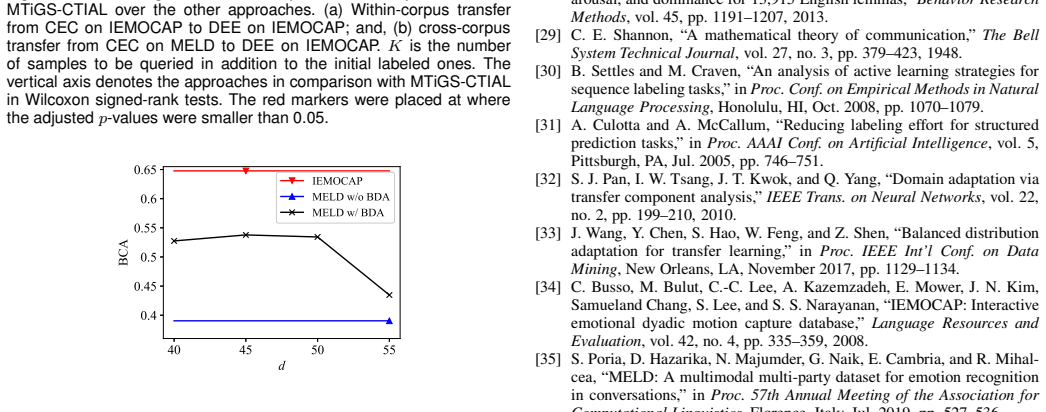
reported as 40 in setup, best at 45 in Fig. 8
- BDA balance factor =
selected from {0.1,...,0.9} to minimize MMD
assumptions (4)
- domain assumption The NRC Lexicon's word-level valence, arousal, and dominance scores can represent emotion categories for speech utterances in the mapping of Eq. (3).
- domain assumption The source model's predictions on the unlabeled target pool are reliable enough that CTI reflects meaningful disagreement.
- domain assumption The L2 distance between the two task-specific predictions is a valid informativeness measure for active learning.
- domain assumption wav2vec 2.0 features provide a shared representation that is informative for both classification and regression tasks.
Cite this review
Pith. "Pith review of Cross-Task Inconsistency Based Active Learning (CTIAL) for Emotion Recognition." pith.science (2026). https://pith.science/paper/3RV4HXD6
@misc{pith2026241201171,
  author       = {Pith},
  title        = {Pith review of: Cross-Task Inconsistency Based Active Learning (CTIAL) for Emotion Recognition},
  year         = {2026},
  howpublished = {\url{https://pith.science/paper/3RV4HXD6}},
  note         = {Machine review of arXiv:2412.01171}
}
read the original abstract
Emotion recognition is a critical component of affective computing. Training accurate machine learning models for emotion recognition typically requires a large amount of labeled data. Due to the subtleness and complexity of emotions, multiple evaluators are usually needed for each affective sample to obtain its ground-truth label, which is expensive. To save the labeling cost, this paper proposes an inconsistency-based active learning approach for cross-task transfer between emotion classification and estimation. Affective norms are utilized as prior knowledge to connect the label spaces of categorical and dimensional emotions. Then, the prediction inconsistency on the two tasks for the unlabeled samples is used to guide sample selection in active learning for the target task. Experiments on within-corpus and cross-corpus transfers demonstrated that cross-task inconsistency could be a very valuable metric in active learning. To our knowledge, this is the first work that utilizes prior knowledge on affective norms and data in a different task to facilitate active learning for a new task, even the two tasks are from different datasets.
Figures


Figures from the paper (4 more)


Reference graph
Works this paper leans on
-
[3]
Affect estimation in 3D space using mu lti-task active learning for regression,
D. Wu and J. Huang, “Affect estimation in 3D space using mu lti-task active learning for regression,” IEEE Trans. on Affective Computing , vol. 13, no. 41, pp. 16–27, 2022
work page 2022
-
[14]
Active learning for regr ession using greedy sampling,
D. Wu, C.-T. Lin, and J. Huang, “Active learning for regr ession using greedy sampling,” Information Sciences , vol. 474, pp. 90–105, 2019. 9 50 100 150 200 K CTIAL CT iGS Source LC MT iGS Rand (a) 50 100 150 200 K CTIAL CT iGS Source LC MT iGS Rand (b) Fig. 7. Statistical significance of the performance improve ments of MTiGS-CTIAL over the other approach...
work page 2019
-
[1]
Automatic analysis of faci al expressions: The state of the art,
M. Pantic and L. Rothkrantz, “Automatic analysis of faci al expressions: The state of the art,” IEEE Trans. on Pattern Analysis and Machine Intelligence, vol. 22, no. 12, pp. 1424–1445, 2000
work page 2000
-
[2]
Real-time inference of c omplex mental states from facial expressions and head gestures,
R. E. Kaliouby and P . Robinson, “Real-time inference of c omplex mental states from facial expressions and head gestures,” in Proc. Int’l Conf. on Computer Vision and Pattern Recognition , Washington DC, June 2004, p. 154
work page 2004
-
[4]
Affective brain-comp uter interfaces (aBCIs): A tutorial,
D. Wu, B.-L. Lu, B. Hu, and Z. Zeng, “Affective brain-comp uter interfaces (aBCIs): A tutorial,” Proc. of the IEEE , 2023, in press
work page 2023
-
[5]
Y . Jiang, W. Li, M. S. Hossain, M. Chen, A. Alelaiwi, and M. Al- Hammadi, “A snapshot research and implementation of multim odal information fusion for data-driven emotion recognition,” Information Fusion, vol. 53, pp. 209–221, 2020
work page 2020
-
[6]
Emotion based mus ic recom- mendation system using wearable physiological sensors,
D. Ayata, Y . Y aslan, and M. E. Kamasak, “Emotion based mus ic recom- mendation system using wearable physiological sensors,” IEEE Trans. on Consumer Electronics , vol. 64, no. 2, pp. 196–203, 2018
work page 2018
-
[7]
Universals and cultural differences in the judgments of f acial expressions of emotion
P . Ekman, W. V . Friesen, M. O’sullivan, A. Chan, I. Diacoy anni-Tarlatzis, K. Heider, R. Krause, W. A. LeCompte, T. Pitcairn, P . E. Ricci -Bitti et al. , “Universals and cultural differences in the judgments of f acial expressions of emotion.” Journal of Personality and Social Psychology , vol. 53, no. 4, p. 712, 1987
work page 1987
Show all 40 references
-
[8]
Mehrabian, Basic dimensions for a general psychological theory: Implications for personality, social, environmental, and developmental studies
A. Mehrabian, Basic dimensions for a general psychological theory: Implications for personality, social, environmental, and developmental studies. Cambridge, MA: Oelgeschlager, Gunn & Hain, 1980
1980
-
[9]
A circumplex model of affect
J. A. Russell, “A circumplex model of affect.” Journal of Personality and Social Psychology, vol. 39, no. 6, p. 1161, 1980
1980
-
[10]
Active learning literature survey,
B. Settles, “Active learning literature survey,” Univ ersity of Wisconsin– Madison, Computer Sciences Technical Report 1648, 2009
2009
-
[11]
A survey on transfer learning,
S. J. Pan and Q. Y ang, “A survey on transfer learning,” IEEE Trans. on Knowledge and Data Engineering , vol. 22, no. 10, pp. 1345–1359, 2010
2010
-
[12]
User emotion recognitio n from a larger pool of social network data using active learning,
G. Muhammad and M. F. Alhamid, “User emotion recognitio n from a larger pool of social network data using active learning,” Multimedia Tools and Applications, vol. 76, no. 8, pp. 10 881–10 892, 2017
2017
-
[13]
Dynamic active learning based on agreement and applied to emotion re cognition in spoken interactions,
Y . Zhang, E. Coutinho, Z. Zhang, C. Quan, and B. Schuller , “Dynamic active learning based on agreement and applied to emotion re cognition in spoken interactions,” in Proc. of the ACM on Int’l Conf. on Multimodal Interaction, Seattle, Washington, W A, Nov. 2015, pp. 275–278
2015
-
[15]
Active learning for speech emotion recognition using deep neural network,
M. Abdelwahab and C. Busso, “Active learning for speech emotion recognition using deep neural network,” in Proc. Int’l Conf. on Affective Computing and Intelligent Interaction , Cambridge, UK, Sep. 2019, pp. 1–7
2019
-
[16]
Transfer learning for EEG-ba sed brain- computer interfaces: A review of progress made since 2016,
D. Wu, Y . Xu, and B.-L. Lu, “Transfer learning for EEG-ba sed brain- computer interfaces: A review of progress made since 2016,” IEEE Trans. on Cognitive and Developmental Systems , vol. 14, no. 1, pp. 4–19, 2020
2016
-
[17]
A survey on negati ve transfer,
W. Zhang, L. Deng, L. Zhang, and D. Wu, “A survey on negati ve transfer,” IEEE/CAA Journal of Automatica Sinica , vol. 10, no. 2, pp. 305–329, 2023
2023
-
[18]
Can emotion be transferred?—A review on transfer learning for EEG-base d emotion recognition,
W. Li, W. Huan, B. Hou, Y . Tian, Z. Zhang, and A. Song, “Can emotion be transferred?—A review on transfer learning for EEG-base d emotion recognition,” IEEE Trans. on Cognitive and Developmental Systems , vol. 14, no. 3, pp. 833–846, 2021
2021
-
[19]
Transferable positive/negative s peech emotion recognition via class-wise adversarial domain adaptation ,
H. Zhou and K. Chen, “Transferable positive/negative s peech emotion recognition via class-wise adversarial domain adaptation ,” in Proc. IEEE Int’l Conf. on Acoustics, Speech and Signal Processing , Brighton, UK, May 2019, pp. 3732–3736
2019
-
[20]
Video-based emo tion recognition in the wild using deep transfer learning and score fusion,
H. Kaya, F. G¨ urpınar, and A. A. Salah, “Video-based emo tion recognition in the wild using deep transfer learning and score fusion,” Image and Vision Computing, vol. 65, pp. 66–75, 2017
2017
-
[21]
Facial expression recognition on static images,
T. Q. Ngo and S. Y oon, “Facial expression recognition on static images,” in Proc. Future Data and Security Engineering , Nha Trang City, Viet- nam, Nov. 2019, pp. 640–647
2019
-
[22]
Cross-domain knowl edge transfer for incremental deep learning in facial expression recogni tion,
N. Sugianto and D. Tjondronegoro, “Cross-domain knowl edge transfer for incremental deep learning in facial expression recogni tion,” in Proc. Int’l Conf. on Robot Intelligence Technology and Applicati ons, Daejeon, South Korea, Nov. 2019, pp. 205–209
2019
-
[23]
Speech emotion recognition based on hierarchical attributes using feature nets,
H. Zhao, N. Y e, and R. Wang, “Speech emotion recognition based on hierarchical attributes using feature nets,” Int’l Journal of Parallel, Emergent and Distributed Systems , vol. 35, no. 3, pp. 354–364, 2020
2020
-
[24]
Toward dimen sional emo- tion detection from categorical emotion annotations,
S. Park, J. Kim, J. Jeon, H. Park, and A. Oh, “Toward dimen sional emo- tion detection from categorical emotion annotations,” arXiv:1911.02499, 2019
1911 arXiv
-
[25]
Obtaining reliable human ratings of V a lence, Arousal, and Dominance for 20,000 English words,
S. M. Mohammad, “Obtaining reliable human ratings of V a lence, Arousal, and Dominance for 20,000 English words,” in Proc. Annual Conf. of the Association for Computational Linguistics , Melbourne, Australia, Jul. 2018
2018
-
[26]
Affective norms for Englis h words (ANEW): Instruction manual and affective ratings,
M. M. Bradley and P . J. Lang, “Affective norms for Englis h words (ANEW): Instruction manual and affective ratings,” The Cen ter for Research in Psychophysiology, University of Florida, Tech . Rep., 1999
1999
-
[27]
Fine -grained facial expression analysis using dimensional emotion mode l,
F. Zhou, S. Kong, C. C. Fowlkes, T. Chen, and B. Lei, “Fine -grained facial expression analysis using dimensional emotion mode l,” Neurocom- puting, vol. 392, pp. 38–49, 2020
2020
-
[28]
Norms of valence, arousal, and dominance for 13,915 English lemmas,
A. B. Warriner, V . Kuperman, and M. Brysbaert, “Norms of valence, arousal, and dominance for 13,915 English lemmas,” Behavior Research Methods, vol. 45, pp. 1191–1207, 2013
2013
-
[29]
A mathematical theory of communication ,
C. E. Shannon, “A mathematical theory of communication ,” The Bell System Technical Journal, vol. 27, no. 3, pp. 379–423, 1948
1948
-
[30]
An analysis of active learnin g strategies for sequence labeling tasks,
B. Settles and M. Craven, “An analysis of active learnin g strategies for sequence labeling tasks,” in Proc. Conf. on Empirical Methods in Natural Language Processing, Honolulu, HI, Oct. 2008, pp. 1070–1079
2008
-
[31]
Reducing labeling effort f or structured prediction tasks,
A. Culotta and A. McCallum, “Reducing labeling effort f or structured prediction tasks,” in Proc. AAAI Conf. on Artificial Intelligence , vol. 5, Pittsburgh, PA, Jul. 2005, pp. 746–751
2005
-
[32]
Domain ada ptation via transfer component analysis,
S. J. Pan, I. W. Tsang, J. T. Kwok, and Q. Y ang, “Domain ada ptation via transfer component analysis,” IEEE Trans. on Neural Networks , vol. 22, no. 2, pp. 199–210, 2010
2010
-
[33]
Balanced d istribution adaptation for transfer learning,
J. Wang, Y . Chen, S. Hao, W. Feng, and Z. Shen, “Balanced d istribution adaptation for transfer learning,” in Proc. IEEE Int’l Conf. on Data Mining, New Orleans, LA, November 2017, pp. 1129–1134
2017
-
[34]
IEMOCAP: Inte ractive emotional dyadic motion capture database,
C. Busso, M. Bulut, C.-C. Lee, A. Kazemzadeh, E. Mower, J . N. Kim, Samueland Chang, S. Lee, and S. S. Narayanan, “IEMOCAP: Inte ractive emotional dyadic motion capture database,” Language Resources and Evaluation, vol. 42, no. 4, pp. 335–359, 2008
2008
-
[35]
MELD: A multimodal multi-party dataset for emotion re cognition in conversations,
S. Poria, D. Hazarika, N. Majumder, G. Naik, E. Cambria, and R. Mihal- cea, “MELD: A multimodal multi-party dataset for emotion re cognition in conversations,” in Proc. 57th Annual Meeting of the Association for Computational Linguistics, Florence, Italy, Jul. 2019, pp. 527–536
2019
-
[36]
The V era am Mit tag German audio-visual emotional speech database,
M. Grimm, K. Kroschel, and S. Narayanan, “The V era am Mit tag German audio-visual emotional speech database,” in Proc. IEEE Int’l Conf. on Multimedia and Expo , Hannover, Germany, Jun. 2008, pp. 865–868
2008
-
[37]
wav2vec 2. 0: A framework for self-supervised learning of speech represen tations,
A. Baevski, Y . Zhou, A. Mohamed, and M. Auli, “wav2vec 2. 0: A framework for self-supervised learning of speech represen tations,” in Proc. Int’l Conf. on Neural Information Processing Systems , vol. 33, Virtual Event, Dec. 2020, pp. 12 449–12 460
2020
-
[38]
Libr ispeech: An ASR corpus based on public domain audio books,
V . Panayotov, G. Chen, D. Povey, and S. Khudanpur, “Libr ispeech: An ASR corpus based on public domain audio books,” in Proc. Int’l Conf. on Acoustics, Speech and Signal Processing , South Brisbane, Australia, Apr. 2015, pp. 5206–5210
2015
-
[39]
Integrating structured biological data by kernel max- imum mean discrepancy,
K. M. Borgwardt, A. Gretton, M. J. Rasch, H.-P . Kriegel, B. Sch¨ olkopf, and A. J. Smola, “Integrating structured biological data by kernel max- imum mean discrepancy,” Bioinformatics, vol. 22, no. 14, pp. 49–57, 2006
2006
-
[40]
A simple sequentially rejective multiple tes t procedure,
S. Holm, “A simple sequentially rejective multiple tes t procedure,” Scandinavian Journal of Statistics , vol. 6, no. 2, pp. 65–70, 1979
1979
Reviewed August 12, 2026 · model on record in the stance chip above.
Discussion (0). Continue with ORCID to comment.