REVIEW 3 major objections 5 minor 50 references
Three-baryon femtoscopy as an effective 3$\rightarrow$3 scattering experiment
T0 review · 3 major / 5 minor · reviewed 2026-08-15 · deepseek-v4-flash
Pith's one-line read This paper reports the first measurement of the three-proton correlation function in high-energy proton-proton collisions and shows that it behaves as an effective three-to-three scattering experiment, giving direct access to the…
desk verdict First genuine p-p-p femtoscopy measurement with full three-body continuum calculations, carefully analyzed; main caveat is the unquantified rho0=2r0 source-size relation. read the letter →
The pith
A machine-rendered reading of the paper's core claim, the machinery that carries it, and where it could break.
The reading
What carries the argument
The load-bearing object is the three-body femtoscopic correlation function $C(Q_3)$, computed from the Koonin–Pratt formula in hyperspherical coordinates with the full three-proton scattering wave function built by hyperspherical adiabatic expansion. The calculation uses the AV18 nucleon-nucleon potential with screened Coulomb interaction, truncates the grand-angular-momentum expansion at $K_{\max}=7$, and fixes the Gaussian source size to $\rho_0 = 2 r_0$ with $r_0$ measured from the two-proton correlation. The analysis-side machinery is the data-driven decomposition of the measured correlation into genuine, feed-down, misidentified, and baseline components (Eq. 2), which lets the genuine $C_{ppp}(Q_3)$ be compared directly to theory; the $K$ truncation and the $\zeta/\rho^3$ asymptotic form are what carry the partial-wave-sensitivity and long-range-attraction conclusions.
What would settle it
Re-measure the p-p-p correlation in a collision system where the three-particle source can be determined without the $\rho_0=2r_0$ assumption—for instance, from three-particle correlations in a channel with no final-state interaction or from an independently modeled source—and check whether removing the p-wave still produces a 22.2σ disagreement when $\rho_0$ is varied over its systematic uncertainty.
Extended reading notes
Core claim
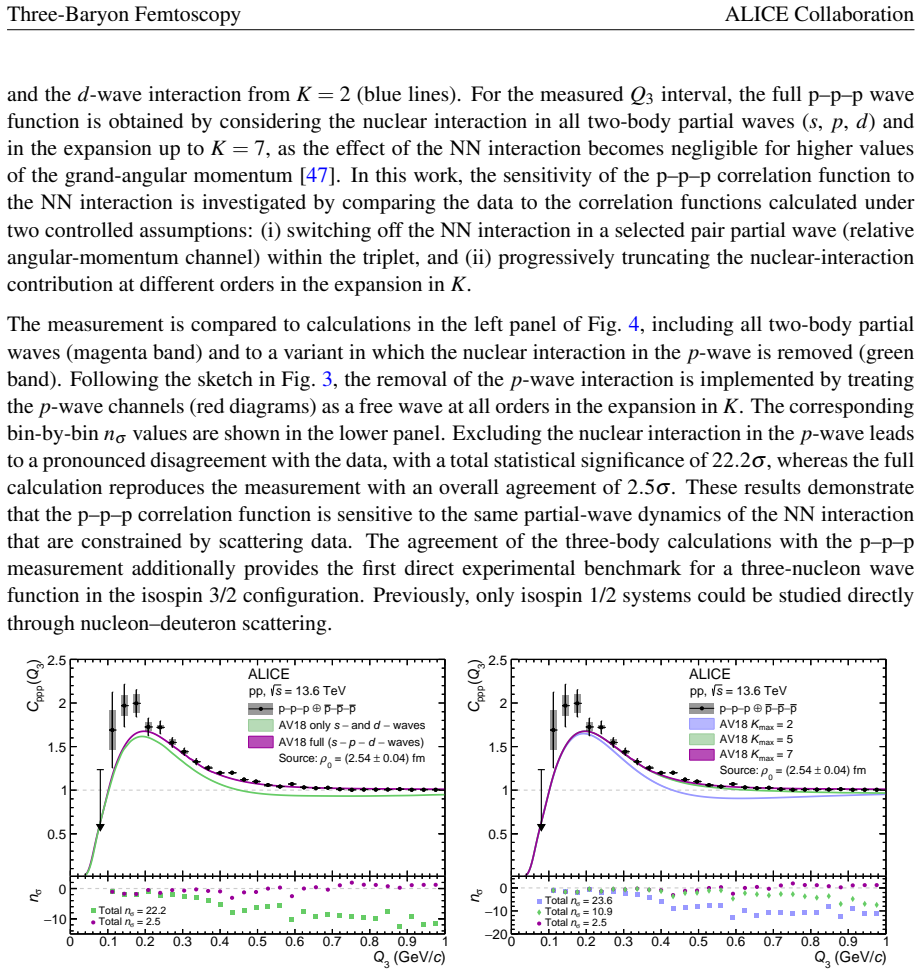
The paper's central claim is that the measured genuine three-proton correlation function $C_{ppp}(Q_3)$, freed of feed-down and non-femtoscopic contributions, is reproduced by a full three-body scattering calculation only when the nuclear interaction is active in all two-body partial waves up through $d$-waves and the hyperspherical expansion runs to grand-angular momentum $K_{\max}=7$. Removing the $p$-wave interaction degrades the agreement to $22.2\sigma$, whereas the complete calculation matches the data at $2.5\sigma$. The correlation stays above unity as it approaches the uncorrelated limit, which the authors attribute to an effective long-range attraction $\sim \zeta/\rho^3$ with $\zeta$ proportional to the two-body scattering length. Together these observations establish the p-p-p continuum as the first directly measured isospin-3/2 three-nucleon system and three-baryon femtoscopy as an effective $3\to3$ scattering experiment.
Load-bearing premise
The three-proton source size is set to exactly twice the measured two-proton source radius ($\rho_0 = 2 r_0$); if that factor is wrong, the absolute scale of the predicted correlation shifts and the agreement, p-wave sensitivity, and long-range attraction signature could all change.
Editorial extensions
If this is right
- Three-baryon femtoscopy becomes a working alternative to beam scattering for constraining the partial-wave content of baryon-baryon interactions, including channels that are experimentally inaccessible otherwise.
- The same method applied to p-p-Λ, p-p-Σ, and p-p-Ξ systems could yield the first continuum three-body data in the strangeness sector, informing hyperon-nucleon interactions relevant to dense matter.
- The measured long-range attraction provides an experimental anchor for the universal $\zeta/\rho^3$ dynamics used in calculations of three- and four-neutron continuum states.
- The requirement $K_{\max}\ge7$ for convergence means three-body continuum observables carry information from high grand-angular-momentum components, so future models must retain them to match correlation data.
- Because the p-wave sensitivity shows up as a 22.2σ effect, correlation functions can now discriminate between NN potentials that agree on two-body scattering observables but differ off-shell.
Reading between the lines
- If the assumed $\rho_0=2r_0$ relation carries a hidden systematic error, the absolute scale of $C_{ppp}$ shifts, so the cleanest follow-up is a source-size determination internal to the three-body system; until then the quoted significances should be read with that caveat.
- The 22.2σ p-wave sensitivity suggests the same data could rank NN potentials by how well they reproduce three-body correlations, effectively an off-shell benchmark beyond two-body data.
- The long-range attraction should appear generically in other three-body systems with large two-body scattering lengths, so p-p-Λ femtoscopy offers a direct test of whether this signature persists when one baryon is strange.
Signed reviews
Editorial analysis
A structured set of objections, weighed in public.
Referee Report
Summary. The paper reports the first measurement of the three-proton correlation function C_ppp(Q3) in pp collisions at sqrt(s)=13.6 TeV with ALICE Run 3 data. The authors develop a data-driven decomposition (Eq. 2) with lambda parameters, feed-down constraints from a dedicated p-p-Lambda measurement, and a cumulant-expansion baseline cross-check, then compare the extracted genuine C_ppp with continuum three-body calculations using the AV18 potential and a screened Coulomb interaction. They find that the full model agrees with the data within n_sigma = 2.4-2.5, while removing the p-wave component from the nuclear interaction produces a 22.2 sigma disagreement. They further find that the nuclear interaction must be retained up to grand-angular momentum K=7 and that the correlation approaches unity from above at large Q3, which they interpret as the first experimental signature of an effective long-range attraction in a three-proton continuum system. The paper's central claim is framed as establishing three-baryon femtoscopy as an effective 3-to-3 scattering experiment.
Significance. Should the central claims hold, this is a substantial experimental advance: it extends femtoscopy from two-body to unbound three-baryon systems, provides a controlled benchmark for three-body continuum calculations in the isospin-3/2 channel, and offers a path toward p-p-Lambda, p-p-Sigma, and p-p-Xi measurements. The analysis has real strengths: the lambda parameters are data-driven, the feed-down is constrained by a dedicated p-p-Lambda measurement, the non-femtoscopic baseline is cross-checked by a cumulant expansion from the two-body measurement, and the theory comparison includes checks against the Norfolk potential and K_max truncation. The reporting of n_sigma with correlated systematics is useful. However, the quantitative claims (2.5 sigma agreement, 22.2 sigma p-wave sensitivity, and the long-range-attraction signature) depend on the assumed relation rho0 = 2r0 and on the self-consistency of the baseline extraction; these are the main points that need attention before publication.
major comments (3)
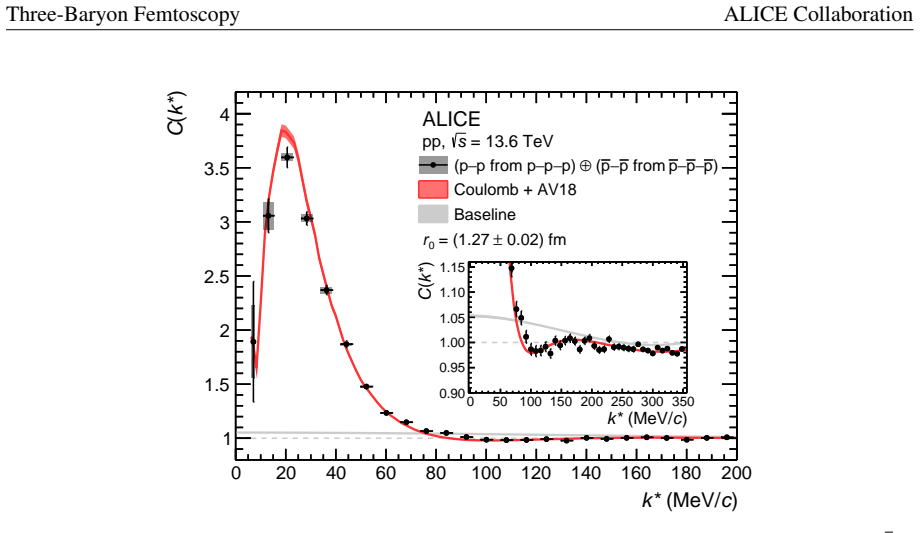
- [Sec. 2, source-size assumption rho0 = 2r0] The relation rho0 = 2r0 in Sec. 2 is treated as exact: the only propagated uncertainty is delta_r0 = 0.02 fm from the two-proton fit, giving rho0 = (2.54 +/- 0.04) fm. Because r0 is an effective radius that absorbs short-lived resonance feed-down and experimental selection effects, there is no reason for the three-proton effective radius to be exactly twice the two-proton one, and the factor 2 enters the absolute scale of every C_ppp(Q3) calculation used in Fig. 4. A 10-20% error in rho0 would rescale the correlation over the full Q3 range and would likely shift the quoted n_sigma values (full model about 2.5, no-p-wave 22.2) as well as the magnitude of the high-Q3 tail interpreted as long-range attraction. Please add a systematic estimate for the rho0-r0 relation (e.g., from alternative source parametrizations, event-generator templates, or a direct two-body-constrained three-body source model), or demonstrate explicitly that the conclusions are stable under such variations.
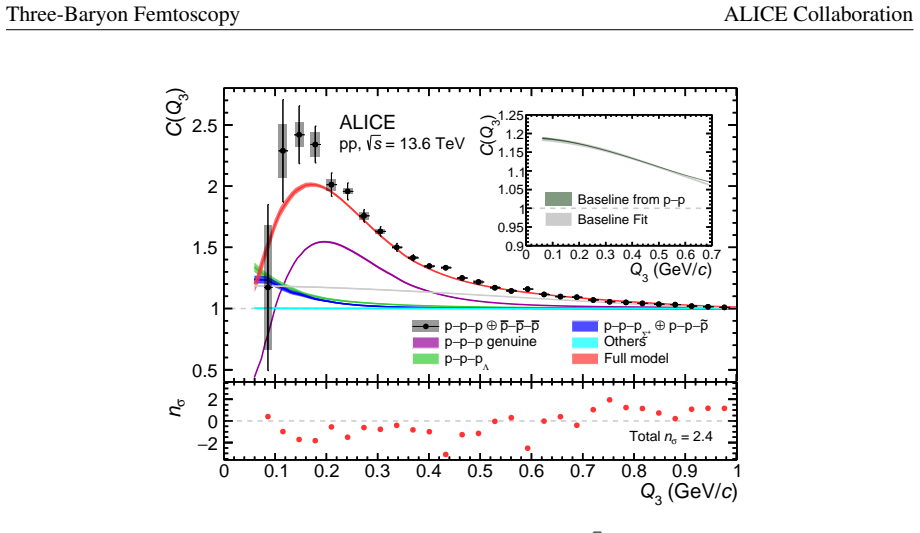
- [Sec. 3, Fig. 4 and Eq. (2)] The 22.2 sigma no-p-wave significance in Sec. 3 (Fig. 4, left) is obtained by comparing the 'genuine' C_ppp, which is extracted using the full-model baseline and feed-down decomposition of Eq. (2), with a calculation in which the p-wave is switched off. Because the baseline B(Q3) is fitted to the measured spectrum using the full model, the extracted C_ppp is not fully model-independent, and part of the disagreement may reflect that the baseline has been optimized to the full model. I request a self-consistent test: re-fit the baseline (and, where applicable, rho0 and the lambda parameters) under the no-p-wave hypothesis and recompute the n_sigma, or otherwise show that the no-p-wave discrepancy survives with a baseline determined without using C_ppp.
- [Sec. 3, Fig. 2 inset and Fig. 4] The claim of an effective long-range attraction rests on the genuine C_ppp remaining above unity as Q3 approaches 1 GeV/c (Sec. 3 and Fig. 4). The baseline B(Q3) = a + b Q3^2 + c Q3^3 is the only quantity fitted in the three-body case, and its uncertainty is not propagated into the high-Q3 tail in an explicit way; the inset of Fig. 2 shows agreement with the cumulant-based baseline only qualitatively. Please quantify the stability of the extracted C_ppp tail under (i) alternative baseline functional forms, (ii) variations of the fit range, and (iii) the minimum-bias-sample boundary near Q3 about 1.1-1.4 GeV/c, and report binned residuals of the cumulant-based baseline comparison.
minor comments (5)
- [Fig. 4, bottom panels] The tick labels in the bottom panels appear as '10-0' and '20-10-0'; this is likely a rendering or formatting error and should be corrected.
- [Sec. 2 and Sec. 3] The text quotes n_sigma = 2.4 for the full model in Sec. 2 and n_sigma = 2.5 for the genuine C_ppp comparison in Sec. 3; please clarify explicitly which data/model comparison each value refers to.
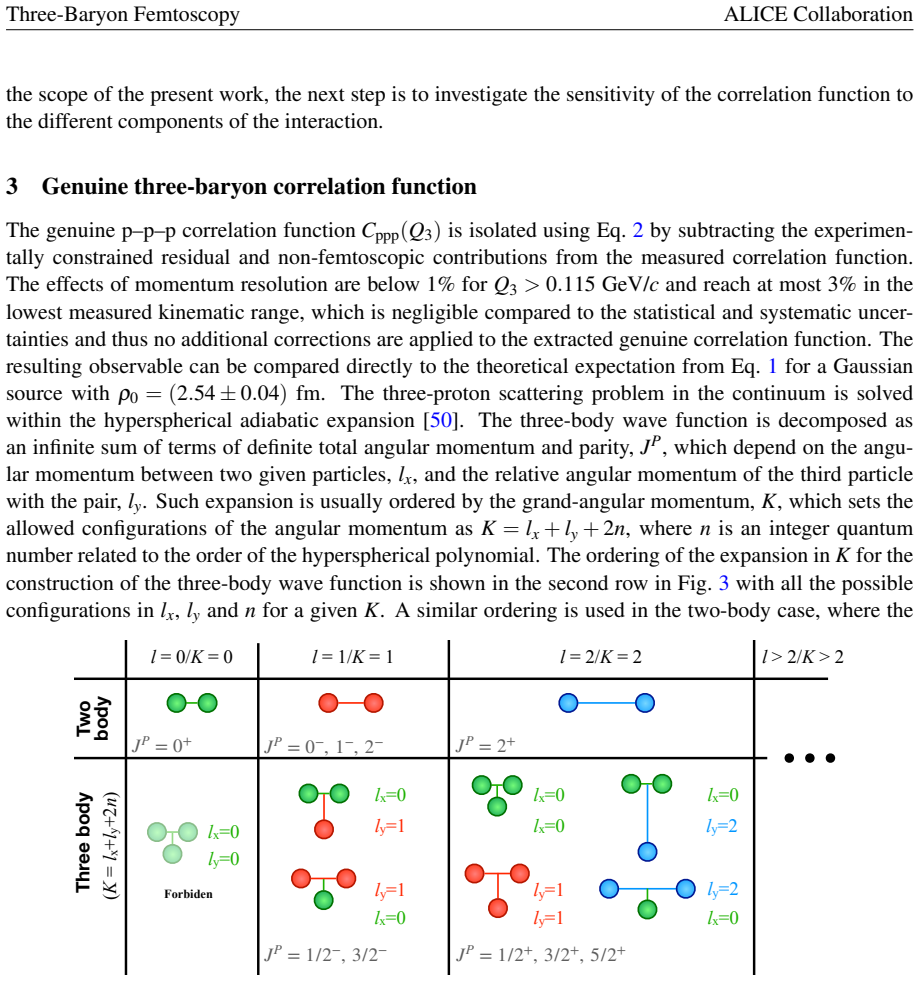
- [Fig. 3] The figure is informative but dense; please define K, l_x, l_y, and the relation K = l_x + l_y + 2n in the caption itself rather than only in the main text.
- [Appendix A.5, Eq. (A.2)] Please state in one place the sign convention for zeta (units of length and whether zeta < 0 corresponds to attraction), since the text and the f(rho) plots use the same quantity with opposite presentations.
- [Appendix A.3, Eq. (A.1)] The symbols P_i and F_i used in the definition of lambda_ij are introduced only in Appendix A.2; please define all symbols at first use in Eq. (A.1) or add a brief reminder.
Circularity Check
No significant circularity: the p-p-p comparison is driven by an external two-body potential and an independently calibrated source; no fitted quantity is relabeled as a prediction.
full rationale
The derivation chain is self-contained and non-circular. The only quantity fitted to the three-body data is the non-femtoscopic baseline B(Q3)=a+bQ3^2+cQ3^3, and the paper explicitly cross-validates it against the cumulant expansion built from the two-body measurement: 'Since the baseline is the only quantity fitted in the three-body case, and its behavior is independently confirmed in a data-driven way by the two-body measurement, the remaining agreement between model and data constitutes a direct comparison to the interaction models.' The genuine C_ppp is then compared with calculations from Ref. [47] using the AV18 potential, which is fixed by external two-nucleon scattering data, not by the p-p-p correlation function. The three-body source radius is calibrated from the measured p-p correlation within triplets via the stated relation rho0=2r0; this is an input assumption rather than a predicted output, and while the factor-of-two carries no quoted systematic uncertainty, that is a robustness gap, not circularity. No parameter is fitted to C_ppp itself, and the partial-wave sensitivity claim (22.2 sigma without p-wave versus 2.5 sigma full) is a comparison of two fixed theory variants to the same residual, so the result is not forced by construction or by a self-citation chain.
Assumptions & free parameters
free parameters (4)
- effective two-proton source radius r0 =
1.27 ± 0.02 fm
- three-body source radius rho0 =
2.54 ± 0.04 fm
- two-body baseline coefficients a,b,c =
not quoted
- three-body baseline coefficients a,b,c =
not quoted
assumptions (5)
- domain assumption The three-proton source function is Gaussian with rho0 = 2 r0, where r0 is the two-proton effective source radius.
- domain assumption Independent emission of the three protons, so the three-body source factorizes into a Gaussian in hyperradius rho.
- domain assumption The three-nucleon force is negligible in the p-p-p system (effect below 0.1%).
- ad hoc to paper Coulomb interaction in the p-p-p system can be treated with a screened Coulomb potential; no exact three-body Coulomb solution exists.
- domain assumption The non-femtoscopic baseline B(Q3) is a third-order polynomial without a linear term.
Cite this review
Pith. "Pith review of Three-baryon femtoscopy as an effective 3$\rightarrow$3 scattering experiment." pith.science (2026). https://pith.science/paper/3S7VOLGV
@misc{pith2026260805708,
  author       = {Pith},
  title        = {Pith review of: Three-baryon femtoscopy as an effective 3$\rightarrow$3 scattering experiment},
  year         = {2026},
  howpublished = {\url{https://pith.science/paper/3S7VOLGV}},
  note         = {Machine review of arXiv:2608.05708}
}
abstract
Scattering experiments have long been the gold standard for constraining hadron$-$hadron interactions, providing direct information on the angular momentum and spin dependence over a wide range of kinematic configurations. However, experimental constraints on three-body dynamics remain limited, specifically for unbound systems and systems involving short-lived hadrons. In this work, the three-proton correlation function is measured in pp collisions at $\sqrt{s}=13.6$ TeV with ALICE at the LHC and presented as a novel approach to access hadronic interactions in three-body systems. A new analysis strategy is employed to isolate the p$-$p$-$p contribution to the correlation function by correcting for background channels and experimental effects, and enabling a direct comparison with state-of-the-art three-body continuum calculations. The extracted correlation function provides the first direct access to the isospin $3/2$ three-body system. The measured observable is found to be sensitive to the partial-wave structure of the nucleon$-$nucleon interaction and indicates that the nuclear interaction acts even at high angular momentum and parity states of the three-body system, revealing an effective long-range attractive component, observed experimentally for the first time in a three-proton continuum system. Hence, three-hadron femtoscopy emerges as an effective 3$\rightarrow$3 scattering experiment with three unbound hadrons in initial and final states. The copious production of hyperons at the modern high-energy colliders ensures the possibility of extending such measurements beyond nucleons, opening a new avenue for future precision studies of three-body dynamics in the strangeness sector.
Figures
Figures from the paper (1 more)
Reference graph
Works this paper leans on
-
[1]
Nuclear effective field theory: status and perspectives
H. W. Hammer, S. König, and U. van Kolck, “Nuclear effective field theory: status and perspectives”,Rev. Mod. Phys.92(2020) 025004,arXiv:1906.12122 [nucl-th]
arXiv 2020
-
[2]
Three nucleon forces from chiral effective field theory
E. Epelbaum, A. Nogga, W. Gloeckle, H. Kamada, U. G. Meissner, and H. Witała, “Three nucleon forces from chiral effective field theory”,Phys. Rev. C66(2002) 064001, arXiv:nucl-th/0208023
arXiv 2002
-
[3]
A Guided Tour ofab initioNuclear Many-Body Theory
H. Hergert, “A Guided Tour ofab initioNuclear Many-Body Theory”,Front. in Phys.8(2020) 379,arXiv:2008.05061 [nucl-th]
arXiv 2020
-
[4]
Modern Theory of Nuclear Forces
E. Epelbaum, H.-W. Hammer, and U.-G. Meissner, “Modern Theory of Nuclear Forces”,Rev. Mod. Phys.81(2009) 1773–1825,arXiv:0811.1338 [nucl-th]
arXiv 2009
-
[5]
Partial wave analysis of all nucleon-nucleon scattering data below 350 MeV
V . G. J. Stoks, R. A. M. Klomp, M. C. M. Rentmeester, and J. J. de Swart, “Partial wave analysis of all nucleon-nucleon scattering data below 350 MeV”,Phys. Rev. C48(1993) 792–815
work page 1993
-
[6]
Construction of high quality NN potential models
V . G. J. Stoks, R. A. M. Klomp, C. P. F. Terheggen, and J. J. de Swart, “Construction of high quality NN potential models”,Phys. Rev. C49(1994) 2950–2962,arXiv:nucl-th/9406039. [7]LENPICCollaboration, E. Epelbaumet al., “Few- and many-nucleon systems with semilocal coordinate-space regularized chiral two- and three-body forces”,Phys. Rev. C99(2019) 02431...
arXiv 1994
-
[8]
Light-nuclei spectra from chiral dynamics
M. Piarulliet al., “Light-nuclei spectra from chiral dynamics”,Phys. Rev. Lett.120(2018) 052503,arXiv:1707.02883 [nucl-th]. 12 Three-Baryon Femtoscopy ALICE Collaboration
arXiv 2018
-
[9]
The Three nucleon continuum: Achievements, challenges and applications
W. Gloeckle, H. Witała, D. Huber, H. Kamada, and J. Golak, “The Three nucleon continuum: Achievements, challenges and applications”,Phys. Rep.274(1996) 107–285
work page 1996
Show all 50 references
-
[10]
Polarization observables in p-d scattering below 30 MeV
A. Kievsky, M. Viviani, and S. Rosati, “Polarization observables in p-d scattering below 30 MeV”, Phys. Rev. C64(2001) 024002,arXiv:nucl-th/0103058
2001 arXiv
-
[11]
N-d scattering including electromagnetic forces
A. Kievsky, M. Viviani, and L. E. Marcucci, “N-d scattering including electromagnetic forces”, Phys. Rev. C69(2004) 014002,arXiv:nucl-th/0309066
2004 arXiv
-
[12]
Significance of chiral three-nucleon force contact terms for understanding of elastic nucleon-deuteron scattering
H. Witała, J. Golak, and R. Skibi ´nski, “Significance of chiral three-nucleon force contact terms for understanding of elastic nucleon-deuteron scattering”,Phys. Rev. C105(2022) 054004, arXiv:2203.08499 [nucl-th]
2022 arXiv
-
[13]
Effect of the N3LO three-nucleon contact interaction on p-d scattering observables
L. Girlanda, E. Filandri, A. Kievsky, L. E. Marcucci, and M. Viviani, “Effect of the N3LO three-nucleon contact interaction on p-d scattering observables”,Phys. Rev. C107(2023) L061001,arXiv:2302.03468 [nucl-th]
2023 arXiv
-
[14]
Impact of chiral hyperonic three-body forces on neutron stars
D. Logoteta, I. Vidana, and I. Bombaci, “Impact of chiral hyperonic three-body forces on neutron stars”,Eur . Phys. J. A55(2019) 207,arXiv:1906.11722 [nucl-th]
2019 arXiv
-
[15]
Neutron Star Properties and Femtoscopic Constraints
I. Vidana, V . M. Sarti, J. Haidenbauer, D. L. Mihaylov, and L. Fabbietti, “Neutron Star Properties and Femtoscopic Constraints”,Eur . Phys. J. A61(2025) 59,arXiv:2412.12729 [nucl-th]. [16]Particle Data GroupCollaboration, S. Navaset al., “Review of particle physics”,Phys. Rev...
2025 arXiv
-
[17]
ElasticΣ±p scattering at low energies
F. Eisele, H. Filthuth, W. Foehlisch, V . Hepp, and G. Zech, “ElasticΣ±p scattering at low energies”,Phys. Lett. B37(1971) 204–206
1971
-
[18]
Study of theΛ-N system in low-energyΛ-p elastic scattering
G. Alexander, U. Karshon, A. Shapira, G. Yekutieli, R. Engelmann, H. Filthuth, and W. Lughofer, “Study of theΛ-N system in low-energyΛ-p elastic scattering”,Phys. Rev.173(1968) 1452–1460
1968
-
[19]
Low-energyΛ-proton elastic scattering
B. Sechi-Zorn, B. Kehoe, J. Twitty, and R. A. Burnstein, “Low-energyΛ-proton elastic scattering”,Phys. Rev.175(1968) 1735–1740. [20]BESIIICollaboration, M. Ablikimet al., “First Study of Antihyperon-Nucleon Scattering Λp→Λp and Measurement ofΛp→Λp Cross Section”,Phys. Rev. Let...
1968
-
[23]
Strangeness in nuclear physics
A. Gal, E. V . Hungerford, and D. J. Millener, “Strangeness in nuclear physics”,Rev. Mod. Phys.88 (2016) 035004,arXiv:1605.00557 [nucl-th]
2016 arXiv
-
[24]
Observation of a (Sigma)He-4 bound state in the He-4(K-,pi-) reaction at 600-MeV/c
T. Nagaeet al., “Observation of a (Sigma)He-4 bound state in the He-4(K-,pi-) reaction at 600-MeV/c”,Phys. Rev. Lett.80(1998) 1605–1609
1998
-
[25]
The first evidence of a deeply bound state ofΞ −–14N system
K. Nakazawaet al., “The first evidence of a deeply bound state ofΞ −–14N system”,PTEP2015 (2015) 033D02. 13 Three-Baryon Femtoscopy ALICE Collaboration [26]J-PARC E07Collaboration, S. H. Hayakawaet al., “Observation of Coulomb-Assisted Nuclear Bound State ofΞ−–14N System”,Phys...
2015
-
[27]
First observation of a nuclear s-state of aΞhypernucleus, 15 Ξ C
M. Yoshimotoet al., “First observation of a nuclear s-state of aΞhypernucleus, 15 Ξ C”,PTEP2021 (2021) 073D02,arXiv:2103.08793 [nucl-ex]
2021 arXiv
-
[28]
Hyperon–nucleon interaction within chiral effective field theory revisited
J. Haidenbauer, U. G. Meißner, and A. Nogga, “Hyperon–nucleon interaction within chiral effective field theory revisited”,Eur . Phys. J. A56(2020) 91,arXiv:1906.11681 [nucl-th]. [29]ALICECollaboration, “Letter of intent for ALICE 3: A next-generation heavy-ion experiment at th...
2020 arXiv
-
[31]
Study of the Strong Interaction Among Hadrons with Correlations at the LHC
L. Fabbietti, V . Mantovani Sarti, and O. Vazquez Doce, “Study of the Strong Interaction Among Hadrons with Correlations at the LHC”,Ann. Rev. Nucl. Part. Sci.71(2021) 377–402, arXiv:2012.09806 [nucl-ex]. [32]ALICECollaboration, S. Acharyaet al., “Search for a common baryon so...
2021 arXiv
-
[36]
Constraining the pΛinteraction from a combined analysis of scattering data and correlation functions
D. L. Mihaylov, J. Haidenbauer, and V . M. Sarti, “Constraining the pΛinteraction from a combined analysis of scattering data and correlation functions”,Phys. Lett. B850(2024) 138550, arXiv:2312.16970 [nucl-th]
2024 arXiv
-
[37]
Role of three-body dynamics in nucleon-deuteron correlation functions
M. Viviani, S. König, A. Kievsky, L. E. Marcucci, B. Singh, and O. Vázquez Doce, “Role of three-body dynamics in nucleon-deuteron correlation functions”,Phys. Rev. C108(2023) 064002, arXiv:2306.02478 [nucl-th]. [38]ALICECollaboration, S. Acharyaet al., “Exploring the Strong In...
2023 arXiv
-
[39]
Comprehensive study of the three- and four-neutron systems at low energies
M. D. Higgins, C. H. Greene, A. Kievsky, and M. Viviani, “Comprehensive study of the three- and four-neutron systems at low energies”,Phys. Rev. C103(2021) 024004,arXiv:2011.11687 [nucl-th]
2021 arXiv
-
[40]
Nonresonant Density of States Enhancement at Low Energies for Three or Four Neutrons
M. D. Higgins, C. H. Greene, A. Kievsky, and M. Viviani, “Nonresonant Density of States Enhancement at Low Energies for Three or Four Neutrons”,Phys. Rev. Lett.125(2020) 052501, arXiv:2005.04714 [nucl-th]. [41]ALICECollaboration, S. Acharyaet al., “Towards the understanding of...
2020 arXiv
-
[45]
nnn and ppp correlation functions
A. Kievsky, E. Garrido, M. Viviani, L. E. Marcucci, L. Šerkšnyt˙e, and R. Del Grande, “nnn and ppp correlation functions”,Phys. Rev. C109(2024) 034006,arXiv:2310.10428 [nucl-th]
2024 arXiv
-
[46]
pΛand ppΛcorrelation functions
E. Garrido, A. Kievsky, M. Gattobigio, M. Viviani, L. E. Marcucci, R. Del Grande, L. Fabbietti, and D. Melnichenko, “pΛand ppΛcorrelation functions”,Phys. Rev. C110(2024) 054004, arXiv:2408.01750 [nucl-th]
2024 arXiv
-
[47]
Convergence of the ppp correlation function within the hyperspherical adiabatic basis
E. Garrido, A. Kievsky, R. Del Grande, L. Šerkšnyt ˙e, M. Viviani, and L. E. Marcucci, “Convergence of the ppp correlation function within the hyperspherical adiabatic basis”,Phys. Lett. B868(2025) 139731,arXiv:2505.22190 [nucl-th]. [48]ALICECollaboration, S. Acharyaet al., “C...
2025 arXiv
-
[49]
Novel model for particle emission in small collision systems
D. Mihaylov and J. González González, “Novel model for particle emission in small collision systems”,Eur . Phys. J. C83(2023) 590,arXiv:2305.08441 [hep-ph]
2023 arXiv
-
[50]
The three-body problem with short-range interactions
E. Nielsen, D. V . Fedorov, A. S. Jensen, and E. Garrido, “The three-body problem with short-range interactions”,Phys. Rep.347(2001) 373–459
2001
-
[51]
The Hyperspherical Harmonics method: a tool for testing and improving nuclear interaction models
L. E. Marcucci, J. Dohet-Eraly, L. Girlanda, A. Gnech, A. Kievsky, and M. Viviani, “The Hyperspherical Harmonics method: a tool for testing and improving nuclear interaction models”, Front. in Phys.8(2020) 69,arXiv:1912.09751 [nucl-th]. [52]ALICECollaboration, S. Acharyaet al....
2020 arXiv
-
[53]
Technical Design Report for the Upgrade of the Online-Offline Computing System
P. Buncic, M. Krzewicki, and P. Vande Vyvre, “Technical Design Report for the Upgrade of the Online-Offline Computing System”, CERN-LHCC-2015-006, ALICE-TDR-019. [54]ALICECollaboration, S. Acharyaet al., “Investigation of the p–Σ 0 interaction via femtoscopy in pp collisions”,...
2020 arXiv
-
[55]
Nucleon-nucleon correlation functions from different interactions in comparison
M. Göbel and A. Kievsky, “Nucleon-nucleon correlation functions from different interactions in comparison”,Phys. Lett. B869(2025) 139835,arXiv:2505.13433 [nucl-th]. [56]ALICECollaboration, S. Acharyaet al., “Femtoscopic study of the proton-proton and proton-deuteron systems in...
2025 arXiv
-
[57]
An Accurate nucleon-nucleon potential with charge independence breaking
R. B. Wiringa, V . G. J. Stoks, and R. Schiavilla, “An Accurate nucleon-nucleon potential with charge independence breaking”,Phys. Rev. C51(1995) 38–51,arXiv:nucl-th/9408016. [58]ALICECollaboration, D. Ali Hassan Abdallahet al., “Multiplicity dependence of the size of the comm...
1995 arXiv
-
[59]
A Decade of Collectivity in Small Systems
J. F. Grosse-Oetringhaus and U. A. Wiedemann, “A Decade of Collectivity in Small Systems”, CERN-TH-2024-110,arXiv:2407.07484 [hep-ex]. [60]ALICECollaboration, S. Acharyaet al., “p-p, p-ΛandΛ-Λcorrelations studied via femtoscopy in pp reactions at√s= 7 TeV”,Phys. Rev. C99(2019)...
2019 arXiv
-
[61]
ThepppCorrelation Function with a Screened Coulomb Potential
A. Kievsky, E. Garrido, M. Viviani, and M. Gattobigio, “ThepppCorrelation Function with a Screened Coulomb Potential”,Few Body Syst.65(2024) 23,arXiv:2402.06317 [nucl-th]
2024 arXiv
-
[62]
A method to remove lower order contributions in multi-particle femtoscopic correlation functions
R. Del Grande, L. Šerkšnyt ˙e, L. Fabbietti, V . M. Sarti, and D. Mihaylov, “A method to remove lower order contributions in multi-particle femtoscopic correlation functions”,Eur . Phys. J. C82 (2022) 244,arXiv:2107.10227 [nucl-th]
2022 arXiv
-
[63]
Universality in few-body systems with large scattering length
E. Braaten and H. W. Hammer, “Universality in few-body systems with large scattering length”, Phys. Rep.428(2006) 259–390,arXiv:cond-mat/0410417
2006 arXiv
-
[64]
Efimov Physics and Connections to Nuclear Physics
A. Kievsky, L. Girlanda, M. Gattobigio, and M. Viviani, “Efimov Physics and Connections to Nuclear Physics”,Ann. Rev. Nucl. Part. Sci.71(2021) 465–490,arXiv:2102.13504 [nucl-th]
2021 arXiv
-
[65]
Candidate Resonant Tetraneutron State Populated by the He4(He8,Be8) Reaction
K. Kisamoriet al., “Candidate Resonant Tetraneutron State Populated by the He4(He8,Be8) Reaction”,Phys. Rev. Lett.116(2016) 052501
2016
-
[66]
Direct observation of three-neutron emission from He 7 and the search for the trineutron
S. W. Huanget al., “Direct observation of three-neutron emission from He 7 and the search for the trineutron”,Phys. Rev. Res.8(2026) L022003,arXiv:2603.10859 [nucl-ex]. [67]RIBF-SHARAQ11 and RCNP-E502Collaboration, K. Miki, K. Kameya,et al., “Precise spectroscopy of the 3nand ...
2026
-
[73]
A comprehensive guide to the physics and usage of PYTHIA 8.3
C. Bierlichet al., “A comprehensive guide to the physics and usage of PYTHIA 8.3”SciPost Phys. Codeb.2022(2022) 8,arXiv:2203.11601 [hep-ph]
2022 arXiv
-
[74]
Recent developments in Geant4
J. Allisonet al., “Recent developments in Geant4”,Nucl. Instrum. Meth. A835(2016) 186–225
2016
-
[75]
Geant4 developments and applications
J. Allisonet al., “Geant4 developments and applications”,IEEE Trans. Nucl. Sci.53(2006) 270. [76]GEANT4Collaboration, S. Agostinelliet al., “GEANT4 - A Simulation Toolkit”,Nucl. Instrum. Meth. A506(2003) 250–303. 16 Three-Baryon Femtoscopy ALICE Collaboration
2006
-
[77]
A femtoscopic Correlation Analysis Tool using the Schrödinger equation (CATS)
D. L. Mihaylov, V . Mantovani Sarti, O. W. Arnold, L. Fabbietti, B. Hohlweger, and A. M. Mathis, “A femtoscopic Correlation Analysis Tool using the Schrödinger equation (CATS)”,Eur . Phys. J. C78(2018) 394,arXiv:1802.08481 [hep-ph]
2018 arXiv
-
[78]
Can the Strong Interactions between Hadrons Be Determined Using Femtoscopy?
E. Epelbaum, S. Heihoff, U.-G. Meißner, and A. Tscherwon, “Can the Strong Interactions between Hadrons Be Determined Using Femtoscopy?”,Phys. Rev. Lett.136(2026) 212301, arXiv:2504.08631 [nucl-th]
2026 arXiv
-
[79]
Minimally nonlocal nucleon-nucleon potentials with chiral two-pion exchange including∆ resonances
M. Piarulli, L. Girlanda, R. Schiavilla, R. Navarro Pérez, J. E. Amaro, and E. Ruiz Arriola, “Minimally nonlocal nucleon-nucleon potentials with chiral two-pion exchange including∆ resonances”,Phys. Rev. C91(2015) 024003,arXiv:1412.6446 [nucl-th]
2015 arXiv
-
[80]
Local chiral interactions, the tritium Gamow-Teller matrix element, and the three-nucleon contact term
A. Baroniet al., “Local chiral interactions, the tritium Gamow-Teller matrix element, and the three-nucleon contact term”,Phys. Rev. C98(2018) 044003,arXiv:1806.10245 [nucl-th]. 17 Three-Baryon Femtoscopy ALICE Collaboration A Appendix A.1 Experimental apparatus and data sampl...
2018 arXiv
Reviewed August 15, 2026 · model on record in the stance chip above.
Discussion (0). Continue with ORCID to comment.