REVIEW 2 major objections 4 minor 58 references
Icebreaker: Element-wise Active Information Acquisition with Bayesian Deep Latent Gaussian Model
T0 review · 2 major / 4 minor · reviewed 2026-08-14 · deepseek-v4-flash
Pith's one-line read Icebreaker, a fully Bayesian deep latent Gaussian model with partial amortized inference and uncertainty-driven acquisition, claims to solve the ice-start problem and reach the best test-time performance using the least training data.
desk verdict A solid combination paper: ice-start is a real problem, the PA-BELGAM inference scheme is a sensible engineering contribution, and the acquisition functions are well-motivated, but the theoretical grounding in Eq. 3 has a real gap that needs patching before the uncertainty estimates can be trusted. read the letter →
The pith
A machine-rendered reading of the paper's core claim, the machinery that carries it, and where it could break.
The reading
What carries the argument
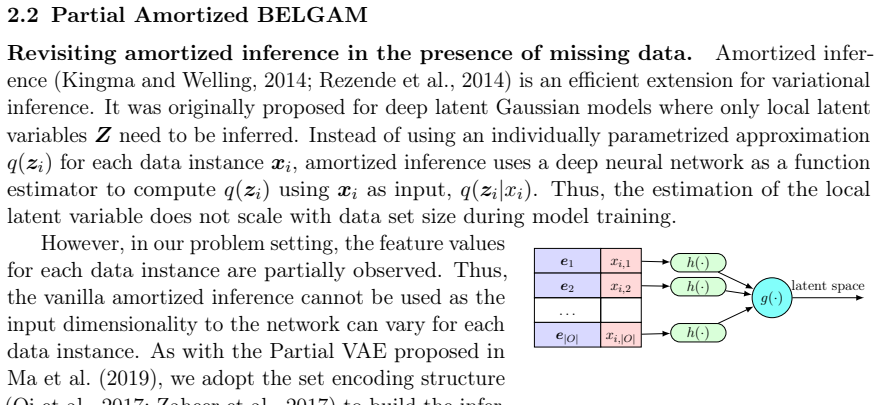
The machinery is partial amortized inference: local latent variables $z_i$ are encoded by a set-encoding network $q_\phi(z_i|x_i)$ that accepts variable-size partial observations, while global weights $\theta$ are produced by preconditioned stochastic gradient Hamiltonian Monte Carlo. The step that carries the argument is Eq.~3, which replaces the intractable gradient $\nabla_\theta \log p(X_O,\theta)$ with the gradient of the ELBO maximized over the amortized family $\mathcal{F}$; this makes the weight sampler feasible and supplies the model-parameter uncertainty that both acquisition functions consume. The imputation acquisition uses nested Monte Carlo estimates of expected posterior-entropy reduction, and the prediction acquisition uses the conditional variant, blended by the parameter $\alpha$.
What would settle it
Run PA-BELGAM on a small dataset such as Boston Housing and compare its stochastic gradient Hamiltonian Monte Carlo samples of the weights against a reference posterior obtained by full Hamiltonian Monte Carlo over both latent variables and weights. If the reference and approximate posterior predict the held-out data differently, or if the top-ranked candidate acquisitions from Eq.~7 disagree with the ranking computed from the reference posterior, the central claim fails.
Extended reading notes
Core claim
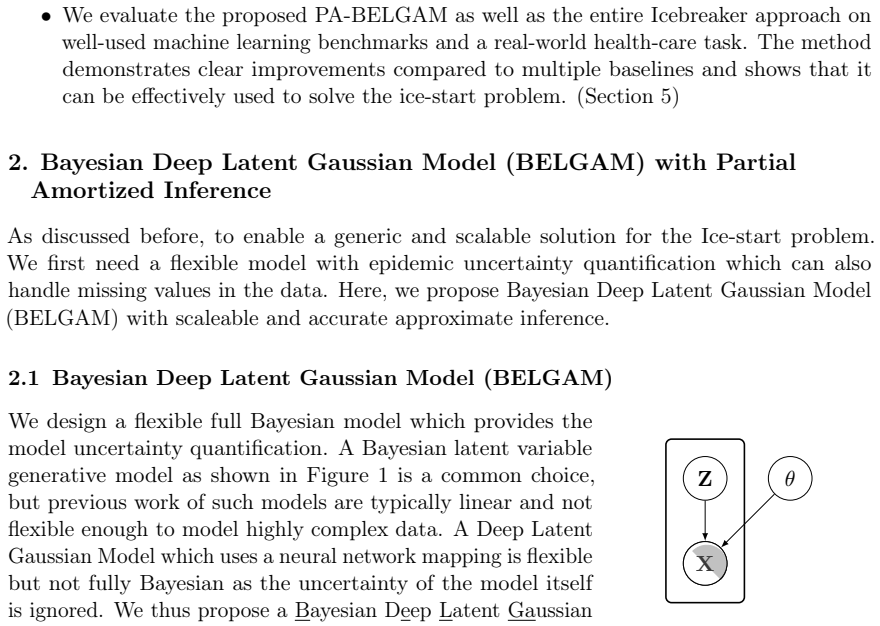
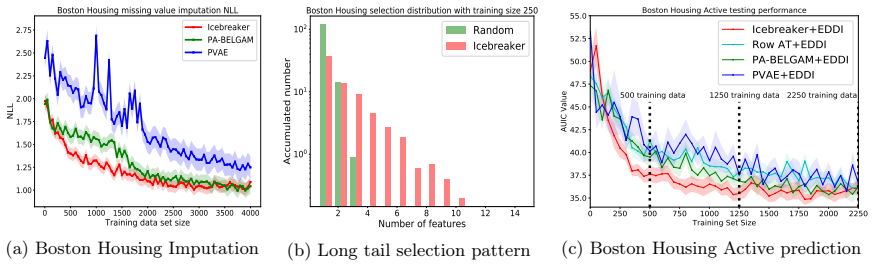
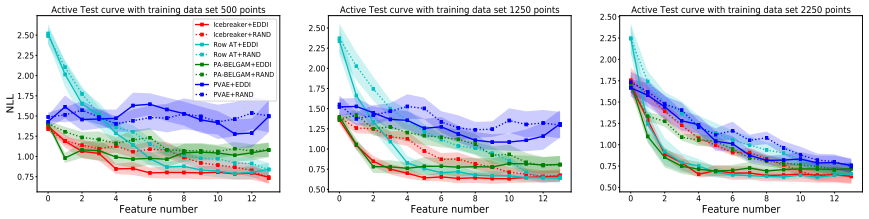
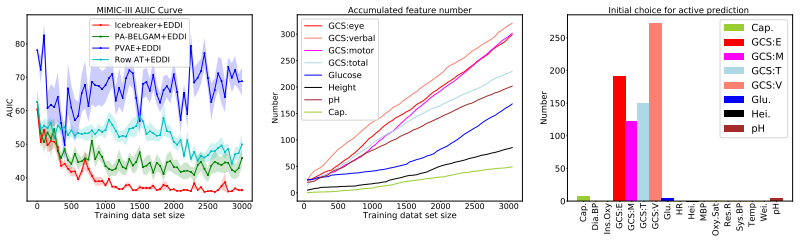
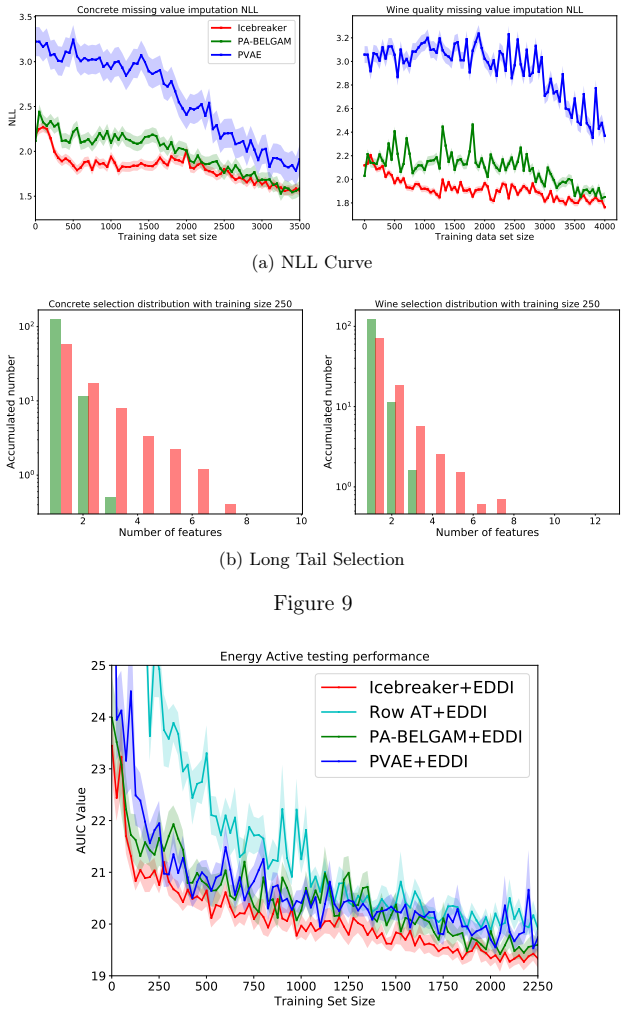
The paper's central discovery is that the ice-start problem can be addressed by making the training data itself the object of active acquisition. In BELGAM, each observed feature $x_{i,d}$ is generated from a local latent variable $z_i$ through a Bayesian neural network with global weights $\theta$; PA-BELGAM then infers $z_i$ with a permutation-invariant amortized encoder and samples $\theta$ with stochastic gradient Hamiltonian Monte Carlo. This gives a scalable posterior over model parameters, and the paper defines two acquisition rules: Eq.~5 scores a candidate feature by the expected reduction in posterior uncertainty of $\theta$, while Eq.~8 scores it by conditional mutual information between the target and $\theta$, with a combined objective that equals half the conditional mutual information $I(\theta; y_i,x_{i,d} \mid X_O)$ when $\alpha=1/2$. On UCI benchmarks, MovieLens-1M, and MIMIC-III, Icebreaker achieves lower NLL and AUIC than random acquisition, the partial-VAE baseline, and row-wise acquisition, and its long-tailed selection pattern shows it exploits feature correlations inside rows while still exploring new ones.
Load-bearing premise
The method assumes that replacing the true intractable parameter-gradient with the gradient of a maximized variational lower bound over the encoder family is accurate enough that the sampling step still explores nearly the true posterior over the weights; if the encoder family is too small, the uncertainty scores that decide which feature values to acquire are biased.
Editorial extensions
If this is right
- Where training data are scarce, using a Bayesian treatment of the decoder improves imputation and active prediction even without active acquisition, so parameter uncertainty is a prerequisite for efficient cold-start learning.
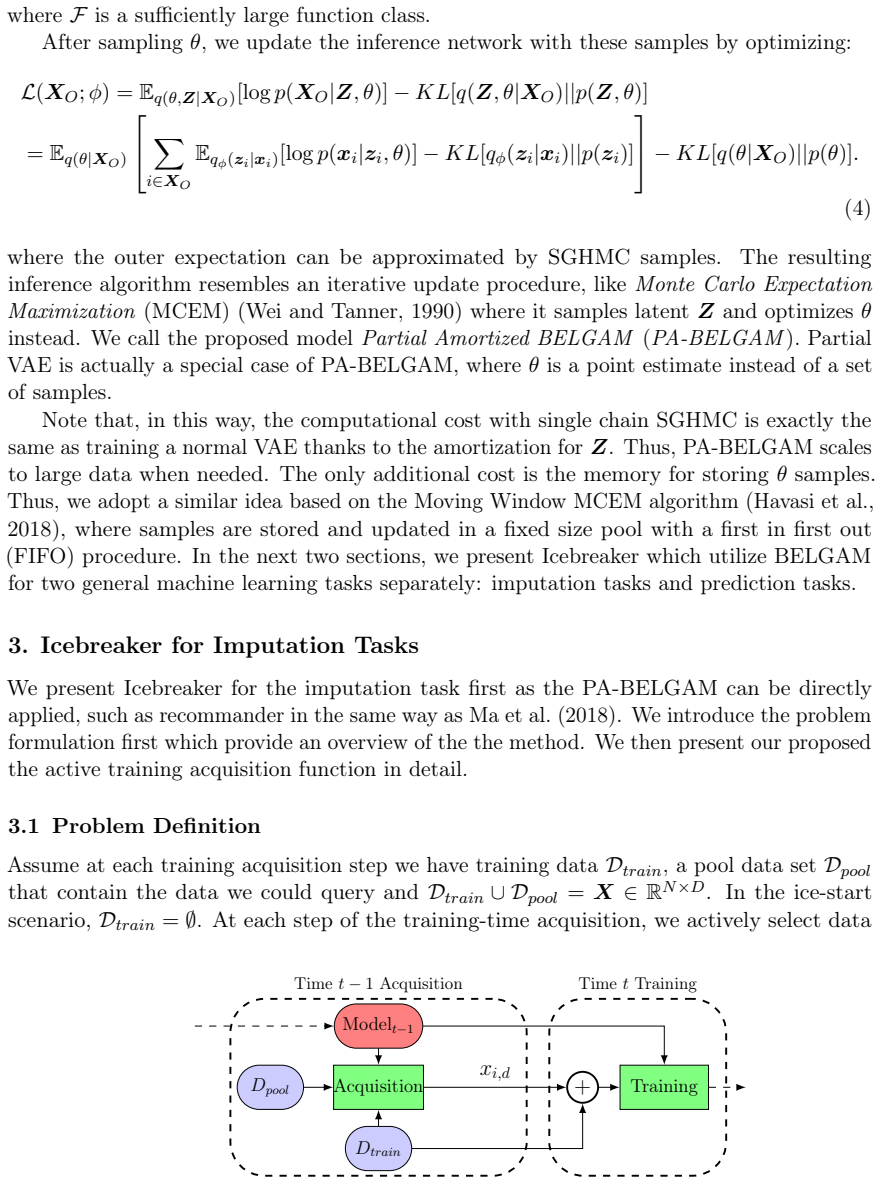
- Element-wise training acquisition is more data-efficient than acquiring whole rows: with the same query budget, Icebreaker obtains many partially observed points and reaches good test-time performance earlier than row-wise active learning.
- The acquisition functions balance exploration and exploitation; at $\alpha=1/2$ the combined objective is exactly half the conditional mutual information between the weights and the feature-target pair, giving it a clear information-theoretic meaning.
- Models trained on Icebreaker-selected data also make test-time active prediction more effective, lowering the area under the information curve compared with random or row-wise training acquisition.
Reading between the lines
- The same partial-amortization recipe—amortize local variables, sample global weights—can likely be dropped into other deep generative models, so the contribution may help any latent-variable setting where decisions depend on parameter uncertainty.
- A deployment of Icebreaker would benefit from a posterior-calibration check against a full Bayesian baseline before trusting the acquisition rankings, since the paper does not directly measure the gap between the approximate and true posterior over the weights.
- The information-theoretic objectives suggest a testable extension: replacing raw mutual information with task-specific utility, such as expected health outcome, should change the acquisition pattern, and the paper leaves that comparison open.
Signed reviews
Editorial analysis
A structured set of objections, weighed in public.
Referee Report
Summary. This paper introduces the 'ice-start' problem: deploying a prediction or imputation model when initially little or no training data is available and feature elements can be acquired at cost. The authors propose Icebreaker, a framework built on a Bayesian Deep Latent Gaussian Model (BELGAM) with partial amortized inference (PA-BELGAM), in which local latent variables are handled by an amortized encoder and global weights are sampled with SGHMC. Two training-time acquisition functions are proposed, one for imputation and one for active prediction, and the framework is evaluated on UCI benchmarks, MovieLens, and MIMIC-III. The paper reports that Icebreaker and PA-BELGAM outperform P-VAE and random acquisition, especially in the small-data regime.
Significance. If the result holds, this is a potentially significant contribution because it addresses element-wise training-time acquisition, a practically important problem, and it combines amortized inference with MCMC in a Bayesian deep generative model. The acquisition functions are information-theoretically motivated, and the experimental evaluation spans multiple benchmarks and real-world applications. The paper also gives a clear problem formulation and a detailed discussion of feature-selection patterns. However, the theoretical grounding depends on an unvalidated gradient identity that biases the SGHMC posterior; without a fix, the uncertainty estimates that drive the acquisition functions are not justified. The empirical comparisons also lack statistical support. The central idea is interesting, but the current manuscript needs substantial corrective work.
major comments (2)
- [Section 2.2, Eq. (3); Algorithm 4] The equality in Eq. (3), ∇θ log p(XO,θ) = ∇θ max_{qφ∈F} Ljoint(XO;φ), is not valid for the implemented encoder. For the right-hand side to equal the left, the maximizing qφ would have to coincide with the exact conditional posterior p(Z|XO,θ) for every relevant θ. But the inference network qφ(zi|xi) does not take θ as an input, and Eq. (4) optimizes it against an average over SGHMC samples rather than against the θ-conditional posterior. Hence the maximizer in Eq. (3) is not p(Z|XO,θ), and the SGHMC updates in Algorithm 4 use a biased gradient: E_{qφ}[∇θ log p(xi|zi,θ)] instead of E_{p(zi|xi,θ)}[∇θ log p(xi|zi,θ)]. No bound on the resulting bias is provided. Since the θ samples are used both for prediction and for the acquisition functions (Eqs. 5, 7, 8, 9, 10), the epistemic uncertainty driving Icebreaker is not justified. This is a load-bearing defect in the derivation, not merely a cosmetic issue. The authors should either use a θ-conditioned amortized family qφ(zi|xi,θ), provide an unbiased estimator of ∇θ log p(xi|θ), or explicitly treat the sampler as targeting an approximate posterior and demonstrate that the approximation is accurate enough for the proposed acquisition functions.
- [Section 5, Figures 4, 6, 9, 10] The abstract and Section 5 claim that BELGAM/Icebreaker performs 'significantly better' than baselines, but the main experimental curves are reported without error bars, confidence intervals, or statistical significance tests. The text states that all experiments are averaged over 10 runs, but no measure of spread is provided for the UCI or MovieLens results; only the MIMIC experiment mentions standard error. Without this information, the central empirical claim of significant improvement is not statistically supported. The authors should report standard deviations or bootstrap intervals and, where feasible, paired significance tests across runs.
minor comments (4)
- [Section 4.2, Eq. (8)] The text states that Eq. (8) is 'equivalent to conditional mutual information I(yi,θ|xi,d; XO)'. Expanding the expression gives H(yi|xi,d,XO) - E_θ[H(yi|θ,xi,d,XO)] = I(yi; θ | xi,d, XO), i.e., the mutual information between yi and θ conditional on xi,d and XO. The notation I(yi,θ|xi,d; XO) is non-standard and should be corrected to avoid conflating this with a three-way conditional mutual information. The Appendix C claim that the α=1/2 combination equals 1/2 I(θ; {yi,xi,d}|XO) appears consistent.
- [Sections 2.1 and 6] There are typos in key terms: 'epidemic uncertainty' should be 'epistemic uncertainty' (Section 2.1), 'aleoteric uncertainty' should be 'aleatoric uncertainty' (Section 6), and 'recommander' should be 'recommender' (Sections 1 and 3.1).
- [Section 5, experimental setup] The problem definition states Dtrain=∅ for the ice-start scenario, but the experiments initialize with 2% (UCI) or 0.5% (MovieLens/MIMIC) randomly selected pre-train data. This discrepancy should be acknowledged and discussed, since the acquisition procedure is not evaluated from a completely empty training set.
- [Appendix D.1, Eq. (28)] The normalization formula for the softmax weights is written ambiguously as wid = exp(rid/T) / Σ rid exp(rid/T). It should be wid = exp(rid/T) / Σ_{jd} exp(rjd/T) over the candidate elements in the pool.
Circularity Check
No significant circularity: Icebreaker's acquisition gains are tested on held-out data, and its active-learning objectives are not fitted to those test targets.
full rationale
The paper's central claim—that Icebreaker achieves the best test-time performance with the fewest training feature elements—is not circular. The acquisition functions (Eqs. 5, 7, 8, 9, 10) are information-theoretic objectives computed from the current model's posterior, and the reported NLL and AUIC values are evaluated on test sets that are not used to fit any parameter of those acquisition functions. The comparison against random acquisition under the same PA-BELGAM/P-VAE backbone isolates the effect of the acquisition rule, and the test metrics are external to the selection objective. The paper does build on prior same-group work (P-VAE and EDDI, Ma et al. 2018, 2019), but these are used as architectural baselines and test-time components, not as the source of the claimed improvement; the improvement over P-VAE and random selection is demonstrated empirically on UCI, MovieLens, and MIMIC. The only notable theoretical concern is the unproven gradient identity in Eq. 3, which requires the amortized encoder to be able to represent the θ-conditional posterior; the implemented encoder qφ(zi|xi) is not θ-conditioned, so the SGHMC uncertainty estimates may be biased. This is a correctness or rigor gap, not a circularity: the paper does not define its predictions in terms of its fitted inputs, and the empirical evaluation would still be meaningful even if the posterior approximation is imperfect. Therefore the circularity score is 0.
Assumptions & free parameters
free parameters (3)
- alpha (acquisition trade-off) =
alpha=1 for imputation; alpha=0.4 for active prediction
- beta (conditional BELGAM trade-off) =
beta=0.6
- Temperature T =
not specified
assumptions (3)
- domain assumption The amortized inference family F is large enough that the ELBO maximized over q_phi gives an accurate approximation to log p(XO, theta) and its gradient.
- domain assumption Observing a single feature element x_i,d does not change the posterior of the global weights theta.
- domain assumption Features are conditionally independent given the latent variable z and the weights theta.
Cite this review
Pith. "Pith review of Icebreaker: Element-wise Active Information Acquisition with Bayesian Deep Latent Gaussian Model." pith.science (2026). https://pith.science/paper/3SGF5QEZ
@misc{pith2026190804537,
  author       = {Pith},
  title        = {Pith review of: Icebreaker: Element-wise Active Information Acquisition with Bayesian Deep Latent Gaussian Model},
  year         = {2026},
  howpublished = {\url{https://pith.science/paper/3SGF5QEZ}},
  note         = {Machine review of arXiv:1908.04537}
}
read the original abstract
In this paper we introduce the ice-start problem, i.e., the challenge of deploying machine learning models when only little or no training data is initially available, and acquiring each feature element of data is associated with costs. This setting is representative for the real-world machine learning applications. For instance, in the health-care domain, when training an AI system for predicting patient metrics from lab tests, obtaining every single measurement comes with a high cost. Active learning, where only the label is associated with a cost does not apply to such problem, because performing all possible lab tests to acquire a new training datum would be costly, as well as unnecessary due to redundancy. We propose Icebreaker, a principled framework to approach the ice-start problem. Icebreaker uses a full Bayesian Deep Latent Gaussian Model (BELGAM) with a novel inference method. Our proposed method combines recent advances in amortized inference and stochastic gradient MCMC to enable fast and accurate posterior inference. By utilizing BELGAM's ability to fully quantify model uncertainty, we also propose two information acquisition functions for imputation and active prediction problems. We demonstrate that BELGAM performs significantly better than the previous VAE (Variational autoencoder) based models, when the data set size is small, using both machine learning benchmarks and real-world recommender systems and health-care applications. Moreover, based on BELGAM, Icebreaker further improves the performance and demonstrate the ability to use minimum amount of the training data to obtain the highest test time performance.
Figures
Figures from the paper (7 more)


Reference graph
Works this paper leans on
-
[1]
An introduction to MCMC for machine learning
Christophe Andrieu, Nando De Freitas, Arnaud Doucet, and Michael I Jordan. An introduction to MCMC for machine learning. Machine learning, 50 0 (1-2): 0 5--43, 2003
work page 2003
-
[2]
Online choice of active learning algorithms
Yoram Baram, Ran El Yaniv, and Kobi Luz. Online choice of active learning algorithms. Journal of Machine Learning Research, 5 0 (Mar): 0 255--291, 2004
work page 2004
-
[3]
Variational algorithms for approximate Bayesian inference
Matthew James Beal et al. Variational algorithms for approximate Bayesian inference. 2003
work page 2003
-
[4]
Expected information as expected utility
Jos \'e M Bernardo. Expected information as expected utility. The Annals of Statistics, pages 686--690, 1979
work page 1979
-
[5]
Shayok Chakraborty, Jiayu Zhou, Vineeth Balasubramanian, Sethuraman Panchanathan, Ian Davidson, and Jieping Ye. Active matrix completion. In 2013 IEEE 13th International Conference on Data Mining, pages 81--90. IEEE, 2013
work page 2013
-
[6]
Bridging the gap between stochastic gradient MCMC and stochastic optimization
Changyou Chen, David Carlson, Zhe Gan, Chunyuan Li, and Lawrence Carin. Bridging the gap between stochastic gradient MCMC and stochastic optimization. In Artificial Intelligence and Statistics, pages 1051--1060, 2016
work page 2016
-
[7]
Elements of information theory
Thomas M Cover and Joy A Thomas. Elements of information theory. John Wiley & Sons, 2012
2012
-
[8]
UCI machine learning repository, 2017
Dua Dheeru and Efi Karra Taniskidou. UCI machine learning repository, 2017. URL http://archive.ics.uci.edu/ml
work page 2017
Show all 58 references
-
[9]
Deep bayesian active learning with image data
Yarin Gal, Riashat Islam, and Zoubin Ghahramani. Deep bayesian active learning with image data. In Proceedings of the 34th International Conference on Machine Learning-Volume 70, pages 1183--1192. JMLR. org, 2017
2017
-
[10]
The Movielens datasets: History and context
F Maxwell Harper and Joseph A Konstan. The Movielens datasets: History and context. Acm transactions on interactive intelligent systems (tiis), 5 0 (4): 0 19, 2016
2016
-
[11]
Multitask learning and benchmarking with clinical time series data
Hrayr Harutyunyan, Hrant Khachatrian, David C Kale, and Aram Galstyan. Multitask learning and benchmarking with clinical time series data. arXiv preprint arXiv:1703.07771, 2017
2017 arXiv
-
[12]
Inference in deep gaussian processes using stochastic gradient Hamiltonian Monte Carlo
Marton Havasi, Jos \'e Miguel Hern \'a ndez-Lobato, and Juan Jos \'e Murillo-Fuentes. Inference in deep gaussian processes using stochastic gradient Hamiltonian Monte Carlo . In Advances in Neural Information Processing Systems, pages 7506--7516, 2018
2018
-
[13]
Bayesian active learning for classification and preference learning
Neil Houlsby, Ferenc Husz \'a r, Zoubin Ghahramani, and M \'a t \'e Lengyel. Bayesian active learning for classification and preference learning. arXiv preprint arXiv:1112.5745, 2011
2011 arXiv
-
[14]
Cold-start active learning with robust ordinal matrix factorization
Neil Houlsby, Jos \'e Miguel Hern \'a ndez-Lobato, and Zoubin Ghahramani. Cold-start active learning with robust ordinal matrix factorization. In International Conference on Machine Learning, pages 766--774, 2014
2014
-
[15]
Active feature acquisition with supervised matrix completion
Sheng-Jun Huang, Miao Xu, Ming-Kun Xie, Masashi Sugiyama, Gang Niu, and Songcan Chen. Active feature acquisition with supervised matrix completion. arXiv preprint arXiv:1802.05380, 2018
2018 arXiv
-
[16]
Classification with costly features using deep reinforcement learning
Jarom \' r Janisch, Tom \'a s Pevn \`y , and Viliam Lis \`y . Classification with costly features using deep reinforcement learning. arXiv preprint arXiv:1711.07364, 2017
2017 arXiv
-
[17]
MIMIC-III , a freely accessible critical care database
Alistair EW Johnson, Tom J Pollard, Lu Shen, H Lehman Li-wei, Mengling Feng, Mohammad Ghassemi, Benjamin Moody, Peter Szolovits, Leo Anthony Celi, and Roger G Mark. MIMIC-III , a freely accessible critical care database. Scientific Data, 3: 0 160035, 2016
2016
-
[18]
An introduction to variational methods for graphical models
Michael I Jordan, Zoubin Ghahramani, Tommi S Jaakkola, and Lawrence K Saul. An introduction to variational methods for graphical models. Machine learning, 37 0 (2): 0 183--233, 1999
1999
-
[19]
Selective supervision: Guiding supervised learning with decision-theoretic active learning
Ashish Kapoor, Eric Horvitz, and Sumit Basu. Selective supervision: Guiding supervised learning with decision-theoretic active learning
-
[20]
Auto-encoding variational Bayes
Diederik P Kingma and Max Welling. Auto-encoding variational Bayes . In International Conference on Learning Representation, 2014
2014
-
[21]
A utility-theoretic approach to privacy in online services
Andreas Krause and Eric Horvitz. A utility-theoretic approach to privacy in online services. Journal of Artificial Intelligence Research, 39: 0 633--662, 2010
2010
-
[22]
Traffic updates: Saying a lot while revealing a little
John Krumm and Eric Horvitz. Traffic updates: Saying a lot while revealing a little. 2019
2019
-
[23]
Knowing what to ask: A Bayesian active learning approach to the surveying problem
Yoad Lewenberg, Yoram Bachrach, Ulrich Paquet, and Jeffrey S Rosenschein. Knowing what to ask: A Bayesian active learning approach to the surveying problem. In AAAI, pages 1396--1402, 2017
2017
-
[24]
Preconditioned stochastic gradient Langevin dynamics for deep neural networks
Chunyuan Li, Changyou Chen, David Carlson, and Lawrence Carin. Preconditioned stochastic gradient Langevin dynamics for deep neural networks. In Thirtieth AAAI Conference on Artificial Intelligence, 2016
2016
-
[25]
Approximate Inference: New Visions
Yingzhen Li. Approximate Inference: New Visions. PhD thesis, University of Cambridge, 2018
2018
-
[26]
On a measure of the information provided by an experiment
Dennis V Lindley. On a measure of the information provided by an experiment. The Annals of Mathematical Statistics, pages 986--1005, 1956
1956
-
[27]
Partial VAE for hybrid recommender system
Chao Ma, Wenbo Gong, Jos \'e Miguel Hern \'a ndez-Lobato, Noam Koenigstein, Sebastian Nowozin, and Cheng Zhang. Partial VAE for hybrid recommender system. In NIPS Workshop on Bayesian Deep Learning, 2018
2018
-
[28]
EDDI : Efficient dynamic discovery of high-value information with partial vae
Chao Ma, Sebastian Tschiatschek, Konstantina Palla, Jose Miguel Hernandez Lobato, Sebastian Nowozin, and Cheng Zhang. EDDI : Efficient dynamic discovery of high-value information with partial vae. In Proceedings of the International Conference on Machine Learning, 2019
2019
-
[29]
Information-based objective functions for active data selection
David JC MacKay. Information-based objective functions for active data selection. Neural computation, 4 0 (4): 0 590--604, 1992
1992
-
[30]
Pointing the way: active collaborative filtering
David Maltz and Kate Ehrlich. Pointing the way: active collaborative filtering
-
[31]
Employing EM and pool-based active learning for text classification
Andrew Kachites McCallumzy and Kamal Nigamy. Employing EM and pool-based active learning for text classification. In International Conference on Machine Learning, pages 359--367. Citeseer, 1998
1998
-
[32]
Active feature-value acquisition for classifier induction
Prem Melville, Maytal Saar-Tsechansky, Foster Provost, and Raymond Mooney. Active feature-value acquisition for classifier induction. In International Conference on Data Mining, pages 483--486. IEEE, 2004
2004
-
[33]
An expected utility approach to active feature-value acquisition
Prem Melville, Maytal Saar-Tsechansky, Foster Provost, and Raymond Mooney. An expected utility approach to active feature-value acquisition. In Fifth IEEE International Conference on Data Mining (ICDM'05), pages 4--pp. IEEE, 2005
2005
-
[34]
Handling incomplete heterogeneous data using VAEs
Alfredo Nazabal, Pablo M Olmos, Zoubin Ghahramani, and Isabel Valera. Handling incomplete heterogeneous data using VAEs . arXiv preprint arXiv:1807.03653, 2018
2018 arXiv
-
[35]
Resolving cold start problem in recommendation system using demographic approach
Anand Kishor Pandey and Dharmveer Singh Rajpoot. Resolving cold start problem in recommendation system using demographic approach. In 2016 International Conference on Signal Processing and Communication (ICSC), pages 213--218. IEEE, 2016
2016
-
[36]
Interpretable outcome prediction with sparse Bayesian neural networks in intensive care
Anna-Lena Popkes, Hiske Overweg, Ari Ercole, Yingzhen Li, Jos \'e Miguel Hern \'a ndez-Lobato, Yordan Zaykov, and Cheng Zhang. Interpretable outcome prediction with sparse Bayesian neural networks in intensive care. arXiv preprint arXiv:1905.02599, 2019
1905 arXiv
-
[37]
Pointnet: Deep learning on point sets for 3D classification and segmentation
Charles R Qi, Hao Su, Kaichun Mo, and Leonidas J Guibas. Pointnet: Deep learning on point sets for 3D classification and segmentation. In Proceedings of the IEEE Conference on Computer Vision and Pattern Recognition, pages 652--660, 2017
2017
-
[38]
Stochastic backpropagation and approximate inference in deep generative models
Danilo Jimenez Rezende, Shakir Mohamed, and Daan Wierstra. Stochastic backpropagation and approximate inference in deep generative models. In Interantional Conference on Machine Learning, 2014
2014
-
[39]
Toward optimal active learning through monte carlo estimation of error reduction
Nicholas Roy and Andrew McCallum. Toward optimal active learning through monte carlo estimation of error reduction
-
[40]
Matrix completion with queries
Natali Ruchansky, Mark Crovella, and Evimaria Terzi. Matrix completion with queries. In Proceedings of the 21th ACM SIGKDD International Conference on Knowledge Discovery and Data Mining, pages 1025--1034. ACM, 2015
2015
-
[41]
Active feature-value acquisition
Maytal Saar-Tsechansky, Prem Melville, and Foster Provost. Active feature-value acquisition. Management Science, 55 0 (4): 0 664--684, 2009
2009
-
[42]
Methods and metrics for cold-start recommendations
Andrew I Schein, Alexandrin Popescul, Lyle H Ungar, and David M Pennock. Methods and metrics for cold-start recommendations. In Proceedings of the 25th annual international ACM SIGIR conference on Research and development in information retrieval, pages 253--260. ACM, 2002
2002
-
[43]
Active learning
Burr Settles. Active learning. Synthesis Lectures on Artificial Intelligence and Machine Learning, 6 0 (1): 0 1--114, 2012
2012
-
[44]
Joint active feature acquisition and classification with variable-size set encoding
Hajin Shim, Sung Ju Hwang, and Eunho Yang. Joint active feature acquisition and classification with variable-size set encoding. In Advances in Neural Information Processing Systems, 2018
2018
-
[45]
Learning structured output representation using deep conditional generative models
Kihyuk Sohn, Honglak Lee, and Xinchen Yan. Learning structured output representation using deep conditional generative models. In Advances in neural information processing systems, pages 3483--3491, 2015
2015
-
[46]
Predicting outcome after traumatic brain injury: development and international validation of prognostic scores based on admission characteristics
Ewout W Steyerberg, Nino Mushkudiani, Pablo Perel, Isabella Butcher, Juan Lu, Gillian S McHugh, Gordon D Murray, Anthony Marmarou, Ian Roberts, J Dik F Habbema, et al. Predicting outcome after traumatic brain injury: development and international validation of prognostic score...
2008
-
[47]
Active learning and search on low-rank matrices
Dougal J Sutherland, Barnab \'a s P \'o czos, and Jeff Schneider. Active learning and search on low-rank matrices. In Proceedings of the 19th ACM SIGKDD international conference on Knowledge discovery and data mining, pages 212--220. ACM, 2013
2013
-
[48]
An efficient heuristic method for active feature acquisition and its application to protein-protein interaction prediction
Mohamed Thahir, Tarun Sharma, and Madhavi K Ganapathiraju. An efficient heuristic method for active feature acquisition and its application to protein-protein interaction prediction. In BMC proceedings, volume 6, page S2. BioMed Central, 2012
2012
-
[49]
Support vector machine active learning with applications to text classification
Simon Tong and Daphne Koller. Support vector machine active learning with applications to text classification. Journal of machine learning research, 2 0 (Nov): 0 45--66, 2001
2001
-
[50]
Intelligent information acquisition for improved clustering
Duy Vu, Prem Melville, Mikhail Bilenko, and Maytal Saar-Tsechansky. Intelligent information acquisition for improved clustering
-
[51]
Graphical models, exponential families, and variational inference
Martin J Wainwright, Michael I Jordan, et al. Graphical models, exponential families, and variational inference. Foundations and Trends in Machine Learning , 1 0 (1--2): 0 1--305, 2008
2008
-
[52]
A Monte Carlo implementation of the EM algorithm and the poor man's data augmentation algorithms
Greg CG Wei and Martin A Tanner. A Monte Carlo implementation of the EM algorithm and the poor man's data augmentation algorithms. Journal of the American statistical Association, 85 0 (411): 0 699--704, 1990
1990
-
[53]
Ice-breaking: mitigating cold-start recommendation problem by rating comparison
Jingwei Xu, Yuan Yao, Hanghang Tong, Xianping Tao, and Jian Lu. Ice-breaking: mitigating cold-start recommendation problem by rating comparison. In Twenty-Fourth International Joint Conference on Artificial Intelligence, 2015
2015
-
[54]
Deep sets
Manzil Zaheer, Satwik Kottur, Siamak Ravanbakhsh, Barnabas Poczos, Ruslan R Salakhutdinov, and Alexander J Smola. Deep sets. In Advances in Neural Information Processing Systems, pages 3391--3401, 2017
2017
-
[55]
Odin: Optimal discovery of high-value information using model-based deep reinforcement learning
Sara Zannone, Jos \'e Miguel Hern \'a ndez-Lobato, Cheng Zhang, and Konstantina Palla. Odin: Optimal discovery of high-value information using model-based deep reinforcement learning. In ICML Real-world Sequential Decision Making Workshop, 2019
2019
-
[56]
Advances in variational inference
Cheng Zhang, Judith Butepage, Hedvig Kjellstrom, and Stephan Mandt. Advances in variational inference. IEEE transactions on pattern analysis and machine intelligence, 2018
2018
-
[57]
Generative adversarial active learning
Jia-Jie Zhu and Jos \'e Bento. Generative adversarial active learning. arXiv preprint arXiv:1702.07956, 2017
2017 arXiv
-
[58]
Combining active learning and semi-supervised learning using gaussian fields and harmonic functions
Xiaojin Zhu, John Lafferty, and Zoubin Ghahramani. Combining active learning and semi-supervised learning using gaussian fields and harmonic functions
Reviewed August 14, 2026 · model on record in the stance chip above.
Discussion (0). Continue with ORCID to comment.