REVIEW 3 major objections 4 minor 109 references
This paper projects that a modular trapped-ion quantum computer can generate remote Bell pairs at 99.9% fidelity and 10^5 s−1 cm−2, making the intermodule link no longer the bottleneck.
Reviewed by Pith at T0; open to challenge. T0 means a machine referee read the full paper against a public rubric. the ladder, T0–T4 →
T0 review · deepseek-v4-flash
2026-08-01 15:31 UTC pith:3SH6Q7KP
load-bearing objection A credible, transparent architecture projection for modular trapped-ion links that deserves peer review, but its headline all-to-all rate/fidelity claim hinges on a 408 nm switch that does not exist yet. the 3 major comments →
Remote entanglement need not be the bottleneck for modular trapped-ion quantum computing
The pith
A machine-rendered reading of the paper's core claim, the machinery that carries it, and where it could break.
Core claim
The central claim is that single-photon heralding, coherent recoil correction, a single projective-distillation round, and trap-integrated photonics compound to decouple entanglement rate, density, and fidelity in a way no previous trapped-ion interconnect achieves. With 88Sr+ ions and parameters drawn from demonstrated components, the paper projects a raw herald probability of 0.18% per 237 ns attempt, a distilled rate of 858 s−1 per channel after buffer-starvation corrections, and a delivered Bell-pair fidelity of about 99.96%, limited mostly by a 0.024% false-herald contribution. The architecture tiles six 375 µm QCCD zones per channel into a Bell-factory density of about 10^5 s−1 cm−2, a
What carries the argument
The key mechanism is single-photon heralding on a two-step excitation: each ion is weakly driven on a narrow quadrupole transition to a metastable state and then to a short-lived state that decays by emitting a single photon; interfering the two emitted photons and detecting one photon heralds a Bell pair. Because the success probability scales linearly with detection efficiency (rather than quadratically), compact integrated optics suffice, and the architecture can be pipelined through dedicated QCCD zones whose slowest block—Bell generation, CNOT, or detection—sets the rate. Fidelity is restored by a spin-dependent displacement that undoes photon recoil, leakage checks, and one round of lo
Load-bearing premise
The whole rate-and-density projection rests on assembling several individually demonstrated components—225 µs local CNOTs, 100 µs detection windows, 100 µs shuttles, 375 µm zones, and a 408 nm high-extinction optical switch that has not yet reached the required performance—into one parallel pipeline where they operate together without degrading each other, while phase noise between consecutive Bell pairs stays below 0.02 radians.
What would settle it
Build a single-channel Bell factory using the paper's parameters (end-to-end detection efficiency ≈0.5%, excitation probability ≈0.198, 225 µs CNOT, 100 µs detection, 100 µs shuttle, four-ion buffer) and measure the delivered distilled Bell-pair rate and fidelity; if the rate falls well below 858 s−1 at 99.9% fidelity, or if the 408 nm switch cannot reach the assumed extinction and crosstalk levels, the central 10^5 s−1 cm−2 projection fails.
If this is right
- If the projection holds, a single Bell-factory channel delivers roughly 858 distilled pairs per second at above 99.9% fidelity, sitting near the local-operation plateau where further collection improvements buy at most 1.8×.
- The 10^5 s−1 cm−2 density means a few hundred channels fit within cm2-scale module footprints, meeting the per-module Bell-pair counts assumed by surface-code and qLDPC fault-tolerant architectures.
- Distillation's insensitivity to slow phase drifts removes the need for global interferometric stabilization; only phase stability across consecutive heralds matters.
- The scheme transfers to other trapped-ion species, and in principle to neutral atoms, though recoil heating makes the latter considerably less practical.
- The remaining bottleneck shifts to local gates, detection, and shuttling, so improving those raises the performance of the whole system rather than just the link.
Where Pith is reading between the lines
- A natural next experiment is a two-module prototype with integrated grating couplers and a single channel; confirming a distilled rate near 10^3 s−1 at roughly 99.9% fidelity would validate the linear-scaling premise before building the dense multi-channel array.
- Because the rate saturates at the local-operation limit, architectures that invest in faster shuttling and readout—rather than in higher collection efficiency—would see nearly proportional gains in delivered Bell pairs.
- The false-herald contribution is the largest residual infidelity, so detector technology with lower dark counts, such as superconducting nanowire detectors, could push the delivered fidelity closer to 99.99%.
- The distillation stage converts most imperfections (double excitation, asymmetry, slow phase drift) into rate loss rather than error, suggesting that the link fidelity requirement could be relaxed further if raw-pair rate is plentiful.
Editorial analysis
A structured set of objections, weighed in public.
Referee Report
Summary. This Perspective proposes a modular trapped-ion quantum computing interconnect based on single-photon heralded entanglement between 88Sr+ ions in surface-electrode traps with integrated photonics. The scheme combines weak two-step excitation, coherent recoil correction, projective distillation, and leakage detection. The central projection is a distilled Bell-pair rate of 858 s^-1 per channel at fidelity ~99.96%, tiling to a remote Bell-pair rate density of ~10^5 s^-1 cm^-2, which the authors argue is sufficient for fault-tolerant operations and supports parallel all-to-all module connectivity via an active butterfly switch network. The paper emphasizes that single-photon heralding's linear scaling with detection efficiency removes the need for high-NA collection optics and allows dense integrated photonic channels, shifting the bottleneck to local operations.
Significance. If the projection holds, the paper would represent a substantial advance in modular trapped-ion quantum computing, potentially closing the rate/fidelity gap between remote and local entangling operations and providing a concrete architectural path toward fault-tolerant modular processors. The work is valuable for its explicit end-to-end rate model (Eqs. 2-5), a transparent fidelity budget (Table II) with derivations in App. A2, quantitative comparisons with time-bin and two-photon schemes, a novel routing proof for a rearrangeable butterfly network (App. C), and a power-requirement analysis (App. D). The authors are candid about the main open component, the fast high-extinction 408 nm switch, and about the fact that many parameters are drawn from separate state-of-the-art demonstrations rather than an integrated system. The paper makes falsifiable projections and identifies clear technical milestones, which are strengths for a Perspective.
major comments (3)
- [Sec. V-B, App. C, Table II] The headline 'parallel all-to-all' claim at 99.9% fidelity depends on an active butterfly switch network with high extinction at 408 nm. With p_e=0.198, the 0.024% false-herald row in Table II requires p_false ≈ 2×10^-4 (since the residual infidelity is ≈6 p_e p_false ≈ 1.19 p_false). In the butterfly network, each crossing of a live line contributes leakage equal to the switch extinction ratio. The best demonstrated fast switch achieves 30 dB, but at 737 nm [46]; the closest 408-nm device has only >10 dB [71]. At 30 dB, p_false ≈ 10^-3 per crossing, already giving ~0.12% infidelity — above the 99.9% target; at 10 dB the infidelity is ~1-10%. The paper's own Sec. VI.C concedes that this switch 'exceeds demonstrated performances.' Therefore the specific numerical claim of simultaneous all-to-all entanglement at 99.9% fidelity is not supported by current components. Please either provide a
- [Sec. V-B, Table III] The 10^5 s^-1 cm^-2 rate density rests on the simultaneous realization of a full local-operation stack: 225 µs CNOT, 100 µs detection, 100 µs shuttling, a four-ion buffer, 375-µm zones, and an integrated collection/detection efficiency of 0.5% taken from the authors' own integrated-optics work. These have not been demonstrated together. The working point already sits at the edge of the local-operation plateau (the Bell-pair block is 359 µs vs the 325 µs CNOT block); any degradation in t_CNOT, t_detect, t_shuttle, or buffer capacity directly reduces the per-channel rate and hence the density. The claim that remote entanglement 'need not be the bottleneck' would be strengthened by a sensitivity analysis showing how the headline density depends on each Table III parameter and by discussing which combinations are plausibly co-realizable.
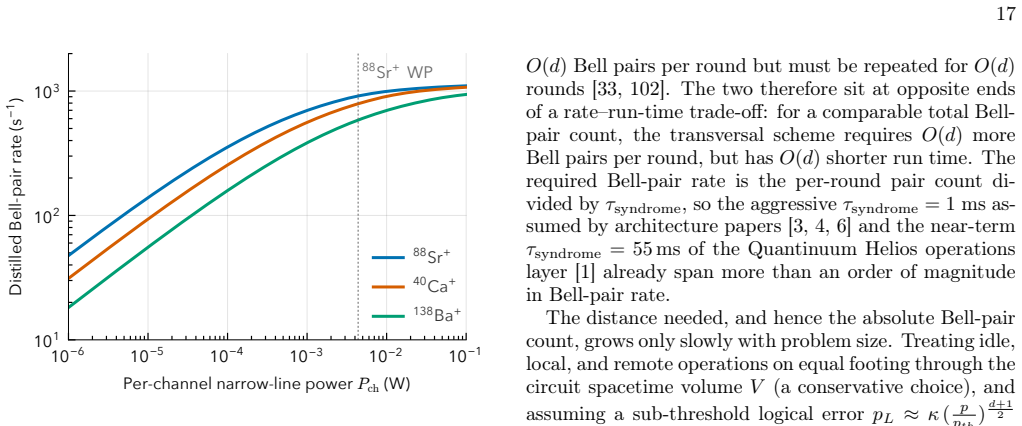
- [Sec. V-B, Fig. 2] The statement that the scheme is 'local-operation-limited' and 'robust' to collection efficiency is only true under the assumed balance of the pipelined blocks. The paper's own parameters give a Bell-pair generation block (359 µs) slower than the CNOT block (325 µs); achieving the plateau requires the Bell block to be no slower than local operations. If t_CNOT or t_detect increases by even a modest factor, the rate becomes sensitive to collection efficiency again, undermining the 'need not be the bottleneck' narrative. A robustness plot with t_CNOT/t_detect variations would clarify this.
minor comments (4)
- [General] The preprint has several OCR/formatting errors, including 'distance<8m' (should be 'distance < 8 m'), 'M 2 log2 M' formatting in Table V, the axis label '±Á = ¼' in Fig. 10, and garbled sub/superscripts throughout. These should be corrected in the final version.
- [Fig. 2] The legend 'pd = 0:5% / pd /p2 d' is difficult to read; please relabel the curves clearly (e.g., 'SE, raw', 'SE, distilled', 'SE, distilled, finite local ops').
- [App. A2c / Sec. V-B] The 'Monte-Carlo-modeled 13.3% buffer-starvation skip fraction' is quoted as a number but the underlying simulation is not described. A brief definition of the model and its assumptions would aid reproducibility.
- [App. B] The notation 're E[e^{iδφ}|δt]' should be 'Re E[...]', and the definition of S_φ(f) as a 'white-frequency-noise' Wiener process is slightly confusing; please clarify the noise-model terminology.
Circularity Check
No construction-level circularity: the rate/fidelity numbers are a parameterized engineering projection, not a derivation from its own outputs; the main caveats are the acknowledged undemonstrated 408 nm switch and load-bearing self-cited photonics inputs, which are feasibility risks rather than circular reductions.
full rationale
The central claim is a projection built from independent component parameters (Table III), not a definitional tautology. Per-channel rate 858 s^-1 follows from p_herald = 0.18%, p_distill = 0.32, and the pipelined cycle time in Eq. (4); the 10^5 s^-1 cm^-2 density is that rate divided by the 0.84 mm^2 per-channel area. Fidelity Table II is a sum of separately estimated error terms: phase 0.007% from an assumed link phase noise sigma_delta_phi < 0.02 rad, motional 0.002% from a recoil-correction calculation, polarization 0.006% from an assumed epsilon_2 <= 0.05%, and false herald 0.024% from two detectors with R_dc = 7 s^-1 (p_false ~ 2e-4, infidelity ~ 6 p_e p_false). No term is inverted from the 0.1% target, so the 99.96% result is not a fitted-input-called-prediction. The most serious caveat is explicit in Sec. VI C: the parallel all-to-all version requires 'the high-extinction ratio, fast switch at 408 nm', whose closest demonstrated device has '>10 dB extinction ratio at 420 nm'; the fidelity budget for the active network assumes 'high-extinction switches' rather than deriving the required extinction from measured devices. That is a genuine feasibility/validity gap for the headline parallel-connectivity claim, but it is a missing-component assumption, not a circular reduction: the paper does not define the switch extinction in terms of the target fidelity, and it flags the limitation. Self-citations [30,43,31] provide the -19 dB collection budget and recoil-correction analysis; these are load-bearing inputs, but they are prior technical results with stated assumptions, not definitions of the current output, so they do not make the derivation circular. Overall, no step of the derivation chain is equivalent by construction to its inputs; score 2 reflects the reliance on self-cited designs and the acknowledged switch gap, not circularity.
Axiom & Free-Parameter Ledger
free parameters (13)
- pe (SE excitation probability) =
0.198
- pd (end-to-end photon detection probability) =
0.005
- σδϕ (link phase uncertainty) =
0.02 rad
- tπ (narrow-line pi time) =
75 ns
- ε2 (sigma-/pi intensity ratio) =
0.05%
- ν (trap frequency) =
2π×2 MHz
- Nbuf (buffer capacity) =
4
- tdetect (fluorescence detection time) =
100 µs
- tCNOT (local CNOT duration) =
225 µs
- tshuttle (per-handoff shuttle time) =
100 µs
- dzone (QCCD zone side length) =
375 µm
- Rdc (dark-count rate) =
7 s^-1
- nbar (thermal motional occupation) =
10
axioms (8)
- domain assumption Single-photon Cabrillo-Cirac scheme produces the density matrix (1) with a spin-dependent kick structure.
- domain assumption The post-herald spin-dependent displacement exactly reverses the photon-recoil displacement for impulsive plane-wave emission, and approximately for NA=0.4.
- standard math The Bennett/Campbell-Benjamin distillation circuit projects a raw pair into |Ψ+> with probability (1/2)(1-chi^2)(1-pe)^2.
- domain assumption Phase noise on 10 m fiber patch cords has the reported laboratory spectral density and is Gaussian/Wiener.
- domain assumption The entanglement attempts and heralds are not commensurate with motional mode frequencies, so recoil heating is incoherent and bounded by ~1 quantum.
- domain assumption All local operations (CNOT, shuttle, readout, buffer swap) are error-free in the fidelity budget; the remaining error sources are only those listed in Table II.
- domain assumption Polarization impurity ε2 on the second excitation is the dominant 'return to |0>' pathway; pulse shaping and ~20 G field suppress off-resonant excitation.
- domain assumption The photonic switch network (or passive multiport) achieves the assumed crosstalk/dark-count properties; for the active network, the required fast high-extinction 408 nm switch exceeds demonstrated performance.
invented entities (1)
-
None
no independent evidence
Cite this review
Pith. "Pith review of Remote entanglement need not be the bottleneck for modular trapped-ion quantum computing." pith.science (2026). https://pith.science/paper/3SH6Q7KP
@misc{pith2026260718387,
  author       = {Pith},
  title        = {Pith review of: Remote entanglement need not be the bottleneck for modular trapped-ion quantum computing},
  year         = {2026},
  howpublished = {\url{https://pith.science/paper/3SH6Q7KP}},
  note         = {Machine review of arXiv:2607.18387}
}
read the original abstract
Modularity underpins classical computing; as quantum processors encounter limits on fabrication yield, reliability, and size, they will also need it acutely. The bottleneck to linking modules is producing shared entanglement at sufficient rate, density, and fidelity. Trapped ions hold the best demonstrated photonic links, yet they rely on bulky collection optics that cap how densely links can be packed, and remote entanglement operations trail local gates by two orders of magnitude in rate and fidelity. We synthesize several enabling results $\unicode{x2014}$ single-photon heralding, coherent recoil correction, projective distillation, and trap-integrated photonics $\unicode{x2014}$ into one comprehensive architecture that substantially narrows this gap. Single-photon heralding leads to linear scaling of success probability with detection efficiency, allowing compact integrated photonics to saturate the entanglement rate at a local-operation limit in dense, easy-to-parallelize channels. Addressing its inherent error mechanisms at their source, we project a Bell-pair fidelity of 99.9% at rates and densities compatible with fault-tolerant operations. Remote entanglement then need not remain the bottleneck for modular trapped-ion computing; the limit shifts to the local operations that must improve regardless.
Figures


Reference graph
Works this paper leans on
-
[1]
Cooling in buffer Classical control lines Bell measurement Photon routing Heralding and feedforward Photonic switch Trapped ion Diffraction grating Single-mode waveguide Surface-electrode ion trap
-
[2]
Bell pair buffer Channel 1 Channel 2 Channel 4 Channel 3
-
[3]
P. Webster, L. Berent, O. Chandra, E. T. Hockings, N. Baspin, F. Thomsen, S. C. Smith, and L. Z. Cohen, The pinnacle architecture: Reducing the cost of break- ing RSA-2048 to 100000 physical qubits using quantum LDPC codes (2026), arXiv:2602.11457 [quant-ph]
Pith/arXiv arXiv 2048
-
[4]
Figure 7 shows a graphical representation of the loop timing
Inner entanglement generation loop Eachentanglementattemptconsistsofafixedsequence of state preparation, excitation of|0 g⟩with probability pe, and decision branching. Figure 7 shows a graphical representation of the loop timing. a. State preparation At the start – when an ion first enters the entangle- ment loop, or after a previous unsuccessful iteratio...
-
[5]
Decision/ transport FIG. 5. Remote entanglement generation architecture. Each quantum processing unit (QPU) is a module consisting of a microfabricated surface-electrode trap with integrated optics. The Bell factory produces and distills remote Bell pairs for intermodule operations. The photonic links consist of single-mode waveguides and fibers. A switch...
-
[6]
2 = I¾ ¡ =I¼ 10−5 10−4 10−3 10−2 Distilled-pair infidelity 1 ¡ F F = 99.9% F = 99.99% 1 ¡F /
Outer correction loop In the correction loop, we apply error mitigation tech- niques outside the latency-critical entanglement attempt path, merge the two raw Bell pairs to suppress errors through distillation, and deliver successfully entangled qubits to the rest of the processor while re-using the rest of the ions for subsequent rounds. To optimize thro...
2048
-
[7]
Ransfordet al., Nature655, 81 (2026)
A. Ransfordet al., Nature655, 81 (2026)
2026
-
[8]
C. Gidney, How to factor 2048 bit RSA integers with lessthanamillionnoisyqubits(2025),arXiv:2505.15917 [quant-ph]
Pith/arXiv arXiv 2048
-
[9]
M. Cain, Q. Xu, R. King, L. R. B. Picard, H. Levine, M. Endres, J. Preskill, H.-Y. Huang, and D. Blu- vstein, Shor’s algorithm is possible with as few as 10,000 reconfigurable atomic qubits (2026), arXiv:2603.28627 [quant-ph]
Pith/arXiv arXiv 2026
-
[10]
F. Tripier, W. C. Chung, J. Young, S. Alam, B. Bjork, A. Brodutch, F. L. Buessen, N. J. Coble, T. Del- laert, D. Maslov, M. Roetteler, E. Tham, M. Webster, M. Ye, J. Gamble, A. Maksymov, J. P. Marceaux, and N. Delfosse, Fault-tolerant quantum computing with trapped ions: The walking cat architecture (2026), arXiv:2604.19481 [quant-ph]
Pith/arXiv arXiv 2026
-
[11]
H. Zhou, C. Duckering, C. Zhao, D. Bluvstein, M. Cain, A. Kubica, S.-T. Wang, and M. D. Lukin, inProceedings of the 52nd Annual International Symposium on Com- puter Architecture (ISCA ’25)(ACM, Tokyo, Japan, 2025)
2025
-
[12]
Schwab, and C
D.Stick, W.K.Hensinger, S.Olmschenk, M.J.Madsen, K. Schwab, and C. Monroe, Nat. Phys.2, 36 (2006)
2006
-
[13]
K. R. Brown, J. Chiaverini, J. M. Sage, and H. Häffner, Nat. Rev. Mater.6, 892 (2021)
2021
-
[14]
Malinowski, D
M. Malinowski, D. T. C. Allcock, and C. J. Ballance, PRX Quantum4, 040313 (2023)
2023
-
[15]
Lekitsch, S
B. Lekitsch, S. Weidt, A. G. Fowler, K. Mølmer, S. J. Devitt, C. Wunderlich, and W. K. Hensinger, Science Advances3, e1601540 (2017)
2017
-
[16]
Bermudez, X
A. Bermudez, X. Xu, R. Nigmatullin, J. O’Gorman, V. Negnevitsky, P. Schindler, T. Monz, U. G. Poschinger, C. Hempel, J. Home, F. Schmidt-Kaler, M.Biercuk, R.Blatt, S.Benjamin,andM.Müller,Phys. Rev. X7, 041061 (2017)
2017
-
[17]
E. Tham, M. Ye, I. Khait, J. Gamble, and N. Delfosse, Distributedfault-tolerantquantummemoriesovera2×l array of qubit modules (2025), arXiv:2508.01879 [quant- ph]
Pith/arXiv arXiv 2025
-
[18]
D.L.Moehring, P.Maunz, S.Olmschenk, K.C.Younge, D. N. Matsukevich, L.-M. Duan, and C. Monroe, Nature 449, 68 (2007)
2007
-
[19]
Hucul, I
D. Hucul, I. V. Inlek, G. Vittorini, C. Crocker, S. Deb- nath, S. M. Clark, and C. Monroe, Nat. Phys.11, 37 (2015)
2015
-
[20]
S. Saha, M. Shalaev, J. O’Reilly, I. Goetting, G. Toh, A. Kalakuntla, Y. Yu, and C. Monroe, Nature Commu- nications16, 2533 (2025)
2025
-
[21]
D. Main, P. Drmota, D. P. Nadlinger, E. M. Ainley, A. Agrawal, B. C. Nichol, R. Srinivas, G. Araneda, and D. M. Lucas, Nature638, 383 (2025)
2025
-
[22]
O’Reilly, G
J. O’Reilly, G. Toh, I. Goetting, S. Saha, M. Sha- laev, A. L. Carter, A. Risinger, A. Kalakuntla, T. Li, A. Verma, and C. Monroe, Phys. Rev. Lett.133, 090802 (2024)
2024
-
[23]
A. C. Hughes, R. Srinivas, C. M. Löschnauer, H. M. Knaack, R. Matt, C. J. Ballance, M. Malinowski, T. P. Harty, and R. T. Sutherland, Trapped-ion two-qubit gates with>99.99%fidelity without ground-state cool- ing (2025), arXiv:2510.17286 [quant-ph]
arXiv 2025
-
[24]
S. D. Barrett and P. Kok, Phys. Rev. A71, 060310(R) (2005)
2005
-
[25]
Simon and W
C. Simon and W. T. M. Irvine, Phys. Rev. Lett.91, 110405 (2003)
2003
-
[26]
Krutyanskiy, M
V. Krutyanskiy, M. Galli, V. Krcmarsky, S. Baier, D. A. Fioretto, Y. Pu, A. Mazloom, P. Sekatski, M. Canteri, M. Teller, J. Schupp, J. Bate, M. Meraner, N. San- gouard, B. P. Lanyon, and T. E. Northup, Phys. Rev. Lett.130, 050803 (2023)
2023
-
[27]
E. Novakoski and J. Kim, Design tradeoffs in photon- ically linked qubit networks (2025), arXiv:2506.06268 [quant-ph]
Pith/arXiv arXiv 2025
-
[28]
Sutcliffe, B
E. Sutcliffe, B. Jonnadula, C. Le Gall, A. E. Moylett, and C. M. Westoby, in2025 IEEE International Confer- ence on Quantum Computing and Engineering (QCE) (2025)
2025
-
[29]
A. L. Carter, J. O’Reilly, G. Toh, S. Saha, M. Sha- laev, I. Goetting, and C. Monroe, Rev. Sci. Instrum. 95, 033201 (2024)
2024
-
[30]
S. Kikura, K. Tanji, A. Goban, and S. Sunami, Passive quantum interconnects: multiplexed remote entangle- ment generation with cavity-assisted photon scattering (2026), arXiv:2507.01229 [quant-ph]
Pith/arXiv arXiv 2026
-
[31]
C. H. Bennett, G. Brassard, S. Popescu, B. Schumacher, J. A. Smolin, and W. K. Wootters, Phys. Rev. Lett.76, 722 (1996)
1996
-
[32]
Reichle, D
R. Reichle, D. Leibfried, E. Knill, J. Britton, R. B. Blakestad, J. D. Jost, C. Langer, R. Ozeri, S. Seidelin, and D. J. Wineland, Nature443, 838 (2006)
2006
-
[33]
Nigmatullin, C
R. Nigmatullin, C. J. Ballance, N. de Beaudrap, and S. C. Benjamin, New J. Phys.18, 103028 (2016)
2016
-
[34]
Cabrillo, J
C. Cabrillo, J. I. Cirac, P. García-Fernández, and P. Zoller, Phys. Rev. A59, 1025 (1999)
1999
-
[35]
F. W. Knollmann, E. Clements, P. T. Callahan, M. Gehl, J. D. Hunker, T. Mahony, R. McConnell, R. Swint, C. Sorace-Agaskar, I. L. Chuang, J. Chi- averini, and D. Stick, Optica Quantum2, 230 (2024)
2024
-
[36]
Apolín and D
J. Apolín and D. P. Nadlinger, PRX Quantum7, 010326 (2026)
2026
-
[37]
E. T. Campbell and S. C. Benjamin, Phys. Rev. Lett. 101, 130502 (2008)
2008
-
[38]
Swaroop, T
E. Swaroop, T. Jochym-O’Connor, and T. J. Yoder, PRX Quantum7, 010324 (2026)
2026
-
[39]
Kielpinski, C
D. Kielpinski, C. Monroe, and D. J. Wineland, Nature 417, 709 (2002)
2002
-
[40]
Chiaverini, R
J. Chiaverini, R. B. Blakestad, J. Britton, J. D. Jost, C. Langer, D. Leibfried, R. Ozeri, and D. J. Wineland, Quantum Inf. Comput.5, 419 (2005)
2005
-
[41]
K. K. Mehta and R. J. Ram, Scientific Reports7, 2019 (2017)
2019
-
[42]
Monroe, R
C. Monroe, R. Raussendorf, A. Ruthven, K. R. Brown, P. Maunz, L.-M. Duan, and J. Kim, Phys. Rev. A89, 022317 (2014)
2014
-
[43]
Duan and C
L.-M. Duan and C. Monroe, Rev. Mod. Phys.82, 1209 (2010)
2010
-
[44]
Monroe and J
C. Monroe and J. Kim, Science339, 1164 (2013)
2013
-
[45]
Liu, Y.-B
W.-Z. Liu, Y.-B. Zhou, J.-P. Chen, B. Wang, A. Teng, 19 X.-W. Han, G.-C. Liu, Z.-J. Zhang, Y. Yang, F.-G. Liu, C.-H. Xue, B.-W. Yang, J. Yang, C. Zeng, D.-R. Pan, M.-Y. Zheng, X. Zhang, S. Cao, Y.-Z. Zhen, Y. Xiao, H.Li, L.You, X.Ma, Q.Zhao, F.Xu, Y.Wang, Y.Wan, Q. Zhang, and J.-W. Pan, Nature652, 51 (2026)
2026
-
[46]
Slodička, G
L. Slodička, G. Hétet, N. Röck, P. Schindler, M. Hen- nrich, and R. Blatt, Phys. Rev. Lett.110, 083603 (2013)
2013
-
[47]
N. Kalb, A. A. Reiserer, P. C. Humphreys, J. J. W. Bak- ermans, S. J. Kamerling, N. H. Nickerson, S. C. Ben- jamin, D. J. Twitchen, M. Markham, and R. Hanson, Science356, 928 (2017)
2017
-
[48]
F. W. Knollmann, S. M. Corsetti, E. R. Clements, R. Swint, A. D. Leu, M. E. Kim, P. T. Callahan, D. Kharas, T. Mahony, C. Sorace-Agaskar, R. Mc- Connell, C. D. Bruzewicz, I. L. Chuang, J. Notaros, and J. Chiaverini, Light: Science & Applications15, 95 (2026)
2026
-
[49]
E. M. Ainley, A. Agrawal, D. Main, P. Drmota, D. P. Nadlinger, B. C. Nichol, R. Srinivas, and G. Araneda, Multipartite entanglement for multi-node quantum net- works (2024), arXiv:2408.00149 [quant-ph]
Pith/arXiv arXiv 2024
-
[50]
D.Assumpcao, D.Renaud, A.Baradari, B.Zeng, C.De- Eknamkul, C. J. Xin, A. Shams-Ansari, D. Barton, B. Machielse, and M. Lončar, Nature Communications 15, 10459 (2024)
2024
-
[51]
M. Dong, G. Clark, A. J. Leenheer, M. Zimmermann, D. Dominguez, A. J. Menssen, D. Heim, G. Gilbert, D. Englund, and M. Eichenfield, Nature Photonics16, 59 (2022)
2022
-
[52]
M. Momenzadeh, K. Sun, Q. Wu, B. You, Y.-L. Tang, H. Häffner, and M. R. Shcherbakov, Scalable trapped ion addressing with adjoint-optimized multimode pho- tonic circuits (2025), arXiv:2505.08997 [physics.optics]
Pith/arXiv arXiv 2025
-
[53]
L. J. Stephenson, D. P. Nadlinger, B. C. Nichol, S. An, P. Drmota, T. G. Ballance, K. Thirumalai, J. F. Good- win, D. M. Lucas, and C. J. Ballance, Phys. Rev. Lett. 124, 110501 (2020)
2020
-
[54]
R. D. Delaney, L. R. Sletten, M. J. Cich, B. Estey, M. I. Fabrikant, D. Hayes, I. M. Hoffman, J. Hostetter, C. Langer, S. A. Moses, A. R. Perry, T. A. Peterson, A. Schaffer, C. Volin, G. Vittorini, and W. C. Burton, Phys. Rev. X14, 041028 (2024)
2024
-
[55]
G.-C. Liu, C.-H. Xue, F.-X. Chen, M.-Y. Zheng, Y. Yang, L.-B. Li, B. Wang, B.-W. Yang, H.-F. Jiang, Y. Wan, Y. Wang, J.-P. Chen, Q. Zhang, and J.-W. Pan, Bayesian phase stabilization at the shot-noise limit for scalable quantum networks (2026), arXiv:2604.21388 [quant-ph]
Pith/arXiv arXiv 2026
-
[56]
Minář, H
J. Minář, H. de Riedmatten, C. Simon, H. Zbinden, and N. Gisin, Phys. Rev. A77, 052325 (2008)
2008
-
[57]
Grosche, O
G. Grosche, O. Terra, K. Predehl, R. Holzwarth, B. Lip- phardt, F. Vogt, U. Sterr, and H. Schnatz, Opt. Lett. 34, 2270 (2009)
2009
-
[58]
Crocker, M
C. Crocker, M. Lichtman, K. Sosnova, A. Carter, S. Scarano, and C. Monroe, Optics Express27, 28143 (2019)
2019
-
[59]
E. E. Wollman, V. B. Verma, A. D. Beyer, R. M. Briggs, B. Korzh, J. P. Allmaras, F. Marsili, A. E. Lita, R. P. Mirin, S. W. Nam, and M. D. Shaw, Optics Express25, 26792 (2017)
2017
-
[60]
E. H. Pinnington, R. W. Berends, and M. Lumsden, J. Phys. B: At. Mol. Opt. Phys.28, 2095 (1995)
2095
-
[61]
Zhang, M
H. Zhang, M. Gutierrez, G. H. Low, R. Rines, J. Stuart, T. Wu, and I. Chuang, New J. Phys.18, 123021 (2016)
2016
-
[62]
J. P. Gaebler, C. H. Baldwin, S. A. Moses, J. M. Dreil- ing, C. Figgatt, M. Foss-Feig, D. Hayes, and J. M. Pino, Phys. Rev. A104, 062440 (2021)
2021
-
[63]
L.-M. Duan, M. D. Lukin, J. I. Cirac, and P. Zoller, Nature414, 413 (2001)
2001
-
[64]
M. K. Bhaskar, R. Riedinger, B. Machielse, D. S. Levo- nian, C. T. Nguyen, E. N. Knall, H. Park, D. Englund, M. Lončar, D. D. Sukachev, and M. D. Lukin, Nature 580, 60 (2020)
2020
-
[65]
H. Lim, J. E. Fröch, C. M. Pluchar, A. Majumdar, and S. L. Mouradian, ACS Photonics13, 2052 (2026)
2052
-
[66]
I. V. Inlek, C. Crocker, M. Lichtman, K. Sosnova, and C. Monroe, Phys. Rev. Lett.118, 250502 (2017)
2017
-
[67]
C. N. Gilbreth, D. Filin, M. S. Safronova, G. Lao, and E.R.Hudson,Yttriumionasaplatformforquantumin- formation processing (2026), arXiv:2604.16274 [quant- ph]
Pith/arXiv arXiv 2026
-
[68]
Petrosyan, F
D. Petrosyan, F. Motzoi, M. Saffman, and K. Mølmer, Phys. Rev. A96, 042306 (2017)
2017
-
[69]
Pagano, S
A. Pagano, S. Weber, D. Jaschke, T. Pfau, F. Meinert, S. Montangero, and H. P. Büchler, Phys. Rev. Research 4, 033019 (2022)
2022
-
[70]
Hölzl, A
C. Hölzl, A. Götzelmann, E. Pultinevicius, M. Wirth, and F. Meinert, Phys. Rev. X14, 021024 (2024)
2024
-
[71]
Li and J
Y. Li and J. D. Thompson, PRX Quantum5, 020363 (2024)
2024
-
[72]
C. D. Bruzewicz, J. Chiaverini, R. McConnell, and J. M. Sage, Appl. Phys. Rev.6, 021314 (2019)
2019
-
[73]
Moodyet al., J
G. Moodyet al., J. Phys. Photonics4, 012501 (2022)
2022
-
[74]
S. A. Tabatabaei Mashayekh,Visible wavelength pho- tonic integrated circuits for life science applications, Ph.D. thesis, RWTH Aachen University (2023)
2023
-
[75]
C. W. Hogle, D. Dominguez, M. Dong, A. Leenheer, H. J. McGuinness, B. P. Ruzic, M. Eichenfield, and D. Stick, npj Quantum Information9, 74 (2023)
2023
-
[76]
Z. A. Castillo, R. Shugayev, D. Dominguez, M. Gehl, N. Karl, A. Leenheer, B. Little, Y.-Y. Jau, and M. Eichenfield, Optica Quantum4, 114 (2026)
2026
-
[77]
J. Kwon, W. J. Setzer, M. Gehl, N. Karl, J. Van Der Wall, R. Law, M. G. Blain, D. Stick, and H. J. McGuinness, Nature Communications15, 3709 (2024)
2024
-
[78]
C. Lin, M. Kiewiet, R. R. Petit, J. Dendooven, N. Le Thomas, C. Detavernier, and B. Kuyken, Journal of Lightwave Technology43, 7265 (2025)
2025
-
[79]
Y. Du, X. Ji, W. Xie, Y. He, Y. Zhang, M. Tian, and Y. Su, Advanced Materials Technologies9, 2400196 (2024)
2024
-
[80]
R. Munoz, P. Nuschke, T. Meiners, B. Kaune, and C. Ospelkaus, A framework for the benchmark- ing of transport-induced excitations in shuttling-based ion-trap quantum processors (2026), arXiv:2605.25118 [quant-ph]
Pith/arXiv arXiv 2026
discussion (0)
Sign in with ORCID, Apple, or X to comment. Anyone can read and Pith papers without signing in.