Low-Complexity Hybrid Precoding for Cell-Free Massive MU-MIMO ISAC Systems
Pith reviewed 2026-06-27 03:11 UTC · model grok-4.3
The pith
Hybrid precoding compresses high-dimensional channels to low-dimensional effective ones, cutting fronthaul and baseband complexity in cell-free massive MU-MIMO ISAC while maximizing ergodic sum-rate under position error bound constraints.
A machine-rendered reading of the paper's core claim, the machinery that carries it, and where it could break.
Core claim
By applying hybrid architecture at the access points, the original high-dimensional channel information is converted into a low-dimensional effective channel, enabling digital precoding over the compressed channel domain and thereby substantially reducing both fronthaul overhead and baseband computational complexity. The joint hybrid precoding design is formulated as an ergodic sum-rate maximization problem with position error bound constraints; an efficient alternating optimization solver reformulates the position error bound constraint into tractable convex constraints, carries out digital-domain optimization over the reduced-dimensional effective channel, and refines analog precoding on t
What carries the argument
The alternating optimization solver that reformulates position error bound constraints into tractable convex constraints while performing digital precoding over the reduced-dimensional effective channel and analog precoding on the constant-modulus manifold.
If this is right
- High ergodic sum-rate is achieved simultaneously with accurate multi-target sensing.
- Computational complexity drops by 87.02 percent relative to conventional baselines.
- Fronthaul overhead is substantially lowered because only the low-dimensional effective channel needs to be exchanged.
- Dynamic user topologies are handled efficiently by recursive MMSE-THP updates that avoid full matrix recomputation.
Where Pith is reading between the lines
- The channel-compression step could make cell-free ISAC deployments feasible in bandwidth-limited fronthaul networks where full CSI exchange is prohibitive.
- The convex PEB reformulation may generalize to other sensing metrics that admit similar tractable bounds.
- Recursive precoder updates suggest the scheme could support higher mobility scenarios than full-recomputation methods.
Load-bearing premise
The position error bound constraint can be reformulated into tractable convex constraints while preserving the required multi-target sensing accuracy, and the partially-connected hybrid architecture at distributed access points is feasible without significant performance loss.
What would settle it
A simulation or hardware test in which the convex reformulation of the position error bound produces actual multi-target localization errors that exceed the design target, or in which the measured baseband-plus-fronthaul complexity reduction falls well below 87 percent under realistic channel conditions.
Figures

read the original abstract
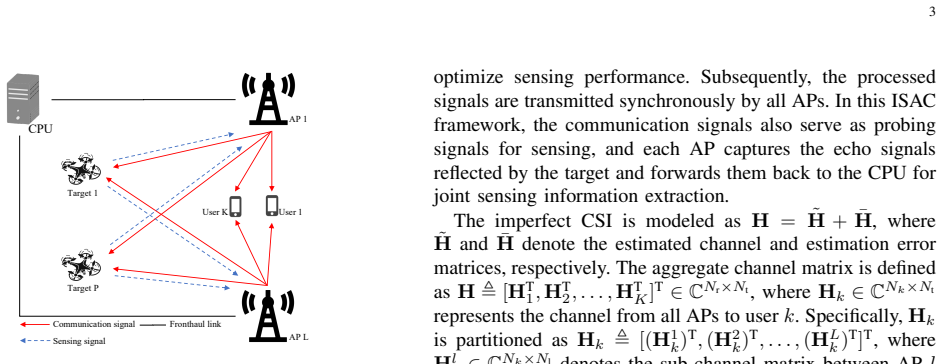
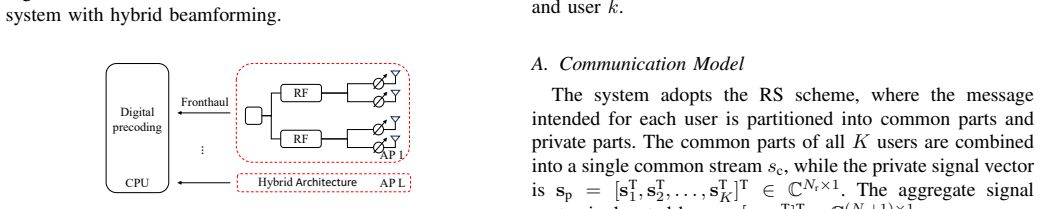
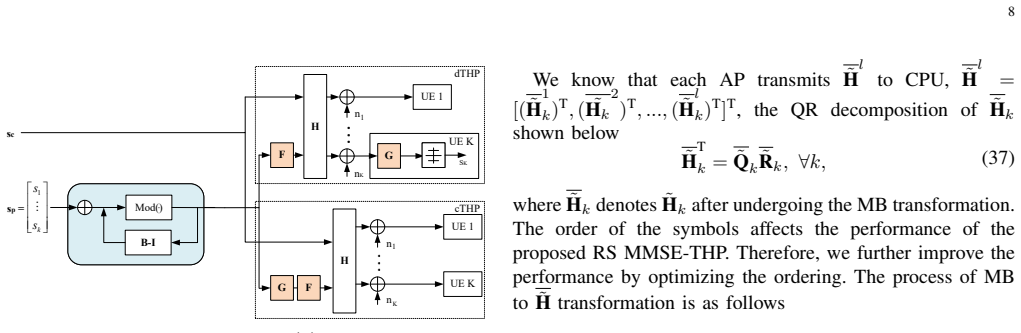
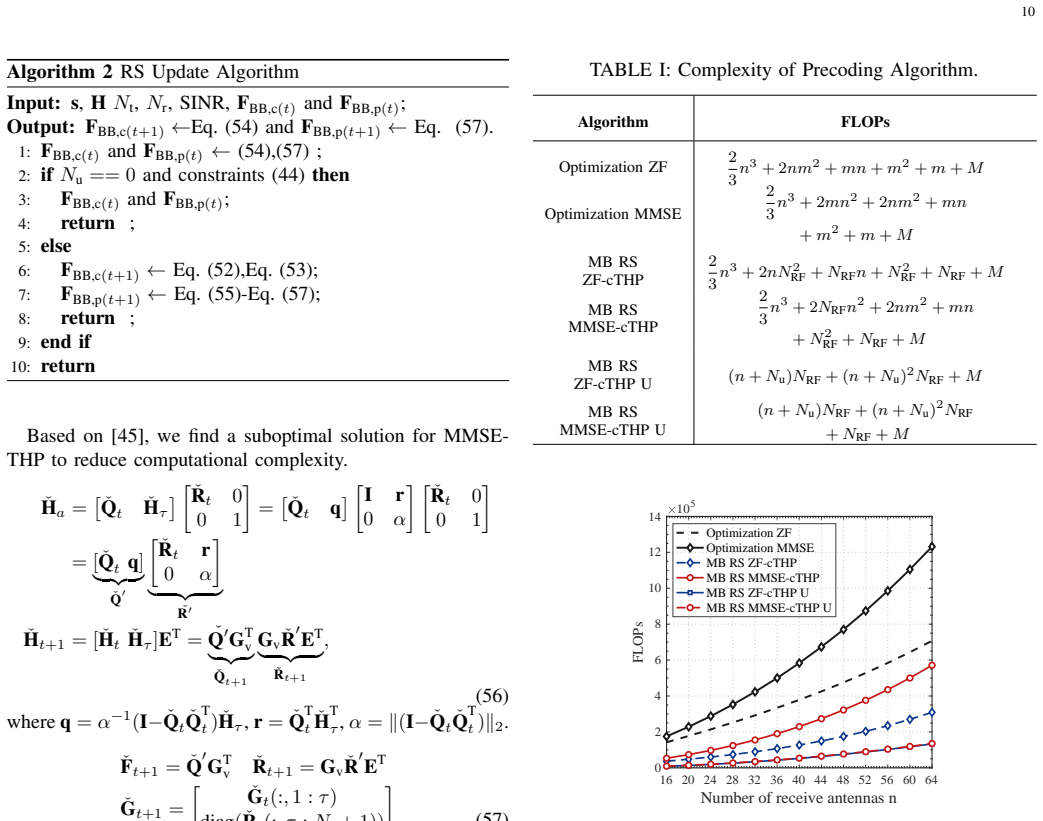
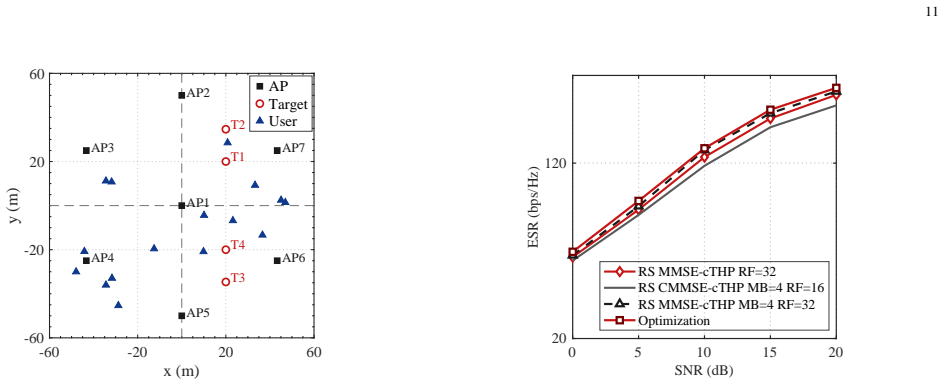
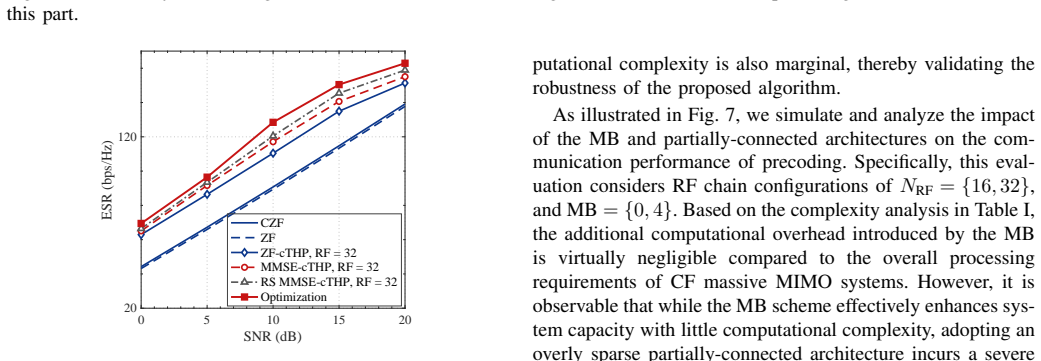
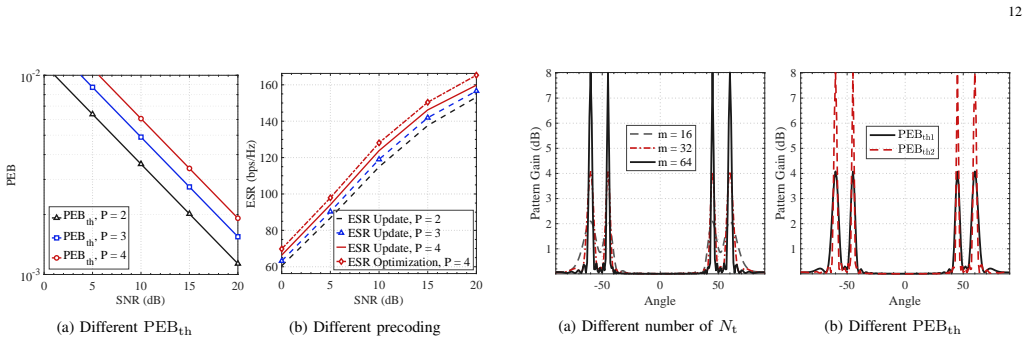
Integrated sensing and communication (ISAC) in cell-free (CF) massive multi-user multiple-input multiple-output (MU-MIMO) system is a promising architecture for high-rate communications and high-accuracy multi-target sensing. However, centralized coordination among distributed access points (APs) incurs substantial fronthaul overhead and computation complexity. This paper proposes a low-complexity hybrid precoding framework for CF massive MU-MIMO ISAC systems with partially-connected architectures at the APs. By applying hybrid architecture at the APs, the proposed framework converts the original high-dimensional channel information into a low-dimensional effective channel, enabling digital precoding over the compressed channel domain and thereby substantially reducing both fronthaul overhead and baseband computational complexity. We formulate the joint hybrid precoding design as an ergodic sum-rate (ESR) maximization problem with position error bound (PEB) constraints to ensure multi-target sensing accuracy. An efficient alternating optimization (AO)-based solver is then developed, where the PEB constraint is reformulated into tractable convex constraints, while the digital-domain optimization is carried out over the reduced-dimensional effective channel and the analog precoding is refined on the constant-modulus manifold. For dynamic user topology, we further propose multi-branch (MB) rate-splitting (RS) minimum mean-square-error Tomlinson-Harashima precoding (MMSE-THP) update algorithm that combines multi-branch ordering with recursive MMSE-THP matrix updates, enabling common and private digital precodings to be refreshed without repeated full matrix recomputation. Simulation results demonstrate that the proposed scheme achieves high ESR and accurate multi-target sensing while reducing computational complexity by 87.02\% compared with conventional baselines.
Editorial analysis
A structured set of objections, weighed in public.
Referee Report
Summary. The paper proposes a low-complexity hybrid precoding framework for cell-free massive MU-MIMO ISAC systems employing partially-connected architectures at distributed APs. It formulates an ergodic sum-rate (ESR) maximization problem subject to position error bound (PEB) constraints for multi-target sensing accuracy, develops an alternating optimization (AO) solver that reformulates the PEB constraint into tractable convex forms and performs digital precoding over a reduced-dimensional effective channel with analog precoding on the constant-modulus manifold, and introduces a multi-branch rate-splitting MMSE-THP algorithm for dynamic user topologies. Simulations are reported to achieve high ESR, accurate sensing, and an 87.02% complexity reduction versus baselines.
Significance. If the central claims hold, the work would be significant for enabling practical ISAC deployment in cell-free systems by addressing fronthaul and computational overhead through hybrid architectures and dimensionality reduction. The combination of manifold optimization, recursive MMSE-THP updates, and convex PEB reformulation offers a concrete algorithmic path that could scale to distributed massive MIMO ISAC; the reported complexity reduction is a clear practical strength if reproducible.
major comments (2)
- [Abstract] Abstract (and AO solver description): the claim that the PEB constraint is reformulated into tractable convex constraints while preserving multi-target sensing accuracy lacks an equivalence proof, error bounds, or post-optimization validation that the achieved PEB meets the original target. This step is load-bearing for the central claim of 'accurate multi-target sensing' alongside the ESR and complexity results.
- [Abstract] Simulation results paragraph: the reported 87.02% complexity reduction and 'accurate multi-target sensing' are stated without error bars, dataset details, or explicit verification that the convex reformulation does not relax the original PEB constraint, making it impossible to assess whether the sensing half of the headline claim is robust.
minor comments (2)
- [Abstract] The abstract mentions 'partially-connected architectures at the APs' and 'multi-branch (MB) rate-splitting (RS) minimum mean-square-error Tomlinson-Harashima precoding (MMSE-THP)' but does not define the precise partially-connected structure or the branch count in the MB algorithm; these should be clarified with diagrams or pseudocode for reproducibility.
- [Abstract] Notation for the effective channel after hybrid architecture and the manifold optimization step for analog precoding is introduced without explicit equations in the provided abstract; adding a short notation table would improve clarity.
Simulated Author's Rebuttal
We thank the referee for the constructive comments, which highlight important aspects of clarity and validation in our presentation of the PEB reformulation and simulation results. We address each major comment below and outline revisions that will strengthen the manuscript without altering its core contributions.
read point-by-point responses
-
Referee: [Abstract] Abstract (and AO solver description): the claim that the PEB constraint is reformulated into tractable convex constraints while preserving multi-target sensing accuracy lacks an equivalence proof, error bounds, or post-optimization validation that the achieved PEB meets the original target. This step is load-bearing for the central claim of 'accurate multi-target sensing' alongside the ESR and complexity results.
Authors: The abstract summarizes the approach at a high level. The PEB reformulation is derived in Section IV-B via a convex upper-bound approximation based on the trace expression of the position error bound and first-order Taylor expansion around the target locations; this yields tractable linear matrix inequalities while remaining conservative with respect to the original non-convex constraint. The manuscript does not contain a formal equivalence proof because the mapping is an approximation rather than an exact equivalence. We will revise the abstract and add a short remark in Section IV-B explicitly stating the approximation nature, together with a brief analytic bound on the relaxation gap under the assumed far-field and high-SNR regime. Post-optimization PEB values will also be tabulated in the simulation section to confirm that the achieved sensing accuracy meets the prescribed thresholds. revision: partial
-
Referee: [Abstract] Simulation results paragraph: the reported 87.02% complexity reduction and 'accurate multi-target sensing' are stated without error bars, dataset details, or explicit verification that the convex reformulation does not relax the original PEB constraint, making it impossible to assess whether the sensing half of the headline claim is robust.
Authors: We agree that the abstract omits statistical details. The 87.02% figure is obtained from flop-count analysis in Section V-C averaged over 1000 independent channel realizations; the simulations already enforce the PEB constraint after each AO iteration and report the resulting ESR and PEB values. To improve transparency we will (i) add error bars (standard deviation) to all plotted metrics, (ii) state the number of Monte-Carlo trials and the random-seed policy in the revised abstract and Section V, and (iii) include a supplementary plot comparing the original non-convex PEB against the value obtained after the convex reformulation to demonstrate that the relaxation remains tight enough to satisfy the target accuracy. revision: yes
Circularity Check
No significant circularity; algorithmic solver and simulation claims are self-contained.
full rationale
The paper presents an AO-based optimization framework that reformulates the PEB constraint into convex forms and develops a multi-branch RS MMSE-THP update procedure for dynamic topologies. No derivation step reduces by the paper's own equations to a fitted parameter renamed as a prediction, a self-definitional loop, or a load-bearing self-citation chain. Performance claims rest on external simulation comparisons to baselines rather than tautological equivalence to inputs. The framework is presented as an independent algorithmic contribution with no evidence that central results are forced by construction from prior author work or internal fits.
Axiom & Free-Parameter Ledger
Reference graph
Works this paper leans on
-
[1]
Decentralized Hybrid Precoding for Massive MU-MIMO ISAC,
J. Zhu, Y . Xu, D. He, H. Li, Y . Guan, and W. Zhang, “Decentralized Hybrid Precoding for Massive MU-MIMO ISAC,” inProc. IEEE Int. Conf. Commun. (ICC), 2025, pp. 3236–3242
2025
-
[2]
Integrated Sensing and Communications: Toward Dual- Functional Wireless Networks for 6G and Beyond,
F. Liu, Y . Cui, C. Masouros, J. Xu, T. X. Han, Y . C. Eldar, and S. Buzzi, “Integrated Sensing and Communications: Toward Dual- Functional Wireless Networks for 6G and Beyond,”IEEE J. Sel. Areas Commun., vol. 40, no. 6, pp. 1728–1767, 2022. 13
2022
-
[3]
Interference Management for Full-Duplex ISAC in B5G/6G Networks: Architectures, Challenges, and Solutions,
A. Tang, X. Wang, and J. A. Zhang, “Interference Management for Full-Duplex ISAC in B5G/6G Networks: Architectures, Challenges, and Solutions,”IEEE Communications Magazine, vol. 62, no. 9, pp. 20–26, 2024
2024
-
[4]
Towards 6G Networks: A Survey on Integrated Sensing and Communication in Cell- Free Massive MIMO,
M. Ahmed, A. A. Nasir, M. Masood, K. A. Memon, K. K. Qureshi, F. Khan, T. Hussain, W. U. Khan, F. Xu, and Z. Han, “Towards 6G Networks: A Survey on Integrated Sensing and Communication in Cell- Free Massive MIMO,”IEEE Internet Things J., pp. 1–1, 2026
2026
-
[5]
RSMA-Assisted Cell-Free Massive MIMO Multi-Static ISAC System With Correlated Aging Channels,
S. K. Menanor, R. Akwafo, D. K. P. Asiedu, M. Benjillali, and K.-J. Lee, “RSMA-Assisted Cell-Free Massive MIMO Multi-Static ISAC System With Correlated Aging Channels,”IEEE Trans. Veh. Technol., pp. 1–16, 2026
2026
-
[6]
Multi-Target Localization and Association in Cell-Free Massive Mimo for Multi-Static Isac,
H. Yu, H. Q. Ngo, J. He, and M. Matthaiou, “Multi-Target Localization and Association in Cell-Free Massive Mimo for Multi-Static Isac,” in Proc. IEEE Int. Conf. Commun. (ICC), 2025, pp. 6663–6668
2025
-
[7]
A GNN-Based Distributed Beamforming Design for MIMO Cell-Free ISAC Networks,
Y . Du, S. Xu, G. Chen, and J. Zhang, “A GNN-Based Distributed Beamforming Design for MIMO Cell-Free ISAC Networks,”IEEE Trans. Veh. Technol., vol. 75, no. 2, pp. 3294–3299, 2026
2026
-
[8]
Enhancement of Rural Connectivity by Recycling TV Towers with Massive MIMO Techniques,
A. E. Falou and M.-S. Alouini, “Enhancement of Rural Connectivity by Recycling TV Towers with Massive MIMO Techniques,”IEEE Communications Magazine, vol. 61, no. 4, pp. 78–83, 2023
2023
-
[9]
Communication-Sensing Region for Cell-Free Massive MIMO ISAC Systems,
W. Mao, Y . Lu, C.-Y . Chi, B. Ai, Z. Zhong, and Z. Ding, “Communication-Sensing Region for Cell-Free Massive MIMO ISAC Systems,”IEEE Trans. Wireless Commun., vol. 23, no. 9, pp. 12 396– 12 411, 2024
2024
-
[10]
ISAC for Cell-Free Massive MIMO: Cooperation and Sensing Information Fusion,
J. Ling, J. Jin, Q. Wang, X. Zhao, J. Li, Y . Hu, J. Dong, S. Lv, D. Wang, X. You, and J. Wang, “ISAC for Cell-Free Massive MIMO: Cooperation and Sensing Information Fusion,”IEEE Trans. Wireless Commun., vol. 25, pp. 13 511–13 527, 2026
2026
-
[11]
Power Allocation for Multi-Static Cooperative ISAC in Cell-Free Massive MIMO Systems,
J. Wu, Z. Sheng, P. Zhu, J. Li, and D. Wang, “Power Allocation for Multi-Static Cooperative ISAC in Cell-Free Massive MIMO Systems,” IEEE Trans. Veh. Technol., pp. 1–5, 2025
2025
-
[12]
Distributed Compression Method for Channel Calibration in Cell-Free MIMO ISAC Systems,
S. Xu, H. Sun, Y . Xu, T. Guo, C. Li, and L. Yang, “Distributed Compression Method for Channel Calibration in Cell-Free MIMO ISAC Systems,”IEEE J. Sel. Areas Commun., vol. 43, no. 7, pp. 2349–2363, 2025
2025
-
[13]
Rate-Splitting Multiple Access for Cell-Free ISAC Massive MIMO Systems,
M. R. Camana, C. E. Garcia, and I. Lee, “Rate-Splitting Multiple Access for Cell-Free ISAC Massive MIMO Systems,”IEEE Commun. Lett., vol. 29, no. 12, pp. 2860–2864, 2025
2025
-
[14]
Efficient Beam Selection for ISAC in Cell-Free Massive MIMO via Digital Twin-Assisted Deep Reinforcement Learning,
J. Zhang, S. Xu, C. Li, Y . Huang, and L. Yang, “Efficient Beam Selection for ISAC in Cell-Free Massive MIMO via Digital Twin-Assisted Deep Reinforcement Learning,”IEEE Trans. Wireless Commun., vol. 25, pp. 9875–9890, 2026
2026
-
[15]
On the Performance of ISAC in Dynamic TDD Cell-Free Massive MIMO Systems,
A. Chowdhury, S. S. Thoota, and E. G. Larsson, “On the Performance of ISAC in Dynamic TDD Cell-Free Massive MIMO Systems,” inProc. IEEE Int. Conf. Commun. (ICC), 2025, pp. 3948–3953
2025
-
[16]
Interference Management and Joint Precoding Design for Multi-Static ISAC and Full- Duplex Communication Cell-Free Systems,
X. Sun, J. Li, G. Chen, D. Wang, P. Zhu, and X. You, “Interference Management and Joint Precoding Design for Multi-Static ISAC and Full- Duplex Communication Cell-Free Systems,”IEEE Trans. Commun., vol. 73, no. 10, pp. 9798–9814, 2025
2025
-
[17]
Secure Spatial Signal Design for ISAC in a Cell-Free MIMO Network,
S. Rivetti, E. Bj ¨ornson, and M. Skoglund, “Secure Spatial Signal Design for ISAC in a Cell-Free MIMO Network,” inProc. IEEE Wireless Commun. Netw. Conf. (WCNC), 2024, pp. 01–06
2024
-
[18]
Scalable Cell-Free Massive MIMO- Based Integrated Sensing and Communication,
G. Femenias and F. Riera-Palou, “Scalable Cell-Free Massive MIMO- Based Integrated Sensing and Communication,”IEEE Trans. Veh. Tech- nol., vol. 74, no. 10, pp. 15 643–15 659, 2025
2025
-
[19]
On Linearly Precoded Rate Splitting for Gaussian MIMO Broadcast Channels,
Z. Li, S. Yang, and S. Shamai, “On Linearly Precoded Rate Splitting for Gaussian MIMO Broadcast Channels,”IEEE Trans. Inf. Theory, vol. 67, no. 7, pp. 4693–4709, 2021
2021
-
[20]
Precoding-Based Downlink OAM-MIMO Communications With Rate Splitting,
R. Chen, J. Lin, B. Zhang, Y . Ding, and K. Xu, “Precoding-Based Downlink OAM-MIMO Communications With Rate Splitting,”IEEE Trans. Broadcast., vol. 69, no. 4, pp. 894–903, 2023
2023
-
[21]
Scalable GNN-Based Power Allocation for Rate-Splitting Cell-Free Massive MIMO Systems
R. Wang, Y . Xu, A. Tang, X. Ou, and J. Zhu, “Scalable GNN-Based Power Allocation for Rate-Splitting Cell-Free Massive MIMO Systems,” 2026, arXiv:2606.01714
work page internal anchor Pith review Pith/arXiv arXiv 2026
-
[22]
A Hybrid VLC/RF Cell-Free Massive MIMO System,
A. Almehdhar, M. Obeed, A. Chaaban, and S. Zummo, “A Hybrid VLC/RF Cell-Free Massive MIMO System,” inProc. IEEE Int. Conf. Commun. (ICC), 2022, pp. 1871–1876
2022
-
[23]
Energy Efficiency in Cell-Free Massive MIMO with Zero-Forcing Precoding Design,
L. D. Nguyen, T. Q. Duong, H. Q. Ngo, and K. Tourki, “Energy Efficiency in Cell-Free Massive MIMO with Zero-Forcing Precoding Design,”IEEE Commun. Lett., vol. 21, no. 8, pp. 1871–1874, 2017
2017
-
[24]
Performance Analysis of Cell-Free Massive MIMO System With Limited Fronthaul Capacity and Hardware Impairments,
H. Masoumi and M. J. Emadi, “Performance Analysis of Cell-Free Massive MIMO System With Limited Fronthaul Capacity and Hardware Impairments,”IEEE Trans. Wireless Commun., vol. 19, no. 2, pp. 1038– 1053, 2020
2020
-
[25]
Cell-Free mmWave Massive MIMO Systems With Low-Capacity Fronthaul Links and Low-Resolution ADC/DACs,
I.-s. Kim, M. Bennis, and J. Choi, “Cell-Free mmWave Massive MIMO Systems With Low-Capacity Fronthaul Links and Low-Resolution ADC/DACs,”IEEE Trans. Veh. Technol., vol. 71, no. 10, pp. 10 512– 10 526, 2022
2022
-
[26]
Un- supervised Learning-Based Joint Power Control and Fronthaul Capacity Allocation in Cell-Free Massive MIMO With Hardware Impairments,
N. Rajapaksha, K. B. S. Manosha, N. Rajatheva, and M. Latva-aho, “Un- supervised Learning-Based Joint Power Control and Fronthaul Capacity Allocation in Cell-Free Massive MIMO With Hardware Impairments,” IEEE Wireless Commun. Lett., vol. 12, no. 7, pp. 1159–1163, 2023
2023
-
[27]
Joint Precoding and Fronthaul Compression for Cell-Free MIMO With Hybrid Topology,
Y . Chen, W. Xia, J. Zhang, X. Hou, K.-K. Wong, and H. Zhu, “Joint Precoding and Fronthaul Compression for Cell-Free MIMO With Hybrid Topology,”IEEE Internet Things J., vol. 12, no. 11, pp. 18 125–18 136, 2025
2025
-
[28]
Joint Precoding and Fronthaul Compres- sion for Cell-Free MIMO Downlink With Radio Stripes,
S. Jo, H. Lee, and S.-H. Park, “Joint Precoding and Fronthaul Compres- sion for Cell-Free MIMO Downlink With Radio Stripes,” inProc. IEEE Global Commun. Conf. (GLOBECOM), 2023, pp. 4945–4951
2023
-
[29]
Model-Driven Deep Learning-Based Optimization of Downlink Precoding and Fronthaul Compression in Cell-Free MIMO Systems,
Y . Chen, W. Xia, S. Cai, G. Zheng, and H. Zhu, “Model-Driven Deep Learning-Based Optimization of Downlink Precoding and Fronthaul Compression in Cell-Free MIMO Systems,”IEEE Trans. Netw. Sci. Eng., vol. 12, no. 3, pp. 1804–1817, 2025
2025
-
[30]
Partially-Connected Hybrid Beamforming Design for Integrated Sensing and Communication Sys- tems,
X. Wang, Z. Fei, J. A. Zhang, and J. Xu, “Partially-Connected Hybrid Beamforming Design for Integrated Sensing and Communication Sys- tems,”IEEE Trans. Commun., vol. 70, no. 10, pp. 6648–6660, 2022
2022
-
[31]
Low Complexity Precoding for OTFS-aided Cell-Free mMIMO ISAC System,
D. J. Das, A. Ranjan, E. Sharma, and P. Singh, “Low Complexity Precoding for OTFS-aided Cell-Free mMIMO ISAC System,” inProc. IEEE Wireless Commun. Netw. Conf. (WCNC), 2025, pp. 1–6
2025
-
[32]
Integrated Massive Communication and Target Localization in 6G Cell- Free Networks,
J. Gao, W. Zhu, S. Zhang, Y . Wu, J. Cao, G. Caire, and L. Liu, “Integrated Massive Communication and Target Localization in 6G Cell- Free Networks,”IEEE Trans. Wireless Commun., vol. 25, pp. 8498– 8515, 2026
2026
-
[33]
Multi-Static Target Detection and Power Allocation for Integrated Sensing and Communication in Cell-Free Massive MIMO,
Z. Behdad, O. T. Demir, K. W. Sung, E. Bj ¨ornson, and C. Cavdar, “Multi-Static Target Detection and Power Allocation for Integrated Sensing and Communication in Cell-Free Massive MIMO,”IEEE Trans. Wireless Commun., vol. 23, no. 9, pp. 11 580–11 596, 2024
2024
-
[34]
Joint Resource Allocation for User-Centric Cell- Free Integrated Sensing and Communication Systems,
Y . Cao and Q.-Y . Yu, “Joint Resource Allocation for User-Centric Cell- Free Integrated Sensing and Communication Systems,”IEEE Commun. Lett., vol. 27, no. 9, pp. 2338–2342, 2023
2023
-
[35]
Multi-Target Position Error Bound and Power Allocation Scheme for Cell-Free mMIMO- OTFS ISAC Systems,
Y . Fan, S. Wu, H. Wang, M. Sun, and J. Wang, “Multi-Target Position Error Bound and Power Allocation Scheme for Cell-Free mMIMO- OTFS ISAC Systems,”IEEE Commun. Lett., pp. 1908–1913, 2025
1908
-
[36]
Joint Access Points Activation and Power Allocation for Energy-efficient Cell- Free ISACoT Networks,
X. Chen, X. Wang, Y . Dou, X. Wang, Q. Sun, and J. Zhang, “Joint Access Points Activation and Power Allocation for Energy-efficient Cell- Free ISACoT Networks,”IEEE Trans. Veh. Technol., pp. 1–14, 2025
2025
-
[37]
Dedicated AP-Based Interference Cancellation in Cell-Free Massive MIMO Sys- tems: Architecture and Algorithm,
S.-M. Park, D.-Y . Kim, K.-W. Kim, J. Won, and J.-W. Lee, “Dedicated AP-Based Interference Cancellation in Cell-Free Massive MIMO Sys- tems: Architecture and Algorithm,”IEEE Trans. Veh. Technol., pp. 1–11, 2025
2025
-
[38]
Joint Power Allocation and Access Point Selection for Cell-Free Massive MIMO,
T. X. Vu, S. Chatzinotas, S. ShahbazPanahi, and B. Ottersten, “Joint Power Allocation and Access Point Selection for Cell-Free Massive MIMO,” inProc. IEEE Int. Conf. Commun. (ICC), 2020, pp. 1–6
2020
-
[39]
Transmit Beamforming Opti- mization for Cell-Free Integrated Sensing and Communication Systems,
W. Li, M. Li, M.-M. Zhao, and A. Liu, “Transmit Beamforming Opti- mization for Cell-Free Integrated Sensing and Communication Systems,” IEEE Trans. Wireless Commun., vol. 25, pp. 1062–1077, 2026
2026
-
[40]
Device-Free Localization in ISAC Networks: Performance Limits and Fisher Information-Based Cooperative Localization,
Z.-J. Wang, A. Tang, and X. Wang, “Device-Free Localization in ISAC Networks: Performance Limits and Fisher Information-Based Cooperative Localization,”IEEE J. Sel. Areas Commun., 2025
2025
-
[41]
Sum Rate Maximization With Rate-Splitting Multiple Access for Hybrid Precoding Systems,
H. Cho and J. Choi, “Sum Rate Maximization With Rate-Splitting Multiple Access for Hybrid Precoding Systems,”IEEE Transactions on Communications, vol. 73, no. 9, pp. 7874–7886, 2025
2025
-
[42]
Decentralization of Tomlinson-Harashima Precoding for MU-MIMO System,
J. Zhu, Y . Xu, G. Yi, D. He, H. Li, X. Ou, Y . Guan, and W. Zhang, “Decentralization of Tomlinson-Harashima Precoding for MU-MIMO System,” inProc. IEEE 100th Veh. Technol. Conf. (VTC-Fall), 2024, pp. 1–5
2024
-
[43]
Tomlinson-Harashima Precoded Rate-Splitting With Stream Combiners for MU-MIMO Sys- tems,
A. R. Flores, R. C. De Lamare, and B. Clerckx, “Tomlinson-Harashima Precoded Rate-Splitting With Stream Combiners for MU-MIMO Sys- tems,”IEEE Trans. Commun., vol. 69, no. 6, pp. 3833–3845, 2021
2021
-
[44]
Multi-Branch Tomlinson- Harashima Precoding Design for MU-MIMO Systems: Theory and Algorithms,
K. Zu, R. C. de Lamare, and M. Haardt, “Multi-Branch Tomlinson- Harashima Precoding Design for MU-MIMO Systems: Theory and Algorithms,”IEEE Trans. Commun., vol. 62, no. 3, pp. 939–951, 2014
2014
-
[45]
RIS- Assisted Low Complexity Precoding for Decentralized Massive MU- MIMO System,
J. Zhu, Y . Xu, T. Ma, D. He, H. Li, Y . Guan, and W. Zhang, “RIS- Assisted Low Complexity Precoding for Decentralized Massive MU- MIMO System,”IEEE Trans. Green Commun. Netw., vol. 10, pp. 881– 895, 2026
2026
discussion (0)
Sign in with ORCID, Apple, or X to comment. Anyone can read and Pith papers without signing in.