REVIEW 3 major objections 5 minor 3 cited by
GazeGaussian: High-Fidelity Gaze Redirection with 3D Gaussian Splatting
T0 review · 3 major / 5 minor · reviewed 2026-08-12 · deepseek-v4-flash
Pith's one-line read GazeGaussian, a two-stream 3D Gaussian splatting model that explicitly rotates eye Gaussians according to the target gaze direction, achieves state-of-the-art gaze redirection accuracy and rendering speed (74 FPS), outperforming existing…
desk verdict A genuine and well-engineered 3DGS gaze redirection system whose novelty is real, but whose headline speed and SOTA accuracy claims need caveats about per-input finetuning and an ETH-XGaze-trained estimator appearing on both sides of the evaluation. read the letter →
The pith
A machine-rendered reading of the paper's core claim, the machinery that carries it, and where it could break.
The reading
What carries the argument
The key mechanism is a two-stream 3D Gaussian Splatting (3DGS) model: a face-only stream deforms canonical Gaussians with MLPs conditioned on expression codes and head pose, while an eye stream introduces a Gaussian eye rotation representation that rotates eye Gaussians in canonical space according to the target gaze direction, with learned bias MLPs to absorb gaze-label noise. The transformed Gaussians from both streams are concatenated, rasterized into feature maps, and fed into an expression-guided neural renderer (EGNR) that injects subject-specific latent codes via cross-attention at the bottleneck. This explicit geometric control of the eye region is the feature that distinguishes the method from prior implicit feature-map-based approaches.
What would settle it
Evaluate redirected images from GazeGaussian and the baselines with a gaze estimator trained on a different dataset (e.g., MPIIFaceGaze or a synthetic rigged-eye dataset with known ground-truth gaze), and compare gaze angular errors; if GazeGaussian's advantage shrinks or disappears, the method is overfitting to the particular estimator used in training. Alternatively, compare the 3D rotation of the eye Gaussians against known ground-truth eye rotation from a calibrated multi-camera rig.
Extended reading notes
Core claim
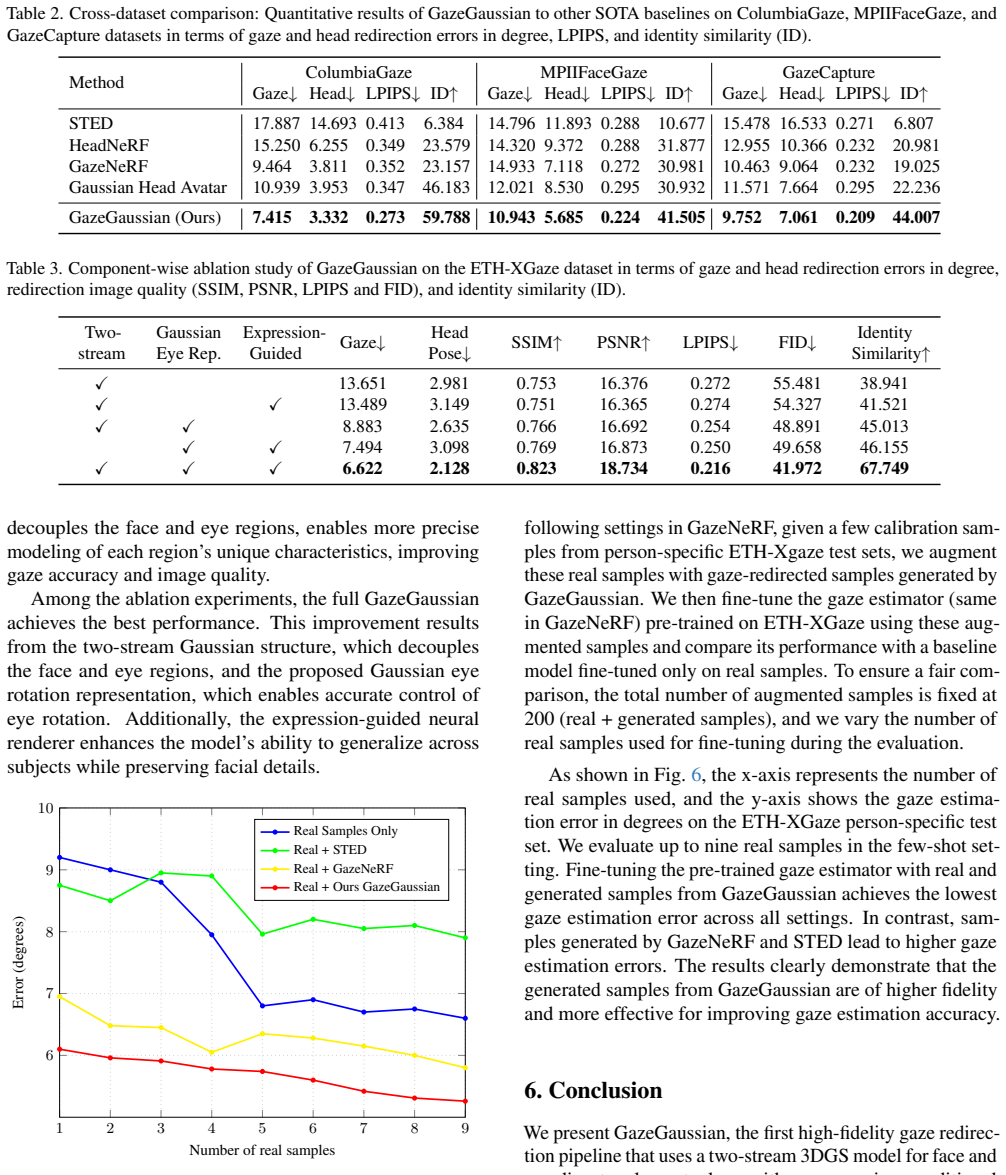
The central discovery is that decoupling the head into a face-only Gaussian stream and an eye Gaussian stream, and explicitly rotating the eye Gaussians in 3D according to the target gaze vector, gives both more precise gaze redirection and more detailed face synthesis than implicit feature-map manipulation. The paper validates this on ETH-XGaze, ColumbiaGaze, MPIIFaceGaze, and GazeCapture, reporting lower gaze and head angular errors, higher SSIM, PSNR, LPIPS, FID, and identity-similarity scores than GazeNeRF, HeadNeRF, STED, and Gaussian Head Avatar, while rendering at 74 FPS. The two-stream design plus an expression-guided neural renderer is what makes both precise gaze control and cross-subject generalization possible.
Load-bearing premise
The evaluation assumes that the pre-trained gaze estimator used both as a training loss and as the accuracy metric (trained on ETH-XGaze) measures true gaze direction; if the model learns to exploit that estimator's blind spots rather than geometrically rotating the eyeball, the reported angular-error improvements would not reflect genuine redirection quality.
Editorial extensions
If this is right
- Gaze redirection becomes fast enough (about 74 FPS after initialization) to serve as a real-time data augmentation engine for gaze estimators.
- The face–eye disentanglement allows direct, controllable eye movement while preserving identity and expression, which is useful for avatar animation and content editing.
- The expression-guided renderer generalizes to unseen subjects, addressing a known limitation of 3DGS head avatars that are typically person-specific.
- The reported state-of-the-art results on four datasets suggest 3DGS is a practical alternative to NeRF for gaze-related synthesis and possibly other fine-grained face editing tasks.
Reading between the lines
- A portion of the reported accuracy gain may come from the model fitting the specific gaze estimator used both in the loss function and in the evaluation; testing with a held-out estimator trained on a different dataset would reveal whether the geometric eye rotation itself is more accurate.
- Because the eye rotation is explicit and parameterized by gaze direction, the learned rotation parameters could be read off as a direct 3D gaze estimate, potentially making the method serve as a gaze estimator as well as a synthesis tool.
- The per-input initialization takes about 30 seconds, so a fully amortized version that avoids per-image fine-tuning would be needed for truly interactive applications; otherwise the 74 FPS figure applies only after that per-input step.
- The two-stream recipe could generalize to other region-specific face edits (e.g., blinking, mouth movements) by assigning each region its own Gaussian stream and control signal.
Signed reviews
Editorial analysis
A structured set of objections, weighed in public.
Referee Report
Summary. The paper introduces GazeGaussian, a gaze redirection method built on 3D Gaussian Splatting (3DGS). It represents the face and eye regions with two separate streams of Gaussians, deforms the face branch with expression/head-pose conditioned MLPs, and models eye rotation via learned offsets and multiplications conditioned on gaze direction. An expression-guided neural renderer injects subject-specific latent codes to improve generalization. The method is evaluated on ETH-XGaze, ColumbiaGaze, MPIIFaceGaze, and GazeCapture, reporting improvements over baselines in gaze and head angular errors, image quality, identity preservation, and rendering speed (74 FPS). The paper claims to be the first 3DGS-based gaze redirection pipeline and to achieve state-of-the-art performance.
Significance. If the claims hold, GazeGaussian is a meaningful advance: it brings explicit, controllable 3DGS representations to gaze redirection, decouples eye and face deformations, and introduces a subject-conditional renderer that improves generalization across identities. The experimental scope is broad (four datasets), the ablations are systematic, and the code is promised. The main significance is tempered by a train/evaluation metric overlap: the gaze redirection loss and the reported gaze errors both rely on ETH-XGaze-trained estimator families, so the headline accuracy gains need independent confirmation before they can be relied upon.
major comments (3)
- [Sec. 4.4 (Eq. 12), Sec. 5.1, Supplementary Sec. 9] The gaze redirection loss in Eq. (12) minimizes the angular error between the rendered and ground-truth images as judged by a VGG-based gaze estimator fine-tuned on ETH-XGaze (Supplementary Sec. 9). All reported gaze and head errors in Tables 1 and 2 use a ResNet50 gaze estimator trained on ETH-XGaze. The model is therefore explicitly trained to minimize the same quantity family on which it is evaluated, and both estimators share the same training-domain bias. With the high capacity of 3DGS plus a neural renderer, the model may satisfy the estimator by producing estimator-friendly eye appearances rather than by truly rotating the eyeball to the target gaze. This affects the central SOTA accuracy claim. Please add an independent evaluation that breaks this loop: for example, report gaze errors using a held-out estimator trained on a different dataset, or use synthetic/geometric ground truth for eye orientation. Without such a check, the reported accuracy numbers are not sufficient to support the paper's main claim.
- [Abstract and Sec. 4.2.2 (Eqs. 4-5)] The abstract and contributions describe the method as enabling 'rigid eye rotation' based on the target gaze. However, Eq. (4) computes the eye Gaussian center as µe = Ee_μ(µe_0, τ) + Ge_μ(µe_0, φ) µe_0, which is an MLP-predicted offset plus a learned affine transformation, with no orthogonality or rotation constraint on Ge_μ. Similarly, Eq. (5) applies learned scales/rotations to other attributes without enforcing rigidity. The method is better described as a learned, gaze-conditioned affine deformation of eye Gaussians, which is still an explicit spatial control but not a rigid rotation. Please revise the terminology, or change the formulation to explicitly predict and apply a rotation (e.g., a quaternion) to support the 'rigid eye rotation' claim.
- [Abstract, Table 1, Supplementary Sec. 10] The abstract highlights 'rendering speed' and Table 1 reports 74 FPS for GazeGaussian. However, Supplementary Sec. 10 states that 'during inference, GazeGaussian fine-tunes on a single input image, taking approximately 30 seconds for fine-tuning and 0.2 seconds per image for generation.' The reported FPS therefore measures only the forward rendering pass, not the end-to-end inference cost required for a new input image. This materially affects the comparison with baselines, which do not all require per-input fine-tuning. Please report the full per-image inference time (fine-tuning plus rendering) and either remove or qualify the 'rendering speed' claim in the abstract and Table 1.
minor comments (5)
- [Sec. 5.3] The phrase 'To access the generalization capability' should be 'To assess the generalization capability'.
- [Table 3] The rows in Table 3 are shown only with checkmarks, making it hard to map each row to the variant described in Sec. 5.4. Please add explicit row labels (e.g., 'Vanilla', 'w/o Eye Rep.', 'w/o Expression-Guided', 'w/o Two-stream', 'Ours') to the table.
- [Sec. 5.1 and Sec. 4.4] Sec. 5.1 says the metrics use 'the same ResNet50-based estimator in GazeNeRF', while Sec. 4.4 and Supplementary Sec. 9 reveal the loss uses a different VGG-based estimator fine-tuned on ETH-XGaze. The main text should clearly distinguish the loss network and the evaluation network, and state their training domains, to avoid the impression that the metric is the exact loss network.
- [Sec. 4.2.2] Eqs. (4)-(5) introduce MLPs Ee_μ and Ge_μ but do not specify their inputs' dimensionality or architecture. A sentence noting that the gaze direction φ and latent code τ are concatenated and fed into these MLPs would improve reproducibility.
- [Sec. 5.4] The ablation text refers to 'the first row of the table and the first column of the visualizations' without naming the variant; making the row-to-variant mapping explicit in the table and figure captions would help readers follow the ablation discussion.
Circularity Check
No significant circularity found; the training and evaluation use different gaze estimators, and image-quality metrics are external.
full rationale
The paper is an empirical supervised-learning method, not a derivation, so classic derivation-equals-input circularity does not arise. The only plausible concern is that the gaze redirection loss (Eq. 12) uses a pre-trained VGG-based gaze estimator, while the evaluation metric (Sec. 5.1) uses a ResNet50-based estimator. These are distinct architectures, both trained on ETH-XGaze, so the model is not optimizing the exact evaluation quantity. This is a measurement-validation concern (estimator bias), not a circularity of the type where a prediction is equivalent to its input by construction. Image quality metrics (SSIM, PSNR, LPIPS, FID) and identity similarity are external to the training loss. There is no self-citation chain, no imported uniqueness theorem, and no renaming of a known result as a new contribution. The paper follows existing baselines (GazeNeRF, Gaussian Head Avatar) for standard preprocessing and initialization, which is normal practice and not circular. Therefore, no specific circular step can be exhibited, and the correct score is 0.
Assumptions & free parameters
free parameters (3)
- Distance thresholds d1, d2 =
d1=0.15, d2=0.25
- Loss weights lambda_SSIM, lambda_VGG, lambda_I, lambda_G =
0.1, 0.1, 1.0, 0.1
- Number of training epochs =
10 for SDF, 20 for full pipeline
assumptions (3)
- domain assumption FLAME/3DMM tracking provides accurate identity and expression latent codes and camera poses for every training image across all four datasets.
- domain assumption The pre-trained gaze estimators used in the redirection loss and evaluation respond to true geometric gaze direction rather than dataset-specific artifacts.
- domain assumption A neutral mesh extracted from an SDF field on the training set provides a valid coarse geometry for initializing Gaussians across different subjects.
Cite this review
Pith. "Pith review of GazeGaussian: High-Fidelity Gaze Redirection with 3D Gaussian Splatting." pith.science (2026). https://pith.science/paper/3TVXQBA3
@misc{pith2026241112981,
  author       = {Pith},
  title        = {Pith review of: GazeGaussian: High-Fidelity Gaze Redirection with 3D Gaussian Splatting},
  year         = {2026},
  howpublished = {\url{https://pith.science/paper/3TVXQBA3}},
  note         = {Machine review of arXiv:2411.12981}
}
read the original abstract
Gaze estimation encounters generalization challenges when dealing with out-of-distribution data. To address this problem, recent methods use neural radiance fields (NeRF) to generate augmented data. However, existing methods based on NeRF are computationally expensive and lack facial details. 3D Gaussian Splatting (3DGS) has become the prevailing representation of neural fields. While 3DGS has been extensively examined in head avatars, it faces challenges with accurate gaze control and generalization across different subjects. In this work, we propose GazeGaussian, the first high-fidelity gaze redirection method that uses a two-stream 3DGS model to represent the face and eye regions separately. Leveraging the unstructured nature of 3DGS, we develop a novel representation of the eye for rigid eye rotation based on the target gaze direction. To enable synthesis generalization across various subjects, we integrate an expression-guided module to inject subject-specific information into the neural renderer. Comprehensive experiments show that GazeGaussian outperforms existing methods in rendering speed, gaze redirection accuracy, and facial synthesis across multiple datasets. The code is available at: https://ucwxb.github.io/GazeGaussian.
Figures


Figures from the paper (10 more)




Forward citations
Cited by 3 Pith papers
-
GraphAvatar: Compact Head Avatars with GNN-Generated 3D Gaussians
Head avatars are produced by graph-neural-network-generated 3D Gaussians, cutting model size to about 10 MB and improving reported image quality over prior Gaussian-splatting avatars.
-
OmniIndoor3D: Comprehensive Indoor 3D Reconstruction
OmniIndoor3D jointly optimizes appearance, geometry, and panoptic labels in a single set of 3D Gaussians initialized from RGB-D camera depth, reporting state-of-the-art numbers on ScanNet and ScanNet++.
-
ManipDreamer: Boosting Robotic Manipulation World Model with Action Tree and Visual Guidance
ManipDreamer conditions a robot-manipulation video diffusion model on action-tree instruction embeddings and multi-modal visual guidance, reporting modest gains over RoboDreamer that are undercut by evaluation inconsi...
Reference graph
Works this paper leans on
-
[1]
Conversational gaze aversion for humanlike robots
Sean Andrist, Xiang Zhi Tan, Michael Gleicher, and Bilge Mutlu. Conversational gaze aversion for humanlike robots. In Proceedings of the 2014 ACM/IEEE international conference on Human-robot interaction, pages 25–32, 2014. 1
work page 2014
-
[2]
Diffusiontalker: Person- alization and acceleration for speech-driven 3d face diffuser
Peng Chen, Xiaobao Wei, Ming Lu, Yitong Zhu, Naiming Yao, Xingyu Xiao, and Hui Chen. Diffusiontalker: Person- alization and acceleration for speech-driven 3d face diffuser. arXiv preprint arXiv:2311.16565, 2023. 2
arXiv 2023
-
[3]
Gaze estimation using transformer
Yihua Cheng and Feng Lu. Gaze estimation using transformer. In 2022 26th International Conference on Pattern Recognition (ICPR), pages 3341–3347. IEEE, 2022. 1
work page 2022
-
[4]
Appearance-based gaze estimation with deep learning: A review and benchmark
Yihua Cheng, Haofei Wang, Yiwei Bao, and Feng Lu. Appearance-based gaze estimation with deep learning: A review and benchmark. IEEE Transactions on Pattern Analy- sis and Machine Intelligence, 2024. 1
work page 2024
-
[5]
Gaze manipulation for one-to-one teleconferencing
Criminisi, Shotton, Blake, and Torr. Gaze manipulation for one-to-one teleconferencing. In Proceedings Ninth IEEE International Conference on Computer Vision , pages 191– 198 vol.1, 2003. 2
work page 2003
-
[6]
Capture, learning, and synthesis of 3D speaking styles
Daniel Cudeiro, Timo Bolkart, Cassidy Laidlaw, Anurag Ran- jan, and Michael Black. Capture, learning, and synthesis of 3D speaking styles. In Proceedings IEEE Conf. on Computer Vision and Pattern Recognition (CVPR), pages 10101–10111,
-
[7]
Headgas: Real-time animatable head avatars via 3d gaussian splatting
Helisa Dhamo, Yinyu Nie, Arthur Moreau, Jifei Song, Richard Shaw, Yiren Zhou, and Eduardo P ´erez-Pellitero. Headgas: Real-time animatable head avatars via 3d gaussian splatting. arXiv preprint arXiv:2312.02902, 2023. 2
arXiv 2023
-
[8]
Faceformer: Speech-driven 3d facial animation with transformers
Yingruo Fan, Zhaojiang Lin, Jun Saito, Wenping Wang, and Taku Komura. Faceformer: Speech-driven 3d facial animation with transformers. In Proceedings of the IEEE/CVF Confer- ence on Computer Vision and Pattern Recognition , pages 18770–18780, 2022. 2
work page 2022
Show all 70 references
-
[9]
Dynamic neural radiance fields for monocular 4d facial avatar reconstruction
Guy Gafni, Justus Thies, Michael Zollhofer, and Matthias Nießner. Dynamic neural radiance fields for monocular 4d facial avatar reconstruction. In Proceedings of the IEEE/CVF Conference on Computer Vision and Pattern Recognition , pages 8649–8658, 2021. 2
2021
-
[10]
Deepwarp: Photorealistic image resyn- thesis for gaze manipulation
Yaroslav Ganin, Daniil Kononenko, Diana Sungatullina, and Victor Lempitsky. Deepwarp: Photorealistic image resyn- thesis for gaze manipulation. In Computer Vision – ECCV 2016, pages 311–326, Cham, 2016. Springer International Publishing. 1, 2
2016
-
[11]
Gaze correction with a single webcam
Dominik Giger, Jean-Charles Bazin, Claudia Kuster, Tiberiu Popa, and Markus Gross. Gaze correction with a single webcam. IEEE International Conference on Multimedia & Expo, 2014. 2
2014
-
[12]
Neural head avatars from monocular rgb videos
Philip-William Grassal, Malte Prinzler, Titus Leistner, Carsten Rother, Matthias Nießner, and Justus Thies. Neural head avatars from monocular rgb videos. In Proceedings of the IEEE/CVF Conference on Computer Vision and Pattern Recognition, pages 18653–18664, 2022. 1
2022
-
[13]
Deep residual learning for image recognition
Kaiming He, Xiangyu Zhang, Shaoqing Ren, and Jian Sun. Deep residual learning for image recognition. In Proceed- ings of the IEEE conference on computer vision and pattern recognition, pages 770–778, 2016. 5
2016
-
[14]
Photo-realistic monocular gaze redirection using generative adversarial networks
Zhe He, Adrian Spurr, Xucong Zhang, and Otmar Hilliges. Photo-realistic monocular gaze redirection using generative adversarial networks. In IEEE International Conference on Computer Vision (ICCV). IEEE, 2019. 2
2019
-
[16]
Headnerf: A real-time nerf-based parametric head model
Yang Hong, Bo Peng, Haiyao Xiao, Ligang Liu, and Juyong Zhang. Headnerf: A real-time nerf-based parametric head model. In Proceedings of the IEEE/CVF Conference on Com- puter Vision and Pattern Recognition, pages 20374–20384,
-
[17]
S3gaussian: Self-supervised street gaussians for autonomous driving
Nan Huang, Xiaobao Wei, Wenzhao Zheng, Pengju An, Ming Lu, Wei Zhan, Masayoshi Tomizuka, Kurt Keutzer, and Shanghang Zhang. S3gaussian: Self-supervised street gaussians for autonomous driving. arXiv preprint arXiv:2405.20323, 2024. 1
2024 arXiv
-
[18]
3d gaussian splatting for real-time radiance field rendering
Bernhard Kerbl, Georgios Kopanas, Thomas Leimk¨uhler, and George Drettakis. 3d gaussian splatting for real-time radiance field rendering. ACM Trans. Graph., 42(4):139–1, 2023. 1, 2, 3
2023
-
[19]
Kingma and Jimmy Ba
Diederik P. Kingma and Jimmy Ba. Adam: A method for stochastic optimization. In 3rd International Conference on Learning Representations, ICLR, 2015. 1
2015
-
[20]
Learning to look up: Realtime monocular gaze correction using machine learning
Daniil Kononenko and Victor Lempitsky. Learning to look up: Realtime monocular gaze correction using machine learning. In 2015 IEEE Conference on Computer Vision and Pattern Recognition (CVPR), pages 4667–4675, 2015. 2
2015
-
[21]
Eye tracking for everyone
Kyle Krafka, Aditya Khosla, Petr Kellnhofer, Harini Kannan, Suchendra Bhandarkar, Wojciech Matusik, and Antonio Tor- ralba. Eye tracking for everyone. In Proceedings of the IEEE conference on computer vision and pattern recognition, pages 2176–2184, 2016. 5, 1
2016
-
[22]
Gaze correction for home video conferencing
Claudia Kuster, Tiberiu Popa, Jean-Charles Bazin, Craig Gots- man, and Markus Gross. Gaze correction for home video conferencing. ACM Trans. Graph., 31(6), 2012. 2
2012
-
[23]
Eyenerf: a hy- brid representation for photorealistic synthesis, animation and relighting of human eyes
Gengyan Li, Abhimitra Meka, Franziska Mueller, Marcel C Buehler, Otmar Hilliges, and Thabo Beeler. Eyenerf: a hy- brid representation for photorealistic synthesis, animation and relighting of human eyes. ACM Transactions on Graphics (TOG), 41(4):1–16, 2022. 2
2022
-
[24]
Learning a model of facial shape and expression from 4d scans
Tianye Li, Timo Bolkart, Michael J Black, Hao Li, and Javier Romero. Learning a model of facial shape and expression from 4d scans. ACM Trans. Graph., 36(6):194–1, 2017. 2
2017
-
[25]
Scaffold-gs: Structured 3d gaussians for view-adaptive rendering
Tao Lu, Mulin Yu, Linning Xu, Yuanbo Xiangli, Limin Wang, Dahua Lin, and Bo Dai. Scaffold-gs: Structured 3d gaussians for view-adaptive rendering. In Proceedings of the IEEE/CVF Conference on Computer Vision and Pattern Recognition , pages 20654–20664, 2024. 1
2024
-
[26]
Gaussianhair: Hair modeling and rendering with light-aware gaussians
Haimin Luo, Min Ouyang, Zijun Zhao, Suyi Jiang, Longwen Zhang, Qixuan Zhang, Wei Yang, Lan Xu, and Jingyi Yu. Gaussianhair: Hair modeling and rendering with light-aware gaussians. arXiv preprint arXiv:2402.10483, 2024. 3
2024 arXiv
-
[27]
Eye gaze tracking based driver monitoring sys- tem
Annu George Mavely, JE Judith, PA Sahal, and Steffy Ann Kuruvilla. Eye gaze tracking based driver monitoring sys- tem. In 2017 IEEE international conference on circuits and systems (ICCS), pages 364–367. IEEE, 2017. 1
2017
-
[28]
Srinivasan, Matthew Tancik, Jonathan T
Ben Mildenhall, Pratul P. Srinivasan, Matthew Tancik, Jonathan T. Barron, Ravi Ramamoorthi, and Ren Ng. Nerf: Representing scenes as neural radiance fields for view synthe- sis, 2020. 1, 2
2020
-
[29]
Optimizing vr for all users through adap- tive focus displays
Nitish Padmanaban, Robert Konrad, Emily A Cooper, and Gordon Wetzstein. Optimizing vr for all users through adap- tive focus displays. In ACM SIGGRAPH 2017 Talks, pages 1–2, 2017. 1
2017
-
[30]
Few-shot adaptive gaze estimation
Seonwook Park, Shalini De Mello, Pavlo Molchanov, Umar Iqbal, Otmar Hilliges, and Jan Kautz. Few-shot adaptive gaze estimation. In Proceedings of the IEEE/CVF international conference on computer vision, pages 9368–9377, 2019. 2
2019
-
[31]
Selftalk: A self- supervised commutative training diagram to comprehend 3d talking faces
Ziqiao Peng, Yihao Luo, Yue Shi, Hao Xu, Xiangyu Zhu, Hongyan Liu, Jun He, and Zhaoxin Fan. Selftalk: A self- supervised commutative training diagram to comprehend 3d talking faces. In Proceedings of the 31st ACM International Conference on Multimedia, pages 5292–5301, 2023. 2
2023
-
[32]
Emotalk: Speech-driven emotional disentanglement for 3d face anima- tion
Ziqiao Peng, Haoyu Wu, Zhenbo Song, Hao Xu, Xiangyu Zhu, Jun He, Hongyan Liu, and Zhaoxin Fan. Emotalk: Speech-driven emotional disentanglement for 3d face anima- tion. In Proceedings of the IEEE/CVF International Confer- ence on Computer Vision, pages 20687–20697, 2023. 2
2023
-
[33]
Gaussiana- vatars: Photorealistic head avatars with rigged 3d gaussians
Shenhan Qian, Tobias Kirschstein, Liam Schoneveld, Davide Davoli, Simon Giebenhain, and Matthias Nießner. Gaussiana- vatars: Photorealistic head avatars with rigged 3d gaussians. In Proceedings of the IEEE/CVF Conference on Computer Vision and Pattern Recognition, pages 20299–...
2024
-
[34]
Eye gaze correction with a single webcam based on eye-replacement
Yalun Qin, Kuo-Chin Lien, Matthew Turk, and Tobias H¨ollerer. Eye gaze correction with a single webcam based on eye-replacement. In Advances in Visual Computing, pages 599–609, Cham, 2015. Springer International Publishing. 2
2015
-
[35]
Generating 3d faces using convolutional mesh au- toencoders
Anurag Ranjan, Timo Bolkart, Soubhik Sanyal, and Michael J Black. Generating 3d faces using convolutional mesh au- toencoders. In Proceedings of the European conference on computer vision (ECCV), pages 704–720, 2018. 2
2018
-
[36]
Gazenerf: 3d-aware gaze redirection with neural radiance fields
Alessandro Ruzzi, Xiangwei Shi, Xi Wang, Gengyan Li, Shalini De Mello, Hyung Jin Chang, Xucong Zhang, and Otmar Hilliges. Gazenerf: 3d-aware gaze redirection with neural radiance fields. In 2023 IEEE/CVF Conference on Computer Vision and Pattern Recognition (CVPR) , pages 9676...
2023
-
[37]
Deep marching tetrahedra: a hybrid represen- tation for high-resolution 3d shape synthesis
Tianchang Shen, Jun Gao, Kangxue Yin, Ming-Yu Liu, and Sanja Fidler. Deep marching tetrahedra: a hybrid represen- tation for high-resolution 3d shape synthesis. Advances in Neural Information Processing Systems, 34:6087–6101, 2021. 3
2021
-
[38]
Eyeopener: Editing eyes in the wild
Zhixin Shu, Eli Shechtman, Dimitris Samaras, and Sunil Hadap. Eyeopener: Editing eyes in the wild. ACM Trans. Graph., 36(1), 2016. 2
2016
-
[39]
Smith, Q
B.A. Smith, Q. Yin, S.K. Feiner, and S.K. Nayar. Gaze Locking: Passive Eye Contact Detection for Human?Object Interaction. In ACM Symposium on User Interface Software and Technology (UIST), pages 271–280, 2013. 5, 1
2013
-
[40]
Learning-by-synthesis for appearance-based 3d gaze estima- tion
Yusuke Sugano, Yasuyuki Matsushita, and Yoichi Sato. Learning-by-synthesis for appearance-based 3d gaze estima- tion. In Proceedings of the IEEE conference on computer vision and pattern recognition, pages 1821–1828, 2014. 5
2014
-
[41]
Nonlinear 3d face morphable model
Luan Tran and Xiaoming Liu. Nonlinear 3d face morphable model. In Proceedings of the IEEE conference on computer vision and pattern recognition, pages 7346–7355, 2018. 2
2018
-
[42]
High-fidelity eye animatable neural radi- ance fields for human face
Hengfei Wang, Zhongqun Zhang, Yihua Cheng, and Hyung Jin Chang. High-fidelity eye animatable neural radi- ance fields for human face. arXiv preprint arXiv:2308.00773,
-
[43]
Facex-zoo: A pytorch toolbox for face recognition
Jun Wang, Yinglu Liu, Yibo Hu, Hailin Shi, and Tao Mei. Facex-zoo: A pytorch toolbox for face recognition. In Pro- ceedings of the 29th ACM International Conference on Multi- media, pages 3779–3782, 2021. 5
2021
-
[44]
Neus: Learning neural implicit surfaces by volume rendering for multi-view reconstruction
Peng Wang, Lingjie Liu, Yuan Liu, Christian Theobalt, Taku Komura, and Wenping Wang. Neus: Learning neural implicit surfaces by volume rendering for multi-view reconstruction. arXiv preprint arXiv:2106.10689, 2021. 1
2021 arXiv
-
[45]
Plgs: Robust panoptic lifting with 3d gaussian splatting
Yu Wang, Xiaobao Wei, Ming Lu, and Guoliang Kang. Plgs: Robust panoptic lifting with 3d gaussian splatting. arXiv preprint arXiv:2410.17505, 2024. 1
2024 arXiv
-
[46]
Nto3d: Neural target object 3d reconstruction with segment anything
Xiaobao Wei, Renrui Zhang, Jiarui Wu, Jiaming Liu, Ming Lu, Yandong Guo, and Shanghang Zhang. Nto3d: Neural target object 3d reconstruction with segment anything. InPro- ceedings of the IEEE/CVF Conference on Computer Vision and Pattern Recognition, pages 20352–20362, 2024. 1
2024
-
[47]
Gazedirector: Fully articulated eye gaze redirection in video, 2017
Erroll Wood, Tadas Baltrusaitis, Louis-Philippe Morency, Peter Robinson, and Andreas Bulling. Gazedirector: Fully articulated eye gaze redirection in video, 2017. 2
2017
-
[48]
Controllable continuous gaze redirection
Weihao Xia, Yujiu Yang, Jing-Hao Xue, and Wensen Feng. Controllable continuous gaze redirection. In Proceedings of the 28th ACM International Conference on Multimedia, pages 1782–1790, 2020. 2
2020
-
[49]
Flashavatar: High-fidelity head avatar with efficient gaussian embedding
Jun Xiang, Xuan Gao, Yudong Guo, and Juyong Zhang. Flashavatar: High-fidelity head avatar with efficient gaussian embedding. In The IEEE Conference on Computer Vision and Pattern Recognition (CVPR), 2024. 1, 2
2024
-
[50]
Learning a general- ized gaze estimator from gaze-consistent feature
Mingjie Xu, Haofei Wang, and Feng Lu. Learning a general- ized gaze estimator from gaze-consistent feature. In Proceed- ings of the AAAI conference on artificial intelligence, pages 3027–3035, 2023. 1
2023
-
[51]
Gaussian head avatar: Ultra high-fidelity head avatar via dynamic gaussians
Yuelang Xu, Benwang Chen, Zhe Li, Hongwen Zhang, Lizhen Wang, Zerong Zheng, and Yebin Liu. Gaussian head avatar: Ultra high-fidelity head avatar via dynamic gaussians. In Proceedings of the IEEE/CVF Conference on Computer Vision and Pattern Recognition (CVPR), 2024. 1, 2, 3, 4, 5
2024
-
[52]
Nerf-gaze: A head-eye redirection parametric model for gaze estimation
Pengwei Yin, Jingjing Wang, Jiawu Dai, and Xiaojun Wu. Nerf-gaze: A head-eye redirection parametric model for gaze estimation. In ICASSP 2024-2024 IEEE International Confer- ence on Acoustics, Speech and Signal Processing (ICASSP), pages 2760–2764. IEEE, 2024. 1, 2, 5
2024
-
[53]
Unsupervised representation learning for gaze estimation
Yu Yu and Jean-Marc Odobez. Unsupervised representation learning for gaze estimation. In Proceedings of the IEEE/CVF Conference on Computer Vision and Pattern Recognition , pages 7314–7324, 2020. 1
2020
-
[54]
Gazeonce: Real-time multi-person gaze estimation
Mingfang Zhang, Yunfei Liu, and Feng Lu. Gazeonce: Real-time multi-person gaze estimation. In Proceedings of the IEEE/CVF Conference on Computer Vision and Pattern Recognition, pages 4197–4206, 2022. 1
2022
-
[55]
Appearance-based gaze estimation in the wild
Xucong Zhang, Yusuke Sugano, Mario Fritz, and Andreas Bulling. Appearance-based gaze estimation in the wild. In Proc. of the IEEE Conference on Computer Vision and Pattern Recognition (CVPR), pages 4511–4520, 2015. 5, 1
2015
-
[56]
It’s written all over your face: Full-face appearance- based gaze estimation
Xucong Zhang, Yusuke Sugano, Mario Fritz, and Andreas Bulling. It’s written all over your face: Full-face appearance- based gaze estimation. In Computer Vision and Pattern Recog- nition Workshops (CVPRW), 2017 IEEE Conference on, pages 2299–2308. IEEE, 2017. 5, 1
2017
-
[57]
Revis- iting data normalization for appearance-based gaze estimation
Xucong Zhang, Yusuke Sugano, and Andreas Bulling. Revis- iting data normalization for appearance-based gaze estimation. In Proc. International Symposium on Eye Tracking Research and Applications (ETRA), pages 12:1–12:9, 2018. 1, 5
2018
-
[58]
Eth-xgaze: A large scale dataset for gaze estimation under extreme head pose and gaze variation
Xucong Zhang, Seonwook Park, Thabo Beeler, Derek Bradley, Siyu Tang, and Otmar Hilliges. Eth-xgaze: A large scale dataset for gaze estimation under extreme head pose and gaze variation. In European Conference on Computer Vision (ECCV), 2020. 5, 1
2020
-
[59]
Self-learning transformations for improving gaze and head redirection
Yufeng Zheng, Seonwook Park, Xucong Zhang, Shalini De Mello, and Otmar Hilliges. Self-learning transformations for improving gaze and head redirection. In Neural Information Processing Systems (NeurIPS), 2020. 2, 5
2020
-
[60]
Pointavatar: Deformable point- based head avatars from videos
Yufeng Zheng, Wang Yifan, Gordon Wetzstein, Michael J Black, and Otmar Hilliges. Pointavatar: Deformable point- based head avatars from videos. In Proceedings of the IEEE/CVF conference on computer vision and pattern recog- nition, pages 21057–21067, 2023. 1, 2
2023
-
[61]
Towards metrical reconstruction of human faces
Wojciech Zielonka, Timo Bolkart, and Justus Thies. Towards metrical reconstruction of human faces. In European con- ference on computer vision, pages 250–269. Springer, 2022. 2
2022
-
[62]
Instant volumetric head avatars
Wojciech Zielonka, Timo Bolkart, and Justus Thies. Instant volumetric head avatars. In Proceedings of the IEEE/CVF Conference on Computer Vision and Pattern Recognition , pages 4574–4584, 2023. 1, 2
2023
-
[63]
Using modified bisenet for face parsing in pytorch,
zllrunning. Using modified bisenet for face parsing in pytorch,
-
[65]
Overview The supplementary material encompasses the subsequent components. • Video for continuous gaze redirection • Implementation details • Dataset and pre-processing details • Supplementary experiments – Ablation study on cross-dataset – Comparison with the FLAME-based meth...
-
[66]
continuous gaze redirection.mp4
Video for continuous gaze redirection Please refer to the video“continuous gaze redirection.mp4” in the supplementary material for continuous gaze redirec- tion results on the ETH-Xgaze. The side-by-side visualiza- tion showcases smooth transitions and high-quality novel gaze ...
-
[67]
Implementation details We use the Adam optimizer [19], with a learning rate that follows an exponential decay schedule, starting at 1 × 10⁻⁴. We use the VGG-based network pre-trained on ImageNet, as provided by the GazeNeRF [36] implementation, and fine- tune it on the ETH-XGa...
-
[68]
ETH-XGaze [58] is a large-scale gaze estimation dataset featuring high-resolution images across a wide range of head poses and gaze directions
Dataset and pre-processing details Following the baseline GazeNeRF [36], all experiments are conducted on four widely used datasets. ETH-XGaze [58] is a large-scale gaze estimation dataset featuring high-resolution images across a wide range of head poses and gaze directions. ...
-
[69]
Supplementary experiments 11.1. Ablation study on cross-dataset To further validate the effectiveness of each proposed com- ponent, we conduct an ablation study on the cross-dataset evaluation to assess the generalization capability of our full pipeline. As shown in Tab. 4, th...
-
[70]
Supplementary visualization 12.1. Visualization for transformed Gaussians To demonstrate the advantages of GazeGaussian’s explicit control of head pose and gaze direction for head and eye regions, we visualize the Gaussians after deformation from the canonical space. As shown ...
-
[71]
Example of a failure case
Ethical considerations and limitations Our approach allows for the creation of lifelike portrait videos that may be exploited to spread misinformation, sway public opinion, and erode trust in media, with grave societal GazeGaussianTarget Image GazeGaussianTarget Image Figure 9...
-
[2019]
5, 1 GazeGaussian: High-Fidelity Gaze Redirection with 3D Gaussian Splatting Supplementary Material
https://github.com/zllrunning/face- parsing.PyTorch. 5, 1 GazeGaussian: High-Fidelity Gaze Redirection with 3D Gaussian Splatting Supplementary Material
Reviewed August 12, 2026 · model on record in the stance chip above.
Discussion (0). Continue with ORCID to comment.