REVIEW 4 major objections 4 minor 54 references
OmniIndoor3D: Comprehensive Indoor 3D Reconstruction
T0 review · 4 major / 4 minor · reviewed 2026-08-07 · deepseek-v4-flash
Pith's one-line read OmniIndoor3D claims a single 3D-Gaussian representation can be jointly optimized to simultaneously deliver state-of-the-art appearance, geometry, and panoptic reconstruction on ScanNet and ScanNet++.
desk verdict A useful integrated 3DGS system for indoor reconstruction, but the geometry SOTA claim is compromised by circular use of sensor depth in the evaluation and needs controls before publication. read the letter →
The pith
A machine-rendered reading of the paper's core claim, the machinery that carries it, and where it could break.
The reading
What carries the argument
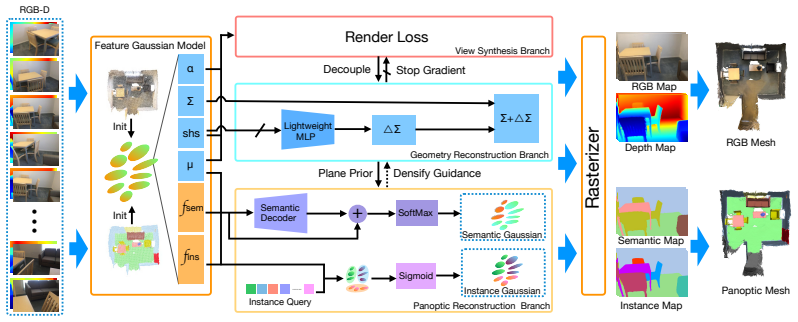
The load-bearing object is the geometry-offset MLP of Eq. (3), which takes detached appearance features and view direction and emits scale and rotation deltas that construct a geometry-specific covariance matrix while leaving the rendering covariance untouched. This decouples appearance and geometry optimization and acts as a low-pass filter for surface noise. The second mechanism is panoptic-guided densification, Eq. (9), where a signed-distance residual between rendered depth and Gaussian-center depth is weighted by the maximum non-background semantic confidence and added to the accumulated gradient magnitude to decide when to spawn new Gaussians. RGB-D fusion initialization supplies structured point clouds for the Gaussian centers and appearance parameters, and the semantic and instance branches use residual MLP prediction and query-Gaussian attention, both rendered through the geometry-adjusted covariance.
What would settle it
Re-run the panoptic comparison after also training PanopticSplatting with the exact same ground-truth semantic and instance maps, and re-run the geometry comparison with depth frames held out from both initialization and the depth loss; if the reported margins vanish, the central claim of mutual reinforcement is not supported.
Extended reading notes
Core claim
The central claim is that appearance, geometry, and panoptic labeling are not competing objectives in Gaussian splatting but mutually reinforcing ones, and that a unified optimization makes each task better than specialized pipelines. The paper supports this with three mechanisms: RGB-D fusion gives the Gaussians a structured coarse initialization; a lightweight MLP computes a separate covariance for geometry, acting as a low-pass filter that suppresses indoor noise and decouples geometry updates from rendering; and panoptic-guided densification uses semantic confidence to modulate the gradient signal that decides where Gaussians are cloned or split. The panoptic branch assigns semantic and instance labels to Gaussians before rasterization, which the paper says improves cross-view consistency. Extensive comparisons on ScanNet and ScanNet++ report the best results in novel view synthesis, geometric reconstruction, and panoptic lifting, with the component ablation showing that removing any of the three mechanisms degrades all tasks.
Load-bearing premise
The reported state-of-the-art depends on the comparison being apples-to-apples: the model is trained with the datasets' hand-labeled semantic and instance maps and with the same depth frames used to build the evaluation mesh, so if the main baselines are not given the same labels, the margin may reflect an advantage in supervision rather than in the method itself.
Editorial extensions
If this is right
- A robot with a consumer RGB-D camera could in principle obtain a navigation mesh, a photorealistic view, and an object-level map from one trained representation instead of running separate pipelines.
- Because panoptic labels are assigned to Gaussians in 3D before rasterization, segmentation consistency across views becomes a property of the representation rather than of per-image 2D networks.
- The reported ScanNet++ F1 of 0.983 would imply that Gaussian-based mesh extraction can match or exceed implicit SDF methods indoors, at lower optimization cost, since the method replaces the SDF field with a lightweight MLP.
- The ablation indicates the three objectives are coupled: removing RGB-D initialization or panoptic densification degrades all three tasks, not only the task each component directly serves.
Reading between the lines
- I would expect the panoptic margin to shrink if the main baseline, PanopticSplatting, were retrained with the same ground-truth semantic and instance maps, because this method uses those maps while PanopticSplatting is evaluated in an open-vocabulary setting; a matched-supervision rerun would isolate the geometric contribution from the label advantage.
- The geometry-offset MLP is representation-agnostic enough that it could be dropped into any 3DGS variant with a depth loss, and applying it to outdoor or dynamic scenes would test whether the low-pass behavior generalizes beyond indoor planar surfaces.
- The densification rule suggests a broader principle: semantic confidence can modulate primitive growth in any differentiable renderer, so a natural extension is to use predicted rather than ground-truth confidence for online or zero-shot reconstruction.
Editorial analysis
A structured set of objections, weighed in public.
Referee Report
Summary. The paper proposes OmniIndoor3D, a 3D Gaussian Splatting framework that jointly optimizes novel-view synthesis, geometric mesh reconstruction, and panoptic segmentation of indoor RGB-D scenes. The method initializes Gaussians from fused multi-view depth, introduces a lightweight MLP that predicts scale and rotation offsets to decouple geometry from appearance optimization, augments Gaussians with semantic and instance features for panoptic lifting, and uses panoptic-guided densification to improve Gaussian distribution. The authors evaluate on ScanNet and ScanNet++, reporting state-of-the-art numbers in Tables 1-3, and provide a component-wise ablation in Table 4. The central claim is that a single Gaussian representation can be the best renderer, surface reconstructor, and panoptic segmenter among the compared methods.
Significance. The paper addresses a genuine gap: most 3DGS-based indoor reconstruction systems optimize either appearance and geometry or panoptic segmentation, but rarely all three jointly. The proposed geometry-decoupling MLP and the panoptic-guided densification are simple and plausible mechanisms, and the multi-task ablation in Table 4 is informative. If the empirical claims hold, the framework would be a useful unified indoor reconstruction system for robotics. However, the headline geometry claim is not supported by the current evaluation protocol because the sensor depth used for initialization and depth supervision is also the data from which the ground-truth meshes are built, and no depth-fusion baseline is included. The panoptic comparison also has a supervision-asymmetry concern. With additional controls and clarifications, the contribution could be valuable; as submitted, the SOTA geometry claim is overstated.
major comments (4)
- [Sec. 3.1, Eq. (11), Tables 2 and 4]
- [Sec. 3.5, Eqs. (13)-(14), Table 3]
- [Eq. (12)]
- [Sec. 4.1 and Sec. 4.5]
minor comments (4)
- [Sec. 2]
- [Figures 3-5]
- [Sec. 3.3]
- [Tables 1-3]
Circularity Check
No significant circularity: OmniIndoor3D is an empirically evaluated systems paper; depth-supervision/evaluation overlap is an experimental-protocol concern, not a derivation-level circularity.
full rationale
OmniIndoor3D makes no first-principles derivation claim; its contributions are benchmark results and ablations. The use of RGB-D depth for Gaussian initialization (Sec. 3.1) and for the depth loss (Eq. 11) is the method's explicit input design, not a hidden equivalence: the depth renders are TSDF-fused to produce meshes that are scored against dataset GT, and the panoptic branch is supervised with dataset GT labels (Eqs. 13-14) and evaluated with external PQ/mIoU metrics. The ablation (Table 4) isolates the components' causal roles. The fact that ScanNet GT meshes share sensor-depth provenance with the training depth is a comparison-fairness/evaluation-protocol asymmetry versus monocular baselines, but it does not make Eq. 11 equal to the evaluation metric by construction. Self-citations in Related Work are numerous but non-load-bearing; the core architecture follows external prior work (PanopticSplatting, CarGS). No fitted parameter is renamed as a prediction, and no uniqueness claim is imported from the authors' own prior work.
Assumptions & free parameters
free parameters (6)
- Loss weights =
lambda_rgb=1.0, lambda_depth=1.0, lambda_cross=1.5, lambda_sem=0.5, lambda_ins=0.5
- SDF modulation sigma
- Densification threshold
- Number of instance queries
- Feature dimensions N_sem, N_ins
- MLP architectures
assumptions (6)
- domain assumption 3DGS alpha-blending (Eq. 2) is a valid model for rendering appearance, depth, and semantic/instance features.
- domain assumption RGB-D depth maps are accurate enough for both initialization and depth supervision.
- domain assumption Grounded SAM pseudo labels are reliable enough to initialize semantic and instance features.
- ad hoc to paper Detaching appearance features and learning scale/rotation offsets in a separate MLP decouples appearance and geometry optimization.
- ad hoc to paper The geometry MLP acts as a low-pass filter and suppresses high-frequency noise.
- ad hoc to paper Semantic-confidence-weighted SDF modulation guides densification toward meaningful regions.
Cite this review
Pith. "Pith review of OmniIndoor3D: Comprehensive Indoor 3D Reconstruction." pith.science (2026). https://pith.science/paper/UCLCYJN7
@misc{pith2026250520610,
  author       = {Pith},
  title        = {Pith review of: OmniIndoor3D: Comprehensive Indoor 3D Reconstruction},
  year         = {2026},
  howpublished = {\url{https://pith.science/paper/UCLCYJN7}},
  note         = {Machine review of arXiv:2505.20610}
}
read the original abstract
We propose a novel framework for comprehensive indoor 3D reconstruction using Gaussian representations, called OmniIndoor3D. This framework enables accurate appearance, geometry, and panoptic reconstruction of diverse indoor scenes captured by a consumer-level RGB-D camera. Since 3DGS is primarily optimized for photorealistic rendering, it lacks the precise geometry critical for high-quality panoptic reconstruction. Therefore, OmniIndoor3D first combines multiple RGB-D images to create a coarse 3D reconstruction, which is then used to initialize the 3D Gaussians and guide the 3DGS training. To decouple the optimization conflict between appearance and geometry, we introduce a lightweight MLP that adjusts the geometric properties of 3D Gaussians. The introduced lightweight MLP serves as a low-pass filter for geometry reconstruction and significantly reduces noise in indoor scenes. To improve the distribution of Gaussian primitives, we propose a densification strategy guided by panoptic priors to encourage smoothness on planar surfaces. Through the joint optimization of appearance, geometry, and panoptic reconstruction, OmniIndoor3D provides comprehensive 3D indoor scene understanding, which facilitates accurate and robust robotic navigation. We perform thorough evaluations across multiple datasets, and OmniIndoor3D achieves state-of-the-art results in appearance, geometry, and panoptic reconstruction. We believe our work bridges a critical gap in indoor 3D reconstruction. The code will be released at: https://ucwxb.github.io/OmniIndoor3D/
Figures


Figures from the paper (2 more)


Reference graph
Works this paper leans on
-
[1]
A survey on robot semantic navigation systems for indoor environments
Raghad Alqobali, Maha Alshmrani, Reem Alnasser, Asrar Rashidi, Tareq Alhmiedat, and Osama Moh’d Alia. A survey on robot semantic navigation systems for indoor environments. Applied Sciences, 14(1):89, 2023
work page 2023
-
[2]
Contrastive lift: 3d object instance segmentation by slow-fast contrastive fusion
Yash Bhalgat, Iro Laina, João F Henriques, Andrea Vedaldi, and Andrew Zisserman. Contrastive lift: 3d object instance segmentation by slow-fast contrastive fusion. InNeurIPS, 2023
work page 2023
-
[3]
Pgsr: Planar-based gaussian splatting for efficient and high-fidelity surface reconstruction.IEEE Transactions on Visualization and Computer Graphics, 2024
Danpeng Chen, Hai Li, Weicai Ye, Yifan Wang, Weijian Xie, Shangjin Zhai, Nan Wang, Haomin Liu, Hujun Bao, and Guofeng Zhang. Pgsr: Planar-based gaussian splatting for efficient and high-fidelity surface reconstruction.IEEE Transactions on Visualization and Computer Graphics, 2024
2024
-
[4]
Panoptic vision- language feature fields.IEEE Robotics and Automation Letters, 9(3):2144–2151, 2024
Haoran Chen, Kenneth Blomqvist, Francesco Milano, and Roland Siegwart. Panoptic vision- language feature fields.IEEE Robotics and Automation Letters, 9(3):2144–2151, 2024
work page 2024
-
[5]
Peng Chen, Xiaobao Wei, Qingpo Wuwu, Xinyi Wang, Xingyu Xiao, and Ming Lu. Mixedgaus- sianavatar: Realistically and geometrically accurate head avatar via mixed 2d-3d gaussian splatting.arXiv preprint arXiv:2412.04955, 2024
arXiv 2024
-
[6]
Omnire: Omni urban scene reconstruction.arXiv preprint arXiv:2408.16760, 2024
Ziyu Chen, Jiawei Yang, Jiahui Huang, Riccardo de Lutio, Janick Martinez Esturo, Boris Ivanovic, Or Litany, Zan Gojcic, Sanja Fidler, Marco Pavone, et al. Omnire: Omni urban scene reconstruction.arXiv preprint arXiv:2408.16760, 2024
arXiv 2024
-
[7]
Gaussianpro: 3d gaussian splatting with progressive propagation
Kai Cheng, Xiaoxiao Long, Kaizhi Yang, Yao Yao, Wei Yin, Yuexin Ma, Wenping Wang, and Xuejin Chen. Gaussianpro: 3d gaussian splatting with progressive propagation. InForty-first International Conference on Machine Learning, 2024
2024
-
[8]
Semantic information for robot navigation: A survey.Applied Sciences, 10(2):497, 2020
Jonathan Crespo, Jose Carlos Castillo, Oscar Martinez Mozos, and Ramon Barber. Semantic information for robot navigation: A survey.Applied Sciences, 10(2):497, 2020
work page 2020
Show all 54 references
-
[9]
Scannet: Richly-annotated 3d reconstructions of indoor scenes
Angela Dai, Angel X Chang, Manolis Savva, Maciej Halber, Thomas Funkhouser, and Matthias Nießner. Scannet: Richly-annotated 3d reconstructions of indoor scenes. InProceedings of the IEEE conference on computer vision and pattern recognition, pages 5828–5839, 2017
2017
-
[10]
Depth-supervised nerf: Fewer views and faster training for free
Kangle Deng, Andrew Liu, Jun-Yan Zhu, and Deva Ramanan. Depth-supervised nerf: Fewer views and faster training for free. InProceedings of the IEEE/CVF conference on computer vision and pattern recognition, pages 12882–12891, 2022
2022
-
[11]
Geo-neus: Geometry-consistent neural implicit surfaces learning for multi-view reconstruction.Advances in Neural Information Processing Systems, 35:3403–3416, 2022
Qiancheng Fu, Qingshan Xu, Yew Soon Ong, and Wenbing Tao. Geo-neus: Geometry-consistent neural implicit surfaces learning for multi-view reconstruction.Advances in Neural Information Processing Systems, 35:3403–3416, 2022
2022
-
[12]
Sugar: Surface-aligned gaussian splatting for efficient 3d mesh reconstruction and high-quality mesh rendering
Antoine Guédon and Vincent Lepetit. Sugar: Surface-aligned gaussian splatting for efficient 3d mesh reconstruction and high-quality mesh rendering. InProceedings of the IEEE/CVF Conference on Computer Vision and Pattern Recognition, pages 5354–5363, 2024
2024
-
[13]
2d gaussian splatting for geometrically accurate radiance fields
Binbin Huang, Zehao Yu, Anpei Chen, Andreas Geiger, and Shenghua Gao. 2d gaussian splatting for geometrically accurate radiance fields. InACM SIGGRAPH 2024 conference papers, pages 1–11, 2024
2024
-
[14]
S3gaussian: Self-supervised street gaussians for autonomous driving.arXiv preprint arXiv:2405.20323, 2024
Nan Huang, Xiaobao Wei, Wenzhao Zheng, Pengju An, Ming Lu, Wei Zhan, Masayoshi Tomizuka, Kurt Keutzer, and Shanghang Zhang. S3gaussian: Self-supervised street gaussians for autonomous driving.arXiv preprint arXiv:2405.20323, 2024
2024 arXiv
-
[15]
3d gaussian splatting for real-time radiance field rendering.ACM Trans
Bernhard Kerbl, Georgios Kopanas, Thomas Leimkühler, and George Drettakis. 3d gaussian splatting for real-time radiance field rendering.ACM Trans. Graph., 42(4):139–1, 2023
2023
-
[16]
Panoptic segmentation
Alexander Kirillov, Kaiming He, Ross Girshick, Carsten Rother, and Piotr Dollár. Panoptic segmentation. InProceedings of the IEEE/CVF conference on computer vision and pattern recognition, pages 9404–9413, 2019. 11
2019
-
[17]
Segment anything
Alexander Kirillov, Eric Mintun, Nikhila Ravi, Hanzi Mao, Chloe Rolland, Laura Gustafson, Tete Xiao, Spencer Whitehead, Alexander C Berg, Wan-Yen Lo, et al. Segment anything. In Proceedings of the IEEE/CVF international conference on computer vision, pages 4015–4026, 2023
2023
-
[18]
Compact 3d gaussian representation for radiance field
Joo Chan Lee, Daniel Rho, Xiangyu Sun, Jong Hwan Ko, and Eunbyung Park. Compact 3d gaussian representation for radiance field. InProceedings of the IEEE/CVF Conference on Computer Vision and Pattern Recognition, pages 21719–21728, 2024
2024
-
[19]
Neuralangelo: High-fidelity neural surface reconstruction
Zhaoshuo Li, Thomas Müller, Alex Evans, Russell H Taylor, Mathias Unberath, Ming-Yu Liu, and Chen-Hsuan Lin. Neuralangelo: High-fidelity neural surface reconstruction. InProceedings of the IEEE/CVF Conference on Computer Vision and Pattern Recognition, pages 8456–8465, 2023
2023
-
[20]
Helixsurf: A robust and efficient neural implicit surface learning of indoor scenes with iterative intertwined regularization
Zhihao Liang, Zhangjin Huang, Changxing Ding, and Kui Jia. Helixsurf: A robust and efficient neural implicit surface learning of indoor scenes with iterative intertwined regularization. In Proceedings of the IEEE/CVF Conference on Computer Vision and Pattern Recognition, pages...
2023
-
[21]
Neural sparse voxel fields.Advances in Neural Information Processing Systems, 33:15651–15663, 2020
Lingjie Liu, Jiatao Gu, Kyaw Zaw Lin, Tat-Seng Chua, and Christian Theobalt. Neural sparse voxel fields.Advances in Neural Information Processing Systems, 33:15651–15663, 2020
2020
-
[22]
Marching cubes: A high resolution 3d surface construction algorithm
William E Lorensen and Harvey E Cline. Marching cubes: A high resolution 3d surface construction algorithm. InSeminal graphics: pioneering efforts that shaped the field, pages 347–353. 1998
1998
-
[23]
Scaffold- gs: Structured 3d gaussians for view-adaptive rendering
Tao Lu, Mulin Yu, Linning Xu, Yuanbo Xiangli, Limin Wang, Dahua Lin, and Bo Dai. Scaffold- gs: Structured 3d gaussians for view-adaptive rendering. InProceedings of the IEEE/CVF Conference on Computer Vision and Pattern Recognition, pages 20654–20664, 2024
2024
-
[24]
Nerf: Representing scenes as neural radiance fields for view synthesis
Ben Mildenhall, Pratul P Srinivasan, Matthew Tancik, Jonathan T Barron, Ravi Ramamoor- thi, and Ren Ng. Nerf: Representing scenes as neural radiance fields for view synthesis. Communications of the ACM, 65(1):99–106, 2021
2021
-
[25]
Instant neural graphics primitives with a multiresolution hash encoding.ACM transactions on graphics (TOG), 41(4):1– 15, 2022
Thomas Müller, Alex Evans, Christoph Schied, and Alexander Keller. Instant neural graphics primitives with a multiresolution hash encoding.ACM transactions on graphics (TOG), 41(4):1– 15, 2022
2022
-
[26]
Regnerf: Regularizing neural radiance fields for view synthesis from sparse inputs
Michael Niemeyer, Jonathan T Barron, Ben Mildenhall, Mehdi SM Sajjadi, Andreas Geiger, and Noha Radwan. Regnerf: Regularizing neural radiance fields for view synthesis from sparse inputs. InProceedings of the IEEE/CVF conference on computer vision and pattern recognition, page...
2022
-
[27]
Differentiable volu- metric rendering: Learning implicit 3d representations without 3d supervision
Michael Niemeyer, Lars Mescheder, Michael Oechsle, and Andreas Geiger. Differentiable volu- metric rendering: Learning implicit 3d representations without 3d supervision. InProceedings of the IEEE/CVF conference on computer vision and pattern recognition, pages 3504–3515, 2020
2020
-
[28]
Langsplat: 3d language gaussian splatting
Minghan Qin, Wanhua Li, Jiawei Zhou, Haoqian Wang, and Hanspeter Pfister. Langsplat: 3d language gaussian splatting. InProceedings of the IEEE/CVF Conference on Computer Vision and Pattern Recognition, pages 20051–20060, 2024
2024
-
[29]
Sam 2: Segment anything in images and videos.arXiv preprint arXiv:2408.00714, 2024
Nikhila Ravi, Valentin Gabeur, Yuan-Ting Hu, Ronghang Hu, Chaitanya Ryali, Tengyu Ma, Haitham Khedr, Roman Rädle, Chloe Rolland, Laura Gustafson, et al. Sam 2: Segment anything in images and videos.arXiv preprint arXiv:2408.00714, 2024
2024 arXiv
-
[30]
Grounded sam: Assembling open-world models for diverse visual tasks.arXiv preprint arXiv:2401.14159, 2024
Tianhe Ren, Shilong Liu, Ailing Zeng, Jing Lin, Kunchang Li, He Cao, Jiayu Chen, Xinyu Huang, Yukang Chen, Feng Yan, et al. Grounded sam: Assembling open-world models for diverse visual tasks.arXiv preprint arXiv:2401.14159, 2024
2024 arXiv
-
[31]
Structure-from-motion revisited
Johannes L Schonberger and Jan-Michael Frahm. Structure-from-motion revisited. InCVPR, pages 4104–4113, 2016. 12
2016
-
[32]
Evolving high-quality rendering and reconstruction in a unified framework with contribution-adaptive regularization.arXiv preprint arXiv:2503.00881, 2025
You Shen, Zhipeng Zhang, Xinyang Li, Yansong Qu, Yu Lin, Shengchuan Zhang, and Liu- juan Cao. Evolving high-quality rendering and reconstruction in a unified framework with contribution-adaptive regularization.arXiv preprint arXiv:2503.00881, 2025
2025 arXiv
-
[33]
Language embedded 3d gaus- sians for open-vocabulary scene understanding
Jin-Chuan Shi, Miao Wang, Hao-Bin Duan, and Shao-Hua Guan. Language embedded 3d gaus- sians for open-vocabulary scene understanding. InProceedings of the IEEE/CVF Conference on Computer Vision and Pattern Recognition, pages 5333–5343, 2024
2024
-
[34]
Panoptic lifting for 3d scene understanding with neural fields
Yawar Siddiqui, Lorenzo Porzi, Samuel Rota Buló, Norman Müller, Matthias Nießner, Angela Dai, and Peter Kontschieder. Panoptic lifting for 3d scene understanding with neural fields. In Proceedings of the IEEE/CVF Conference on Computer Vision and Pattern Recognition, pages 904...
2023
-
[35]
Dn-splatter: Depth and normal priors for gaussian splatting and meshing
Matias Turkulainen, Xuqian Ren, Iaroslav Melekhov, Otto Seiskari, Esa Rahtu, and Juho Kannala. Dn-splatter: Depth and normal priors for gaussian splatting and meshing. In2025 IEEE/CVF Winter Conference on Applications of Computer Vision (WACV), pages 2421–2431. IEEE, 2025
2025
-
[36]
Sparsenerf: Distilling depth ranking for few-shot novel view synthesis
Guangcong Wang, Zhaoxi Chen, Chen Change Loy, and Ziwei Liu. Sparsenerf: Distilling depth ranking for few-shot novel view synthesis. InProceedings of the IEEE/CVF international conference on computer vision, pages 9065–9076, 2023
2023
-
[37]
Embodiedocc++: Boosting embodied 3d occupancy prediction with plane regularization and uncertainty sampler.arXiv preprint arXiv:2504.09540, 2025
Hao Wang, Xiaobao Wei, Xiaoan Zhang, Jianing Li, Chengyu Bai, Ying Li, Ming Lu, Wenzhao Zheng, and Shanghang Zhang. Embodiedocc++: Boosting embodied 3d occupancy prediction with plane regularization and uncertainty sampler.arXiv preprint arXiv:2504.09540, 2025
2025 arXiv
-
[38]
Neus: learning neural implicit surfaces by volume rendering for multi-view reconstruction
Peng Wang, Lingjie Liu, Yuan Liu, Christian Theobalt, Taku Komura, and Wenping Wang. Neus: learning neural implicit surfaces by volume rendering for multi-view reconstruction. In Proceedings of the 35th International Conference on Neural Information Processing Systems, pages 2...
2021
-
[39]
Plgs: Robust panoptic lifting with 3d gaussian splatting.arXiv preprint arXiv:2410.17505, 2024
Yu Wang, Xiaobao Wei, Ming Lu, and Guoliang Kang. Plgs: Robust panoptic lifting with 3d gaussian splatting.arXiv preprint arXiv:2410.17505, 2024
2024 arXiv
-
[40]
Gazegaussian: High-fidelity gaze redirection with 3d gaussian splatting.arXiv preprint arXiv:2411.12981, 2024
Xiaobao Wei, Peng Chen, Guangyu Li, Ming Lu, Hui Chen, and Feng Tian. Gazegaussian: High-fidelity gaze redirection with 3d gaussian splatting.arXiv preprint arXiv:2411.12981, 2024
2024 arXiv
-
[41]
Challenges and solutions for autonomous ground robot scene understanding and navigation in unstructured outdoor environ- ments: A review.Applied Sciences, 13(17):9877, 2023
Liyana Wijayathunga, Alexander Rassau, and Douglas Chai. Challenges and solutions for autonomous ground robot scene understanding and navigation in unstructured outdoor environ- ments: A review.Applied Sciences, 13(17):9877, 2023
2023
-
[42]
Opengaussian: Towards point-level 3d gaussian-based open vocabulary understanding.arXiv preprint arXiv:2406.02058, 2024
Yanmin Wu, Jiarui Meng, Haijie Li, Chenming Wu, Yahao Shi, Xinhua Cheng, Chen Zhao, Haocheng Feng, Errui Ding, Jingdong Wang, et al. Opengaussian: Towards point-level 3d gaussian-based open vocabulary understanding.arXiv preprint arXiv:2406.02058, 2024
2024 arXiv
-
[43]
Embodiedocc: Embodied 3d occupancy prediction for vision-based online scene understanding.arXiv preprint arXiv:2412.04380, 2024
Yuqi Wu, Wenzhao Zheng, Sicheng Zuo, Yuanhui Huang, Jie Zhou, and Jiwen Lu. Embodiedocc: Embodied 3d occupancy prediction for vision-based online scene understanding.arXiv preprint arXiv:2412.04380, 2024
2024 arXiv
-
[44]
Gaussianroom: Improving 3d gaussian splatting with sdf guidance and monocular cues for indoor scene reconstruction.arXiv preprint arXiv:2405.19671, 2024
Haodong Xiang, Xinghui Li, Kai Cheng, Xiansong Lai, Wanting Zhang, Zhichao Liao, Long Zeng, and Xueping Liu. Gaussianroom: Improving 3d gaussian splatting with sdf guidance and monocular cues for indoor scene reconstruction.arXiv preprint arXiv:2405.19671, 2024
2024 arXiv
-
[45]
Panopticsplatting: End-to-end panoptic gaussian splatting.arXiv preprint arXiv:2503.18073, 2025
Yuxuan Xie, Xuan Yu, Changjian Jiang, Sitong Mao, Shunbo Zhou, Rui Fan, Rong Xiong, and Yue Wang. Panopticsplatting: End-to-end panoptic gaussian splatting.arXiv preprint arXiv:2503.18073, 2025
2025 arXiv
-
[46]
Upsnet: A unified panoptic segmentation network
Yuwen Xiong, Renjie Liao, Hengshuang Zhao, Rui Hu, Min Bai, Ersin Yumer, and Raquel Urtasun. Upsnet: A unified panoptic segmentation network. InProceedings of the IEEE/CVF conference on computer vision and pattern recognition, pages 8818–8826, 2019. 13
2019
-
[47]
Gaussian grouping: Segment and edit anything in 3d scenes
Mingqiao Ye, Martin Danelljan, Fisher Yu, and Lei Ke. Gaussian grouping: Segment and edit anything in 3d scenes. InEuropean Conference on Computer Vision, pages 162–179. Springer, 2024
2024
-
[48]
Scannet++: A high- fidelity dataset of 3d indoor scenes
Chandan Yeshwanth, Yueh-Cheng Liu, Matthias Nießner, and Angela Dai. Scannet++: A high- fidelity dataset of 3d indoor scenes. InProceedings of the IEEE/CVF International Conference on Computer Vision, pages 12–22, 2023
2023
-
[49]
Gsdf: 3dgs meets sdf for improved rendering and reconstruction.arXiv preprint arXiv:2403.16964, 2024
Mulin Yu, Tao Lu, Linning Xu, Lihan Jiang, Yuanbo Xiangli, and Bo Dai. Gsdf: 3dgs meets sdf for improved rendering and reconstruction.arXiv preprint arXiv:2403.16964, 2024
2024 arXiv
-
[50]
Panopticrecon: Leverage open-vocabulary instance segmentation for zero-shot panoptic reconstruction
Xuan Yu, Yili Liu, Chenrui Han, Sitong Mao, Shunbo Zhou, Rong Xiong, Yiyi Liao, and Yue Wang. Panopticrecon: Leverage open-vocabulary instance segmentation for zero-shot panoptic reconstruction. In2024 IEEE/RSJ International Conference on Intelligent Robots and Systems (IROS),...
2024
-
[51]
Lever- age cross-attention for end-to-end open-vocabulary panoptic reconstruction.arXiv preprint arXiv:2501.01119, 2025
Xuan Yu, Yuxuan Xie, Yili Liu, Haojian Lu, Rong Xiong, Yiyi Liao, and Yue Wang. Lever- age cross-attention for end-to-end open-vocabulary panoptic reconstruction.arXiv preprint arXiv:2501.01119, 2025
2025
-
[52]
Monosdf: Exploring monocular geometric cues for neural implicit surface reconstruction.Advances in neural information processing systems, 35:25018–25032, 2022
Zehao Yu, Songyou Peng, Michael Niemeyer, Torsten Sattler, and Andreas Geiger. Monosdf: Exploring monocular geometric cues for neural implicit surface reconstruction.Advances in neural information processing systems, 35:25018–25032, 2022
2022
-
[53]
2dgs-room: Seed-guided 2d gaussian splatting with geometric constrains for high-fidelity indoor scene reconstruction.arXiv preprint arXiv:2412.03428, 2024
Wanting Zhang, Haodong Xiang, Zhichao Liao, Xiansong Lai, Xinghui Li, and Long Zeng. 2dgs-room: Seed-guided 2d gaussian splatting with geometric constrains for high-fidelity indoor scene reconstruction.arXiv preprint arXiv:2412.03428, 2024
2024 arXiv
-
[54]
Feature 3dgs: Supercharging 3d gaussian splatting to enable distilled feature fields
Shijie Zhou, Haoran Chang, Sicheng Jiang, Zhiwen Fan, Zehao Zhu, Dejia Xu, Pradyumna Chari, Suya You, Zhangyang Wang, and Achuta Kadambi. Feature 3dgs: Supercharging 3d gaussian splatting to enable distilled feature fields. InProceedings of the IEEE/CVF Conference on Computer ...
2024
Reviewed August 7, 2026 · model on record in the stance chip above.
Discussion (0). Sign in to comment.