REVIEW 4 major objections 5 minor 34 references
A prompt-based BERT model extracts fine-grained Crohn's disease findings from Hebrew radiology reports, outperforming standard fine-tuning and cutting inference cost by a factor of five.
Reviewed by Pith at T0; open to challenge. T0 means a machine referee read the full paper against a public rubric. the ladder, T0–T4 →
T0 review · deepseek-v4-flash
2026-08-05 11:06 UTC pith:3TZYDYVA
load-bearing objection Practical Hebrew radiology extraction pipeline with a real 5x speedup, but the raw-text leakage of test reports into pretraining makes the headline F1/kappa optimistic until a leakage analysis is run. the 4 major comments →
Hierarchical Section Matching Prediction (HSMP) BERT for Fine-Grained Extraction of Structured Data from Hebrew Free-Text Radiology Reports in Crohn's Disease
The pith
A machine-rendered reading of the paper's core claim, the machinery that carries it, and where it could break.
Core claim
The central discovery is that a section-aware pretraining objective plus prompt-based hierarchical inference yields a model that, after light supervision on 512 reports, extracts 24 organ–finding labels from Hebrew radiology reports with a mean F1 of 0.83 ± 0.08 and Cohen's kappa of 0.65 ± 0.17, outperforming both a zero-shot prompted model (F1 0.49) and standard fine-tuning (F1 0.30, p < 10^-7). The same model applied to all 9,683 reports recovers clinically expected associations—ileal wall thickening co-occurring with stenosis and pre-stenotic dilatation—and reveals age- and sex-stratified patterns of inflammatory findings. The paper presents this as evidence that structured extraction in
What carries the argument
The load-bearing mechanism is the Section Matching Prediction (SMP) pretraining objective: the model is trained to classify whether a Findings section and an Impression section come from the same radiology report, analogous to next-sentence prediction. This teaches the model the logical coherence between the detailed observations and the interpretive summary, which is exactly the relation the downstream extraction prompts exploit. At inference, a hand-designed hierarchical tree routes queries from 'is the scan normal?' to 'is there an abnormality in the ileum?' to 'is there wall thickening in the ileum?', skipping lower-level prompts when a parent answer is negative, which reduces BERT calls
Load-bearing premise
The reported test accuracy assumes that including the 512 annotated reports in the 9,683-report pretraining corpus does not let the model memorize the test text; with no leakage check, the absolute numbers may be optimistic.
What would settle it
Retrain HSMP-BERT with the 512 annotated reports excluded from the MLM and SMP pretraining corpus, evaluate on the same 24 targets, and compare mean F1 and kappa; a drop greater than about 0.05 in mean F1 would confirm the pretraining overlap inflates the reported results.
If this is right
- Fine-grained structured extraction from Hebrew radiology reports is achievable with a few hundred annotated examples, lowering the barrier to cohort curation and disease surveillance.
- The hierarchical inference scheme cuts runtime roughly fivefold with no loss in F1, making whole-corpus analysis of ~10,000 reports practical.
- Zero-shot SMP already outperforms standard fine-tuning, indicating the section-matching objective captures much of the task's structure without labeled data.
- Applying the model to the full cohort surfaces the expected Crohn's co-occurrence pattern of ileal wall thickening with stenosis and pre-stenotic dilatation, supporting its use for population-level phenotyping.
- The per-label F1/kappa table across 24 targets offers a reproducible benchmark for future Hebrew radiology extraction systems.
Where Pith is reading between the lines
- The reported F1/kappa are upper bounds: the 512 annotated reports, test split included, are a subset of the 9,683 reports used for pretraining, so the model saw the raw test text before evaluation; a fresh test set outside the pretraining corpus is needed to know true deployment performance.
- SMP pretraining needs only paired Findings/Impression sections and no labels, so the same recipe could transfer to other sectioned clinical documents (pathology, discharge summaries) and other low-resource languages by swapping the base language model.
- The 5x speedup relies on a manually designed prompt tree; learning the hierarchy from label co-occurrence could improve efficiency and accuracy, especially for the rarest findings where F1 drops to 0.63.
- Collapsing 'organ not visible' and 'organ resected' into negative labels may mask surgically relevant information; a model that distinguishes these categories could add clinical value in follow-up and resection planning.
Editorial analysis
A structured set of objections, weighed in public.
Referee Report
Summary. The manuscript presents HSMP-BERT, a Hebrew BERT (HeRo) adapted to radiology reports via masked language modeling and a novel Section Matching Prediction (SMP) objective, then prompted hierarchically to classify 24 organ–finding labels from MRE/CTE reports. On a 512-report annotated subset, it reports mean F1 0.83±0.08 and Cohen's κ 0.65±0.17, surpassing a zero-shot SMP baseline and standard fine-tuning, with a 5.1× inference speedup from hierarchical routing. The model is then applied to the full corpus to estimate prevalence and associations by age, sex, and anatomical site.
Significance. If the results are validated, the combination of self-supervised section matching and hierarchical prompt routing is a practical contribution for low-resource clinical NLP, particularly for Hebrew radiology text. The paper has real strengths: external radiologist labels, a multilabel-stratified split, multiple metrics, repeated-measures ANOVA with paired post-hoc tests across seeds, and a concrete efficiency analysis with measured runtime, BERT calls, and token counts. However, the overlap between the pretraining corpus and the annotated test set, together with the unreported quantitative validation of the population-level predictions, means that the headline absolute performance numbers and the downstream clinical associations are not yet established. The strengths are sufficient to merit a revision rather than rejection.
major comments (4)
- [§2.1, §2.2, §2.2.1] The 512 annotated reports—including the held-out test reports—are a subset of the 9,683-report corpus used for domain-adaptive MLM and SMP pretraining. Because SMP is explicitly trained on Findings–Impression pairs from these reports, the model has seen the raw text of test reports before evaluation. The paper provides no leakage analysis and no ablation with pretraining restricted to the 9,171 non-annotated reports. This makes the absolute F1 0.83±0.08, κ 0.65±0.17, and the zero-shot results potentially optimistic, and it compromises the claimed validation of population-level predictions against the annotated subset. Please rerun pretraining excluding the annotated reports, or provide a quantitative leakage check (e.g., performance stratified by nearest-neighbor overlap between test reports and pretraining data).
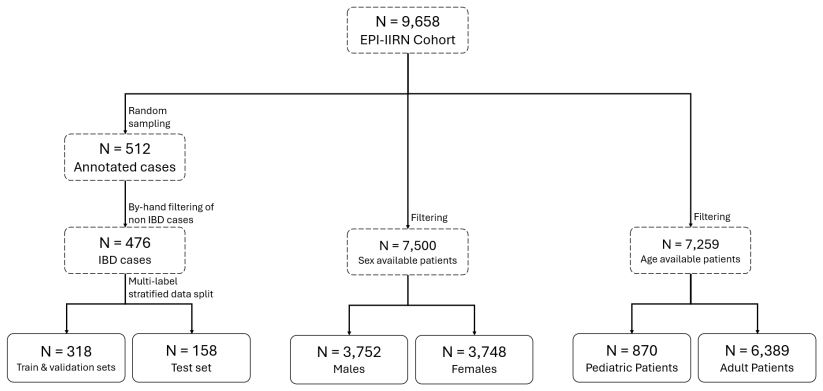
- [§3, Table 3, §2.1] The paper gives two inconsistent cohort sizes: §2.1 and the abstract state 9,683 reports from 8,093 unique patients, while §3 and Table 3 state 9,658 reports from 7,389 patients. Since the population-level prevalences, Figure 5, and the 5.1× speedup figures are computed on the corpus, this discrepancy must be resolved and the correct denominators reported consistently throughout.
- [§2.3, §4, Figure 5, Figure S1] The population-level associations ('revealed associations', prevalence patterns, and pairwise correlations) are derived entirely from the model's own predictions. The paper claims that 'aggregate patterns' were validated against expert annotations, but no quantitative agreement metrics (e.g., prevalence calibration, rank-order correlation, correlation-structure agreement) are reported. Without such validation, these associations should be described as exploratory model outputs, not as validated clinical findings.
- [Abstract; Table 4] The abstract states that HSMP-BERT 'outperformed' the baselines without mentioning the SMP-Finetune arm. Table 4 and the post-hoc tests show that HSMP-BERT and SMP-Finetune have indistinguishable accuracy, F1, κ, and balanced accuracy (p > 0.80). The demonstrated advantage of the hierarchical component is inference speed, not accuracy. Please state this plainly so readers do not infer an accuracy gain over the strongest baseline.
minor comments (5)
- [§3, Table 2, Table S1] There are numeric inconsistencies: the text says 'near-perfect NPV of 0.9' for rectum wall thickness, but Table 2 reports NPV 0.99; the text says rectal wall enhancement prevalence is 7%, but Table S1 reports 4.4%; the abstract says a 33% test split, while §2.3 says 34%.
- [§3, Table 3] The sentence '1.77 vs. 0.35 seconds per single radiology report' needs to specify which number corresponds to flat vs. hierarchical inference. As written, the ordering is ambiguous and should be matched to the total runtimes in Table 3.
- [Figure 5] There are minor discrepancies between the text and the figure caption regarding which findings are more common in adults vs. pediatric patients (e.g., stenosis and inflammation). Please align the text and caption.
- [Table S3] The table title contains a typo: 'SMP/BERT' should be 'SMP-BERT' or 'SMP BERT'.
- [§2.3–§2.4] Section 2.4 appears after §2.3 but is titled 'Evaluation Framework'; this suggests a numbering or heading error. Also, the model configurations are described with inconsistent names ('Fine-tuned HSMP-BERT' vs. 'SMP Finetune').
Circularity Check
Test reports are inside the MLM/SMP pretraining corpus, so the headline test F1/kappa are leakage-inflated; otherwise the core evaluation is against external radiologist labels and not circular.
specific steps
-
fitted input called prediction
[§2.1, §2.2, §2.2.1, §2.4]
"Given the scarcity of publicly available Hebrew medical corpora, we adapted HeRo to the radiology domain through additional pretraining on all 9,683 MRE and CTE reports described in Section 2.1. ... Multilabel-stratified split (66% for training and validation; 34% for held-out evaluation). ... During SMP training, we construct input pairs as: xin = [CLS] xF_i [SEP] xI_i [EOS]. ... Each input took the form: xin = [CLS] xF_i [SEP] p_j [EOS]"
The annotated 512-report set—including the held-out test reports—is a subset of the 9,683 reports used for domain-adaptive MLM and SMP pretraining. SMP is trained on the real Impression sections (xI_i) of those exact reports. At test time, the prompt p_j (e.g., 'There is wall thickening in the ileum.') is semantically the same kind of text as an Impression, and the input format is identical ([CLS] Findings [SEP] prompt). A model can therefore answer a test item by retrieving the Impression content it saw during pretraining rather than by generalizing from the annotated split. The reported absolute F1 and kappa are thus not clean out-of-sample predictions: the raw test inputs were already fitted during pretraining. This is test-contamination/leakage rather than label-level identity, so rela
full rationale
The core F1/kappa evaluation is against external radiologist annotations on a held-out split, and the comparison with SMP zero-shot and standard fine-tuning is an empirical result with independent content, so the paper is not fundamentally circular. The main circularity-adjacent flaw is the leakage described above: the held-out test reports appear verbatim in the MLM/SMP pretraining corpus, and the SMP pretraining task uses the Impression sections of those reports, which are the same semantic type as the test-time prompts. This makes the absolute test numbers optimistic. The population-level 'revealed' associations are computed from the model's own predictions, and the promised quantitative consistency check against expert annotations is not reported, so those downstream findings are self-referential. Reference [26] is a self-citation used to motivate the Findings–Impression structure, but it is not load-bearing because the paper provides its own SMP-vs-SFT experiments. Overall score 3: minor self-citation plus a real leakage/self-referentiality concern, but the central supervised evaluation retains independent content.
Axiom & Free-Parameter Ledger
free parameters (3)
- minimum positive count for label selection =
15
- decision threshold for binary labels =
not reported
- hierarchical prompt tree design =
manually authored
axioms (4)
- domain assumption The 9,683-report pretraining corpus contains the 512 annotated reports, including the test set
- domain assumption Radiology reports have discrete Findings and Impression sections with logical consistency
- domain assumption Labels 2 (organ not visible) and 9 (organ resected) can be treated as negatives
- domain assumption Adjudicated radiologist labels are ground truth
Cite this review
Pith. "Pith review of Hierarchical Section Matching Prediction (HSMP) BERT for Fine-Grained Extraction of Structured Data from Hebrew Free-Text Radiology Reports in Crohn's Disease." pith.science (2026). https://pith.science/paper/3TZYDYVA
@misc{pith2026250904519,
  author       = {Pith},
  title        = {Pith review of: Hierarchical Section Matching Prediction (HSMP) BERT for Fine-Grained Extraction of Structured Data from Hebrew Free-Text Radiology Reports in Crohn's Disease},
  year         = {2026},
  howpublished = {\url{https://pith.science/paper/3TZYDYVA}},
  note         = {Machine review of arXiv:2509.04519}
}
read the original abstract
Extracting structured clinical information from radiology reports is challenging, especially in low-resource languages. This is pronounced in Crohn's disease, with sparsely represented multi-organ findings. We developed Hierarchical Structured Matching Prediction BERT (HSMP-BERT), a prompt-based model for extraction from Hebrew radiology text. In an administrative database study, we analyzed 9,683 reports from Crohn's patients imaged 2010-2023 across Israeli providers. A subset of 512 reports was radiologist-annotated for findings across six gastrointestinal organs and 15 pathologies, yielding 90 structured labels per subject. Multilabel-stratified split (66% train+validation; 33% test), preserving label prevalence. Performance was evaluated with accuracy, F1, Cohen's $\kappa$, AUC, PPV, NPV, and recall. On 24 organ-finding combinations with $>$15 positives, HSMP-BERT achieved mean F1 0.83$\pm$0.08 and $\kappa$ 0.65$\pm$0.17, outperforming the SMP zero-shot baseline (F1 0.49$\pm$0.07, $\kappa$ 0.06$\pm$0.07) and standard fine-tuning (F1 0.30$\pm$0.27, $\kappa$ 0.27$\pm$0.34; paired t-test $p < 10^{-7}$). Hierarchical inference cuts runtime 5.1$\times$ vs. traditional inference. Applied to all reports, it revealed associations among ileal wall thickening, stenosis, and pre-stenotic dilatation, plus age- and sex-specific trends in inflammatory findings. HSMP-BERT offers a scalable solution for structured extraction in radiology, enabling population-level analysis of Crohn's disease and demonstrating AI's potential in low-resource settings.
Figures


Reference graph
Works this paper leans on
-
[1]
Rethinking radiology reports: A survey of referring physicians’ perspectives,
P. Reschke, C. Booz, L. D. Gruenewald, V. Koch, E. H¨ ohne, A. G¨ okduman, K. Eichler, J. Schl¨ uchtermann, T. J. Vogl, and J. Gotta, “Rethinking radiology reports: A survey of referring physicians’ perspectives,” European Journal of Radiology, vol. 187, 6 2025
work page 2025
-
[2]
T. Jorg, M. C. Halfmann, N. R¨ olz, R. Mager, D. P. dos Santos, C. D¨ uber, P. Mildenberger, and L. M¨ uller, “Structured reporting in radiology enables epidemiological analysis through data mining: urolithiasis as a use case,” Abdominal Radiology, vol. 48, pp. 3520–3529, 11 2023
work page 2023
-
[3]
Practical guide to natural language processing for radiology,
A. Mozayan, A. R. Fabbri, M. Maneevese, I. Tocino, and S. Chheang, “Practical guide to natural language processing for radiology,” Radiographics, vol. 41, pp. 1446–1453, 9 2021
work page 2021
-
[4]
Transformer-based structuring of free-text radiology report databases,
S. Nowak, D. Biesner, Y. C. Layer, M. Theis, H. Schneider, W. Block, B. Wulff, U. I. Atten- berger, R. Sifa, and A. M. Sprinkart, “Transformer-based structuring of free-text radiology report databases,” European Radiology, vol. 33, pp. 4228–4236, 6 2023
work page 2023
-
[5]
Transformation of free-text radiology reports into structured data,
M. M. Graf, K. K. Bressem, and L. C. Adams, “Transformation of free-text radiology reports into structured data,” Radiologie, vol. 65, pp. 249–256, 4 2025
work page 2025
-
[6]
Automatic structuring of radiology reports with on-premise open-source large language models,
P. Wo´ znicki, C. Laqua, I. Fiku, A. Hekalo, D. Truhn, S. Engelhardt, J. Kather, S. Foersch, T. A. D’Antonoli, D. P. dos Santos, B. Baeßler, and F. C. Laqua, “Automatic structuring of radiology reports with on-premise open-source large language models,” European Radiology, vol. 35, pp. 2018–2029, 4 2025
work page 2018
-
[7]
D. R. Schlegel, K. Gordon, C. Gaudioso, and M. Peleg, “Clinical tractor: A framework for automatic natural language understanding of clinical practice guidelines,” AMIA Annual Sym- posium Proceedings, vol. 2019, pp. 784–793, 3 2020
work page 2019
-
[8]
D. Reichenpfader, H. M¨ uller, and K. Denecke, “A scoping review of large language model based approaches for information extraction from radiology reports,” npj Digital Medicine 2024 7:1 , vol. 7, pp. 1–12, 8 2024
work page 2024
-
[9]
B. L. Guellec, A. Lef` evre, C. Geay, L. Shorten, C. Bruge, L. Hacein-Bey, P. Amouyel, J. P. Pruvo, G. Kuchcinski, and A. Hamroun, “Performance of an open-source large language model in extracting information from free-text radiology reports,” Radiology: Artificial Intelligence , vol. 6, 7 2024. 13
work page 2024
-
[10]
S. Liu, A. B. McCoy, and A. Wright, “Improving large language model applications in biomedicine with retrieval-augmented generation: a systematic review, meta-analysis, and clinical development guidelines,” Journal of the American Medical Informatics Association , vol. 32, pp. 605–615, 4 2025
work page 2025
-
[11]
Radiorag: Online retrieval-augmented generation for radiology question answering,
S. T. Arasteh, M. Lotfinia, K. Bressem, R. Siepmann, L. Adams, D. Ferber, C. Kuhl, J. N. Kather, S. Nebelung, and D. Truhn, “Radiorag: Online retrieval-augmented generation for radiology question answering,” Radiology. Artificial intelligence, vol. 7, 7 2025
work page 2025
-
[12]
M. G. Linguraru, S. Bakas, M. Aboian, P. D. Chang, A. E. Flanders, J. Kalpathy-Cramer, F. C. Kitamura, M. P. Lungren, J. Mongan, L. M. Prevedello, R. M. Summers, C. C. Wu, M. Adewole, and C. E. Kahn, “Clinical, cultural, computational, and regulatory considerations to deploy ai in radiology: Perspectives of rsna and miccai experts,” Radiology: Artificial ...
work page 2024
-
[13]
Challenges in using large language models for simplifying radiology reports,
Y. Artsi, V. Sorin, and E. Klang, “Challenges in using large language models for simplifying radiology reports,” Journal of the American College of Radiology , vol. 22, p. 405, 4 2025
work page 2025
-
[14]
F. Dennst¨ adt, J. Hastings, P. M. Putora, M. Schmerder, and N. Cihoric, “Implementing large language models in healthcare while balancing control, collaboration, costs and security,” npj Digital Medicine, vol. 8, pp. 1–4, 12 2025
work page 2025
-
[15]
Current applications and challenges in large language models for patient care: a systematic review,
F. Busch, L. Hoffmann, C. Rueger, E. H. van Dijk, R. Kader, E. Ortiz-Prado, M. R. Makowski, L. Saba, M. Hadamitzky, J. N. Kather, D. Truhn, R. Cuocolo, L. C. Adams, and K. K. Bressem, “Current applications and challenges in large language models for patient care: a systematic review,” Communications Medicine 2025 5:1 , vol. 5, pp. 1–13, 1 2025
work page 2025
-
[16]
Medical ethics of large language models in medicine,
J. C. L. Ong, S. Y.-H. Chang, W. William, A. J. Butte, N. H. Shah, L. S. T. Chew, N. Liu, F. Doshi-Velez, W. Lu, J. Savulescu, and D. S. W. Ting, “Medical ethics of large language models in medicine,” NEJM AI , vol. 1, p. 14, 6 2024
work page 2024
-
[17]
Cybersecurity threats and mitigation strategies for large language models in health care,
T. A. D’Antonoli, A. S. Tejani, B. Khosravi, C. Bluethgen, F. Busch, K. K. Bressem, L. C. Adams, M. Moassefi, S. Faghani, and J. W. Gichoya, “Cybersecurity threats and mitigation strategies for large language models in health care,” Radiology. Artificial intelligence, vol. 7, 7 2025
work page 2025
-
[18]
Lchaim - investigating long context reasoning in hebrew,
E. Malul, O. Perets, Z. Mor, Y. Kassel, and E. Sulem, “Lchaim - investigating long context reasoning in hebrew,” in Findings of the Association for Computational Linguistics: ACL 2025 (W. Che, J. Nabende, E. Shutova, and M. T. Pilehvar, eds.), pp. 7928–7939, Association for Computational Linguistics, 7 2025
work page 2025
-
[19]
J. Sha, M. Zhu, C. Feng, and Y. Shang, “Veef-multi-llm: Effective vocabulary expansion and parameter efficient finetuning towards multilingual large language models,” in Proceedings of the 31st International Conference on Computational Linguistics (O. Rambow, L. Wanner, M. Apidianaki, H. Al-Khalifa, B. D. Eugenio, and S. Schockaert, eds.), pp. 7963–7981, ...
work page 2025
-
[20]
H. Y. Li, J. F. Fu, and A. Python, “Implementing large language models in health care: Clinician-focused review with interactive guideline,” Journal of medical Internet research , vol. 27, p. e71916, 7 2025. 14
work page 2025
-
[21]
E. Avnat, M. Levy, D. Herstain, E. Yanko, D. B. Joya, M. T. Katz, D. Eshel, S. Laros, Y. Dagan, S. Barami, J. Mermelstein, S. Ovadia, N. Shomron, V. Shalev, and R. E. E. Abdul- nour, “Performance of large language models in numerical versus semantic medical knowledge: Cross-sectional benchmarking study on evidence-based questions and answers,” Journal of ...
work page 2025
-
[22]
D. H. Bruining, E. M. Zimmermann, E. V. Loftus Jr, W. J. Sandborn, C. G. Sauer, S. A. Strong, and S. of Abdominal Radiology Crohn’s Disease-Focused Panel, “Consensus recom- mendations for evaluation, interpretation, and utilization of computed tomography and mag- netic resonance enterography in patients with small bowel crohn’s disease,”Radiology, vol. 28...
work page 2018
-
[23]
Promptbert: Improving bert sentence embeddings with prompts,
T. Jiang, J. Jiao, S. Huang, Z. Zhang, D. Wang, F. Zhuang, F. Wei, H. Huang, D. Deng, and Q. Zhang, “Promptbert: Improving bert sentence embeddings with prompts,” in Proceedings of the 2022 Conference on Empirical Methods in Natural Language Processing (Y. Goldberg, Z. Kozareva, and Y. Zhang, eds.), pp. 8826–8837, Association for Computational Linguistics...
work page 2022
-
[24]
Y. Zhuang, J. Zhang, X. Li, C. Liu, Y. Yu, W. Dong, and K. He, “Autonomous interna- tional classification of diseases coding using pretrained language models and advanced prompt learning techniques: Evaluation of an automated analysis system using medical text,” JMIR Medical Informatics, vol. 13, 2025
work page 2025
-
[25]
D. Reichenpfader, J. Knupp, S. U. von D¨ aniken, R. Gaio, F. Dennst¨ adt, G. M. Cereghetti, A. Sander, H. Hiltbrunner, K. Nairz, and K. Denecke, “Enhancing bidirectional encoder rep- resentations from transformers (bert) with frame semantics to extract clinically relevant infor- mation from german mammography reports: Algorithm development and validation,...
work page 2025
-
[26]
L. Hazan, N. Gavrielov, R. Reichart, T. Hagopian, M.-L. Greer, R. Cytter-Kuint, G. Focht, D. Turner, and M. Freiman, “Leveraging prompt-learning for structured information extraction from crohn’s disease radiology reports in a low-resource language,” in Proceedings of the 6th Clinical Natural Language Processing Workshop (T. Naumann, A. B. Abacha, S. Beth...
work page 2024
-
[27]
M. Y. Friedman, M. Leventer-Roberts, J. Rosenblum, N. Zigman, I. Goren, V. Mourad, N. Led- erman, N. Cohen, E. Matz, D. Z. Dushnitzky, N. Borovsky, M. B. Hoshen, G. Focht, M. Avit- zour, Y. Shachar, Y. Chowers, R. Eliakim, S. Ben-Horin, S. Odes, D. Schwartz, I. Dotan, E. Israeli, Z. Levi, E. I. Benchimol, R. D. Balicer, and D. Turner, “Development and val...
work page 2018
-
[28]
Hero: Roberta and longformer hebrew language models,
V. Shalumov and H. Haskey, “Hero: Roberta and longformer hebrew language models,” arXiv preprint arXiv:2304.11077, 2023
Pith/arXiv arXiv 2023
-
[29]
Don’t stop pretraining: Adapt language models to domains and tasks,
S. Gururangan, A. Marasovi´ c, S. Swayamdipta, K. Lo, I. Beltagy, D. Downey, and N. A. Smith, “Don’t stop pretraining: Adapt language models to domains and tasks,” in Proceedings of the 58th Annual Meeting of the Association for Computational Linguistics (D. Jurafsky, J. Chai, N. Schluter, and J. Tetreault, eds.), pp. 8342–8360, Association for Computatio...
work page 2020
-
[30]
Bert: Pre-training of deep bidirectional transformers for language understanding,
J. Devlin, M.-W. Chang, K. Lee, and K. Toutanova, “Bert: Pre-training of deep bidirectional transformers for language understanding,” in Proceedings of the 2019 Conference of the North American Chapter of the Association for Computational Linguistics: Human Language Tech- nologies, Volume 1 (Long and Short Papers) (J. Burstein, C. Doran, and T. Solorio, e...
work page 2019
-
[31]
Biobert: A pre-trained biomedical language representation model for biomedical text mining,
J. Lee, W. Yoon, S. Kim, D. Kim, S. Kim, C. H. So, and J. Kang, “Biobert: A pre-trained biomedical language representation model for biomedical text mining,” Bioinformatics, vol. 36, pp. 1234–1240, 2 2020
work page 2020
-
[32]
Clinicalbert: Modeling clinical notes and predict- ing hospital readmission,
K. Huang, J. Altosaar, and R. Ranganath, “Clinicalbert: Modeling clinical notes and predict- ing hospital readmission,” arXiv preprint arXiv:1904.05342 , 2019
Pith/arXiv arXiv 1904
-
[33]
A survey of gpt-3 family large language models including chatgpt and gpt-4,
K. S. Kalyan, “A survey of gpt-3 family large language models including chatgpt and gpt-4,” Natural Language Processing Journal, vol. 6, p. 100048, 3 2024
work page 2024
-
[34]
G. Al-Kateb, E. Cengiz, and M. G¨ ok, “Biogpt: A generative transformer-based framework for personalized genomic medicine and rare disease diagnosis,” Mesopotamian Journal of Artificial Intelligence in Healthcare, vol. 2025, pp. 154–164, 7 2025. 16 Supporting information Table S1: Label prevalence for each of the selected labels (with at least 15 positive...
work page 2025
discussion (0)
Sign in with ORCID, Apple, or X to comment. Anyone can read and Pith papers without signing in.