REVIEW 3 major objections 6 minor 2 cited by
Optimizing QAOA circuit transpilation with parity twine and SWAP network encodings
T0 review · 3 major / 6 minor · reviewed 2026-08-07 · deepseek-v4-flash
Pith's one-line read The paper claims that parity twine chains and SWAP networks, when paired with simulated-annealing qubit ordering, outperform standard transpilers for QAOA circuits once problem edge density exceeds a threshold that shrinks as qubit count…
desk verdict Solid single-layer benchmarking with a useful SA heuristic, but the multi-layer claims rest on an unproved reverse-pass rule that needs to be fixed before the hardware results can be trusted. read the letter →
The pith
A machine-rendered reading of the paper's core claim, the machinery that carries it, and where it could break.
The reading
What carries the argument
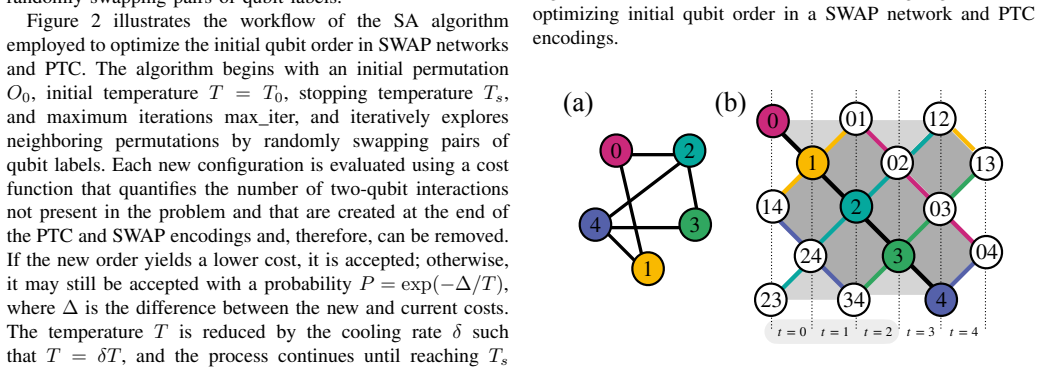
Parity twine chains (PTC) are the central object: a CNOT-based encoding that folds the parities of several logical qubits onto a single physical qubit, so that a two-qubit ZZ interaction becomes a local single-qubit RZ rotation. A simulated-annealing step relabels the qubits' initial order so that the parities appearing at the end of the encoding correspond to edges missing from the problem graph and can be dropped; the same relabeling is applied to SWAP networks, where the dropped operations are SWAP gates belonging to missing edges. The paper's resource identities are $N_g = N_q^2 - 1$ and $d = 2N_q + 2$ for PTC per layer on a 1D chain, versus $N_g = \frac{3}{2}N_q^2 - \frac{5}{2}N_q + 1$ and $d = 3N_q - 2$ for SWAP networks.
What would settle it
Run a noiseless statevector simulation of a 6–8 qubit non-fully connected weighted MaxCut instance for $p=3$ and $p=4$ using the alternating forward/backward PTC or SWAP construction and compare the output distribution against the exact QAOA unitary evolution; any discrepancy would falsify the truncation rule.
Extended reading notes
Core claim
The central claim is that PTC and SWAP encodings, when their initial qubit order is chosen by simulated annealing, outperform Qiskit's optimization-level-3 transpiler for QAOA instances once the problem graph's edge density exceeds a threshold that decreases with qubit count: roughly $E_d = 0.35$ at 20 qubits and $E_d = 0.13$ at 120 qubits. Above the threshold the PTC+SA construction yields both fewer two-qubit gates and smaller circuit depth; at 120 qubits with $E_d = 0.248$ it reports an 85% reduction in depth and a 28% reduction in two-qubit gates relative to Qiskit-T. The paper further claims this is the first demonstration of these encodings beating standard transpilers in reduced-connectivity scenarios, and validates PTC on real hardware, finding optimal solutions up to 20 qubits whereas SWAP networks stop at 15.
Load-bearing premise
The multi-layer hardware claims assume that, for a non-fully connected graph, truncating the first QAOA layer at $t=2$ and alternating forward/backward passes over subsequent layers reproduces $p$ independent cost-Hamiltonian evolutions without correction circuits, an assumption the paper states but does not derive.
Editorial extensions
If this is right
- For QAOA on linear-chain hardware with non-trivial connectivity, PTC+SA and SWAP+SA become the preferred transpilation strategy above the density threshold, with the threshold shrinking as system size increases.
- The PTC+SA construction reduces circuit depth relative to all tested transpilers across almost the entire edge-density range, even in regimes where it uses more two-qubit gates.
- Under a depolarizing noise model, PTC improves success probability over SWAP networks by up to 5.65 percentage points at a moderate error strength, while approximation ratios remain comparable.
- On the ibm_fez device, PTC extends the size at which optimal solutions to fully connected weighted MaxCut are found from 15 to 20 qubits, and extends distinguishability from a random sampler from 20 to 22 qubits.
Reading between the lines
- If the alternating forward/backward layer rule holds, the annealed qubit ordering amortizes over all $p$ layers, meaning the reported per-layer resource counts understate the encodings' advantage for deep QAOA circuits.
- The simulated-annealing cost function is a generic graph-relabeling heuristic that could transfer to other parity-based encodings or to T- and H-shaped hardware topologies, a direction the paper mentions but does not demonstrate.
- The systematic fall of the crossing threshold with qubit count suggests a scaling law for when structured encodings beat general transpilers; fitting such a law to more sizes and hardware graphs would sharpen practical guidance.
- A testable extension is to check whether the threshold depends only on edge density or also on graph structure, for instance by comparing random regular graphs with Erdős–Rényi graphs of the same density.
Editorial analysis
A structured set of objections, weighed in public.
Referee Report
Summary. The paper proposes a simulated-annealing-based qubit-order optimization for two connectivity-aware encodings of QAOA circuits on a linear chain: the SWAP network and parity twine chains (PTC). It benchmarks PTC+SA and SWAP+SA against Qiskit-T, Qiskit-P, Qiskit-AI, and TKET on weighted MaxCut instances with varying edge density, reporting resource tables for 20, 60, and 120 qubits, a depolarizing-noise simulation for 8 qubits at p=50, and ibm_fez hardware experiments for up to 22–25 qubits. The central claim is that above a connectivity threshold, these encodings reduce two-qubit gate count and depth relative to Qiskit-T, e.g., an 85% depth reduction and 28% gate reduction for a 120-qubit instance at 25% connectivity, and that PTC extends LR-QAOA to larger qubit counts than SWAP networks on real hardware.
Significance. If the central claims hold, the work is a practically valuable contribution to QAOA transpilation. The SA-based ordering heuristic is simple and scales to 120 qubits, and the paper provides a public repository with instances and results, which aids reproducibility. The claim that PTC and SWAP encodings can outperform a general-purpose transpiler above density thresholds is useful for practitioners. However, the validation is incomplete: the multi-layer extension relies on an unproved alternating-pass rule, and the depth metric in Table I is inconsistent with the paper's own formulas. The single-layer resource-reduction results are credible enough to warrant revision rather than rejection.
major comments (3)
- [II-C, Fig. 3(b), Figs. 7–8] The paper states that for a non-fully connected graph the PTC circuit can be truncated at t=2 for the first QAOA layer and that 'subsequent layers can then proceed in the reverse direction.' This alternating-pass rule is the only stated mechanism for extending the single-layer encoding to the p>1 circuits used in the depolarizing-noise simulation (Fig. 7, p=50) and the ibm_fez experiments (Fig. 8, p=3..20). No derivation, circuit identity, or numerical validation is provided to show that a reversed truncated pass, with interleaved RZ rotations and mixers, implements another independent cost-Hamiltonian layer; CNOT conjugation of the diagonal RZ gates generally changes the effective two-qubit interactions. Please supply a formal argument or a statevector-level check for p=2 and state explicitly how the mixer and the reversed RZ angles are scheduled. Without this, the multi-layer hardware and noise claims are unsupported, although the single-layer resource comparisons could still stand.
- [II-A, II-B, Table I] The depth formulas in Sec. II state d=2Nq+2 for PTC and d=3Nq-2 for SWAP networks, and Ng=Nq^2-1 for PTC. Table I at Ed=1.0 reports substantially larger depths for the SA-optimized encodings (e.g., Nq=20: PTC+SA depth 66 vs 42, SWAP+SA depth 77 vs 58; Nq=120: 366 vs 242 and 477 vs 358). Please clarify whether Table I counts native-gate depth, includes final uncompute/measurement-order restoration, or includes single-qubit rotations, and correct either the table or the formulas. Since the abstract's depth-reduction percentages are computed from Table I, this inconsistency is load-bearing and must be resolved.
- [III-A, Fig. 6, Table I] The quantitative thresholds quoted in the abstract and conclusions (e.g., Ed≈0.35 for Nq=20 and Ed≈0.13 for Nq=120) are based on only three randomly generated graphs per data point. The error bars in Fig. 6 are standard deviations over these three instances, and no confidence intervals or significance tests are reported. Given the visible variance, the crossing points should be presented as ranges or supported by more instances, and the text should avoid presenting them as precise thresholds. The qualitative trend is not in question, but the specific threshold values are not statistically established.
minor comments (6)
- [II-C] The stopping temperature T_s is mentioned in the SA description but never given a value; only T0, delta, and max_iter are specified.
- [II-D] 'Qiskit-P allows implemention' should read 'implementation.'
- [II-F, Eq. (8)] The expression U_{ij}^{2Q}ρU_{ij}^{2Q} should presumably be U_{ij}^{2Q}ρU_{ij}^{2Q†} unless the gate is assumed Hermitian.
- [III-A, Fig. 4] The 'minimum possible depth' d_min used for the ratios in Fig. 4 is not defined in the text; please define it explicitly.
- [III-C, Fig. 8(b)] The formula for the effective approximation ratio r_eff appears only in the inset and is not defined in the text; please add a definition.
- [II-E] The paragraphs introducing r and p_gs do not specify the sample count used for the noiseless simulation in Fig. 8(a), which would help interpret the comparison with the random sampler.
Circularity Check
No circularity found: SA-optimized gate counts are empirical outputs, not fitted inputs; the reverse-direction multilayer rule is an unproved correctness risk, not a circular reduction.
full rationale
We find no input-output reduction of the kind that would constitute circularity. The SA method optimizes an explicit cost function (number of removable terminal two-qubit interactions) and then reports the actual gate counts and depths of the circuits produced; the threshold values E_d=0.35, 0.13, etc. are empirical crossings against external baseline transpilers (Qiskit-T, Qiskit-P, Qiskit-AI, TKET), not parameters fitted to the claim. The PTC and SWAP encodings are introduced from prior literature [6]–[13], and the SA contribution is benchmarked independently. The paper does reuse the authors' own LR-QAOA protocol [17], [18] in Secs. II-E and III-B/C; this self-citation is real but not load-bearing for the central transpilation comparison, since resource counts are schedule-independent and PTC/SWAP hardware results use identical protocols. The one notable unsupported assertion is Sec. II-C's rule that after truncating the first QAOA layer at t=2, 'subsequent layers can then proceed in the reverse direction, effectively alternating forward and backward passes as the QAOA p increases.' No circuit identity or derivation is given, and all p>1 noise/hardware results inherit this risk. That is a missing-proof/correctness concern, not a circularity, because the rule is not defined in terms of the results it is used to produce.
Assumptions & free parameters
free parameters (4)
- SA initial temperature T0 =
0.01
- SA cooling rate delta =
0.999
- SA max_iter =
50000
- LR-QAOA schedule amplitude Delta_beta_gamma =
0.63 for Nq<=15, 0.3 for Nq>15
assumptions (4)
- domain assumption The PTC and SWAP schedules from prior work [6]-[13] generate all pair interactions on a 1D chain.
- ad hoc to paper Trailing interactions can be removed and subsequent layers can alternate forward and backward without changing the QAOA evolution.
- domain assumption A depolarizing channel with uniform epsilon_g on all two-qubit gates captures the dominant hardware noise.
- ad hoc to paper Simulated annealing converges to a near-optimal qubit order for the chosen hyperparameters.
Cite this review
Pith. "Pith review of Optimizing QAOA circuit transpilation with parity twine and SWAP network encodings." pith.science (2026). https://pith.science/paper/3U4UUYNS
@misc{pith2026250517944,
  author       = {Pith},
  title        = {Pith review of: Optimizing QAOA circuit transpilation with parity twine and SWAP network encodings},
  year         = {2026},
  howpublished = {\url{https://pith.science/paper/3U4UUYNS}},
  note         = {Machine review of arXiv:2505.17944}
}
read the original abstract
Mapping quantum approximate optimization algorithm (QAOA) circuits with non-trivial connectivity in fixed-layout quantum platforms such as superconducting-based quantum processing units (QPUs) requires a process of transpilation to match the quantum circuit on the given layout. This step is critical for reducing error rates when running on noisy QPUs. Two methodologies that improve the resource required to do such transpilation are the SWAP network and parity twine chains (PTC). These approaches reduce the two-qubit gate count and depth needed to represent fully connected circuits. In this work, a simulated annealing-based method is introduced that reduces the PTC and SWAP network encoding requirements in QAOA circuits with non-fully connected two-qubit gates. This method is benchmarked against various transpilers and demonstrates that, beyond specific connectivity thresholds, it achieves significant reductions in both two-qubit gate count and circuit depth, surpassing the performance of Qiskit transpiler at its highest optimization level. For example, for a 120-qubit QAOA instance with 25% connectivity, our method achieves an 85% reduction in depth and a 28% reduction in two-qubit gates. Finally, the practical impact of PTC encoding is validated by benchmarking QAOA on the ibm_fez device, showing improved performance up to 20 qubits, compared to a 15-qubit limit when using SWAP networks.
Figures


Figures from the paper (5 more)


Forward citations
Cited by 2 Pith papers
-
From Circuits to Hardware: Benchmarking Standard and Qubit-Efficient Quantum Optimization on Real Hardware
Across 247 hardware runs, an empirical fidelity proxy near 0.1 (~770 two-qubit gates) marks noise-dominated execution for packing and independent-set problems, while QAP is structurally infeasible and compiled QAOA mo...
-
Demonstrating Record Fidelity for the Quantum Fourier Transform
Parity Architecture delivers record ~0.01 fidelity for 50-qubit QFT on IBM hardware with super-exponential scaling improvement.
Reference graph
Works this paper leans on
-
[20]
Y . Ji, K. F. Koenig, and I. Polian, “Improving the performance of digitized counterdiabatic quantum optimization via algorithm-oriented qubit mapping,”Phys. Rev. A, vol. 110, p. 032421, Sep 2024. [Online]. Available: https://link.aps.org/doi/10.1103/PhysRevA.110.032421
-
[1]
Quantum circuit synthesis and compilation optimization: Overview and prospects,
Y . Ge, W. Wenjie, C. Yuheng, P. Kaisen, L. Xudong, Z. Zixiang, W. Yuhan, W. Ruocheng, and Y . Junchi, “Quantum circuit synthesis and compilation optimization: Overview and prospects,”arXiv preprint arXiv:2407.00736, 2024
arXiv 2024
-
[2]
J. Kusyk, S. M. Saeed, and M. U. Uyar, “Survey on quantum circuit compilation for noisy intermediate-scale quantum computers: Artificial intelligence to heuristics,”IEEE Transactions on Quantum Engineering, vol. 2, pp. 1–16, 2021
work page 2021
-
[3]
Calibration-aware transpilation for variational quantum optimization,
Y . Ji, S. Brandhofer, and I. Polian, “Calibration-aware transpilation for variational quantum optimization,” in2022 IEEE International Conference on Quantum Computing and Engineering (QCE). Los Alamitos, CA, USA: IEEE Computer Society, 2022, pp. 204–214
work page 2022
-
[4]
M. Y . Siraichi, V . F. d. Santos, C. Collange, and F. M. Q. Pereira, “Qubit allocation,” inProceedings of the 2018 International Symposium on Code Generation and Optimization, ser. CGO 2018. New York, NY , USA: Association for Computing Machinery, 2018, p. 113–125
work page 2018
-
[5]
Computationally efficient zero-noise extrapolation for quantum-gate-error mitigation,
V . R. Pascuzzi, A. He, C. W. Bauer, W. A. de Jong, and B. Nachman, “Computationally efficient zero-noise extrapolation for quantum-gate-error mitigation,”Phys. Rev. A, vol. 105, p. 042406, Apr
-
[6]
Performance of the quantum approximate optimization algorithm on the maximum cut problem,
G. E. Crooks, “Performance of the quantum approximate optimization algorithm on the maximum cut problem,” 2018
work page 2018
-
[7]
Quantum simulation of electronic structure with linear depth and connectivity,
I. D. Kivlichan, J. McClean, N. Wiebe, C. Gidney, A. Aspuru-Guzik, G. K.-L. Chan, and R. Babbush, “Quantum simulation of electronic structure with linear depth and connectivity,”Physical review letters, vol. 120, no. 11, p. 110501, 2018
work page 2018
Show all 30 references
-
[8]
Generalized swap networks for near-term quantum computing,
B. O’Gorman, W. J. Huggins, E. G. Rieffel, and K. B. Whaley, “Generalized swap networks for near-term quantum computing,”arXiv preprint arXiv:1905.05118, 2019
1905 arXiv
-
[9]
Optimal fermionic swap networks for hubbard models,
T. Hagge, “Optimal fermionic swap networks for hubbard models,”arXiv preprint arXiv:2001.08324, 2020
2001 arXiv
-
[10]
Scaling of the quantum approximate optimization algorithm on superconducting qubit based hardware,
J. Weidenfeller, L. C. Valor, J. Gacon, C. Tornow, L. Bello, S. Woerner, and D. J. Egger, “Scaling of the quantum approximate optimization algorithm on superconducting qubit based hardware,”Quantum, vol. 6, p. 870, 2022
2022
-
[11]
Algorithm-oriented qubit mapping for variational quantum algorithms,
Y . Ji, X. Chen, I. Polian, and Y . Ban, “Algorithm-oriented qubit mapping for variational quantum algorithms,”Phys. Rev. Appl., vol. 23, p. 034022, Mar 2025. [Online]. Available: https: //link.aps.org/doi/10.1103/PhysRevApplied.23.034022
2025 doi
-
[12]
Connectivity-aware synthesis of quantum algorithms,
F. Dreier, C. Fleckenstein, G. Aigner, M. Fellner, R. Stahn, M. Lanthaler, and W. Lechner, “Connectivity-aware synthesis of quantum algorithms,” 2025
2025
-
[13]
Swap-less implementation of quantum algorithms,
B. Klaver, S. Rombouts, M. Fellner, A. Messinger, K. Ender, K. Ludwig, and W. Lechner, “Swap-less implementation of quantum algorithms,” 2024. [Online]. Available: https://arxiv.org/abs/2408.10907
2024
-
[14]
A quantum approximate optimization algorithm,
E. Farhi, J. Goldstone, and S. Gutmann, “A quantum approximate optimization algorithm,” 2014. [Online]. Available: https://arxiv.org/abs/ 1411.4028
2014 arXiv
-
[15]
M. a. Nielsen and I. L. Chuang,Quantum Computation and Quantum Information: 10th Anniversary Edition, 2011
2011
-
[16]
An approximate fourier transform useful in quantum factoring,
D. Coppersmith, “An approximate fourier transform useful in quantum factoring,” 2002
2002
-
[17]
Towards a universal qaoa protocol: Evidence of a scaling advantage in solving some combinatorial optimization problems,
J. A. Montanez-Barrera and K. Michielsen, “Towards a universal qaoa protocol: Evidence of a scaling advantage in solving some combinatorial optimization problems,” 2024. [Online]. Available: https://arxiv.org/abs/2405.09169
2024 arXiv
-
[18]
Evaluating the performance of quantum process units at large width and depth,
J. A. Montanez-Barrera, K. Michielsen, and D. E. B. Neira, “Evaluating the performance of quantum process units at large width and depth,” 2025
2025
-
[19]
Optimized swap networks with equivalent circuit averaging for qaoa,
A. Hashim, R. Rines, V . Omole, R. K. Naik, J. M. Kreikebaum, D. I. Santiago, F. T. Chong, I. Siddiqi, and P. Gokhale, “Optimized swap networks with equivalent circuit averaging for qaoa,”Phys. Rev. Res., vol. 4, p. 033028, Jul 2022. [Online]. Available: https://link.aps.org/d...
2022 doi
-
[21]
Synergistic dynamical decoupling and circuit design for enhanced algorithm performance on near-term quantum devices,
Y . Ji and I. Polian, “Synergistic dynamical decoupling and circuit design for enhanced algorithm performance on near-term quantum devices,”Entropy, vol. 26, no. 7, 2024. [Online]. Available: https://www.mdpi.com/1099-4300/26/7/586
2024
-
[22]
Optimizing quantum algorithms on bipotent architectures,
Y . Ji, K. F. Koenig, and I. Polian, “Optimizing quantum algorithms on bipotent architectures,”Phys. Rev. A, vol. 108, p. 022610, Aug 2023
2023
-
[23]
Simulated annealing,
D. Bertsimas and J. Tsitsiklis, “Simulated annealing,”Statistical science, vol. 8, no. 1, pp. 10–15, 1993
1993
-
[24]
Qiskit: An Open-Source Quantum SDK,
IBM Quantum, “Qiskit: An Open-Source Quantum SDK,” 2025, accessed: 2025-03-19. [Online]. Available: https://www.ibm.com/ quantum/qiskit
2025
-
[25]
Qiskit transpiler api documentation,
Qiskit Development Team, “Qiskit transpiler api documentation,” 2025, accessed: 2025-05-13. [Online]. Available: https://docs.quantum.ibm. com/api/qiskit/transpiler
2025
-
[26]
AI-powered transpiler passes,
IBM Quantum, “AI-powered transpiler passes,” 2025, accessed: 2025-03-19. [Online]. Available: https://docs.quantum.ibm.com/guides/ ai-transpiler-passes#ai-routing-pass
2025
-
[27]
Tket documentation,
Quantinuum, “Tket documentation,” https://docs.quantinuum.com/tket/, accessed: 2025-03-19
2025
-
[28]
Suppressing quantum circuit errors due to system variability,
P. D. Nation and M. Treinish, “Suppressing quantum circuit errors due to system variability,”PRX Quantum, vol. 4, no. 1, Mar. 2023. [Online]. Available: http://dx.doi.org/10.1103/PRXQuantum.4.010327
2023 doi
-
[29]
Benchmarking the performance of quantum computing software,
P. D. Nation, A. A. Saki, S. Brandhofer, L. Bello, S. Garion, M. Treinish, and A. Javadi-Abhari, “Benchmarking the performance of quantum computing software,” 2025. [Online]. Available: https: //arxiv.org/abs/2409.08844
2025 arXiv
-
[2022]
Available: https://journals.aps.org/pra/abstract/10.1103/ PhysRevA.105.042406
[Online]. Available: https://journals.aps.org/pra/abstract/10.1103/ PhysRevA.105.042406
Reviewed August 7, 2026 · model on record in the stance chip above.
Discussion (0). Sign in to comment.