Vortex pinning of Ba_(0.62)K_(0.38)BiO₃ investigated by magneto-optical Kerr-effect and magnetization measurements
Pith reviewed 2026-06-27 11:50 UTC · model grok-4.3
The pith
The zero-field MOKE signal in Ba0.62K0.38BiO3 follows Bean's critical-state model for trapped vortices with linear training-field dependence.
A machine-rendered reading of the paper's core claim, the machinery that carries it, and where it could break.
Core claim
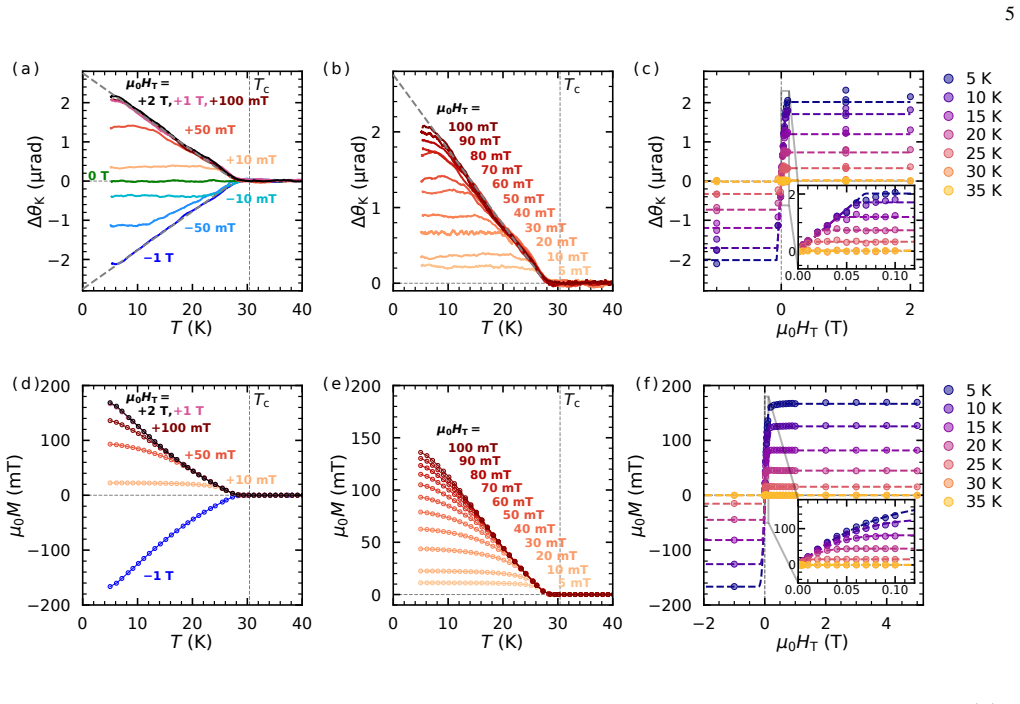
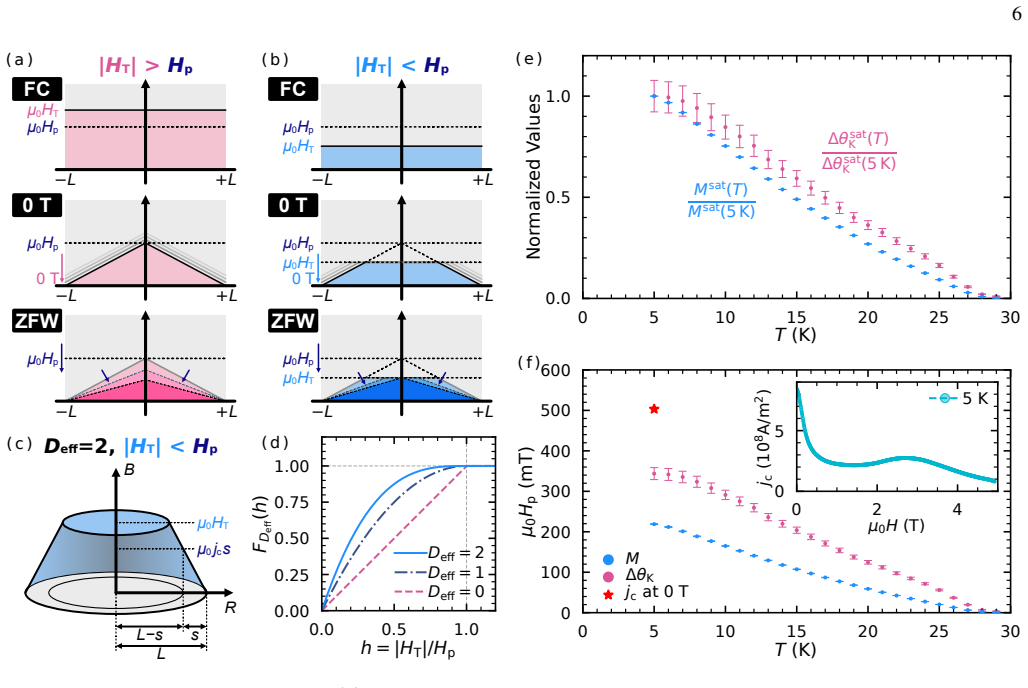
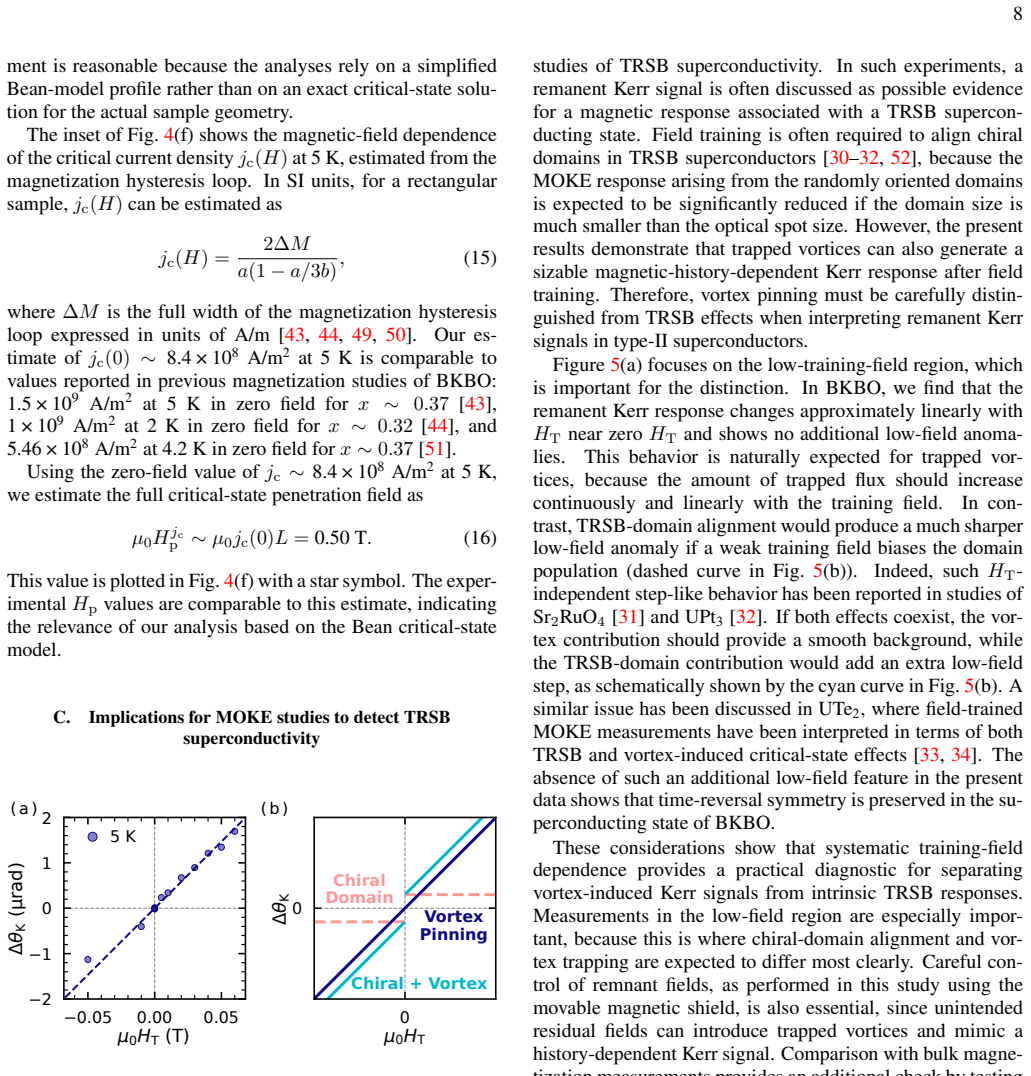
The observed evolution of the MOKE signals is well described by Bean's critical-state model for trapped vortices, and the training-field dependence of the MOKE is linear near zero training field without anomalies indicative of spontaneous time-reversal-symmetry breaking in an unconventional superconducting state.
What carries the argument
Bean's critical-state model for trapped vortices, applied to interpret history-dependent zero-field MOKE signals as remanent magnetization.
If this is right
- MOKE becomes a viable optical probe of vortex pinning in type-II superconductors at mesoscopic scales.
- A clear experimental protocol exists to separate vortex-induced MOKE responses from those potentially linked to time-reversal-symmetry breaking.
- The absence of anomalies supports conventional behavior with respect to spontaneous symmetry breaking in this material.
- Magnetization and MOKE data together confirm that pinning governs the irreversible response without additional order-parameter effects.
Where Pith is reading between the lines
- The same MOKE protocol could be tested on other three-dimensional oxide superconductors to check whether pinning signatures remain dominant.
- If future measurements in related compounds detect zero-field anomalies, they could be compared against the linear baseline established here to isolate possible unconventional contributions.
- Contact-free optical detection of remanent vortex magnetization opens routes to spatially resolved studies of pinning landscapes in thin films or devices.
Load-bearing premise
The zero-field MOKE signal arises exclusively from remanent magnetization due to trapped vortices rather than other magneto-optical contributions or surface effects.
What would settle it
A non-linear training-field dependence of the MOKE signal near zero field or the appearance of anomalies at zero training field would contradict the claim that the response is purely vortex-induced.
Figures
read the original abstract
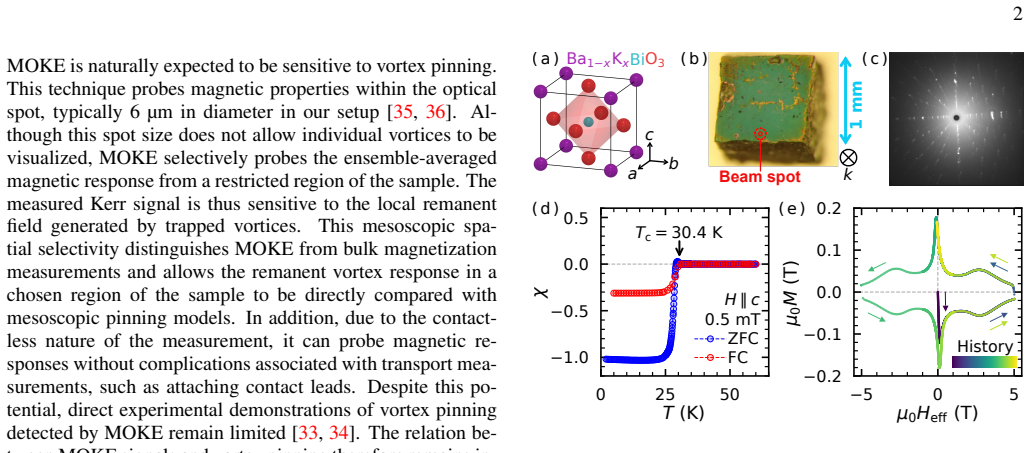
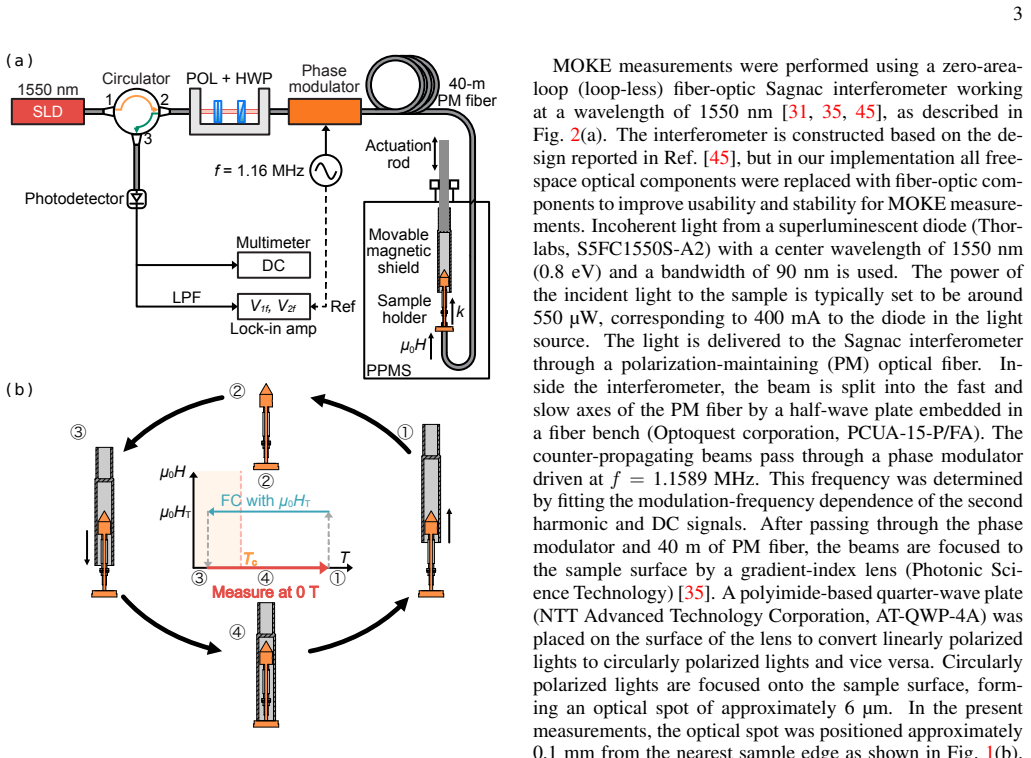
Vortex pinning plays a crucial role in determining properties of type-II superconductors. For example, it governs the irreversible magnetic response as well as dissipation caused by vortex motion. Here, we study vortex pinning in the three-dimensional oxide superconductor Ba1-xKxBiO3 using ultra-high-resolution magneto-optical Kerr effect (MOKE) and detailed magnetization measurements. We find that the zero-field MOKE signal in the superconducting state exhibits a pronounced magnetic-history dependence. This behavior closely resembles the remanent magnetization caused by trapped vortices. Furthermore, we demonstrate that the observed evolution of the MOKE signals is well described by Bean's critical-state model for trapped vortices. Our results establish MOKE as a viable optical and mesoscopic probe of vortex pinning in type-II superconductors, providing a new complementary approach to investigate mixed-state phenomena. We also find that the training-field dependence of the MOKE is linear near zero training field, without any anomalies indicative of spontaneous time-reversal-symmetry breaking in an unconventional superconducting state. Our study defines a clear protocol to distinguish vortex-induced MOKE responses from those associated with a time-reversal-symmetry broken superconducting order parameter.
Editorial analysis
A structured set of objections, weighed in public.
Referee Report
Summary. The manuscript investigates vortex pinning in the three-dimensional oxide superconductor Ba_{0.62}K_{0.38}BiO_3 via ultra-high-resolution magneto-optical Kerr effect (MOKE) and magnetization measurements. It reports that the zero-field MOKE signal exhibits pronounced magnetic-history dependence consistent with remanent magnetization from trapped vortices, that the evolution of these signals is well described by Bean's critical-state model, and that the training-field dependence of the MOKE is linear near zero training field without anomalies indicative of spontaneous time-reversal-symmetry breaking. The work establishes MOKE as a mesoscopic optical probe of vortex pinning and defines a protocol to distinguish vortex-induced responses from those associated with a TRS-broken superconducting order parameter.
Significance. If the central claims hold, the results provide a new complementary optical approach to study mixed-state phenomena and vortex pinning in type-II superconductors. The explicit protocol for separating vortex contributions from potential TRS-breaking signals is a useful methodological contribution for the field. The analysis rests on direct comparison to an established external model (Bean's critical-state model) rather than internally defined parameters.
major comments (1)
- [Results] Results section: The claim that the observed evolution of the MOKE signals is well described by Bean's critical-state model is central to the paper but is presented without quantitative fits, error bars, raw data overlays, or goodness-of-fit metrics, making it impossible to assess the quality of the agreement or rule out post-hoc selection of data subsets.
minor comments (1)
- [Abstract and Methods] The abstract and methods do not specify the achieved spatial or magnetic-field resolution of the MOKE setup or how it improves upon prior magneto-optical studies of this material.
Simulated Author's Rebuttal
We thank the referee for their constructive comment and positive overall assessment of the work. We agree that the central claim regarding Bean's model requires stronger quantitative support and will revise the manuscript accordingly.
read point-by-point responses
-
Referee: [Results] Results section: The claim that the observed evolution of the MOKE signals is well described by Bean's critical-state model is central to the paper but is presented without quantitative fits, error bars, raw data overlays, or goodness-of-fit metrics, making it impossible to assess the quality of the agreement or rule out post-hoc selection of data subsets.
Authors: We agree that the submitted manuscript presents only a qualitative description of the agreement with Bean's model. In the revised version we will add quantitative fits of the MOKE data to the critical-state model, including error bars on all data points, direct overlays of raw data with model predictions, and goodness-of-fit metrics such as reduced chi-squared values. We will also state explicitly the criteria used to select the data subsets shown, thereby removing any ambiguity about post-hoc selection. These additions will appear in the Results section together with updated figures. revision: yes
Circularity Check
No significant circularity; claims rest on external model comparison
full rationale
The paper's central claims involve experimental MOKE signals exhibiting history dependence that matches the remanent magnetization expected from Bean's critical-state model (an external, previously published framework) and linear training-field dependence without TRS-breaking anomalies. No equations or steps in the provided text reduce a prediction or result to a fitted parameter or self-citation by construction; the analysis compares data directly to an independent model without redefining inputs as outputs. The protocol for distinguishing vortex contributions is presented as an experimental distinction rather than a self-referential derivation. This is a standard non-circular experimental validation against an external benchmark.
Axiom & Free-Parameter Ledger
axioms (1)
- domain assumption Bean's critical-state model accurately describes vortex pinning and the resulting remanent magnetization in this material
Reference graph
Works this paper leans on
-
[1]
Blatter, M
G. Blatter, M. V . Feigel’man, V . B. Geshkenbein, A. I. Larkin, and V . M. Vinokur, Rev. Mod. Phys.66, 1125 (1994)
1994
-
[2]
C. P. Bean, Rev. Mod. Phys.36, 31 (1964)
1964
-
[3]
S. Eley, A. Glatz, and R. Willa, J. Appl. Phys.130, 050901 (2021)
2021
-
[4]
W.-K. Kwok, U. Welp, A. Glatz, A. E. Koshelev, K. J. Kihlstrom, and G. W. Crabtree, Rep. Prog. Phys.79, 116501 (2016)
2016
-
[5]
Sigrist and K
M. Sigrist and K. Ueda, Rev. Mod. Phys.63, 239 (1991)
1991
-
[6]
Kallin and J
C. Kallin and J. Berlinsky, Rep. Prog. Phys.79, 054502 (2016)
2016
-
[7]
S. K. Ghosh, M. Smidman, T. Shang, J. F. Annett, A. D. Hillier, J. Quintanilla, and H. Yuan, J. Phys. Condens. Matter 33, 033001 (2020)
2020
-
[8]
R. J. Cava, B. Batlogg, J. J. Krajewski, R. Farrow, L. W. Rupp, Jr, A. E. White, K. Short, W. F. Peck, and T. Kometani, Nature 332, 814 (1988)
1988
-
[9]
D. G. Hinks, B. Dabrowski, J. D. Jorgensen, A. W. Mitchell, D. R. Richards, S. Pei, and D. Shi, Nature333, 836 (1988)
1988
-
[10]
A. W. Sleight, Physica C Supercond.514, 152 (2015)
2015
-
[11]
Griffitt, M
S. Griffitt, M. Spai ´c, J. Joe, Z. W. Anderson, D. Zhai, M. J. Krogstad, R. Osborn, D. Pelc, and M. Greven, Nat. Commun. 14, 845 (2023)
2023
-
[12]
S. N. Barilo, S. V . Shiryaev, V . I. Gatalskaya, D. I. Zhigunov, A. V . Pushkarev, V . V . Fedotova, H. Szymczak, R. Szymczak, M. Baran, J. W. Lynn, N. Rosov, and S. Skanthakumar, J. Cryst. Growth198-199, 636 (1999)
1999
-
[13]
Kumar, D
P. Kumar, D. Hall, and R. G. Goodrich, Phys. Rev. Lett.82, 4532 (1999)
1999
-
[14]
W. D. Mosley, J. W. Dykes, R. N. Shelton, A. Sterne, and R. H. Howell, Phys. Rev. Lett.73, 1271 (1994)
1994
-
[15]
C. H. P. Wen, H. C. Xu, Q. Yao, R. Peng, X. H. Niu, Q. Y . Chen, Z. T. Liu, D. W. Shen, Q. Song, X. Lou, Y . F. Fang, X. S. Liu, Y . H. Song, Y . J. Jiao, T. F. Duan, H. H. Wen, P. Dudin, G. Kotliar, Z. P. Yin, and D. L. Feng, Phys. Rev. Lett.121, 117002 (2018)
2018
-
[16]
Bhattacharyya, R
S. Bhattacharyya, R. Thangavel, and P. M. Sarun, J. Appl. Phys. 137, 155902 (2025)
2025
-
[17]
Damascelli, Z
A. Damascelli, Z. Hussain, and Z.-X. Shen, Rev. Mod. Phys. 75, 473 (2003)
2003
-
[18]
Shibauchi, T
T. Shibauchi, T. Hanaguri, and Y . Matsuda, J. Phys. Soc. Jpn. 89, 102002 (2020)
2020
-
[19]
P. J. Hirschfeld, M. M. Korshunov, and I. I. Mazin, Rep. Prog. Phys.74, 124508 (2011)
2011
-
[20]
H. F. Hess, R. B. Robinson, R. C. Dynes, J. M. Valles, Jr, and J. V . Waszczak, Phys. Rev. Lett.62, 214 (1989)
1989
-
[21]
J. R. Kirtley, Rep. Prog. Phys.73, 126501 (2010)
2010
-
[22]
Jooss, J
C. Jooss, J. Albrecht, H. Kuhn, S. Leonhardt, and H. Kron- müller, Rep. Prog. Phys.65, 651 (2002)
2002
-
[23]
P. E. Goa, H. Hauglin, M. Baziljevich, E. Il’yashenko, P. L. Gammel, and T. H. Johansen, Supercond. Sci. Technol.14, 729 (2001)
2001
-
[24]
Kerr, Lond
J. Kerr, Lond. Edinb. Dublin Philos. Mag. J. Sci.3, 321 (1877)
-
[25]
Z. Q. Qiu and S. D. Bader, Rev. Sci. Instrum.71, 1243 (2000)
2000
-
[26]
T. Higo, H. Man, D. B. Gopman, L. Wu, T. Koretsune, O. M. J. van ’t Erve, Y . P. Kabanov, D. Rees, Y . Li, M.-T. Suzuki, S. Patankar, M. Ikhlas, C. L. Chien, R. Arita, R. D. Shull, 10 J. Orenstein, and S. Nakatsuji, Nat. Photonics12, 73 (2018)
2018
-
[27]
Y . D. Kato, Y . Okamura, M. Hirschberger, Y . Tokura, and Y . Takahashi, Nat. Commun.14, 5416 (2023)
2023
-
[28]
G. Watanabe, S. Yamane, R. Maki, A. Ikeda, A. Kirikoshi, J. Otsuki, T. Aoyama, K. Ohgushi, and S. Yonezawa, arXiv.2604.14947 (2026)
Pith/arXiv arXiv 2026
-
[29]
W. Yang, C. Won, C. Cress, M. Z. Franklin, X. Fang, S. Fields, N. Combs, S. Han, W. Lu, S. P. Bennett, S.-W. Cheong, and J. Xia, arXiv.2604.21021 (2026)
Pith/arXiv arXiv 2026
-
[30]
Kapitulnik, J
A. Kapitulnik, J. Xia, E. Schemm, and A. Palevski, New J. Phys.11, 055060 (2009)
2009
-
[31]
J. Xia, Y . Maeno, P. T. Beyersdorf, M. M. Fejer, and A. Kapit- ulnik, Phys. Rev. Lett.97, 167002 (2006)
2006
-
[32]
E. R. Schemm, W. J. Gannon, C. M. Wishne, W. P. Halperin, and A. Kapitulnik, Science345, 190 (2014)
2014
-
[33]
D. S. Wei, D. Saykin, O. Y . Miller, S. Ran, S. R. Saha, D. F. Agterberg, J. Schmalian, N. P. Butch, J. Paglione, and A. Ka- pitulnik, Phys. Rev. B.105, 024521 (2022)
2022
-
[34]
M. O. Ajeesh, M. Bordelon, C. Girod, S. Mishra, F. Ronning, E. D. Bauer, B. Maiorov, J. D. Thompson, P. F. S. Rosa, and S. M. Thomas, Phys. Rev. X.13, 041019 (2023)
2023
-
[35]
Ikeda, S
A. Ikeda, S. Nakamura, S. Yamane, K. Noda, A. Ikeda, and S. Yonezawa, Phys. Rev. Res.8, 013169 (2026)
2026
-
[36]
Yamane, S
S. Yamane, S. Nakamura, A. Ikeda, K. Noda, A. Ikeda, and S. Yonezawa, JJAP Conference Proceedings12, 011011 (2026)
2026
-
[37]
Sullivan and A
C. Sullivan and A. Kaszynski, J. Open Source Softw.4, 1450 (2019)
2019
-
[38]
S. P. Ong, W. D. Richards, A. Jain, G. Hautier, M. Kocher, S. Cholia, D. Gunter, V . L. Chevrier, K. A. Persson, and G. Ceder, Comput. Mater. Sci.68, 314 (2013)
2013
-
[39]
M. L. Norton, Mater. Res. Bull.24, 1391 (1989)
1989
-
[40]
Nishio, H
T. Nishio, H. Minami, and H. Uwe, Physica C Supercond.357- 360, 376 (2001)
2001
-
[41]
Aharoni, J
A. Aharoni, J. Appl. Phys.83, 3432 (1998)
1998
-
[42]
S. Pei, J. D. Jorgensen, B. Dabrowski, D. G. Hinks, D. R. Richards, A. W. Mitchell, J. M. Newsam, S. K. Sinha, D. Vaknin, and A. J. Jacobson, Phys. Rev. B Condens. Matter 41, 4126 (1990)
1990
-
[43]
Kim, K.-Y
H.-T. Kim, K.-Y . Kang, B.-J. Kim, Y . C. Kim, W. Schmidbauer, and J. W. Hodby, Physica C Supercond.341-348, 729 (2000)
2000
-
[44]
J. Tao, Q. Deng, H. Yang, Z. Wang, X. Zhu, and H.-H. Wen, Phys. Rev. B91, 214516 (2015)
2015
-
[45]
J. Xia, P. T. Beyersdorf, M. M. Fejer, and A. Kapitulnik, Appl. Phys. Lett.89, 062508 (2006)
2006
-
[46]
Buchner, K
M. Buchner, K. Höfler, B. Henne, V . Ney, and A. Ney, J. Appl. Phys.124, 161101 (2018)
2018
-
[47]
Šimša, H
Z. Šimša, H. Legall, and P. Široký, Phys. Stat. Solidi B Basic Res.100, 665 (1980)
1980
-
[48]
W. F. J. Fontijn, P. J. van der Zaag, M. A. C. Devillers, V . A. M. Brabers, and R. Metselaar, Phys. Rev. B Condens. Matter56, 5432 (1997)
1997
-
[49]
Y . B. Kim, C. F. Hempstead, and A. R. Strnad, Phys. Rev.129, 528 (1963)
1963
-
[50]
D. Chen, A. Sanchez, J. Nogues, and J. S. Muoz, Phys. Rev. B Condens. Matter41, 9510 (1990)
1990
-
[51]
S. N. Barilo, V . I. Gatalskaya, S. V . Shiryaev, A. S. Shestac, L. A. Kurochkin, T. V . Smirnova, V . T. Koyava, N. S. Orlova, and A. V . Pushkarev, Physica C Supercond.254, 181 (1995)
1995
-
[52]
E. R. Schemm, R. E. Baumbach, P. H. Tobash, F. Ronning, E. D. Bauer, and A. Kapitulnik, Phys. Rev. B Condens. Matter Mater. Phys.91, 140506 (2015)
2015
discussion (0)
Sign in with ORCID, Apple, or X to comment. Anyone can read and Pith papers without signing in.