REVIEW 3 major objections 6 minor 17 references
BCD-Net for Low-dose CT Reconstruction: Acceleration, Convergence, and Generalization
T0 review · 3 major / 6 minor · reviewed 2026-08-14 · deepseek-v4-flash
Pith's one-line read This paper argues that an iterative network alternating learned convolutional denoisers with physics-based CT reconstruction can reconstruct low-dose CT images more accurately and with better generalization than pure deep regression…
desk verdict Plausible empirical gains for low-dose CT from a modified BCD-Net, but the convergence theorem is not supported as written and should not be the reason to accept the paper. read the letter →
The pith
A machine-rendered reading of the paper's core claim, the machinery that carries it, and where it could break.
The reading
What carries the argument
The machinery is a repeating layer with two modules. The denoising module is a convolutional autoencoder $D_{\theta^{(l+1)}}(x)=\frac{1}{R}\sum_{k=1}^{K} d_k^{(l+1)} \circledast T_{\exp(\alpha_k^{(l+1)})}(e_k^{(l+1)} \circledast x)$, with thresholds parameterized as $\exp(\alpha_k)$ to keep them positive during training. The MBIR module solves the statistical data-fidelity problem $x^{(l+1)} = \arg\min_{x \succeq 0} \frac{1}{2}\|y-Ax\|_W^2 + \frac{\beta}{2}\|x-z^{(l+1)}\|_2^2$ using APG-M iterations with the diagonal majorizer $M=\operatorname{diag}(A^{\mathsf T}WA\mathbf{1})+\beta I$. The convergence argument rests on Definition 1: paired denoisers $\{D_{\theta^{(l)}}, D_{\theta^{(l+1)}}\}$ are asymptotically nonexpansive if $\|D_{\theta^{(l+1)}}(u)-D_{\theta^{(l)}}(v)\|_2^2 \le \|u-v\|_2^2 + \epsilon^{(l+1)}$ with $\sum_l \epsilon^{(l+1)}<\infty$; Theorem 2 then proves the layer sequence converges, for the version without the non-negativity constraints.
What would settle it
Compute layer-by-layer the squared output difference minus input difference for many image pairs; if the maximum does not form a summable sequence, the theorem premise fails. Equally, running the algorithm with non-negativity disabled and observing divergence would refute the guarantee.
Extended reading notes
Core claim
The central claim is that BCD-Net, a layer-wise alternation of convolutional-autoencoder denoising and model-based image reconstruction, delivers fast, accurate, and generalizable low-dose CT reconstruction. The authors support this by applying APG-M instead of slower proximal-gradient updates inside each MBIR module, which both speeds the inner solves and lowers final reconstruction error; by providing a sequence-convergence theorem for the whole network under the assumption that successive denoising operators are asymptotically nonexpansive with a summable error sequence; and by showing numerically that the network beats a learned-transform MBIR method and ADMM-Net on phantoms, and transfers to clinical data far better than FBPConvNet, which has no MBIR modules.
Load-bearing premise
The convergence theorem assumes trained denoisers become asymptotically nonexpansive with summable errors, and excludes the non-negativity constraint in the actual algorithm; only empirical evidence supports the assumption.
Editorial extensions
If this is right
- Using accelerated solvers inside MBIR modules pays off: for the same number of network layers, more APG-M iterations lower RMSE, and faster solvers reduce reconstruction time.
- The trained 100-layer BCD-Nets reduce phantom RMSE relative to the learned-transform MBIR baseline, for example from 36.5 HU to 30.7 HU on test image #1 with $K=R=8^2$, and to 27.5 HU with $K=10^2, R=8^2$.
- BCD-Net consistently beats ADMM-Net when both use identical denoiser architectures, with fewer artifacts around bone regions in the error images.
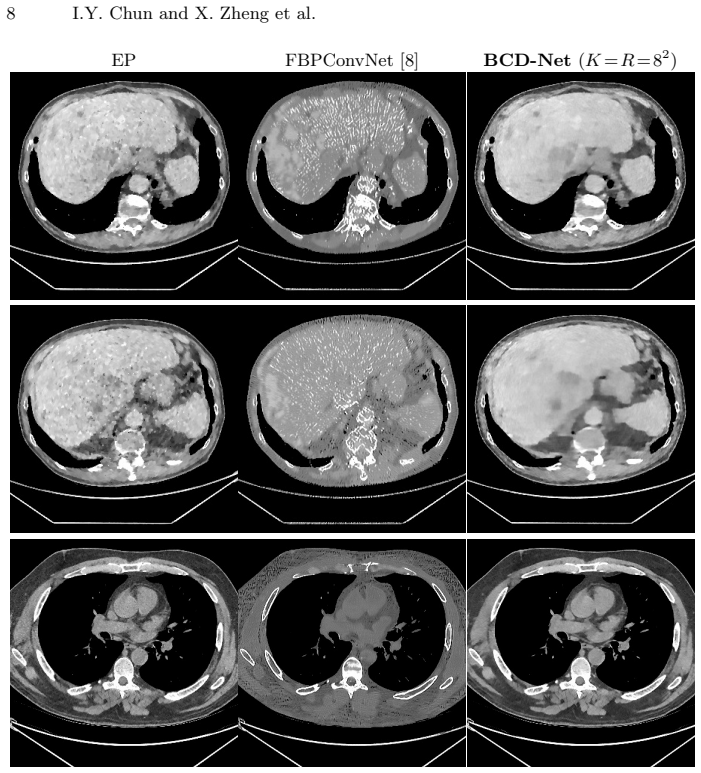
- On clinical data, BCD-Net retains image quality while FBPConvNet shows high overfitting risk, indicating that MBIR modules regularize regression-CNN overfitting.
- Under the asymptotic nonexpansiveness condition, the sequence of reconstructed images across BCD-Net layers converges, so the network settles at a fixed point instead of oscillating.
Reading between the lines
- Inference: the same two-module template should transfer to other inverse problems, since any learned denoiser paired with a data-fidelity solver may inherit the regularization benefit observed here.
- Inference: a testable extension is to enforce asymptotic nonexpansiveness explicitly during training, for example by normalizing filter gains, which would turn the empirical condition into a guaranteed premise for Theorem 2.
- Inference: the excluded non-negativity constraint suggests a follow-up proof using proximal operators for the constraint; if the guarantee extends to that case, the theorem would exactly match the implemented algorithm.
- Inference: the observed trade-off between inner MBIR iterations and number of network layers implies that layer count and iterations per layer could be co-optimized to reach a target RMSE with less total computation than current unrolled networks.
Signed reviews
Editorial analysis
A structured set of objections, weighed in public.
Referee Report
Summary. The manuscript modifies BCD-Net, an iterative regression CNN, for low-dose CT reconstruction. The modifications include layer-wise autoencoding CNNs with exponential threshold parameters and the use of an accelerated proximal gradient with majorizer (APG-M) solver in the MBIR modules. The paper claims a sequence-convergence guarantee (Theorem 2) under an asymptotic nonexpansiveness condition on the paired denoising CNNs, and presents phantom and clinical experiments that report lower RMSE than a learned-transform MBIR method and ADMM-Net, and better generalization than FBPConvNet.
Significance. The empirical findings, if reproduced without hyperparameter tuning on test data, would support the value of embedding MBIR modules in iterative CNNs for CT. The comparison with FBPConvNet and ADMM-Net is a useful contribution to the literature. However, the central convergence claim is presented as a theorem without proof and with hypotheses that are neither verified nor matched to the implemented algorithm; the comparison protocol includes test-set tuning. As it stands, the manuscript does not substantiate the convergence or generalization claims at the level expected of a journal publication.
major comments (3)
- [Section 2.3, Theorem 2 and Fig. S.1] The convergence result is stated without proof, and it does not cover the algorithm actually implemented. The theorem explicitly disregards the non-negativity constraints in (P1), whereas Algorithm 1 and the APG-M update in Eq. (2) include the projection [·]+; the constraint is active in CT attenuation imaging. Moreover, Fig. S.1(b) does not support the assumption of asymptotic nonexpansiveness: the vertical axis spans 1.00 to 1.02, and the plotted empirical Lipschitz constants appear to remain above 1, contradicting the text's claim that they converge to a value below 1. The theorem's hypothesis (Definition 1) therefore remains unverified for the trained networks. The authors should either supply a complete proof, adapt the theorem to the projected algorithm, or remove the convergence claim from the abstract and title.
- [Section 3.1 and S.2] Hyperparameters for the comparison methods are tuned on the test data, which biases the reported improvements. The ADMM-Net penalty parameter is chosen by matching spatial resolution on test sample #1 (Section 3.1), and the BCD-Net regularization parameter β is set separately for each clinical image (Section S.2, with β = 3×10^6 for the first two images and β = 0.08 for the third). This makes the generalization comparison with FBPConvNet unfair, since FBPConvNet is evaluated with a single fixed architecture. Hyperparameters should be selected on a validation set, and the sensitivity of the reported RMSE values to those choices should be reported.
- [Section 3, Table 1] The quantitative evidence consists of three phantom test images and three clinical images, with no error bars, repeated trials, or statistical significance tests. The abstract's claim that BCD-Net 'significantly' improves accuracy is not supported by the reported numbers: for example, the RMSE gaps between BCD-Net (K=R=8^2) and ADMM-Net are about 0.6–1.4 HU on three samples. The authors should either provide more test cases or quantify uncertainty, and should moderate the 'significantly' language accordingly.
minor comments (6)
- [Section 2.3, Definition 1] The theorem assumes ATWA≻0; the paper does not discuss whether this holds for the CT system matrix and weighting used in the experiments, especially for truncated or missing-view sinograms.
- [Section 3.2, first paragraph] The sentence 'APG-M is faster than PG-M (i.e., APG-M using no 'momentum')' is confusing; presumably PG-M is the method without momentum, not APG-M. Please rephrase.
- [Fig. 1] The figure lacks axis labels and a legend; the x-axis appears to be iteration count and the y-axis RMSE, but this should be stated in the caption.
- [Supplementary Fig. S.1] There is a typo 'Lipchitz'; also the y-axis of panel (b) is not labeled and the chosen range [1.00, 1.02] is not justified.
- [Algorithm 2] The training loop does not specify how the MBIR subproblem is solved (e.g., with the same J APG-M iterations as in Algorithm 1, or exactly). This should be clarified because the number of inner iterations is a free parameter that affects training.
- [Section S.2] The per-image β values for the clinical images (3×10^6 and 0.08) differ by seven orders of magnitude with no explanation; even for per-image tuning, such a jump seems unusual and should be justified.
Circularity Check
No significant circularity: empirical comparisons are external and the convergence theorem is conditional, not a reduced prediction.
full rationale
The paper's claimed contributions are (i) architectural modifications of the authors' prior BCD-Net [4] with faster MBIR solvers and (ii) a convergence property. The central empirical claims—BCD-Net improves accuracy over learned-transform MBIR, ADMM-Net, and FBPConvNet—are evaluated on separate XCAT phantom and clinical test data against external baselines, with RMSE values reported in Table 1. These results are not constructed from the method's own fitted parameters; the layer-wise training loss (P2) trains denoising CNNs on previous-layer reconstructions, and the MBIR module (P1) is subsequently applied to test measurements. No prediction is algebraically identical to a training loss or to a fitted input. The self-citations to [4], [5], and [6] provide the architecture, majorizer design, and Definition 1, but they serve as provenance and technical tools rather than as a substitute for the empirical comparison. The convergence result in Theorem 2 is conditional on the asymptotic-nonexpansiveness assumption in Definition 1 and explicitly 'disregard[s] the non-negativity constraints' used in Algorithm 1; the supplementary Fig. S.1 offers only empirical measures and does not establish the assumption, with the plotted Lipschitz constants appearing above 1. This is an unsupported premise and a correctness risk, not a circular derivation: the theorem does not assume its own conclusion, and no fitted value is renamed as a prediction. Accordingly, no circular step meeting the required reduction standard is present.
Assumptions & free parameters
free parameters (3)
- beta (regularization parameter in (P1)) =
4e6 (phantoms), 3e6 and 0.08 (clinical images)
- ADMM-Net penalty parameter =
1e6
- Number of APG-M iterations J per MBIR module =
20 (as used in convergence experiments)
assumptions (4)
- domain assumption Poisson-Gaussian noise model with weighting W_mm = rho_m^2 / (rho_m + sigma^2)
- ad hoc to paper Paired denoising CNNs are asymptotically nonexpansive with summable epsilon (Definition 1)
- standard math ATWA is positive definite
- domain assumption Circulant boundary condition without filter flip for convolutions in (1)
Cite this review
Pith. "Pith review of BCD-Net for Low-dose CT Reconstruction: Acceleration, Convergence, and Generalization." pith.science (2026). https://pith.science/paper/3UWD7WN5
@misc{pith2026190801287,
  author       = {Pith},
  title        = {Pith review of: BCD-Net for Low-dose CT Reconstruction: Acceleration, Convergence, and Generalization},
  year         = {2026},
  howpublished = {\url{https://pith.science/paper/3UWD7WN5}},
  note         = {Machine review of arXiv:1908.01287}
}
read the original abstract
Obtaining accurate and reliable images from low-dose computed tomography (CT) is challenging. Regression convolutional neural network (CNN) models that are learned from training data are increasingly gaining attention in low-dose CT reconstruction. This paper modifies the architecture of an iterative regression CNN, BCD-Net, for fast, stable, and accurate low-dose CT reconstruction, and presents the convergence property of the modified BCD-Net. Numerical results with phantom data show that applying faster numerical solvers to model-based image reconstruction (MBIR) modules of BCD-Net leads to faster and more accurate BCD-Net; BCD-Net significantly improves the reconstruction accuracy, compared to the state-of-the-art MBIR method using learned transforms; BCD-Net achieves better image quality, compared to a state-of-the-art iterative NN architecture, ADMM-Net. Numerical results with clinical data show that BCD-Net generalizes significantly better than a state-of-the-art deep (non-iterative) regression NN, FBPConvNet, that lacks MBIR modules.
Figures

Reference graph
Works this paper leans on
-
[1]
Aggarwal, H.K., Mani, M.P., Jacob, M.: MoDL : Model based deep learning architecture for inverse problems. IEEE Trans. Med. Imag. 38(2), 394--405 (Feb 2019)
work page 2019
-
[2]
Beck, A., Teboulle, M.: A fast iterative shrinkage-thresholding algorithm for linear inverse problems. SIAM J. Imaging Sci. 2(1), 183--202 (Mar 2009)
work page 2009
-
[3]
Chan, S.H., Wang, X., Elgendy, O.A.: Plug-and-play ADMM for image restoration: fixed-point convergence and applications. IEEE Trans. Comput. Imag. 3(1), 84--98 (Mar 2017)
work page 2017
- [4]
-
[5]
Convolutional Analysis Operator Learning: Acceleration and Convergence
Chun, I.Y., Fessler, J.A.: Convolutional analysis operator learning: A cceleration and convergence. submitted (Jan 2019), https://arxiv.org/abs/1802.05584
work page Pith review arXiv 2019
-
[6]
Chun, I.Y., Huang, Z., Lim, H., Fessler, J.A.: Momentum-Net : F ast and convergent recurrent neural network for inverse problems. preprint (Feb 2019)
work page 2019
-
[7]
Fessler, J.A., Rogers, W.L.: Spatial resolution properties of penalized-likelihood image reconstruction methods: Space-invariant tomographs. IEEE Trans. Image Process. 5(9), 1346--58 (Sep 1996)
work page 1996
-
[8]
Jin, K.H., McCann, M.T., Froustey, E., Unser, M.: Deep convolutional neural network for inverse problems in imaging. IEEE Trans. Image Process. 26(9), 4509--4522 (Sep 2017)
work page 2017
Show all 17 references
-
[9]
In: Proc
Kingma, D.P., Ba, J.L.: Adam: A method for stochastic optimization. In: Proc. ICLR 2015 . pp. 1--15. San Diego, CA (May 2015)
2015
-
[10]
Rockafellar, R.T.: Monotone operators and the proximal point algorithm. SIAM J. Control Optm. 14(5), 877--898 (Aug 1976)
1976
-
[11]
Romano, Y., Elad, M., Milanfar, P.: The little engine that could: Regularization by denoising ( RED ). SIAM J. Imaging Sci. 10(4), 1804--1844 (Oct 2017)
2017
-
[12]
Segars, W.P., Mahesh, M., Beck, T.J., Frey, E.C., Tsui, B.M.: Realistic CT simulation using the 4D XCAT phantom. Med. Phys. 35(8), 3800--3808 (Jul 2008)
2008
-
[13]
Taylor, A.B., Hendrickx, J.M., Glineur, F.: Exact worst-case performance of first-order methods for composite convex optimization. SIAM J. Optim. 27(3), 1283--1313 (Jan 2017)
2017
-
[14]
In: Proc
Yang, Y., Sun, J., Li, H., Xu, Z.: Deep ADMM-Net for compressive sensing MRI . In: Proc. NIPS 29 . pp. 10--18. Long Beach, CA (Dec 2016)
2016
-
[15]
submitted (Feb 2019), http://arxiv.org/abs/1711.00905
Zheng, X., Chun, I.Y., Li, Z., Long, Y., Fessler, J.A.: Sparse-view X -ray CT reconstruction using _1 prior with learned transform. submitted (Feb 2019), http://arxiv.org/abs/1711.00905
2019 arXiv
-
[16]
, " * write output.state after.block = add.period write
ENTRY address author booktitle chapter doi edition editor eid howpublished institution journal key month note number organization pages publisher school series title type url volume year label INTEGERS output.state before.all mid.sentence after.sentence after.block FUNCTION in...
-
[17]
write newline
" write newline "" before.all 'output.state := FUNCTION n.dashify 't := "" t empty not t #1 #1 substring "-" = t #1 #2 substring "--" = not "--" * t #2 global.max substring 't := t #1 #1 substring "-" = "-" * t #2 global.max substring 't := while if t #1 #1 substring * t #2 gl...
Reviewed August 14, 2026 · model on record in the stance chip above.
Discussion (0). Continue with ORCID to comment.