REVIEW 3 major objections 4 minor 1 cited by
Stability of cosmological singularity-free solutions in quadratic gravity
T0 review · 3 major / 4 minor · reviewed 2026-08-11 · deepseek-v4-flash
Pith's one-line read Quadratic gravity's singularity-free universes are unstable and can tip into a Big Bang.
desk verdict The instability claim rests on a questionable pointwise Hessian criterion, but the paper contains a genuinely new eigenvalue analysis and deserves a serious referee. read the letter →
The pith
A machine-rendered reading of the paper's core claim, the machinery that carries it, and where it could break.
The reading
What carries the argument
The load-bearing object is the Hessian matrix (21), the second variation of the gravitational action on the minisuperspace, i.e. the reduced configuration space parametrized by $(a,\dot a,\ddot a)$ for a flat FLRW metric. Its entries mix the parameters $\gamma$, $\Lambda$, $\alpha$, $\beta$, the matter density $\rho_0$ and equation-of-state $\omega$, together with the scale factor and its time derivatives. The stability verdict is read from the time-dependent eigenvalues and eigenvectors of this matrix evaluated on a background nonsingular solution: positive definiteness would mean stability, while the observed non-positive eigenvalues -- and the dominant eigenvector pointing to expansion at the bounce -- signal instability.
What would settle it
Compute the full linearized perturbation spectrum, including inhomogeneous scalar, vector, and tensor modes, around the nonsingular solution of Figure 10: if every physical gauge-invariant mode decays for the same parameters, the claimed instability is not established, while a growing inhomogeneous mode would make it stronger than claimed. A simpler check is to integrate nearby initial conditions around the same background and look for the first trajectory whose scale factor reaches zero.
Extended reading notes
Core claim
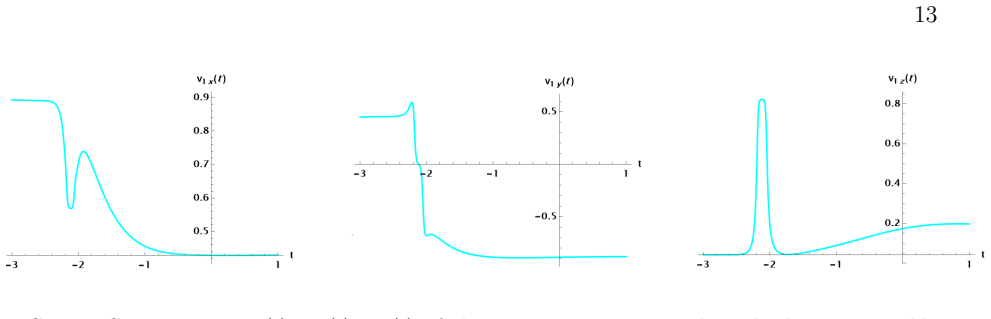
The central claim is that the nonsingular FLRW solutions of quadratic gravity found in the unstable de Sitter branch $3\alpha<\beta$ are dynamically unstable. The evidence is the second-order variation of the reduced action: the Hessian matrix (21) in the variables $(a,\dot a,\ddot a)$ has a spectrum that is not positive definite, with the dominant unstable eigenvalue growing without bound at the time $t_c\approx2.12$ when the scale factor reaches its near-zero minimum $a(t_c)\approx0.028$. At that moment the associated eigenvector has $\dot a\approx0$ and $\ddot a>0$, exactly the signature of expansion. The paper therefore asserts that perturbations drive a transition from a contraction-then-expansion nonsingular universe into a singular Big Bang solution, and that this instability is intrinsic to the singularity-free branch rather than an artifact of initial conditions.
Load-bearing premise
The instability verdict assumes that positivity of the Hessian matrix (21) in the reduced variables $(a,\dot a,\ddot a)$ is the correct stability criterion for this constrained, higher-derivative gravitational system, and that the single numerically integrated solution of Figure 10 is representative of the whole nonsingular family.
Editorial extensions
If this is right
- In the regime $3\alpha<\beta$, the nonsingular cosmological solutions sit at a dynamical threshold: small parameter changes can turn them into solutions with a Big Bang.
- The same analysis implies that the bounce-like phase is transient rather than periodically recurring, because the fastest-growing mode near the minimal scale factor drives expansion away from the contracting phase.
- The instability is visible already within the homogeneous, isotropic ansatz, so restoring isotropy is not what protects the nonsingular branch; the destabilizing direction is present in the reduced action itself.
- Since the condition $3\alpha=\beta$ reduces the FLRW action to an $f(R)$ model of the $R^2$ type, the nonsingular family belongs specifically to the sector where the scalaron mass is imaginary, linking the instability to the ghost-like content of the theory.
Reading between the lines
- The paper only perturbs within the homogeneous, isotropic ansatz; whether inhomogeneous scalar, vector, or tensor modes make the nonsingular branch more unstable, or instead stabilize it, remains untested.
- Because the Hessian diverges as the scale factor approaches zero, the analysis suggests a testable gradient: nonsingular solutions with smaller minimal $a(t)$ should be progressively more unstable, a prediction that could be checked by scanning the family of solutions numerically.
- If the instability survives a gauge-invariant treatment, bouncing and ekpyrotic scenarios built on this branch of quadratic gravity would need an external stabilizing mechanism or would not persist as long-lived cosmological histories.
Editorial analysis
A structured set of objections, weighed in public.
Referee Report
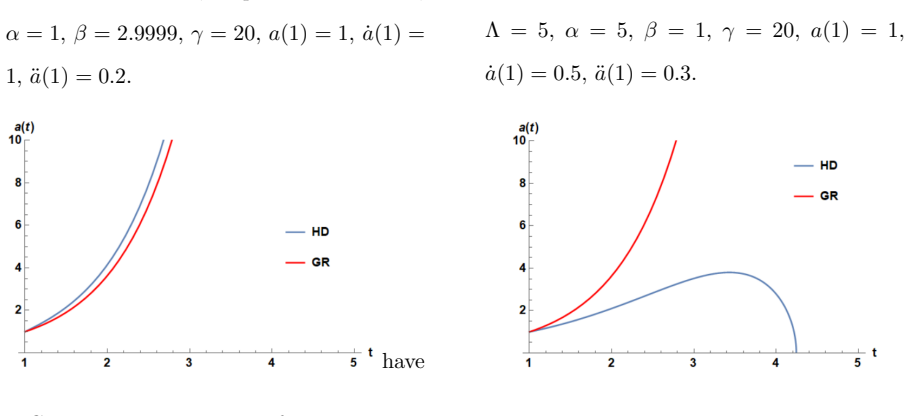
Summary. The paper studies homogeneous and isotropic FLRW solutions in quadratic gravity with action (1), focusing on the regime 3α < β where the de Sitter branch is unstable. It presents numerical solutions showing that this regime admits singularity-free bouncing universes (Figure 9, Figure 10) in addition to collapsing and singular solutions. The central claim is that these nonsingular solutions are unstable: the authors compute the second variation of the action with respect to (a, ȧ, ä), forming the matrix (21), and from its time-dependent eigenvalues (Figure 11) and the associated eigenvector (Figure 12) conclude that a Big Bang can emerge from the singularity-free regime when parameters are slightly modified. The paper also observes that on FLRW backgrounds the quadratic gravity action reduces to a Starobinsky-like f(R) form (19), since the Weyl tensor vanishes.
Significance. If the stability conclusion were rigorously established, the paper would make a useful contribution to the debate on singularity avoidance in higher-derivative gravity: it would show that the nonsingular classical solutions in the 3α < β branch are dynamically unstable, so that they cannot serve as a complete resolution of the initial singularity. The reduction to an f(R) form on FLRW backgrounds and the numerical identification of a large family of nonsingular solutions are interesting and potentially valuable. However, the paper's central claim rests on a stability criterion that is not justified for this constrained higher-derivative system, and the evidence is limited to one representative numerical solution with no error estimates or parameter scan. The paper is clearly written in its descriptive parts, but the stability analysis as presented does not meet the burden of proof for the strong statement in the abstract.
major comments (3)
- [Section V, Eq. (21) and Figures 10–12] The Hessian-positivity criterion used to conclude instability is not established for this higher-derivative, diffeomorphism-invariant system. The second variation of the action is an integral functional in which δȧ and δä are time derivatives of δa, not independent directions at a fixed time. Diagonalizing the pointwise matrix ∂²L/∂x_i∂x_j in (a, ȧ, ä) space does not yield a Lyapunov spectrum, and a negative eigenvalue of this matrix does not by itself imply a growing solution of the linearized equations of motion. The manuscript must either prove that this criterion is equivalent to a standard dynamical stability analysis for this constrained fourth-order system, or replace it with a direct analysis of the linearized perturbation equations (e.g., solving the perturbed equations of motion with appropriate boundary conditions). Without this, the central instability claim in the abstract is not supported.
- [Section V, 'the behavior of the family ... is qualitatively the same' and Figure 10] The stability verdict is based on a single numerically integrated solution, with no code, data, or error estimates provided. The text asserts that the family of nonsingular solutions behaves qualitatively the same, but no parameter scan or second example is shown. Moreover, the abstract claims that a Big Bang emerges when parameters are slightly modified, yet the paper never integrates nearby parameters or perturbed initial data to demonstrate that the scale factor actually crosses a = 0. Providing a small parameter scan around the Figure 10 solution and explicitly integrating a nearby trajectory that becomes singular would be necessary to substantiate that load-bearing claim.
- [Section V, eigenvector analysis around t_c] The identification of the eigenvector direction with 'expansion' is not meaningful without a valid dynamical interpretation of the Hessian eigenvectors. Even if the Hessian criterion were accepted, the statement that v1y ≈ 0 and v1z > 0 corresponds to expansion around the critical time conflates an instantaneous direction in the finite-dimensional configuration space (a, ȧ, ä) with the time evolution of a physical perturbation. The manuscript should clarify how the eigenvector components relate to a growing mode of the actual equations of motion, or avoid this interpretive claim.
minor comments (4)
- [Throughout] The manuscript contains several typos and grammatical errors that should be corrected, e.g., 'homegeneous' (Section IV), 'wievpoint' and 'o the fact' (Section VI), 'the of the vanishing' (Section V), and 'under homogeneous perturbations are stable or not' (Section V).
- [Section V, Eq. (21)] The matrix (21) is introduced without derivation, and the prefactor '24' as well as the layout of the matrix entries are not fully clear as typeset. The authors should present the explicit second-order variation of the action, including the treatment of boundary terms, so that the reader can verify the quadratic form.
- [Abstract and Section VI] The abstract states that 'the complete analysis shows that a Big Bang can emerge from a singularity-free regime,' while Section V concludes that the analysis 'suggests the existence of an instability.' The wording should be aligned; the stronger claim is not supported by the current evidence.
- [Section III, Eq. (17)] The relation ˙E_b = ˙a b E_a appears dimensionally odd; if this is a typo, it should be fixed, and if not, the notation should be defined more carefully.
Circularity Check
No circular derivation: the singularity-free solutions and the second variation of the action are computed from the same quadratic-gravity action by the standard variational criterion, with no fitted parameter renamed as a prediction.
full rationale
The paper's central chain is: choose the Stelle action (1), specialize to FLRW (7), solve the vacuum/matter equations (15)-(16), obtain nonsingular solutions in the 3α<β branch (Figures 9-10), then evaluate the Hessian (21) of the same action at such a solution and read off its eigenvalues. Each ingredient is independently stated in the paper (Eqs. 1, 7, 15, 16, 21), and none is defined in terms of the conclusion. The instability claim is a standard variational-stability assessment, not a fitted parameter or an external datum; no constants are tuned to force the eigenvalues to be negative, and no 'prediction' is stated that was used as an input. The two self-citations ([6] and [8]) appear in the introduction as background on ghosts and are not load-bearing for the stability computation; reference [22] on de Sitter stability is external. Possible methodological objections—that the pointwise Hessian in (a, ȧ, ä) may not be a valid Lyapunov criterion for a fourth-order constrained system, or that one representative solution is used for the whole family—concern correctness and representativeness, not circularity, and therefore do not raise the circularity score. The score of 1 reflects only the minor presence of non-load-bearing self-citations; there is no reduction of the central result to its own inputs.
Assumptions & free parameters
free parameters (6)
- higher-curvature couplings α and β =
α=3, β=16 (Fig. 9); α=4, β=19 (Fig. 10)
- cosmological constant Λ =
Λ=1.5 (Fig. 9); Λ=0.5 (Fig. 10)
- Planck-scale coefficient γ =
γ=10 in all figures
- matter amplitude ρ0 =
ρ0=15 (Fig. 9); ρ0=1.66 (Fig. 10)
- equation-of-state parameter ω =
ω=0 (matter) in Figs. 9-10
- initial conditions a(1), ȧ(1), ä(1) =
1, 0.8, 0.7 (Fig. 9); 1, 0.8, 0.7 (Fig. 10)
assumptions (6)
- domain assumption On FLRW backgrounds the Weyl tensor vanishes, so the quadratic gravity action (1) reduces to the Starobinsky-like action (19) with coefficient (3α−β)/3.
- standard math Gauss-Bonnet and □R terms can be neglected because they are topological or total derivatives on the relevant backgrounds.
- domain assumption Diffeomorphism invariance permits the gauge choice b(t)=1 in the FLRW metric.
- domain assumption Inserting the FLRW ansatz into the action before variation is equivalent to using the full field equations restricted to the ansatz.
- ad hoc to paper The eigenvalues of the Hessian matrix (21) determine the stability or instability of the nonsingular background.
- domain assumption The matter content is a perfect fluid with equation of state p=ωρ and conserved energy-momentum.
Cite this review
Pith. "Pith review of Stability of cosmological singularity-free solutions in quadratic gravity." pith.science (2026). https://pith.science/paper/3VDWYOO4
@misc{pith2026241210111,
  author       = {Pith},
  title        = {Pith review of: Stability of cosmological singularity-free solutions in quadratic gravity},
  year         = {2026},
  howpublished = {\url{https://pith.science/paper/3VDWYOO4}},
  note         = {Machine review of arXiv:2412.10111}
}
abstract
We introduce a large family of homogeneous and isotropic cosmological solutions in quadratic gravity which are singularity-free at early and late times. This kind of smooth solutions only emerges beyond the unstable de Sitter branch $3\alpha < \beta$, $\alpha$ being the coupling of the $R^2$ term and $-\beta$ the coupling of the $R_{\mu\nu}^2$ term. We have analyzed the stability of these singularity-free solutions by computing the second-order variation of the action. The complete analysis shows that a Big Bang can emerge from a singularity-free regime when the parameters of the theory are slightly modified, revealing the unstable nature of this type of solutions.
Figures


Figures from the paper (5 more)


Forward citations
Cited by 1 Pith paper
-
Unstable de Sitter inflationary solution in sixth-order gravity
For the sixth-order gravity action (2.1), the exact FLRW de Sitter solution is unstable whenever 3γ1+γ2<0, while the second-order limit admits a stable de Sitter attractor.
Reference graph
Works this paper leans on
-
[24]
I. Kuntz and R. Casadio. Singularity avoidance in quantum gravity. Phys. Lett. B, 802:135219,
-
[22]
A. V. Toporensky and P. V. Tretyakov. De Sitter stability in quadratic gravity. International Journal of Modern Physics D , 16(06):1075–1085, 2007. doi:10.1142/s0218271807010572
-
[1]
M. Goroff and A. Sagnotti. The Ultraviolet Behavior of Einstein Gravity. Nucl. Phys. B , 266:709–736, 1986. doi:10.1016/0550-3213(86)90193-8
-
[2]
K. S. Stelle. Renormalization of Higher Derivative Quantum Gravity. Phys. Rev. D , 16:953– 969, 1977. doi:10.1103/PhysRevD.16.953
-
[3]
K. S. Stelle. Classical Gravity with Higher Derivatives. Gen. Rel. Grav. , 9:353–371, 1978. doi:10.1007/BF00760427
-
[4]
J. F. Donoghue and G. Menezes. On quadratic gravity, 2021. arXiv:2112.01974
arXiv 2021
-
[5]
R. P. Woodard. Ostrogradsky’s theorem on Hamiltonian instability. Scholarpedia, 10(8):32243,
- [6]
Show all 29 references
-
[7]
F. Sbis` a. Classical and quantum ghosts. European Journal of Physics , 36(1):015009, 2014. doi:10.1088/0143-0807/36/1/015009
2014 doi
-
[8]
Asorey, L
M. Asorey, L. Rachwal, and I. L. Shapiro. Unitary Issues in Some Higher Derivative Field Theories. Galaxies, 6(1):23, 2018. doi:10.3390/galaxies6010023. 15
2018 doi
-
[9]
I. Kuntz. Exorcising ghosts in quantum gravity. Eur. Phys. J. Plus , 135(10):859, 2020. doi:10.1140/epjp/s13360-020-00875-x
2020 doi
-
[10]
J. F. Donoghue and G. Menezes. Ostrogradsky instability can be overcome by quantum physics. Physical Review D , 104(4), 2021. doi:10.1103/physrevd.104.045010
2021 doi
-
[11]
Deffayet, S
C. Deffayet, S. Mukohyama, and A. Vikman. Ghosts without runaway instabilities. Phys. Rev. Lett., 128:041301, 2022. doi:10.1103/PhysRevLett.128.041301
2022 doi
-
[12]
P. D. Mannheim. Solution to the ghost problem in higher-derivative gravity. Nuovo Cim. C , 45(2):27, 2022. doi:10.1393/ncc/i2022-22027-6
2022 doi
-
[13]
Deffayet, A
C. Deffayet, A. Held, S. Mukohyama, and A. Vikman. Global and local stability for ghosts coupled to positive energy degrees of freedom, 2023
2023
-
[14]
A. A. Starobinsky. A New Type of Isotropic Cosmological Models Without Singularity. Phys. Lett. B, 91:99–102, 1980. doi:10.1016/0370-2693(80)90670-X
1980 doi
-
[15]
Akrami et al
Y. Akrami et al. Planck 2018 results. X. Constraints on inflation. Astron. Astrophys., 641:A10,
2018
-
[16]
H. J. Schmidt. Fourth order gravity: Equations, history, and applications to cosmology. eConf, C0602061:12, 2006. doi:10.1142/S0219887807001977
2006 doi
-
[17]
Alvarez-Gaume et al
L. Alvarez-Gaume et al. Aspects of Quadratic Gravity. Fortsch. Phys., 64(2-3):176–189, 2016. doi:10.1002/prop.201500100
2016 doi
-
[18]
A. Salvio. Quadratic Gravity. Front. in Phys., 6:77, 2018. doi:10.3389/fphy.2018.00077
2018
-
[19]
C. P. Burgess. Quantum gravity in everyday life: General relativity as an effective field theory. Living Reviews in Relativity , 7(1), 2004. doi:10.12942/lrr-2004-5
2004 doi
-
[20]
Iihoshi, S
M. Iihoshi, S. V. Ketov, and A. Morishita. Conformally flat FR W metrics. Progress of Theoretical Physics, 118(3):475–489, 2007. doi:10.1143/ptp.118.475
2007 doi
-
[21]
De Felice and S
A. De Felice and S. Tsujikawa. f(R) theories. Living Rev. Rel. , 13:3, 2010. doi:10.12942/ lrr-2010-3
2010
-
[23]
Middleton and J
J. Middleton and J. D. Barrow. The Stability of an Isotropic Cosmological Singularity in Higher-Order Gravity. Phys. Rev. D , 77:103523, 2008. doi:10.1103/PhysRevD.77.103523
2008 doi
-
[25]
Khoury, B
J. Khoury, B. A. Ovrut, P. J. Steinhardt, and N. Turok. The Ekpyrotic universe: Colliding branes and the origin of the hot big bang. Phys. Rev. D , 64:123522, 2001. doi:10.1103/ PhysRevD.64.123522
2001
-
[26]
Miranda, D
M. Miranda, D. Vernieri, S. Capozziello, and F. S. N. Lobo. Bouncing cosmology in fourth- order gravity. Universe, 8(3):161, 2022. doi:10.3390/universe8030161
2022 doi
-
[27]
doi:10.1016/j.physletb.2020.135219. 16
2020
-
[2015]
doi:10.4249/scholarpedia.32243
-
[2020]
doi:10.1051/0004-6361/201833887
Reviewed August 11, 2026 · model on record in the stance chip above.
Discussion (0). Continue with ORCID to comment.