REVIEW 3 major objections 6 minor 19 references
Best Practices for First-Principles Modeling of Amorphous Oxide Semiconductors: A Statistical Framework and Application to Zn-Sn-O
T0 review · 3 major / 6 minor · reviewed 2026-07-10 · glm-5.2
Pith's one-line read Statistical DFT shows Zn-Sn-O matches IGZO performance but shares its hydrogen flaw
desk verdict Solid statistical DFT framework for amorphous Zn-Sn-O, but the hydrogen 'doping' claim overreaches the binding-energy evidence read the letter →
The pith
A machine-rendered reading of the paper's core claim, the machinery that carries it, and where it could break.
The reading
What carries the argument
The Inverse State Weighted Overlap (ISWO), a dimensionless metric that measures how spatially connected and energetically close the electronic states near the conduction-band edge are, serving as a proxy for electron mobility in materials where the band-structure concept of effective mass is invalid because translational symmetry is absent. The decorate-and-relax method for generating amorphous structural models, combined with ensemble sizes of ~20 models per composition and ~200 atoms per model, provides the statistical power needed to distinguish real trends from noise.
What would settle it
If experimental field-effect mobility measurements on amorphous Zn-Sn-O films with varying zinc-to-tin ratios show strong composition-dependent variation, the claim that the electronic properties are composition-insensitive would be undermined. If hydrogen-exposure experiments on Zn-Sn-O transistors show no threshold-voltage shift, the claim of shared hydrogen sensitivity with IGZO would be falsified.
Extended reading notes
Core claim
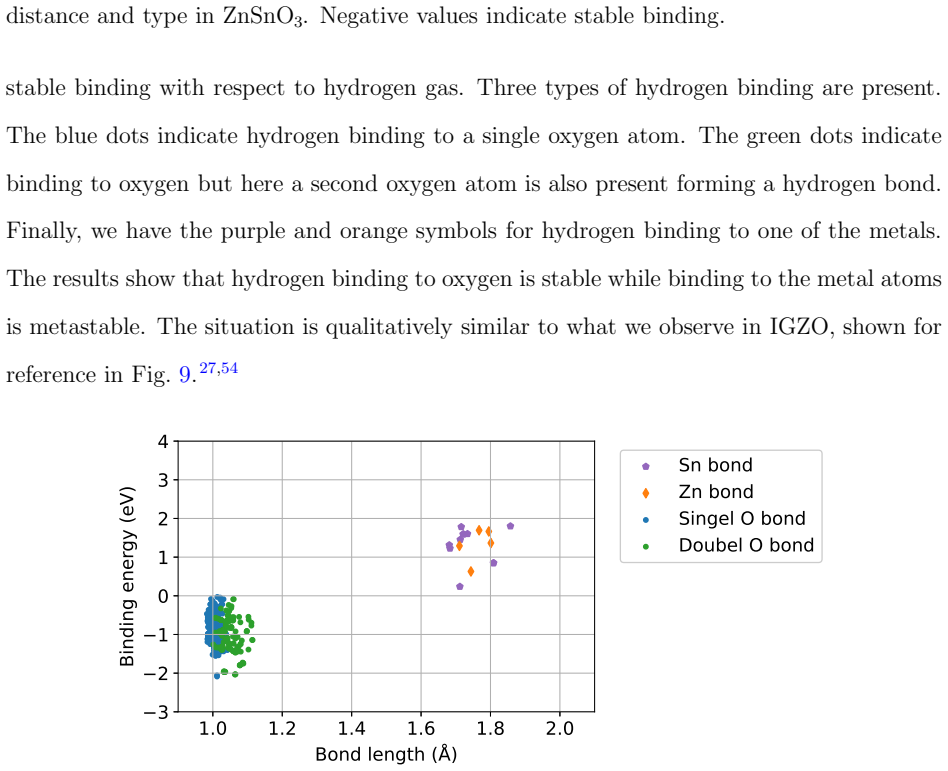
When amorphous Zn-Sn-O is modeled with proper statistical sampling across many independently generated structural models, its electronic gap and a mobility-proxy metric called the Inverse State Weighted Overlap (ISWO) are remarkably stable across different zinc-to-tin ratios, suggesting compositional variation in real devices would not degrade performance. But the same computations show that oxygen is bound more weakly than in IGZO and that interstitial hydrogen binds stably to oxygen atoms throughout the amorphous network, indicating that the hydrogen-doping instability observed in IGZO transistors would likely persist in Zn-Sn-O.
Load-bearing premise
The ISWO metric, introduced by the same authors in prior work, is assumed to be a valid proxy for real electron mobility in amorphous oxides, but no experimental comparison between ISWO values and measured field-effect mobilities is provided to confirm this connection.
Editorial extensions
If this is right
- Researchers publishing DFT results on amorphous oxides should be expected to report distributions over multiple structural models, not single-cell values, and to test whether those distributions are statistically significant.
- The ISWO metric could be applied to other candidate amorphous oxide semiconductors to rank their likely electron mobility without requiring experimentally validated effective masses.
- The finding that oxygen binding in Zn-Sn-O is weaker than in IGZO suggests that process integration steps involving forming-gas anneals or oxygen-poor deposition conditions may require the same engineering mitigations developed for IGZO.
- The compositional stability of the bandgap in Zn-Sn-O could relax manufacturing tolerances for the metal ratio in deposited films, potentially lowering production cost.
Signed reviews
Editorial analysis
A structured set of objections, weighed in public.
Referee Report
Summary. This manuscript presents a first-principles DFT study of amorphous Zn-Sn-O oxide semiconductors, framed as both a methodological best-practices guide and a materials assessment. The authors generate ensembles of ~20 amorphous supercell models (~200 atoms each) for four Zn:Sn stoichiometric ratios, compute electronic gaps and an inverse state weighted overlap (ISWO) mobility proxy, and compare oxygen off-stoichiometry and interstitial hydrogen binding to the IGZO benchmark. The central conclusions are: (1) Zn-Sn-O is a promising performance alternative to IGZO due to favorable conduction-band character and compositional stability of the gap; (2) Zn-Sn-O exhibits similar sensitivity to hydrogen-induced doping as IGZO. The statistical framework—Shapiro-Wilk normality tests, t-tests with reported p-values, and honest reporting of non-significant results—is a genuine strength. However, the second conclusion overreaches the evidence presented, as detailed below.
Significance. The paper's methodological advocacy for statistical sampling of amorphous structural models is well-motivated and timely. The generation of over 1250 DFT calculations with systematic convergence checks, the transparent reporting of non-significant p-values for oxygen off-stoichiometry (Table 4), and the exhaustive hydrogen site screening (~1000 sites) are commendable. The ISWO metric provides a falsifiable, parameter-free proxy for mobility that avoids the well-identified pitfall of applying Bloch theorem concepts to amorphous phases. The identification of gap stability across compositions as a device-relevant advantage is a concrete, testable prediction.
major comments (3)
- The claim of 'similar sensitivity to hydrogen induced doping' (Abstract, Conclusions section) is not supported by the analysis presented. Figs. 7-9 report only binding energies and nearest-neighbor bond types for interstitial hydrogen. Stable hydrogen binding to oxygen does not automatically imply n-type doping; whether interstitial H acts as a shallow donor depends on its charge transition level relative to the conduction band minimum. The paper does not compute charge transition levels, defect formation energies as a function of Fermi level position, or the electronic structure of the H-doped system (e.g., whether a donor state appears near the CBM). Without at least one of these analyses, the paper demonstrates similar hydrogen *binding* but not similar hydrogen *doping*. The authors should either (a) compute the H (+/0) transition level or the defect formation energy vs. Fermi level,
- The oxygen off-stoichiometry analysis (Fig. 5, Table 4) reports p-values of 0.36-0.86, indicating no statistically significant difference between stoichiometric and oxygen-reduced models for any composition. The text acknowledges this ('not a statistically significant trend'), yet the paper still draws physical conclusions from the median reaction energies (e.g., 'oxygen seems to be bound more weakly' with increasing Sn content, and 'all compositions are vulnerable to oxygen scavenging by H2 gas exposure'). The latter claim relies on comparing the computed binding energies to the H2O formation energy (2.58 eV), but since the distributions overlap substantially and the t-tests are non-significant, the vulnerability claim should be stated more cautiously, or additional sampling should be performed to achieve statistical significance. The tension between reporting non-significant p-values
- The ISWO metric (Refs. 52, 90) is the sole basis for all mobility conclusions, including the central claim that Zn-Sn-O is a 'promising material class' from a performance standpoint. While the conceptual motivation for replacing effective mass with a state-overlap metric in amorphous systems is sound, the paper provides no validation that ISWO correlates with experimentally measured field-effect mobilities in amorphous oxides. The IGZO reference value (green line in Figs. 3-4) is itself computed with the same metric and code. Without at least a qualitative comparison to experimental mobility data for Zn-Sn-O (which exists, e.g., Refs. 56-57), the performance assessment remains internally circular. The authors should either provide such a comparison or explicitly qualify that the performance claim rests on the ISWO proxy being a valid relative mobility indicator.
minor comments (6)
- Fig. 8 caption and legend contain typos: 'Singel O bond' should be 'Single O bond', 'Doubel O bond' should be 'Double O bond', and the y-axis label reads 'Binding energ' (missing 'y'). Fig. 9 has the same 'Binding energ' typo.
- The ISWO metric (Refs. 52, 90) is introduced without a compact mathematical definition in the main text. A brief equation or formal definition would improve accessibility for readers unfamiliar with the authors' prior work.
- The extension of hydrogen binding results from the 1:1 Zn:Sn ratio to other ratios is acknowledged as an assumption ('we estimate that the defect state results can be extended to other Zn:Sn ratios'). Given that the authors themselves note Zn-rich ratios optimize field-effect mobility (Ref. 57), this limitation is material. The text should state this more prominently, e.g., in the Conclusions rather than only in the Results section.
- Table 1 lists Zn2SnO2 with formula implying Zn:Sn = 2:1, but the text and figures refer to Zn2SnO4 for this ratio. The table entry 'Zn2SnO2' appears inconsistent with the stoichiometry discussed elsewhere (Zn2+ Sn4+ with 2:1:4 ratio). This should be corrected or clarified.
- The paper states that 20 models per composition are used, but the supplementary information (Figs. S1-S4) shows radial distribution functions averaged over 'all models' without specifying the count. The figure captions should state the number of models averaged.
- Section 'Substoichiometric oxygen content': the statement 'When calculating the distributions of only ten amorphous models per composition, no significantly different distributions... are obtained' is important for justifying the sample size but is mentioned only in passing. A brief table or figure comparing the 10-model vs. 20-model p-values would strengthen the best-practices argument.
Circularity Check
No significant circularity: self-citations are methodological tools, not fitted parameters or definitional reductions
full rationale
The paper's derivation chain is largely self-contained. The central claims about Zn-Sn-O performance and hydrogen sensitivity are supported by direct DFT computations (binding energies, ISWO values, bandgaps, oxygen reaction energies) performed on independently generated structural models. The ISWO metric (Refs. 52, 90 by overlapping authors) is a methodological tool — a defined quantity computed from electronic state overlaps — not a fitted parameter renamed as a prediction. The paper does not fit ISWO to experimental mobility data and then 'predict' mobility; it computes ISWO from first principles and compares distributions across compositions and against IGZO. The IGZO reference structure (Ref. 27) and the decorate-and-relax method (Ref. 52) are similarly methodological choices, not circular inputs. The hydrogen binding energy analysis compares computed distributions between ZnSnO3 and IGZO without fitting to the conclusion. No step in the derivation chain reduces to its own inputs by construction. The self-citations are normal methodological continuity, not load-bearing circular dependencies. The reader's concern about whether binding energy alone demonstrates 'doping' is a correctness/completeness issue, not a circularity issue.
Assumptions & free parameters
free parameters (4)
- Number of structural models per composition =
20
- Supercell size =
~200 atoms (structural), ~400 atoms (H-doping)
- ISWO energy window =
0.3 eV
- Hydrogen site grid spacing =
1.0 Å
assumptions (5)
- domain assumption The decorate-and-relax method produces representative amorphous structures
- domain assumption ISWO correlates with charge carrier mobility in amorphous oxides
- domain assumption PBEsol bandgaps preserve qualitative trends across compositions even though absolute values are underestimated
- domain assumption A single k-point (Γ) sampling is sufficient for the supercell sizes used
- ad hoc to paper Hydrogen binding results at 1:1 Zn:Sn ratio extend to other ratios
Cite this review
Pith. "Pith review of Best Practices for First-Principles Modeling of Amorphous Oxide Semiconductors: A Statistical Framework and Application to Zn-Sn-O." pith.science (2026). https://pith.science/paper/3WPN2V3D
@misc{pith2026260708667,
  author       = {Pith},
  title        = {Pith review of: Best Practices for First-Principles Modeling of Amorphous Oxide Semiconductors: A Statistical Framework and Application to Zn-Sn-O},
  year         = {2026},
  howpublished = {\url{https://pith.science/paper/3WPN2V3D}},
  note         = {Machine review of arXiv:2607.08667}
}
read the original abstract
Ternary and quaternary amorphous oxide semiconductors have many properties that make them promising candidates for use in electronic applications like display, memory, and back end of line logic. However, finding the right material for a given application and optimizing its properties, deposition, and integration, requires a thorough understanding of the physics and chemistry at play. When properly carried out, first principles computations can play a crucial role in enhancing this understanding. In this work, we highlight several pitfalls often observed in research applying these computations, with the Zn-Sn-O system as an example. We show that a proper understanding of the fundamental differences between the physics of the crystalline and amorphous or disordered phases is crucial, as is a proper statistical sampling of structural models. For the Zn-Sn-O system we conclude that from a performance point of view, mobility and initial threshold voltage, it is a promising material class. However, our computed results show that a similar sensitivity to hydrogen induced doping may be present as in IGZO.
Figures


Figures from the paper (6 more)



Reference graph
Works this paper leans on
-
[1]
(1) Nomura, K.; Ohta, H.; Takagi, A.; Kamiya, T.; Hirano, M.; Hosono, H . Room- temperature fabrication of transparent flexible thin-film transist ors using amorphous oxide semiconductors. Nature 2004, 432, 488–492. (2) Walsh, A.; Da Silva, J. L. F.; Wei, S.-H. Interplay between Order an d Disorder in the High Performance of Amorphous Transparent Conducting...
work page 2004
-
[2]
(19) Sharifi, S. H.; Chasin, A.; Fantini, A.; Dekkers, H.; Mao, M.; Nag, M .; Mertens, S.; Rao, S.; Jossart, N.; Crotti, D.; Kar, G. S. Sub- µm a-IGZO, Fully integrated, Pro- cess improved, Vertical diode for Crosspoint arrays. 2020 IEEE I nternational Memory Workshop (IMW)
work page 2020
-
[3]
(20) Belmonte, A.; Oh, H.; Rassoul, N.; Donadio, G.; Mitard, J.; Dekker s, H.; Del- hougne, R.; Subhechha, S.; Chasin, A.; van Setten, M. J.; Kljucar, L .; Mao, M.; Puliyalil, H.; Pak, M.; Teugels, L.; Tsvetanova, D.; Banerjee, K.; Souria u, L.; Tokei, Z.; Goux, L.; Kar, G. S. Capacitor-less, Long-Retention ( >400s) DRAM Cell Paving the Way towards Low-Po...
work page 2020
-
[4]
(21) Hiblot, G.; Rassoul, N.; Teugels, L.; Devriendt, K.; Chasin, A. V.; v an Setten, M. J.; Belmonte, A.; Delhougne, R.; Kar, G. S. Process-induced charging d amage in IGZO nTFTs. 2021 IEEE International Reliability Physics Symposium (IRPS )
work page 2021
-
[5]
(22) Han, H.; Jang, S.; Kim, D.; Kim, T.; Cho, H.; Shin, H.; Choi, C. Memory Char- acteristics of Thin Film Transistor with Catalytic Metal Layer Induce d Crystallized Indium-Gallium-Zinc-Oxide (IGZO) Channel. Electron. 2021, 11,
work page 2021
-
[6]
(23) Liu, J.; Tang, W.; Li, H.; Chen, D.; Long, W.; Liu, Y.; Jiang, C.; Yang, H.; Li, X. TFT- Based Near-Sensor In-Memory Computing: Circuits and Architect ure Perspectives of Large-Area eDRAM and ROM CiM Chips. IEEE Trans. Circuits Syst. I Regul. Pap. 2024, 71, 620–633. 24 (24) Endangered Elements. https://www.acs.org/green-chemistry-sustainability/resea...
work page 2024
-
[7]
(33) Vogt, K. T.; Malmberg, C. E.; Buchanan, J. C.; Mattson, G. W.; B randt, G. M.; Fast, D. B.; Cheong, P. H.-Y.; Wager, J. F.; Graham, M. W. Ultrabroa dband density of states of amorphous In-Ga-Zn-O. Phys. Rev. Research 2020, 2, 033358. (34) Kang, Y.; Lee, W.; Kim, J.; Keum, K.; Kang, S.-H.; Jo, J.-W.; Park, S . K.; Kim, Y.-H. Effects of crystalline stru...
work page 2020
-
[8]
(36) Wu, Z.; Chasin, A.; Franco, J.; Subhechha, S.; Dekkers, H.; Bhu vaneshwari, Y.; Bel- monte, A.; Rassoul, N.; van Setten, M.; Afanas’Ev, V.; Delhougne, R.; Kaczer, B.; Kar, G. Characterizing and Modelling of the BTI Reliability in IGZO-TFT u sing Light-assisted I-V Spectroscopy. 2022 International Electron Devices Meeting (IEDM)
work page 2022
Show all 19 references
-
[9]
26 (37) Rinaudo, P.; Chasin, A.; Franco, J.; Wu, Z.; Subhechha, S.; Arut chelvan, G.; Ene- man, G.; Ramana, B. Y. V.; Rassoul, N.; Delhougne, R.; Kaczer, B.; De W olf, I.; Kar, G. S. Degradation Mapping and Impact of Device Dimension on IG ZO TFTs BTI. IEEE Trans. Device Mater...
2023
-
[10]
D.; Putri, M.; Heo, Y.-W.; Lee, H
(41) Lestari, A. D.; Putri, M.; Heo, Y.-W.; Lee, H. Y. Influence of Oxy gen Partial Pressure on Radio Frequency Magnetron Sputtered Amorphous InZnSnO Th in Film Transis- tors. J. Nanosci. Nanotechnol. 2020, 20, 252–256. (42) Guo, H.-B.; Shan, F.; Kim, H.-S.; Lee, J.-Y.; Kim, N....
2020
-
[11]
Enhance- ment on carrier mobility in amorphous indium tin oxynitride (ITON) thin fi lms
27 (44) Avelar-Mu˜ noz, F.; Berumen, J.; Aguilar-Frutis, M.; Araiza, J.; Ortega, J. Enhance- ment on carrier mobility in amorphous indium tin oxynitride (ITON) thin fi lms. J. Alloys Compd. 2020, 835, 155353. (45) Park, J.-M.; Kim, H.-S. Ultra-High Mobility Transistors Via Meta...
2020
-
[12]
J.; Dekkers, H
28 (52) van Setten, M. J.; Dekkers, H. F. W.; Pashartis, C.; Chasin, A.; Belmonte, A.; Del- hougne, R.; Kar, G. S.; Pourtois, G. Complex amorphous oxides: pro perty prediction from high throughput DFT and AI for new material search. Materials Advances 2022, 3, 8413–8427. (53) ...
2022
-
[13]
T.; H¨ agglund, C.; Bent, S
(65) Tanskanen, J. T.; H¨ agglund, C.; Bent, S. F. Correlating Grow th Characteristics in Atomic Layer Deposition with Precursor Molecular Structure: The C ase of Zinc Tin Oxide. Chem. Mater. 2014, 26, 2795–2802. (66) Medvedeva, J. E.; Buchholz, D. B.; Chang, R. P. H. Recent A...
2014
-
[14]
P.; Burke, K.; Ernzerhof, M
(76) Perdew, J. P.; Burke, K.; Ernzerhof, M. Generalized Gradient Approximation Made Simple. Phys. Rev. Lett. 1996, 77, 3865–3868. (77) Perdew, J. P.; Ruzsinszky, A.; Csonka, G. I.; Vydrov, O. A.; Sc useria, G. E.; Con- stantin, L. A.; Zhou, X.; Burke, K. Restoring the Density...
1996
-
[15]
General Considerations. IMA J. Appl. Math. 1970, 6, 76–90. (85) Fletcher, R. A new approach to variable metric algorithms. Comput. J. 1970, 13, 317–322. (86) Goldfarb, D. A family of variable-metric methods derived by var iational means. Math. Comput. 1970, 24, 23–26. (87) Sha...
1970
-
[16]
(90) de Jamblinne de Meux, A.; Pourtois, G.; Genoe, J.; Heremans, P. Method to quantify the delocalization of electronic states in amorphous semiconductor s and its application to assessing charge carrier mobility of P-type amorphous oxide sem iconductors. Phys. Rev. B 2018, 9...
2018
-
[17]
F.; Els¨ asser, C
(93) K¨ orner, W.; Urban, D. F.; Els¨ asser, C. Origin of subgap stat es in amorphous In-Ga- Zn-O. J. Appl. Phys. 2013, 114, 163704. (94) Lordi, V.; Erhart, P.; ˚ Aberg, D. Charge carrier scattering by defects in semiconductor s. Phys. Rev. B 2010, 81, 235204. (95) Sheng, P. F...
2013
-
[18]
N.; H¨ agglund, C.; Tanskanen, J
(98) Mullings, M. N.; H¨ agglund, C.; Tanskanen, J. T.; Yee, Y.; Geyer, S.; Bent, S. F. Thin film characterization of zinc tin oxide deposited by thermal atomic lay er deposition. Thin Solid Films 2014, 556, 186–194. (99) Baerends, E. J.; Gritsenko, O. V.; van Meer, R. The Kohn...
2014
-
[19]
J.; Dekkers, H
34 (102) van Setten, M. J.; Dekkers, H. F. W.; Pourtois, G. Hydrogen binding in Amorphous, C-Axis Aligned, and Spinel IGZO. in preparation 2024, Supplementary material Data and data processing The full data and the jupyter notebook used to perform the data processing and analy...
2024
Reviewed July 10, 2026 · model on record in the stance chip above.
Discussion (0). Continue with ORCID to comment.