A Multi-task Mixture of Experts Framework for Malware Classification, Packing Detection, and Family Attribution
Pith reviewed 2026-06-30 04:58 UTC · model grok-4.3
The pith
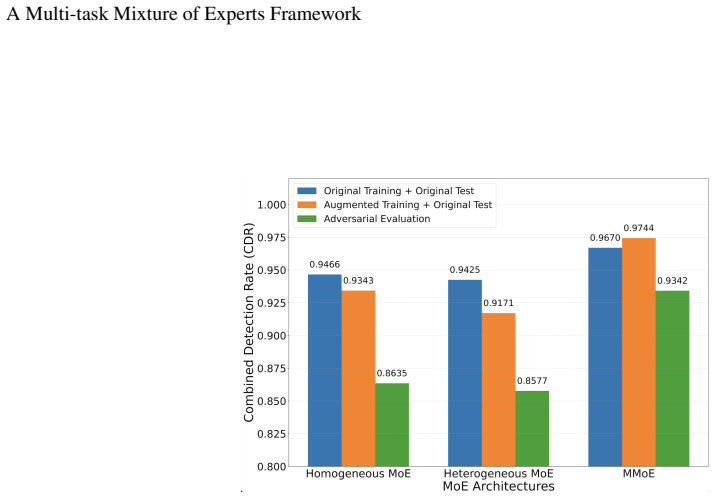
A Multi-Gate Mixture of Experts model performs malware family classification, packing detection, and benign identification together at a combined rate of 0.9744 while showing robustness to mutations.
A machine-rendered reading of the paper's core claim, the machinery that carries it, and where it could break.
Core claim
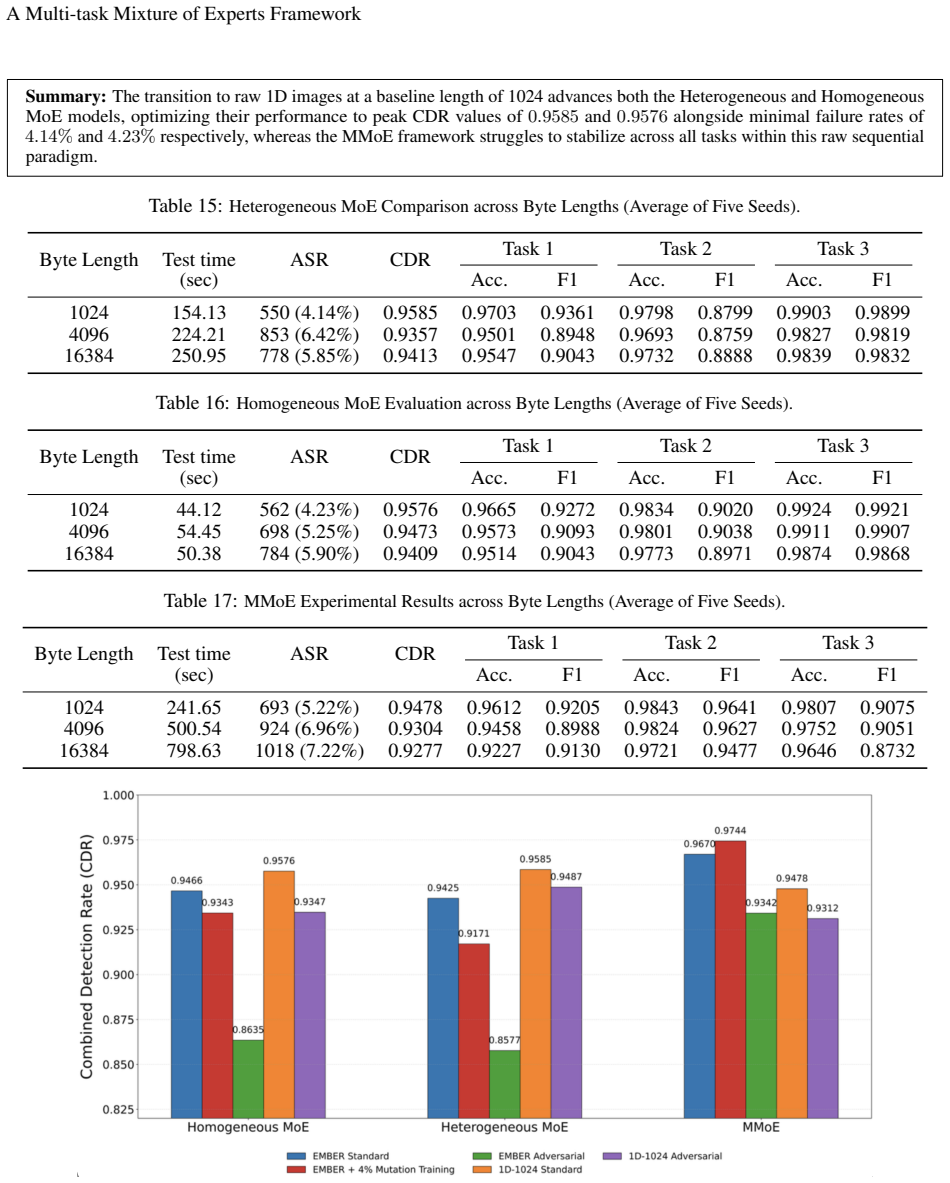
The Multi-Gate MoE model achieves the best performance, reaching a combined detection rate of 0.9744 with only 2.56% failure rate. Moreover, this configuration exhibits improved robustness under mutation-induced distribution shifts.
What carries the argument
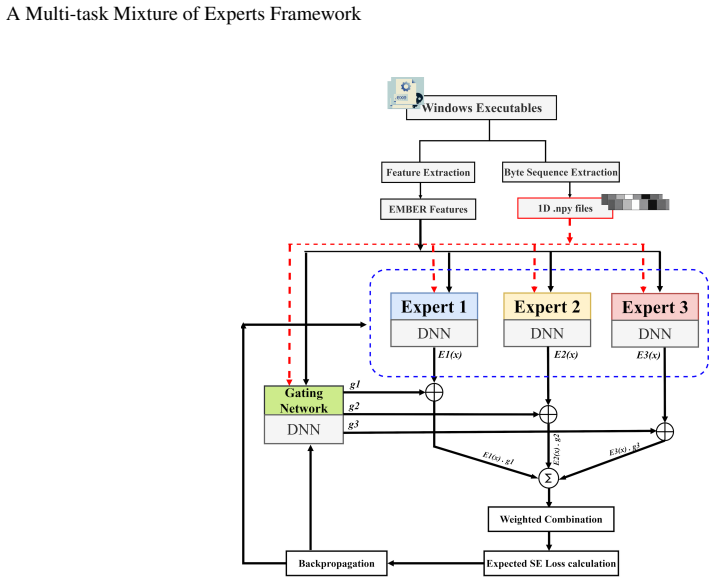
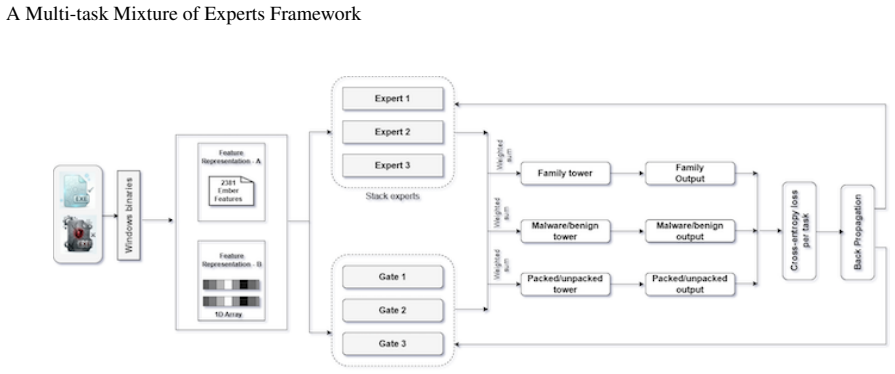
Multi-Gate MoE (MMoE) architecture that uses multiple adaptive gating mechanisms to route inputs across specialized expert networks for concurrent task-specific learning.
If this is right
- Expert specialization allows the system to manage heterogeneous malware distributions more effectively than single-model approaches.
- The framework supports simultaneous execution of multiple analysis tasks without requiring separate models for each.
- Task-specific routing improves handling of obfuscated and rare samples in both standard and adversarial conditions.
- The approach offers a scalable path toward resilient detection systems that adapt to distribution shifts from mutations.
Where Pith is reading between the lines
- The same gating structure might transfer to other security domains that involve concurrent classification tasks on binary data.
- Additional experiments on larger and more temporally diverse malware corpora would be required to verify whether the observed robustness persists outside the evaluated mutation types.
- Alternative input representations, such as graph-based or behavioral features, could be routed through the same multi-gate setup to test further gains.
Load-bearing premise
The performance gains observed on the tested datasets and mutations will continue to hold for diverse unseen real-world malware without significant degradation.
What would settle it
Evaluating the trained Multi-Gate MoE on a fresh set of malware binaries collected from a different time window or source that contain novel packing methods and families absent from the original training and mutation experiments.
Figures
read the original abstract
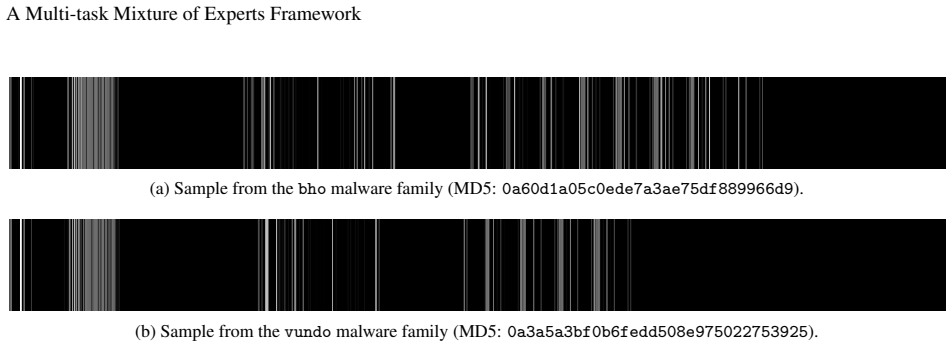
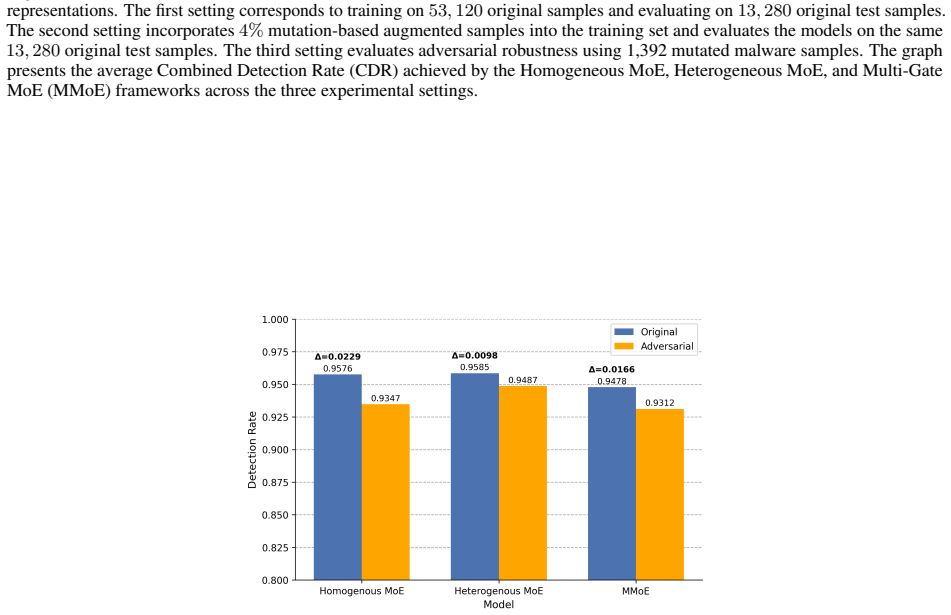
Malware classification remains a challenging problem due to its inherent heterogeneity, the presence of packed binaries, and the diverse distribution of malware families. Traditional single-model detection mechanisms often fail to generalize across such diverse data, leading to degraded performance, particularly on obfuscated and rare malware samples. In this work, we propose a unified multi-task malware analysis framework based on Mixture of Experts (MoE) architectures. The proposed system evaluates performance across two different input representations, i.e., high-dimensional EMBER feature sets and raw 1D byte arrays extracted from Portable Executable files. It simultaneously performs three critical tasks: malware family classification, packed versus unpacked detection, and malware versus benign identification. By decomposing the problem into specialized expert networks and employing adaptive gating mechanisms, the model enables effective task-specific learning while maintaining overall scalability. We investigate multiple architectural variants, including Homogeneous MoE, Heterogeneous MoE, and Multi-Gate MoE (MMoE). Performance is evaluated in both standard and adversarial settings using original and mutated samples. The obtained results demonstrate that the Multi-Gate MoE model achieves the best performance, reaching a combined detection rate of 0.9744 with only $2.56\%$ failure rate. Moreover, this configuration exhibits improved robustness under mutation-induced distribution shifts. Our findings highlight the effectiveness of expert specialization and task-specific routing in handling complex malware distributions, making the proposed framework a promising direction for scalable and resilient malware detection systems.
Editorial analysis
A structured set of objections, weighed in public.
Referee Report
Summary. The manuscript proposes a multi-task Mixture of Experts (MoE) framework for simultaneous malware family classification, packing detection, and malware-vs-benign identification. It evaluates three architectural variants (Homogeneous MoE, Heterogeneous MoE, Multi-Gate MoE) on two input representations (EMBER features and raw 1D byte arrays from PE files), reporting results in both standard and mutation-induced adversarial settings. The central claim is that the Multi-Gate MoE variant achieves the highest combined detection rate of 0.9744 (2.56% failure) and exhibits improved robustness to the tested distribution shifts.
Significance. If the empirical results are reproducible and the experimental design adequately controls for dataset composition and mutation coverage, the work would demonstrate that adaptive task-specific gating can improve handling of heterogeneous and obfuscated malware data across multiple related tasks. The dual use of hand-crafted features and raw bytes, together with explicit multi-task evaluation, would constitute a concrete contribution to scalable malware analysis pipelines.
major comments (2)
- [Abstract] Abstract: The headline performance figures (combined detection rate 0.9744, 2.56% failure) are presented without any accompanying information on dataset cardinality, class balance, train/test split ratios, number of families, or the precise procedure used to generate the mutated samples. These details are load-bearing for assessing whether the reported numbers support the superiority and robustness claims.
- [Abstract] Abstract (robustness statement): The assertion of 'improved robustness under mutation-induced distribution shifts' rests on the unexamined assumption that the paper's chosen mutations adequately sample the space of real-world packing, obfuscation, and family drift. No quantitative comparison to held-out real-world samples or discussion of mutation coverage is supplied, directly affecting the generalization claim identified in the stress-test.
Simulated Author's Rebuttal
We thank the referee for the detailed comments on the abstract and the robustness claims. We address each point below, agreeing where revisions are warranted and providing clarifications based on the manuscript content.
read point-by-point responses
-
Referee: [Abstract] Abstract: The headline performance figures (combined detection rate 0.9744, 2.56% failure) are presented without any accompanying information on dataset cardinality, class balance, train/test split ratios, number of families, or the precise procedure used to generate the mutated samples. These details are load-bearing for assessing whether the reported numbers support the superiority and robustness claims.
Authors: We agree that the abstract would benefit from including summary experimental details to better support interpretation of the results. The full manuscript provides these in Section 3 (Dataset Description) and Section 4 (Experimental Setup), covering dataset cardinality, class balance, train/test splits, number of families, and the mutation generation procedure. We will revise the abstract to concisely incorporate key elements such as dataset size, number of families, split ratios, and a high-level description of the mutations, while respecting length constraints. revision: yes
-
Referee: [Abstract] Abstract (robustness statement): The assertion of 'improved robustness under mutation-induced distribution shifts' rests on the unexamined assumption that the paper's chosen mutations adequately sample the space of real-world packing, obfuscation, and family drift. No quantitative comparison to held-out real-world samples or discussion of mutation coverage is supplied, directly affecting the generalization claim identified in the stress-test.
Authors: The robustness claim is relative to the other MoE variants under the specific controlled mutations tested (detailed in Section 4), which simulate common packing and obfuscation techniques. We do not claim exhaustive coverage of real-world shifts. We will add discussion in the revised manuscript on the mutation types, their rationale, and limitations regarding generalization. We cannot supply new quantitative comparisons to held-out real-world samples, as that would require additional experiments beyond the current scope. revision: partial
- Quantitative comparison to held-out real-world samples for mutation coverage
Circularity Check
No circularity: purely empirical ML evaluation with no derivations or self-referential reductions
full rationale
The paper reports performance metrics (e.g., 0.9744 combined detection rate) obtained by training and evaluating MoE variants on fixed datasets and mutations. No equations, first-principles derivations, or load-bearing self-citations appear in the provided text; results are direct outputs of standard supervised learning and testing procedures. The central claims rest on experimental outcomes rather than any reduction of predictions to fitted inputs or imported uniqueness theorems. This is the expected non-finding for an applied ML architecture paper.
Axiom & Free-Parameter Ledger
Reference graph
Works this paper leans on
-
[1]
Malwarebazaar: Malware sample exchange platform
abuse.ch. Malwarebazaar: Malware sample exchange platform. https://bazaar.abuse.ch/, 2024. Accessed: 2026
2024
-
[2]
Miracle: Malware image recognition and classification by layered extraction: I
Inzamamul Alam, Md Samiullah, SM Asaduzzaman, Upama Kabir, AM Aahad, and Simon S Woo. Miracle: Malware image recognition and classification by layered extraction: I. alam et al.Data Mining and Knowledge Discovery, 39(1):10, 2025
2025
-
[3]
Fasnet: Federated adversarial siamese networks for robust malware image classification.Journal of Parallel and Distributed Computing, 198:105039, 2025
Namrata Govind Ambekar, Sonali Samal, N Nandini Devi, and Surmila Thokchom. Fasnet: Federated adversarial siamese networks for robust malware image classification.Journal of Parallel and Distributed Computing, 198:105039, 2025
2025
-
[4]
A survey on deep learning and multi-task learning techniques for malware analysis
Yacine Bensaoud et al. A survey on deep learning and multi-task learning techniques for malware analysis. Computers & Security, 139:103756, 2024
2024
-
[5]
Security through the eyes of ai: How visualization is shaping malware detection
Matteo Brosolo, KA Asmitha, Mauro Conti, Rafidha Rehiman KA, Muhammed Shafi KP, Serena Nicolazzo, Antonino Nocera, and P Vinod. Security through the eyes of ai: How visualization is shaping malware detection. Computer Science Review, 61:100914, 2026
2026
-
[6]
Sok: visualization-based malware detection techniques
Matteo Brosolo, Vinod Puthuvath, Asmitha Ka, Rafidha Rehiman, and Mauro Conti. Sok: visualization-based malware detection techniques. InProceedings of the 19th international conference on availability, reliability and security, pages 1–13, 2024. 21 A Multi-task Mixture of Experts Framework Table 10:Heterogeneous MoE – Results obtained on Adversarial Attac...
2024
-
[7]
Malware detection by eating a whole exe
Bryan Catanzaro and Charles Nicholas. Malware detection by eating a whole exe. InThe Workshops of the Thirty-Second AAAI Conference on Artificial Intelligence, pages 268–276, 2018
2018
-
[8]
Machine learning and ensemble approaches for cybersecurity: A survey.IEEE Transactions on Artificial Intelligence, 3(5):761–779, 2022
Dipankar Dasgupta et al. Machine learning and ensemble approaches for cybersecurity: A survey.IEEE Transactions on Artificial Intelligence, 3(5):761–779, 2022
2022
-
[9]
Modeling task relationships in multi-task learning with multi-gate mixture-of-experts
Jiaqi Ma et al. Modeling task relationships in multi-task learning with multi-gate mixture-of-experts. InKDD, pages 1930–1939, 2018
1930
-
[10]
Outrageously Large Neural Networks: The Sparsely-Gated Mixture-of-Experts Layer
Noam Shazeer et al. Outrageously large neural networks: The sparsely-gated mixture-of-experts layer.arXiv preprint arXiv:1701.06538, 2017
work page internal anchor Pith review Pith/arXiv arXiv 2017
-
[11]
Qirui et al
S. Qirui et al. Investigating the effects of packers on ml-based malware detection. InCySSS, 2022
2022
-
[12]
Switch transformers: Scaling to trillion parameter models with simple and efficient sparsity.Journal of Machine Learning Research, 23(120):1–39, 2022
William Fedus, Barret Zoph, and Noam Shazeer. Switch transformers: Scaling to trillion parameter models with simple and efficient sparsity.Journal of Machine Learning Research, 23(120):1–39, 2022
2022
-
[13]
Daniel Gibert, Carles Mateu, and Jordi Planes. The rise of machine learning for detection and classification of malware: Research developments, trends and challenges.Journal of Network and Computer Applications, 153:102526, 2020
2020
-
[14]
Assessing the impact of packing on static machine learning-based malware detection and classification systems.Computers & Security, 156:104495, 2025
Daniel Gibert, Nikolaos Totosis, Constantinos Patsakis, Quan Le, and Giulio Zizzo. Assessing the impact of packing on static machine learning-based malware detection and classification systems.Computers & Security, 156:104495, 2025
2025
-
[15]
Multi-task learning for cybersecurity applications: A comprehensive survey.Neural Computing and Applications, 36(18):10435–10468, 2024
Mohamed Ibrahim et al. Multi-task learning for cybersecurity applications: A comprehensive survey.Neural Computing and Applications, 36(18):10435–10468, 2024
2024
-
[16]
Jacobs, Michael I
Robert A. Jacobs, Michael I. Jordan, Steven J. Nowlan, and Geoffrey E. Hinton. Adaptive mixtures of local experts.Neural Computation, 3(1):79–87, 1991
1991
-
[17]
Static multi feature-based malware detection using multi spp-net in smart iot environments.IEEE Transactions on Information Forensics and Security, 19:2487–2500, 2024
Jueun Jeon, Byeonghui Jeong, Seungyeon Baek, and Young-Sik Jeong. Static multi feature-based malware detection using multi spp-net in smart iot environments.IEEE Transactions on Information Forensics and Security, 19:2487–2500, 2024. 22 A Multi-task Mixture of Experts Framework Summary:Data augmentation uniquely benefits the MMoE framework, optimizing its...
2024
-
[18]
Joyce et al
Robert J. Joyce et al. Ember2024 – a benchmark dataset for holistic evaluation of malware classifiers. In Proceedings of the 31st ACM SIGKDD Conference on Knowledge Discovery and Data Mining V . 2, 2025
2025
-
[19]
Naseem Khan, Aref Al-Tamimi, Amine Bermak, and Issa Khalil. Adaptive malware detection using sequential feature selection: A dueling double deep q-network framework for intelligent classification.Journal of Information Security and Applications, 99:104407, 2026
2026
-
[20]
Federated malware intelligence framework for distributed threat classification.Future Generation Computer Systems, 157:302–315, 2024
Hyun Kim et al. Federated malware intelligence framework for distributed threat classification.Future Generation Computer Systems, 157:302–315, 2024
2024
-
[21]
Deep learning for classification of malware system call sequences
Bojan Kolosnjaji et al. Deep learning for classification of malware system call sequences. InAI Conference, 2016
2016
-
[22]
Pe malware machine learning dataset
Michael Lester. Pe malware machine learning dataset. https://www.practicalsecurityanalytics.com,
-
[23]
Accessed for benign PE samples
-
[24]
Attention-driven lightweight cnn architecture for malware image classification.Expert Systems with Applications, 245:123115, 2024
Yong Liu et al. Attention-driven lightweight cnn architecture for malware image classification.Expert Systems with Applications, 245:123115, 2024
2024
-
[25]
Identifying useful features for malware detection in the ember dataset
Yoshihiro Oyama, Takumi Miyashita, and Hirotaka Kokubo. Identifying useful features for malware detection in the ember dataset. InCANDARW, pages 360–366, 2019
2019
-
[26]
Hierarchical visual encoding for scalable malware image analysis.Pattern Recognition, 158:110945, 2025
Jihoon Park et al. Hierarchical visual encoding for scalable malware image analysis.Pattern Recognition, 158:110945, 2025
2025
-
[27]
Portableapps.com - portable software collection
PortableApps.com. Portableapps.com - portable software collection. https://portableapps.com/, 2024. Accessed: 2026
2024
-
[28]
Ember feature dataset analysis for malware detection
Marian ¸ Sandor, Radu Marian Portase, and Adrian Cole¸ sa. Ember feature dataset analysis for malware detection. In2023 IEEE 19th International Conference on Intelligent Computer Communication and Processing (ICCP), pages 203–210. IEEE, 2023
2023
-
[29]
Migan: Gan for facilitating malware image synthesis with improved malware classification on novel dataset.Expert Systems with Applications, 241:122678, 2024
Osho Sharma, Akashdeep Sharma, and Arvind Kalia. Migan: Gan for facilitating malware image synthesis with improved malware classification on novel dataset.Expert Systems with Applications, 241:122678, 2024
2024
-
[30]
Static malware detection of ember windows-pe api call using machine learning.COMPUTATIONAL INTELLIGENCE AND NETWORK SECURITY, 2724(1):020001, 2023
Omkar Shinde, Anish Khobragade, and Pooja Agrawal. Static malware detection of ember windows-pe api call using machine learning.COMPUTATIONAL INTELLIGENCE AND NETWORK SECURITY, 2724(1):020001, 2023
2023
-
[31]
Detecting and mitigating sampling bias in cybersecurity with unlabeled data
Saravanan Thirumuruganathan, Fatih Deniz, Issa Khalil, Ting Yu, Mohamed Nabeel, and Mourad Ouzzani. Detecting and mitigating sampling bias in cybersecurity with unlabeled data. In33rd USENIX Security Symposium (USENIX Security 24), pages 1741–1758, 2024
2024
-
[32]
Improved multi-gate mixture-of-experts framework for multi-step gas load forecasting.Energy, 282:128553, 2023
Jian Tong et al. Improved multi-gate mixture-of-experts framework for multi-step gas load forecasting.Energy, 282:128553, 2023
2023
-
[33]
Transmal: Transformer-based malware image classification framework.Computers & Security, 138:103640, 2024
Lei Wang et al. Transmal: Transformer-based malware image classification framework.Computers & Security, 138:103640, 2024
2024
-
[34]
Multi-head mixture-of-experts
Xun Wu, Shaohan Huang, Wenhui Wang, Shuming Ma, Li Dong, and Furu Wei. Multi-head mixture-of-experts. InAdvances in Neural Information Processing Systems (NeurIPS), 2024. 23 A Multi-task Mixture of Experts Framework Table 13:Evaluation of the proposed Homogeneous-MoE framework trained on 53,120 original samples with 4% mutation-based augmentation and test...
2024
-
[35]
Bitcn-taefficientnet malware classification approach based on sequence and rgb fusion.Computers & Security, 139:103734, 2024
Bona Xuan, Jin Li, and Yafei Song. Bitcn-taefficientnet malware classification approach based on sequence and rgb fusion.Computers & Security, 139:103734, 2024
2024
-
[36]
A survey of adversarial attack and defense methods for malware classification in cyber security.IEEE Communications Surveys & Tutorials, 25(1):467–496, 2022
Senming Yan, Jing Ren, Wei Wang, Limin Sun, Wei Zhang, and Quan Yu. A survey of adversarial attack and defense methods for malware classification in cyber security.IEEE Communications Surveys & Tutorials, 25(1):467–496, 2022
2022
-
[37]
Multimodal transformer fusion for robust malware family classification.IEEE Transactions on Information Forensics and Security, 20:2145–2159, 2025
Wei Zhang et al. Multimodal transformer fusion for robust malware family classification.IEEE Transactions on Information Forensics and Security, 20:2145–2159, 2025. 24 A Multi-task Mixture of Experts Framework Summary:The transition to raw 1D images at a baseline length of 1024 advances both the Heterogeneous and Homogeneous MoE models, optimizing their p...
2025
discussion (0)
Sign in with ORCID, Apple, or X to comment. Anyone can read and Pith papers without signing in.