REVIEW 2 major objections 1 minor 43 references
Orbital Hall effect-driven spin-orbit torque enhancement in Ti-based systems via rare-earth interface engineering
T0 review · 2 major / 1 minor · reviewed 2026-07-02 · grok-4.3
Pith's one-line read A gadolinium interlayer between titanium and cobalt produces orbital torque efficiency above 1, exceeding both Ti/Co and Gd/Co bilayers.
desk verdict The paper claims a fivefold SOT efficiency boost above 1 in Ti/Gd/Co via Gd interlayer for orbital conversion, but the abstract leaves open whether Gd's own SHE or interface effects are subtracted. read the letter →
The pith
A machine-rendered reading of the paper's core claim, the machinery that carries it, and where it could break.
The reading
What carries the argument
The gadolinium interlayer that converts orbital current from the titanium layer into spin current acting on the cobalt ferromagnet.
What would settle it
A repeat of the spin-torque ferromagnetic resonance experiment on the same Ti/Gd/Co stacks that finds torque efficiency no higher than the Ti/Co or Gd/Co bilayers or below 1 would falsify the reported enhancement.
Extended reading notes
Core claim
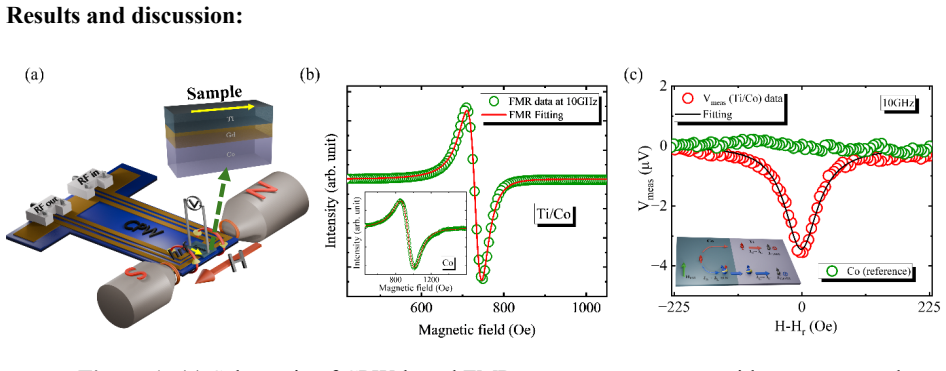
The Ti/Gd/Co trilayer architecture exhibits a spin (orbital) torque efficiency greater than 1, which is higher than that of the bilayer Ti/Co and Gd/Co structures, irrespective of Ti thickness. Ferromagnetic resonance-based spin (orbital) pumping measurements identify an optimal Gd thickness of around 4 nm, where the orbital-to-spin conversion efficiency reaches its maximum. The Ti-thickness dependence of the inverse orbital Hall effect signal confirms a bulk orbital Hall origin in Ti and yields a qualitative orbital diffusion length exceeding 20 nm. Spin-torque ferromagnetic resonance measurements demonstrate a fivefold enhancement of the SOT efficiency in Ti(20 nm)/Co compared to a Gd(4 nm
Load-bearing premise
The ferromagnetic resonance and spin-torque ferromagnetic resonance measurements isolate the orbital-to-spin conversion efficiency at the gadolinium interface without contributions from the spin Hall effect inside gadolinium or from unaccounted interface scattering.
Editorial extensions
If this is right
- Orbital torque efficiency can exceed unity when a rare-earth interlayer is added to a light-metal orbital source.
- The torque enhancement remains independent of titanium thickness once the gadolinium layer is present.
- An optimal gadolinium thickness of approximately 4 nm maximizes the orbital-to-spin conversion.
- The orbital Hall effect in titanium is shown to be a bulk phenomenon with diffusion length longer than 20 nm.
- Rare-earth interlayers offer a practical route to higher-efficiency orbital-torque devices.
Reading between the lines
- The same interlayer strategy could be tested with other light metals that possess large orbital Hall conductivities.
- Efficiency values above 1 may indicate either additional torque channels or a need to refine the normalization used in the measurements.
- Interface scattering or spin memory loss at the gadolinium-cobalt boundary could be quantified separately to test whether they limit further gains.
- The approach might be combined with other orbital sources or different rare-earth choices to map the parameter space of conversion efficiency.
Editorial analysis
A structured set of objections, weighed in public.
Referee Report
Summary. The manuscript reports experimental results on Ti/Gd/Co trilayer structures for enhancing orbital Hall effect-driven spin-orbit torques. Using ferromagnetic resonance-based spin (orbital) pumping and spin-torque FMR measurements, it identifies an optimal Gd thickness of ~4 nm for maximum orbital-to-spin conversion, confirms bulk orbital Hall origin in Ti via thickness dependence with diffusion length >20 nm, and claims a fivefold SOT efficiency enhancement in Ti(20 nm)/Gd(4 nm)/Co relative to Gd/Co bilayers, with the trilayer torque efficiency exceeding 1 independent of Ti thickness.
Significance. If the central attribution holds, the work provides a concrete experimental demonstration that rare-earth interlayers can boost orbital torque efficiencies above unity in light-metal systems, offering a materials-engineering route for spin-orbitronic devices. The use of thickness-dependent measurements to support bulk orbital Hall origin in Ti is a positive methodological feature.
major comments (2)
- [Abstract] Abstract and Results: The headline claim that the Ti/Gd/Co trilayer exhibits spin (orbital) torque efficiency >1 (fivefold larger than Gd/Co) rests on the unshown separation of orbital-to-spin conversion at the Gd interface from possible spin Hall effect contributions within the 4 nm Gd layer itself. No Gd-thickness series in the absence of Ti, nor separate quantification of Gd spin Hall conductivity, is described to rule out confounding; the bilayer references alone do not address this.
- [Abstract] Abstract and Methods: The reported efficiency values lack accompanying error bars, raw ST-FMR spectra, fitting procedures, or explicit controls for interface scattering contributions, making it impossible to assess the statistical robustness of the >1 efficiency and its Ti-thickness independence.
minor comments (1)
- Notation for 'spin (orbital) torque efficiency' should be clarified to distinguish the extracted damping-like torque from the underlying orbital versus spin conversion mechanisms.
Simulated Author's Rebuttal
We thank the referee for the careful review and constructive comments on our manuscript. We address the major comments point by point below, indicating where revisions will strengthen the presentation.
read point-by-point responses
-
Referee: [Abstract] Abstract and Results: The headline claim that the Ti/Gd/Co trilayer exhibits spin (orbital) torque efficiency >1 (fivefold larger than Gd/Co) rests on the unshown separation of orbital-to-spin conversion at the Gd interface from possible spin Hall effect contributions within the 4 nm Gd layer itself. No Gd-thickness series in the absence of Ti, nor separate quantification of Gd spin Hall conductivity, is described to rule out confounding; the bilayer references alone do not address this.
Authors: The Gd/Co bilayer reference already incorporates any spin Hall contribution from the fixed 4 nm Gd layer. The observed fivefold enhancement and efficiency exceeding 1 in the trilayer therefore arise from the additional orbital current generated in Ti and converted at the Ti/Gd interface. The reported independence of the trilayer efficiency on Ti thickness (while remaining >1) further indicates that the excess torque scales with the Ti orbital source rather than with Gd. We will revise the text to explicitly articulate this subtraction logic and to note that a dedicated Gd-thickness series without Ti, while desirable, is not required to interpret the differential enhancement shown by the existing controls. revision: partial
-
Referee: [Abstract] Abstract and Methods: The reported efficiency values lack accompanying error bars, raw ST-FMR spectra, fitting procedures, or explicit controls for interface scattering contributions, making it impossible to assess the statistical robustness of the >1 efficiency and its Ti-thickness independence.
Authors: We agree that the statistical presentation can be strengthened. In the revised manuscript we will add error bars to all efficiency values, include representative raw ST-FMR spectra with fits, provide a detailed description of the fitting procedure, and discuss controls for interface scattering to allow readers to evaluate the robustness of the >1 efficiency and its Ti-thickness independence. revision: yes
Circularity Check
No circularity: purely experimental report with independent measurements
full rationale
The manuscript presents experimental data from ferromagnetic resonance-based spin/orbital pumping and spin-torque FMR measurements on Ti/Gd/Co trilayers. No equations, derivations, or fitted parameters are described that reduce the reported torque efficiencies (>1 in trilayer, fivefold enhancement) to quantities defined by the same dataset. Bilayer references and thickness series are used as controls, but these are external benchmarks rather than self-definitional. No self-citation chains or ansatzes are invoked to justify the central claims. The derivation chain is empty; results stand as direct observations.
Assumptions & free parameters
free parameters (1)
- optimal Gd thickness =
~4 nm
assumptions (1)
- domain assumption Orbital currents generated in Ti possess large orbital Hall conductivity that can be converted to spin current at a rare-earth interface.
Cite this review
Pith. "Pith review of Orbital Hall effect-driven spin-orbit torque enhancement in Ti-based systems via rare-earth interface engineering." pith.science (2026). https://pith.science/paper/3XA3QQUL
@misc{pith2026260601308,
  author       = {Pith},
  title        = {Pith review of: Orbital Hall effect-driven spin-orbit torque enhancement in Ti-based systems via rare-earth interface engineering},
  year         = {2026},
  howpublished = {\url{https://pith.science/paper/3XA3QQUL}},
  note         = {Machine review of arXiv:2606.01308}
}
read the original abstract
Orbital currents in light metals offer large orbital Hall conductivities, yet translating this into practical spin-orbit torque efficiency is hindered by fundamental limitations. In this work, we introduce a Gd interlayer between a Ti orbital source and a Co ferromagnet to enhance the orbital torque efficiency. Ferromagnetic resonance-based spin (orbital) pumping measurements identify an optimal Gd thickness of around 4 nm, where the orbital-to-spin conversion efficiency reaches its maximum. The Ti-thickness dependence of the inverse orbital Hall effect signal confirms a bulk orbital Hall origin in Ti and yields a qualitative orbital diffusion length exceeding 20 nm. Spin-torque ferromagnetic resonance measurements demonstrate a fivefold enhancement of the SOT efficiency in Ti(20 nm)/Co compared to a Gd(4 nm)/Co reference. Interestingly, the trilayer Ti/Gd/Co architecture exhibits a spin (orbital) torque efficiency greater than 1, which is higher than that of the bilayer Ti/Co and Gd/Co structures, irrespective of Ti thickness. These results establish rare-earth interlayer engineering as a viable route to enhanced orbital torque efficiency for next-generation spin-orbitronic devices.
Figures

Reference graph
Works this paper leans on
-
[1]
I. M. Miron, K. Garello, G. Gaudin, P.-J. Zermatten, M. V. Costache, S. Auffret, S. Bandiera, B. Rodmacq, A. Schuhl, and P. Gambardella, Perpendicular switching of a single ferromagnetic layer induced by in -plane current injection, Nature 476, 189 (2011)
work page 2011
- [2]
- [3]
-
[4]
K.-S. Ryu, S. -H. Yang, L. Thomas, and S. S. P. Parkin, Chiral spin torque arising from proximity -induced magnetization, Nat Commun 5, 3910 (2014)
work page 2014
-
[5]
A. Manchon, J. Železný, I. M. Miron, T. Jungwirth, J. Sinova, A. Thiaville, K. Garello, and P. Gambardella, Current-induced spin -orbit torques in ferromagnetic and antiferromagnetic systems, Rev. Mod. Phys. 91, (2019)
work page 2019
- [6]
-
[7]
C.-F. Pai, L. Liu, Y. Li, H. W. Tseng, D. C. Ralph, and R. A. Buhrman, Spin transfer torque devices utilizing the giant spin Hall effect of tungsten, Appl. Phys. Lett. 101, 122404 (2012)
work page 2012
-
[8]
L. Vila, T. Kimura, and Y. Otani, Evolution of the Spin Hall Effect in Pt Nanowires: Size and Temperature Effects, Phys. Rev. Lett. 99, 226604 (2007)
work page 2007
Show all 43 references
-
[9]
Rojas-Sánchez, N
J.-C. Rojas-Sánchez, N. Reyren, P. Laczkowski, W. Savero, J.-P. Attané, C. Deranlot, M. Jamet, J.-M. George, L. Vila, and H. Jaffrès, Spin Pumping and Inverse Spin Hall Effect in Platinum: The Essential Role of Spin - Memory Loss at Metallic Interfaces, Phys. Rev. Lett. 112, 1...
2014
-
[10]
Kontani, T
H. Kontani, T. Tanaka, D. S. Hirashima, K. Yamada, and J. Inoue, Giant Orbital Hall Effect in Transition Metals: Origin of Large Spin and Anomalous Hall Effects, Phys. Rev. Lett. 102, 016601 (2009)
2009
-
[11]
Zhang, W
W. Zhang, W. Han, X. Jiang, S. -H. Yang, and S. S. P. Parkin, Role of transparency of platinum –ferromagnet interfaces in determining the intrinsic magnitude of the spin Hall effect, Nature Phys 11, 496 (2015)
2015
-
[12]
Tanaka, H
T. Tanaka, H. Kontani, M. Naito, T. Naito, D. S. Hirashima, K. Yamada, and J. Inoue, Intrinsic spin Hall effect and orbital Hall effect in 4 d and 5 d transition metals, Phys. Rev. B 77, 165117 (2008)
2008
-
[13]
B. A. Bernevig, T. L. Hughes, and S.-C. Zhang, Orbitronics: The Intrinsic Orbital Current in p -Doped Silicon, Phys. Rev. Lett. 95, 066601 (2005)
2005
-
[14]
D. Go, D. Jo, C. Kim, and H.-W. Lee, Intrinsic Spin and Orbital Hall Effects from Orbital Texture, Phys. Rev. Lett. 121, (2018)
2018
-
[15]
Salemi and P
L. Salemi and P. M. Oppeneer, First -principles theory of intrinsic spin and orbital Hall and Nernst effects in metallic monoatomic crystals, Phys. Rev. Materials 6, 095001 (2022)
2022
-
[16]
D. Go, D. Jo, H.-W. Lee, M. Kläui, and Y. Mokrousov, Orbitronics: Orbital currents in solids, EPL 135, 37001 (2021)
2021
-
[17]
Gupta et al., Harnessing orbital Hall effect in spin-orbit torque MRAM, Nat Commun 16, 130 (2025)
R. Gupta et al., Harnessing orbital Hall effect in spin-orbit torque MRAM, Nat Commun 16, 130 (2025)
2025
-
[18]
N. Sebe, A. Pezo, S. Krishnia, S. Collin, J. -M. George, A. Fert, V. Cros, and H. Jaffrès, Orbital Torque and Efficient Magnetization Switching Using Ultrathin Co|Al Light -Metal Interfaces: Experiments and Modeling , arXiv:2512.18419
-
[19]
Krishnia et al., Large Interfacial Rashba Interaction Generating Strong Spin –Orbit Torques in Atomically Thin Metallic Heterostructures, Nano Lett
S. Krishnia et al., Large Interfacial Rashba Interaction Generating Strong Spin –Orbit Torques in Atomically Thin Metallic Heterostructures, Nano Lett. 23, 6785 (2023)
2023
-
[20]
Go and H
D. Go and H. -W. Lee, Orbital torque: Torque generation by orbital current injection, Phys. Rev. Research 2, 013177 (2020)
2020
-
[21]
Fukami, K.-J
S. Fukami, K.-J. Lee, and M. Kläui, Challenges and opportunities in orbitronics, Nat. Phys. (2025)
2025
-
[22]
Lee et al., Orbital torque in magnetic bilayers, Nat Commun 12, (2021)
D. Lee et al., Orbital torque in magnetic bilayers, Nat Commun 12, (2021)
2021
-
[23]
Lee et al., Efficient conversion of orbital Hall current to spin current for spin-orbit torque switching, Commun Phys 4, (2021)
S. Lee et al., Efficient conversion of orbital Hall current to spin current for spin-orbit torque switching, Commun Phys 4, (2021)
2021
-
[24]
Lyalin, S
I. Lyalin, S. Alikhah, M. Berritta, P. M. Oppeneer, and R. K. Kawakami, Magneto -Optical Detection of the Orbital Hall Effect in Chromium, Phys. Rev. Lett. 131, 156702 (2023)
2023
-
[25]
Fukunaga, S
R. Fukunaga, S. Haku, H. Hayashi, and K. Ando, Orbital torque originating from orbital Hall effect in Zr, Phys. Rev. Research 5, 023054 (2023)
2023
-
[26]
Yang et al., Orbital torque switching in perpendicularly magnetized materials, Nat Commun 15, 8645 (2024)
Y. Yang et al., Orbital torque switching in perpendicularly magnetized materials, Nat Commun 15, 8645 (2024)
2024
-
[27]
F. Liu, B. Liang, J. Xu, C. Jia, and C. Jiang, Giant efficiency of long -range orbital torque in Co/Nb bilayers, Phys. Rev. B 107, 054404 (2023)
2023
-
[28]
Y.-G. Choi, D. Jo, K. -H. Ko, D. Go, K. -H. Kim, H. G. Park, C. Kim, B. -C. Min, G.-M. Choi, and H. -W. Lee, Observation of the orbital Hall effect in a light metal Ti, Nature 619, 52 (2023). 16
2023
-
[29]
Hayashi, D
H. Hayashi, D. Jo, D. Go, T. Gao, S. Haku, Y. Mokrousov, H.-W. Lee, and K. Ando, Observation of long-range orbital transport and giant orbital torque, Commun Phys 6, 32 (2023)
2023
-
[30]
Xu et al., Observation of Giant Effective Orbital Hall Angle in Ti/Pt Metallic Heterostructure, Small 21, (2025)
X. Xu et al., Observation of Giant Effective Orbital Hall Angle in Ti/Pt Metallic Heterostructure, Small 21, (2025)
2025
-
[31]
Schmitt et al., Giant Orbital Magnetoresistance in the Antiferromagnet CoO Driven by Dynamic Orbital Angular Momentum Interaction, arXiv:2603.06425
C. Schmitt et al., Giant Orbital Magnetoresistance in the Antiferromagnet CoO Driven by Dynamic Orbital Angular Momentum Interaction, arXiv:2603.06425
-
[32]
D. Go, D. Jo, T. Gao, K. Ando, S. Blügel, H. -W. Lee, and Y. Mokrousov, Orbital Rashba effect in a surface - oxidized Cu film, Phys. Rev. B 103, L121113 (2021)
2021
-
[33]
D. Go, F. Freimuth, J. -P. Hanke, F. Xue, O. Gomonay, K. -J. Lee, S. Blügel, P. M. Haney, H. -W. Lee, and Y. Mokrousov, Theory of current -induced angular momentum transfer dynamics in spin -orbit coupled systems, Phys. Rev. Research 2, 033401 (2020)
2020
-
[34]
J. Kim, D. Go, H. Tsai, D. Jo, K. Kondou, H. -W. Lee, and Y. Otani, Nontrivial torque generation by orbital angular momentum injection in ferromagnetic-metal/ Cu / Al 2 O 3 trilayers, Phys. Rev. B 103, L020407 (2021)
2021
-
[35]
C. Du, H. Wang, F. Yang, and P. C. Hammel, Systematic variation of spin-orbit coupling with d -orbital filling: Large inverse spin Hall effect in 3 d transition metals, Phys. Rev. B 90, 140407 (2014)
2014
-
[36]
Sala and P
G. Sala and P. Gambardella, Giant orbital Hall effect and orbital-to-spin conversion in 3 d , 5 d , and 4 f metallic heterostructures, Phys. Rev. Research 4, 033037 (2022)
2022
-
[37]
Mondal, V
R. Mondal, V. Alman, A. Haldar, and C. Murapaka, Impact of Cr Insertion Layer on Spin Transport Properties in Co2FeAl/Ta System, J Supercond Nov Magn 38, 76 (2025)
2025
-
[38]
Azevedo, L
A. Azevedo, L. H. Vilela -Leão, R. L. Rodríguez -Suárez, A. F. Lacerda Santos, and S. M. Rezende, Spin pumping and anisotropic magnetoresistance voltages in magnetic bilayers: Theory and experiment, Phys. Rev. B 83, 144402 (2011)
2011
-
[39]
Santos, J
E. Santos, J. L. Costa, R. L. Rodríguez -Suárez, J. B. S. Mendes, and A. Azevedo, Probing orbital currents through inverse orbital Hall and Rashba effects, Commun Phys 9, 98 (2026)
2026
-
[41]
Hayashi, D
H. Hayashi, D. Go, S. Haku, Y. Mokrousov, and K. Ando, Observation of orbital pumping, Nat Electron 7, 646 (2024)
2024
-
[42]
Mondal, Z
R. Mondal, Z. Wen, C. Murapaka, S. Mitani, H. Sukegawa, Q. Le, X. Liu, B. York, and M. Maeda, Enhanced spin–orbit torque efficiency via interface engineering in BiSb/X/CoFeB (X = Ge, NiAl, NiFeGe) topological heterostructures, Journal of Applied Physics 139, 183903 (2026)
2026
-
[43]
C.-F. Pai, Y. Ou, L. H. Vilela-Leão, D. C. Ralph, and R. A. Buhrman, Dependence of the efficiency of spin Hall torque on the transparency of Pt/ferromagnetic layer interfaces, Phys. Rev. B 92, 064426 (2015)
2015
-
[44]
B. Bony, S. Krishnia, Y. Xu, S. Collin, A. Fert, J. -M. George, M. Viret, V. Cros, and H. Jaffrès, Quantitative analysis of vectorial torques in a thin Co 3 d ferromagnet using orbital-spin conversion, Phys. Rev. Applied 23, 054038 (2025)
2025
Reviewed July 2, 2026 · model on record in the stance chip above.
Discussion (0). Continue with ORCID to comment.