REVIEW 3 major objections 4 minor 1 cited by
For the smallest mixed Majorana-Dirac multiplets, Higgs-coupled minimal dark matter predicts spin-independent direct-detection cross sections below the neutrino floor, so direct detection alone cannot fully test these models.
Reviewed by Pith at T0; open to challenge. T0 means a machine referee read the full paper against a public rubric. the ladder, T0–T4 →
T0 review · deepseek-v4-flash
2026-08-02 22:08 UTC pith:42JLALRA
load-bearing objection First systematic treatment of higher-multiplet Higgs-coupled minimal dark matter, with real limit checks, but the below-neutrino-floor headline depends on an unquantified loop correction to the blind spot. the 3 major comments →
Minimal Dark Matter: Generalized Framework and Direct-Detection Sensitivity
The pith
A machine-rendered reading of the paper's core claim, the machinery that carries it, and where it could break.
Core claim
Working with a Majorana multiplet of zero hypercharge and a Dirac multiplet of hypercharge one-half, with sizes differing by one and coupled by the Higgs with equal-magnitude couplings y1=-y2 and equal masses, the paper computes the relic abundance of the mixed state. It derives the long-range t-channel potentials, forms the coupled Schrodinger system for MM and DD two-particle states, diagonalizes the potential matrix, and computes Sommerfeld-enhanced annihilation and bound-state formation through W, B, and H emission, including thermal break-up and branching ratios. Matching the relic abundance fixes the dark matter mass for each multiplet pair. Because the chosen couplings and masses canc
What carries the argument
The central object is the 2x2 potential matrix for two-particle states, with gauge-boson and Higgs-exchange terms; the off-diagonal Higgs term mixes MM and DD states. Diagonalizing this matrix gives two potential eigenstates that carry the Sommerfeld factors and bound-state formation rates, and projecting back yields annihilation cross sections. The companion mechanism is the blind-spot condition, equal-magnitude opposite-sign Higgs couplings with equal Majorana and Dirac masses, which zeroes the tree-level Higgs-nucleon coupling and lets the direct-detection cross section be inherited from the pure Majorana case. A notable methodological choice is keeping only t-channel diagrams for the lon
Load-bearing premise
The load-bearing premise is that the tree-level blind spot, equal-magnitude opposite-sign Higgs couplings with equal Majorana and Dirac masses, keeps the spin-independent direct-detection cross section at the pure-Majorana loop level, because the paper does not compute the Higgs-exchange loop corrections that could lift the signal above the neutrino floor.
What would settle it
Compute the one-loop Higgs-mediated spin-independent nucleon cross section for the 3M2D and 5M4D models at their relic-density masses with y1=-y2 and y=1; if that loop contribution exceeds the neutrino-floor cross section at those masses, the claim that these models can escape direct detection fails. A second check would be to include n>1 and higher-angular-momentum bound states and see whether the relic mass drops enough to shift the direct-detection curves above the floor.
If this is right
- If the paper is right, the usual statement that minimal dark matter is fully testable by next-generation direct detection does not extend to Higgs-coupled mixed multiplets; the low combinations can hide below the neutrino floor.
- The relic-mass predictions differ from pure Majorana multiplets, especially for small Higgs coupling, where mixed-model masses are lower; this shifts the masses against which current direct-detection limits should be interpreted.
- The framework supplies complete Sommerfeld and bound-state formation formulas for any size-differing Majorana-Dirac pair, so other coupling and mass choices can be evaluated without re-deriving the machinery.
- Larger multiplet combinations, 9M8D and above, remain within the reach of next-generation direct-detection experiments, so a null search would single out the larger representations while leaving the low combinations untested.
- Because direct detection cannot fully probe the low multiplet combinations, indirect detection of annihilation products and directional detectors become the necessary complementary probes.
Where Pith is reading between the lines
- The full-text abstract and Section VII.E list 3M2D, 5M4D, and 7M6D as extending below the neutrino floor, while the metadata abstract lists only 3M2D and marginally 5M4D; if the narrower scope is intended, the conclusion about direct detection losing full coverage still holds, but the set of affected models shrinks.
- The below-neutrino-floor claim relies on a tree-level blind spot protected only by an approximate custodial symmetry broken by hypercharge; the paper does not compute the Higgs-exchange loop corrections, so the claim should be read as conditional on those corrections staying small.
- The paper's conservative truncation of bound states and its use of the SU(2)-symmetric limit tend to underpredict the dark matter mass, which pushes the direct-detection bands further below the neutrino floor; a full treatment would likely strengthen, not weaken, the main conclusion.
- A practical test of the framework is to apply it to the pure Majorana limit and compare against published computations; the paper does this and finds agreement except for the largest multiplet, where its truncation under-predicts the mass by about thirty percent.
Editorial analysis
A structured set of objections, weighed in public.
Referee Report
Summary. The paper develops a generalized nonperturbative freezeout framework for Higgs-coupled minimal dark matter (HC-MDM), i.e., models with one mass-degenerate Majorana multiplet M and one Dirac multiplet D of adjacent dimensionality, coupled through Higgs-portal Yukawa interactions. It computes Sommerfeld-enhanced annihilation and bound-state formation cross sections in the SU(2)L-symmetric limit, then derives the DM mass required to match the observed relic abundance for the 3M2D through 13M12D combinations at three representative Yukawa couplings (y = 10^-9, 0.005, 1). For direct detection, the paper adopts the pure-Majorana spin-independent cross sections of Ref. [30] on the grounds that the blind-spot condition y1 = -y2 and mD = mM exactly cancels tree-level Higgs-mediated scattering. The central claim is that for 3M2D, 5M4D, and 7M6D (or, in the metadata abstract, only 3M2D and marginally 5M4D) the predicted direct-detection bands extend below the neutrino floor, so next-generation direct-detection experiments cannot fully test minimal DM; larger multiplets remain within reach.
Significance. If the central claim holds, the paper is significant: it provides a systematic framework for HC-MDM that corrects earlier treatments of long-range potentials and bound states, and it sharpens the phenomenological distinction between minimal and Higgs-coupled minimal dark matter by identifying parameter space that evades conventional direct-detection probes. The derivation is forward (no parameter is fitted to the target relic abundance), and the framework is validated against the pure-Majorana results of Ref. [30] for small multiplets, with only a ~30% deficit for the 13-plet due to explicit bound-state truncation. The paper also usefully compiles extensive technical appendices and clearly identifies the approximations made, including the blind-spot cancellation and the neglect of loop-induced Higgs exchange.
major comments (3)
- [Sec. VIII (also Sec. II and Sec. VII.E)] Loop corrections to the blind spot are acknowledged but not quantified; an estimate or explicit loop calculation is needed before the direct-detection conclusion can be considered robust.
- [Abstract vs Sec. VII.E] The central claim is stated inconsistently between the metadata abstract and the full text; this needs to be fixed.
- [Sec. VII.A and Sec. VII.E] The claim that more complete bound-state/truncation corrections would extend the below-floor region needs quantitative support, since sigma_SI and the neutrino floor both depend on mass.
minor comments (4)
- [Sec. I] Typo: 'calculation of the the DM annihilation cross section' should read 'calculation of the DM annihilation cross section'.
- [Fig. 12 caption] Typo: 'PandaX-4T exlusion region' should be 'PandaX-4T exclusion region'.
- [Sec. IV.C] Typo: 'For M, D in the in the non-relativistic limit' should be 'For M and D in the non-relativistic limit'.
- [Eq. (11)] The displayed formula for Y_DM(infinity) appears to have a misplaced parenthesis; the inverse of the bracket should be explicit. Please check the typesetting.
Circularity Check
No significant circularity: relic-mass derivation is self-contained; the direct-detection claim uses an explicit tree-level blind spot and external lattice-QCD cross sections, with an acknowledged (non-circular) loop-level gap.
full rationale
The central derivation is forward and not fitted to the target result. For each multiplet combination and chosen y, the DM mass is solved by matching the relic abundance through Eqs. (4)-(12), with Sommerfeld and bound-state effects computed from the potentials in Eq. (24) and the cross sections derived in Secs. V-VI. No parameter is fitted to the direct-detection cross section or to the below-neutrino-floor conclusion. The spin-independent cross sections are imported from Ref. [30] (Bottaro et al., lattice-QCD based) and applied to HC-MDM only at the explicitly stated tree-level blind-spot point y1=-y2, mD=mM, where the Higgs-mediated nucleon coupling cancels (Sec. II and Sec. VII.E). This cancellation is not an unverified black box: it is a stated tree-level result, also supported by external blind-spot literature (Refs. [46-48]), so the self-citation to Ref. [35] is not load-bearing in a circular sense. The bound-state formalism draws on Refs. [29,39] (two with overlapping authorship), but those are prior technical results being extended to new representations, not uniqueness claims or fitted substitutes for the present calculation. The main genuine limitation, flagged by the paper in Sec. VIII, is that loop-induced H-exchange corrections to the blind spot are not computed and U(1)_Y breaks the approximate custodial symmetry; the paper only asserts that conclusions are 'qualitatively unchanged.' That is a robustness/correctness gap rather than a circular reduction, because the tree-level input does not contain the loop-level answer by construction. The internal discrepancy between the full-text abstract (3M2D, 5M4D, 7M6D below floor) and the metadata abstract (3M2D, marginally 5M4D) is also not circularity. Overall, the core claims are not equivalent to their inputs; score 1 reflects the presence of some self-citations in load-bearing formalism, not a circular derivation.
Axiom & Free-Parameter Ledger
free parameters (3)
- Yukawa coupling y (|y1|=|y2|) =
scanned values: 10^-9 (small), 0.005 (mid), 1 (large)
- Bound-state energy truncation factor =
1/4 (E_BS > E_BS,max/4)
- Freezeout integration cutoff z_max =
z_Δm = m/0.58 GeV
axioms (5)
- domain assumption Non-relativistic two-body quantum mechanics with a Yukawa/Coulomb potential correctly captures Sommerfeld enhancement and bound-state formation for electroweak-scale DM.
- domain assumption SU(2)_L symmetry is unbroken during the freezeout-relevant epoch, and remains approximately valid up to T ≈ Δm ≈ α_em M_W.
- domain assumption Only s-wave (ℓ=0) annihilation and ℓ=0 bound states with n=1 are relevant; ℓ>0 and n>1 contributions are subdominant.
- ad hoc to paper The blind-spot condition y1=-y2, m_D=m_M exactly cancels tree-level Higgs-mediated direct detection, and loop corrections do not lift σ_SI above the neutrino floor.
- domain assumption Bound states with representation size >5 decay to smaller representations rather than annihilating directly, and this is subdominant.
read the original abstract
Minimal electroweak dark matter models are compelling due to their simplicity, though calculations of their freezeout abundance are complicated by nonperturbative effects due to Sommerfeld enhancement and bound-state formation. It has been shown that all individual multiplet scenarios beyond the doublet lead to direct-detection signals above the neutrino floor and thus within the reach of next-generation experiments. If no signals are found, would minimal dark matter be excluded? Yes for the simplest models, but it has been unknown for the important extension of two multiplets coupled by Higgs interactions (Higgs-coupled minimal dark matter). We present a generalized framework for calculating nonperturbative effects for such models that also covers the case of individual multiplets. In this framework, we calculate nonperturbative effects on freezeout as well as the prospects for direct detection, correcting shortcomings and omissions in the literature. Importantly, for the mixed Majorana (odd) and Dirac (even) multiplet combination 3M2D (and marginally the 5M4D), we find that the predicted direct-detection signals can extend below the neutrino floor. Fully testing minimal dark matter will thus require more than direct-detection experiments.
Figures




Forward citations
Cited by 1 Pith paper
-
Self-consistent computation of pair production from non-relativistic effective field theories in the Keldysh-Schwinger formalism
Self-consistent four-point functions in NR EFT with Keldysh-Schwinger formalism render Sommerfeld unitarization temperature-dependent and keep bound states on-shell in out-of-equilibrium decay even with finite-width B...
Reference graph
Works this paper leans on
-
[1]
limits, the amplitudes are MDD;M M= 4m2 |⃗ p−⃗k|2 y1y2 MDD = 4m2 |⃗ p−⃗k|2 (g 2 1Y 2 D −g 2 2t a Dt a D) MDD =− 4m2 |⃗ p−⃗k|2 (g 2 1Y 2 D +g 2 2t a Dt a D) MM D=− 4m2 |⃗ p−⃗k|2 (g 2 2t a Dt a M −y 1y2) MM D =− 4m2 |⃗ p−⃗k|2 (g 2 2t a Dt a M −y 2 ) MM M=− 4m2 |⃗ p−⃗k|2 g 2 2t a M t a M , (14) where we have omitted theu-channel diagrams where they appear (s...
-
[2]
BecauseWhas spin one and the individual particle spins are conserved in the process, we must have|∆ℓ|= 1 from the initial to bound state
W emission Figure 3 shows the processesX 1X2 →BS(X 1X2)+W. BecauseWhas spin one and the individual particle spins are conserved in the process, we must have|∆ℓ|= 1 from the initial to bound state. In the center of momentum frame, we have σvrel = |⃗ q| 128π2m3 Z dΩ ϵ a∗ µ (q)M µ 2 ,(46) whereqis theW a 4-momentum, while⃗ qdenotes its 3- momentum,ϵ a µ(q) i...
-
[3]
B emission ForB-emission, we only have the first two diagrams from Fig. 3. We can read off the cross section from the W-emission case. In Eq. (50) we replace (t a X1 )i′ k(ˆϵX1 )ki(ˆϵX2 )j′ j →Y X1 (ˆϵX1 )i′ i(ˆϵX2 )j′ j (t a X2 )j′ k(ˆϵX2 )kj(ˆϵX1 )i′ i →Y X2 (ˆϵX1 )i′ i(ˆϵX2 )j′ j i(t b X1 )i′ i(t c X2 )j′ jf abc ⃗T ij,i′ j′ →0. (58) We define B JC IS,B...
-
[4]
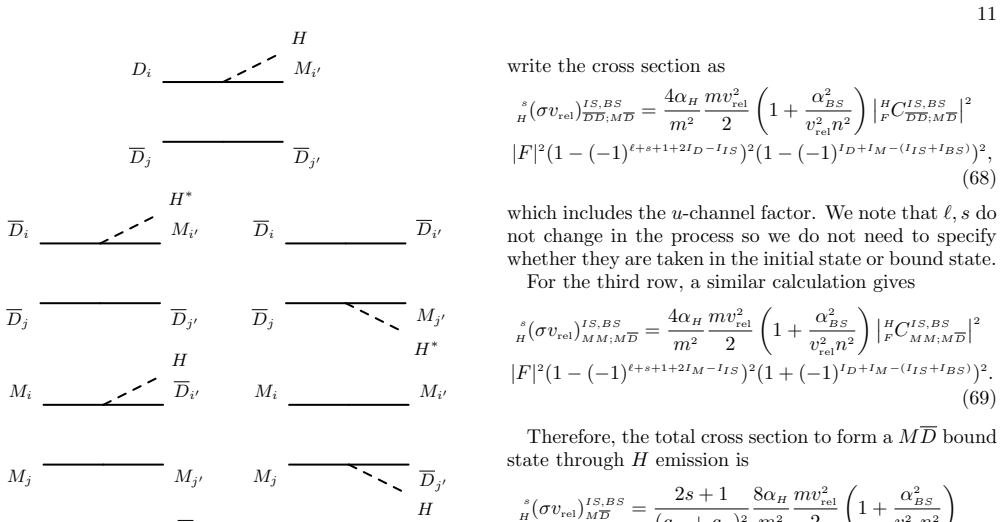
MM bound states.M Mbound-state formation with Higgs emission occurs through the two diagrams in Fig
H emission Figures 4 and 5 show two examples in detail from which we can extract all of theH-emission bound-state forma- tion cross sections. MM bound states.M Mbound-state formation with Higgs emission occurs through the two diagrams in Fig. 4. These diagrams do not interfere so we can compute the cross sections separately and add them together. Mj(p2) D...
-
[5]
G. Bertone and D. Hooper, Reviews of Modern Physics 90(2018), 10.1103/revmodphys.90.045002
-
[6]
B. Carr, M. Raidal, T. Tenkanen, V. Vaskonen, and H. Veerm¨ ae, Phys. Rev. D96, 023514 (2017), arXiv:1705.05567 [astro-ph.CO]
Pith/arXiv arXiv 2017
-
[7]
S. Ge, K. Lawson, and A. Zhitnitsky, Phys. Rev. D99, 116017 (2019), arXiv:1903.05090 [hep-ph]
Pith/arXiv arXiv 2019
-
[8]
M. Cirelli, Y. Gouttenoire, K. Petraki, and F. Sala, JCAP02, 014 (2019), arXiv:1811.03608 [hep-ph]
Pith/arXiv arXiv 2019
-
[9]
J. Berges, A. Chatrchyan, and J. Jaeckel, JCAP08, 020 (2019), arXiv:1903.03116 [hep-ph]
Pith/arXiv arXiv 2019
-
[10]
M. Blennow, E. Fernandez-Martinez, A. Olivares- Del Campo, S. Pascoli, S. Rosauro-Alcaraz, and A. V. Titov, Eur. Phys. J. C79, 555 (2019), arXiv:1903.00006 [hep-ph]
Pith/arXiv arXiv 2019
-
[11]
G. Arcadi, A. Djouadi, and M. Raidal, Phys. Rept.842, 1 (2020), arXiv:1903.03616 [hep-ph]
Pith/arXiv arXiv 2020
-
[12]
S. W. Allen, A. E. Evrard, and A. B. Mantz, Ann. Rev. Astron. Astrophys.49, 409 (2011), arXiv:1103.4829 [astro-ph.CO]
Pith/arXiv arXiv 2011
-
[13]
P. Salucci, Astron. Astrophys. Rev.27, 2 (2019), arXiv:1811.08843 [astro-ph.GA]
Pith/arXiv arXiv 2019
-
[14]
N. Aghanimet al.(Planck), Astron. Astrophys.641, A6 (2020), [Erratum: Astron.Astrophys. 652, C4 (2021)], arXiv:1807.06209 [astro-ph.CO]
Pith/arXiv arXiv 2020
-
[15]
J. D. Simon, Ann. Rev. Astron. Astrophys.57, 375 (2019), arXiv:1901.05465 [astro-ph.GA]
Pith/arXiv arXiv 2019
-
[16]
M. Cirelli, A. Strumia, and J. Zupan, (2024), arXiv:2406.01705 [hep-ph]
Pith/arXiv arXiv 2024
-
[17]
M. Cirelli, N. Fornengo, and A. Strumia, Nucl. Phys. B 753, 178 (2006), arXiv:hep-ph/0512090
Pith/arXiv arXiv 2006
-
[18]
M. Cirelli, A. Strumia, and M. Tamburini, Nucl. Phys. B787, 152 (2007), arXiv:0706.4071 [hep-ph]
Pith/arXiv arXiv 2007
-
[19]
Steigman and M
G. Steigman and M. S. Turner, Nucl. Phys. B253, 375 (1985)
1985
-
[20]
G. Bertone, D. Hooper, and J. Silk, Phys. Rept.405, 279 (2005), arXiv:hep-ph/0404175
Pith/arXiv arXiv 2005
-
[21]
G. Steigman, B. Dasgupta, and J. F. Beacom, Phys. Rev. D86, 023506 (2012), arXiv:1204.3622 [hep-ph]
Pith/arXiv arXiv 2012
-
[22]
G. Arcadi, M. Dutra, P. Ghosh, M. Lindner, Y. Mam- brini, M. Pierre, S. Profumo, and F. S. Queiroz, Eur. Phys. J. C78, 203 (2018), arXiv:1703.07364 [hep-ph]
Pith/arXiv arXiv 2018
-
[23]
L. Roszkowski, E. M. Sessolo, and S. Trojanowski, Rept. Prog. Phys.81, 066201 (2018), arXiv:1707.06277 [hep- ph]
Pith/arXiv arXiv 2018
-
[24]
J. Smirnov, SciPost Phys. Proc.12, 003 (2023), arXiv:2212.14361 [hep-ph]
Pith/arXiv arXiv 2023
-
[25]
J. Hisano, S. Matsumoto, and M. M. Nojiri, Phys. Rev. Lett.92, 031303 (2004), arXiv:hep-ph/0307216
Pith/arXiv arXiv 2004
-
[26]
J. Hisano, S. Matsumoto, M. M. Nojiri, and O. Saito, Phys. Rev. D71, 063528 (2005), arXiv:hep-ph/0412403
Pith/arXiv arXiv 2005
- [27]
-
[28]
N. Arkani-Hamed, D. P. Finkbeiner, T. R. Slatyer, and N. Weiner, Phys. Rev. D79, 015014 (2009), arXiv:0810.0713 [hep-ph]
Pith/arXiv arXiv 2009
- [29]
-
[30]
J. D. March-Russell and S. M. West, Phys. Lett. B676, 133 (2009), arXiv:0812.0559 [astro-ph]
Pith/arXiv arXiv 2009
-
[31]
B. von Harling and K. Petraki, JCAP12, 033 (2014), arXiv:1407.7874 [hep-ph]
Pith/arXiv arXiv 2014
-
[32]
H. An, M. B. Wise, and Y. Zhang, Phys. Rev. D93, 115020 (2016), arXiv:1604.01776 [hep-ph]
Pith/arXiv arXiv 2016
-
[33]
A. Mitridate, M. Redi, J. Smirnov, and A. Strumia, JCAP05, 006 (2017), arXiv:1702.01141 [hep-ph]
Pith/arXiv arXiv 2017
-
[34]
S. Bottaro, D. Buttazzo, M. Costa, R. Franceschini, P. Panci, D. Redigolo, and L. Vittorio, Eur. Phys. J. C82, 31 (2022), arXiv:2107.09688 [hep-ph]
Pith/arXiv arXiv 2022
-
[35]
I. M. Bloch, S. Bottaro, D. Redigolo, and L. Vittorio, JHEP08, 216 (2025), arXiv:2410.02723 [hep-ph]
Pith/arXiv arXiv 2025
-
[36]
Aalberset al.(XLZD), (2024), arXiv:2410.17137 [hep- ex]
J. Aalberset al.(XLZD), (2024), arXiv:2410.17137 [hep- ex]
arXiv 2024
-
[37]
M. W. Goodman and E. Witten, Phys. Rev. D31, 3059 (1985)
1985
-
[38]
D. S. Akeribet al.(CDMS), Phys. Rev. Lett.96, 011302 (2006), arXiv:astro-ph/0509259
Pith/arXiv arXiv 2006
-
[39]
L. Lopez Honorez, M. H. G. Tytgat, P. Tziveloglou, and B. Zaldivar, JHEP04, 011 (2018), arXiv:1711.08619 [hep-ph]
Pith/arXiv arXiv 2018
-
[40]
R. Oncala and K. Petraki, JHEP06, 124 (2021), arXiv:2101.08666 [hep-ph]
Pith/arXiv arXiv 2021
-
[41]
R. Oncala and K. Petraki, JHEP08, 069 (2021), arXiv:2101.08667 [hep-ph]
Pith/arXiv arXiv 2021
-
[42]
P. Asadi, M. Baumgart, P. J. Fitzpatrick, E. Krupczak, and T. R. Slatyer, JCAP02, 005 (2017), arXiv:1610.07617 [hep-ph]
Pith/arXiv arXiv 2017
-
[43]
J. Smirnov and J. F. Beacom, Phys. Rev. D100, 043029 (2019), arXiv:1904.11503 [hep-ph]
Pith/arXiv arXiv 2019
-
[44]
T. Hambye, F. S. Ling, L. Lopez Honorez, and J. Rocher, JHEP07, 090 (2009), [Erratum: JHEP 05, 066 (2010)], arXiv:0903.4010 [hep-ph]
Pith/arXiv arXiv 2009
-
[45]
J. Billard, L. Strigari, and E. Figueroa-Feliciano, Phys. Rev. D89, 023524 (2014), arXiv:1307.5458 [hep-ph]
Pith/arXiv arXiv 2014
-
[46]
B. R. Safdi and W. L. Xu, (2025), arXiv:2507.15934 [hep-ph]
arXiv 2025
-
[47]
M. Aghaie, A. Dondarini, G. Marino, and P. Panci, (2025), arXiv:2507.17607 [hep-ph]
Pith/arXiv arXiv 2025
-
[48]
M. Baumgart, S. Bottaro, D. Redigolo, N. L. Rodd, and T. R. Slatyer, (2025), arXiv:2507.15937 [hep-ph]
arXiv 2025
-
[49]
J. Hisano, K. Ishiwata, and N. Nagata, JHEP06, 097 (2015), arXiv:1504.00915 [hep-ph]
Pith/arXiv arXiv 2015
-
[50]
T. Cohen, J. Kearney, A. Pierce, and D. Tucker-Smith, Phys. Rev. D85, 075003 (2012), arXiv:1109.2604 [hep- ph]
Pith/arXiv arXiv 2012
-
[51]
C. Cheung and D. Sanford, JCAP02, 011 (2014), arXiv:1311.5896 [hep-ph]
Pith/arXiv arXiv 2014
-
[52]
L. Calibbi, A. Mariotti, and P. Tziveloglou, JHEP10, 116 (2015), arXiv:1505.03867 [hep-ph]
Pith/arXiv arXiv 2015
-
[53]
A. Mitridate, M. Redi, J. Smirnov, and A. Strumia, JHEP10, 210 (2017), arXiv:1707.05380 [hep-ph]
Pith/arXiv arXiv 2017
-
[54]
N. A. Dondi, F. Sannino, and J. Smirnov, Phys. Rev. D 101, 103010 (2020), arXiv:1905.08810 [hep-ph]
Pith/arXiv arXiv 2020
-
[55]
M. Garny and J. Heisig, Phys. Rev. D105, 055004 (2022), arXiv:2112.01499 [hep-ph]
Pith/arXiv arXiv 2022
-
[56]
Navaset al.(Particle Data Group), Phys
S. Navaset al.(Particle Data Group), Phys. Rev. D110, 030001 (2024)
2024
-
[57]
M. E. Peskin and D. V. Schroeder,An Introduction to quantum field theory(Addison-Wesley, Reading, USA, 1995)
1995
-
[58]
Schiff,Quantum Mechanics: 3rd Edition(McGraw 24 Hill, 1968)
L. Schiff,Quantum Mechanics: 3rd Edition(McGraw 24 Hill, 1968)
1968
-
[59]
Cohen-Tannoudji, B
C. Cohen-Tannoudji, B. Diu, and F. Lalo¨ e,Quantum Mechanics, Volume 2: Angular Momentum, Spin, and Approximation Methods(Wiley, 2019)
2019
-
[60]
H. A. Bethe and E. E. Salpeter,Quantum Mechanics of One and Two-Electron Atoms(Springer Berlin, Heidel- berg, 1957)
1957
-
[61]
Griest and D
K. Griest and D. Seckel, Phys. Rev. D43, 3191 (1991)
1991
-
[62]
J. Billard, F. Mayet, and D. Santos, Phys. Rev. D85, 035006 (2012), arXiv:1110.6079 [astro-ph.CO]
Pith/arXiv arXiv 2012
discussion (0)
Sign in with ORCID, Apple, or X to comment. Anyone can read and Pith papers without signing in.