REVIEW 3 major objections 5 minor 56 references
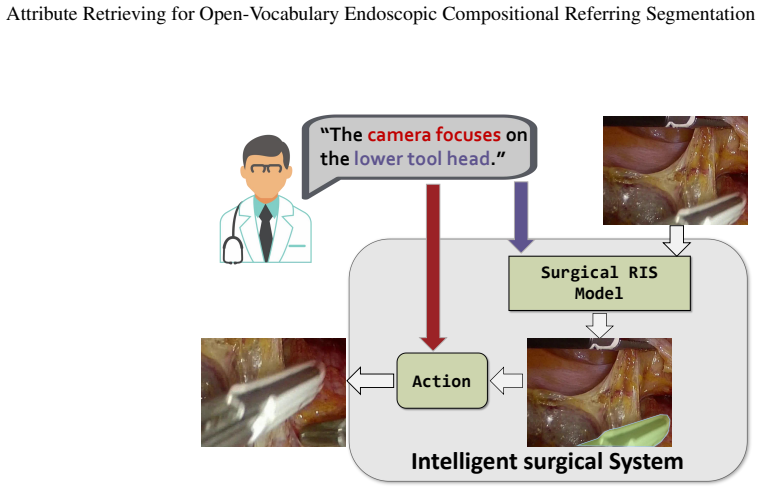
Attribute retrieval and frequency-aware fusion let language prompts segment surgical instruments and organs in endoscopy, even for unseen tools and scenes.
Reviewed by Pith at T0; open to challenge. T0 means a machine referee read the full paper against a public rubric. the ladder, T0–T4 →
T0 review · grok-4.5
2026-07-10 08:05 UTC pith:42OZI7MV
load-bearing objection Solid new endoscopic RIS benchmark + attribute-retrieval model that beats natural-image baselines and transfers to an unseen robotic set; automatic OpenCV attributes are the main unvalidated hinge. the 3 major comments →
Attribute Retrieving for Open-Vocabulary Endoscopic Compositional Referring Segmentation
The pith
A machine-rendered reading of the paper's core claim, the machinery that carries it, and where it could break.
Core claim
The paper claims that open-vocabulary compositional referring segmentation for endoscopy becomes practical once a large attribute-grounded benchmark (ReferEndoscopy) is available and a model (AR-ERIS) can retrieve those attributes at inference while also fusing frequency-decomposed visual features; under that regime the model achieves roughly 74-75 percent overall mIoU on multi-attribute prompts and generalizes to unseen surgical domains.
What carries the argument
Attribute Retrieval Module (ARM) plus Frequency-Aware Referring Network (FAR-Net): ARM stores class-attribute co-occurrences learned in pretraining and, at test time, retrieves top-k attributes (or nearest neighbors for novel classes) to build compositional text prompts; FAR-Net applies FFT to separate high- and low-frequency image components, fuses them with RGB via a mixture-of-experts path, and aligns the result with text through cross-modal attention, supervised by BCE, Dice, and high-frequency consistency losses.
Load-bearing premise
The automatic OpenCV attributes (mean color, size bins, centroid location, contour relations) plus template fill-ins must be accurate and diverse enough to supply reliable language supervision; if those labels are systematically noisy or biased, both the memory bank and the reported gains collapse.
What would settle it
Re-annotate a held-out subset of ReferEndoscopy with independent human attribute labels, retrain or re-evaluate ARM retrieval, and measure whether mIoU under medium/hard prompts and zero-shot SAR-RARP50 performance remain within a few points of the reported figures; a large drop would falsify the claim that the automatic pipeline is sufficient.
If this is right
- A single pretrained model can accept free-form multi-attribute instructions and produce masks for both instruments and organs across multiple endoscopic datasets without per-dataset retraining.
- At inference, novel tools or tissues can be described by retrieving attributes of the most similar pretrained classes rather than requiring new labeled masks.
- High-frequency loss terms sharpen boundaries of elongated metallic instruments that ordinary multimodal models tend to oversmooth.
- Zero-shot transfer to completely unseen robotic prostatectomy footage becomes measurable (approximately 21 percent mIoU), establishing a concrete baseline for open-vocabulary surgical RIS.
- Public release of the 1.45-million-triplet benchmark supplies a shared evaluation suite for future compositional medical referring work.
Where Pith is reading between the lines
- The same attribute-memory idea could be attached to other medical modalities (laparoscopy, ultrasound, robotic endoscopy) where class-name-only prompts are too coarse.
- If the frequency split is replaced by learnable band-pass filters, the model might adapt the high/low cut-offs to different endoscope optics without hand-tuned radii.
- Spoken commands in an operating room could be mapped through ARM into the same compositional prompts, turning the system into a real-time language interface for robotic assistance.
- Long-tail rare classes (<0.2 percent of masks) remain the practical limit; extending ARM with generative attribute synthesis might be the next necessary step.
Editorial analysis
A structured set of objections, weighed in public.
Referee Report
Summary. The paper introduces ReferEndoscopy, a large-scale endoscopic referring image segmentation (RIS) benchmark assembled from ten public datasets (65,964 images, 242,055 masks, ~1.45M image–mask–instruction triplets) with automatically generated multi-attribute instructions. It further proposes AR-ERIS / FAR-Net, which decomposes RGB inputs via FFT into high- and low-frequency components, fuses them (optionally via MoE), aligns them with CLIP text embeddings through cross-modal attention, and uses an Attribute Retrieval Module (ARM) that stores class–attribute co-occurrences for open-vocabulary instruction generation at test time. Training combines BCE, Dice, and a high-frequency consistency loss. Experiments report SOTA multi-attribute mIoU (~74–75 %) on the new benchmark versus natural-image RIS baselines (GroundedSAM, EVF-SAM, LAVT), competitive numbers against specialized non-referring surgical segmentors, and zero-shot transfer to the held-out SAR-RARP50 prostatectomy set (~21 % mIoU).
Significance. If the automatic attribute pipeline is sufficiently reliable, the work supplies the first large-scale compositional RIS resource for endoscopy and a practical open-vocabulary baseline that demonstrably outperforms strong natural-image foundation models on both in-domain multi-attribute prompts and a completely unseen robotic procedure. Public release of the dataset and code would lower the barrier for vision–language research in surgical AI and enable real-time text-driven instrument/organ localization. The frequency-aware fusion and ARM ideas are transferable beyond endoscopy. The contribution is therefore of clear applied and methodological interest to medical computer vision, provided the quality of the synthetic language supervision is substantiated.
major comments (3)
- §2.2 Steps 2–3 and the open-vocabulary claim rest on the unvalidated premise that OpenCV-derived attributes (mean HSV color, pixel-area size bins, centroid location, contour-distance relations) plus template fill-ins produce accurate, diverse language supervision. No human validation, inter-annotator agreement, error analysis, or qualitative examples of generated instructions versus visual ground truth are reported. Endoscopic specular highlights, smoke, and deformable tissues make mean-color and contour attributes systematically noisy; if the labels are largely redundant with class names, the medium/hard gains in Table 2 and the ARM-driven transfer in Table 4 become artifacts of the same noisy pipeline rather than genuine compositional understanding. A modest human audit (e.g., 200–500 random triplets) or ablation that replaces automatic attributes with class names only is required to s
- Tables 2–4 report point estimates without error bars, multiple runs, or statistical tests. Several numerical inconsistencies appear between the abstract/text claims (e.g., “74.11 %”) and the tabulated values, and the “naive” model’s large drop under hard prompts is presented without variance. For a new benchmark and SOTA claim these omissions leave the magnitude and reliability of the reported gains uncertain; at minimum, standard deviations over 3–5 seeds and a clarification of the exact numbers used for ranking are needed.
- §3.1 Eqs. (1)–(5) introduce Freq-Fusion with free radii r_low / r_high and multiple fusion options (naive conv, bilinear, self-attention, MoE), yet the main results do not systematically ablate these choices or report the selected radii. Table 3 shows only partial MoE + L_high-freq variants. Without this information it is unclear how much of the instrument-edge gains attributed to L_freq actually stem from the frequency decomposition versus the Dice term or the richer language supervision.
minor comments (5)
- Figure 2 caption and body text mix “AR-ERIS”, “FAR-Net”, “Freq-Fusion” and “ARM” without a single consistent naming diagram; a clearer architecture schematic would help.
- Table 1 lists 56 categories while the text states 59; the discrepancy should be resolved.
- §4.1 states λ_Dice = 0.3 and λ_freq = 0.15, yet the ablation text sometimes refers to a weight of 0.3 for L_freq; unify the hyper-parameter statements.
- Several citations appear twice (e.g., CLIP / Radford et al. as [31] and [57]); clean the bibliography.
- The abstract and introduction promise “strong generalization across both simulated and real-world endoscopic data,” yet LaparoI2I (synthetic) is mixed into pre-training; a clearer train/test domain split table would strengthen the claim.
Circularity Check
No circularity: empirical supervised RIS pipeline on auto-generated attributes, validated by external held-out benchmarks and baselines.
full rationale
This is a standard computer-vision empirical paper that constructs a multi-source endoscopic RIS benchmark via OpenCV attribute extraction plus template instructions, trains a frequency-aware CLIP-based model (FAR-Net + ARM memory bank) with BCE/Dice/frequency losses, and reports mIoU/Dice gains versus external baselines (GroundedSAM, LAVT, EVF-SAM, ISI-Net, etc.) plus zero-shot transfer to the completely disjoint SAR-RARP50 set. There is no mathematical derivation, uniqueness theorem, or fitted constant that is later re-presented as a prediction; the attribute pipeline is used consistently for supervision and retrieval but does not force the reported segmentation metrics by construction. External held-out evaluation and comparisons to independently trained models supply independent grounding. No self-citation is load-bearing for any central claim. Score 0 is therefore the correct, non-manufactured finding.
Axiom & Free-Parameter Ledger
free parameters (5)
- λ_Dice =
0.3
- λ_freq =
0.15
- FFT low/high frequency radii r_low, r_high
- top-k attribute sampling
- learning-rate schedule and batch size =
1e-3 / 64 / 20
axioms (4)
- ad hoc to paper OpenCV mean-color, area, centroid and contour-distance features map reliably onto the linguistic attribute vocabulary used in the templates.
- domain assumption CLIP text and image encoders pretrained on natural images remain sufficiently aligned for fine-grained endoscopic attributes after the described fine-tuning.
- domain assumption High-frequency Fourier components predominantly encode instrument/tissue boundaries while low-frequency components encode texture.
- domain assumption Original train/test splits of the ten source datasets remain valid after attribute augmentation and black-border cropping.
invented entities (3)
-
ReferEndoscopy benchmark
no independent evidence
-
Attribute Retrieval Module (ARM)
no independent evidence
-
Freq-Fusion / FAR-Net
no independent evidence
read the original abstract
Referring Image Segmentation (RIS) aims to segment image regions specified by natural language, enabling fine-grained and controllable visual understanding. Extending RIS to endoscopic imagery, however, presents unique challenges, including scarce high-quality annotations and complex, domain-specific image-text relationships. Although recent vision-language models demonstrate strong cross-domain alignment, they often fail to capture fine-grained textual cues in endoscopic settings, resulting in suboptimal performance and limited generalization. To address these challenges, we introduce ReferEndoscopy, a large-scale benchmark for RIS in the endoscopy field. Building on this dataset, we propose the Attribute Retrieval-based Endoscopic-RIS (AR-ERIS) framework for open-vocabulary endoscopic compositional referring segmentation. AR-ERIS leverages attribute retrieval for open-vocabulary endoscopic compositional referring segmentation and is pretrained on the curated ReferEndoscopy dataset, achieving state-of-the-art performance with strong generalization across both simulated and real-world endoscopic data. The dataset and code will be publicly released upon completion of the review process.
Figures

Reference graph
Works this paper leans on
-
[1]
Kaiming He, Georgia Gkioxari, Piotr Dollár, and Ross Girshick. Mask r-cnn. InProceedings of the IEEE international conference on computer vision, pages 2961–2969, 2017
work page 2017
-
[2]
U-net: Convolutional networks for biomedical image segmentation
Olaf Ronneberger, Philipp Fischer, and Thomas Brox. U-net: Convolutional networks for biomedical image segmentation. InMedical image computing and computer-assisted intervention–MICCAI 2015: 18th international conference, Munich, Germany, October 5-9, 2015, proceedings, part III 18, pages 234–241. Springer, 2015
work page 2015
-
[3]
Zongwei Zhou, Md Mahfuzur Rahman Siddiquee, Nima Tajbakhsh, and Jianming Liang. Unet++: Redesigning skip connections to exploit multiscale features in image segmentation.IEEE transactions on medical imaging, 39(6):1856–1867, 2019
work page 2019
-
[4]
Cris: Clip-driven referring image segmentation
Zhaoqing Wang, Yu Lu, Qiang Li, Xunqiang Tao, Yandong Guo, Mingming Gong, and Tongliang Liu. Cris: Clip-driven referring image segmentation. InProceedings of the IEEE/CVF conference on computer vision and pattern recognition, pages 11686–11695, 2022
work page 2022
-
[5]
Ziyi Wang, Bo Lu, Yonghao Long, Fangxun Zhong, Tak-Hong Cheung, Qi Dou, and Yunhui Liu. Autolaparo: A new dataset of integrated multi-tasks for image-guided surgical automation in laparoscopic hysterectomy. In International Conference on Medical Image Computing and Computer-Assisted Intervention, pages 486–496. Springer, 2022
work page 2022
-
[6]
Shu Yang, Fengtao Zhou, Leon Mayer, Fuxiang Huang, Yiliang Chen, Yihui Wang, Sunan He, Yuxiang Nie, Xi Wang, Yueming Jin, et al. Large-scale self-supervised video foundation model for intelligent surgery.npj Digital Medicine, 2026
work page 2026
-
[7]
Gynsurg: A comprehensive gynecology laparoscopic surgery dataset
Sahar Nasirihaghighi, Negin Ghamsarian, Leonie Peschek, Matteo Munari, Heinrich Husslein, Raphael Sznitman, and Klaus Schoeffmann. Gynsurg: A comprehensive gynecology laparoscopic surgery dataset. InProceedings of the 33rd ACM International Conference on Multimedia, pages 13141–13147, 2025
work page 2025
-
[8]
Nathan Darjana, Ryo Fujii, Hideo Saito, and Hiroki Kajita. Egosurgery-hts: A dataset for egocentric hand–tool segmentation in open surgery videos.Healthcare Technology Letters, 12(1):e70049, 2025. 11 Attribute Retrieving for Open-V ocabulary Endoscopic Compositional Referring Segmentation
work page 2025
-
[9]
Lisa: Reasoning segmentation via large language model
Xin Lai, Zhuotao Tian, Yukang Chen, Yanwei Li, Yuhui Yuan, Shu Liu, and Jiaya Jia. Lisa: Reasoning segmentation via large language model. InProceedings of the IEEE/CVF Conference on Computer Vision and Pattern Recognition, pages 9579–9589, 2024
work page 2024
-
[10]
Xueyan Zou, Jianwei Yang, Hao Zhang, Feng Li, Linjie Li, Jianfeng Wang, Lijuan Wang, Jianfeng Gao, and Yong Jae Lee. Segment everything everywhere all at once.Advances in Neural Information Processing Systems, 36, 2024
work page 2024
-
[11]
Surgical scene segmentation using semantic image synthesis with a virtual surgery environment
Jihun Yoon, SeulGi Hong, Seungbum Hong, Jiwon Lee, Soyeon Shin, Bokyung Park, Nakjun Sung, Hayeong Yu, Sungjae Kim, SungHyun Park, et al. Surgical scene segmentation using semantic image synthesis with a virtual surgery environment. InInternational Conference on Medical Image Computing and Computer-Assisted Intervention, pages 551–561. Springer, 2022
work page 2022
-
[12]
CholecSeg8k: A Semantic Segmentation Dataset for Laparoscopic Cholecystectomy Based on Cholec80
W-Y Hong, C-L Kao, Y-H Kuo, J-R Wang, W-L Chang, and C-S Shih. Cholecseg8k: a semantic segmentation dataset for laparoscopic cholecystectomy based on cholec80.arXiv preprint arXiv:2012.12453, 2020
work page internal anchor Pith review Pith/arXiv arXiv 2012
-
[13]
Debesh Jha, Sharib Ali, Krister Emanuelsen, Steven A Hicks, Vajira Thambawita, Enrique Garcia-Ceja, Michael A Riegler, Thomas de Lange, Peter T Schmidt, Håvard D Johansen, et al. Kvasir-instrument: Diagnostic and therapeutic tool segmentation dataset in gastrointestinal endoscopy. InMultiMedia Modeling: 27th International Conference, MMM 2021, Prague, Cze...
work page 2021
-
[14]
Luis C. Garcia-Peraza-Herrera, Lucas Fidon, Claudia D’Ettorre, Danail Stoyanov, Tom Vercauteren, and Sébastien Ourselin. Image compositing for segmentation of surgical tools without manual annotations.IEEE Transactions on Medical Imaging, 40(5):1450–1460, 2021
work page 2021
-
[15]
Matthias Carstens, Franziska M Rinner, Sebastian Bodenstedt, Alexander C Jenke, Jürgen Weitz, Marius Distler, Stefanie Speidel, and Fiona R Kolbinger. The dresden surgical anatomy dataset for abdominal organ segmentation in surgical data science.Scientific Data, 10(1):1–8, 2023
work page 2023
-
[16]
2017 robotic instrument segmentation challenge, 2019
Max Allan, Alex Shvets, Thomas Kurmann, Zichen Zhang, Rahul Duggal, Yun-Hsuan Su, Nicola Rieke, Iro Laina, Niveditha Kalavakonda, Sebastian Bodenstedt, Luis Herrera, Wenqi Li, Vladimir Iglovikov, Huoling Luo, Jian Yang, Danail Stoyanov, Lena Maier-Hein, Stefanie Speidel, and Mahdi Azizian. 2017 robotic instrument segmentation challenge, 2019
work page 2017
-
[17]
2018 robotic scene segmentation challenge, 2020
Max Allan, Satoshi Kondo, Sebastian Bodenstedt, Stefan Leger, Rahim Kadkhodamohammadi, Imanol Luengo, Felix Fuentes, Evangello Flouty, Ahmed Mohammed, Marius Pedersen, Avinash Kori, Varghese Alex, Ganapathy Krishnamurthi, David Rauber, Robert Mendel, Christoph Palm, Sophia Bano, Guinther Saibro, Chi-Sheng Shih, Hsun-An Chiang, Juntang Zhuang, Junlin Yang,...
work page 2018
-
[18]
Dimitrios Psychogyios, Emanuele Colleoni, Beatrice Van Amsterdam, Chih-Yang Li, Shu-Yu Huang, Yuchong Li, Fucang Jia, Baosheng Zou, Guotai Wang, Yang Liu, et al. Sar-rarp50: Segmentation of surgical instrumentation and action recognition on robot-assisted radical prostatectomy challenge.arXiv preprint arXiv:2401.00496, 2023
work page internal anchor Pith review Pith/arXiv arXiv 2023
-
[19]
Micha Pfeiffer, Isabel Funke, Maria R Robu, Sebastian Bodenstedt, Leon Strenger, Sandy Engelhardt, Tobias Roß, Matthew J Clarkson, Kurinchi Gurusamy, Brian R Davidson, et al. Generating large labeled data sets for laparoscopic image processing tasks using unpaired image-to-image translation. InMedical Image Computing and Computer Assisted Intervention–MIC...
work page 2019
- [20]
-
[21]
Image segmentation using text and image prompts
Timo Lüddecke and Alexander Ecker. Image segmentation using text and image prompts. InProceedings of the IEEE/CVF conference on computer vision and pattern recognition, pages 7086–7096, 2022
work page 2022
-
[22]
Locate then segment: A strong pipeline for referring image segmentation
Ya Jing, Tao Kong, Wei Wang, Liang Wang, Lei Li, and Tieniu Tan. Locate then segment: A strong pipeline for referring image segmentation. InProceedings of the IEEE/CVF Conference on Computer Vision and Pattern Recognition, pages 9858–9867, 2021
work page 2021
-
[23]
Vision-language transformer and query generation for referring segmentation
Henghui Ding, Chang Liu, Suchen Wang, and Xudong Jiang. Vision-language transformer and query generation for referring segmentation. InProceedings of the IEEE/CVF International Conference on Computer Vision, pages 16321–16330, 2021
work page 2021
-
[24]
Language as queries for referring video object segmentation
Jiannan Wu, Yi Jiang, Peize Sun, Zehuan Yuan, and Ping Luo. Language as queries for referring video object segmentation. InProceedings of the IEEE/CVF Conference on Computer Vision and Pattern Recognition, pages 4974–4984, 2022. 12 Attribute Retrieving for Open-V ocabulary Endoscopic Compositional Referring Segmentation
work page 2022
-
[25]
Si Liu, Tianrui Hui, Shaofei Huang, Yunchao Wei, Bo Li, and Guanbin Li. Cross-modal progressive comprehension for referring segmentation.IEEE Transactions on Pattern Analysis and Machine Intelligence, 44(9):4761–4775, 2021
work page 2021
-
[26]
Attention is all you need.Advances in Neural Information Processing Systems, 2017
A Vaswani. Attention is all you need.Advances in Neural Information Processing Systems, 2017
work page 2017
-
[27]
Learning to segment every referring object point by point
Mengxue Qu, Yu Wu, Yunchao Wei, Wu Liu, Xiaodan Liang, and Yao Zhao. Learning to segment every referring object point by point. InProceedings of the IEEE/CVF Conference on Computer Vision and Pattern Recognition, pages 3021–3030, 2023
work page 2023
-
[29]
End-to-end referring video object segmentation with multimodal transformers
Adam Botach, Evgenii Zheltonozhskii, and Chaim Baskin. End-to-end referring video object segmentation with multimodal transformers. InProceedings of the IEEE/CVF Conference on Computer Vision and Pattern Recognition, pages 4985–4995, 2022
work page 2022
-
[30]
Grounded SAM: Assembling Open-World Models for Diverse Visual Tasks
Tianhe Ren, Shilong Liu, Ailing Zeng, Jing Lin, Kunchang Li, He Cao, Jiayu Chen, Xinyu Huang, Yukang Chen, Feng Yan, et al. Grounded sam: Assembling open-world models for diverse visual tasks.arXiv preprint arXiv:2401.14159, 2024
work page internal anchor Pith review Pith/arXiv arXiv 2024
-
[31]
Learning transferable visual models from natural language supervision
Alec Radford, Jong Wook Kim, Chris Hallacy, Aditya Ramesh, Gabriel Goh, Sandhini Agarwal, Girish Sastry, Amanda Askell, Pamela Mishkin, Jack Clark, et al. Learning transferable visual models from natural language supervision. InInternational conference on machine learning, pages 8748–8763. PMLR, 2021
work page 2021
-
[32]
EVF-SAM: Early Vision-Language Fusion for Text-Prompted Segment Anything Model
Yuxuan Zhang, Tianheng Cheng, Rui Hu, Lei Liu, Heng Liu, Longjin Ran, Xiaoxin Chen, Wenyu Liu, and Xinggang Wang. Evf-sam: Early vision-language fusion for text-prompted segment anything model.arXiv preprint arXiv:2406.20076, 2024
work page internal anchor Pith review Pith/arXiv arXiv 2024
-
[33]
Lavt: Language-aware vision transformer for referring image segmentation
Zhao Yang, Jiaqi Wang, Yansong Tang, Kai Chen, Hengshuang Zhao, and Philip HS Torr. Lavt: Language-aware vision transformer for referring image segmentation. InProceedings of the IEEE/CVF Conference on Computer Vision and Pattern Recognition, pages 18155–18165, 2022
work page 2022
-
[34]
Adam: A Method for Stochastic Optimization
Diederik P Kingma. Adam: A method for stochastic optimization.arXiv preprint arXiv:1412.6980, 2014
work page internal anchor Pith review Pith/arXiv arXiv 2014
-
[35]
Masked autoencoders are scalable vision learners
Kaiming He, Xinlei Chen, Saining Xie, Yanghao Li, Piotr Dollár, and Ross Girshick. Masked autoencoders are scalable vision learners. InProceedings of the IEEE/CVF conference on computer vision and pattern recognition, pages 16000–16009, 2022
work page 2022
-
[36]
Xinlong Wang, Rufeng Zhang, Chunhua Shen, Tao Kong, and Lei Li. Solo: A simple framework for instance segmentation.IEEE transactions on pattern analysis and machine intelligence, 44(11):8587–8601, 2021
work page 2021
-
[37]
Masked-attention mask transformer for universal image segmentation
Bowen Cheng, Ishan Misra, Alexander G Schwing, Alexander Kirillov, and Rohit Girdhar. Masked-attention mask transformer for universal image segmentation. InProceedings of the IEEE/CVF conference on computer vision and pattern recognition, pages 1290–1299, 2022
work page 2022
-
[38]
Yueming Jin, Keyun Cheng, Qi Dou, and Pheng-Ann Heng. Incorporating temporal prior from motion flow for instrument segmentation in minimally invasive surgery video. InMedical Image Computing and Computer Assisted Intervention–MICCAI 2019: 22nd International Conference, Shenzhen, China, October 13–17, 2019, Proceedings, Part V 22, pages 440–448. Springer, 2019
work page 2019
-
[39]
Isinet: an instance-based approach for surgical instrument segmentation
Cristina González, Laura Bravo-Sánchez, and Pablo Arbelaez. Isinet: an instance-based approach for surgical instrument segmentation. InInternational Conference on Medical Image Computing and Computer-Assisted Intervention, pages 595–605. Springer, 2020
work page 2020
-
[40]
OR-UNet: an Optimized Robust Residual U-Net for Instrument Segmentation in Endoscopic Images
Fabian Isensee and Klaus H Maier-Hein. Or-unet: an optimized robust residual u-net for instrument segmentation in endoscopic images.arXiv preprint arXiv:2004.12668, 2020
work page internal anchor Pith review Pith/arXiv arXiv 2004
-
[41]
Modeling context in referring expressions
Licheng Yu, Patrick Poirson, Shan Yang, Alexander C Berg, and Tamara L Berg. Modeling context in referring expressions. InComputer Vision–ECCV 2016: 14th European Conference, Amsterdam, The Netherlands, October 11-14, 2016, Proceedings, Part II 14, pages 69–85. Springer, 2016
work page 2016
-
[42]
Modeling context between objects for referring expression understanding
Varun K Nagaraja, Vlad I Morariu, and Larry S Davis. Modeling context between objects for referring expression understanding. InComputer Vision–ECCV 2016: 14th European Conference, Amsterdam, The Netherlands, October 11–14, 2016, Proceedings, Part IV 14, pages 792–807. Springer, 2016
work page 2016
-
[43]
Segmentation from natural language expressions
Ronghang Hu, Marcus Rohrbach, and Trevor Darrell. Segmentation from natural language expressions. In Computer Vision–ECCV 2016: 14th European Conference, Amsterdam, The Netherlands, October 11–14, 2016, Proceedings, Part I 14, pages 108–124. Springer, 2016. 13 Attribute Retrieving for Open-V ocabulary Endoscopic Compositional Referring Segmentation
work page 2016
-
[44]
Referring image segmentation via recurrent refinement networks
Ruiyu Li, Kaican Li, Yi-Chun Kuo, Michelle Shu, Xiaojuan Qi, Xiaoyong Shen, and Jiaya Jia. Referring image segmentation via recurrent refinement networks. InProceedings of the IEEE Conference on Computer Vision and Pattern Recognition, pages 5745–5753, 2018
work page 2018
-
[45]
Recurrent multimodal interaction for referring image segmentation
Chenxi Liu, Zhe Lin, Xiaohui Shen, Jimei Yang, Xin Lu, and Alan Yuille. Recurrent multimodal interaction for referring image segmentation. InProceedings of the IEEE international conference on computer vision, pages 1271–1280, 2017
work page 2017
-
[46]
Key-word-aware network for referring expression image segmentation
Hengcan Shi, Hongliang Li, Fanman Meng, and Qingbo Wu. Key-word-aware network for referring expression image segmentation. InProceedings of the European Conference on Computer Vision (ECCV), pages 38–54, 2018
work page 2018
-
[47]
Cross-modal relationship inference for grounding referring expressions
Sibei Yang, Guanbin Li, and Yizhou Yu. Cross-modal relationship inference for grounding referring expressions. InProceedings of the IEEE/CVF conference on computer vision and pattern recognition, pages 4145–4154, 2019
work page 2019
-
[48]
Restr: Convolution-free referring image segmentation using transformers
Namyup Kim, Dongwon Kim, Cuiling Lan, Wenjun Zeng, and Suha Kwak. Restr: Convolution-free referring image segmentation using transformers. InProceedings of the IEEE/CVF Conference on Computer Vision and Pattern Recognition, pages 18145–18154, 2022
work page 2022
-
[49]
Liang Lin, Pengxiang Yan, Xiaoqian Xu, Sibei Yang, Kun Zeng, and Guanbin Li. Structured attention network for referring image segmentation.IEEE Transactions on Multimedia, 24:1922–1932, 2021
work page 1922
-
[50]
Contrastive grouping with transformer for referring image segmentation
Jiajin Tang, Ge Zheng, Cheng Shi, and Sibei Yang. Contrastive grouping with transformer for referring image segmentation. InProceedings of the IEEE/CVF Conference on Computer Vision and Pattern Recognition, pages 23570–23580, 2023
work page 2023
-
[51]
Dynamic graph attention for referring expression comprehension
Sibei Yang, Guanbin Li, and Yizhou Yu. Dynamic graph attention for referring expression comprehension. In Proceedings of the IEEE/CVF International Conference on Computer Vision, pages 4644–4653, 2019
work page 2019
-
[52]
Graph-structured referring expression reasoning in the wild
Sibei Yang, Guanbin Li, and Yizhou Yu. Graph-structured referring expression reasoning in the wild. In Proceedings of the IEEE/CVF conference on computer vision and pattern recognition, pages 9952–9961, 2020
work page 2020
-
[53]
Sibei Yang, Guanbin Li, and Yizhou Yu. Relationship-embedded representation learning for grounding referring expressions.IEEE Transactions on Pattern Analysis and Machine Intelligence, 43(8):2765–2779, 2020
work page 2020
-
[54]
Bottom-up shift and reasoning for referring image segmentation
Sibei Yang, Meng Xia, Guanbin Li, Hong-Yu Zhou, and Yizhou Yu. Bottom-up shift and reasoning for referring image segmentation. InProceedings of the IEEE/CVF Conference on Computer Vision and Pattern Recognition, pages 11266–11275, 2021
work page 2021
-
[55]
Position-Aware Contrastive Alignment for Referring Image Segmentation
Bo Chen, Zhiwei Hu, Zhilong Ji, Jinfeng Bai, and Wangmeng Zuo. Position-aware contrastive alignment for referring image segmentation.arXiv preprint arXiv:2212.13419, 2022
work page internal anchor Pith review Pith/arXiv arXiv 2022
-
[56]
Henghui Ding, Chang Liu, Suchen Wang, and Xudong Jiang. Vlt: Vision-language transformer and query genera- tion for referring segmentation.IEEE Transactions on Pattern Analysis and Machine Intelligence, 45(6):7900– 7916, 2022
work page 2022
-
[57]
Learning transferable visual models from natural language supervision
Alec Radford, Jong Wook Kim, Chris Hallacy, Aditya Ramesh, Gabriel Goh, Sandhini Agarwal, Girish Sastry, Amanda Askell, Pamela Mishkin, Jack Clark, et al. Learning transferable visual models from natural language supervision. InInternational conference on machine learning, pages 8748–8763. PMLR, 2021. 14
work page 2021
discussion (0)
Sign in with ORCID, Apple, or X to comment. Anyone can read and Pith papers without signing in.