Prediction Sets for Counterfactual Decisions: Coverage, Optimality, and Conformal Prediction
Pith reviewed 2026-07-03 05:52 UTC · model grok-4.3
The pith
Policy-coupled coverage equates uncertainty quantification with optimal counterfactual decision making.
A machine-rendered reading of the paper's core claim, the machinery that carries it, and where it could break.
Core claim
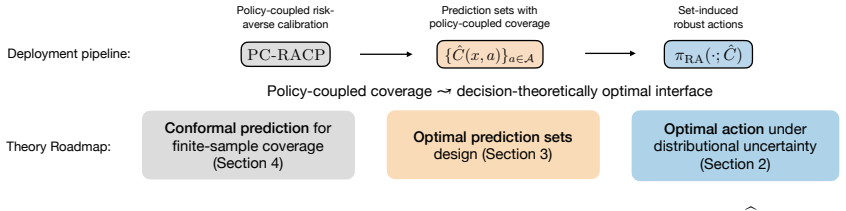
Policy-coupled coverage plays three roles. First, it justifies acting via a natural max-min rule as minimax-optimal under distributional ambiguity. Second, optimizing prediction sets under policy-coupled coverage is equivalent both to a stronger universal-coverage formulation and to the direct risk-averse optimization over policies and utility certificates; this equivalence yields the explicit form of the population-optimal prediction sets. Third, it admits a two-stage procedure, Policy-Coupled Risk-Averse Conformal Prediction (PC-RACP), that approximates these optimal sets with rigorous finite-sample coverage.
What carries the argument
Policy-coupled coverage, defined as coverage of the realized outcome under the action induced by the prediction sets themselves, serves as the interface between uncertainty quantification and decision optimality.
If this is right
- A natural max-min rule over policies is minimax-optimal under distributional ambiguity.
- The population-optimal prediction sets take an explicit form derived from the equivalences.
- PC-RACP approximates the optimal sets while maintaining rigorous finite-sample coverage.
- Ignoring the counterfactual dependence between actions and outcomes produces suboptimal validity and utility.
Where Pith is reading between the lines
- The framework suggests redefining coverage relative to the induced policy in any setting where predictions directly shape the actions taken.
- Extensions to sequential or multi-stage decisions could test whether the same equivalences continue to hold when later outcomes depend on earlier choices.
- The explicit form of the optimal sets provides a benchmark that could be used to diagnose when standard conformal methods lose efficiency in decision contexts.
Load-bearing premise
The counterfactual outcome distribution admits a well-defined policy-coupled coverage property that serves as a lossless interface between uncertainty quantification and decision making, and the stated equivalences between the three optimization problems hold.
What would settle it
A concrete distribution or dataset where the sets obtained by optimizing under policy-coupled coverage differ from those obtained under the universal-coverage formulation would falsify the claimed equivalence.
Figures

read the original abstract
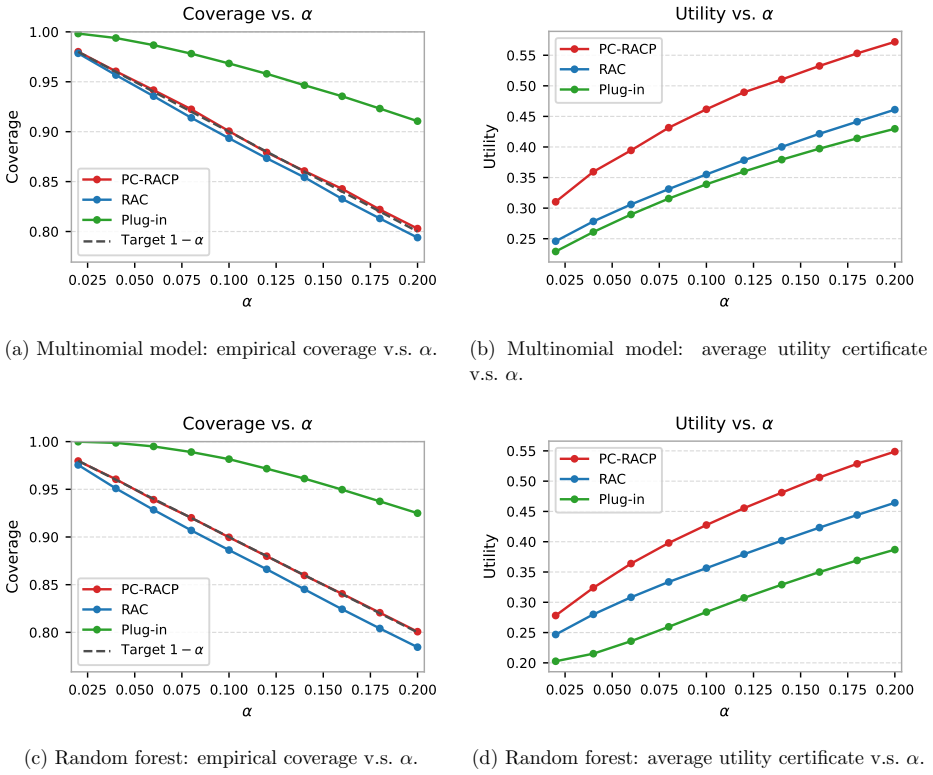
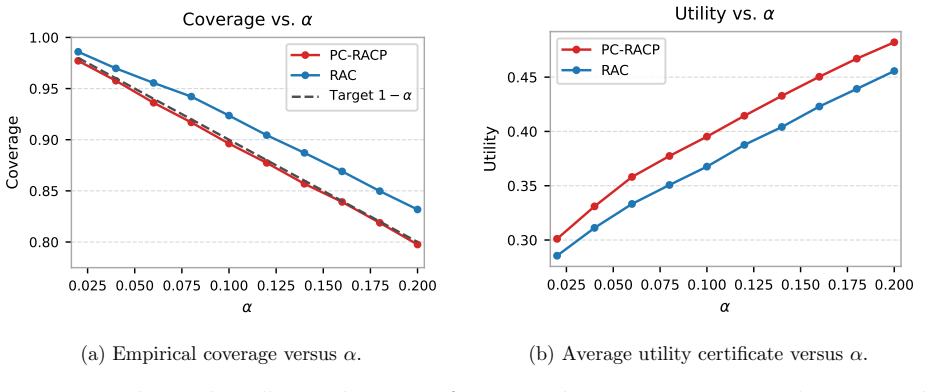
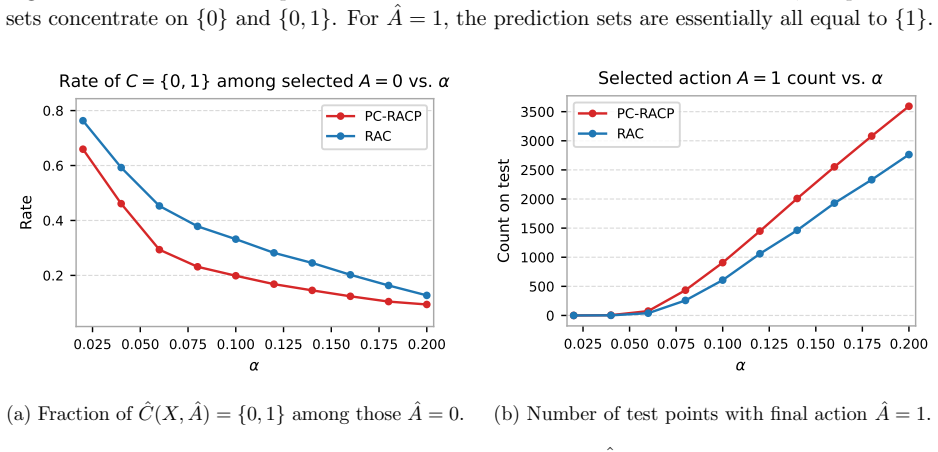
Predictions are increasingly used to guide high-stakes decisions, from treatment selection to policy making. To ensure reliability with imperfect predictions, uncertainty quantification methods such as conformal prediction build prediction sets with coverage guarantees. However, statistical validity alone does not immediately determine the decisions to take, nor the optimality thereof. This gap is especially delicate in counterfactual settings where the outcome that materializes depends on the action taken, so uncertainty cannot be specified independently of the decision rule. We develop a decision-theoretic framework for uncertainty-informed counterfactual decisions. We identify a novel notion of \emph{policy-coupled coverage} -- namely, coverage of the realized outcome under the action induced by the prediction sets themselves -- as the optimal and lossless interface between uncertainty and action. It plays three roles. First, it justifies acting via a natural max-min rule as minimax-optimal under distributional ambiguity. Second, optimizing prediction sets under policy-coupled coverage is equivalent both to a stronger universal-coverage formulation and to the direct risk-averse optimization over policies and utility certificates; this equivalence yields the explicit form of the population-optimal prediction sets. Third, it admits a two-stage procedure, Policy-Coupled Risk-Averse Conformal Prediction (PC-RACP), that approximates these optimal sets with rigorous finite-sample coverage. Simulations and a real email-marketing experiment confirm that PC-RACP delivers higher utility than existing approaches while maintaining valid coverage, and that ignoring the counterfactual structure of the decision problem is suboptimal for both validity and utility.
Editorial analysis
A structured set of objections, weighed in public.
Referee Report
Summary. The paper develops a decision-theoretic framework for using prediction sets to guide counterfactual decisions. It introduces policy-coupled coverage (coverage of the realized outcome under the action induced by the sets themselves) as the interface between uncertainty quantification and action. The central claims are that this notion justifies a max-min decision rule as minimax-optimal under distributional ambiguity, that optimizing sets under policy-coupled coverage is equivalent both to a stronger universal-coverage problem and to direct risk-averse optimization over policies and utility certificates (yielding explicit population-optimal sets), and that the two-stage PC-RACP procedure approximates these sets while delivering rigorous finite-sample coverage. Simulations and an email-marketing experiment are used to show improved utility relative to baselines.
Significance. If the claimed equivalences hold under the modeling conditions, the work supplies a principled bridge between conformal prediction and decision theory in settings where outcomes depend on the chosen action. The explicit form of the optimal sets, the finite-sample guarantees of PC-RACP, and the empirical demonstration of utility gains would constitute a substantive contribution to reliable decision-making under uncertainty.
major comments (1)
- [Abstract (and the sections presenting the three optimization problems)] The load-bearing claim that optimization under policy-coupled coverage is equivalent to both the universal-coverage formulation and direct risk-averse optimization (and that this equivalence produces the explicit population-optimal sets) is asserted without an accompanying derivation or list of assumptions on the ambiguity set, utility function, or support of the counterfactual distribution. This equivalence is required to justify the max-min rule as minimax-optimal and to establish that PC-RACP approximates the optimum; its absence prevents verification of the central theoretical results.
minor comments (2)
- [Theoretical development] Clarify the precise definition of the ambiguity set used for the minimax optimality argument.
- [PC-RACP section] Add a short table summarizing the finite-sample coverage guarantee of PC-RACP (including the exact probability statement and any dependence on sample size or dimension).
Simulated Author's Rebuttal
We thank the referee for the careful reading and for identifying the need for explicit derivations of the central equivalences. We address the major comment below.
read point-by-point responses
-
Referee: [Abstract (and the sections presenting the three optimization problems)] The load-bearing claim that optimization under policy-coupled coverage is equivalent to both the universal-coverage formulation and direct risk-averse optimization (and that this equivalence produces the explicit population-optimal sets) is asserted without an accompanying derivation or list of assumptions on the ambiguity set, utility function, or support of the counterfactual distribution. This equivalence is required to justify the max-min rule as minimax-optimal and to establish that PC-RACP approximates the optimum; its absence prevents verification of the central theoretical results.
Authors: We agree that the equivalence claims require an explicit derivation together with a clear list of assumptions. In the revision we will insert a dedicated subsection (and supporting appendix) that derives the three-way equivalence under the following assumptions: (i) the ambiguity set consists of all distributions over the counterfactual outcome space that are consistent with the observed marginals; (ii) the utility function is bounded and continuous; (iii) the support of each counterfactual distribution is finite (or satisfies the regularity conditions needed for the max-min to be attained). The new material will also show how these conditions make the max-min rule minimax-optimal and how the two-stage PC-RACP procedure approximates the resulting population-optimal sets. revision: yes
Circularity Check
No significant circularity; derivation relies on decision-theoretic arguments rather than self-referential reductions
full rationale
The abstract introduces policy-coupled coverage as a novel interface between uncertainty quantification and counterfactual decisions, asserting its equivalence to universal-coverage and risk-averse optimization problems along with minimax optimality of the max-min rule. These claims are presented as derived from the modeling conditions on counterfactual outcomes and distributional ambiguity, without any visible self-definition, fitted inputs renamed as predictions, or load-bearing self-citations. The PC-RACP procedure is positioned as an approximation with independent finite-sample guarantees, supported by simulations and an experiment. No equations or steps in the provided text reduce the central results to their own inputs by construction, making the derivation self-contained against external benchmarks.
Axiom & Free-Parameter Ledger
invented entities (1)
-
policy-coupled coverage
no independent evidence
Reference graph
Works this paper leans on
-
[1]
Language models with conformal factuality guarantees , author=. arXiv preprint arXiv:2402.10978 , year=
-
[2]
arXiv preprint arXiv:2405.10301 , year=
Conformal Alignment: Knowing When to Trust Foundation Models with Guarantees , author=. arXiv preprint arXiv:2405.10301 , year=
-
[3]
Journal of the American Statistical Association , volume=
False discovery rate--adjusted multiple confidence intervals for selected parameters , author=. Journal of the American Statistical Association , volume=. 2005 , publisher=
2005
-
[4]
Journal of the Royal statistical society: series B (Methodological) , volume=
Controlling the false discovery rate: a practical and powerful approach to multiple testing , author=. Journal of the Royal statistical society: series B (Methodological) , volume=. 1995 , publisher=
1995
-
[5]
Journal of Machine Learning Research , volume=
Selection by prediction with conformal p-values , author=. Journal of Machine Learning Research , volume=
-
[6]
The Thirty-eighth Annual Conference on Neural Information Processing Systems , year=
Conformalized Multiple Testing after Data-dependent Selection , author=. The Thirty-eighth Annual Conference on Neural Information Processing Systems , year=
-
[7]
arXiv preprint arXiv:2403.12295 , year=
Selecting informative conformal prediction sets with false coverage rate control , author=. arXiv preprint arXiv:2403.12295 , year=
-
[8]
arXiv preprint arXiv:2403.03868 , year=
Confidence on the focal: Conformal prediction with selection-conditional coverage , author=. arXiv preprint arXiv:2403.03868 , year=
-
[9]
Computing Meaning: Volume 4 , pages=
Natural logic and natural language inference , author=. Computing Meaning: Volume 4 , pages=. 2014 , publisher=
2014
-
[10]
2005 , publisher=
Algorithmic learning in a random world , author=. 2005 , publisher=
2005
-
[11]
Conformal language modeling , author=. arXiv preprint arXiv:2306.10193 , year=
-
[12]
arXiv preprint arXiv:2307.09291 , year=
Model-free selective inference under covariate shift via weighted conformal p-values , author=. arXiv preprint arXiv:2307.09291 , year=
-
[13]
Annals of statistics , pages=
The control of the false discovery rate in multiple testing under dependency , author=. Annals of statistics , pages=. 2001 , publisher=
2001
-
[14]
arXiv preprint arXiv:2502.02561 , year=
Decision theoretic foundations for conformal prediction: Optimal uncertainty quantification for risk-averse agents , author=. arXiv preprint arXiv:2502.02561 , year=
-
[15]
Information and Inference: A Journal of the IMA , volume=
The limits of distribution-free conditional predictive inference , author=. Information and Inference: A Journal of the IMA , volume=. 2021 , publisher=
2021
-
[16]
Advances in neural information processing systems , volume=
Conformal prediction under covariate shift , author=. Advances in neural information processing systems , volume=
-
[17]
Games and Economic Behavior , volume=
Calibrated learning and correlated equilibrium , author=. Games and Economic Behavior , volume=
-
[18]
Advances in Neural Information Processing Systems , volume=
Calibrating predictions to decisions: A novel approach to multi-class calibration , author=. Advances in Neural Information Processing Systems , volume=
-
[19]
Journal of the American statistical Association , volume=
Causal inference using potential outcomes: Design, modeling, decisions , author=. Journal of the American statistical Association , volume=. 2005 , publisher=
2005
-
[20]
2015 , publisher=
Causal inference in statistics, social, and biomedical sciences , author=. 2015 , publisher=
2015
-
[21]
Annals of Mathematics and Artificial Intelligence , volume=
Current application of conformal prediction in drug discovery: Two useful applications , author=. Annals of Mathematics and Artificial Intelligence , volume=. 2017 , publisher=
2017
-
[22]
arXiv preprint arXiv:2602.00989 , year=
Optimal Decision-Making Based on Prediction Sets , author=. arXiv preprint arXiv:2602.00989 , year=
-
[23]
Journal of the Royal Statistical Society Series B: Statistical Methodology , volume=
Conformal inference of counterfactuals and individual treatment effects , author=. Journal of the Royal Statistical Society Series B: Statistical Methodology , volume=. 2021 , publisher=
2021
-
[24]
Proceedings of the National Academy of Sciences , volume=
Sensitivity analysis of individual treatment effects: A robust conformal inference approach , author=. Proceedings of the National Academy of Sciences , volume=. 2023 , publisher=
2023
-
[25]
2008 , urldate =
Hillstrom, Kevin , title =. 2008 , urldate =
2008
-
[26]
Proceedings of the National Academy of Sciences , volume=
Causal inference in economics and marketing , author=. Proceedings of the National Academy of Sciences , volume=. 2016 , publisher=
2016
-
[27]
Journal of the American Statistical Association , volume=
Conformal sensitivity analysis for individual treatment effects , author=. Journal of the American Statistical Association , volume=. 2024 , publisher=
2024
-
[28]
2026 , eprint=
Conformal Risk-Averse Decision Making with Action Conditional Guarantee , author=. 2026 , eprint=
2026
-
[29]
Advances in neural information processing systems , volume=
Conformal meta-learners for predictive inference of individual treatment effects , author=. Advances in neural information processing systems , volume=
-
[30]
Biometrika , volume=
Asymptotic calibration , author=. Biometrika , volume=. 1998 , publisher=
1998
-
[31]
Journal of Computer and System Sciences , volume=
Deterministic calibration and Nash equilibrium , author=. Journal of Computer and System Sciences , volume=. 2008 , publisher=
2008
-
[32]
Journal of Marketing Theory and Practice , volume=
Data, measurement, and causal inferences in machine learning: opportunities and challenges for marketing , author=. Journal of Marketing Theory and Practice , volume=. 2021 , publisher=
2021
-
[33]
Proceedings of the 21th ACM SIGKDD international conference on knowledge discovery and data mining , pages=
Machine learning and causal inference for policy evaluation , author=. Proceedings of the 21th ACM SIGKDD international conference on knowledge discovery and data mining , pages=
-
[34]
Nature Medicine , volume=
Causal machine learning for predicting treatment outcomes , author=. Nature Medicine , volume=. 2024 , publisher=
2024
-
[35]
ACM Transactions on Information Systems , volume=
Causal inference in recommender systems: A survey and future directions , author=. ACM Transactions on Information Systems , volume=. 2024 , publisher=
2024
-
[36]
Proceedings of the 19th international conference on World wide web , pages=
A contextual-bandit approach to personalized news article recommendation , author=. Proceedings of the 19th international conference on World wide web , pages=
-
[37]
Econometrica , volume=
Statistical treatment rules for heterogeneous populations , author=. Econometrica , volume=. 2004 , publisher=
2004
discussion (0)
Sign in with ORCID, Apple, or X to comment. Anyone can read and Pith papers without signing in.