REVIEW 3 major objections 6 minor 20 references
BacktrackAgent: Enhancing GUI Agent with Error Detection and Backtracking Mechanism
T0 review · 3 major / 6 minor · reviewed 2026-08-07 · deepseek-v4-flash
Pith's one-line read A GUI agent that backtracks from wrong actions lifts task success by 7.59 points on Mobile3M.
desk verdict Solid Mobile3M evidence for a backtracking GUI agent, but the Auto-UI generality claim is undercut by the paper's own simulated-execution ablation. read the letter →
The pith
A machine-rendered reading of the paper's core claim, the machinery that carries it, and where it could break.
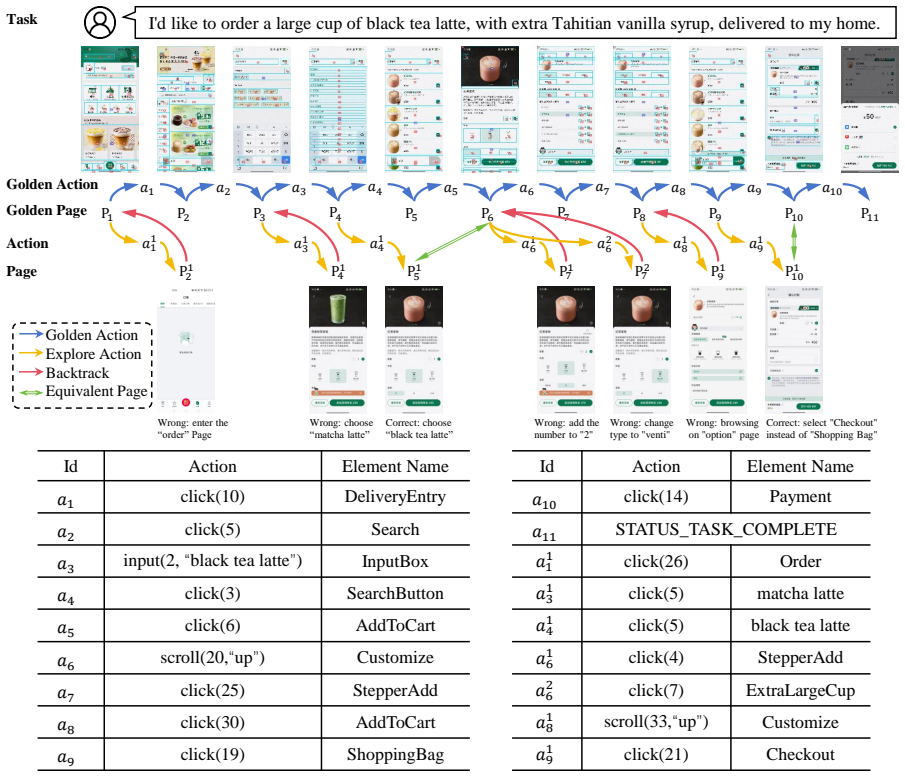
The reading
What carries the argument
The load-bearing object is the post-execution page $P_{t+1}^{i}$ obtained after an attempted action $\hat{a}_t^i$ is run, because both detection modules consume it. The verifier is rule-based: it rejects actions that are not executable or that leave the page unchanged unless the task is complete. The judger is a trained binary classifier that receives the task $X$, the current page $P_t$, the action $\hat{a}_t^i$, and the outcome page $P_{t+1}^{i}$, and decides whether the action moved the task forward. The reflector receives the task, page, action history, all failed attempts at step $t$, and the outcome page, and generates a new action. The loop repeats until the action passes or three reflections are exhausted, and the binary judgments are added as reward terms to the generator and reflector training losses.
What would settle it
Run BacktrackAgent on a mobile test suite where every candidate action, including wrong ones, can actually be executed, and compare task success against the simulated-execution variant. If simulated and real post-action pages produce similar gains, the paper's attribution of the improvement to real outcome pages is refuted; the current evidence for that attribution is the Mobile3M ablation showing gains of 5.65 points with real pages and 0.70 points with simulated ones.
Extended reading notes
Core claim
The paper's claim is that explicit backtracking—treating the page after an action as evidence and acting on that evidence—is what lets a 7B vision-language agent complete longer GUI tasks. The generator first proposes an action; the system executes it (actually or by simulation) to get the next page; the verifier and judger independently decide whether the action was executable and whether it contributed to the task; and if either says no, the reflector generates a replacement action using the task, the action history, all failed attempts, and the outcome page. The binary judgments also become reward terms when fine-tuning the generator and reflector. The paper reports that this mechanism improves Mobile3M task success rate from 46.52% to 54.11%, improves Auto-UI task-level accuracy from 25.28% to 29.72%, and is stable across resampled test sets and retrained seeds. The supporting observation is the ablation: the gain nearly vanishes when the judger and reflector are trained with simulated execution pages instead of real post-action pages.
Load-bearing premise
The framework assumes that the page observed after an action is executed—or the hand-annotated stand-in for it—faithfully shows whether the action helped, and that the judger and reflector trained on such pages keep working in the real GUI environment.
Editorial extensions
If this is right
- Task success on multi-step mobile benchmarks can be improved without a larger model: the gains come from the detection-recovery loop around a 7B backbone, not from model scale.
- Judgments from the verifier and judger can serve as dense step-level rewards, a cheaper alternative to the pre-sampled preference pairs used by DPO-based agents.
- The same framework transfers to Auto-UI, a different chain-structured benchmark, suggesting the backtracking pattern generalizes beyond Mobile3M's graph-structured pages.
- Removing the judger costs 5.32 points in Mobile3M task success while removing the verifier costs only 0.45 points, so model-based judgment carries most of the detection burden.
- The backtracking loop roughly halves inference speed, so adopting the mechanism trades latency for task-level reliability.
Reading between the lines
- If post-action page fidelity is the real driver, benchmarks that cannot replay wrong actions will systematically understate the value of backtracking; investing in replayable mobile testbeds may matter more than enlarging the judger.
- The judger's recall is only 43.58% on Mobile3M and 48.04% on Auto-UI, so most wrong actions are never flagged; raising recall without losing precision is the most direct scaling path for the framework.
- Because the reflector rewrites 0.78% of actions that were originally correct into wrong ones, a cheap safeguard is to require rewritten actions to pass the judger again or to add a confidence threshold before rewriting.
- The same detect-and-rewrite loop could transfer to desktop or web agents whenever an action's result can be captured by replay, not only to mobile GUI datasets.
Editorial analysis
A structured set of objections, weighed in public.
Referee Report
Summary. The paper proposes BacktrackAgent, a GUI agent framework that augments a generator with three error-handling modules: a rule-based verifier, a VLM-based judger, and a reflector that rewrites erroneous actions. The agent executes or simulates the execution of each candidate action, uses the verifier and judger to decide whether the resulting page indicates an error, and invokes the reflector to produce a corrected action; the detection results are also used as reward signals for further RL-style training. The framework is evaluated on Mobile3M and Auto-UI, reporting a task success rate of 54.11% versus 46.52% for the ReachAgent baseline on Mobile3M, and a task-level accuracy of 29.72% versus 25.28% on Auto-UI. The authors attribute these gains to the backtracking mechanism and claim it generalizes across both benchmarks.
Significance. If the Mobile3M results are taken at face value, BacktrackAgent is a genuinely useful contribution: the ablations in Table 3 isolate the contributions of the verifier, judger, and reflector, and the stability analysis in Table 13 provides repeated evaluations and significance tests, which is stronger evidence than is common in this area. The idea of training a judger on actual post-execution pages and using detection outputs as rewards is well motivated and could be reused by other GUI-agent work. However, the cross-benchmark generality claim rests on the Auto-UI experiments, and those experiments are materially weaker: they use only simulated execution pages, are single-run, and lack an Auto-UI ablation of the backtracking mechanism. The paper's own Mobile3M ablation (Table 3) shows that simulated execution nearly eliminates the backtracking benefit, so the Auto-UI result currently does not establish the paper's central generality claim.
major comments (3)
- [Sec. 4.2 / Table 3 / Appendix G] The generality claim is not supported by the Auto-UI experiments. Section 4.2 states that Auto-UI uses simulated execution pages for judger/reflector training because actual outcome pages for incorrect actions are unavailable. The Mobile3M ablation in Table 3, however, shows that switching from actual to simulated execution reduces the backtracking gain from 5.65% to 0.70% in task success rate and makes task-level accuracy negative (-0.63%). Since the Auto-UI training uses exactly this weaker simulated-execution setting, the reported 4.44% task-level gain over ReachAgent on Auto-UI cannot be attributed to the backtracking mechanism without an Auto-UI ablation that removes the verifier/judger/reflector. The paper should either add such an ablation or explicitly restrict the claim to Mobile3M.
- [Sec. 5.3 / Appendix G / Table 12] The Auto-UI results are reported as single runs with no error bars, repeated seeds, or significance tests, in contrast to the Mobile3M results in Table 13. The stability analysis in Section 5.5 applies only to Mobile3M, and Appendix G reports only one set of numbers for Auto-UI. Because the Auto-UI experiment is the sole evidence for the 'framework can generally improve task completion abilities' claim, the authors should provide repeated evaluations for Auto-UI, or at least confidence intervals, before drawing that conclusion.
- [Sec. 5.5 / Tables 5 and 6] The error-detection and recovery analysis raises questions about the mechanism's effectiveness that should be addressed explicitly. The judger recall on Mobile3M is only 43.58% (Table 5), and Table 6 shows that out of all generated results, only 2.37% are correctly detected errors that are then successfully recovered, while 6.11% are detected-but-unrecovered errors and 0.78% are correct actions that the reflector incorrectly modifies. The paper should reconcile these numbers with the claimed 7.59% task-success improvement, for example by reporting the net contribution of backtracking to the final task success rate after accounting for missed errors and false-positive modifications.
minor comments (6)
- [Table 2] The caption contains a typo: 'benchamrks' should be 'benchmarks'.
- [Appendix G] The text says BacktrackAgent is 'slightly worse in Google and Single splits' compared with the SOTA baseline, but Table 12 shows BacktrackAgent is better in the Single split (58.79 vs 46.26 for ReachAgent separate and 48.70 for ReachAgent unified). This sentence should be corrected.
- [Sec. 5.5] The sentence 'Figure 5 shows the accuracy of BacktrackAgent in detecting and recovering from errors' refers to Table 5, not Figure 5. The cross-reference should be fixed.
- [References] The Android-in-the-Wild dataset appears twice as Rawles et al. 2023a and Rawles et al. 2023b with the same title; one entry should be removed and citations unified.
- [Appendix B] There are typos in the section heading 'Releated Work' and in the name 'WebPliot'; these should be corrected to 'Related Work' and 'WebPilot'.
- [Sec. 3.5 / Table 8] The loss weights beta1 and beta2 are set to 0.1, but no sensitivity analysis is reported. Since they control the strength of the verifier and judger rewards, a brief discussion or ablation would help interpret the RL contribution in Table 3.
Circularity Check
No significant circularity; the paper's claims are empirical, with disjoint training/test evaluation and self-citations used only as baselines.
full rationale
BacktrackAgent makes an empirical claim about GUI-agent performance, not a derivation from first principles. The judger and reflector are trained on labels derived from IoU/text matching against golden actions, and the same metrics are later used for evaluation; however, the test splits are disjoint from the training splits, so this is standard supervised training and evaluation rather than a definitional equivalence. The rule-based verifier is stated as two general executable/effectiveness checks and is not derived from the target results. The paper's self-citations to Mobile3M, MobileVLM, and ReachAgent serve as dataset and baseline comparisons, not as load-bearing theoretical premises: no uniqueness theorem, no ansatz is justified solely by the authors' prior work, and the baseline numbers are externally computed on public benchmarks. The ablation showing that simulated execution yields much smaller gains (Table 3: 0.70% vs 5.65%) is a legitimate concern about attributing the Auto-UI improvements to the backtracking mechanism, but that is a question of experimental attribution and generalization, not circularity. No quoted passage exhibits a fitted parameter renamed as a prediction, nor does any equation reduce the reported gains to the training labels by construction. Accordingly, the paper receives a score of 0 for circularity.
Assumptions & free parameters
free parameters (4)
- beta1 and beta2 (loss weights) =
0.1
- max reflection times =
3
- IoU error tolerance and text F1 threshold =
IoU within 14%, text F1 > 0.8
- Effective action sampling ratio for reflection dataset =
20%
assumptions (3)
- domain assumption The Mobile3M graph structure provides the actual outcome page for any action in the action space, while Auto-UI does not, so simulated execution pages are used as proxies for wrong actions.
- ad hoc to paper Simulated execution, which draws arrows and marks bounding boxes on the page, adequately represents the true post-execution page for the purpose of training error detection and recovery.
- domain assumption The golden action sequence defines the reference correctness for step-level and task-level accuracy, while task success also accepts alternative routes that reach key pages.
Cite this review
Pith. "Pith review of BacktrackAgent: Enhancing GUI Agent with Error Detection and Backtracking Mechanism." pith.science (2026). https://pith.science/paper/43B5D5KP
@misc{pith2026250520660,
  author       = {Pith},
  title        = {Pith review of: BacktrackAgent: Enhancing GUI Agent with Error Detection and Backtracking Mechanism},
  year         = {2026},
  howpublished = {\url{https://pith.science/paper/43B5D5KP}},
  note         = {Machine review of arXiv:2505.20660}
}
read the original abstract
Graphical User Interface (GUI) agents have gained substantial attention due to their impressive capabilities to complete tasks through multiple interactions within GUI environments. However, existing agents primarily focus on enhancing the accuracy of individual actions and often lack effective mechanisms for detecting and recovering from errors. To address these shortcomings, we propose the BacktrackAgent, a robust framework that incorporates a backtracking mechanism to improve task completion efficiency. BacktrackAgent includes verifier, judger, and reflector components as modules for error detection and recovery, while also applying judgment rewards to further enhance the agent's performance. Additionally, we develop a training dataset specifically designed for the backtracking mechanism, which considers the outcome pages after action executions. Experimental results show that BacktrackAgent has achieved performance improvements in both task success rate and step accuracy on Mobile3M and Auto-UI benchmarks. Our data and code will be released upon acceptance.
Figures


Figures from the paper (4 more)



Reference graph
Works this paper leans on
-
[1]
On the Starbucks homepage, BacktrackAgent decides to click the Order button. P1 -> click ("Order") -> P1 2 After observing the action execution result page, the error detection module found that the agent went to the order page without selecting coffee and decided to start the backtrack. The error recovery module reflects the action of the current step an...
-
[2]
VisualWebArena: Evaluating multimodal agents on realistic visual web tasks. In Proceedings of the 62nd Annual Meeting of the Association for Computational Linguistics (Volume 1: Long Papers), pages 881–905, Bangkok, Thailand. Association for Computational Linguistics. Hung Le, Yue Wang, Akhilesh Deepak Gotmare, Silvio Savarese, and Steven Chu Hong Hoi. 20...
arXiv 2022
-
[3]
For the SFT version, the Generator, Judge, and Reflector were trained for 2 epochs on the Mobile3M and Auto-UI datasets, respectively. For the RL version, the generator and reflector were further trained for 2 epochs with the new loss function. To ensure fair comparisons, we maintain consistent hyperparameters across all the baselines and the ablations of...
work page 2023
-
[4]
Exact: Teaching ai agents to explore with reflective-mcts and exploratory learning. Preprint, arXiv:2410.02052. Zhuosheng Zhan and Aston Zhang. 2023. You only look at screens: Multimodal chain-of-action agents. arXiv preprint arXiv:2309.11436. Chi Zhang, Zhao Yang, Jiaxuan Liu, Yucheng Han, Xin Chen, Zebiao Huang, Bin Fu, and Gang Yu. 2023. Appagent: Mult...
arXiv 2023
-
[5]
Android in the zoo: Chain-of-action-thought for GUI agents. In Findings of the Association for Computational Linguistics: EMNLP 2024 , pages 12016–12031, Miami, Florida, USA. Association for Computational Linguistics. Yao Zhang, Zijian Ma, Yunpu Ma, Zhen Han, Yu Wu, and V olker Tresp. 2025. Webpilot: A versatile and autonomous multi-agent system for web t...
work page 2024
-
[6]
Here, since the Auto-UI dataset does not contain the complete XML document of the GUI page or the mobile environment image, it is difficult for us to obtain the result page after executing a wrong action on the GUI page, so we use the simulated execution page as the result of the action execution. Hyperparameter SFT RL epoch 2 2 batch size 2 1 learning ra...
-
[7]
On the parameter page, the BacktrackAgent clicks the Add button for Tahitian vanilla syrup. The error detection module passes this action. P7 -> click ("StepperAdd") -> P8
-
[8]
After selecting the parameters, the agent decides to continue swiping up to browse more parameters. The error detection module finds that all param- eters of the "black tea latte" have been customized and there is no need to continue browsing. The error recovery module changes the current action to add to the shopping cart. P8 -> scroll ("Customize", "up"...
Show all 20 references
-
[9]
IngredientButton
The inputs of the generator, judger and reflector are shown in below three tables respectively. As can be seen from the tables, the input of the generator needs to fill the current GUI page, the action space of the current GUI page, the history action list and the given task. ...
1930
-
[10]
The error detection module passes this action
BacktrackAgent clicks the payment button. The error detection module passes this action. P10 -> click ("Payment") -> P11
-
[11]
order” Page Wrong: choose “matcha latte
On the delivery entry page, the generator decides to click the Search button. P2 -> click ("Search") -> P3 The error detection module believes that entering the search page helps complete the task and proceeds to the next step. Golden Action Golden Page P1 P2 P3 P4 P5 P6 P7 P8...
-
[12]
matcha latte
On the search page, the agent decides to click the matcha latte button in the recommendation column. P3 -> click ("matcha latte") -> P1 4 The error detection module finds that the agent has entered the product page of Matcha Latte and starts to backtrack. The reflector rewrite...
-
[13]
black tea latte
After entering "black tea latte", the agent clicks the search button. The error detection module also considers this action to be correct. P4 -> click ("SearchButton") -> P5
-
[14]
black tea latte
On the search results page for "black tea latte", the agent clicks the add button for the product. The error detection module decides to go directly to step 6. P5 -> click ("AddToCart") -> P6
-
[15]
black tea latte,
On the product page for “black tea latte,” the agent first clicks the plus icon in the number of cups. The error detection module finds that the current Stuck in “Address Collection” Stuck in “Browsing History” ReachAgent BacktrackAgent ReachAgent BacktrackAgent Figure 7: Two ...
-
[18]
ShoppingBag
BacktrackAgent decides to click the shopping bag button. The error detection module sees that it has reached the checkout page and goes to step 10. P9 -> click ("ShoppingBag") -> P10
-
[20]
STATUS_TASK_COMPLETE
BacktrackAgent believes that the task has been completed and generates the special token "STATUS_TASK_COMPLETE" to end the reasoning process. P11 -> STATUS_TASK_COMPLETE F Case Study Here we provide two cases of errors during eval- uation (See Figure 7). We can see that the Re...
-
[2023]
to further improve existing generation based on feedback or scoring of execution results. A main reason why verifiers are effective on these tasks is that both mathematical expressions and codes are executable, and the results after exe- cution reflect the quality of generatio...
2025
-
[2024]
Preprint, arXiv:2410.05243
Navigating the digital world as humans do: Universal visual grounding for gui agents. Preprint, arXiv:2410.05243. Wenyi Hong, Weihan Wang, Qingsong Lv, Jiazheng Xu, Wenmeng Yu, Junhui Ji, Yan Wang, Zihan Wang, Yuxuan Zhang, Juanzi Li, Bin Xu, Yuxiao Dong, Ming Ding, and Jie Ta...
-
[2025]
Preprint, arXiv:2502.02955
Reachagent: Enhancing mobile agent via page reaching and operation. Preprint, arXiv:2502.02955. Qinzhuo Wu, Weikai Xu, Wei Liu, Tao Tan, Liujian Liujianfeng, Ang Li, Jian Luan, Bin Wang, and Shuo Shang. 2024. MobileVLM: A vision-language model for better intra- and inter-UI un...
2024 arXiv
Reviewed August 7, 2026 · model on record in the stance chip above.
Discussion (0). Continue with ORCID to comment.