Constraints on Binarity for the Extreme Oe Variable Star AzV 493
Pith reviewed 2026-06-26 01:01 UTC · model grok-4.3
The pith
X-ray observations set an upper limit of 2.5 x 10^33 erg/s on AzV 493 without confirming a binary companion.
A machine-rendered reading of the paper's core claim, the machinery that carries it, and where it could break.
Core claim
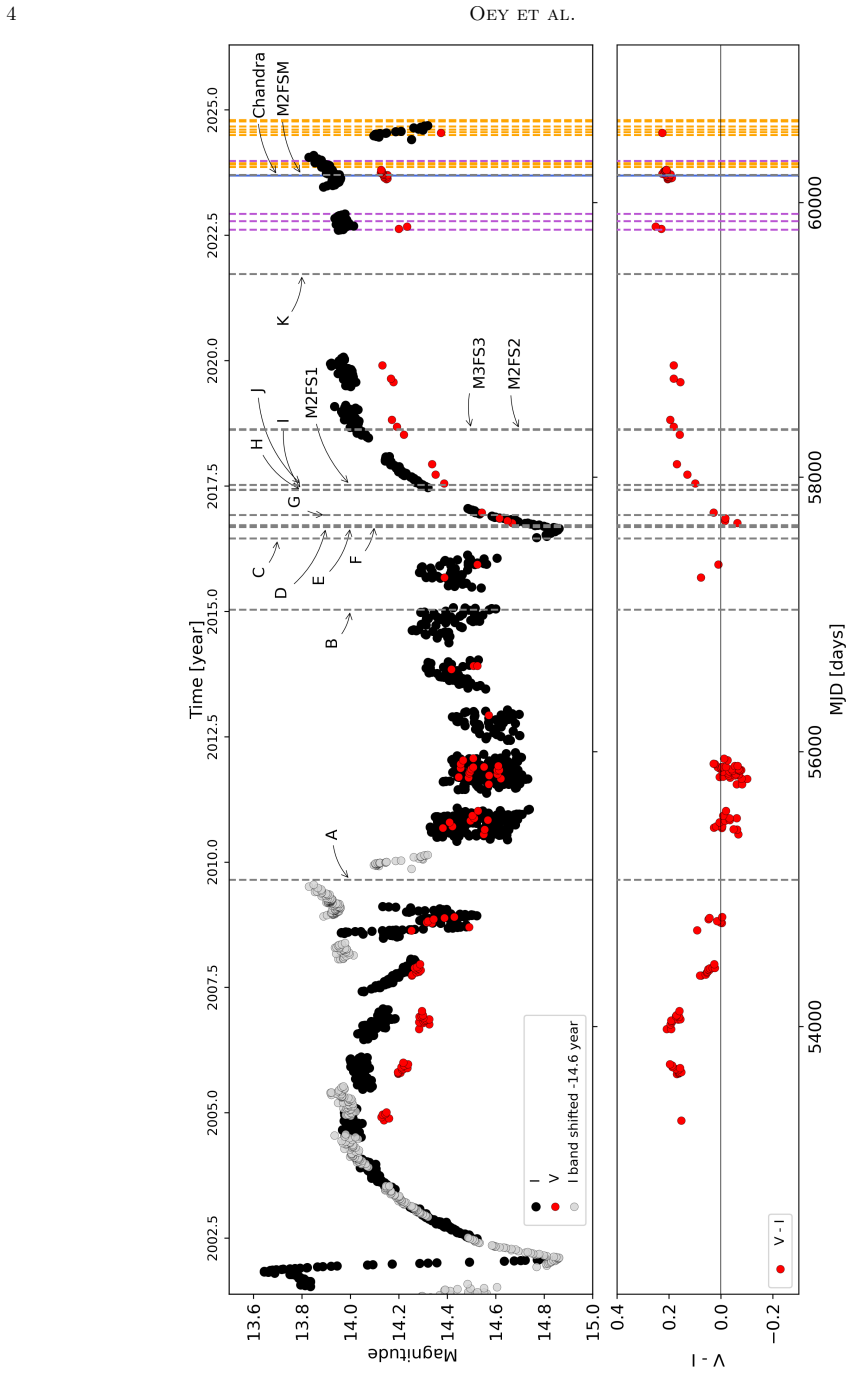
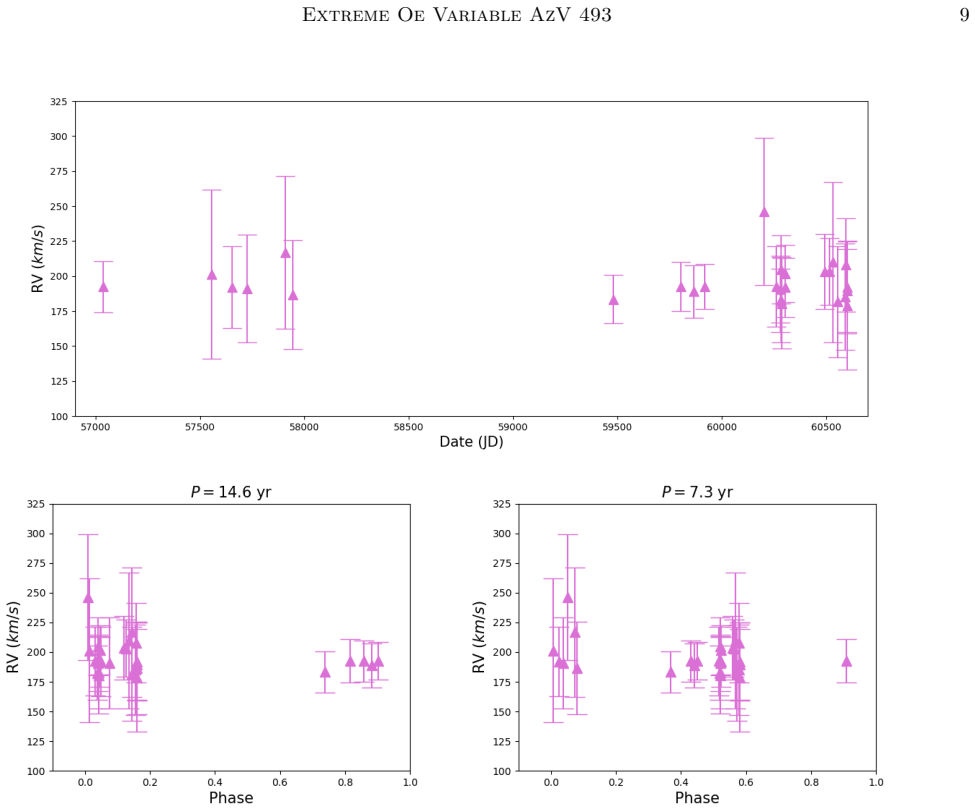
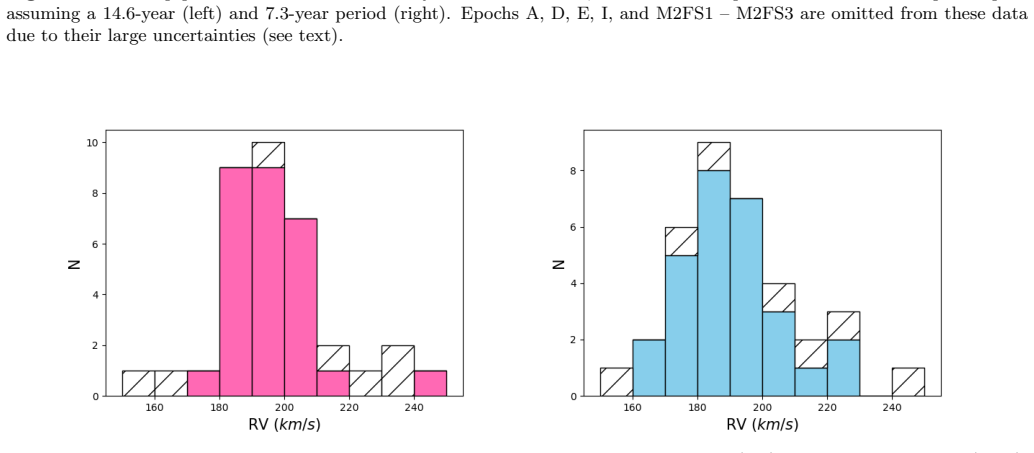
The Chandra/ACIS observation near the putative periastron for the 7.3-year orbit only places an upper limit to the X-ray luminosity of L_X < 2.5 x 10^33 erg/s based on the 0.5 - 8 keV flux limit. Statistical analysis of the RV measurements yields inconclusive results regarding the existence of variations. Possible mass limits for a potential companion, which may be a black hole, are discussed in the event that the variations are real. The violet-to-red (V/R) Balmer ratio has also recently inverted, which may be a further indication of a companion.
What carries the argument
Chandra X-ray imaging near predicted periastron combined with radial velocity monitoring from Magellan and VLT spectra to test for binarity signals.
If this is right
- If the radial velocity variations are real, the unseen companion may have a mass consistent with a black hole.
- The recent inversion of the V/R Balmer ratio provides possible additional evidence for a companion.
- The X-ray non-detection rules out strong accretion or colliding winds at the observed epoch.
- Further monitoring is required to establish whether the 7.3 or 14.6 year period produces detectable signals.
Where Pith is reading between the lines
- Similar long-period eccentric systems may exist among other extreme Oe stars and could be tested with targeted X-ray observations.
- Non-detection of X-rays suggests that any companion interacts only weakly with the primary star's circumstellar material.
- Confirmation of binarity would link the star's variability directly to orbital dynamics rather than intrinsic stellar processes.
Load-bearing premise
The photometric and spectroscopic variability indicate the presence of an unseen companion in a highly eccentric and long-period orbit.
What would settle it
Detection of X-ray emission above 2.5 x 10^33 erg/s near the predicted periastron passage or statistically significant radial velocity variations with a 7.3 or 14.6 year period would confirm the binary companion.
Figures
read the original abstract
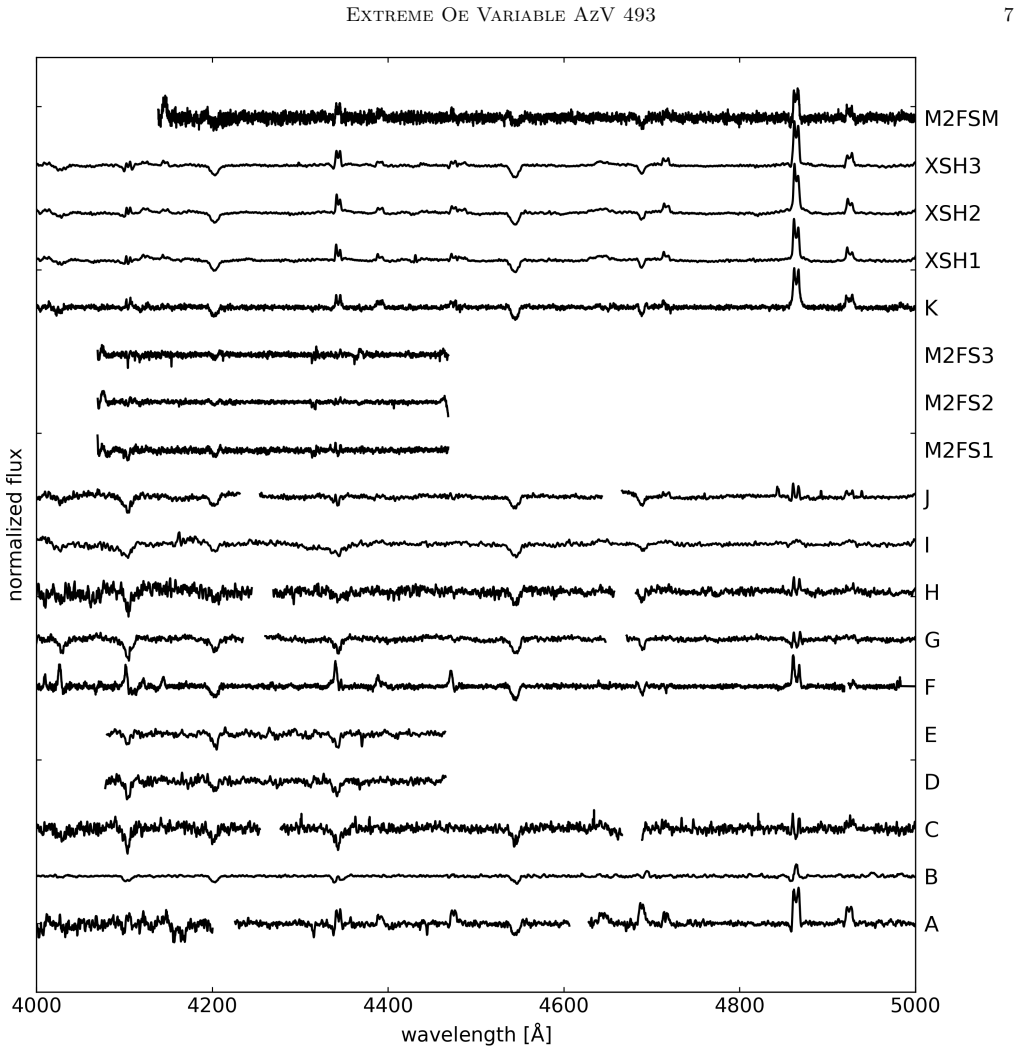
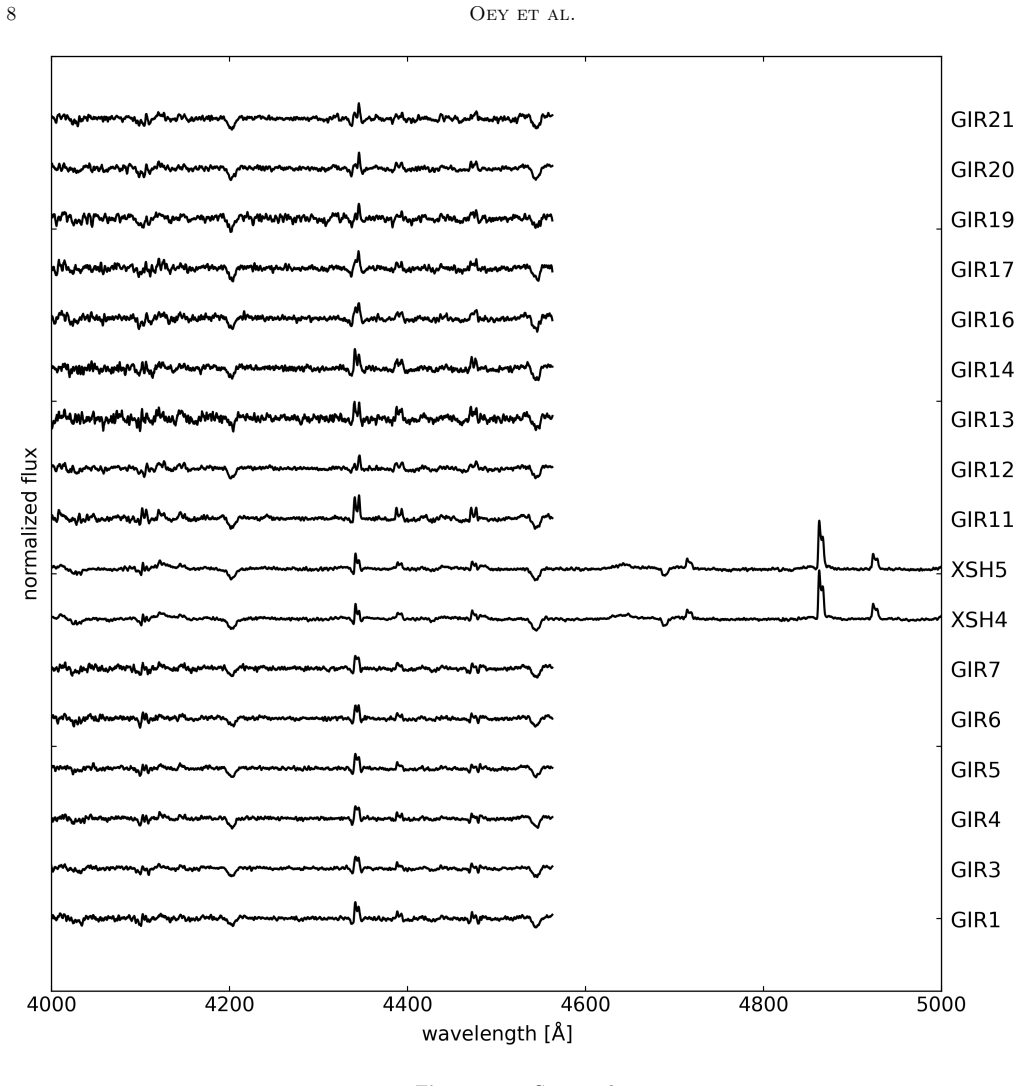
The extreme Oe star AzV 493 is known to show unusual photometric and spectroscopic variability that suggest the presence of an unseen companion in a highly eccentric and long-period (7.3 or 14.6-year) orbit. We obtained a Chandra/ACIS observation near the putative periastron for the 7.3-year orbit to test for transient X-ray emission that would confirm its binary nature. Our data only place an upper limit to the X-ray luminosity of L_X < 2.5 x 10^33 erg/s based on the 0.5 - 8 keV flux limit. Additionally, we obtained 4 new spectroscopic observations with the M2FS spectrograph at Magellan and 20 archive FLAMES/GIRAFFE and X-Shooter spectra from ESO/VLT to further constrain the possibility of radial velocity (RV) variation. Statistical analysis of the RV measurements yields inconclusive results regarding the existence of variations. We discuss possible mass limits for a potential companion, which may be a black hole, in the event that the variations are real. The violet-to-red (V/R) Balmer ratio has also recently inverted, which may be a further indication of a companion.
Editorial analysis
A structured set of objections, weighed in public.
Referee Report
Summary. The paper reports a Chandra/ACIS X-ray observation of the extreme Oe star AzV 493 obtained near the predicted periastron of a hypothesized 7.3-year eccentric binary orbit. The observation yields only an upper limit L_X < 2.5 × 10^33 erg/s (0.5–8 keV). New M2FS spectra plus 20 archival FLAMES/GIRAFFE and X-Shooter spectra are combined for radial-velocity analysis; statistical tests are reported as inconclusive regarding variability. The authors discuss conditional mass limits for a possible companion (including a black-hole scenario) assuming the known photometric and spectroscopic variability traces binarity, and note a recent inversion of the V/R Balmer ratio as possible additional evidence.
Significance. If the reported limits hold, the work supplies useful observational constraints on binarity for an extreme Oe variable. The X-ray non-detection near periastron provides a direct, falsifiable bound that can be compared against accretion models for a compact companion. The appropriately cautious reporting of inconclusive RV results and the conditional mass-limit discussion avoid over-claiming while guiding future monitoring. The paper’s purely observational character and lack of circular derivations strengthen its utility as a constraint paper.
minor comments (3)
- [§2] §2 (Observations): the text should explicitly state the exact orbital phase at which the Chandra observation was taken relative to the 7.3 yr ephemeris and quantify the uncertainty in that phase arising from the period uncertainty.
- [§3.2] §3.2 (RV analysis): the description of the statistical test for periodicity or variability should include the exact method (e.g., Lomb-Scargle, χ² test against constant) and the number of degrees of freedom so that the “inconclusive” verdict can be reproduced.
- [Discussion] Discussion: the mass-limit curves in any figure should be labeled with the assumed inclination range and the adopted primary mass so readers can assess the black-hole scenario without external references.
Simulated Author's Rebuttal
We thank the referee for their positive assessment of the manuscript, including its observational focus, cautious interpretation of the inconclusive RV results, and utility as a constraint on binarity for AzV 493. The recommendation for minor revision is noted; we will implement appropriate editorial improvements in the revised version.
Circularity Check
No significant circularity; purely observational reporting
full rationale
The paper presents Chandra X-ray non-detection yielding an upper limit L_X < 2.5e33 erg/s and statistical analysis of combined new + archival RV data that is explicitly inconclusive. No equations, fitted parameters, or derivations are used to generate predictions; mass-limit discussion is conditional on the (unproven) variability being real. No self-citations, uniqueness theorems, or ansatzes appear as load-bearing steps. The work is self-contained against external benchmarks with no reduction of outputs to inputs by construction.
Axiom & Free-Parameter Ledger
axioms (1)
- domain assumption Standard assumptions for converting observed X-ray flux to luminosity at the distance of AzV 493
Reference graph
Works this paper leans on
-
[1]
doi:10.1007/978-1-4020-5803-5 , adsurl =
Asteroseismology. doi:10.1007/978-1-4020-5803-5 , adsurl =
-
[2]
Evolution of the Disk in the Be Binary Scorpii Probed during Three Periastron Passages. , keywords =. doi:10.3847/1538-4357/ad40a2 , archivePrefix =. 2404.14504 , primaryClass =
-
[3]
Stars and Galaxies , year = 2023, month = dec, volume =
Long-term evolution of the H emission line of Pleione between Jan 2009 and Mar 2023 in the BeSS database. Stars and Galaxies , year = 2023, month = dec, volume =. doi:10.32231/starsandgalaxies.6.0_1 , adsurl =
-
[4]
Star formation history in the SMC: the case of NGC602
Star Formation History in the Small Magellanic Cloud: The Case of NGC 602. , keywords =. doi:10.1088/0004-6256/137/3/3668 , archivePrefix =. 0901.1237 , primaryClass =
work page internal anchor Pith review Pith/arXiv arXiv doi:10.1088/0004-6256/137/3/3668
-
[5]
A Tidally-Stripped Stellar Component of the Magellanic Bridge
A Tidally Stripped Stellar Component of the Magellanic Bridge. , keywords =. doi:10.1088/0004-637X/779/2/145 , archivePrefix =. 1310.4824 , primaryClass =
work page internal anchor Pith review Pith/arXiv arXiv doi:10.1088/0004-637x/779/2/145
-
[6]
Charles R. Harris and K. Jarrod Millman and St. Array programming with. 2020 , month = sep, journal =. doi:10.1038/s41586-020-2649-2 , publisher =
-
[7]
Astropy: A Community Python Package for Astronomy
doi:10.1051/0004-6361/201322068 , Eid =. arXiv , Author =:1307.6212 , Journal =
work page internal anchor Pith review Pith/arXiv arXiv doi:10.1051/0004-6361/201322068
-
[8]
The Astropy Project: Building an inclusive, open-science project and status of the v2.0 core package
The Astropy Project: Building an Open-science Project and Status of the v2.0 Core Package. , keywords =. doi:10.3847/1538-3881/aabc4f , archivePrefix =. 1801.02634 , primaryClass =
work page internal anchor Pith review Pith/arXiv arXiv doi:10.3847/1538-3881/aabc4f
-
[9]
The Astropy Project: Sustaining and Growing a Community-oriented Open-source Project and the Latest Major Release (v5.0) of the Core Package. , keywords =. doi:10.3847/1538-4357/ac7c74 , archivePrefix =. 2206.14220 , primaryClass =
work page internal anchor Pith review Pith/arXiv arXiv doi:10.3847/1538-4357/ac7c74
-
[10]
and Haberland, Matt and Reddy, Tyler and Cournapeau, David and Burovski, Evgeni and Peterson, Pearu and Weckesser, Warren and Bright, Jonathan and
Virtanen, Pauli and Gommers, Ralf and Oliphant, Travis E. and Haberland, Matt and Reddy, Tyler and Cournapeau, David and Burovski, Evgeni and Peterson, Pearu and Weckesser, Warren and Bright, Jonathan and. Nature Methods , year =
-
[11]
Decretion disc evolution and neutron star accretion in short-period eccentric Be/X-ray binaries. , keywords =. doi:10.1093/mnras/staf244 , archivePrefix =. 2502.04705 , primaryClass =
-
[12]
Channels of Stellar-mass Black Hole Formation. , keywords =. doi:10.3847/1538-4357/addd04 , archivePrefix =. 2412.07831 , primaryClass =
-
[13]
Interacting binaries on the Main Sequence as in-situ tracers of mass transfer efficiency and stability. arXiv e-prints , keywords =. doi:10.48550/arXiv.2511.15347 , archivePrefix =. 2511.15347 , primaryClass =
-
[14]
Binary Stars Take What They Get: Evidence for Efficient Mass Transfer from Stripped Stars with Rapidly Rotating Companions. , keywords =. doi:10.3847/2041-8213/adfdd4 , archivePrefix =. 2505.14780 , primaryClass =
-
[15]
On the kinematics of a runaway Be star population
On the kinematics of a runaway Be star population. , keywords =. doi:10.1093/mnras/sty980 , archivePrefix =. 1804.05849 , primaryClass =
work page internal anchor Pith review Pith/arXiv arXiv doi:10.1093/mnras/sty980
-
[16]
CIAO: Chandra's data analysis system. Observatory Operations: Strategies, Processes, and Systems , year = 2006, editor =. doi:10.1117/12.671760 , adsurl =
-
[17]
The Araucaria Project. The distance to the Small Magellanic Cloud from late-type eclipsing binaries
The Araucaria Project. The Distance to the Small Magellanic Cloud from Late-type Eclipsing Binaries. , keywords =. doi:10.1088/0004-637X/780/1/59 , archivePrefix =. 1311.2340 , primaryClass =
work page internal anchor Pith review Pith/arXiv arXiv doi:10.1088/0004-637x/780/1/59
-
[18]
A Quantitative Comparison of SMC, LMC, and Milky Way UV to NIR Extinction Curves
A Quantitative Comparison of the Small Magellanic Cloud, Large Magellanic Cloud, and Milky Way Ultraviolet to Near-Infrared Extinction Curves. , keywords =. doi:10.1086/376774 , archivePrefix =. astro-ph/0305257 , primaryClass =
work page internal anchor Pith review Pith/arXiv arXiv doi:10.1086/376774
-
[19]
New Field OB and OBe Binaries of the SMC Wing: Observational Properties and Population Modeling. , keywords =. doi:10.3847/1538-4357/ade523 , archivePrefix =. 2506.13004 , primaryClass =
-
[20]
Power comparisons of Shapiro-Wilk, Kolmogorov-Smirnov, Lilliefors and Anderson-Darling tests. J. Stat. Modeling & Analytics , year = 2011, pages =
2011
-
[21]
The Runaways and Isolated O-Type Star Spectroscopic Survey of the SMC (RIOTS4)
The Runaways and Isolated O-Type Star Spectroscopic Survey of the SMC (RIOTS4). , keywords =. doi:10.3847/0004-637X/817/2/113 , archivePrefix =. 1512.01233 , primaryClass =
work page internal anchor Pith review Pith/arXiv arXiv doi:10.3847/0004-637x/817/2/113
-
[22]
Reevaluating Old Stellar Populations
Re-evaluating old stellar populations. , keywords =. doi:10.1093/mnras/sty1353 , archivePrefix =. 1805.08784 , primaryClass =
work page internal anchor Pith review Pith/arXiv arXiv doi:10.1093/mnras/sty1353
-
[23]
Binary Population and Spectral Synthesis Version 2.1: Construction, Observational Verification, and New Results. , keywords =. doi:10.1017/pasa.2017.51 , archivePrefix =. 1710.02154 , primaryClass =
work page internal anchor Pith review Pith/arXiv arXiv doi:10.1017/pasa.2017.51 2017
-
[24]
Strong Variability in AzV 493, an Extreme Oe-type Star in the SMC. , keywords =. doi:10.3847/1538-4357/acb690 , archivePrefix =. 2301.11433 , primaryClass =
-
[25]
Classical OBe Stars as Post-supernova Runaways: Confirming Binary Origins. , keywords =. doi:10.3847/1538-4357/ac8988 , archivePrefix =. 2208.10408 , primaryClass =
-
[26]
Runaway OB Stars in the Small Magellanic Cloud. III. Updated Kinematics and Insights into Dynamical versus Supernova Ejections. , keywords =. doi:10.3847/1538-4357/ad3909 , archivePrefix =. 2403.17198 , primaryClass =
-
[27]
Deep Chandra Survey of the Small Magellanic Cloud. III. Formation Efficiency of High-mass X-Ray Binaries. , keywords =. doi:10.3847/1538-4357/ab4a7a , archivePrefix =. 1901.01237 , primaryClass =
-
[28]
Exploring the Small Magellanic Cloud to the Faintest X-ray Fluxes: Source Catalog, Timing, and Spectral Analysis. , keywords =. doi:10.1088/0004-637X/716/2/1217 , archivePrefix =. 0809.1738 , primaryClass =
work page internal anchor Pith review Pith/arXiv arXiv doi:10.1088/0004-637x/716/2/1217
-
[29]
Simulating the X-ray luminosity of Be X-ray binaries: the case for black holes versus neutron stars
Simulating the X-ray luminosity of Be X-ray binaries: the case for black holes versus neutron stars. , keywords =. doi:10.1093/mnras/sty973 , archivePrefix =. 1804.05749 , primaryClass =
work page internal anchor Pith review Pith/arXiv arXiv doi:10.1093/mnras/sty973
-
[30]
A Search for In Situ Field OB Star Formation in the Small Magellanic Cloud. , keywords =. doi:10.3847/1538-4357/abbb95 , archivePrefix =. 2009.12379 , primaryClass =
-
[31]
The two-step ejection of massive stars and the issue of their formation in isolation. , keywords =. doi:10.1111/j.1365-2966.2010.16376.x , archivePrefix =. 1001.3671 , primaryClass =
-
[32]
, year = 1956, month = sep, volume =
Catalogues of H -emission Stars and Nebulae in the Magellanic Clouds. , year = 1956, month = sep, volume =. doi:10.1086/190025 , adsurl =
-
[33]
, year = 1969, month = nov, volume =
The Expected Fraction of Evolved Close Binaries among Main-Sequence Stars of Spectral Type Earlier than A5. , year = 1969, month = nov, volume =. doi:10.1086/110909 , adsurl =
-
[34]
Partial-envelope stripping and nuclear-timescale mass transfer from evolved supergiants at low metallicity. , keywords =. doi:10.1051/0004-6361/202142701 , archivePrefix =. 2111.10271 , primaryClass =
-
[35]
Neutron Star Kicks by the Gravitational Tug-boat Mechanism in Asymmetric Supernova Explosions: Progenitor and Explosion Dependence. , keywords =. doi:10.3847/1538-4357/aa618e , archivePrefix =. 1611.07562 , primaryClass =
work page internal anchor Pith review Pith/arXiv arXiv doi:10.3847/1538-4357/aa618e
-
[36]
The Large-scale Behavior in the Disk of Scorpii from 2000 to 2018. , keywords =. doi:10.3847/1538-4357/ab68dc , archivePrefix =. 2001.04966 , primaryClass =
-
[37]
, keywords =
Models of scattered light in UXORs. , keywords =
-
[38]
The life cycles of Be viscous decretion discs: The case of {\omega} CMa
The life cycles of Be viscous decretion discs: The case of CMa. , keywords =. doi:10.1093/mnras/sty1577 , archivePrefix =. 1806.04301 , primaryClass =
work page internal anchor Pith review Pith/arXiv arXiv doi:10.1093/mnras/sty1577
-
[39]
Mind Your Ps and Qs: The Interrelation between Period (P) and Mass-ratio (Q) Distributions of Binary Stars. , keywords =. doi:10.3847/1538-4365/aa6fb6 , archivePrefix =. 1606.05347 , primaryClass =
work page internal anchor Pith review Pith/arXiv arXiv doi:10.3847/1538-4365/aa6fb6
-
[40]
Fallback and Black Hole Production in Massive Stars
Fallback and Black Hole Production in Massive Stars. , keywords =. doi:10.1086/526404 , archivePrefix =. astro-ph/0701083 , primaryClass =
work page internal anchor Pith review Pith/arXiv arXiv doi:10.1086/526404
-
[41]
Black Hole Formation in Failing Core-Collapse Supernovae
Black Hole Formation in Failing Core-Collapse Supernovae. , keywords =. doi:10.1088/0004-637X/730/2/70 , archivePrefix =. 1010.5550 , primaryClass =
work page internal anchor Pith review Pith/arXiv arXiv doi:10.1088/0004-637x/730/2/70
-
[42]
PoWR grids of non-LTE model atmospheres for OB-type stars of various metallicities
PoWR grids of non-LTE model atmospheres for OB-type stars of various metallicities. , keywords =. doi:10.1051/0004-6361/201833787 , archivePrefix =. 1811.06307 , primaryClass =
work page internal anchor Pith review Pith/arXiv arXiv doi:10.1051/0004-6361/201833787
-
[43]
Determining stellar atmospheric parameters and chemical abundances of FGK stars with iSpec
Determining stellar atmospheric parameters and chemical abundances of FGK stars with iSpec. , keywords =. doi:10.1051/0004-6361/201423945 , archivePrefix =. 1407.2608 , primaryClass =
work page internal anchor Pith review Pith/arXiv arXiv doi:10.1051/0004-6361/201423945
-
[44]
Extracting Radial Velocities of A- and B-type Stars from Echelle Spectrograph Calibration Spectra
Extracting Radial Velocities of A- and B-type Stars from Echelle Spectrograph Calibration Spectra. , keywords =. doi:10.1088/0067-0049/217/2/29 , archivePrefix =. 1503.03874 , primaryClass =
work page internal anchor Pith review Pith/arXiv arXiv doi:10.1088/0067-0049/217/2/29
-
[45]
Runaway OB Stars in the Small Magellanic Cloud: Dynamical versus Supernova Ejections. , keywords =. doi:10.3847/1538-4357/abbc6b , archivePrefix =. 2009.03571 , primaryClass =
-
[46]
The Detection and Characterization of Be+sdO Binaries from HST/STIS FUV Spectroscopy. , keywords =. doi:10.3847/1538-3881/abf144 , archivePrefix =. 2103.13642 , primaryClass =
-
[47]
Be Star Disk Models in Consistent Vertical Hydrostatic Equilibrium
Be Star Disk Models in Consistent Vertical Hydrostatic Equilibrium. , keywords =. doi:10.1088/0004-637X/699/2/1973 , archivePrefix =. 0905.1295 , primaryClass =
work page internal anchor Pith review Pith/arXiv arXiv doi:10.1088/0004-637x/699/2/1973 1973
-
[48]
The spectroscopic Hertzsprung-Russell diagram of hot massive stars in the SMC
The Spectroscopic Hertzsprung-Russell Diagram of Hot Massive Stars in the Small Magellanic Cloud. , keywords =. doi:10.3847/1538-4357/aae6d0 , archivePrefix =. 1810.04682 , primaryClass =
work page internal anchor Pith review Pith/arXiv arXiv doi:10.3847/1538-4357/aae6d0
-
[49]
EAS Publications Series , year = 2013, editor =
Physics of Eclipsing Binaries: Heartbeat Stars and Tidally Induced Pulsations. EAS Publications Series , year = 2013, editor =. doi:10.1051/eas/1364039 , adsurl =
-
[50]
Heartbeat Stars, Tidally Excited Oscillations, and Resonance Locking
Heartbeat stars, tidally excited oscillations and resonance locking. , keywords =. doi:10.1093/mnras/stx2135 , archivePrefix =. 1706.05054 , primaryClass =
work page internal anchor Pith review Pith/arXiv arXiv doi:10.1093/mnras/stx2135
-
[51]
, keywords =
List of 506 stars, probable Small Magellanic Cloud members. , keywords =
-
[52]
The loudest stellar heartbeat: Characterizing the most extreme amplitude heartbeat star system. , keywords =. doi:10.1093/mnras/stab1920 , archivePrefix =. 2104.13925 , primaryClass =
-
[53]
An extreme amplitude, massive heartbeat system in the LMC characterized using ASAS-SN and TESS. , keywords =. doi:10.1093/mnras/stz2460 , archivePrefix =. 1901.00005 , primaryClass =
-
[54]
The Most Massive Heartbeat: An In-depth Analysis of {\iota} Orionis
The most massive heartbeat: an in-depth analysis of Orionis. , keywords =. doi:10.1093/mnras/stx207 , archivePrefix =. 1703.02086 , primaryClass =
work page internal anchor Pith review Pith/arXiv arXiv doi:10.1093/mnras/stx207
-
[55]
Be discs in coplanar circular binaries: Phase-locked variations of emission lines
Be discs in coplanar circular binaries: Phase-locked variations of emission lines. , keywords =. doi:10.1093/mnras/stx2497 , archivePrefix =. 1704.06751 , primaryClass =
work page internal anchor Pith review Pith/arXiv arXiv doi:10.1093/mnras/stx2497
-
[56]
doi:10.1086/378307 , keywords =
, year =. doi:10.1086/378307 , keywords =
-
[57]
arXiv , doi =:1206.5443 , primaryclass =
, year =. arXiv , doi =:1206.5443 , primaryclass =
-
[58]
arXiv , doi =:1403.2212 , keywords =
, year =. arXiv , doi =:1403.2212 , keywords =
-
[59]
arXiv , doi =:1410.3499 , keywords =
, year =. arXiv , doi =:1410.3499 , keywords =
-
[60]
arXiv , doi =:1102.0530 , keywords =
, year =. arXiv , doi =:1102.0530 , keywords =
-
[61]
doi:10.1051/0004-6361:20042365 , eprint =
, year =. doi:10.1051/0004-6361:20042365 , eprint =
-
[62]
arXiv , doi =:1205.4444 , keywords =
, year =. arXiv , doi =:1205.4444 , keywords =
-
[63]
arXiv , doi =:1512.01233 , keywords =
, year =. arXiv , doi =:1512.01233 , keywords =
-
[64]
doi:10.1086/381926 , keywords =
, year =. doi:10.1086/381926 , keywords =
-
[65]
doi:10.3847/0004-637X/819/1/55 , eid =
, year =. doi:10.3847/0004-637X/819/1/55 , eid =
-
[66]
Edited by Iye, Masanori; Moorwood, Alan F
Instrument Design and Performance for Optical/Infrared Ground-based Telescopes. Edited by Iye, Masanori; Moorwood, Alan F. M. Proceedings of the SPIE, Volume 4841, pp. 1727-1738 (2003). , year =
2003
-
[67]
doi:10.1086/375502 , keywords =
Publications of the Astronomical Society of the Pacific , year =. doi:10.1086/375502 , keywords =
-
[68]
doi:10.1086/308445 , keywords =
, year =. doi:10.1086/308445 , keywords =
-
[69]
Edited by Iye, Masanori; Moorwood, Alan F
Instrument Design and Performance for Optical/Infrared Ground-based Telescopes. Edited by Iye, Masanori; Moorwood, Alan F. M. Proceedings of the SPIE, Volume 4841, pp. 1694-1704 (2003). , year =
2003
-
[70]
doi:10.1071/AS98163 , keywords =
Publications of the Astronomical Society of Australia , year =. doi:10.1071/AS98163 , keywords =
-
[71]
arXiv , doi =:1307.6212 , keywords =
, year =. arXiv , doi =:1307.6212 , keywords =
-
[72]
doi:10.1051/0004-6361/201630211 , eid =
, year =. doi:10.1051/0004-6361/201630211 , eid =
-
[73]
arXiv , doi =:astro-ph/0606270 , keywords =
, year =. arXiv , doi =:astro-ph/0606270 , keywords =
-
[74]
arXiv , doi =:1310.3962 , keywords =
Astronomy and Astrophysics Review , year =. arXiv , doi =:1310.3962 , keywords =
-
[75]
arXiv , doi =:1004.0949 , keywords =
, year =. arXiv , doi =:1004.0949 , keywords =
-
[76]
arXiv , doi =:1203.5115 , keywords =
, year =. arXiv , doi =:1203.5115 , keywords =
-
[77]
arXiv , doi =:astro-ph/0703216 , keywords =
, year =. arXiv , doi =:astro-ph/0703216 , keywords =
-
[78]
arXiv , doi =:1311.3360 , keywords =
, year =. arXiv , doi =:1311.3360 , keywords =
-
[79]
Be Star Newsletter , year =
-
[80]
Publications of the Astronomical Society of Japan , year =
discussion (0)
Sign in with ORCID, Apple, or X to comment. Anyone can read and Pith papers without signing in.