REVIEW 4 major objections 5 minor 33 references
Traversability-aware path planning in dynamic environments
T0 review · 4 major / 5 minor · reviewed 2026-08-07 · deepseek-v4-flash
Pith's one-line read The paper claims that robots in shared spaces navigate more safely by planning around whole crowded regions rather than around individual people, and that a traversability-weighted wavefront achieves this with modest detours.
desk verdict A plausible region-level traversability extension of FMM with a real speed-assumption problem in the evaluation; worth refereeing. read the letter →
The pith
A machine-rendered reading of the paper's core claim, the machinery that carries it, and where it could break.
The reading
What carries the argument
The load-bearing mechanism is a modified Fast Marching Method in which the wavefront's sorted set $W$ is ordered not by arrival-time gradient alone but by a two-key condition (equation 7): a new node outranks an existing one if it lies in a region of higher traversability, and only in ties does the lower gradient value decide. Traversability itself is assembled from three region-level quantities computed on the offline-built region graph $G_R$: deviation (shortest branch distances $D_{ri}$ and $D_{gi}$ from the robot's and goal's regions), occupation ($O_i$, the static-obstacle gradient $\nabla D_{so}$ normalized along obstacle trajectories inside the region), and dispersion (dynamism $P_{doi}=A_{\tau_{doi}}/A_i$ and the penalized obstacle distance $D^+_{doi}$). The offline discretization creates the regions by seeding from the maxima of $\nabla D_{so}$ and letting colliding wavefronts from those seeds carve the boundaries, which makes each region encode the actual free-space shape around static obstacles.
What would settle it
Run the planner with full obstacle-position knowledge in one fixed indoor map, vary the obstacle speed from below to well above the robot's maximum speed while keeping the same seeded random motions, and compare collision rates and average distance to obstacles. If the distance-based rule of equation (5) is miscalibrated, obstacle speeds above the robot's speed should measurably increase collisions in regions the planner classified as non-risky ($D_{ri} < D^+_{doi}$), because those regions are judged safe only under the equal-speed assumption. A sharper test targets a single corridor region with $D_{ri} < D^+_{doi}$, with one obstacle accelerating toward it: a collision occurring before the robot's predicted arrival would falsify the risk classification directly.
Extended reading notes
Core claim
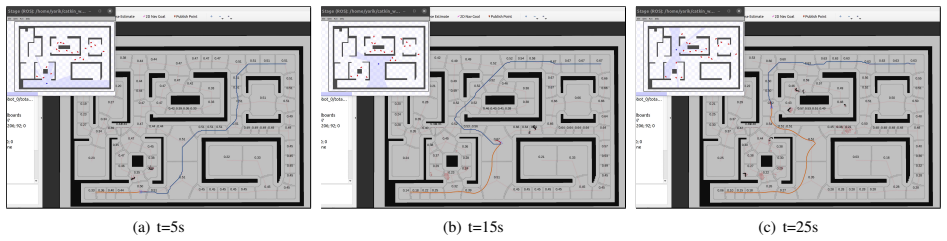
The central claim is that region-level traversability, rather than per-obstacle modeling, is the right unit for avoiding crowds in dynamic environments. The paper's object is the traversability value $T_{ri}$ of equation (5): for each region it combines the robot-goal distance through that region, $D_{rig}$, with an occupation-dispersion penalty $1-O_i P^+_{doi}$ that applies only when dynamic obstacles are expected to reach the region before the robot ($D_{ri} \ge D^+_{doi}$). When the robot is expected to arrive first, the region keeps its full distance-based value and is treated as safe. From these region values, the wavefront propagation in equations (6)-(7) inserts new nodes with region traversability ranked ahead of gradient distance, which is what makes the planner choose a longer but safer route when a crowded region is avoidable, and fall back to less risky regions when it is not.
Load-bearing premise
The load-bearing premise is that dynamic obstacles move at about the same speed as the robot, so comparing distances rather than arrival times correctly decides which regions will be risky by the time the robot gets there.
Editorial extensions
If this is right
- Robots using Tr-FMM will route around obstacle-dense regions whenever an acceptable detour exists, and through less-risky regions only when no free route remains, so crowd avoidance becomes a property of the global path rather than of reactive dodging.
- Planning stays at the base FMM complexity: each replan costs $O(N_f \log N_f)$, because region-traversability updates are constant time given the fixed offline region graph.
- With only line-of-sight sensing, the planner retains most of its safety advantage, trading a modest increase in travel distance and mission time for larger average clearance from obstacles.
- The dispersion term lets a single planned path remain effective without replanning, since the initial route already anticipates future occupation of adjacent regions.
- In fully dispersed environments where no obstacle-free route exists, the planner degrades gracefully: it selects less-risky corridors and accepts higher collision exposure rather than failing outright.
Reading between the lines
- Because equation (5) compares distances rather than arrival times, the planner's risk classification is only calibrated when obstacles move at roughly the robot's speed; tracking obstacle velocities and switching to a time-of-arrival comparison is the natural next step, and the paper itself flags it as beyond its scope.
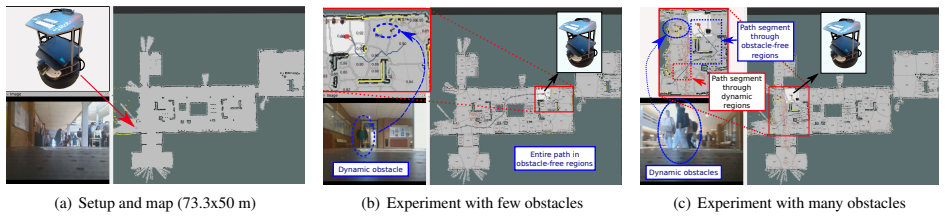
- The paper's real-world Experiment 1 observes that a clutter-free room collapses into a single large region, which reduces routing choices; automatic subdivision of oversized regions into seeded sub-regions is a testable extension that would refine the granularity of crowd avoidance.
- The same region-traversability machinery carries over to missions without a single goal, such as coverage, exploration, and multi-robot teams, by redefining the deviation term against the task's preferred sequence of regions rather than the direct path to one goal.
Signed reviews
Editorial analysis
A structured set of objections, weighed in public.
Referee Report
Summary. The paper presents Tr-FMM, a Fast Marching Method-based global path planner that discretizes the environment into regions, assigns each region a traversability value that combines goal deviation, obstacle occupation, and predicted obstacle dispersion, and then propagates the wavefront through regions of higher traversability while using a velocity map to avoid static and dynamic obstacles. The planner is evaluated in simulation against a basic FMM baseline, a social FMM (SFMM), and a crowd-based dynamic blockages method (CBDB), as well as in three real-world experiments with a Turtlebot, reporting fewer collisions and larger average distances to obstacles at modest additional path length and mission time. The authors claim that avoiding crowded regions directly during path search reduces unnecessary deviations and yields significant safety gains.
Significance. If the central claims are correct, the paper makes a useful practical contribution: a low-complexity, real-time-capable global planner that avoids congested areas without requiring detailed per-obstacle prediction. The real-world demonstrations, including a crowded hall with no collisions and sub-100 ms planning times, provide credible evidence of feasibility. The method is transparent and the underlying FMM machinery is standard, which supports reproducibility if the code becomes available. However, the quantitative safety and efficiency claims rest on a distance-based risk classification whose speed-matching assumption is not validated, and the simulation setup uses obstacle speeds that differ from the robot's speed by a factor of 2.5. Until this mismatch is addressed with either time-to-arrival reasoning or a sensitivity analysis, the reported improvements cannot be cleanly attributed to the method's design rather than to a miscalibrated risk model.
major comments (4)
- [3.3.1, Eq. (5)] The risk classification in Eq. (5) compares the robot's distance to a region (D_ri) with the obstacles' estimated distance to that region (D+_doi), and the text immediately after the equation states that 'the planner currently assumes obstacles move at a similar velocity to the robot, using distances.' This assumption is load-bearing for the central claims of 'significant safety' and 'reducing unnecessary deviations.' In the simulations of Section 4.1, dynamic obstacles move at 0.2 m/s while the robot's maximum linear speed is 0.5 m/s, a 2.5x mismatch. For slower obstacles, Eq. (5) will classify as risky regions that the robot could actually reach first in time, producing detours that the paper then interprets as a deliberate safety/efficiency trade-off; for faster obstacles, the classification would under-penalize genuinely dangerous regions. Because the manuscript provides no sensitivity analysis over obstacle-to-robot speed ratios and no time-based validation, the reported gains in average distance and success rate may be at least partly artifacts of this miscalibration. Please either replace the distance comparison with a time-to-arrival estimate using tracked obstacle velocities, or add controlled experiments that vary the speed ratio and show that the qualitative results are preserved.
- [3.2, Environment discretization] The region-seed suppression range is not specified. The paper states that 'all gradient values ∇D_so within the range of ∇Dso(xRi) are subtracted' when identifying region origins, but neither the formula for this range nor the value used in the experiments is reported. This range directly determines the number, size, and shape of regions, which in turn determines the traversability map and the resulting paths. Without this parameter, the method is not fully reproducible, and the sensitivity of the results to it is unknown. Please report the chosen range and include a brief sensitivity study, or, if the range is selected adaptively, provide the criterion used.
- [3.3.1, Eq. (3)] The dispersion probability in Eq. (3) appears dimensionally inconsistent. Eq. (2) defines P_doi = Aτdoi / A_i for region i, but Eq. (3) then writes P^j_doi = (Aτdoi / A_j) · Pdoi, which reintroduces the same Aτdoi/A_i factor. This makes the dispersion probability depend on the destination region's own dynamism rather than solely on the source region j's movement, which is likely not the intended meaning. This directly affects the penalization D+_doi in Eq. (4) and hence the traversability in Eq. (5). Please clarify the intended definition and correct the notation.
- [4.1.3, Comparison with other approaches] The comparison with CBDB uses FMM instead of the A* algorithm originally employed in [28], with the claim that this 'guarantees that the robot maintains adequate distance from static obstacles.' However, no experiment is shown to verify that the FMM-based CBDB variant performs comparably to the original A*-based CBDB, so the comparison may implicitly penalize CBDB for a modification that is not validated. This is directly relevant to the paper's claim that Tr-FMM outperforms CBDB, and should be addressed with a calibration experiment or a discussion of the expected effect of this substitution.
minor comments (5)
- [3.1, Online phase] There is a typo in 'posisionts' that should read 'positions.'
- [2.2, FMM basics] The notation in equations (1) and (5) uses ∇Dso(xτi) and ∇Dso(xi) without specifying whether these are normalized values or raw distances; please define the normalization more explicitly.
- [4.2, Experiment 3] The real-world safety claim is based on a single 10-minute run with no collisions, and the authors note that people naturally avoided the robot. While this is a useful feasibility demonstration, it should be described as anecdotal rather than as a quantitative validation of safety.
- [1.2, Contributions] The statement 'The code will be available upon publication acceptance' does not provide a concrete artifact for reproducibility; please provide a repository link or a detailed parameter table in a revised version.
- [3.3.2, Equations (6)-(7)] The description of the wavefront insertion condition in Eq. (7) is terse; a short pseudocode description of the modified FMM update loop would improve clarity.
Circularity Check
No significant circularity: Tr-FMM's cost function encodes avoidance, but the claimed safety and efficiency outcomes are measured with external metrics, and no parameter fitting or load-bearing self-citation is present.
full rationale
The paper's derivation chain is not circular. The traversability value in Eq. 5 is a hand-specified cost combining goal distance (D_rig), occupancy (O_i), and dispersion probability (P+_doi); the wavefront sorting in Eqs. 6-7 propagates through higher-traversability regions. This is the normal structure of a cost-based planner: optimizing a cost that encodes the desired behavior does not make the evaluation circular. The claimed results—average and minimum distance to obstacles, success rate, mission time, and traveled distance (Section 4.1, 'Metrics')—are measured externally and are not components of Eq. 5. No parameter was fitted to these metrics, and no baseline result is imported from the authors' own prior work. The speed-assumption caveat after Eq. 5 ('the planner currently assumes obstacles move at a similar velocity to the robot, using distances') is a calibration limitation and a correctness risk, not a circular reduction. Comparisons to SFMM and CBDB are implemented against cited external methods, not against the authors' own unpublished claims. Therefore the paper is self-contained against external benchmarks for its central empirical claims.
Assumptions & free parameters
free parameters (2)
- Region seed suppression range =
unspecified
- Number of regions N_r =
derived from suppression range
assumptions (6)
- standard math Fast Marching Method produces correct distance gradients on a grid without local minima under standard velocity fields
- domain assumption The static map M is known and static obstacles remain fixed during operation
- domain assumption Dynamic obstacle positions and trajectories are observable, either globally or through line-of-sight sensors
- domain assumption Dynamic obstacles move at approximately the same speed as the robot
- ad hoc to paper Obstacles may linger in intermediate regions, modeled by multiplying distances by (1 + P^j_doi)
- domain assumption Distances between regions approximated by graph edge lengths in G_R are adequate proxies for actual travel distances
Cite this review
Pith. "Pith review of Traversability-aware path planning in dynamic environments." pith.science (2026). https://pith.science/paper/43IDJQFR
@misc{pith2026250514580,
  author       = {Pith},
  title        = {Pith review of: Traversability-aware path planning in dynamic environments},
  year         = {2026},
  howpublished = {\url{https://pith.science/paper/43IDJQFR}},
  note         = {Machine review of arXiv:2505.14580}
}
read the original abstract
Planning in environments with moving obstacles remains a significant challenge in robotics. While many works focus on navigation and path planning in obstacle-dense spaces, traversing such congested regions is often avoidable by selecting alternative routes. This paper presents Traversability-aware FMM (Tr-FMM), a path planning method that computes paths in dynamic environments, avoiding crowded regions. The method operates in two steps: first, it discretizes the environment, identifying regions and their distribution; second, it computes the traversability of regions, aiming to minimize both obstacle risks and goal deviation. The path is then computed by propagating the wavefront through regions with higher traversability. Simulated and real-world experiments demonstrate that the approach enhances significant safety by keeping the robot away from regions with obstacles while reducing unnecessary deviations from the goal.
Figures


Figures from the paper (12 more)




Reference graph
Works this paper leans on
-
[28]
A. Deus, G. Daudt, R. Maffei, M. Kolberg, Map- ping crowd-based dynamic blockages for naviga- tion in indoor environments, in: 2023 IEEE 19th International Conference on Automation Science and Engineering (CASE), 2023, pp. 1–6.doi: 10.1109/CASE56687.2023.10260430
arXiv 2023
-
[1]
A. Stratton, K. Hauser, C. Mavrogiannis, Charac- terizing the complexity of social robot navigation scenarios, IEEE Robotics and Automation Letters 10 (1) (2025) 184–191.doi:10.1109/LRA. 2024.3502060
arXiv 2025
-
[2]
J. Li, A. Tinka, S. Kiesel, J. W. Durham, T. K. S. Kumar, S. Koenig, Lifelong multi-agent path find- ing in large-scale warehouses, Proceedings of the AAAI Conference on Artificial Intelligence 35 (13) (2021) 11272–11281.doi:10.1609/ aaai.v35i13.17344
work page 2021
-
[3]
P. T. Singamaneni, P. Bachiller-Burgos, L. J. Manso, A. Garrell, A. Sanfeliu, A. Spalanzani, R. Alami, A survey on socially aware robot navigation: Taxonomy and future challenges, The International Journal of Robotics Research 43 (10) (2024) 1533–1572.doi:10.1177/ 02783649241230562
work page 2024
-
[4]
D. Fox, W. Burgard, S. Thrun, The dynamic win- dow approach to collision avoidance, V ol. 4, 1997, pp. 23–33
work page 1997
-
[5]
S. Quinlan, O. Khatib, Elastic bands: connecting path planning and control, in: [1993] Proceed- ings IEEE International Conference on Robotics and Automation, 1993, pp. 802–807 vol.2.doi: 10.1109/ROBOT.1993.291936
-
[6]
P. Fiorini, Z. Shiller, Motion planning in dy- namic environments using velocity obstacles, The International Journal of Robotics Research 17 (7) (1998) 760–772.doi:10.1177/ 027836499801700706
work page 1998
-
[7]
J. van den Berg, M. Lin, D. Manocha, Reciprocal velocity obstacles for real-time multi-agent navi- gation, in: 2008 IEEE International Conference on Robotics and Automation, 2008, pp. 1928–1935. doi:10.1109/ROBOT.2008.4543489
arXiv 2008
Show all 33 references
-
[8]
van den Berg, S
J. van den Berg, S. J. Guy, M. Lin, D. Manocha, Reciprocal n-body collision avoidance, in: C. Pradalier, R. Siegwart, G. Hirzinger (Eds.), Robotics Research, Springer Berlin Heidelberg, Berlin, Heidelberg, 2011, pp. 3–19
2011
-
[9]
C. Chen, Y . Liu, S. Kreiss, A. Alahi, Crowd- robot interaction: Crowd-aware robot navigation with attention-based deep reinforcement learning, in: 2019 International Conference on Robotics and Automation (ICRA), 2019, pp. 6015–6022. doi:10.1109/ICRA.2019.8794134
2019
-
[10]
Martinez-Baselga, L
D. Martinez-Baselga, L. Riazuelo, L. Montano, Improving robot navigation in crowded environ- ments using intrinsic rewards, in: 2023 IEEE In- ternational Conference on Robotics and Automa- tion (ICRA), 2023, pp. 9428–9434.doi:10. 1109/ICRA48891.2023.10160876
2023
-
[11]
B. Chen, H. Zhu, S. Yao, S. Lu, P. Zhong, Y . Sheng, J. Wang, Socially aware object goal nav- igation with heterogeneous scene representation learning, IEEE Robotics and Automation Letters 9 (8) (2024) 6792–6799.doi:10.1109/LRA. 2024.3414253
2024
-
[12]
Y . Du, J. Zhang, X. Cheng, S. Cui, Cooper- ative motion planning in divided environments via congestion-aware deep reinforcement learning, V ol. 10, 2025, pp. 2295–2302.doi:10.1109/ LRA.2025.3526448. 18
2025
-
[13]
J. A. Sethian, A fast marching level set method for monotonically advancing fronts, Proceedings of the National Academy of Sciences of the United States of America 93 (1996) 1591–1595
1996
-
[14]
S. M. Lavalle, Rapidly-exploring random trees: A new tool for path planning, Tech. rep., Depart- ment of Computer Science, Iowa State University (1998)
1998
-
[15]
N. M. Amato, Y . Wu, A randomized roadmap method for path and manipulation planning, in: IEEE International Conference on Robotics and Automation, V ol. 1, 1996, pp. 113–120 vol.1
1996
-
[16]
Karaman, E
S. Karaman, E. Frazzoli, Sampling-based algorithms for optimal motion planning, The International Journal of Robotics Re- search 30 (7) (2011) 846–894.doi: 10.1177/0278364911406761
2011 doi
-
[17]
Janson, E
L. Janson, E. Schmerling, A. Clark, M. Pavone, Fast marching tree: A fast marching sampling- based method for optimal motion planning in many dimensions, The International Journal of Robotics Research 34 (7) (2015) 883–921.doi: 10.1177/0278364915577958
2015 doi
-
[18]
J. D. Gammell, S. S. Srinivasa, T. D. Barfoot, In- formed rrt*: Optimal sampling-based path plan- ning focused via direct sampling of an admissi- ble ellipsoidal heuristic, in: International Con- ference on Intelligent Robots and Systems, 2014, pp. 2997–3004.doi:10.1109/IROS.2...
2014 doi
-
[19]
J. D. Gammell, T. D. Barfoot, S. S. Srinivasa, Batch informed trees (bit*): Informed asymptot- ically optimal anytime search, The International Journal of Robotics Research 39 (5) (2020) 543– 567.doi:10.1177/0278364919890396
2020 doi
-
[20]
E. W. Dijkstra, A note on two problems in connex- ion with graphs, Numer. Math. 1 (1) (1959) 269– 271
1959
-
[21]
S. Aine, S. Swaminathan, V . Narayanan, V . Hwang, M. Likhachev, Multi-heuristic a*, The International Journal of Robotics Research 35 (1-3) (2016) 224–243. doi:10.1177/0278364915594029
2016 doi
-
[22]
Teja S., R
P. Teja S., R. Alami, Hateb-2: Reactive plan- ning and decision making in human-robot co- navigation, in: 2020 29th IEEE International Con- ference on Robot and Human Interactive Commu- nication (RO-MAN), 2020, pp. 179–186.doi: 10.1109/RO-MAN47096.2020.9223463
2020
-
[23]
Forer, S
S. Forer, S. B. Banisetty, L. Yliniemi, M. Nico- lescu, D. Feil-Seifer, Socially-aware navigation using non-linear multi-objective optimization, in: 2018 IEEE/RSJ International Conference on Intel- ligent Robots and Systems (IROS), 2018, pp. 1–9. doi:10.1109/IROS.2018.8593825
2018
-
[24]
Pérez, F
N. Pérez, F. Caballero, L. Merino, Teaching robot navigation behaviors to optimal rrt planners, Inter- national Journal of Social Robotics 10 (2) (2018) 235 – 249
2018
-
[25]
Kollmitz, K
M. Kollmitz, K. Hsiao, J. Gaa, W. Burgard, Time dependent planning on a layered social cost map for human-aware robot navigation, in: European Conference on Mobile Robots (ECMR), 2015, pp. 1–6.doi:10.1109/ECMR.2015.7324184
2015
-
[26]
J. V . Gómez, N. Mavridis, S. Garrido, Fast march- ing solution for the social path planning problem, in: IEEE International Conference on Robotics and Automation (ICRA), 2014, pp. 1871–1876. doi:10.1109/ICRA.2014.6907105
2014
-
[27]
Talebpour, D
Z. Talebpour, D. Viswanathan, R. Ventura, G. En- glebienne, A. Martinoli, Incorporating perception uncertainty in human-aware navigation: A com- parative study, in: 2016 25th IEEE International Symposium on Robot and Human Interactive Communication (RO-MAN), 2016, pp. 570–577....
2016
-
[29]
J. V . Gómez, A. Lumbier, S. Garrido, L. Moreno, Planning robot formations with fast marching square including uncertainty conditions, Robotics and Autonomous Systems 61 (2) (2013) 137– 152.doi:https://doi.org/10.1016/j. robot.2012.10.009
2013 doi
-
[30]
Fredriksson, A
S. Fredriksson, A. Saradagi, G. Nikolakopoulos, Grid-fast: A grid-based intersection detection for fast semantic topometric mapping, Journal of In- telligent & Robotic Systems 110 (2024). 19
2024
-
[31]
Z. He, H. Sun, J. Hou, Y . Ha, S. Schwertfeger, Hi- erarchical topometric representation of 3d robotic maps, Autonomous Robots 45 (2024) 755–771
2024
-
[32]
Bavle, J
H. Bavle, J. L. Sanchez-Lopez, M. Shaheer, J. Civera, H. V oos, S-graphs+: Real-time local- ization and mapping leveraging hierarchical repre- sentations, IEEE Robotics and Automation Letters 8 (8) (2023) 4927–4934.doi:10.1109/LRA. 2023.3290512
2023
-
[33]
J. A. Sethian, Fast marching methods, SIAM Re- view 41 (2) (1999) 199–235.doi:10.1137/ S0036144598347059. 20
1999
Reviewed August 7, 2026 · model on record in the stance chip above.
Discussion (0). Continue with ORCID to comment.