REVIEW 2 major objections 5 cited by
Multi-Rollout On-Policy Distillation via Peer Successes and Failures
T0 review · 2 major / 0 minor · reviewed 2026-06-30 · grok-4.3
Pith's one-line read Conditioning teacher signals on both successful and failed peer rollouts improves on-policy distillation for language models.
desk verdict MOPD adds peer conditioning from multi-rollout groups to on-policy distillation and reports gains on reasoning benchmarks, but the gains could trace to higher sample volume rather than the conditioning itself. read the letter →
The pith
A machine-rendered reading of the paper's core claim, the machinery that carries it, and where it could break.
The reading
What carries the argument
Peer-conditioned distillation framework that constructs teacher signals via positive peer imitation and contrastive success-failure conditioning on the student's multi-rollout group.
What would settle it
An experiment applying the same multi-rollout setup but finding no improvement in either benchmark performance or alignment between teacher scores and verifier rewards would falsify the central claim.
Extended reading notes
Core claim
MOPD uses the student's local rollout group to build teacher signals by conditioning on both successful and failed peer attempts, so that valid reasoning patterns receive positive reinforcement while plausible mistakes receive explicit contrastive signals, yielding supervision that better matches verifier rewards than isolated-rollout distillation.
Load-bearing premise
Performance gains arise specifically because the local rollout group supplies more faithful instance-adaptive supervision rather than from unrelated factors such as extra compute or altered training dynamics.
Editorial extensions
If this is right
- MOPD yields consistent performance gains over standard on-policy baselines on competitive programming, mathematical reasoning, scientific question answering, and tool-use benchmarks.
- Mixed success-failure contexts produce teacher scores that align more closely with verifier rewards than single-rollout or success-only contexts.
- Effective on-policy distillation should treat the student's multi-rollout trial-and-error behavior as a source of structured supervision rather than isolated samples.
Reading between the lines
- The approach could be extended by varying the number of peer rollouts per prompt to test how many failures are needed for effective contrastive signals.
- Similar peer conditioning might transfer to other post-training regimes that already sample multiple trajectories per prompt.
- Instance-adaptive teacher signals derived from student peers could reduce reliance on a separate, stronger teacher model.
Signed reviews
Editorial analysis
A structured set of objections, weighed in public.
Referee Report
Summary. The paper introduces Multi-Rollout On-Policy Distillation (MOPD), which extends standard on-policy distillation by conditioning the teacher on both successful and failed peer rollouts within the student's local group for the same prompt. It defines two peer-context constructions (positive peer imitation and contrastive success-failure conditioning) to supply denser token-level signals that exploit trial-and-error behavior. Experiments across competitive programming, mathematical reasoning, scientific QA, and tool-use benchmarks report consistent gains over independent-rollout OPD baselines, supported by post-hoc analysis showing that mixed success-failure contexts align teacher scores more closely with verifier rewards.
Significance. If the reported gains are shown to arise specifically from the peer-conditioned signals rather than from increased rollout volume, the approach would provide a practical way to obtain more faithful instance-adaptive supervision from sparse verifiers, strengthening on-policy methods for reasoning and tool-use tasks.
major comments (2)
- [Abstract] Abstract: the central claim that performance gains 'arise from more faithful, instance-adaptive supervision' is not yet supported, because the manuscript provides no same-K independent-distillation control; without it, any uplift could be explained by the simple fact that MOPD draws K>1 rollouts per prompt while the described baselines distill rollouts independently.
- [Abstract] Abstract (teacher-signal analysis paragraph): the post-hoc observation that mixed success-failure contexts align better with verifier rewards does not rule out the sampling-volume confound, as it lacks a direct comparison against an independent multi-rollout baseline using the same total number of trajectories.
Simulated Author's Rebuttal
We thank the referee for the careful reading and for identifying the sampling-volume confound. We agree that the current experimental design does not fully isolate the contribution of peer-conditioned signals from the use of K>1 rollouts per prompt. We will add the requested same-K independent multi-rollout baseline and revise the abstract and analysis sections accordingly.
read point-by-point responses
-
Referee: [Abstract] Abstract: the central claim that performance gains 'arise from more faithful, instance-adaptive supervision' is not yet supported, because the manuscript provides no same-K independent-distillation control; without it, any uplift could be explained by the simple fact that MOPD draws K>1 rollouts per prompt while the described baselines distill rollouts independently.
Authors: We acknowledge the point. The reported baselines distill each rollout independently (standard single-rollout OPD), whereas MOPD conditions on a group of K rollouts. To address the confound, we will introduce an additional control that performs K independent distillations per prompt (same total trajectories, no peer conditioning) and compare it directly to MOPD. This will allow us to quantify how much of the gain is attributable to the peer success/failure construction versus rollout volume. revision: yes
-
Referee: [Abstract] Abstract (teacher-signal analysis paragraph): the post-hoc observation that mixed success-failure contexts align better with verifier rewards does not rule out the sampling-volume confound, as it lacks a direct comparison against an independent multi-rollout baseline using the same total number of trajectories.
Authors: We agree that the current teacher-signal analysis cannot rule out the volume confound. In the revision we will rerun the alignment analysis on the new independent multi-rollout baseline (K independent trajectories) and report whether the improved alignment with verifier rewards is specific to the mixed success-failure peer contexts or appears under any multi-rollout regime. revision: yes
Circularity Check
No circularity: empirical method proposal with independent experimental validation
full rationale
The paper introduces MOPD as an algorithmic extension to on-policy distillation that conditions on peer rollouts for positive imitation and contrastive failure signals. No equations, derivations, or predictions are presented that reduce by construction to fitted parameters, self-definitions, or self-citation chains. The central claims rest on benchmark experiments comparing against standard on-policy baselines, with post-hoc analysis of teacher signals; these are falsifiable empirical results rather than tautological reductions. No load-bearing self-citations, uniqueness theorems, or ansatzes imported from prior author work are invoked in the provided text. This is a standard case of a self-contained empirical contribution.
Assumptions & free parameters
Cite this review
Pith. "Pith review of Multi-Rollout On-Policy Distillation via Peer Successes and Failures." pith.science (2026). https://pith.science/paper/43MK434F
@misc{pith2026260512652,
  author       = {Pith},
  title        = {Pith review of: Multi-Rollout On-Policy Distillation via Peer Successes and Failures},
  year         = {2026},
  howpublished = {\url{https://pith.science/paper/43MK434F}},
  note         = {Machine review of arXiv:2605.12652}
}
read the original abstract
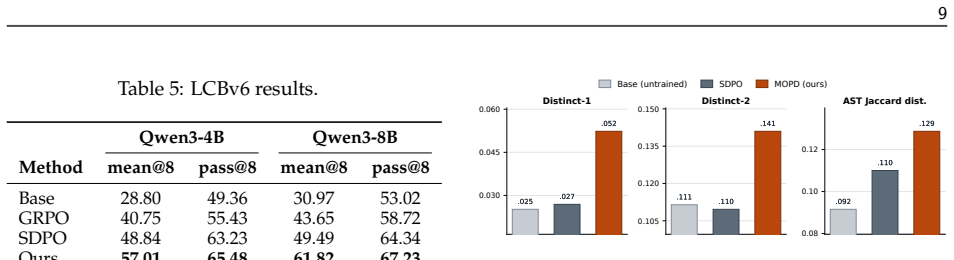
Large language models are often post-trained with sparse verifier rewards, which indicate whether a sampled trajectory succeeds but provide limited guidance about where reasoning succeeds or fails. On-policy distillation (OPD) offers denser token-level supervision by training on student-generated trajectories, yet existing methods typically distill each rollout independently and ignore the other attempts sampled for the same prompt. We introduce Multi-Rollout On-Policy Distillation (MOPD), a peer-conditioned distillation framework that uses the student's local rollout group to construct more informative teacher signals. MOPD conditions the teacher on both successful and failed peer rollouts: successes provide positive evidence for valid reasoning patterns, while failures provide structured negative evidence about plausible mistakes to avoid. We study two peer-context constructions: positive peer imitation and contrastive success-failure conditioning. Experiments on competitive programming, mathematical reasoning, scientific question answering, and tool-use benchmarks show that MOPD consistently improves over standard on-policy baselines. Further teacher-signal analysis shows that mixed success-failure contexts better align teacher scores with verifier rewards, indicating that the gains arise from more faithful, instance-adaptive supervision. These results indicate that effective on-policy distillation should exploit the student's multi-rollout trial-and-error behavior rather than treating rollouts as isolated samples.
Figures


Figures from the paper (2 more)

Forward citations
Cited by 5 Pith papers
-
Latent On-Policy Self-Distillation
Latent On-Policy Self-Distillation learns the self-teacher's privileged context end-to-end as continuous tokens retrieved from past experience, improving final performance and sample efficiency over fixed-context OPSD...
-
Scheduling Mixed RL Rollouts Beyond Prefix Locality
MISA-T is a router-level admission policy that allocates KV-cache capacity per workload class and by residency time, improving mixed RL rollout throughput by 35-53% versus a tuned vLLM Router baseline.
-
Learning from Consensus and Disagreement: Unsupervised On-Policy Self-Distillation with Minority-Trajectory Contrast
A fully unsupervised self-distillation method uses answer-level consensus and minority-trajectory contrast to improve LLM math reasoning without labels or verifiers.
-
Outcome-Confounded Local Supervision in On-Policy Distillation
In on-policy distillation, low teacher–student divergence on failed math trajectories dominates token mass, and local divergence plus a trajectory outcome cannot localize where failure became unrecoverable.
-
Why Does Feedback-Augmented Self-Distillation Fail to Improve Retrieval-Interleaved Search Agents?
Feedback-augmented self-distillation, training a search agent on its own successful rollouts, fails to improve retrieval-interleaved search agents: it collapses into generic, question-agnostic reasoning templates, and...
Reference graph
Works this paper leans on
-
[1]
arXiv preprint arXiv:2402.00782 (2024) 3, 8
URL https://openreview.net/forum?id=bx24KpJ4Eb. Survey Certification, Featured Certification. Alex J Chan, Hao Sun, Samuel Holt, and Mihaela Van Der Schaar. Dense reward for free in reinforcement learning from human feedback.arXiv preprint arXiv:2402.00782, 2024. 11 Zixiang Chen, Yihe Deng, Huizhuo Yuan, Kaixuan Ji, and Quanquan Gu. Self-play fine-tuning ...
-
[2]
A Survey on Knowledge Distillation of Large Language Models
URLhttps://arxiv.org/abs/2402.13116. Jianhao Yan, Yafu Li, Zican Hu, Zhi Wang, Ganqu Cui, Xiaoye Qu, Yu Cheng, and Yue Zhang. Learning to Reason under Off-Policy Guidance.arXiv preprint arXiv:2504.14945, 2025. URL https://arxiv.org/abs/ 2504.14945. An Yang, Anfeng Li, Baosong Yang, Beichen Zhang, Binyuan Hui, Bo Zheng, Bowen Yu, Chang Gao, Chengen Huang, ...
work page Pith review arXiv 2025
Reviewed June 30, 2026 · model on record in the stance chip above.
Discussion (0). Continue with ORCID to comment.