REVIEW 2 major objections 5 minor 2 cited by
Probing the Cosmological Principle with weak lensing shear
T0 review · 2 major / 5 minor · reviewed 2026-08-12 · deepseek-v4-flash
Pith's one-line read A Euclid-like survey could detect late-time anisotropic expansion through the E-B cross-correlation of cosmic shear, at anisotropy levels consistent with current constraints.
desk verdict A transparent, careful forecast of a new E-B shear test of late-time anisotropy; the SNR numbers are plausible but rest on an inherited assumption about post-Born dominance that the paper does not prove. read the letter →
The pith
A machine-rendered reading of the paper's core claim, the machinery that carries it, and where it could break.
The reading
What carries the argument
The argument is carried by a two-parameter perturbation scheme in which every quantity is expanded in orders $\{n,m\}$ of the background shear $\sigma$ (order $n$) and of standard scalar perturbations (order $m$). The dominant shear contribution at order $\{1,1\}$ is a post-Born source term, a correction arising from the deflection of the light ray by the anisotropic background before it encounters the lensing potential, whose angular form contains three covariant derivatives and hence an $\ell^3$ enhancement. The observable is the off-diagonal E-B correlation written in bipolar spherical harmonics (BipoSH), whose leading coefficient is non-zero only for $L=2$ and is linear in the shear; from it the paper builds the estimator $\hat{P}^{\ ij}_{\ell M}$ that carries the five independent shear degrees of freedom. The signal-to-noise analysis compares this estimator's variance under a Gaussian, statistically-isotropic null hypothesis with shape noise, and uses a conservative multipole window $10 \le \ell \le 100$ to avoid both cosmic-variance-dominated and non-linearly contaminated scales.
What would settle it
Compute the full second-order E-B BipoSH coefficients including the dropped $\{1,1\}\times\{1,1\}$ term in Equation 4.16 and the lens-lens coupling terms in the Sachs equation; if at $\ell \simeq 100$ those terms change the predicted E-B amplitude by order one, or a ray-tracing simulation through a Bianchi-I background gives a signal-to-noise ratio below about 3, then the detection claim fails.
Extended reading notes
Core claim
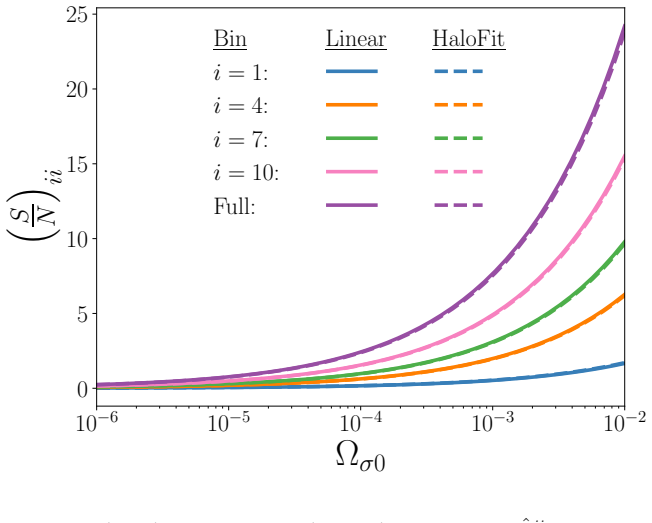
The paper's central discovery is that the E-B cross-correlation of cosmic shear, measured tomographically, can act as a large-scale probe of late-time anisotropic expansion. In an axisymmetric Bianchi-I background treated as a small perturbation of flat FLRW, with anisotropic dark energy driving the shear, the leading B-mode signal appears at second order in the combined perturbation scheme: a post-Born coupling of the Bianchi-I deflection with the scalar potential. Since this term carries three angular derivatives, it grows like $\ell^3$ and dominates at large multipoles, while the E-B correlation itself is first order in the shear-to-Hubble ratio $\sigma/H$, making it far larger than the B-B auto-correlation, which is second order. Using a BipoSH estimator and Euclid's ten-bin tomography, the authors find cumulative signal-to-noise ratios of order 10 to 25 for $\Omega_{\sigma 0}$ up to $10^{-2}$ over $10 \le \ell \le 100$, and conclude that a Euclid-like survey could detect the signal for anisotropy values consistent with current constraints.
Load-bearing premise
The forecast depends on one particular second-order lensing term, the coupling of the anisotropic expansion's deflection with ordinary density fluctuations, being much larger than all other second-order terms at these angular scales, and the paper inherits that dominance claim from earlier work rather than proving it.
Editorial extensions
If this is right
- A Euclid-like photometric survey could detect the E-B signal with cumulative SNR of order 10 to 25 for $\Omega_{\sigma 0}$ up to $10^{-2}$, turning the Cosmological Principle into a weak-lensing observable that can be tested rather than assumed.
- Because shape noise does not correlate E and B modes, the cross-correlation is cleaner than the B-mode auto-spectrum, which remains below the noise floor for all allowed anisotropy values.
- The signal is concentrated at higher-redshift tomographic bins and at multipoles $10 \le \ell \le 100$, so survey depth and photo-z quality matter more than very wide sky coverage for this test.
- The choice $\ell_{\max}=100$ keeps non-linear corrections small: the linear and non-linear spectra diverge just above this scale, marking the regime where this probe must be applied.
- The estimator contains the full five degrees of freedom of the metric shear, so in principle the same measurement can constrain not only the magnitude but also the direction of anisotropic expansion.
Reading between the lines
- If the detection works, the BipoSH estimator could reconstruct the direction of the anisotropy axis, not just its amplitude, because the $M$-dependence of the coefficients encodes the orientation of the shear tensor.
- The same observable could constrain anisotropic stress in modified-gravity and dark-energy models beyond the toy model used here, since it is precisely the anisotropic stress that prevents the shear from decaying at late times.
- The robustness of the forecast should be tested with ray-tracing through a simulated Bianchi-I universe; the paper inherits the claim that one post-Born term dominates all other second-order shear contributions, and that is the main place the SNR estimate could change.
Signed reviews
Editorial analysis
A structured set of objections, weighed in public.
Referee Report
Summary. This paper forecasts the detectability of late-time anisotropic expansion with the cosmic shear E-B cross-correlation in a Euclid-like survey. It uses the two-parameter perturbation scheme of Pitrou, Pereira and Uzan in which Bianchi-I shear is treated as a homogeneous perturbation of FLRW, and computes shear multipoles up to order {1,1}. After showing that the B-mode auto-spectrum lies below shape noise, the authors construct a BipoSH-based estimator for the E-B cross-correlation, evaluate its signal-to-noise for ten tomographic bins with a Euclid source distribution and HaloFit non-linear corrections, and find cumulative SNRs of order 10-25 for Ωσ0 up to 10^-2 over 10≤ℓ≤100. The appendices provide detailed derivations of the angular correlators, harmonic expansions, and the anisotropic-stress model.
Significance. If correct, the result would provide a new, independent observational test of the Cosmological Principle that is complementary to CMB and supernova probes. The paper is transparent and careful: it gives the full perturbative machinery in appendices, uses realistic Euclid tomographic source distributions and HaloFit, and explicitly identifies where the estimator is simplified. It does not overclaim the detectability of B-mode auto-correlations. The main caveat, discussed below, is that the central SNR forecast inherits a truncation assumption from earlier work rather than demonstrating it within the ℓ range used.
major comments (2)
- [§3, Eq. (3.11); §4.4, Eq. (4.16)] The forecast rests on the claim that the {1,1} shear is dominated by the post-Born source S^{1,1}_{AB} in Eq. (3.11), which is taken from [73] and justified by the argument that its three angular derivatives give an ℓ^3 enhancement. For the range used in the forecast, 10≤ℓ≤100, this asymptotic scaling is not established, and the paper does not provide a term-by-term comparison. In particular, Eq. (4.16) drops the {1,1}×{1,1} E-B correlator relative to the leading {0,1}×{1,1} term; both carry the same (ℓ+2)!/(ℓ−2)! geometric factor, and the omitted term is suppressed only by one power of σ/H. For the largest value plotted, Ωσ0=10^-2, the axisymmetric model gives σ/H≈0.25, so the correction to the BipoSH coefficient in Eq. (4.17) and hence to the SNR in Figs. 5.1-5.2 could be at the 10-25% level. I would like to see either a computation of the omitted correlator or a quantitative bound demonstrating that it is negligible on the angular scales used.
- [§3, Eqs. (3.11)-(3.12)] The same dominance assumption also neglects order-{1,1} vector and tensor perturbations sourced by the coupling of the shear to scalar fluctuations. These are formally of the same order as the post-Born term, and the statement that the post-Born term 'should dominate' does not apply to the low-ℓ end of the forecast without a quantitative estimate. Since δB^{1,1} is the entire B-mode signal (Eq. 3.5b), any comparable vector/tensor contribution would change the predicted E-B amplitude directly. A check of the relative size of these terms, even order-of-magnitude, would make the central claim robust.
minor comments (5)
- [Table B.1 caption] The caption contains a typo: 'paramater' should be 'parameter'.
- [Eq. (C.12)] There is a typographical error in the integral: 'Z R k2P(k)' should read '∫ dk k^2 P(k)'.
- [§5.2] The analysis sets ℓmin=10 while citing [97] for Limber accuracy at ℓ≳12; the authors should either justify the choice or set ℓmin=12.
- [§5.1 and §5.2] The covariance in Eq. (5.2) is derived for full-sky Gaussian statistics and then rescaled by fsky; the authors correctly note that masks can create spurious E-B correlations, but the impact of E/B leakage from the mask on the estimator (5.4) is not quantified. This is a limitation rather than an error, but it would be worth stating explicitly.
- [Figures 5.1 and 5.2] The quoted SNRs assume the symmetry axis is aligned with the coordinate z-axis. For an unknown orientation, a search over directions would introduce a trials factor that is not included; the paper's claim that the method can also constrain the direction should be tempered accordingly.
Circularity Check
No significant circularity: the E-B detection forecast is conditional on the assumed shear amplitude and inherits its dominant-term truncation from external prior work, but no fitted parameter is renamed as a prediction.
full rationale
The central claim of the paper is a forecast, not a measurement: for an assumed present-day shear density parameter Ωσ0, Eqs. (4.17)-(4.18) define the E-B BipoSH signal and Eqs. (5.4)-(5.8) compute its cumulative signal-to-noise ratio for a Euclid-like survey. No observed E-B data are used to set the signal amplitude, and no parameter is fitted to the quantity being predicted. The model parameters W in Eq. (B.7) are chosen as boundary conditions to realize the assumed present shear σ0 while suppressing the decaying mode, which is model calibration rather than circular derivation. The claim that the post-Born source term of Eq. (3.11) dominates the order-{1,1} shear is inherited from ref. [73]; that is an external theoretical assumption whose validity could be questioned, but it is not a reduction of the paper's output to its own input, and refs. [59, 73, 74] do not share authors with the present paper. The paper is also explicit about its cut-off choices, the sub-threshold B-B signal, and the use of a null-hypothesis covariance for the estimator. The reviewer's concern about the ℓ^3 dominance for 10 ≲ ℓ ≲ 100 is a robustness or correctness caveat, not evidence of circularity.
Assumptions & free parameters
free parameters (1)
- Ωσ0 (current shear density parameter) =
0 to 10^-2 (scanned)
assumptions (6)
- domain assumption The Universe is well described by an axisymmetric Bianchi-I background with |β_i| ≪ 1 and |σ/H| ≪ 1, treated as a small homogeneous perturbation around flat FLRW.
- domain assumption The order {1,1} shear is dominated by the post-Born source term Eq. (3.11), which couples the Bianchi deflection to the scalar potential with three angular derivatives.
- standard math The primordial curvature perturbation R is Gaussian with power spectrum P(k), statistically isotropic and homogeneous.
- domain assumption The Limber approximation is accurate for lensing observables at ℓ ≳ 10.
- domain assumption HaloFit provides an adequate model of the non-linear matter power spectrum for the scales used to set ℓmax = 100.
- ad hoc to paper The dark energy component has a constant equation of state wde = -1 and an anisotropic stress of the form Π^i_j = f(a) W^i_j with f(a) ∝ Ωde(a).
invented entities (1)
-
Phenomenological anisotropic stress Π^i_j = f(a) W^i_j with constant matrix W
Cite this review
Pith. "Pith review of Probing the Cosmological Principle with weak lensing shear." pith.science (2026). https://pith.science/paper/43PMMFNM
@misc{pith2026241108560,
  author       = {Pith},
  title        = {Pith review of: Probing the Cosmological Principle with weak lensing shear},
  year         = {2026},
  howpublished = {\url{https://pith.science/paper/43PMMFNM}},
  note         = {Machine review of arXiv:2411.08560}
}
abstract
The Cosmological Principle is a cornerstone of the standard model of cosmology and shapes how we view the Universe and our place within it. It is imperative, then, to devise multiple observational tests which can identify and quantify possible violations of this foundational principle. One possible method of probing large-scale anisotropies involves the use of weak gravitational lensing. We revisit this approach in order to analyse the imprint of late-time anisotropic expansion on cosmic shear. We show that the cross-correlation of shear $E$- and $B$-modes on large scales can be used to constrain the magnitude (and possibly direction) of anisotropic expansion. We estimate the signal to noise for multipoles $10\lesssim \ell\lesssim 100$ that is achievable by a Euclid-like survey. Our findings suggest that such a survey could detect the $E$-$B$ signal for reasonable values of the late-time anisotropy parameter.
Figures


Figures from the paper (8 more)



Forward citations
Cited by 2 Pith papers
-
Multipolar structure of the local expansion rate from incomplete sky data
CF4 data yield a 3.3σ excess dipole in the local expansion-rate fluctuation field at (l,b)=(290°,-4°)±5°, sourced mainly by z∈[0.03,0.05], with quadrupole/octupole consistent with ΛCDM and no multipole-vector alignments.
-
Covariant cosmography in the presence of local structures: comparing exact solutions and perturbation theory
Off-center observers in a spherical LTB overdensity get accurate cosmographic distances up to δc≈2.5 near the structure, while linear perturbation theory is better beyond ~3Rs; a gauge dictionary links the two.
Reference graph
Works this paper leans on
-
[73]
C. Pitrou, T.S. Pereira and J.-P. Uzan,Weak-lensing by the large scale structure in a spatially anisotropic universe: Theory and predictions, Phys. Rev. D92 (2015) 023501 [1503.01125]
work page Pith review arXiv 2015
-
[1]
Aluri et al.,Is the observable Universe consistent with the cosmological principle?, Class
P.K. Aluri et al.,Is the observable Universe consistent with the cosmological principle?, Class. Quant. Grav. 40 (2023) 094001 [2207.05765]
arXiv 2023
-
[2]
Astrophys.671 (2023) A68 [2207.09995]
Euclid collaboration, Euclid: Testing the Copernican principle with next-generation surveys, Astron. Astrophys.671 (2023) A68 [2207.09995]
arXiv 2023
-
[3]
E.F. Bunn, P. Ferreira and J. Silk,How Anisotropic is our Universe?, Phys. Rev. Lett.77 (1996) 2883 [astro-ph/9605123]
arXiv 1996
- [4]
-
[5]
Martinez-Gonzalez and J.L
E. Martinez-Gonzalez and J.L. Sanz,∆T /Tand the isotropy of the universe., Astronomy and Astrophysics 300 (1995) 346
1995
-
[6]
R. Maartens, G. Ellis and W. Stoeger,Anisotropy and inhomogeneity of the universe from ∆T/T, Astron. Astrophys.309 (1996) L7 [astro-ph/9510126]
arXiv 1996
-
[7]
D. Saadeh, S.M. Feeney, A. Pontzen, H.V. Peiris and J.D. McEwen,How isotropic is the Universe?, Phys. Rev. Lett.117 (2016) 131302 [1605.07178]
arXiv 2016
Show all 111 references
-
[8]
Akarsu, E
O. Akarsu, E. Di Valentino, S. Kumar, M. Ozyigit and S. Sharma,Testing spatial curvature and anisotropic expansion on top of theΛCDM model, Phys. Dark Univ.39 (2023) 101162 [2112.07807]
2023 arXiv
-
[9]
Anninos, R.A
P. Anninos, R.A. Matzner, T. Rothman and M.P. Ryan,How does inflation isotropize the Universe?, Phys. Rev. D43 (1991) 3821
1991
-
[10]
Pitrou, T.S
C. Pitrou, T.S. Pereira and J.-P. Uzan,Predictions from an anisotropic inflationary era, JCAP 04 (2008) 004 [0801.3596]
2008 arXiv
-
[11]
Rothman and R
T. Rothman and R. Matzner,Effects of Anisotropy and Dissipation on the Primordial Light-Isotope Abundances, Phys. Rev. Lett.48 (1982) 1565
1982
-
[12]
Rothman and R
T. Rothman and R. Matzner,Nucleosynthesis in anisotropic cosmologies revisited, Phys. Rev. D 30 (1984) 1649
1984
-
[13]
Matzner, T
R. Matzner, T. Rothman and G.F.R. Ellis,Conjecture on isotope production in the Bianchi cosmologies, Phys. Rev. D34 (1986) 2926
1986
-
[14]
Campanelli,Helium-4 Synthesis in an Anisotropic Universe, Phys
L. Campanelli,Helium-4 Synthesis in an Anisotropic Universe, Phys. Rev. D84 (2011) 123521 [1112.2076]
2011 arXiv
-
[15]
Barrow,Limits on cosmological magnetic fields and other anisotropic stresses, in4th Paris Cosmology Colloquium, pp
J.D. Barrow,Limits on cosmological magnetic fields and other anisotropic stresses, in4th Paris Cosmology Colloquium, pp. 196–222, June, 1997 [gr-qc/9712020]
1997 arXiv
-
[16]
Sharif and M
M. Sharif and M. Zubair,Dynamics of Bianchi I Universe with Magnetized Anisotropic Dark Energy, Astrophys. Space Sci.330 (2010) 399 [1005.4480]
2010 arXiv
-
[17]
Koivisto and D.F
T. Koivisto and D.F. Mota,Accelerating Cosmologies with an Anisotropic Equation of State, Astrophys. J. 679 (2008) 1 [0707.0279]
2008 arXiv
-
[18]
Koivisto and D.F
T. Koivisto and D.F. Mota,Anisotropic Dark Energy: Dynamics of Background and Perturbations, JCAP 06 (2008) 018 [0801.3676]
2008 arXiv
-
[19]
Akarsu and C.B
O. Akarsu and C.B. Kilinc,LRS Bianchi Type I Models with Anisotropic Dark Energy and Constant Deceleration Parameter, Gen. Rel. Grav.42 (2010) 119 [0807.4867]
2010 arXiv
-
[20]
Akarsu and C.B
O. Akarsu and C.B. Kilinc,Bianchi type III models with anisotropic dark energy, Gen. Rel. Grav. 42 (2010) 763 [0909.1025]
2010 arXiv
-
[21]
Akarsu and C.B
O. Akarsu and C.B. Kilinc,De Sitter expansion with anisotropic fluid in Bianchi type-I space-time, Astrophys. Space Sci.326 (2010) 315 [1001.0550]. – 34 –
2010 arXiv
-
[22]
Kumar and O
S. Kumar and O. Akarsu,Bianchi type II models in the presence of perfect fluid and anisotropic dark energy, Eur. Phys. J. Plus127 (2012) 64 [1110.2408]
2012 arXiv
-
[23]
Appleby and E.V
S.A. Appleby and E.V. Linder,Probing Dark Energy Anisotropy, Phys. Rev. D87 (2013) 023532 [1210.8221]
2013 arXiv
-
[24]
Akarsu, N
O. Akarsu, N. Katirci, A.A. Sen and J.A. Vazquez,Scalar field emulator via anisotropically deformed vacuum energy: Application to dark energy, arXiv e-prints (2020) [ 2004.14863]
2020 arXiv
-
[25]
Mukhanov,Theory of cosmological perturbations, Phys
V. Mukhanov,Theory of cosmological perturbations, Phys. Rept. 215 (1992) 203
1992
-
[26]
Damour, I.I
T. Damour, I.I. Kogan and A. Papazoglou,Non-linear bigravity and cosmic acceleration, Phys. Rev. D66 (2002) 104025 [hep-th/0206044]
2002 arXiv
-
[27]
Kunz and D
M. Kunz and D. Sapone,Dark Energy versus Modified Gravity, Phys. Rev. Lett.98 (2007) 121301 [astro-ph/0612452]
2007 arXiv
-
[28]
Saltas and M
I.D. Saltas and M. Kunz,Anisotropic stress and stability in modified gravity models, Phys. Rev. D 83 (2011) 064042 [1012.3171]
2011 arXiv
-
[29]
Kolatt and O
T.S. Kolatt and O. Lahav,Constraints on Cosmological Anisotropy out to z=1 from Supernovae Ia, Mon. Not. Roy. Astron. Soc.323 (2001) 859 [astro-ph/0008041]
2001 arXiv
-
[30]
Jain, M.S
P. Jain, M.S. Modgil and J.P. Ralston,Search for Global Metric Anisotropy in Type Ia Supernova Data, Mod. Phys. Lett. A22 (2007) 1153 [astro-ph/0510803]
2007 arXiv
-
[31]
Cooray, D.E
A. Cooray, D.E. Holz and R. Caldwell,Measuring dark energy spatial inhomogeneity with supernova data, JCAP 11 (2010) 015 [0812.0376]
2010 arXiv
-
[32]
Brunthaler, I
A. Brunthaler, I. Marti-Vidal, K.M. Menten, M.J. Reid, C. Henkel, G.C. Bower et al.,VLBI observations of SN 2008iz: I. Expansion velocity and limits on anisotropic expansion, Astron. Astrophys. 516 (2010) A27 [1003.4665]
2010 arXiv
-
[33]
Colin, R
J. Colin, R. Mohayaee, S. Sarkar and A. Shafieloo,Probing the anisotropic local universe and beyond with SNe Ia data, Mon. Not. Roy. Astron. Soc.414 (2011) 264 [1011.6292]
2011 arXiv
-
[34]
Cai and Z
R. Cai and Z. Tuo,Direction Dependence of the Deceleration Parameter, JCAP 02 (2012) 004 [1109.0941]
2012 arXiv
-
[35]
Feindt, M
U. Feindt, M. Kerschhaggl, M. Kowalski, G. Aldering, P. Antilogus, C. Aragon et al., Measuring cosmic bulk flows with Type Ia Supernovae from the Nearby Supernova Factory, Astron. Astrophys.560 (2013) A90 [1310.4184]
2013 arXiv
-
[36]
Bahr-Kalus, D.J
B. Bahr-Kalus, D.J. Schwarz, M. Seikel and A. Wiegand,Constraints on anisotropic cosmic expansion from supernovae, Astron. Astrophys.553 (2013) A56 [1212.3691]
2013 arXiv
-
[37]
Appleby and A
S. Appleby and A. Shafieloo,Testing Local Anisotropy Using the Method of Smoothed Residuals I - Methodology, JCAP 03 (2014) 007 [1312.3415]
2014 arXiv
-
[38]
Schucker, A
T. Schucker, A. Tilquin and G. Valent,Bianchi I meets the Hubble diagram, Mon. Not. Roy. Astron. Soc.444 (2014) 2820 [1405.6523]
2014 arXiv
-
[39]
Wang and F.Y
J.S. Wang and F.Y. Wang,Probing the anisotropic expansion from supernovae and GRBs in a model-independent way, Mon. Not. Roy. Astron. Soc.443 (2014) 1680 [1406.6448]
2014 arXiv
-
[40]
Appleby, A
S. Appleby, A. Shafieloo and A. Johnson,Probing bulk flow with nearby SNe Ia data, Astrophys. J. 801 (2015) 76 [1410.5562]
2015 arXiv
-
[41]
Jimenez, V
J.B. Jimenez, V. Salzano and R. Lazkoz,Anisotropic expansion and SNIa: An open issue, Phys. Lett. B741 (2015) 168 [1402.1760]
2015 arXiv
-
[42]
Javanmardi, C
B. Javanmardi, C. Porciani, P. Kroupa and J. Pflamm-Altenburg,Probing the isotropy of cosmic acceleration traced by Type Ia supernovae, Astrophys. J. 810 (2015) 47 [1507.07560]
2015 arXiv
-
[43]
Ghodsi, S
H. Ghodsi, S. Baghram and F. Habibi,Supernovae anisotropy power spectrum, JCAP 10 (2017) 017 [1609.08012]. – 35 –
2017 arXiv
-
[44]
Andrade, C.A.P
U. Andrade, C.A.P. Bengaly, J.S. Alcaniz and B. Santos,Isotropy of low redshift type Ia Supernovae: A Bayesian analysis, Phys. Rev. D97 (2018) 083518 [1711.10536]
2018 arXiv
-
[45]
Andrade, C.A.P
U. Andrade, C.A.P. Bengaly, B. Santos and J.S. Alcaniz,A Model-independent Test of Cosmic Isotropy with Low-z Pantheon Supernovae, Astrophys. J. 865 (2018) 119 [1806.06990]
2018 arXiv
-
[46]
Soltis, A
J. Soltis, A. Farahi, D. Huterer and C.M. Liberato,Percent-Level Test of Isotropic Expansion Using Type Ia Supernovae, Phys. Rev. Lett.122 (2019) 091301 [1902.07189]
2019 arXiv
-
[47]
Colin, R
J. Colin, R. Mohayaee, M. Rameez and S. Sarkar,Evidence for anisotropy of cosmic acceleration, Astron. Astrophys.631 (2019) L13 [1808.04597]
2019 arXiv
-
[48]
Salehi, H
A. Salehi, H. Farajollahi, M. Motahari, P. Pashamokhtari, M. Yarahmadi and S. Fathi,Are Type Ia supernova powerful tool to detect anisotropic expansion of the Universe?, Eur. Phys. J. C 80 (2020) 753
2020
-
[49]
Mohayaee, M
R. Mohayaee, M. Rameez and S. Sarkar,Do supernovae indicate an accelerating universe?, Eur. Phys. J. ST230 (2021) 2067 [2106.03119]
2021 arXiv
-
[50]
Cowell, S
J.A. Cowell, S. Dhawan and H.J. Macpherson,Potential signature of a quadrupolar hubble expansion in Pantheon+supernovae, Mon. Not. Roy. Astron. Soc.526 (2023) 1482 [2212.13569]
2023 arXiv
-
[51]
Rahman, R
W. Rahman, R. Trotta, S.S. Boruah, M.J. Hudson and D.A. van Dyk,New Constraints on Anisotropic Expansion from Supernovae Type Ia, Mon. Not. Roy. Astron. Soc.514 (2022) 139 [2108.12497]
2022 arXiv
-
[52]
Kalbouneh, C
B. Kalbouneh, C. Marinoni and J. Bel,Multipole expansion of the local expansion rate, Phys. Rev. D 107 (2023) 023507 [2210.11333]
2023 arXiv
-
[53]
Maartens, J
R. Maartens, J. Santiago, C. Clarkson, B. Kalbouneh and C. Marinoni,Covariant cosmography: the observer-dependence of the Hubble parameter, JCAP 09 (2024) 070 [2312.09875]
2024 arXiv
-
[54]
Kalbouneh, C
B. Kalbouneh, C. Marinoni and R. Maartens,Cosmography of the local Universe by multipole analysis of the expansion rate fluctuation field, JCAP 09 (2024) 069 [2401.12291]
2024 arXiv
-
[55]
Kalbouneh, J
B. Kalbouneh, J. Santiago, C. Marinoni, R. Maartens, C. Clarkson and M. Sarma,Expanding covariant cosmography of the local Universe: incorporating the snap and axial symmetry, arXiv e-prints (2024) [ 2408.04333]
2024 arXiv
-
[56]
Ellis and J.E
G.F.R. Ellis and J.E. Baldwin,On the expected anisotropy of radio source counts, MNRAS 206 (1984) 377
1984
-
[57]
da Silveira Ferreira and V
P. da Silveira Ferreira and V. Marra,Tomographic redshift dipole: testing the cosmological principle, JCAP 09 (2024) 077 [2403.14580]
2024 arXiv
-
[58]
Amendola, M
L. Amendola, M. Kunz and D. Sapone,Measuring the dark side (with weak lensing), JCAP 04 (2008) 013 [0704.2421]
2008 arXiv
-
[59]
Pitrou, J.-P
C. Pitrou, J.-P. Uzan and T.S. Pereira,Weak lensing B-modes on all scales as a probe of local isotropy, Phys. Rev. D87 (2013) 043003 [1203.6029]
2013 arXiv
-
[60]
Schneider,Weak Gravitational Lensing, inGravitational Lensing: Strong, Weak and Micro, vol
P. Schneider,Weak Gravitational Lensing, inGravitational Lensing: Strong, Weak and Micro, vol. 33, pp. 269–451 (2006), DOI [astro-ph/0509252]
2006 arXiv
-
[61]
Bartelmann and M
M. Bartelmann and M. Maturi,Weak gravitational lensing, Dec., 2016 [1612.06535]
2016 arXiv
-
[62]
Kitching, J
T.D. Kitching, J. Alsing, A.F. Heavens, R. Jimenez, J.D. McEwen and L. Verde,The Limits of Cosmic Shear, Mon. Not. Roy. Astron. Soc.469 (2017) 2737 [1611.04954]
2017 arXiv
-
[63]
Bernardeau, C
F. Bernardeau, C. Bonvin and F. Vernizzi,Full-sky lensing shear at second order, Phys. Rev. D 81 (2010) 083002 [0911.2244]. – 36 –
2010 arXiv
-
[64]
Cooray and W
A. Cooray and W. Hu,Second Order Corrections to Weak Lensing by Large-Scale Structure, Astrophys. J. 574 (2002) 19 [astro-ph/0202411]
2002 arXiv
-
[65]
Hilbert, J
S. Hilbert, J. Hartlap, S.D.M. White and P. Schneider,Ray-tracing through the Millennium Simulation: Born corrections and lens-lens coupling in cosmic shear and galaxy-galaxy lensing, Astron. Astrophys.499 (2009) 31 [0809.5035]
2009 arXiv
-
[66]
Schneider, L
P. Schneider, L. van Waerbeke and Y. Mellier,B-modes in cosmic shear from source redshift clustering, Astron. Astrophys.389 (2002) 729 [astro-ph/0112441]
2002 arXiv
-
[67]
Crittenden, P
R.G. Crittenden, P. Natarajan, U.-L. Pen and T. Theuns,Discriminating weak lensing from intrinsic spin correlations using the curl-gradient decomposition, Astrophys. J. 568 (2002) 20 [astro-ph/0012336]
2002 arXiv
-
[68]
Troxel and M
M.A. Troxel and M. Ishak,The Intrinsic Alignment of Galaxies and its Impact on Weak Gravitational Lensing in an Era of Precision Cosmology, Phys. Rept. 558 (2014) 1 [1407.6990]
2014 arXiv
-
[69]
Chisari, S
N.E. Chisari, S. Codis, C. Laigle, Y. Dubois, C. Pichon, J. Devriendt et al.,Intrinsic alignments of galaxies in the Horizon-AGN cosmological hydrodynamical simulation, Mon. Not. Roy. Astron. Soc.454 (2015) 2736 [1507.07843]
2015 arXiv
-
[70]
Codis, R
S. Codis, R. Gavazzi, Y. Dubois, C. Pichon, K. Benabed, V. Desjacques et al.,Intrinsic alignment of simulated galaxies in the cosmic web: Implications for weak lensing surveys, Mon. Not. Roy. Astron. Soc.448 (2015) 3391 [1406.4668]
2015 arXiv
-
[71]
Yamauchi, T
D. Yamauchi, T. Namikawa and A. Taruya,Weak lensing generated by vector perturbations and detectability of cosmic strings, JCAP 10 (2012) 030 [1205.2139]
2012 arXiv
-
[72]
Yamauchi, T
D. Yamauchi, T. Namikawa and A. Taruya,Full-sky formulae for weak lensing power spectra from total angular momentum method, JCAP 08 (2013) 051 [1305.3348]
2013 arXiv
-
[74]
Pereira, C
T.S. Pereira, C. Pitrou and J.-P. Uzan,Weak-lensing B-modes as a probe of the isotropy of the universe, Astron. Astrophys.585 (2016) L3 [1503.01127]
2016 arXiv
-
[75]
CFHTLenS collaboration, 3D Cosmic Shear: Cosmology from CFHTLenS, Mon. Not. Roy. Astron. Soc.442 (2014) 1326 [1401.6842]
2014 arXiv
-
[76]
Forecast validation for Euclid cosmological probes, Astron
Euclid collaboration, Euclid preparation: VII. Forecast validation for Euclid cosmological probes, Astron. Astrophys.642 (2020) A191 [1910.09273]
2020 arXiv
-
[77]
Modelling of the weak lensing angular power spectrum, Astron
Euclid collaboration, Euclid preparation: XXVIII. Modelling of the weak lensing angular power spectrum, Astron. Astrophys.684 (2024) A138 [2302.04507]
2024 arXiv
-
[78]
VIRGO Consortium collaboration, Stable clustering, the halo model and nonlinear cosmological power spectra, Mon. Not. Roy. Astron. Soc.341 (2003) 1311 [astro-ph/0207664]
2003 arXiv
-
[79]
Takahashi, M
R. Takahashi, M. Sato, T. Nishimichi, A. Taruya and M. Oguri,Revising the Halofit Model for the Nonlinear Matter Power Spectrum, Astrophys. J. 761 (2012) 152 [1208.2701]
2012 arXiv
-
[80]
S. Bird, M. Viel and M.G. Haehnelt,Massive Neutrinos and the Non-linear Matter Power Spectrum, Mon. Not. Roy. Astron. Soc.420 (2012) 2551 [1109.4416]
2012 arXiv
-
[81]
Pitrou, T.S
C. Pitrou, T.S. Pereira and J.-P. Uzan,Theory of cosmological perturbations in an anisotropic universe, JCAP 09 (2007) 006 [0707.0736]
2007 arXiv
-
[82]
Planck collaboration, Planck 2018 results. VI. Cosmological parameters, Astron. Astrophys. 641 (2020) A6 [1807.06209]
2020 arXiv
-
[83]
Particle Data Group collaboration, Review of Particle Physics, PTEP 2022 (2022) 083C01. – 37 –
2022
-
[84]
Almeida, J
J.P.B. Almeida, J. Motoa-Manzano, J. Noreña, T.S. Pereira and C.A. Valenzuela-Toledo, Structure formation in an anisotropic universe: Eulerian perturbation theory, JCAP 02 (2022) 018 [2111.06756]
2022 arXiv
-
[85]
Fleury,Light Propagation in Inhomogeneous and Anisotropic Cosmologies, Ph.D
P. Fleury,Light Propagation in Inhomogeneous and Anisotropic Cosmologies, Ph.D. thesis, Université Pierre-et-Marie-Curie, Nov., 2015.1511.03702
2015
-
[86]
Pontzen and A
A. Pontzen and A. Challinor,Linearization of homogeneous, nearly-isotropic cosmological models, Class. Quant. Grav.28 (2011) 185007 [1009.3935]
2011 arXiv
-
[87]
Pitrou and T.S
C. Pitrou and T.S. Pereira,Bianchi spacetimes as super-curvature modes around isotropic cosmologies, Phys. Rev. D100 (2019) 123534 [1909.13688]
2019 arXiv
-
[88]
Abramo and T.S
L.R. Abramo and T.S. Pereira,Testing gaussianity, homogeneity and isotropy with the cosmic microwave background, Adv. Astron.2010 (2010) 378203 [1002.3173]
2010 arXiv
-
[89]
Part IIIa
COMPACTcollaboration, Cosmic topology. Part IIIa. Microwave background parity violation without parity-violating microphysics, arXiv e-prints (2024) [ 2407.09400]
2024 arXiv
-
[90]
Hajian and T
A. Hajian and T. Souradeep,Measuring statistical isotropy of the CMB anisotropy, Astrophys. J. Lett. 597 (2003) L5 [astro-ph/0308001]
2003 arXiv
-
[91]
Hajian and T
A. Hajian and T. Souradeep,Statistical isotropy of CMB and cosmic topology, arXiv e-prints (2003) [ astro-ph/0301590]
2003 arXiv
-
[92]
Hajian and T
A. Hajian and T. Souradeep,The Cosmic microwave background bipolar power spectrum: Basic formalism and applications, arXiv e-prints (2005) [ astro-ph/0501001]
2005 arXiv
-
[93]
Ghosh, A
T. Ghosh, A. Hajian and T. Souradeep,Unveiling Hidden Patterns in CMB Anisotropy Maps, Phys. Rev. D75 (2007) 083007 [astro-ph/0604279]
2007 arXiv
-
[94]
Joshi, S
N. Joshi, S. Jhingan, T. Souradeep and A. Hajian,Bipolar Harmonic encoding of CMB correlation patterns, Phys. Rev. D81 (2010) 083012 [0912.3217]
2010 arXiv
-
[95]
L.G. Book, M. Kamionkowski and T. Souradeep,Odd-Parity Bipolar Spherical Harmonics, Phys. Rev. D85 (2012) 023010 [1109.2910]
2012 arXiv
-
[96]
Aluri, N
P.K. Aluri, N. Pant, A. Rotti and T. Souradeep,A novel approach to reconstructing signals of isotropy violation from a masked CMB sky, Phys. Rev. D92 (2015) 083015 [1506.00550]
2015 arXiv
-
[97]
Kilbinger, C
M. Kilbinger, C. Heymans, M. Asgari, S. Joudaki, P. Schneider, P. Simon et al.,Precision calculations of the cosmic shear power spectrum projection, Mon. Not. Roy. Astron. Soc.472 (2017) 2126 [1702.05301]
2017 arXiv
-
[98]
Challinor and A
A. Challinor and A. Lewis,Weak Gravitational Lensing of the CMB, Phys. Rept. 429 (2006) 1 [astro-ph/0601594]
2006 arXiv
-
[99]
Challinor and A
A. Challinor and A. Lewis,Lensed CMB power spectra from all-sky correlation functions, Phys. Rev. D71 (2005) 103010 [astro-ph/0502425]
2005 arXiv
-
[100]
Lesgourgues, T
J. Lesgourgues, T. Tram and D. Blas,The Cosmic Linear Anisotropy Solving System (CLASS) II: Approximation schemes, JCAP 07 (2011) 034 [1104.2933]
2011 arXiv
-
[101]
Hu,Power Spectrum Tomography with Weak Lensing, Astrophys
W. Hu,Power Spectrum Tomography with Weak Lensing, Astrophys. J. Lett.522 (1999) L21 [astro-ph/9904153]
1999 arXiv
-
[102]
Harris, K.J
C.R. Harris, K.J. Millman, S.J. van der Walt, R. Gommers, P. Virtanen, D. Cournapeau et al.,Array Programming with NumPy, Nature 585 (2020) 357 [2006.10256]
2020 arXiv
-
[103]
Virtanen, R
P. Virtanen, R. Gommers, T.E. Oliphant, M. Haberland, T. Reddy, D. Cournapeau et al., SciPy 1.0–Fundamental Algorithms for Scientific Computing in Python, Nature Meth. 17 (2020) 261 [1907.10121]
2020 arXiv
-
[104]
Hunter,Matplotlib: A 2D Graphics Environment, Comput
J.D. Hunter,Matplotlib: A 2D Graphics Environment, Comput. Sci. Eng.9 (2007) 90. – 38 –
2007
-
[105]
Arfken and H.-J
G.B. Arfken and H.-J. Weber,Mathematical Methods for Physicists, Elsevier, Boston, 6th ed ed. (2005)
2005
-
[106]
Edmonds,Angular Momentum in Quantum Mechanics, Princeton Landmarks in Physics, Princeton University Press, Princeton (1996)
A.R. Edmonds,Angular Momentum in Quantum Mechanics, Princeton Landmarks in Physics, Princeton University Press, Princeton (1996)
1996
-
[107]
Durrer,The Cosmic Microwave Background, Cambridge University Press, New York, second edition ed
R. Durrer,The Cosmic Microwave Background, Cambridge University Press, New York, second edition ed. (2020)
2020
-
[108]
Newman and R
E.T. Newman and R. Penrose,Note on the Bondi-Metzner-Sachs Group, J. Math. Phys.7 (1966) 863
1966
-
[109]
Goldberg, A.J
J.N. Goldberg, A.J. Macfarlane, E.T. Newman, F. Rohrlich and E.C.G. Sudarshan,Spin- s Spherical Harmonics and ð, J. Math. Phys.8 (1967) 2155
1967
-
[110]
Boyle,How should spin-weighted spherical functions be defined?, J
M. Boyle,How should spin-weighted spherical functions be defined?, J. Math. Phys.57 (2016) 092504 [1604.08140]
2016 arXiv
-
[111]
Hu,Weak Lensing of the CMB: A Harmonic Approach, Phys
W. Hu,Weak Lensing of the CMB: A Harmonic Approach, Phys. Rev. D62 (2000) 043007 [astro-ph/0001303]. – 39 –
2000 arXiv
Reviewed August 12, 2026 · model on record in the stance chip above.
Discussion (0). Continue with ORCID to comment.