REVIEW 2 major objections 4 minor 115 references
Local expansion-rate dipole from Cosmicflows-4 exceeds ΛCDM predictions at 3.3σ, while quadrupole and octupole do not.
Reviewed by Pith at T0; open to challenge. T0 means a machine referee read the full paper against a public rubric. the ladder, T0–T4 →
T0 review · grok-4.5
2026-07-10 17:23 UTC pith:6HBVVDTO
load-bearing objection Solid multipole reconstruction of CF4 η that cleanly recovers all 2ℓ+1 degrees of freedom and finds a 3.3σ dipole excess, but the excess sits in the exact redshift bin where unmodeled Malmquist bias is strongest. the 2 major comments →
Multipolar structure of the local expansion rate from incomplete sky data
The pith
A machine-rendered reading of the paper's core claim, the machinery that carries it, and where it could break.
Core claim
From masked Cosmicflows-4 data the reconstructed dipole power of the expansion-rate fluctuation field is inconsistent with ΛCDM linear-plus-mild-nonlinear predictions at 3.3σ and points at (l, b) = (290°, −4°) ± 5°; the excess is sourced predominantly by objects in z ∈ [0.03, 0.05]. The quadrupole and octupole amplitudes remain consistent with the same predictions at 95 percent confidence, and the complete multipole-vector structure shows no evidence of alignments.
What carries the argument
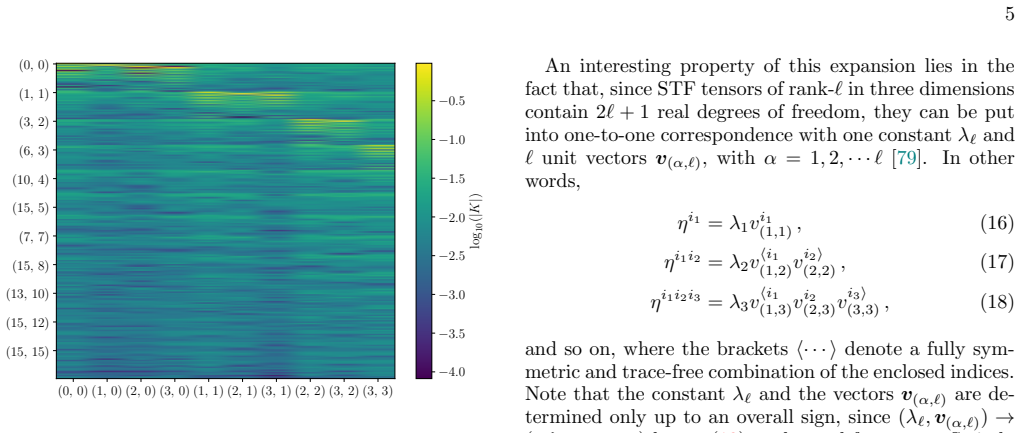
The expansion-rate fluctuation field η ≡ log(z/d_L) − M(z), expanded both in spherical harmonics and in symmetric trace-free tensors whose multipole vectors give every direction associated with each multipole; full-sky coefficients are recovered from a pixel mask via a multipole-coupling-kernel pseudo-inverse and by maximum-likelihood estimation.
Load-bearing premise
Nonlinear velocities can be treated as an uncorrelated 300 km/s Gaussian dispersion added to distance errors, and residual selection biases in the higher-redshift bin do not invent the dipole excess.
What would settle it
An independent distance catalog covering the same sky and z ∈ [0.03, 0.05], analyzed with the identical mask and reconstruction pipeline, that returns a dipole amplitude consistent with the ΛCDM prediction within 1σ.
If this is right
- The bulk-flow signal reported in Cosmicflows-4 is concentrated in the dipole and in the outer half of the 0.01–0.05 window rather than being a broadband multipolar anomaly.
- Higher multipoles of the local expansion rate can be treated as consistent with standard linear theory once incomplete-sky coupling is inverted.
- Maxima of successive multipoles can appear aligned even when the full multipole-vector sets show no statistically significant alignment.
- Tomographic splits of future distance catalogs will be needed to decide whether the excess is residual systematics or a genuine large-scale flow.
Where Pith is reading between the lines
- If the excess survives independent tracers, the preferred direction of the local bulk flow becomes a concrete target for Ellis–Baldwin-style tests against the CMB kinematic dipole.
- The same mask-plus-kernel pipeline can be applied to other low-redshift distance indicators to test whether the 3.3σ tension is catalog-specific.
- Absence of multipole-vector alignments weakens claims that the local expansion-rate field shares the same preferred axes sometimes discussed for CMB low multipoles.
Editorial analysis
A structured set of objections, weighed in public.
Referee Report
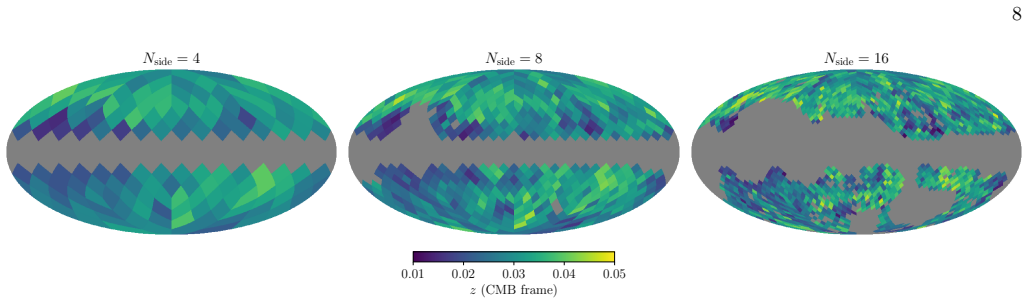
Summary. The paper reconstructs the multipoles ℓ=1,2,3 of the expansion-rate fluctuation field η (Eq. 2) from Cosmicflows-4 galaxies in z∈[0.01,0.05] (CMB frame). It employs both spherical-harmonic coefficients and an equivalent symmetric-trace-free tensor basis that yields one amplitude plus ℓ multipole vectors per multipole. Incomplete sky coverage is handled by three pixel masks (Nside=4,8,16) that excise poorly sampled pixels and a galactic strip; the full-sky multipoles are recovered by a Moore–Penrose pseudo-inverse of the coupling kernel (Eq. 11) and by an independent MCMC maximum-likelihood fit. The reconstructed C1 is found to exceed the linear-theory ΛCDM prediction (Eq. 29, Appendix A) at 3.3σ with direction (l,b)=(290°,-4°)±5°, the excess arising mainly from the sub-bin z∈[0.03,0.05]; C2 and C3 remain consistent with the same prediction at 95% CL. Alignment statistics Sℓ,ℓ' and Tℓ,ℓ' built from the multipole vectors show no significant alignments.
Significance. If the 3.3σ dipole excess survives a more complete treatment of selection systematics, the result supplies an independent, low-redshift probe of a bulk-flow anomaly that is already reported in the literature and that may bear on the Hubble tension and tests of the Cosmological Principle. Methodological strengths that strengthen the claim include (i) two fully independent reconstruction pipelines that agree across three mask resolutions, (ii) an explicit linear-theory derivation of Cℓ with no free amplitude fitted to the data, (iii) 10^5 ΛCDM mocks that incorporate both cosmic variance and the catalog’s distance-modulus errors, and (iv) the use of the complete multipole-vector structure rather than only the locations of multipole maxima. These elements make the analysis a useful advance over earlier CF3/CF4 studies that reported only power spectra or single preferred directions.
major comments (2)
- §V.B and footnote 6 (also Conclusions): the 3.3σ tension on C1 is driven almost entirely by the higher-redshift sub-bin z∈[0.03,0.05]. The mocks of §IV.B keep observed angular positions fixed, assign each galaxy the mean pixel redshift as its “cosmic” redshift, add a linear velocity drawn from Eq. 29 plus an uncorrelated 300 km s⁻¹ Gaussian, and add only Gaussian noise to the distance modulus. They therefore omit the distance-dependent selection function of CF4 (TF/FP magnitude limits, spectroscopic completeness, Zone-of-Avoidance cuts). Because Malmquist bias couples distance errors to that selection function and grows with redshift, residual bias can preferentially inflate the reconstructed dipole precisely in the bin that sources the claimed excess. The authors correctly flag the effect as unmodeled; without a controlled injection of a realistic selection function into the same pipeli
- §II.A Eq. (7) and §IV.B step 3: nonlinear peculiar velocities are modeled solely as an uncorrelated Gaussian dispersion σz=300 km s⁻¹ added in quadrature to the distance-modulus error. While the authors note that raising σz to 500 km s⁻¹ does not change the dipole intensity, the assumption that residual non-linear correlations average to zero inside the large pixels remains untested. A modest coherent non-linear flow on the scale of the Nside=8 pixels could systematically shift the reconstructed C1; at minimum the paper should quantify the residual bias by injecting a non-linear velocity field (e.g., from a constrained N-body realization) into the same mock pipeline.
minor comments (4)
- Table I: the MCMC and pseudo-inverse Cℓ values agree well, but the asymmetric MCMC errors are quoted without stating whether they are highest-density or equal-tailed intervals; a brief clarification would help the reader.
- Fig. 6 and Table II: the multipole-vector error bars are Fréchet standard deviations that ignore the known non-independence of vectors belonging to the same multipole (and residual multipole–multipole correlations induced by the mask). The text already notes this limitation; adding a short quantitative estimate of the neglected covariance (even from the existing mocks) would strengthen the alignment tests of Table III.
- §IV.A: the three mask criteria (minimum objects per pixel, 10° galactic strip, iterative neighbor masking) are reasonable but somewhat ad hoc. A short sensitivity test showing that modest changes in these thresholds leave C1 and the dipole direction stable would be reassuring.
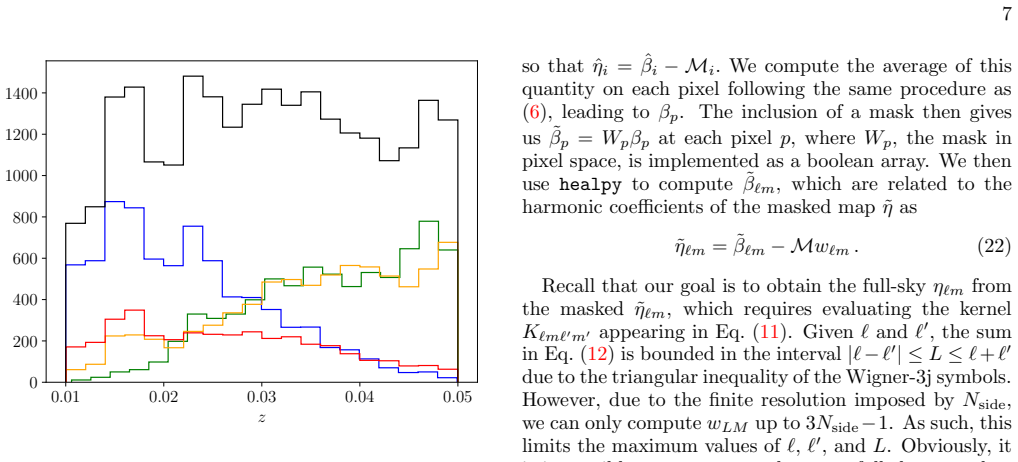
- Appendix A: the geometric-mean approximation for the unequal-time power spectrum and the top-hat window are standard, yet a one-sentence check that replacing the top-hat by the actual redshift histogram of Fig. 3 changes Cℓ by ≲ few percent would close a minor loophole.
Circularity Check
No significant circularity: C_ℓ theory is independent linear-theory derivation; data comparison and mocks do not reduce to fitted inputs or self-definition.
full rationale
The load-bearing claim (dipole C1 inconsistent with ΛCDM at 3.3σ, sourced mainly by z∈[0.03,0.05]) rests on (i) the pixelized estimator of η from CF4 distance moduli (Eqs. 5–8), (ii) mask-deconvolution via pseudo-inverse or MCMC of the coupling kernel (Eqs. 11–12, 24–28), and (iii) comparison of the resulting C_ℓ to the independent theoretical spectrum derived in Appendix A from the continuity equation, linear Pm(k) via CLASS defaults, and a top-hat redshift window (Eq. 29). No free amplitude is fitted to the CF4 multipoles and then re-used as a “prediction.” The STF/multipole-vector reparametrization (Eqs. 13–18) and PolyMV code are a known, frame-independent rewriting of the same 2ℓ+1 degrees of freedom already present in the η_ℓm; they are used only for directional diagnostics and alignment statistics that return null results, not for the amplitude tension. Prior η-field papers cited for the observable definition are by non-overlapping authors. Self-citations of the authors’ earlier multipole-vector work supply a convenience tool, not a uniqueness theorem or ansatz that forces the 3.3σ result. The mock pipeline that sets the significance injects the theoretical C_ℓ plus uncorrelated 300 km s⁻¹ noise; it does not circularly re-inject the measured multipoles. The derivation chain is therefore self-contained against an external benchmark.
Axiom & Free-Parameter Ledger
free parameters (3)
- nonlinear velocity dispersion σ_z =
300 km s⁻¹
- minimum objects per pixel =
14/5/3
- galactic-plane strip width =
10°
axioms (3)
- domain assumption Line-of-sight peculiar velocity is related to the density contrast by the linear continuity equation on sub-horizon scales.
- domain assumption Distance-modulus errors are Gaussian and uncorrelated with the nonlinear velocity component.
- ad hoc to paper The multipole-coupling kernel of a binary mask can be inverted by a Moore–Penrose pseudo-inverse or by a Gaussian likelihood up to ℓ_max = 3.
read the original abstract
Using the Cosmicflows-4 data, we reconstruct the first multipolar moments of a general function describing the local expansion rate. In addition to the conventional harmonic approach, we employ a basis of symmetric and trace-free tensors to characterize the anisotropies of the expansion rate, allowing us to identify all directions associated with each of its multipoles. Focusing on objects in $z\in[0.01,0.05]$ in the CMB rest frame, we derive all $2\ell+1$ degrees of freedom in the multipoles $\ell=1,2$ and 3, which are split into one amplitude and $\ell$ unit vectors per multipole. To mitigate anisotropies induced by incomplete sky coverage, we introduce a pixel-based mask that removes poorly sampled pixels. The full-sky expansion rate is reconstructed using two independent approaches: a pseudo-inverse of the multipole-coupling kernel induced by the mask, and a maximum-likelihood estimate of the underlying full-sky field. These approaches are validated through simulations that explore different mask resolutions, cosmic variance and statistical noise. We find that the quadrupole and octupole amplitudes are consistent (at $95\%$ C.L.) with the expectations of a $\Lambda$CDM universe with linear and mild nonlinear perturbations, where the anisotropies of the expansion rate result from small peculiar velocities. The dipole amplitude, however, is inconsistent with $\Lambda$CDM predictions at 3.3$\sigma$, with a direction $(l, b) = (290^\circ, -4^\circ) \pm 5^\circ$ consistent with a bulk flow. This signal comes predominantly from sources in $z\in[0.03,0.05]$. Finally, we conduct alignment tests between the dipole, quadrupole, and octupole vectors. We confirm recent findings showing that the maxima of these multipoles are approximately located at $(290^\circ,-4^\circ)$. However, detailed tests using the complete vector structure of these multipoles reveal no evidence of alignments.
Figures



Reference graph
Works this paper leans on
-
[1]
Multipolar structure of the local expansion rate from incomplete sky data
for a recent review). Indications of large-angle statis- tical anomalies in the CMB date back to COBE [23], and a plethora of explanations based on deviations from the CP have been proposed—see Refs. [11–13, 24] for com- prehensive reviews. Although they have been reported with lower statistical significances in comparison to the Hubble tension, they are ...
work page internal anchor Pith review Pith/arXiv arXiv 2026
-
[2]
and CF4 [69, 70] data. However, a reconstruction of all the angular degrees of freedom of each multipole, allowing, in particular, for a thorough assessment of pos- sible alignments between them, has not been carried out so far. We introduce two important methodological improve- ments over existing analyses. The first of them relies on the choice of a com...
-
[3]
provides the ideal catalog for this task. It consists of the largest compiled catalog of galaxy distances and peculiar velocities to date, and has been used to map the dynamics of the local universe [85], as well as to study its large scale structure [86]. CF4 contains 55,877 individ- ual galaxy distances, measured from multiple and inde- pendent methods,...
-
[4]
Pseudo-inverse A possible solution to the problem above is to con- struct a pseudo-inverse matrix for the kernelK ℓmℓ′m′. This method is very efficient since, for a given mask, the pseudo-inverse matrix needs to be computed only once. LetK + ℓmℓ′m′ be the pseudo-inverse ofK ℓ′m′ℓ′′m′′, such that the absolute value of the difference X ℓ′,m′ K+ ℓmℓ′m′Kℓ′m′ℓ...
-
[5]
MCMC To check the robustness of our results, we perform an alternative inference to the pseudo-inverse method. Since pseudo-inverse matrices offer a least-squares solution to an overdetermined system of equations, we extend this approach to include the statistical errors in the inversion procedure. That is, we introduce theχ 2 statistic: χ2 = X ℓm X ℓ′m′ ...
-
[6]
For each galaxyiin a pixelp, we define its “cos- mological” redshift to be the mean redshift of all galaxies in pixelp
-
[7]
(29), we usehealpyto generate a new realization of the mapη(ˆn)
From Eq. (29), we usehealpyto generate a new realization of the mapη(ˆn). For this step, it is enough to work withℓ max = 6, since the theoret- ical power spectrum falls steeply with increasing ℓ, as can be easily checked. From this map we compute the peculiar velocity through Eq. (4), us- ing the CF4 angular positions and the cosmological redshifts compu...
-
[8]
As discussed above Eq. (7), to this linear velocity we add a non-linear velocity component drawn from a normal distributionN(0, σ 2 z), whereσ z is a 1D ve- locity dispersion usually taken to be 300 km s −1/c. To check the impact of this step, we have increased σz up to 500 km s −1/c, finding that it does not al- ter the dipole intensity but slightly incr...
-
[9]
Using CF4 redshifts, we compute the distance mod- ulus predicted by the ΛCDM model for each galaxy. To each computed distance, we add Gaussian noise using the reported uncertainties onµfrom the CF4 catalog. These steps effectively produce a new ‘catalog’. In to- tal, we have generated 100,000 such datasets for each mask, repeating the pipeline described i...
-
[10]
The dashed gray circle defines the equator having the dipole vectorv (1,1) as thez-axis. The points and dashed circles in the associated southern hemisphere correspond to the antipodes of each direction. with the theoretical predictions. In order to isolate the source of this effect, we implement the procedures de- scribed in Section IV B for three differ...
work page 2024
-
[11]
Hinshawet al., The Astrophysical Journal Supple- ment Series208, 19 (2013)
G. Hinshawet al., The Astrophysical Journal Supple- ment Series208, 19 (2013)
work page 2013
-
[12]
Komatsuet al., The Astrophysical Journal Supple- ment Series192, 18 (2011)
E. Komatsuet al., The Astrophysical Journal Supple- ment Series192, 18 (2011)
work page 2011
- [13]
-
[14]
Planck 2018 results. I. Overview and the cosmological legacy of Planck
Y. Akramiet al., arXiv preprint arXiv:1807.06205 (2018)
work page internal anchor Pith review Pith/arXiv arXiv 2018
-
[15]
D. G. Yorket al., The Astronomical Journal120, 1579 (2000)
work page 2000
-
[16]
D. H. Joneset al., Monthly Notices of the Royal Astro- nomical Society399, 683 (2009)
work page 2009
-
[17]
Giovanelliet al., The astronomical journal130, 2598 (2005)
R. Giovanelliet al., The astronomical journal130, 2598 (2005)
work page 2005
-
[18]
Zhanget al., Science China Physics, Mechanics & Astronomy67, 219511 (2024)
C.-P. Zhanget al., Science China Physics, Mechanics & Astronomy67, 219511 (2024)
work page 2024
-
[19]
Saidet al., Monthly Notices of the Royal Astronom- ical Society539, 3627 (2025)
K. Saidet al., Monthly Notices of the Royal Astronom- ical Society539, 3627 (2025)
work page 2025
-
[20]
P. J. E. Peebles, Annals of Physics447, 169159 (2022)
work page 2022
-
[21]
E. Abdallaet al., JHEAp34, 49 (2022), [2203.06142]
work page internal anchor Pith review Pith/arXiv arXiv 2022
-
[22]
P. K. Aluriet al., Class. Quant. Grav.40, 094001 (2023), [2207.05765]
work page internal anchor Pith review Pith/arXiv arXiv 2023
-
[23]
CosmoVerse Network, E. Di Valentinoet al., Phys. Dark Univ.49, 101965 (2025), [2504.01669]
work page internal anchor Pith review Pith/arXiv arXiv 2025
-
[24]
A. G. Riesset al., The Astrophysical journal letters 934, L7 (2022)
work page 2022
-
[25]
Breuvalet al., The Astrophysical Journal973, 30 (2024)
L. Breuvalet al., The Astrophysical Journal973, 30 (2024)
work page 2024
-
[26]
Does Hubble Tension Signal a Breakdown in FLRW Cosmology?
C. Krishnan, R. Mohayaee, E. ´O. Colg´ ain, M. M. Sheikh-Jabbari and L. Yin, Class. Quant. Grav.38, 184001 (2021), [2105.09790]
work page internal anchor Pith review Pith/arXiv arXiv 2021
-
[27]
On Larger $H_0$ Values in the CMB Dipole Direction
O. Luongo, M. Muccino, E. ´O. Colg´ ain, M. M. Sheikh- Jabbari and L. Yin, Phys. Rev. D105, 103510 (2022), [2108.13228]
work page internal anchor Pith review Pith/arXiv arXiv 2022
-
[28]
Hints of FLRW Breakdown from Supernovae
C. Krishnan, R. Mohayaee, E. ´O. Colg´ ain, M. M. Sheikh-Jabbari and L. Yin, Phys. Rev. D105, 063514 (2022), [2106.02532]
work page internal anchor Pith review Pith/arXiv arXiv 2022
-
[29]
A void in the Hubble tension? The end of the line for the Hubble bubble
D. Camarena, V. Marra, Z. Sakr and C. Clarkson, Class. Quant. Grav.39, 184001 (2022), [2205.05422]
work page internal anchor Pith review Pith/arXiv arXiv 2022
-
[30]
Anisotropic Distance Ladder in Pantheon+ Supernovae
R. Mc Conville and E. ´O. Colg´ ain, Phys. Rev. D108, 123533 (2023), [2304.02718]
work page internal anchor Pith review Pith/arXiv arXiv 2023
-
[31]
Alleviating the Hubble Tension with a Local Void and Transitions of the Absolute Magnitude
J.-Y. Jia, J.-L. Niu, D.-C. Qiang and H. Wei, Phys. Rev. D112, 043507 (2025), [2504.13380]
work page internal anchor Pith review Pith/arXiv arXiv 2025
-
[32]
Marra, Tensions in Cosmology: Interpreting Them Through Inhomogeneous Models, 2026, [2601.22278]
V. Marra, Tensions in Cosmology: Interpreting Them Through Inhomogeneous Models, 2026, [2601.22278]
-
[33]
2-Point Correlations in the COBE DMR 4-Year Anisotropy Maps
G. Hinshawet al., Astrophys. J. Lett.464, L25 (1996), [astro-ph/9601061]
work page internal anchor Pith review Pith/arXiv arXiv 1996
-
[34]
Beyond $\Lambda$CDM: Problems, solutions, and the road ahead
P. Bullet al., Phys. Dark Univ.12, 56 (2016), [1512.05356]
work page internal anchor Pith review Pith/arXiv arXiv 2016
-
[35]
Precision big bang nucleosynthesis with improved Helium-4 predictions
C. Pitrou, A. Coc, J.-P. Uzan and E. Vangioni, Phys. Rept.754, 1 (2018), [1801.08023]
work page internal anchor Pith review Pith/arXiv arXiv 2018
-
[36]
Barrow, Monthly Notices of the Royal Astronomical Society175, 359 (1976)
J. Barrow, Monthly Notices of the Royal Astronomical Society175, 359 (1976)
work page 1976
-
[37]
J. D. Barrow and R. A. Matzner, Monthly Notices of the Royal Astronomical Society181, 719 (1977)
work page 1977
-
[38]
K. S. Thorne, Astrophys. J.148, 51 (1967)
work page 1967
-
[39]
G. F. R. Ellis and M. A. H. MacCallum, Commun. Math. Phys.12, 108 (1969)
work page 1969
-
[40]
Saunders, Monthly Notices of the Royal Astronomi- cal Society142, 213 (1969)
P. Saunders, Monthly Notices of the Royal Astronomi- cal Society142, 213 (1969)
work page 1969
-
[41]
Light propagation in a homogeneous and anisotropic universe
P. Fleury, C. Pitrou and J.-P. Uzan, Phys. Rev. D91, 043511 (2015), [1410.8473]
work page internal anchor Pith review Pith/arXiv arXiv 2015
-
[42]
T. S. Pereira, C. Pitrou and J.-P. Uzan, JCAP09, 006 (2007), [0707.0736]
work page internal anchor Pith review Pith/arXiv arXiv 2007
-
[43]
A. E. Gumrukcuoglu, C. R. Contaldi and M. Peloso, JCAP11, 005 (2007), [0707.4179]
work page internal anchor Pith review Pith/arXiv arXiv 2007
-
[44]
T. S. Pereira, G. A. M. Marug´ an and S. Carneiro, JCAP 14 07, 029 (2015), [1505.00794]
work page internal anchor Pith review Pith/arXiv arXiv 2015
-
[45]
F. O. Franco and T. S. Pereira, JCAP11, 022 (2017), [1709.00007]
work page internal anchor Pith review Pith/arXiv arXiv 2017
- [46]
-
[47]
R. R. Caldwell and A. Stebbins, Phys. Rev. Lett.100, 191302 (2008), [0711.3459]
work page internal anchor Pith review Pith/arXiv arXiv 2008
-
[48]
P. Zhang and A. Stebbins, Phys. Rev. Lett.107, 041301 (2011), [1009.3967]
work page internal anchor Pith review Pith/arXiv arXiv 2011
- [49]
-
[50]
C. A. P. Bengaly, A. Bernui and J. S. Alcaniz, Astro- phys. J.808, 39 (2015), [1503.01413]
work page internal anchor Pith review Pith/arXiv arXiv 2015
-
[51]
A Model-independent Test of Cosmic Isotropy with Low-z Pantheon Supernovae
U. Andrade, C. A. P. Bengaly, B. Santos and J. S. Al- caniz, Astrophys. J.865, 119 (2018), [1806.06990]
work page internal anchor Pith review Pith/arXiv arXiv 2018
- [52]
- [53]
- [54]
-
[55]
F. Sorrenti, R. Durrer and M. Kunz, Journal of Cos- mology and Astroparticle Physics2023, 054 (2023)
work page 2023
-
[56]
F. Sorrenti, R. Durrer and M. Kunz, Journal of Cos- mology and Astroparticle Physics2025, 013 (2025)
work page 2025
-
[57]
A. Sah, M. Rameez, S. Sarkar and C. G. Tsagas, The European Physical Journal C85, 596 (2025)
work page 2025
-
[58]
C. A. P. Bengaly, A. Bernui, J. S. Alcaniz and I. S. Ferreira, Mon. Not. Roy. Astron. Soc.466, 2799 (2017), [1511.09414]
work page internal anchor Pith review Pith/arXiv arXiv 2017
-
[59]
C. A. P. Bengaly, A. Bernui, J. S. Alcaniz, H. S. Xavier and C. P. Novaes, Mon. Not. Roy. Astron. Soc.464, 768 (2017), [1606.06751]
work page internal anchor Pith review Pith/arXiv arXiv 2017
-
[60]
C. A. P. Bengalyet al., Mon. Not. Roy. Astron. Soc. 475, L106 (2018), [1707.08091]
work page internal anchor Pith review Pith/arXiv arXiv 2018
-
[61]
The dipole anisotropy of AllWISE galaxies
M. Rameez, R. Mohayaee, S. Sarkar and J. Colin, Mon. Not. Roy. Astron. Soc.477, 1772 (2018), [1712.03444]
work page internal anchor Pith review Pith/arXiv arXiv 2018
-
[62]
N. J. Secrestet al., The Astrophysical Journal Letters 908, L51 (2021)
work page 2021
-
[63]
N. J. Secrest, S. von Hausegger, M. Rameez, R. Mo- hayaee and S. Sarkar, The Astrophysical journal letters 937, L31 (2022)
work page 2022
-
[64]
L. Dam, G. F. Lewis and B. J. Brewer, Monthly Notices of the Royal Astronomical Society525, 231 (2023)
work page 2023
-
[65]
K. Migkaset al., Astron. Astrophys.636, A15 (2020), [2004.03305]
work page internal anchor Pith review Pith/arXiv arXiv 2020
-
[66]
T. S. Pereira, C. Pitrou and J.-P. Uzan, Astron. Astro- phys.585, L3 (2016), [1503.01127]
work page internal anchor Pith review Pith/arXiv arXiv 2016
-
[67]
J. Adam, R. Maartens, J. Larena and C. Clarkson, JCAP02, 016 (2025), [2411.08560]
work page internal anchor Pith review Pith/arXiv arXiv 2025
- [68]
- [69]
-
[70]
Consistently Large Cosmic Flows on Scales of 100 Mpc/h: a Challenge for the Standard LCDM Cosmology
R. Watkins, H. A. Feldman and M. J. Hudson, Mon. Not. Roy. Astron. Soc.392, 743 (2009), [0809.4041]
work page internal anchor Pith review Pith/arXiv arXiv 2009
-
[71]
A. Nusser and M. Davis, Astrophys. J.736, 93 (2011), [1101.1650]
work page internal anchor Pith review Pith/arXiv arXiv 2011
-
[72]
Planck, P. A. R. Adeet al., Astron. Astrophys.561, A97 (2014), [1303.5090]
work page internal anchor Pith review Pith/arXiv arXiv 2014
-
[73]
J. Carrick, S. J. Turnbull, G. Lavaux and M. J. Hud- son, Mon. Not. Roy. Astron. Soc.450, 317 (2015), [1504.04627]
work page internal anchor Pith review Pith/arXiv arXiv 2015
-
[74]
G. F. R. Ellis and J. E. Baldwin, Mon. Not. Roy. Astron. Soc.206, 377 (1984)
work page 1984
-
[75]
Forty years of the Ellis-Baldwin test
N. Secrest, S. von Hausegger, M. Rameez, R. Mo- hayaee and S. Sarkar, Nature Rev. Phys.7, 68 (2025), [2501.06450]
work page internal anchor Pith review Pith/arXiv arXiv 2025
-
[76]
R. B. Tullyet al., Astrophys. J.944, 94 (2023), [2209.11238]
work page internal anchor Pith review Pith/arXiv arXiv 2023
-
[77]
R. C. Kraan-Korteweg and O. Lahav, Astron. Astro- phys. Rev.10, 211 (2000), [astro-ph/0005501]
work page internal anchor Pith review Pith/arXiv arXiv 2000
-
[78]
The multipole expansion of the local expansion rate
B. Kalbouneh, C. Marinoni and J. Bel, Phys. Rev. D 107, 023507 (2023), [2210.11333]
work page internal anchor Pith review Pith/arXiv arXiv 2023
-
[79]
Cosmography of the Local Universe by Multipole Analysis of the Expansion Rate Fluctuation Field
B. Kalbouneh, C. Marinoni and R. Maartens, JCAP 09, 069 (2024), [2401.12291]
work page internal anchor Pith review Pith/arXiv arXiv 2024
-
[80]
Updates on dipolar anisotropy in local measurements of the Hubble constant from Cosmicflows-4
V. Salzano, J. Beltr´ an Jim´ enez, D. Bettoni, P. Brax and A. Valade, 2512.02526
work page internal anchor Pith review Pith/arXiv arXiv
discussion (0)
Sign in with ORCID, Apple, or X to comment. Anyone can read and Pith papers without signing in.