REVIEW 4 major objections 5 minor 25 references
Evidence-RL: Towards Evidence-intensive Visual Reasoning
T0 review · 4 major / 5 minor · reviewed 2026-08-12 · deepseek-v4-flash
Pith's one-line read Rewarding answers that depend on the relevant pixels lifts nine vision-language benchmarks.
desk verdict A well-ablated training-time evidence-audit reward, but the 'no question-specific annotations' claim is undermined by the proposal priority chain and needs a hard look before the benchmark gains can be taken at face value. read the letter →
The pith
A machine-rendered reading of the paper's core claim, the machinery that carries it, and where it could break.
The reading
What carries the argument
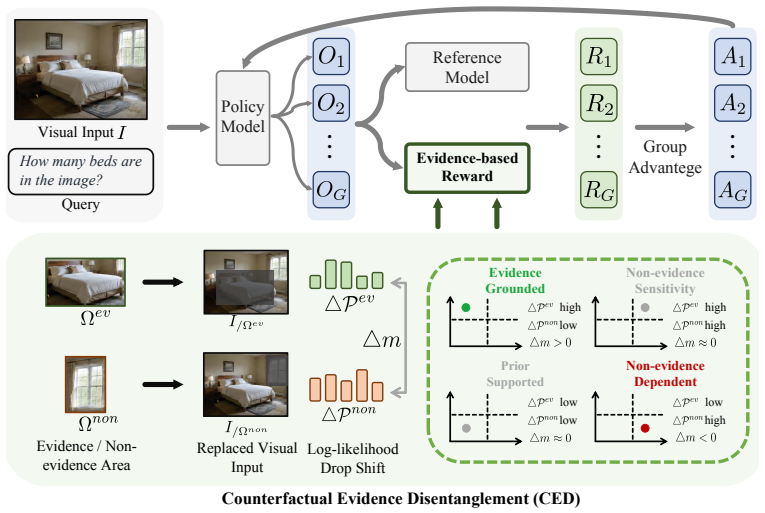
The central object is the Counterfactual Evidence Disentanglement (CED) margin, a contrastive counterfactual likelihood drop. For a sampled answer y, CED neutralizes the visual tokens of an Evidence Region Ωev by mean replacement, records s(Ωev)=log πθ(y|I,q)−log πθ(y|I\Ωev,q), does the same to K matched non-evidence regions, and computes m=tanh((s(Ωev)−μ(snon))/(σ(snon)+ε)). The non-evidence regions act as a sample-local null for masking artifacts and irrelevant sensitivity, and the margin is gated by correctness in the GRPO reward Rtrain=Rans·g(m)+εtie·m. This makes the reward answer-specific, evidence-localized, and robust to generic perturbation sensitivity.
What would settle it
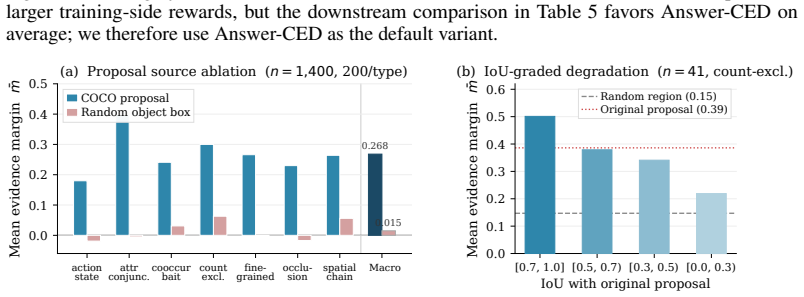
Retrain the full pipeline with the Evidence Region replaced by a random object box (or by proposals that systematically miss the question-relevant object) and compare benchmark deltas: if the reported gains survive or the evidence margin does not collapse to chance (roughly 0.015 with a relevant-beats-random rate near 0.49 on their count-exclusion diagnostic), then the claimed mechanism is not the cause of the improvement.
Extended reading notes
Core claim
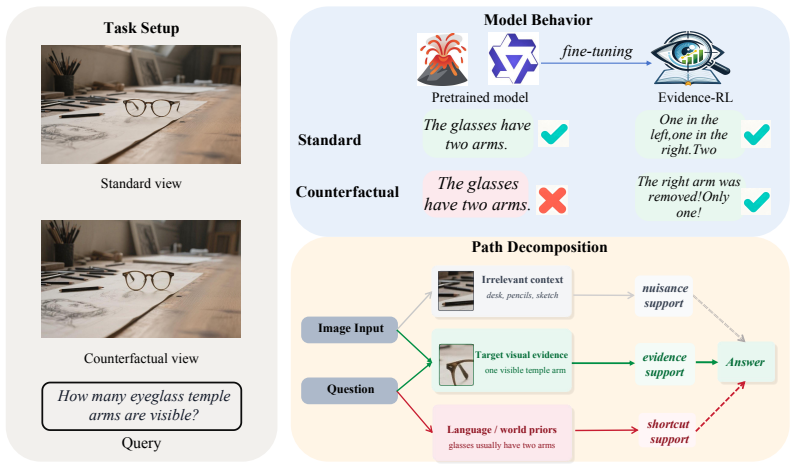
On the paper's own terms, the central discovery is a specification of what 'grounded' should mean for reward design and an implementable training signal for it. A candidate answer y to an image-question pair is evidence-grounded when its support drops more when the proposed Evidence Region is neutralized than when area-matched non-evidence regions are neutralized; the contrastive margin m(I,q,y) = tanh((s(Ωev)−μ(snon))/(σ(snon)+ε)), with s(Ω) the counterfactual log-likelihood drop under feature-space mean replacement, is then combined with answer correctness inside GRPO so that equally correct rollouts are ranked by evidence dependence. The paper claims this turns the causal insight—that the same observed answer can arise from the evidence path, a language-prior shortcut path, or an irrelevant-context nuisance path—into a training objective, and that doing so transfers to nine benchmarks and four backbones without question-specific region annotations or inference-time overhead.
Load-bearing premise
The whole gain rests on the COCO-derived object box chosen as the Evidence Region actually containing the evidence that supports the correct answer; the paper itself notes the same box may or may not contain evidence depending on the question, and replacing it with a random object box collapses the evidence margin from 0.268 to 0.015.
Editorial extensions
If this is right
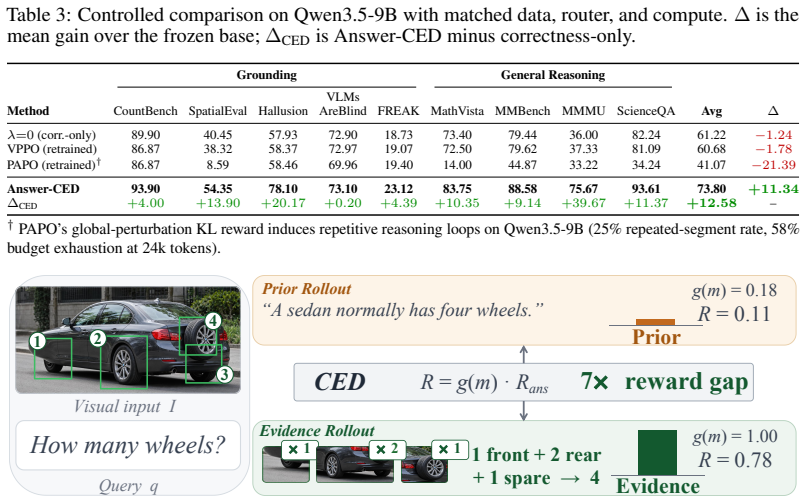
- A correct answer that would survive removal of the evidence region is rewarded less than a correct answer that collapses when the evidence is removed, so GRPO preferentially amplifies visually grounded trajectories.
- Text-only self-evolution rewards are formally unable to separate grounded from shortcut trajectories (evidence-closed self-evolution); an image-conditional signal is structurally necessary, and CED supplies one.
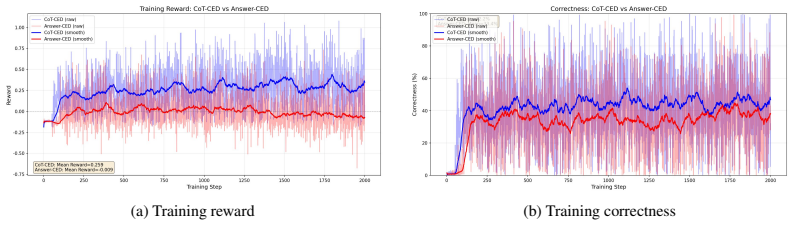
- Answer-level CED avoids the chain-length reward hacking observed with dense per-token evidence rewards, which collapsed CoT-CED's chains to roughly 3.6 tokens on counting tasks.
- The same recipe transfers: positive mean gains on all four backbones and non-negative gains on all 36 benchmark–backbone cells, with no degradation beyond 1.5 percentage points on eight text-only benchmarks.
Reading between the lines
- A testable extension: the same contrastive counterfactual recipe should transfer to attribute-level or relational evidence by changing the intervention, a direction the paper sketches but does not implement.
- Because the evidence margin depends on proposal quality, deployment on domains without good object proposals would likely need a learned or question-conditioned proposer; the paper's own random-box ablation shows why that matters.
- The framework predicts that training gains should concentrate on items where a strong language prior conflicts with the image, and that error analyses should show the model moving from prior-consistent to evidence-consistent answers.
- Since CED adds no inference-time overhead, its practical ceiling is set by training-time proposal coverage rather than by compute at deployment.
Signed reviews
Editorial analysis
A structured set of objections, weighed in public.
Referee Report
Summary. The paper proposes Counterfactual Evidence Disentanglement (CED), a training-time reward component for post-training vision-language models. For each sampled answer, CED compares the drop in answer log-likelihood when an object-centric Evidence Region's visual tokens are mean-replaced with the corresponding drop for matched non-evidence regions, yielding a contrastive evidence margin. This margin is combined multiplicatively with answer correctness inside GRPO, so that equally correct rollouts are ranked by visual-evidence dependence. The authors claim that CED requires only weak object-level proposals, needs no question-specific evidence annotations, adds no inference-time overhead, and improves performance across nine public benchmarks and four backbones. The paper includes signal-validity diagnostics, a controlled comparison on Qwen3.5-9B, cross-backbone results, and robustness ablations under proposal and intervention perturbations.
Significance. If the claims hold, CED would be a practical and appealing training signal: it injects a local, answer-conditioned visual-dependence audit into RL post-training without inference cost and without dense region annotations. The paper has several genuine strengths: the controlled comparison in Table 3 isolates the CED contribution from data, router, and compute; the proposal-robustness ablations in Figure 5 and Appendix A.7 probe the mechanism rather than only reporting aggregate accuracy; the cross-backbone validation in Table 4 shows consistent positive gains; and the appendix provides unusually detailed hyperparameter and implementation documentation. The main source of significance risk is the unresolved relationship between the 'weak proposal' claim and the actual proposal-resolution procedure, which appears to use question-specific target metadata. The empirical gains are conditional on this procedure, and the central novelty claim rests on resolving it. The missing uncertainty estimates for the headline 7B result further weaken the strength of the transfer claim as currently stated.
major comments (4)
- [Section 3.1 and Appendix A.2] The claim that CED 'uses weak object-level proposals' and 'requires no question-specific evidence annotations' is contradicted by the proposal-resolution procedure described in Appendix A.2: the Evidence Region Ωev is 'resolved from sample metadata using the priority proposal_bbox > target_bbox > argument_bbox > metadata.bbox > center-box fallback.' Since the training data are auto-generated from COCO val2017, the target_bbox and argument_bbox fields are almost certainly the bounding boxes of the objects named by the question; under that reading, Ωev is not a generic weak proposal but the answer-relevant object for each question, which is question-specific supervision. The random-object-box ablation in Figure 5(a) is consistent with this reading: the signal tracks the metadata-selected box, not a generic proposal. This is load-bearing because the claimed advantage over methods that require region annotations depends on CED operating with weak, annotation-free proposals. Please clarify what populates proposal_bbox, target_bbox, and argument_bbox; if target_bbox/argument_bbox encode the objects referenced by the question, revise the 'weak proposal' claims and the comparison in Table A.2, and provide an experiment with an off-the-shelf object detector (e.g., Detic or GroundingDINO) in which the Evidence Region is selected without using the question's target object identity.
- [Table 2] The headline nine-benchmark result for Qwen2.5-VL-7B is reported as single-run numbers with no error bars or significance tests, yet it supports strong claims ('the only RL method with non-negative Δ on all nine benchmarks', '+5.94 average improvement'). Because the controlled comparison in Table 3 shows that some baselines are highly unstable on this protocol (e.g., PAPO collapsing on Qwen3.5-9B), single-run point estimates in Table 2 are not sufficient to establish the transfer claim. The paper already provides three-seed standard deviations for Qwen3.5-9B in Table 4; please provide at least three seeds for the Qwen2.5-VL-7B block of Table 2, or a justified statement of why the main comparison does not require them.
- [Section 3.2, Eq. (4)] The sentence 'after within-group normalization Ai = (Rtrain,i − μ)/σ, correctness remains the dominant gradient driver' is not guaranteed by the reward definition. Since m ∈ [−1,1] and g(m) ∈ (0,1), a wrong answer with m close to +1 has Rtrain ≈ 0 + 0.1 = 0.1, while a correct answer with m close to −1 has Rtrain ≈ 0 − 0.1 = −0.1; after group normalization, the wrong answer can receive a positive advantage over the correct one. The 'correctness-anchored' property needs a formal condition—for example, a proof that for all m the raw reward of any correct answer exceeds that of any wrong answer—or the reward should be modified, e.g., Rtrain = Rans · g(m) with ε_tie scaled so that this ordering holds. As written, the method may reward incorrect but evidence-sensitive rollouts, contradicting the mechanism claimed in Section 4.3.1.
- [Section A.12 and Section 5] The formalization of 'evidence-closed self-evolution' does not exactly match the informal statement. Section 5 states that a text-only reward satisfies St ⊥⊥ It | (Yhat_t, Qt) and therefore I(St; Gt | Yhat_t, Qt) = 0. Lemma 1 in Section A.12 instead proves a conditional independence under the larger conditioning set (Yhat_t, Qt, Ft), where Ft is the filtration; Proposition 1 then proves I(T_cl^t; Gt | Bt) = 0 for a Bt-measurable signal. The conditioning sets differ, and the stronger informal claim in Section 5 is not established by the appendix. Proposition 2 is close to tautological and does not sharpen the grounding-identifiability statement. Please restate the formal results so that the conditioning sets and assumptions align with the claims made in Section 5.
minor comments (5)
- [Section 4] There is a dangling comma in the sentence 'the gains transfer across backbones,;' which should be corrected.
- [Table 2] The baseline VLM-R1 is compared against Qwen2.5-VL-3B while all other RL baselines use Qwen2.5-VL-7B; the caption should state the base model for each row explicitly so that the Δ values are not misinterpreted as comparable across rows.
- [Figure 5] The figure caption says 'with the random-region floor at 0.147' but the text in Section 4.3.3 refers to a random floor of 0.147; the values are consistent, but the caption should define whether the floor is computed on the same count-exclusion samples or is a separate aggregate.
- [Section 5] The blank-image ScienceQA discussion is interesting but does not quantify how many items in the ScienceQA evaluation have blank images or how much the 'Cannot determine from image' behavior affects the net gain; please add a count or a sensitivity analysis.
- [Appendix A.12] The notation St is used both for the reward and for the evidence sensitivity s(Ω) in Section 3.1; using different symbols would avoid confusion.
Circularity Check
External benchmark evidence is self-contained; only the evidence-closed formalization is a definitional tautology, with an unverified proposal-priority dependency noted as a correctness risk.
-
self definitional
[Section A.12, Definition 1 and Proposition 1]
"Definition 1 (Evidence-closed self-evolution). A training step is evidence-closed if its signal T^cl_t is measurable with respect to B_t = σ(F_t, I_t, Q_t, \hat Y_t, S_t). ... Proposition 1 (No incremental grounding information). If T^cl_t is evidence-closed, then I(T^cl_t; G_t | B_t) = 0."
This 'theorem' is a direct restatement of the definition. If T^cl_t is B_t-measurable, then conditioning on B_t already pins down T^cl_t, so I(T^cl_t; G_t | B_t) = 0 follows from the definition of measurability, not from any property of grounding or text-only rewards. The paper presents this as making the evidence-closed regime 'precise' in Section 5, but the formal result contains no information beyond its own definition and therefore cannot independently support the claim that text-only self-evolution cannot identify grounding. The empirical benchmark results do not rely on this tautology, so the circularity is minor.
full rationale
The central claim — that the CED margin, when combined with correctness in GRPO, transfers to nine public benchmarks — is not circular: it is an empirical result measured on held-out public benchmarks, and the margin m(I, q, y) is defined directly from model log-likelihood drops, not fitted to those benchmarks. The proposal-ablation study (random object box collapsing the margin from 0.268 to 0.015) is an honest diagnostic rather than a circular validation of the method. I found no self-citation chain: VPPO and other baselines are external works, and no load-bearing result is imported from the authors' prior papers. The only mild definitional issue is the 'evidence-closed self-evolution' formalization in Section A.12: Proposition 1 restates the definition of B_t-measurability, so the claimed impossibility result is a tautology rather than a substantive theorem. This does not affect the external benchmark evidence. Separately, Appendix A.2's proposal-resolution priority (proposal_bbox > target_bbox > argument_bbox > metadata.bbox > center-box fallback) and the claim of 'no question-specific evidence annotations' create an unverified dependency: if target_bbox or argument_bbox fields are populated per question, the Evidence Region would be answer-anchored supervision. This is a correctness and specification risk, not demonstrated circularity, because the paper states the boxes are object-level COCO annotations and the metadata schema is not exhibited.
Assumptions & free parameters
free parameters (5)
- Evidence gate temperature tau_g =
0.20
- Evidence tie-breaker weight epsilon_tie =
0.10
- Composite reward weights alpha_resp and alpha_ans =
0.70 and 0.30
- Number of non-evidence regions K =
3
- Log-prob temperatures tau_resp and tau_ans =
0.20 and 1.00
assumptions (5)
- domain assumption The COCO-derived Evidence Region contains the answer-relevant evidence often enough for the margin to be informative.
- domain assumption Mean replacement of visual tokens removes region-specific evidence while preserving the local representation manifold.
- domain assumption Matched non-evidence Regions provide a valid sample-local null distribution.
- ad hoc to paper The correctness-anchored reward in Eq. (4) keeps correctness as the dominant gradient driver after GRPO normalization.
- standard math Information-theoretic identities used in Section A.12, including conditional independence and mutual information.
invented entities (1)
-
Latent grounding indicator G_t
Cite this review
Pith. "Pith review of Evidence-RL: Towards Evidence-intensive Visual Reasoning." pith.science (2026). https://pith.science/paper/44ZQTYUR
@misc{pith2026260808021,
  author       = {Pith},
  title        = {Pith review of: Evidence-RL: Towards Evidence-intensive Visual Reasoning},
  year         = {2026},
  howpublished = {\url{https://pith.science/paper/44ZQTYUR}},
  note         = {Machine review of arXiv:2608.08021}
}
read the original abstract
Vision-Language Models (VLMs) should answer from concrete image evidence rather than language priors, dataset shortcuts, or irrelevant visual context. Existing perception-aware post-training methods encourage image use through global perturbations or attention proxies, but they do not test whether a sampled answer causally depends on the local evidence that supports it. We propose Counterfactual Evidence Disentanglement (CED), a training-time evidence audit for VLM grounding. For each response, CED neutralizes an object-centric Evidence Region and compares the resulting support drop against matched non-evidence Regions. We combine this signal with answer correctness inside GRPO, rewarding correct answers that rely on the evidence path rather than shortcut or nuisance paths. CED uses weak object-level proposals, requires no question-specific evidence annotations, and adds no inference-time overhead. Across nine public benchmarks and four backbones, CED outperforms prior RL-based post-training methods, with targeted analyses verifying its object-centric signal.
Figures
Figures from the paper (3 more)
Reference graph
Works this paper leans on
-
[1]
Tool- r0: Self-evolving llm agents for tool-learning from zero data.arXiv preprint arXiv:2602.21320,
Emre Can Acikgoz, Cheng Qian, Jonas Hübotter, Heng Ji, Dilek Hakkani-Tür, and Gokhan Tur. Tool- r0: Self-evolving llm agents for tool-learning from zero data.arXiv preprint arXiv:2602.21320,
-
[4]
Sophiavl-r1: Reinforc- ing mllms reasoning with thinking reward.arXiv preprint arXiv:2505.17018,
Kaixuan Fan, Kaituo Feng, Haoming Lyu, Dongzhan Zhou, and Xiangyu Yue. Sophiavl-r1: Reinforc- ing mllms reasoning with thinking reward.arXiv preprint arXiv:2505.17018,
-
[6]
Spotlight on token perception for multimodal reinforcement learning.arXiv preprint arXiv:2510.09285,
Siyuan Huang, Xiaoye Qu, Yafu Li, Yun Luo, Zefeng He, Daizong Liu, and Yu Cheng. Spotlight on token perception for multimodal reinforcement learning.arXiv preprint arXiv:2510.09285,
-
[7]
Feng Li, Renrui Zhang, Hao Zhang, Yuanhan Zhang, Bo Li, Wei Li, Zejun Ma, and Chunyuan Li. Llava-next-interleave: Tackling multi-image, video, and 3d in large multimodal models.arXiv preprint arXiv:2407.07895,
-
[8]
Shawn Li, Jiashu Qu, Yuxiao Zhou, Yuehan Qin, Tiankai Yang, and Yue Zhao. Treble counterfactual vlms: A causal approach to hallucination.arXiv preprint arXiv:2503.06169, 2025a. Yantao Li, Qiang Hui, Chenyang Yan, Kanzhi Cheng, Fang Zhao, Chao Tan, Huanling Gao, Jianbing Zhang, Kai Wang, Xinyu Dai, et al. Palmr: Towards faithful visual reasoning via multim...
-
[9]
Evaluating object hallucination in large vision-language models
Yifan Li, Yifan Du, Kun Zhou, Jinpeng Wang, Xin Zhao, and Ji-Rong Wen. Evaluating object hallucination in large vision-language models. InProceedings of the 2023 conference on empirical methods in natural language processing, pages 292–305,
work page 2023
-
[13]
Pooyan Rahmanzadehgervi, Logan Bolton, Mohammad Reza Taesiri, and Anh Totti Nguyen. Vision language models are blind: Failing to translate detailed visual features into words.arXiv preprint arXiv:2407.06581,
-
[14]
Proximal policy optimization algorithms.arXiv preprint arXiv:1707.06347,
John Schulman, Filip Wolski, Prafulla Dhariwal, Alec Radford, and Oleg Klimov. Proximal policy optimization algorithms.arXiv preprint arXiv:1707.06347,
Show all 25 references
-
[16]
Vlm-r1: A stable and generalizable r1-style large vision-language model.arXiv preprint arXiv:2504.07615,
Haozhan Shen, Peng Liu, Jingcheng Li, Chunxin Fang, Yibo Ma, Jiajia Liao, Qiaoli Shen, Zilun Zhang, Kangjia Zhao, Qianqian Zhang, et al. Vlm-r1: A stable and generalizable r1-style large vision-language model.arXiv preprint arXiv:2504.07615,
-
[17]
Regionreasoner: Region-grounded multi-round visual reasoning.arXiv preprint arXiv:2602.03733,
Wenfang Sun, Hao Chen, Yingjun Du, Yefeng Zheng, and Cees GM Snoek. Regionreasoner: Region-grounded multi-round visual reasoning.arXiv preprint arXiv:2602.03733,
-
[18]
Jiacong Wang, Zijian Kang, Haochen Wang, Haiyong Jiang, Jiawen Li, Bohong Wu, Ya Wang, Jiao Ran, Xiao Liang, Chao Feng, et al
URLhttps://qwen.ai/blog?id=qwen3.5. Jiacong Wang, Zijian Kang, Haochen Wang, Haiyong Jiang, Jiawen Li, Bohong Wu, Ya Wang, Jiao Ran, Xiao Liang, Chao Feng, et al. Vgr: Visual grounded reasoning.arXiv preprint arXiv:2506.11991, 2025a. Jiayu Wang, Yifei Ming, Zhenmei Shi, Vibhav...
-
[19]
Internvl3
12 Weiyun Wang, Zhangwei Gao, Lixin Gu, Hengjun Pu, Long Cui, Xingguang Wei, Zhaoyang Liu, Linglin Jing, Shenglong Ye, Jie Shao, et al. Internvl3. 5: Advancing open-source multimodal models in versatility, reasoning, and efficiency.arXiv preprint arXiv:2508.18265, 2025b. Xiyao...
-
[20]
Perception-r1: Advancing multimodal reasoning capabilities of mllms via visual perception reward.arXiv preprint arXiv:2506.07218,
Tong Xiao, Xin Xu, Zhenya Huang, Hongyu Gao, Quan Liu, Qi Liu, and Enhong Chen. Perception-r1: Advancing multimodal reasoning capabilities of mllms via visual perception reward.arXiv preprint arXiv:2506.07218,
-
[21]
Hii-dpo: Eliminate hallucination via accurate hallucination-inducing counterfactual images.arXiv preprint arXiv:2602.10425,
Yilin Yang, Zhenghui Guo, Yuke Wang, Omprakash Gnawali, Sheng Di, and Chengming Zhang. Hii-dpo: Eliminate hallucination via accurate hallucination-inducing counterfactual images.arXiv preprint arXiv:2602.10425,
-
[22]
Freak: A fine-grained hallucination evaluation benchmark for advanced mllms.arXiv preprint arXiv:2603.19765,
Zhihan Yin, Jianxin Liang, Yueqian Wang, Yifeng Yao, Huishuai Zhang, and Dongyan Zhao. Freak: A fine-grained hallucination evaluation benchmark for advanced mllms.arXiv preprint arXiv:2603.19765,
-
[23]
Vapo: Efficient and reliable reinforcement learning for advanced reasoning tasks.arXiv preprint arXiv:2504.05118,
Yu Yue, Yufeng Yuan, Qiying Yu, Xiaochen Zuo, Ruofei Zhu, Wenyuan Xu, Jiaze Chen, Chengyi Wang, TianTian Fan, Zhengyin Du, et al. Vapo: Efficient and reliable reinforcement learning for advanced reasoning tasks.arXiv preprint arXiv:2504.05118,
-
[25]
Paper notation
13 Table A.1: Complete hyperparameter listing. “Paper notation” gives the corresponding symbol in the main text when applicable. Category Parameter Value Paper notation RL & optimization Learning ratelr1×10 −5 — KL penalty coefficientkl_coeff0.01 — GRPO group sizegroup_size32 ...
2014
-
[2014]
Perceptual-evidence anchored reinforced learning for multimodal reasoning.arXiv preprint arXiv:2511.18437, 2025a
Chi Zhang, Haibo Qiu, Qiming Zhang, Yufei Xu, Zhixiong Zeng, Siqi Yang, Peng Shi, Lin Ma, and Jing Zhang. Perceptual-evidence anchored reinforced learning for multimodal reasoning.arXiv preprint arXiv:2511.18437, 2025a. Juntian Zhang, Song Jin, Chuanqi Cheng, Yuhan Liu, Yankai...
-
[2017]
Deepseekmath: Pushing the limits of mathemat- ical reasoning in open language models.arXiv preprint arXiv:2402.03300,
Zhihong Shao, Peiyi Wang, Qihao Zhu, Runxin Xu, Junxiao Song, Xiao Bi, Haowei Zhang, Mingchuan Zhang, YK Li, Yang Wu, et al. Deepseekmath: Pushing the limits of mathemat- ical reasoning in open language models.arXiv preprint arXiv:2402.03300,
-
[2018]
Chain-of-visual-thought: Teaching vlms to see and think better with continuous visual tokens.arXiv preprint arXiv:2511.19418,
Yiming Qin, Bomin Wei, Jiaxin Ge, Konstantinos Kallidromitis, Stephanie Fu, Trevor Darrell, and XuDong Wang. Chain-of-visual-thought: Teaching vlms to see and think better with continuous visual tokens.arXiv preprint arXiv:2511.19418,
-
[2022]
Mathvista: Evaluating mathematical reasoning of foundation models in visual contexts.arXiv preprint arXiv:2310.02255,
Pan Lu, Hritik Bansal, Tony Xia, Jiacheng Liu, Chunyuan Li, Hannaneh Hajishirzi, Hao Cheng, Kai-Wei Chang, Michel Galley, and Jianfeng Gao. Mathvista: Evaluating mathematical reasoning of foundation models in visual contexts.arXiv preprint arXiv:2310.02255,
-
[2023]
Self-rewarding vision-language model via reasoning decomposition.arXiv preprint arXiv:2508.19652, 2025b
Zongxia Li, Wenhao Yu, Chengsong Huang, Rui Liu, Zhenwen Liang, Fuxiao Liu, Jingxi Che, Dian Yu, Jordan Boyd-Graber, Haitao Mi, et al. Self-rewarding vision-language model via reasoning decomposition.arXiv preprint arXiv:2508.19652, 2025b. 11 Tsung-Yi Lin, Michael Maire, Serge...
-
[2024]
Deepseek-r1: Incentivizing reasoning capability in llms via reinforcement learning.arXiv preprint arXiv:2501.12948,
Daya Guo, Dejian Yang, Haowei Zhang, Junxiao Song, Peiyi Wang, Qihao Zhu, Runxin Xu, Ruoyu Zhang, Shirong Ma, Xiao Bi, et al. Deepseek-r1: Incentivizing reasoning capability in llms via reinforcement learning.arXiv preprint arXiv:2501.12948,
-
[2025]
Linking perception, confidence and accuracy in mllms.arXiv preprint arXiv:2603.12149,
Yuetian Du, Yucheng Wang, Rongyu Zhang, Zhijie Xu, Boyu Yang, Ming Kong, Jie Liu, and Qiang Zhu. Linking perception, confidence and accuracy in mllms.arXiv preprint arXiv:2603.12149,
-
[2026]
Qwen3-vl technical report.arXiv preprint arXiv:2511.21631, 2025a
Shuai Bai, Yuxuan Cai, Ruizhe Chen, Keqin Chen, Xionghui Chen, Zesen Cheng, Lianghao Deng, Wei Ding, Chang Gao, Chunjiang Ge, et al. Qwen3-vl technical report.arXiv preprint arXiv:2511.21631, 2025a. Shuai Bai, Keqin Chen, Xuejing Liu, Jialin Wang, Wenbin Ge, Sibo Song, Kai Dan...
Reviewed August 12, 2026 · model on record in the stance chip above.
Discussion (0). Continue with ORCID to comment.