On the Reparameterization Between Cartesian Position-Velocity Vectors and Orbital Elements in the Kepler Problem
Pith reviewed 2026-06-30 21:45 UTC · model grok-4.3
The pith
A corrected analytic Jacobian for orbital-element to Cartesian transformation removes a singularity in prior microlensing models and improves MCMC sampling.
A machine-rendered reading of the paper's core claim, the machinery that carries it, and where it could break.
Core claim
The central claim is that the Jacobian determinant of the map from orbital elements to Cartesian state vectors admits a compact analytic expression; when this expression is used to revisit the Skowron et al. (2011) parameterization, the reported singularity is traced to an incorrect choice of reference axis for the longitude of the ascending node, and the corrected Jacobian remains effectively identical once the node is defined with respect to an orbit-independent axis.
What carries the argument
The Jacobian determinant of the analytic transformation between the six orbital elements and the six Cartesian position-velocity components in the two-body Kepler problem.
If this is right
- Bayesian priors on orbital elements can be transformed to Cartesian coordinates without numerical differentiation or approximation.
- The corrected Jacobian permits consistent density reparameterization in microlensing light-curve modeling.
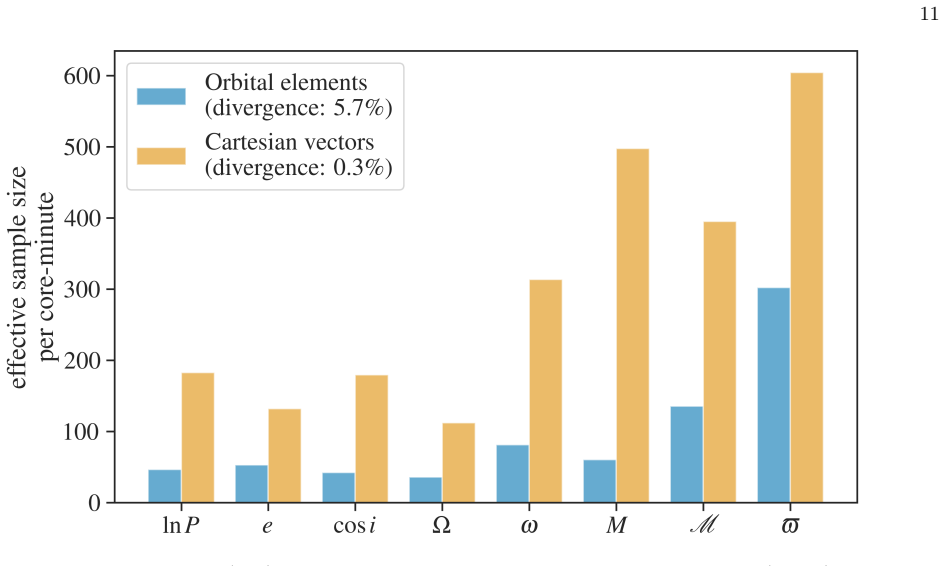
- Cartesian-state sampling in gradient-based MCMC for astrometric orbits produces higher acceptance rates and shorter autocorrelation times than element-based sampling.
- The same closed-form expressions apply unchanged once the ascending node is measured from an axis independent of the binary orbit.
Where Pith is reading between the lines
- The same Jacobian expressions could be reused in other two-body fitting problems where orbital elements are poorly constrained, such as visual binaries or radial-velocity planets.
- Adopting Cartesian state vectors as the sampling space may simplify the incorporation of additional constraints like sky-plane accelerations or proper-motion measurements.
- The approach suggests testing whether similar reparameterizations reduce mixing times in joint fits that combine microlensing, astrometry, and radial velocity.
Load-bearing premise
The Skowron et al. (2011) parameterization inadvertently adopts an incorrect definition of the longitude of the ascending node with respect to the sky-projected binary axis at a reference epoch, rendering the intermediate Jacobian formally singular.
What would settle it
Direct numerical evaluation of the Jacobian matrix entries under the original Skowron et al. definition at a reference epoch where the node aligns with the binary axis, checking whether any determinant vanishes.
Figures
read the original abstract
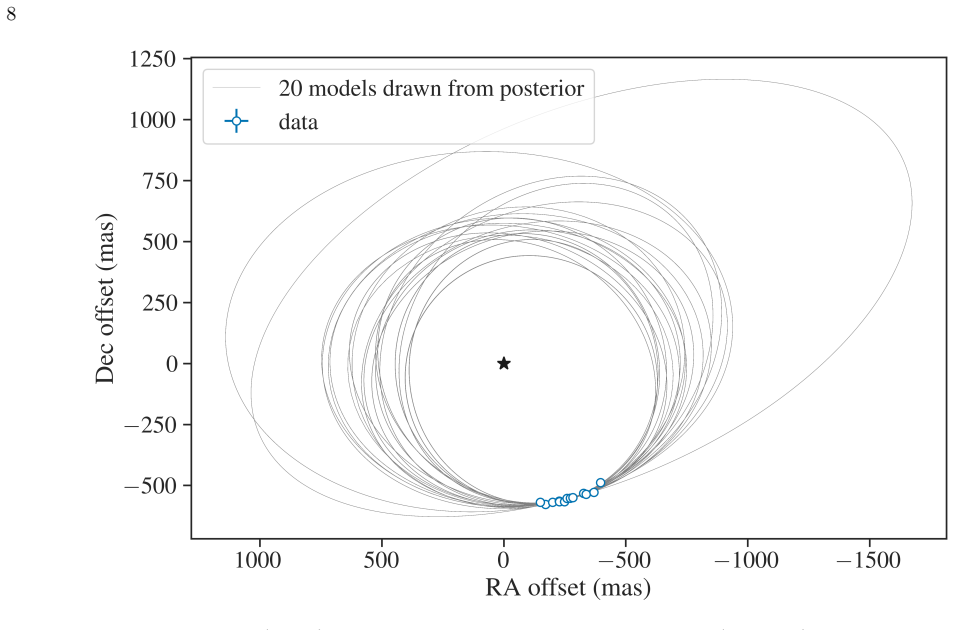
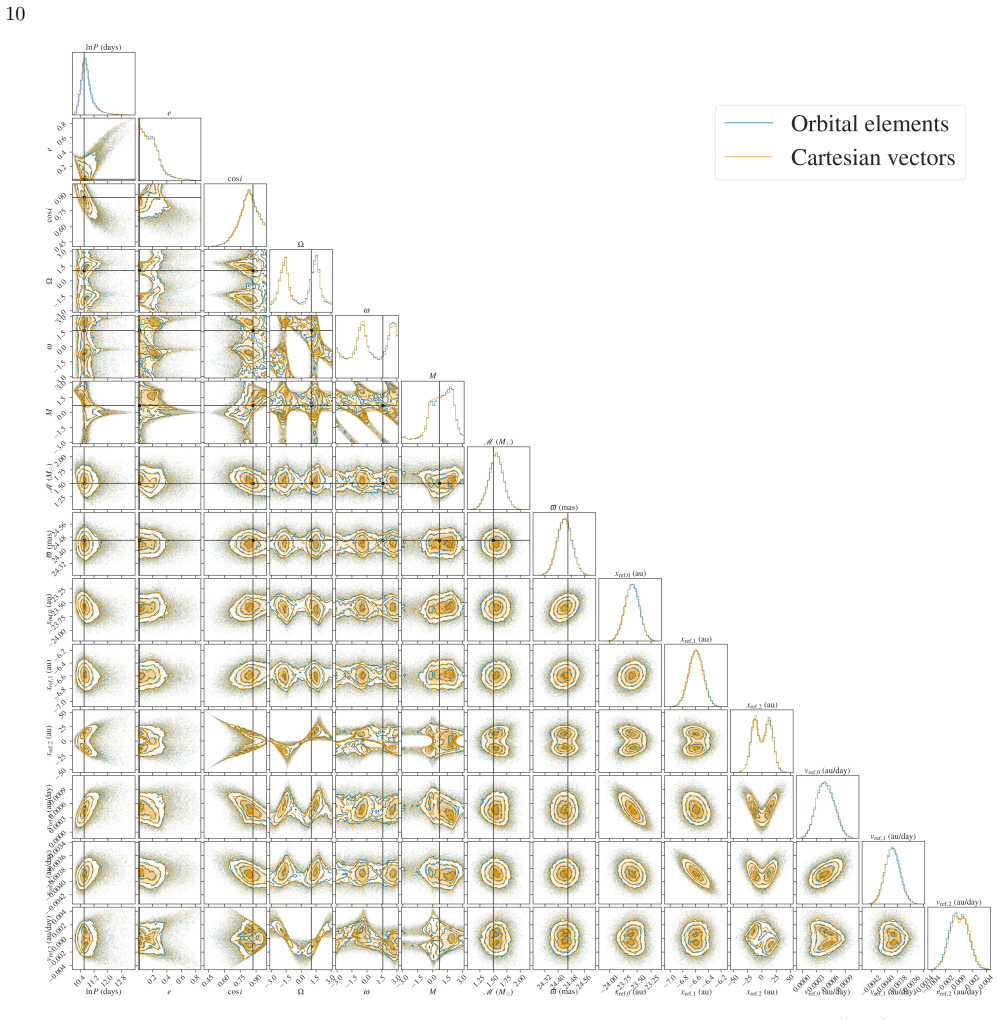
Reparameterization from the standard set of orbital elements to Cartesian position-velocity vectors can be computationally advantageous for orbit inference problems, particularly when orbital elements are weakly constrained. Here we present compact analytic expressions for the Jacobian determinants of this transformation and its variants, which enable consistent transformation of prior probability densities under reparameterization and are therefore useful for a Bayesian treatment of such problems. We then use these results to clarify the application of this reparameterization in microlensing and astrometric contexts. We first revisit the widely used formulation of lens orbital motion during binary microlensing events presented by Skowron et al (2011). We show that their parameterization inadvertently adopts an incorrect definition of the longitude of the ascending node with respect to the sky-projected binary axis at a reference epoch, which renders the intermediate Jacobian formally singular. Using our closed-form expression, we provide a corrected analytic derivation of the Jacobian for this transformation and show that the resulting formula remains effectively unchanged when the longitude of the ascending node is properly defined with respect to an axis independent of the binary orbit. We also perform an explicit quantitative comparison of astrometric orbit fitting using a gradient-based Markov Chain Monte Carlo algorithm under the two parameterizations, and find that reparameterizing to Cartesian state vectors improves sampling efficiency and robustness relative to orbital-element sampling.
Editorial analysis
A structured set of objections, weighed in public.
Referee Report
Summary. The paper derives compact analytic expressions for the Jacobian determinants of the transformation between standard orbital elements and Cartesian position-velocity vectors in the Kepler problem. It revisits the Skowron et al. (2011) parameterization for binary microlensing lens orbital motion, claims that their definition of the longitude of the ascending node (with respect to the sky-projected binary axis at a reference epoch) inadvertently renders the intermediate Jacobian singular, supplies a corrected closed-form derivation, demonstrates that the formula is effectively unchanged under a proper independent-axis definition, and reports a quantitative MCMC comparison in astrometric orbit fitting showing improved sampling efficiency and robustness when using Cartesian state vectors.
Significance. If the identification of the singularity and the corrected Jacobian hold, the closed-form expressions enable consistent prior-density transformations under reparameterization, which is valuable for Bayesian inference in microlensing and astrometric orbit problems. The explicit MCMC comparison provides concrete evidence favoring Cartesian parameterization for gradient-based sampling when orbital elements are weakly constrained. The work supplies reproducible analytic results rather than fitted parameters.
major comments (1)
- [Abstract] Abstract (and the corresponding derivation section): the central claim that the Skowron et al. (2011) choice of reference axis for the longitude of the ascending node renders the intermediate Jacobian formally singular must be supported by an explicit computation of the Jacobian matrix or its determinant showing a zero eigenvalue or vanishing determinant; without this step the assertion that the definition is 'incorrect' (rather than a removable convention) and the need for the 'corrected' derivation remain unverified load-bearing points.
minor comments (2)
- The manuscript should specify the exact reference epoch and coordinate axes used in the Skowron et al. (2011) formulation versus the corrected version to allow direct reproduction of the Jacobian.
- The MCMC comparison section would benefit from reporting the specific number of chains, burn-in length, and convergence diagnostics (e.g., Gelman-Rubin statistic) alongside the efficiency metrics.
Simulated Author's Rebuttal
We thank the referee for their careful review and constructive feedback on the manuscript. We address the single major comment below.
read point-by-point responses
-
Referee: [Abstract] Abstract (and the corresponding derivation section): the central claim that the Skowron et al. (2011) choice of reference axis for the longitude of the ascending node renders the intermediate Jacobian formally singular must be supported by an explicit computation of the Jacobian matrix or its determinant showing a zero eigenvalue or vanishing determinant; without this step the assertion that the definition is 'incorrect' (rather than a removable convention) and the need for the 'corrected' derivation remain unverified load-bearing points.
Authors: We agree that an explicit computation of the Jacobian matrix (or its determinant) for the Skowron et al. (2011) parameterization is needed to verify the singularity claim. In the revised manuscript we will insert the full intermediate Jacobian matrix under their definition of the longitude of the ascending node, compute its determinant, and demonstrate that it vanishes identically. This addition will also clarify why the singularity is not merely a removable convention but arises directly from the reference-axis choice. revision: yes
Circularity Check
No circularity in Jacobian derivations or Skowron et al. critique
full rationale
The paper derives compact analytic expressions for Jacobian determinants of the orbital-element to Cartesian transformation and its variants as independent first-principles results. It references Skowron et al. (2011) only to contextualize a claimed definitional difference in the longitude of the ascending node, then supplies its own closed-form correction and shows the formula is effectively unchanged under a proper axis choice. An MCMC comparison is performed as an explicit numerical test. No step reduces by construction to a fitted input, self-definition, or load-bearing self-citation chain; the derivations stand on their own algebraic content and are externally falsifiable via direct matrix evaluation.
Axiom & Free-Parameter Ledger
axioms (1)
- standard math Standard definitions and properties of Keplerian orbital elements and their relation to Cartesian coordinates
Reference graph
Works this paper leans on
-
[1]
Agol, E., & Fabrycky, D. C. 2018, in Handbook of Exoplanets, ed. H. J. Deeg & J. A. Belmonte, 7, doi: 10.1007/978-3-319-55333-7 7
-
[2]
Bennett, D. P., Rhie, S. H., Nikolaev, S., et al. 2010, ApJ, 713, 837, doi: 10.1088/0004-637X/713/2/837
-
[3]
2016, A&A, 587, A89, doi: 10.1051/0004-6361/201527388
Beust, H., Bonnefoy, M., Maire, A.-L., et al. 2016, A&A, 587, A89, doi: 10.1051/0004-6361/201527388
-
[4]
Blunt, S., Nielsen, E. L., De Rosa, R. J., et al. 2017, AJ, 153, 229, doi: 10.3847/1538-3881/aa6930
-
[5]
Blunt, S., Wang, J. J., Angelo, I., et al. 2020, AJ, 159, 89, doi: 10.3847/1538-3881/ab6663
-
[6]
2021, MNRAS, 505, 126, doi: 10.1093/mnras/stab1376
Bozza, V., Khalouei, E., & Bachelet, E. 2021, MNRAS, 505, 126, doi: 10.1093/mnras/stab1376
-
[7]
2018, JAX: composable transformations of Python+NumPy programs, 0.2.5 http://github.com/google/jax
Bradbury, J., Frostig, R., Hawkins, P., et al. 2018, JAX: composable transformations of Python+NumPy programs, 0.2.5 http://github.com/google/jax
2018
-
[8]
2012, A&A, 542, A41, doi: 10.1051/0004-6361/201118346 Ferrer-Ch´ avez, R., Blunt, S., & Wang, J
Chauvin, G., Lagrange, A.-M., Beust, H., et al. 2012, A&A, 542, A41, doi: 10.1051/0004-6361/201118346 Ferrer-Ch´ avez, R., Blunt, S., & Wang, J. J. 2021, Research Notes of the American Astronomical Society, 5, 162, doi: 10.3847/2515-5172/ac151d
-
[9]
Foreman-Mackey, D. 2016, The Journal of Open Source Software, 24, doi: 10.21105/joss.00024
-
[10]
W., Lang, D., et al.\ 2013, , 125, 306
Foreman-Mackey, D., Hogg, D. W., Lang, D., & Goodman, J. 2013, PASP, 125, 306, doi: 10.1086/670067 Gaia Collaboration, Vallenari, A., Brown, A. G. A., et al. 2023, A&A, 674, A1, doi: 10.1051/0004-6361/202243940
-
[11]
B., Stern, H
Gelman, A., Carlin, J. B., Stern, H. S., et al. 2014, Bayesian data analysis, 3rd edn., Texts in statistical science (CRC Press). https://ci.nii.ac.jp/ncid/BB13945229
2014
-
[12]
The No-U-Turn Sampler: Adaptively Setting Path Lengths in Hamiltonian Monte Carlo
Hoffman, M. D., & Gelman, A. 2011, arXiv e-prints, arXiv:1111.4246. https://arxiv.org/abs/1111.4246
work page internal anchor Pith review Pith/arXiv arXiv 2011
-
[13]
Konopacky, Q. M., Marois, C., Macintosh, B. A., et al. 2016, AJ, 152, 28, doi: 10.3847/0004-6256/152/2/28 14
-
[14]
Kumar, R., Carroll, C., Hartikainen, A., & Martin, O. 2019, The Journal of Open Source Software, 4, 1143, doi: 10.21105/joss.01143
-
[15]
Markley, F. L. 1995, Celestial Mechanics and Dynamical Astronomy, 63, 101, doi: 10.1007/BF00691917
-
[16]
2025, jnkepler: Differentiable N-body model for multi-planet systems,, Astrophysics Source Code Library, record ascl:2505.006 http://ascl.net/2505.006
Masuda, K. 2025, jnkepler: Differentiable N-body model for multi-planet systems,, Astrophysics Source Code Library, record ascl:2505.006 http://ascl.net/2505.006
2025
-
[17]
Masuda, K., Libby-Roberts, J. E., Livingston, J. H., et al. 2024, AJ, 168, 294, doi: 10.3847/1538-3881/ad83d3
-
[18]
D., & Dermott, S
Murray, C. D., & Dermott, S. F. 1999, Solar system dynamics (Cambridge University Press)
1999
-
[19]
Neal, R. M. 2012, arXiv e-prints, arXiv:1206.1901. https://arxiv.org/abs/1206.1901 O’Neil, K. K., Martinez, G. D., Hees, A., et al. 2019, AJ, 158, 4, doi: 10.3847/1538-3881/ab1d66
-
[20]
Peiris, H. V., & Tremaine, S. 2003, ApJ, 599, 237, doi: 10.1086/378638
-
[21]
Composable Effects for Flexible and Accelerated Probabilistic Programming in NumPyro
Phan, D., Pradhan, N., & Jankowiak, M. 2019, arXiv preprint arXiv:1912.11554
work page internal anchor Pith review Pith/arXiv arXiv 2019
-
[22]
Poisson, E., & Will, C. M. 2014, Gravity
2014
-
[23]
2011, ApJ, 738, 87, doi: 10.1088/0004-637X/738/1/87
Skowron, J., Udalski, A., Gould, A., et al. 2011, ApJ, 738, 87, doi: 10.1088/0004-637X/738/1/87
-
[24]
2023, AJ, 166, 164, doi: 10.3847/1538-3881/acf5cc
Thompson, W., Lawrence, J., Blakely, D., et al. 2023, AJ, 166, 164, doi: 10.3847/1538-3881/acf5cc
-
[25]
2020, MNRAS, 491, 1941, doi: 10.1093/mnras/stz3181
Tremaine, S. 2020, MNRAS, 491, 1941, doi: 10.1093/mnras/stz3181
-
[26]
2023, Dynamics of Planetary Systems
Tremaine, S. 2023, Dynamics of Planetary Systems
2023
-
[27]
2021, Bayesian Analysis, 16, 667, doi: 10.1214/20-BA1221
Vehtari, A., Gelman, A., Simpson, D., Carpenter, B., & B¨ urkner, P.-C. 2021, Bayesian Analysis, 16, 667, doi: 10.1214/20-BA1221
discussion (0)
Sign in with ORCID, Apple, or X to comment. Anyone can read and Pith papers without signing in.