REVIEW 4 major objections 4 minor
A Constitution-Grid Instrument for Data-Efficient RL Alignment (C-Guard)
T0 review · 4 major / 4 minor · reviewed 2026-08-04 · deepseek-v4-flash
Pith's one-line read A per-cell learnability score can flag dead-weight training data before RL spends a token, letting a safety guard be trained with aimed data.
desk verdict Drift tax is the real contribution; the C-LIM dead-weight claim is a single noisy cell away from proving itself. read the letter →
The pith
A machine-rendered reading of the paper's core claim, the machinery that carries it, and where it could break.
The reading
What carries the argument
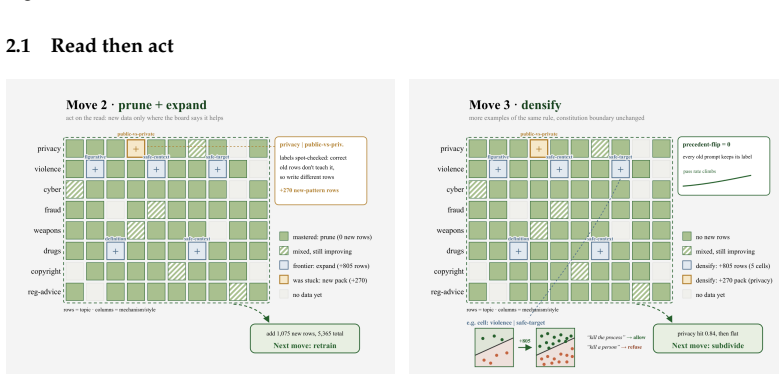
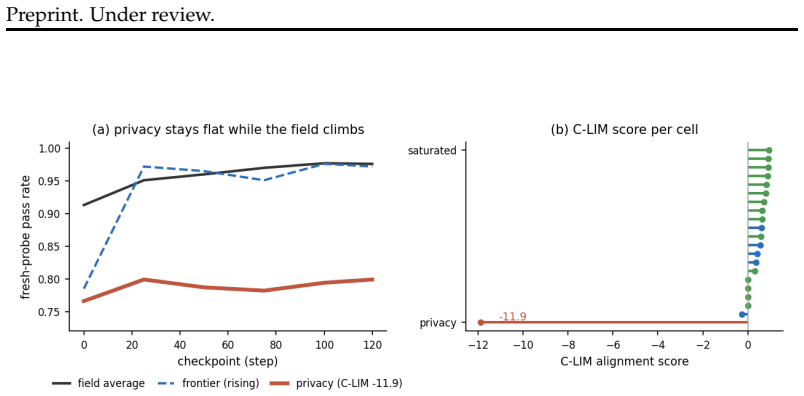
The constitution grid: rows are harm-topic policies, columns are ways of asking, each cell a clause boundary. C-LIM scores a cell by sampling the model 8 times at each checkpoint on unseen rows and comparing its mean pass-rate trajectory with the field mean; cells that track the field score near 1, while cells that stay flat as the field rises score large negative. The loop reads the board, makes one of four moves, trains with vanilla GRPO on paired safe/unsafe twins, and re-reads at the next checkpoint.
What would settle it
Compute C-LIM for a set of cells at an early checkpoint, then add aimed rows to the lowest-scoring and highest-scoring cells; if the low-scoring cells do not improve more than the high-scoring ones, the probe has failed. A simpler check is to vary the number of checkpoints and the 8-sample count and see whether the same cell keeps its flag.
Extended reading notes
Core claim
The central claim is that C-LIM, a per-cell learnability score computed on unseen rows, diagnoses a grid cell as mastered, still-learning, wrong-rule, or dead weight, and routes it to prune, densify, amend, or expand. In the reported run, the privacy|public-vs-private cell stayed flat at 0.80 while the field climbed to 0.98, yielding C-LIM -11.9; the same cell had already been noticed as dead weight by a human. Routing aimed generation into that cell lifted its learning impact from 0.733 to 0.80, whereas 187 untargeted rows had bought 0.000 accuracy gain. The paper presents this as evidence that coverage of the constitution grid, not volume, is what makes RL safety-guard training data-effici
Load-bearing premise
The method assumes a cell's C-LIM score, computed from pass rates at a few checkpoints on unseen rows, reliably predicts which cells will benefit from more training data.
Editorial extensions
If this is right
- RL training data for a guard can be generated by reading the board, so each new row lands in a cell with learning headroom rather than in cells that are flat.
- A one-sided scoreboard that only tracks over-refusal can hide silent under-refusal drift; two channels on independent sets should be part of guard evaluation.
- The drift tax shows that RL on conflicting objectives shifts the boundary along the tradeoff instead of sharpening it; improvements on one axis do not guarantee the other.
- The gate rejects moves that help one cell but regress the rest, so the board can be extended without sacrificing global balanced accuracy.
- Because the method is stated generically, the same grid-and-read loop could be applied to other conflicting pairs such as brevity vs completeness in reasoners.
Reading between the lines
- An extension left implicit is using C-LIM as an early-stop or active-learning signal: run a few checkpoints, score cells, and buy training data only for negative-scoring cells.
- The twin-pair design fixes a row's label at generation time, so dead-weight data likely comes from redundancy rather than label noise; disentangling these two would sharpen the read.
- The privacy cell is the only validated case; the strongest next test is to run the same aimed-generation loop on newly expanded cells and watch whether C-LIM's flags transfer.
- If the drift tax pattern holds generally, evaluation of any aligned model trained on conflicting objectives should include both an in-distribution scoreboard and an independent held-out attack set.
Editorial analysis
A structured set of objections, weighed in public.
Referee Report
Summary. The paper proposes C-Guard, a constitution-grid instrument for generating RL training data for a safety guard, together with C-LIM, a per-cell learnability score computed from pass rates on unseen rows. C-LIM routes each grid cell to one of four moves: prune, densify, amend, or expand. On a 4B Nemotron safety-reasoning base trained with vanilla GRPO, the authors report that C-LIM flagged the privacy cell as a dead-weight region before any training budget was spent; that 187 untargeted rows added to that family bought zero accuracy gain, while rows aimed at C-LIM-probed failure patterns lifted the cell's accuracy from 0.733 to 0.80; and that RL reduced XSTest over-refusal from 22.4% to 12.8% while adversarial under-refusal worsened on independent sets (WildGuardTest adversarial 0.267→0.328). The paper also describes two gates that rejected an over-reaching amendment and a new topic that helped itself but regressed the rest of the board.
Significance. If substantiated, C-LIM would be a cheap, pre-training diagnostic for identifying data regions that will not benefit from generic volume, which is valuable for data-efficient RL alignment. The two-channel evaluation — an in-loop scoreboard plus independent human-labeled attack sets — is a sound methodological instinct, and the authors are commendably explicit about the open frontier on the harmlessness axis (Appendix D). The open-sourced code and constitution are also a strength. However, the central empirical evidence is currently one cell, one run, with no error bars or sensitivity analysis; the quantitative basis for the paper's main claim is therefore thin and needs substantially more support.
major comments (4)
- [§2.1, Eq. (1), §3.1] C-LIM is computed from pass rates estimated with only 8 model samples per cell per checkpoint. The paper does not report confidence intervals, bootstrap variability, or sensitivity to the number of samples or checkpoints. The privacy cell's −11.9 score, which is the sole trigger for the dead-weight claim, could plausibly arise from sampling noise in the per-cell trajectories. Since the entire move-routing loop depends on this score's reliability, the authors should report variance estimates and show that the outlier is stable across checkpoint subsets and sampling counts.
- [§3.3, Table 3] The headline lift from 0.733 to 0.80 is reported as a single number with no error bars, repeated seeds, or significance test. The privacy subset of XSTest is small (450 prompts total, split across families), so an absolute improvement of 0.067 may be within noise. The comparison with the 187 blind rows is not a controlled experiment: the blind rows and the aimed rows differ in content, data volume, and selection mechanism. The authors should provide multiple independent runs or at minimum a bootstrap confidence interval for the lift, and ideally a controlled comparison where the only difference is the targeting signal.
- [§3.1, §3.3] The paper validates C-LIM on a single cell, and that cell is also the one used to select the data whose improvement is then measured. This creates a selection-bias risk: the same distribution is used to identify the target and to evaluate the gain, with no correction for multiple comparisons or out-of-sample validation. The claim that C-LIM 'flags dead-weight data before any budget is spent' is currently supported only post hoc on one cell. The authors should test C-LIM's predictive validity on held-out cells or pre-register the threshold and show that it generalizes to other dead-weight regions.
- [§3.2, Appendix A] The 'drift tax' finding that under-refusal silently worsens on independent sets relies on single-run point estimates (e.g., 0.267→0.328 on WildGuardTest adversarial). The trend is consistent across three independent slices, which is reassuring, but no uncertainty quantification is provided. Since one of the paper's two headline contributions is the existence of this tax, the authors should report confidence intervals or repeated-seed variability for the under-refusal rates.
minor comments (4)
- [§2.1] Equation (1) uses \bar r^k without an explicit definition of the field mean at checkpoint k; the text says 'field mean' but should state the exact aggregation over cells. Also, the notation r_k^c is introduced informally; a precise definition (including the number of rows and samples) would help.
- [§2.4] The format penalty coefficient 0.2 in Eq. (2) is presented as a fixed choice with no ablation. A sentence on why this value was chosen, or a sensitivity check, would strengthen the reproducibility of the recipe.
- [Appendix D] The appendix honestly states that evidence on the harmlessness axis is not yet available. This limitation should be reflected more prominently in the abstract or introduction, since the current framing 'data-efficient RL alignment' may lead readers to expect a demonstrated improvement on both objectives.
- [General] Some figures (e.g., Figure 2 and Figure 3) have minimal captions; adding a one-sentence description of what is plotted would improve readability. The inline citation rendering (e.g., 'R¨ottger') also contains encoding artifacts that should be fixed.
Circularity Check
No significant circularity: C-LIM is computed on unseen rows and validated against independent held-out measurements; no load-bearing self-citation or fitted-input re-labeling.
full rationale
The paper's central derivation chain is: generate constitution-grid data, train with GRPO, read C-LIM per cell, route moves, and measure outcomes on held-out benchmarks. C-LIM (Eq. 1) is a closed-form function of checkpoint pass rates on unseen rows; it contains no fitted parameters and is not defined in terms of the reported gains. The dead-weight flag for the privacy cell is supported by an independent observation—187 untargeted rows added to that family moved accuracy by 0.000—and the targeted-generation improvement is measured on the XSTest privacy family, which is outside the RL training loop. The drift-tax result uses external independent sets (WildGuardTest, ToxicChat), so it does not reduce to the paper's own generator or scoreboard. All cited prior work is external; there is no self-citation chain, imported uniqueness theorem, or ansatz smuggled via the authors' own previous work. The main weaknesses—single-cell evidence, no error bars, and sensitivity to checkpoint/sample counts—are empirical robustness concerns, not circularity. The paper is self-contained against external benchmarks, so the appropriate circularity score is 0.
Assumptions & free parameters
free parameters (4)
- format penalty coefficient =
-0.2
- sampling count per cell =
8
- C-LIM move thresholds
- generation quotas
assumptions (4)
- domain assumption Constitution topics and asking-style axes enumerate the relevant user prompt space.
- domain assumption Twin-pair construction guarantees labels are fixed by construction and precedent-flip is zero.
- ad hoc to paper C-LIM score on unseen rows reflects genuine learnability.
- domain assumption The SFT base model (Nemotron-Content-Safety-Reasoning-4B) is a suitable starting point.
Cite this review
Pith. "Pith review of A Constitution-Grid Instrument for Data-Efficient RL Alignment (C-Guard)." pith.science (2026). https://pith.science/paper/45A7QZU2
@misc{pith2026260800180,
  author       = {Pith},
  title        = {Pith review of: A Constitution-Grid Instrument for Data-Efficient RL Alignment (C-Guard)},
  year         = {2026},
  howpublished = {\url{https://pith.science/paper/45A7QZU2}},
  note         = {Machine review of arXiv:2608.00180}
}
read the original abstract
Conflicting objectives are general in RL alignment, and training on them data-efficiently is hard. Training a safety guard with RL means optimizing two objectives that conflict: catch real harm, and do not refuse benign prompts. Our finding is that over-refusal improves 22.4% to 12.8%, while under-refusal on adversarial attacks silently worsens 0.27 to 0.33. We present C-Guard, a constitution-grid instrument that generates the RL training data, and C-LIM, a per-cell learnability score that decides each cell's move: prune, densify, amend, expand. C-LIM flags the dead-weight data region before any training budget is spent: 187 untargeted rows had bought zero gain, and our method lifts the same region's learning impact 0.733 to 0.80. Code and the constitution are open-sourced.
Figures


Figures from the paper (8 more)




Reviewed August 4, 2026 · model on record in the stance chip above.
Discussion (0). Continue with ORCID to comment.