Gappy Reconstruction of Bubbly Flows by Guided Diffusion Models
Pith reviewed 2026-06-30 04:31 UTC · model grok-4.3
The pith
A guided diffusion model trained on 2D slices from 3D simulations reconstructs realistic bubble-phase velocity fields conditioned on surrounding liquid flow.
A machine-rendered reading of the paper's core claim, the machinery that carries it, and where it could break.
Core claim
We train the model using two-dimensional slices of the velocity field extracted from fully resolved three-dimensional direct numerical simulations. The model generates physically realistic velocity fields both unconditionally and when conditioned on the surrounding liquid flow. The reconstructed bubble-phase velocity field accurately reproduces key statistical features of the flow. A simple patching procedure for adjacent two-dimensional slices enables a reasonable reconstruction of the three-dimensional flow inside a bubble.
What carries the argument
Guided diffusion model trained on 2D slices, serving as a generative prior for conditional reconstruction of bubble velocities from liquid data.
If this is right
- Reconstructed bubble-phase fields match key statistical features of the true flow.
- The approach enables reconstruction of velocity fields from sparse, partial, or phase-limited measurements.
- Diffusion models can serve as generative priors for three-dimensional turbulent multiphase flows.
- Patching adjacent 2D slices yields reasonable 3D reconstructions inside bubbles.
Where Pith is reading between the lines
- The method could be applied to other multiphase regimes such as droplet-laden or particle-laden turbulence.
- It might be tested by conditioning on real experimental liquid data where bubble interiors remain unmeasured.
- Accuracy could degrade for stronger bubble deformations or different density ratios not seen in training.
Load-bearing premise
Training solely on 2D slices from 3D simulations produces accurate conditional reconstructions of bubble velocities when guided by liquid flow, and simple patching across slices suffices for 3D interiors.
What would settle it
Compare statistical moments such as velocity variance and spectra inside reconstructed bubbles against independent fully resolved 3D DNS or experimental measurements to check agreement.
Figures
read the original abstract
Experiments in multiphase flows are often limited in their ability to simultaneously obtain velocity measurements in different phases. At the same time, flow reconstruction from phase-limited measurements is a challenging problem due to the substantially different velocity statistics across the phases. We address this problem for buoyancy-driven bubbly flows in the pseudo-turbulence regime by using a guided diffusion model. We train the model using two-dimensional slices of the velocity field extracted from fully resolved three-dimensional direct numerical simulations. The model generates physically realistic velocity fields both unconditionally and when conditioned on the surrounding liquid flow. The reconstructed bubble-phase velocity field accurately reproduces key statistical features of the flow. We further show that a simple patching procedure for adjacent two-dimensional slices enables a reasonable reconstruction of the three-dimensional flow inside a bubble. These results establish the potential of diffusion models to serve as generative priors for three-dimensional turbulent multiphase flows, opening a route toward the reconstruction of unobserved or experimentally inaccessible velocity fields from sparse, partial, or phase-limited measurements.
Editorial analysis
A structured set of objections, weighed in public.
Referee Report
Summary. The paper claims that a guided diffusion model trained on 2D velocity slices extracted from 3D DNS of buoyancy-driven bubbly flows in the pseudo-turbulence regime can generate physically realistic unconditional and liquid-conditioned bubble-phase velocity fields. The reconstructed fields are asserted to accurately reproduce key statistical features of the flow, and a simple patching procedure across adjacent 2D slices is claimed to enable reasonable 3D reconstruction inside the bubble. These results are presented as establishing diffusion models as generative priors for 3D turbulent multiphase flows and opening a route to reconstruction from sparse or phase-limited measurements.
Significance. If the central claims are supported by quantitative evidence, the work would be significant for multiphase fluid dynamics by demonstrating a data-driven generative approach to phase-limited velocity reconstruction, an area where traditional methods struggle due to differing statistics across phases. The use of diffusion models trained on DNS slices as priors could extend to experimental settings with limited observations.
major comments (2)
- [Abstract] Abstract: The central claims that 'the reconstructed bubble-phase velocity field accurately reproduces key statistical features of the flow' and that 'a simple patching procedure for adjacent two-dimensional slices enables a reasonable reconstruction of the three-dimensional flow inside a bubble' are stated without any accompanying quantitative metrics, error norms, correlation coefficients, spectra, or validation against held-out 3D DNS volumes. This absence prevents assessment of whether the 2D-trained model, when patched, preserves 3D invariants such as the energy spectrum or integrated divergence inside the bubble.
- [Abstract] The manuscript provides no description of training/test splits, quantitative validation details, or error bars for either the 2D conditional reconstructions or the 3D patching step. Without these, the assertion that the approach 'opens a route toward the reconstruction of unobserved or experimentally inaccessible velocity fields' cannot be evaluated for load-bearing correctness.
Simulated Author's Rebuttal
We thank the referee for the constructive feedback on our manuscript. The comments highlight the need for greater quantitative support in the abstract and clearer validation details. We address each point below and will revise the manuscript accordingly to strengthen the presentation.
read point-by-point responses
-
Referee: [Abstract] Abstract: The central claims that 'the reconstructed bubble-phase velocity field accurately reproduces key statistical features of the flow' and that 'a simple patching procedure for adjacent two-dimensional slices enables a reasonable reconstruction of the three-dimensional flow inside a bubble' are stated without any accompanying quantitative metrics, error norms, correlation coefficients, spectra, or validation against held-out 3D DNS volumes. This absence prevents assessment of whether the 2D-trained model, when patched, preserves 3D invariants such as the energy spectrum or integrated divergence inside the bubble.
Authors: We agree that the abstract would be strengthened by including key quantitative metrics to support the claims. While the manuscript body presents detailed comparisons of statistics, spectra, and reconstruction errors, we will revise the abstract to incorporate specific metrics such as mean absolute error norms, correlation coefficients, and references to spectral agreement. For the 3D patching procedure, we will add explicit mention of validation against held-out 3D DNS volumes, including preservation of the energy spectrum and integrated divergence (near-zero inside bubbles). revision: yes
-
Referee: [Abstract] The manuscript provides no description of training/test splits, quantitative validation details, or error bars for either the 2D conditional reconstructions or the 3D patching step. Without these, the assertion that the approach 'opens a route toward the reconstruction of unobserved or experimentally inaccessible velocity fields' cannot be evaluated for load-bearing correctness.
Authors: We acknowledge the value of explicit details on data splits and validation for assessing robustness. The manuscript describes extraction of 2D slices from 3D DNS but will be revised to include a clear statement of the training/test split (e.g., 80/20), quantitative validation procedures with error bars on all reported statistics, and specific metrics for both 2D conditional generation and the 3D patching step. These additions will directly support evaluation of the broader claims regarding applicability to experimental settings. revision: yes
Circularity Check
No significant circularity; claims rest on external DNS training and empirical validation
full rationale
The paper trains a diffusion model on 2D slices extracted from independent 3D DNS data, then applies the trained model to conditional generation and simple patching. No equation, parameter fit, or self-citation reduces any reported statistic or 3D reconstruction to an input by construction. The reproduction of flow features is presented as an observed outcome of model inference rather than a definitional identity. No uniqueness theorem, ansatz smuggling, or renaming of known results appears in the provided text. The central claims therefore remain independent of the input data in the required sense.
Axiom & Free-Parameter Ledger
Reference graph
Works this paper leans on
-
[1]
have previously employed training data obtained from two-dimensional (2d) simulations of pressure-driven channel flows with up to 60 bubbles at small Reynolds numbers (≲.01), to show that physics informed neural networks (PINNs) can successfully predict flow fields. However, for flows with even moderately large Galilei numbers, flow reconstruction remains...
work page internal anchor Pith review Pith/arXiv arXiv 2026
-
[2]
Each dataset is composed of 2dslices (xzandyzplanes aligned with the gravity di- rection) of the flow field, and every slice contains at least one bubble
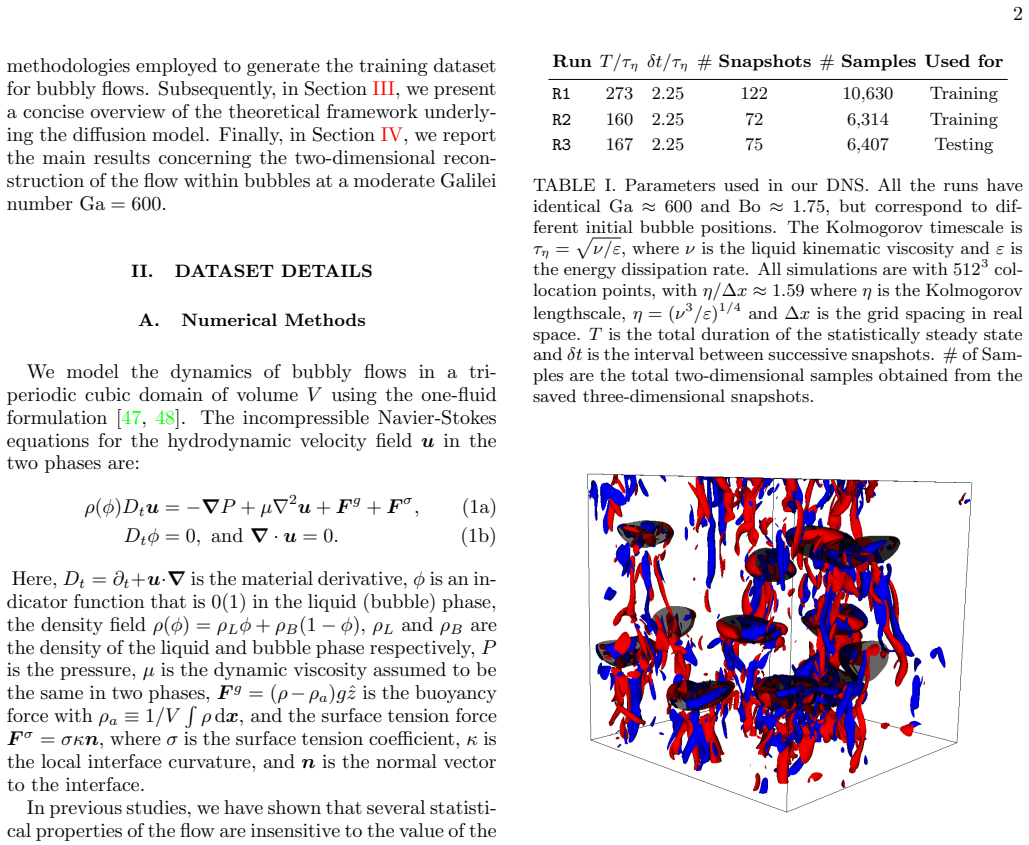
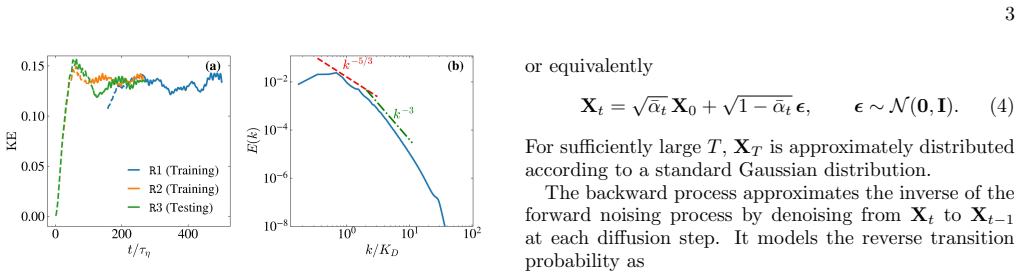
Data acquisition The two-dimensional (2d) training and testing datasets are constructed from the 3dsteady-state realizations of the bubbly flows (runsR1-R3). Each dataset is composed of 2dslices (xzandyzplanes aligned with the gravity di- rection) of the flow field, and every slice contains at least one bubble. To avoid strong correlations, we enforce a m...
-
[3]
We train the model on eight NVIDIA A100 GPUs for about 96 hours with a batch size of four per GPU
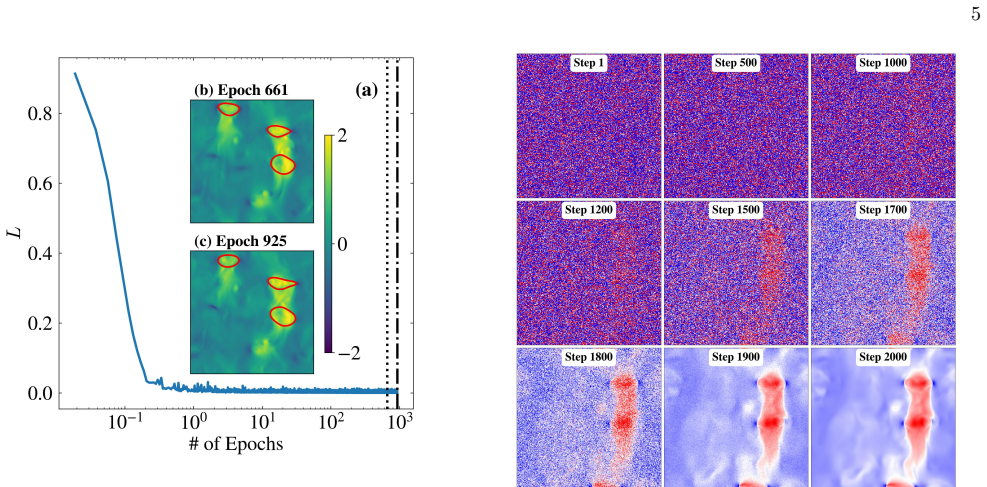
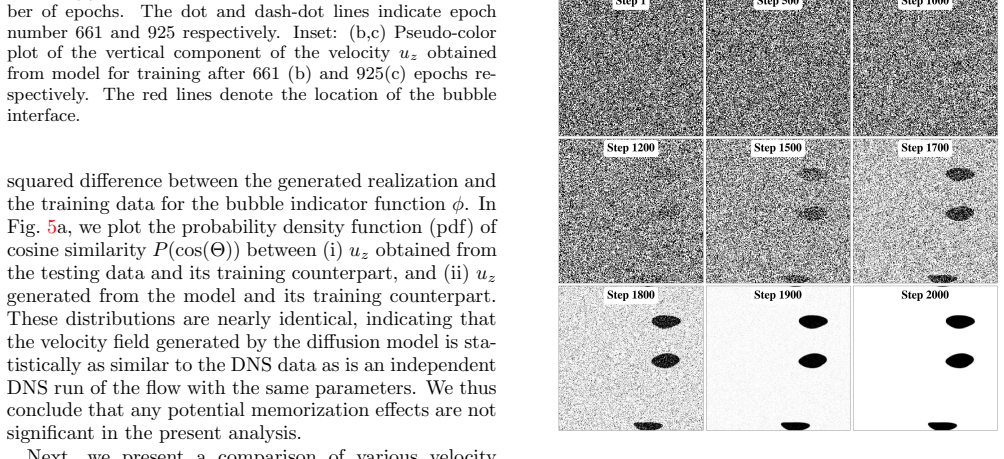
Model training and reconstruction The training set comprises a total of 16944 slices (runs R1–R2). We train the model on eight NVIDIA A100 GPUs for about 96 hours with a batch size of four per GPU. Each epoch is defined as 16944/32≈529 iterations and the model is trained for 925 epochs. The plot of the loss functionLwith respect to the number of epochs in...
-
[4]
av- erage
Flow Reconstruction Inside Bubbles We now address the following experimentally relevant question: given knowledge of the bubble configuration and the velocity field in the liquid phase, can we re- construct the flow inside the bubble? To this end, we FIG. 4. Pseudo-color plot of the vertical velocity fieldu z (left) and the gray-scale plot of the indicato...
2048
-
[5]
Clift, J
R. Clift, J. Grace, and M. Weber,Bubbles, Drops, and Particles, Dover Civil and Mechanical Engineering Series (Dover Publications, 2005)
2005
-
[6]
Balachandar and J
S. Balachandar and J. K. Eaton, Turbulent dispersed multiphase flow, Annu. Rev. Fluid Mech.42, 111 (2010)
2010
-
[8]
Risso, Agitation, mixing, and transfers induced by bubbles, Annu
F. Risso, Agitation, mixing, and transfers induced by bubbles, Annu. Rev. Fluid Mech.50, 25 (2018)
2018
-
[9]
Mathai, D
V. Mathai, D. Lohse, and C. Sun, Bubbly and buoy- ant particle–laden turbulent flows, Annu. Rev. Condens. Matter Phys.11, 529 (2020)
2020
-
[10]
Bhaga and M
D. Bhaga and M. E. Weber, Bubbles in viscous liquids: shapes, wakes and velocities, J. Fluid Mech.105, 61 (1981)
1981
-
[11]
M. K. Tripathi, K. C. Sahu, and R. Govindarajan, Why a falling drop does not in general behave like a rising bubble, Scientific Reports4, 4771 (2014)
2014
-
[12]
M. K. Tripathi, K. C. Sahu, and R. Govindarajan, Dy- namics of an initially spherical bubble rising in quiescent liquid, Nat. Commun.6(2015)
2015
-
[13]
Mendez-Diaz, J
S. Mendez-Diaz, J. C. Serrano-Garc´ia, R. Zenit, and J. A. Hern´ andez-Cordero, Power spectral distributions of pseudo-turbulent bubbly flows, Phys. Fluids25, 043303 (2013)
2013
-
[14]
V. N. Prakash, J. Mart´inez Mercado, L. van Wijngaar- den, E. Mancilla, Y. Tagawa, D. Lohse, and C. Sun, En- ergy spectra in turbulent bubbly flows, J. Fluid Mech. 791, 174 (2016)
2016
-
[15]
Scarbolo, F
L. Scarbolo, F. Bianco, and A. Soldati, Turbulence mod- ification by dispersion of large deformable droplets, Eur. J. Mech. B Fluids55, 294 (2016), vortical Structures and Wall Turbulence
2016
-
[16]
Elghobashi, Direct numerical simulation of turbulent flows laden with droplets or bubbles, Annu
S. Elghobashi, Direct numerical simulation of turbulent flows laden with droplets or bubbles, Annu. Rev. Fluid Mech.51, 217 (2019)
2019
-
[17]
Pandey, R
V. Pandey, R. Ramadugu, and P. Perlekar, Liquid veloc- ity fluctuations and energy spectra in three-dimensional buoyancy-driven bubbly flows, J. Fluid Mech.884, R6 (2020)
2020
-
[18]
Innocenti, A
A. Innocenti, A. Jaccod, S. Popinet, and S. Chibbaro, Di- rect numerical simulation of bubble-induced turbulence, J. Fluid Mech.918, A23 (2021)
2021
-
[19]
Mangani, G
F. Mangani, G. Soligo, A. Roccon, and A. Soldati, Influ- ence of density and viscosity on deformation, breakage, and coalescence of bubbles in turbulence, Phys. Rev. Flu- ids7, 053601 (2022)
2022
-
[20]
Pandey, D
V. Pandey, D. Mitra, and P. Perlekar, Kolmogorov turbu- lence coexists with pseudo-turbulence in buoyancy-driven bubbly flows, Phys. Rev. Lett.131, 114002 (2023)
2023
-
[21]
Ramirez, A
G. Ramirez, A. Burlot, R. Zamansky, G. Bois, and F. Risso, Spectral analysis of dispersed multiphase flows in the presence of fluid interfaces, Int. J. Multiph. Flow 177, 104860 (2024)
2024
-
[23]
T. Ma, S. Tan, R. Ni, H. Hessenkemper, and A. D. Bragg, Kolmogorov scaling in bubble-induced turbulence, Phys. Rev. Lett.134, 244001 (2025)
2025
-
[24]
Thiesset and J
F. Thiesset and J. Vah´ e, Scale-by-scale kinetic energy budgets in multiphase turbulence, J. Fluid Mech.1025, A63 (2025)
2025
-
[25]
Narula, V
H. Narula, V. Pandey, D. Mitra, and P. Perlekar, Scale- by-scale energy transfers in bubbly flows, J. Fluid Mech. 1032, A12 (2026)
2026
-
[26]
Risso, Theoretical model fork −3 spectra in dispersed multiphase flows, Phys
F. Risso, Theoretical model fork −3 spectra in dispersed multiphase flows, Phys. Fluids23, 011701 (2011)
2011
-
[27]
Alm´ eras, V
E. Alm´ eras, V. Mathai, D. Lohse, and C. Sun, Experi- mental investigation of the turbulence induced by a bub- ble swarm rising within incident turbulence, J. Fluid Mech.825, 1091 (2017)
2017
-
[28]
Amoura, C
Z. Amoura, C. Besnaci, F. Risso, and V. Roig, Velocity fluctuations generated by the flow through a random ar- ray of spheres: a model of bubble-induced agitation, J. Fluid Mech. Mechanics823, 592 (2017)
2017
-
[29]
Esmaeeli and G
A. Esmaeeli and G. Tryggvason, Direct numerical simu- lations of bubbly flows part 2. moderate reynolds number arrays, J. Fluid Mech.385, 325 (1999)
1999
-
[31]
Almeras, V
E. Almeras, V. Mathai, C. Sun, and D. Lohse, Mixing induced by a bubble swarm rising through incident tur- bulence, Int. J. Multiph. Flow114, 316 (2019)
2019
-
[32]
Hessenkemper and T
H. Hessenkemper and T. Ziegenhein, Particle shadow ve- locimetry (psv) in bubbly flows, Int. J. Multiph. Flow 106, 268 (2018)
2018
-
[33]
T. Ma, H. Hessenkemper, D. Lucas, and A. D. Bragg, An experimental study on the multiscale properties of turbulence in bubble-laden flows, J. Fluid Mech.936, A42 (2022)
2022
-
[34]
Poletaev, M
I. Poletaev, M. P. Tokarev, and K. S. Pervunin, Bubble patterns recognition using neural networks: Application to the analysis of a two-phase bubbly jet, Int. J. Multiph. Flow126, 103194 (2020)
2020
-
[35]
T. Haas, C. Schubert, M. Eickhoff, and H. Pfeifer, Bubcnn: Bubble detection using faster rcnn and shape regression network, Chem. Eng. Sci.216, 115467 (2020)
2020
-
[36]
R. F. Cerqueira and E. E. Paladino, Development of a deep learning-based image processing technique for bub- ble pattern recognition and shape reconstruction in dense bubbly flows, Chem. Eng. Sci.230, 116163 (2021)
2021
-
[37]
Kim and H
Y. Kim and H. Park, Deep learning-based automated and universal bubble detection and mask extraction in com- plex two-phase flows, Sci. Rep.11, 8940 (2021)
2021
-
[38]
Y. Cui, C. Li, W. Zhang, X. Ning, X. Shi, J. Gao, and X. Lan, A deep learning-based image processing method for bubble detection, segmentation, and shape recon- struction in high gas holdup sub-millimeter bubbly flows, Chem. Eng. J.449, 137859 (2022)
2022
-
[39]
Hessenkemper, S
H. Hessenkemper, S. Starke, Y. Atassi, T. Ziegenhein, and D. Lucas, Bubble identification from images with machine learning methods, Int. J. Multiph. Flow155, 104169 (2022)
2022
-
[40]
H. Wang, Y. Yang, G. Dou, J. Lou, X. Zhu, L. Song, and F. Dong, A 3d reconstruction method of bubble flow field based on multi-view images by bi-direction filtering maxi- mum likelihood expectation maximization algorithm, Int. J. Multiph. Flow165, 104480 (2023). 12
2023
-
[41]
Hessenkemper, L
H. Hessenkemper, L. Wang, D. Lucas, S. Tan, R. Ni, and T. Ma, 3d detection and tracking of deformable bubbles in swarms with the aid of deep learning models, Int. J. Multiph. Flow179, 104932 (2024)
2024
-
[42]
S. K¨ u¸ c¨ uk, C. D. Santina, and A. Laskari, Segmenting the complex and irregular in two-phase flows: A real-world empirical study with sam2 (2025), arXiv:2508.05227 [cs.CV]
-
[43]
H. Zhai, Q. Zhou, and G. Hu, Predicting micro-bubble dynamics with semi-physics-informed deep learning, AIP Advances12, 035153 (2022)
2022
-
[46]
Roghair, J
I. Roghair, J. M. Mercado, M. V. Sint Annaland, H. Kuipers, C. Sun, and D. Lohse, Energy spectra and bubble velocity distributions in pseudo-turbulence: Nu- merical simulations vs. experiments, Int. J. Multiph. Flow37, 1093 (2011)
2011
-
[47]
T. Li, L. Biferale, F. Bonaccorso, M. A. ScarpoliniScar- polini, and M. Buzzicotti, Synthetic lagrangian turbu- lence by generative diffusion models, Nat. Mach. Intell. 6, 393 (2024)
2024
-
[48]
T. Li, S. Tommasi, M. Buzzicotti, F. Bonaccorso, and L. Biferale, Generative diffusion models for synthetic tra- jectories of heavy and light particles in turbulence, Int. J. Multiph. Flow181, 104980 (2024)
2024
-
[49]
T. Li, A. S. Lanotte, M. Buzzicotti, F. Bonaccorso, and L. Biferale, Multi-scale reconstruction of turbulent rotat- ing flows with generative diffusion models, Atmosphere 15(2024)
2024
-
[50]
T. Li, L. Biferale, F. Bonaccorso, M. Buzzicotti, and L. Centurioni, Stochastic reconstruction of gappy la- grangian turbulent signals by conditional diffusion mod- els, Communications Physics8, 372 (2025)
2025
-
[51]
Esmaeeli and G
A. Esmaeeli and G. Tryggvason, Direct numerical simula- tions of bubbly flows. part 1. low reynolds number arrays, J. Fluid Mech.377, 313 (1998)
1998
-
[52]
Bunner and G
B. Bunner and G. Tryggvason, Dynamics of homogeneous bubbly flows part 1. rise velocity and microstructure of the bubbles, J. Fluid Mech.466, 17 (2002)
2002
-
[53]
Pandey, D
V. Pandey, D. Mitra, and P. Perlekar, Turbulence mod- ulation in buoyancy-driven bubbly flows, J. Fluid Mech. 932, A19 (2022)
2022
-
[54]
Canuto, M
C. Canuto, M. Hussaini, A. Quarteroni, and T. Zang, Spectral methods in Fluid Dynamics(Spinger-Verlag, Berlin, 1988)
1988
-
[55]
S. O. Unverdi and G. Tryggvason, A front-tracking method for viscous, incompressible, multi-fluid flows, J. Comput. Phys.100, 25 (1992)
1992
-
[56]
Aniszewski, T
W. Aniszewski, T. Arrufat, M. Crialesi-Esposito, S. Dabiri, D. Fuster, Y. Ling, J. Lu, L. Malan, S. Pal, R. Scardovelli, G. Tryggvason, P. Yecko, and S. Za- leski, Parallel, robust, interface simulator (paris), Com- put. Phys. Commun.263, 107849 (2021)
2021
-
[57]
Sohl-Dickstein, E
J. Sohl-Dickstein, E. Weiss, N. Maheswaranathan, and S. Ganguli, Deep unsupervised learning using nonequi- librium thermodynamics, inProceedings of the 32nd In- ternational Conference on Machine Learning, Proceed- ings of Machine Learning Research, Vol. 37, edited by F. Bach and D. Blei (PMLR, Lille, France, 2015) pp. 2256–2265
2015
-
[58]
J. Ho, A. Jain, and P. Abbeel, Denoising diffusion prob- abilistic models, inProceedings of the 34th International Conference on Neural Information Processing Systems, NIPS ’20 (Curran Associates Inc., Red Hook, NY, USA, 2020)
2020
-
[59]
Supplementary material
- [60]
-
[61]
Chung, J
H. Chung, J. Kim, M. T. Mccann, M. L. Klasky, and J. C. Ye, Diffusion posterior sampling for general noisy inverse problems, inThe Eleventh International Conference on Learning Representations(2023)
2023
-
[62]
P. Du, M. H. Parikh, X. Fan, X.-Y. Liu, and J.-X. Wang, Conditional neural field latent diffusion model for gen- erating spatiotemporal turbulence, Nat. Commun.15, 10416 (2024)
2024
-
[63]
Z. Li, W. Han, Y. Zhang, Q. Fu, J. Li, L. Qin, R. Dong, H. Sun, Y. Deng, and L. Yang, Learning spatiotemporal dynamics with a pretrained generative model, Nat. Mach. Intell.6, 1566 (2024)
2024
-
[64]
X. Gu, C. Du, T. Pang, C. Li, M. Lin, and Y. Wang, On memorization in diffusion models, Transactions on Machine Learning Research (2025)
2025
-
[65]
We have confirmed that choosingN R = 100 instead does not affect the results
-
[66]
Virtanen, R
P. Virtanen, R. Gommers, T. E. Oliphant, M. Haber- land, T. Reddy, D. Cournapeau, E. Burovski, P. Pe- terson, W. Weckesser, J. Bright, S. J. van der Walt, M. Brett, J. Wilson, K. J. Millman, N. Mayorov, A. R. J. Nelson, E. Jones, R. Kern, E. Larson, C. J. Carey, ˙I. Po- lat, Y. Feng, E. W. Moore, J. VanderPlas, D. Laxalde, J. Perktold, R. Cimrman, I. Henr...
2020
-
[67]
Ni, Deformation and breakup of bubbles and drops in turbulence, Annu
R. Ni, Deformation and breakup of bubbles and drops in turbulence, Annu. Rev. Fluid Mech.56, 319 (2024)
2024
-
[68]
CloughTocher2DInterpolator.html(2026), accessed: 2026-04-04
SciPy Developers, CloughTocher2DInterpolator (scipy.interpolate),https://docs.scipy.org/doc/ scipy/reference/generated/scipy.interpolate. CloughTocher2DInterpolator.html(2026), accessed: 2026-04-04
2026
-
[69]
Gappy Reconstruction of Bubbly Flows by Guided Diffusion Models
W. Genuist, ´Eric Savin, F. Gatti, and D. Clouteau, Divergence-free diffusion models for incompressible fluid flows (2026), arXiv:2601.19368 [physics.flu-dyn]. Supplementary Material for “Gappy Reconstruction of Bubbly Flows by Guided Diffusion Models” Hridey Narula, 1,∗ Tianyi Li, 2 Michele Buzzicotti, 2 Luca Biferale, 2 and Prasad Perlekar 1,† 1Tata Ins...
-
[70]
4b, where we also plots the result obtained using a simple cubic spline interpolation from the scipy library [9]
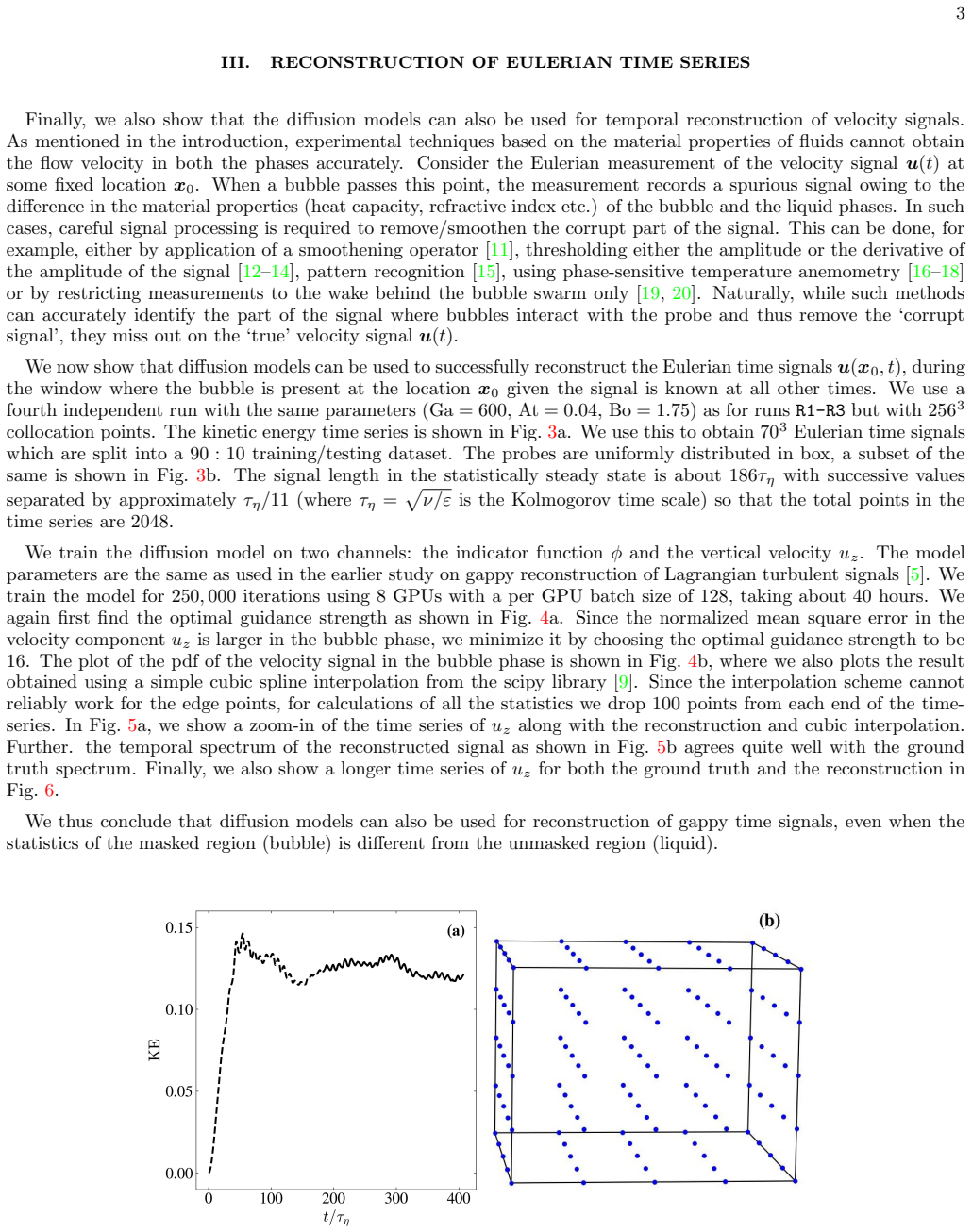
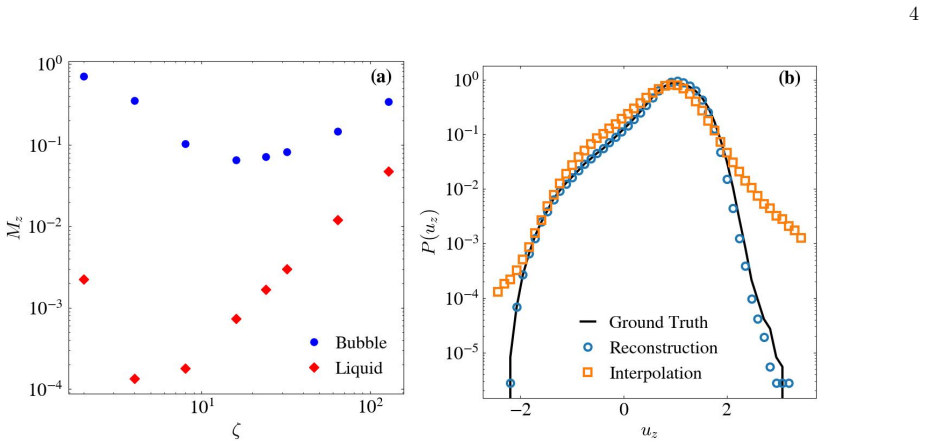
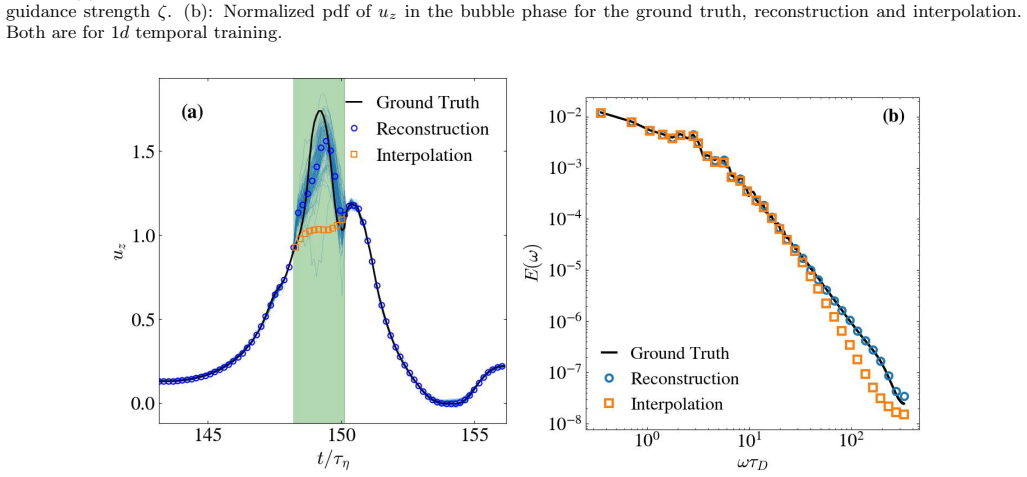
The plot of the pdf of the velocity signal in the bubble phase is shown in Fig. 4b, where we also plots the result obtained using a simple cubic spline interpolation from the scipy library [9]. Since the interpolation scheme cannot reliably work for the edge points, for calculations of all the statistics we drop 100 points from each end of the time- serie...
-
[71]
J. Ho, A. Jain, and P. Abbeel, Denoising diffusion probabilistic models, inProceedings of the 34th International Conference on Neural Information Processing Systems, NIPS ’20 (Curran Associates Inc., Red Hook, NY, USA, 2020)
2020
-
[72]
T. Li, L. Biferale, F. Bonaccorso, M. A. ScarpoliniScarpolini, and M. Buzzicotti, Synthetic lagrangian turbulence by generative diffusion models, Nat. Mach. Intell.6, 393 (2024)
2024
-
[73]
T. Li, A. S. Lanotte, M. Buzzicotti, F. Bonaccorso, and L. Biferale, Multi-scale reconstruction of turbulent rotating flows with generative diffusion models, Atmosphere15(2024)
2024
-
[74]
T. Li, S. Tommasi, M. Buzzicotti, F. Bonaccorso, and L. Biferale, Generative diffusion models for synthetic trajectories of heavy and light particles in turbulence, Int. J. Multiph. Flow181, 104980 (2024)
2024
-
[75]
T. Li, L. Biferale, F. Bonaccorso, M. Buzzicotti, and L. Centurioni, Stochastic reconstruction of gappy lagrangian turbulent signals by conditional diffusion models, Communications Physics8, 372 (2025)
2025
-
[76]
U-Net: Convolutional Networks for Biomedical Image Segmentation
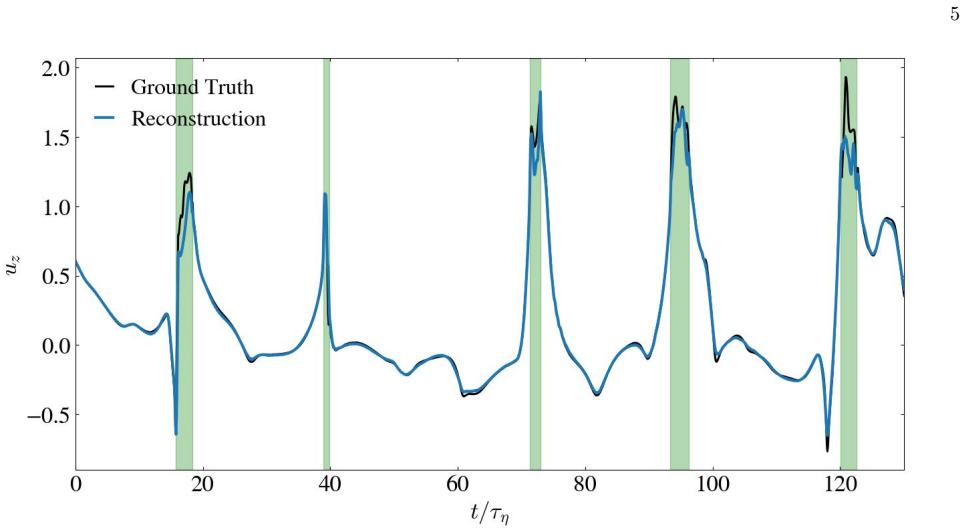
O. Ronneberger, P. Fischer, and T. Brox, U-net: Convolutional networks for biomedical image segmentation (2015), 5 FIG. 6. A longer time series for the ground truth as well as one possible reconstruction of the velocity signalu z. The shaded regions mark the windows where a bubble crosses the Eulerian point. arXiv:1505.04597 [cs.CV]
work page internal anchor Pith review Pith/arXiv arXiv 2015
-
[77]
A. Vaswani, N. Shazeer, N. Parmar, J. Uszkoreit, L. Jones, A. N. Gomez, L. Kaiser, and I. Polosukhin, Attention is all you need (2023), arXiv:1706.03762 [cs.CL]
work page internal anchor Pith review Pith/arXiv arXiv 2023
-
[78]
Decoupled Weight Decay Regularization
I. Loshchilov and F. Hutter, Decoupled weight decay regularization (2019), arXiv:1711.05101 [cs.LG]
work page internal anchor Pith review Pith/arXiv arXiv 2019
-
[79]
Virtanen, R
P. Virtanen, R. Gommers, T. E. Oliphant, M. Haberland, T. Reddy, D. Cournapeau, E. Burovski, P. Peterson, W. Weckesser, J. Bright, S. J. van der Walt, M. Brett, J. Wilson, K. J. Millman, N. Mayorov, A. R. J. Nelson, E. Jones, R. Kern, E. Larson, C. J. Carey, ˙I. Polat, Y. Feng, E. W. Moore, J. VanderPlas, D. Laxalde, J. Perktold, R. Cimrman, I. Henriksen,...
2020
-
[80]
SciPy Developers, CloughTocher2DInterpolator (scipy.interpolate),https://docs.scipy.org/doc/scipy/reference/ generated/scipy.interpolate.CloughTocher2DInterpolator.html(2026), accessed: 2026-04-04
2026
-
[81]
Lance and J
M. Lance and J. Bataille, Turbulence in the liquid phase of a uniform bubbly air–water flow, J. Fluid Mech.222, 9 (1991)
1991
-
[82]
Zenit, D
R. Zenit, D. L. Koch, and A. S. Sangani, Measurements of the average properties of a suspension of bubbles rising in a vertical channel, J. Fluid Mech.429, 307 (2001)
2001
-
[83]
Martinez Mercado, C
J. Martinez Mercado, C. A. Palacios-Morales, and R. Zenit, Measurement of pseudoturbulence intensity in monodispersed bubbly liquids for 10<Re<50, Phys. Fluids19, 103302 (2007)
2007
-
[84]
Alm´ eras, V
E. Alm´ eras, V. Mathai, D. Lohse, and C. Sun, Experimental investigation of the turbulence induced by a bubble swarm rising within incident turbulence, J. Fluid Mech.825, 1091 (2017)
2017
-
[85]
Rensen, S
J. Rensen, S. Luther, and D. Lohse, The effect of bubbles on developed turbulence, J. Fluid Mech.538, 153 (2005)
2005
discussion (0)
Sign in with ORCID, Apple, or X to comment. Anyone can read and Pith papers without signing in.