REVIEW 4 major objections 6 minor 18 references
Sentiment Analysis in Learning Management Systems Understanding Student Feedback at Scale
T0 review · 4 major / 6 minor · reviewed 2026-08-07 · deepseek-v4-flash
Pith's one-line read The paper claims an attention-based LSTM classifies the sentiment of student course comments more accurately than a logistic regression baseline—80% vs 77%—because the network reads feedback sequentially and contextually.
desk verdict Standard LSTM+attention recipe on RateMyProfessor data, undermined by an ambiguous ground-truth label and inconsistent confusion matrices. read the letter →
The pith
A machine-rendered reading of the paper's core claim, the machinery that carries it, and where it could break.
The reading
What carries the argument
The machinery is the proposed deep network, called the RNN model in the paper: a word-embedding layer that turns words into dense vectors, a bidirectional LSTM that reads each comment forward and backward to capture long-range dependencies, an attention layer that up-weights sentiment-bearing words, and a sigmoid output that converts scores to positive/negative probabilities. Around it sits a preprocessing pipeline—TF-IDF for vectorization, chi-squared statistics to select a 5,000-word vocabulary from the full 17,583-word vocabulary, SMOTE to balance classes, plus stopword removal and lemmatization. The baseline, logistic regression on the same features, is the counterfactual: its word-independent weighting is what the RNN is claimed to improve upon.
What would settle it
Inspect the prepared dataset and compare each comment's assigned sentiment label to the per-comment rating recorded with that same comment; if labels were instead assigned from the professor-level average rating, many individual comments will be mislabeled. Re-running the same train/test split with labels derived from each comment's own rating would settle whether the reported 80% vs 77% accuracy gap is real.
Extended reading notes
Core claim
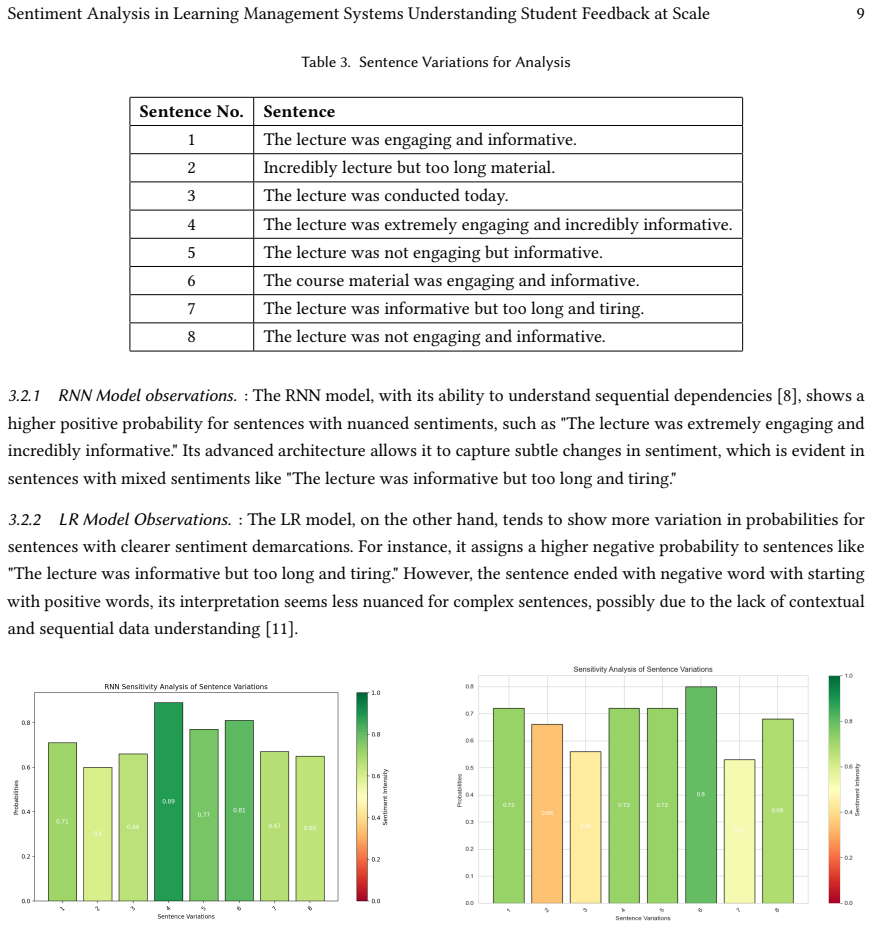
The central claim is that an RNN-based sentiment classifier—implemented as a word embedding layer, a bidirectional LSTM, an attention mechanism, and a sigmoid output—understands the sentiment of student course feedback better than a TF-IDF logistic regression baseline, and is a viable component to embed in a learning management system. On the public professor-review dataset, the paper reports the RNN outperforming the baseline on every metric: accuracy 80% vs 77%, precision 83% vs 77%, recall 85% vs 76%, F1 0.84 vs 0.77, and AUC 0.88 vs 0.86. The paper attributes the gap to sequential and contextual processing: the RNN interprets words in relation to their neighbors, while logistic regression treats each word largely independently. A qualitative sensitivity analysis on constructed sentences adds a second claim: the RNN tracks mixed sentiments better than the baseline, yet neither model correctly handles negation such as "not engaging and informative."
Load-bearing premise
The load-bearing premise is that each comment's sentiment label is derived from the rating attached to that individual comment, not from the professor's overall average rating; the paper never says which field generated the labels, and if the average was used, individual comments are mislabeled and the evaluation is invalid.
Editorial extensions
If this is right
- Embedded in an LMS, the model could produce course-level sentiment summaries for instructors in near real time, turning thousands of comments into an interpretable signal.
- The reported gains across precision, recall, F1, and AUC imply that sequence-aware classifiers are worth their added complexity for this task, at least on public professor-review feedback.
- The qualitative failures on negation imply that a deployed system should either flag sentences containing negations for human review or be paired with a model that handles them.
- The paper presents the public multi-institution data as a proxy that makes the approach transferable to LMS settings, where feedback is often private and restricted.
Reading between the lines
- If the labeling ambiguity is resolved and each comment is labeled by its own rating, a natural next experiment would be to fine-tune the same architecture on actual LMS comments, where feedback is formative and about course logistics rather than professor reputation; the current dataset is retrospective and professor-focused.
- The failure on negation suggests a cheap diagnostic for any future sentiment system in education: test with minimal pairs like "engaging and informative" versus "not engaging and informative" before trusting the model with student feedback.
- The paper proposes transformer-based contextual embeddings as future work; a direct test of that suggestion is to swap the embedding layer for a contextual encoder and compare on the same qualitative sentences, especially the one where both models misread negation.
Editorial analysis
A structured set of objections, weighed in public.
Referee Report
Summary. The paper proposes a sentiment analysis pipeline for student feedback in learning management systems, using the RateMyProfessor dataset. It applies TF-IDF vectorization, chi-squared feature selection, SMOTE balancing, and compares a logistic regression baseline with an LSTM plus attention deep model. The reported results claim the RNN is superior across all metrics, with 80% accuracy versus 77% for logistic regression, and the paper concludes that the deep model better captures sequential and contextual sentiment in student comments.
Significance. If the evaluation were sound, the paper would offer a modest, reproducible comparison of a deep sequence model against a linear baseline on a public educational-feedback dataset, with a useful qualitative sensitivity analysis on constructed sentences. The use of a public dataset and a clear baseline is a strength. However, the central claim of RNN superiority is currently unsupported because of an ambiguous ground-truth label definition, an inconsistency in the reported test-set sizes of the two confusion matrices, and a lack of any statistical significance testing. The paper also frames the work as LMS integration while using RateMyProfessor data, so the ecological validity of the 'LMS' claim is limited.
major comments (4)
- [Section 2.1, Table 1, Section 2.3] The ground-truth label source is never specified. Table 1 distinguishes 'star_rating' (the professor-level average overall quality) from 'students_star' (the rating given by each individual student). Section 2.3 refers only to 'the star rating' as the indicator of dataset distribution. If the aggregate 'star_rating' is used to label each individual comment, then all comments for a given professor share the same label, and the model may be learning professor reputation rather than the sentiment of the specific comment. This is systematic, text-correlated label noise that would invalidate the comparison in Section 3.1. The authors must state explicitly which field generated the 'sentiment' labels and, if the aggregate field was used, rerun the evaluation using per-comment 'students_star' labels or provide a justified alternative.
- [Section 3.1, Figures 7 and 8] The reported confusion matrices are internally inconsistent with the stated 80/20 split. The logistic regression matrix totals 4002 instances (1387 + 1718 + 422 + 475), while the RNN matrix totals 3996 instances (2184 + 1009 + 422 + 381), and both report exactly 422 false positives. Under the same test-set fraction, both models should be evaluated on the same number of test instances. This indicates the two evaluations were not performed on the same, consistently defined test set, so the accuracy, precision, recall, and F1 values in Table 2 are not directly comparable. The authors must rerun both models on the same held-out test set and report consistent totals.
- [Section 2.4 and Section 2.5] The paper does not clarify whether SMOTE is applied before or after the train/test split. Section 2.4 describes applying SMOTE to the dataset and Figure 3 shows class distributions before and after SMOTE, while Section 2.5 describes the 80/20 split only afterward. If SMOTE is applied to the full dataset prior to splitting, synthetic minority-class examples will appear in the test set, artificially inflating the reported metrics. The authors must state explicitly that SMOTE was applied only to the training portion and that the test set consists exclusively of real, held-out examples.
- [Section 2.5 and Table 2] No error bars, confidence intervals, or significance tests are reported for any metric. The central claim of Section 3.1 that the RNN is 'superior across all metrics' rests on a single 80/20 split, where the accuracy difference is only 3 percentage points on a test set of roughly 4000 instances. Such a difference can easily arise from sampling noise. The authors should report multiple runs or cross-validation and apply a paired significance test, such as McNemar's test or a bootstrap interval, to support the claim of superiority.
minor comments (6)
- [Abstract] Several grammatical errors and typos appear in the abstract, such as 'in person learning traditional', 'The absent of non-verbal communication', and 'has impacted the teacher-student especially in non-verbal communication'. These should be corrected throughout.
- [Section 2.2] The paper states that the vocabulary consists of 17,583 unique words and the 'comment' feature contains 19,993 sentences, but it does not report the total number of comments or the class distribution counts corresponding to Figure 3. This information is needed to interpret the SMOTE balancing and the reported test-set sizes.
- [Section 2.4] The oversampling ratio or target class distribution after SMOTE is not specified. Readers cannot assess how much synthetic data was added or whether the resulting distribution is sensible.
- [Section 2.7] Hyperparameters for the deep model are not reported, including embedding dimension, number of LSTM units, dropout, learning rate, batch size, and number of training epochs. Without these, the comparison to logistic regression is not reproducible.
- [Section 3.2] In the qualitative analysis, the paper claims both models failed to classify sentence 8 as negative despite 'not', but Table 3 lists sentence 8 as 'The lecture was not engaging and informative.' The discussion would be clearer if the exact intended sentiment of each constructed sentence were explicitly stated before interpreting model outputs.
- [References] The reference list contains inconsistent formatting, including missing venue information for reference [1] and a dissertation reference [14] that appears unrelated to the cited claim about sentiment analysis in education. These should be corrected.
Circularity Check
No significant circularity: the RNN-vs-LR comparison is a standard supervised-learning evaluation on an external dataset.
full rationale
The paper's central claim—that an LSTM-with-attention model outperforms logistic regression on RateMyProfessor comment sentiment—is supported by a held-out test evaluation. The sentiment labels come from the external RateMyProfessor star ratings, not from the model being evaluated; the text features are TF-IDF and chi-square-selected word representations; and the 80/20 train/test split means the reported accuracy, precision, recall, F1, and AUC are out-of-sample predictions. No equation in the paper defines the target metric in terms of a fitted parameter, and no load-bearing premise is imported from a self-citation; the citations to Lipton and Molnar are background explanations of RNN capabilities and interpretability rather than evidence that the evaluation is true. The paper's ambiguities—such as not stating whether the aggregate 'star_rating' or per-comment 'students_star' is the ground-truth label and the inconsistent confusion-matrix totals between the two models—are correctness and validity concerns, not circularity, because they do not make the comparison true by construction.
Assumptions & free parameters
free parameters (4)
- star-rating to sentiment mapping
- chi-square vocabulary size =
5000 words
- SMOTE oversampling ratio
- Deep network hyperparameters
assumptions (4)
- domain assumption RateMyProfessor comments are a valid proxy for LMS feedback
- domain assumption Star ratings accurately reflect the sentiment of the comment text
- domain assumption The binary positive/negative setup is consistent with the three-class (positive/neutral/negative) framing
- standard math Standard feature engineering (TF-IDF, chi-square, SMOTE) preserves sentiment signal
Cite this review
Pith. "Pith review of Sentiment Analysis in Learning Management Systems Understanding Student Feedback at Scale." pith.science (2026). https://pith.science/paper/45S7WTRQ
@misc{pith2026250605490,
  author       = {Pith},
  title        = {Pith review of: Sentiment Analysis in Learning Management Systems Understanding Student Feedback at Scale},
  year         = {2026},
  howpublished = {\url{https://pith.science/paper/45S7WTRQ}},
  note         = {Machine review of arXiv:2506.05490}
}
read the original abstract
During the wake of the Covid-19 pandemic, the educational paradigm has experienced a major change from in person learning traditional to online platforms. The change of learning convention has impacted the teacher-student especially in non-verbal communication. The absent of non-verbal communication has led to a reliance on verbal feedback which diminished the efficacy of the educational experience. This paper explores the integration of sentiment analysis into learning management systems (LMS) to bridge the student-teacher's gap by offering an alternative approach to interpreting student feedback beyond its verbal context. The research involves data preparation, feature selection, and the development of a deep neural network model encompassing word embedding, LSTM, and attention mechanisms. This model is compared against a logistic regression baseline to evaluate its efficacy in understanding student feedback. The study aims to bridge the communication gap between instructors and students in online learning environments, offering insights into the emotional context of student feedback and ultimately improving the quality of online education.
Figures


Figures from the paper (3 more)


Reference graph
Works this paper leans on
-
[1]
Felipe Child, Marcus Frank, and Jonat Law. 2023. What do higher education students want from online learning? (2023)
work page 2023
-
[2]
Chaitali Choudhary, Inder Singh, and Manoj Kumar. 2023. SARWAS: Deep ensemble learning techniques for sentiment based recommendation system. Expert Systems with Applications 216 (2023), 119420
work page 2023
-
[3]
Yuhuan Cui, Zezhong Ma, Liya Wang, Aimin Yang, Qiumei Liu, Shanshan Kong, and Huifang Wang. 2023. A survey on big data-enabled innovative online education systems during the COVID-19 pandemic. Journal of Innovation & Knowledge 8, 1 (2023), 100295
work page 2023
-
[4]
Simon L Evans, Rosalind Jones, Erkan Alkan, Jaime Simão Sichman, Amanul Haque, Francisco Bráulio Silva de Oliveira, Davoud Mougouei, et al
-
[5]
Kutay Güler. 2023. Structuring knowledge-building in online design education. International Journal of Technology and Design Education 33, 3 (2023), 1055–1086
work page 2023
-
[6]
Jibo He. 2020. Big Data Set from RateMyProfessor.com for Professors’ Teaching Evaluation. Mendeley Data. https://doi.org/10.17632/fvtfjyvw7d.2
-
[7]
Sarah Hodges. 2023. The Eyes Have It: The importance of eye contact in education and strategies to improve teaching in the virtual environment. eLearn 2023, 2 Special Issue (2023)
work page 2023
-
[8]
Zachary Chase Lipton. 2015. A Critical Review of Recurrent Neural Networks for Sequence Learning. CoRR abs/1506.00019 (2015). arXiv:1506.00019 http://arxiv.org/abs/1506.00019
arXiv 2015
Show all 18 references
-
[9]
Qi Liu, Matt J Kusner, and Phil Blunsom. 2020. A survey on contextual embeddings. arXiv preprint arXiv:2003.07278 (2020)
2020 arXiv
-
[10]
Rommel Pascual Manzon. 2023. SENTIMENTS ANALYSIS ON THE PERFORMANCE OF SECONDARY SCHOOL ENGLISH TEACHERS DURING ONLINE CLASSES. EPRA International Journal of Research and Development (IJRD) 8, 6 (2023), 27–30
2023
-
[11]
Christoph Molnar. [n. d.]. Interpretable machine learning: A guide for making black box models explainable
-
[12]
Natural Language Toolkit. 2023. NLTK WordNet Lemmatizer Source Code. Available: https://www.nltk.org/_modules/nltk/stem/wordnet.html
2023
-
[13]
Natural Language Toolkit. 2023. stopwords. Available: https://www.nltk.org/search.html?q=stopwords
2023
-
[14]
NIDHI NIRBHIK. 2023. INTEGRATING TEXT AND EMOTICONS FOR DETECTING EXTREMIST AFFILIATIONS ON TWITTER USING DEEP LEARNING . Ph. D. Dissertation
2023
-
[15]
Ž Vujović et al. 2021. Classification model evaluation metrics. International Journal of Advanced Computer Science and Applications 12, 6 (2021), 599–606
2021
-
[16]
Chengcheng Xu, Xiabing Zheng, and Feng Yang. 2023. Examining the effects of negative emotions on review helpfulness: The moderating role of product price. Computers in Human Behavior 139 (2023), 107501
2023
-
[17]
Tan Zi Yi, Kazuya Shide, Hirotake Kanisawa, Naoto Mine, Kazuki Otsu, Yohei Koga, and Shunsuke Someya. 2023. A study on the effectiveness of non-verbal teaching materials in construction accidents prevention education: through an International comparative experiment. Journal of...
2023
-
[2023]
Human Behavior and Emerging Technologies 2023 (2023)
The emotional impact of COVID-19 news reporting: A longitudinal study using natural language processing. Human Behavior and Emerging Technologies 2023 (2023)
2023
Reviewed August 7, 2026 · model on record in the stance chip above.
Discussion (0). Sign in to comment.