REVIEW 3 major objections 4 minor 1 cited by
Systematic analysis of the mass spectra of triply heavy baryons
T0 review · 3 major / 4 minor · reviewed 2026-08-10 · deepseek-v4-flash
Pith's one-line read This paper predicts the complete low-lying mass spectra of the four triply heavy baryons made only of charm and bottom quarks, and shows that each spectrum is organized by a dominant internal excitation mode.
desk verdict Solid standard-model calculation with genuinely new numbers, but the Omega_ccc/bbb tables contain Pauli-forbidden states and the abstract promises G-wave results the tables do not deliver. read the letter →
The pith
A machine-rendered reading of the paper's core claim, the machinery that carries it, and where it could break.
The reading
What carries the argument
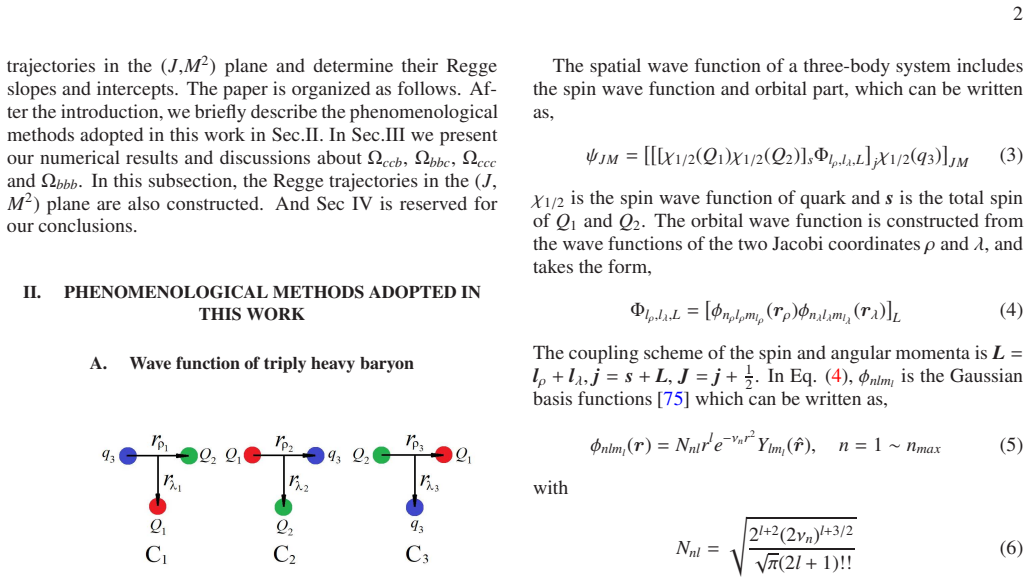
The load-bearing object is the relativized quark-model Hamiltonian with relativistic kinetic energy, linear confinement, one-gluon exchange, hyperfine contact and tensor terms, and spin-orbit terms. Its matrix elements are evaluated with infinitesimally-shifted Gaussian basis functions on Jacobi coordinates, which encode the two internal motions: the $\rho$ mode between two quarks and the $\lambda$ mode between one quark and the pair's center of mass. A heavy-quark-dominance criterion selects the lower of the two modes for each baryon, and a generalized eigenvalue problem with configuration mixing over allowed angular-momentum couplings produces the mass eigenvalues and eigenvectors tabulated in the paper.
What would settle it
Measure the ground-state mass of $\Omega_{bbb}$: the paper predicts $J^P = \tfrac{3}{2}^+$ at 14394 MeV with a claimed 30 MeV uncertainty, while existing lattice QCD places it at 14371(12) MeV; a future measurement more than about 60 MeV from the prediction would falsify the parameter transfer.
Extended reading notes
Core claim
The central claim is that the mass spectra of the ground and low-lying excited states of $\Omega_{ccb}$, $\Omega_{bbc}$, $\Omega_{ccc}$, and $\Omega_{bbb}$ can be obtained from a single relativized quark-model Hamiltonian, and that the four tables of predicted masses are accurate to about 30 MeV for the charmed-bottom systems. The authors first establish a pattern they call heavy-quark dominance: in a baryon containing both charm and bottom quarks, the excited energy is tied to the heavier quark. Consequently the lowest states of $\Omega_{ccb}$ are dominated by the $\lambda$-mode, while those of $\Omega_{bbc}$ are dominated by the $\rho$-mode. They then include configuration mixing and report masses, r.m.s. radii, radial density distributions, and linear Regge trajectories in the $(J,M^2)$ plane for all four baryons; the mixing also lowers the lowest energy for each $J^P$ assignment.
Load-bearing premise
The predictions stand or fall on the transfer of quark masses and potential parameters from singly and doubly heavy baryons to triply heavy baryons, together with the assumption that the dominant internal excitation mode plus configuration mixing captures every state in the reported spectrum.
Editorial extensions
If this is right
- If the predicted spectra are correct, the ground state of $\Omega_{ccc}$ and $\Omega_{bbb}$ should be $J^P = \tfrac{3}{2}^+$ near 4805 MeV and 14394 MeV, with no $J^P = \tfrac{1}{2}^+$ S-wave ground state allowed by the Pauli principle.
- For $\Omega_{ccb}$ and $\Omega_{bbc}$, the ground states cluster near 8025/8046 MeV and 11217/11236 MeV, giving narrow search windows at hadron colliders.
- Configuration mixing lowers each lowest level by a few MeV, so unmixed quark-model predictions should be treated as upper bounds for the lowest state of each quantum number.
- The predicted linear $(J,M^2)$ Regge trajectories provide interpolation among the computed states and extrapolation to higher-spin members of the same radial family.
- The $\Omega_{bbc}$ states $1P(\tfrac{5}{2}^-)$ and $1F(\tfrac{3}{2}^-)$ stand 40–70 MeV above their P- and F-wave siblings because the preferred $\rho$-mode is forbidden for those quantum numbers, making them distinctive experimental signatures.
Reading between the lines
- A testable extension the paper does not pursue: because the predicted radii and density profiles differ sharply between the $\lambda$-dominated $\Omega_{ccb}$ and the $\rho$-dominated $\Omega_{bbc}$, measurements of electromagnetic transitions or strong decay widths could distinguish the two geometries without resolving a mass shift.
- The parameter-transfer assumption could be checked by lattice QCD calculations of the new excited states, for instance the $2P$ or $1D$ levels of $\Omega_{ccb}$, which would either confirm the 30 MeV accuracy claim or reveal a systematic mass offset that grows with excitation.
- A natural next step would be to use the predicted wavefunctions to compute strong decay widths, turning the mass tables into predictions about which excited states are narrow enough to be observed.
Signed reviews
Editorial analysis
A structured set of objections, weighed in public.
Referee Report
Summary. The paper predicts the mass spectra, r.m.s. radii, and radial density distributions of the triply heavy baryons Omega_ccb, Omega_bbc, Omega_ccc, and Omega_bbb in a relativized quark model. The authors first analyze the orbital excitation modes for Omega_ccb and Omega_bbc, arguing from a quark-mass-dependence study that the lowest excitations are lambda-mode for Omega_ccb and rho-mode for Omega_bbc. They then include configuration mixing for selected multiplets and present mass tables for states up to n=4 and, as claimed, L=4, together with Regge trajectories in the (J, M^2) plane. The parameter set is taken from the authors' earlier fits to single and doubly heavy baryons.
Significance. If the results were correct, the paper would provide a useful systematic set of predictions for undiscovered triply heavy baryons, complementing existing quark-model, QCD sum-rule, and lattice studies. The explicit comparisons with many earlier calculations, the r.m.s. radii and density profiles, and the Regge-trajectory fits are valuable. However, the central claim of a complete spectrum is currently not supported: the Pauli principle is not fully enforced for the three-identical-quark systems Omega_ccc and Omega_bbb, leading to unphysical states in Tables 5 and 6, and the advertised G-wave (L=4) states are absent from all tables. These issues affect the load-bearing content of the manuscript and must be addressed before the predictions can be considered reliable.
major comments (3)
- [Sec. II A and Tables 5, 6] The Pauli principle is imposed only on the Q1Q2 pair via the condition (-1)^{s+l_rho}=-1 stated after Eq. (10). For Omega_ccc and Omega_bbb all three quarks are identical, so the total wave function must be antisymmetric under the full S3 exchange symmetry: with color antisymmetric and flavor symmetric, the space-spin wave function must be totally symmetric. This full condition is not imposed. Consequently Tables 5 and 6 list 1P(5/2-) states (5114 MeV for Omega_ccc and 14693 MeV for Omega_bbb) that are forbidden: a 5/2- P-wave state needs total spin S=3/2, whose [3] spin symmetry times the [21] orbital symmetry of L=1 contains no totally symmetric component. These rows are unphysical. Moreover, because the variational space is not restricted to the fully antisymmetric sector, the eigenvalues of the allowed P-wave states (e.g., 1P(1/2-,3/2-)) may be contaminated by unphysical symmetric components. Please restrict the model space to the fully antisymmetric sector for Omega_ccc and Omega_bbb, or at least delete the forbidden states, and recompute the affected entries.
- [Abstract and Sec. III B (Tables 3-6)] The abstract and the Conclusion state that the spectra of 1S~4S, 1P~4P, 1D~4D, 1F~4F and 1G~4G are systematically analyzed, and Sec. III B says the calculations go up to n=4 and L=4. However, Tables 3-6 contain only S-, P-, D-, and F-wave states, and Appendix Tables 9 and 10 also stop at L=3. No G-wave entry appears anywhere in the paper. The central claim of a complete spectrum to L=4 is therefore not backed by the presented results. Either add the missing G-wave tables or revise the abstract, the Sec. III B text, and the Conclusion to state the actual L range covered (L=3).
- [Table 6] In Table 6, the Omega_bbb 1P(1/2-) entry in the column for Ref. [56] is given as 8164 MeV. This is the same value as the Omega_ccb entry in Table 3 and is far below any reasonable Omega_bbb mass (which is near 14.7 GeV in this work and in the cited literature). This appears to be a transcription error and should be corrected, since it undermines the quantitative comparison with Ref. [56].
minor comments (4)
- [Abstract and Introduction] The abstract says the mass spectra of Omega_ccb and Omega_bbc are "firstly analyzed in the present work." This overstates the novelty, as several earlier works cited in the Introduction (e.g., Refs. [18], [19], [29]) already compute these spectra; please rephrase to indicate what is new in the present treatment.
- [Throughout] There are several typographical errors: "frame work" in the abstract, "predicated" in the abstract and Introduction, and "there energies" in Sec. III B. A careful proofread is needed.
- [Sec. II B] The Hamiltonian matrix elements for the three-body system are not displayed; the paper refers to Ref. [69] for the ISG basis details, but for a self-contained presentation it would be helpful to give at least the general form of the three-body matrix elements or to state explicitly that they are identical in structure to Ref. [69] and available from the authors upon request.
- [Sec. III C and Table 8] The Regge slopes and intercepts for Omega_bbb have very large uncertainties (e.g., parent slope 0.19 +/- 0.15 GeV^2), so the statement that all masses are "fitted nicely" into linear trajectories is stronger than the quoted errors support. Please report a goodness-of-fit measure or soften the wording.
Circularity Check
No circularity: quark-model parameters are externally calibrated, triply-heavy masses are genuine model outputs, and Regge lines are explicitly fits to those outputs.
full rationale
The derivation is self-contained in the relevant sense. The Hamiltonian parameters in Table 1 are taken from the authors' earlier work Ref. [69], where they were adjusted to reproduce experimental masses of singly heavy baryons; no triply-heavy datum is used to tune them, so the predicted masses in Tables 3-6 are genuine outputs rather than fits to their own target. The 'heavy quark dominance' conclusion of Ref. [72] is cited only as a cross-check; the paper independently derives the mode ordering in Fig. 2 from the same Hamiltonian and also includes configuration mixing among allowed angular-momentum assignments, so the prior conclusion is not load-bearing. The Regge trajectories are openly described as linear fits to the model masses ('The straight lines in these figures are obtained by linear fitting of the numerical results'), not as independent confirmations, so no prediction is masked as an input. The main caveats are non-circular: the Pauli principle is imposed only on the Q1Q2 pair in Sec. II A, and Tables 5-6 list 1P(5/2-) states for Omega_ccc and Omega_bbb that are forbidden for three identical quarks, which is a symmetry/correctness risk rather than a circularity; likewise the abstract mentions 1G-4G states that do not appear in the tables. These do not make any derived quantity equivalent to its input by construction.
Assumptions & free parameters
free parameters (17)
- b (string tension) =
0.14 GeV^2
- c (confinement constant) =
-198 MeV
- sigma0 =
1.8 GeV
- gamma1, gamma2, gamma3 =
1/2, sqrt(10)/2, sqrt(1000)/2 (as printed, possibly OCR-garbled)
- s =
1.55
- epsilon_c =
-0.168
- epsilon_so(v) =
-0.035
- epsilon_t =
0.025
- epsilon_so(s) =
0.055
- alpha1 =
0.25
- alpha2 =
0.15
- alpha3 =
0.20
- mc (charm quark mass) =
1628 MeV
- mb (bottom quark mass) =
4997 MeV
- ra (Gaussian basis range parameter) =
0.18 fm
- ramax =
15 fm
- nmax =
10
assumptions (5)
- domain assumption The relativized quark model Hamiltonian (Eq. 11) with Godfrey-Isgur smeared potentials describes triply heavy baryons.
- ad hoc to paper The C3 Jacobi channel and the heavy quark dominance conclusion from Ref. 72 are used to select lambda-mode for Omega_ccb and rho-mode for Omega_bbc.
- domain assumption The Gaussian basis truncation (nmax=10, ra=0.18 fm, ramax=15 fm) is sufficient for convergence.
- domain assumption Regge trajectory linearity M^2 = alpha J + alpha0 holds for these baryons.
- standard math Color, flavor, and spin symmetry constraints, including (-1)^(s+l_rho) = -1, correctly enforce the Pauli principle.
Cite this review
Pith. "Pith review of Systematic analysis of the mass spectra of triply heavy baryons." pith.science (2026). https://pith.science/paper/463I4NPE
@misc{pith2026250101803,
  author       = {Pith},
  title        = {Pith review of: Systematic analysis of the mass spectra of triply heavy baryons},
  year         = {2026},
  howpublished = {\url{https://pith.science/paper/463I4NPE}},
  note         = {Machine review of arXiv:2501.01803}
}
abstract
The mass spectra, root mean square (r.m.s.) radii and radial density distributions of $\Omega_{ccb}$ and $\Omega_{bbc}$ baryons are firstly analyzed in the present work. The calculations are carried out in the frame work of relativized quark model, where the baryon is regarded as a real three-quark system. Our results show that the excited energy of charmed-bottom triply baryons are always associated with heavier quark. This means the lowest state of $\Omega_{ccb}$ baryon is dominated by the $\lambda$-mode, however, the dominant orbital excitation for $\Omega_{bbc}$ baryon is $\rho$-mode. In addition, the influence of configuration mixing on mass spectrum, which is induced by different angular momentum assignments, is also analyzed. It shows that energy of the lowest state will be further lowered by this mixing effect. According to this conclusion, we systematically analyze the mass spectra of the ground and excited states($1S\sim4S$, $1P\sim4P$, $1D\sim4D$, $1F\sim4F$ and $1G\sim4G$) of $\Omega_{ccb}$, $\Omega_{bbc}$, $\Omega_{ccc}$ and $\Omega_{bbb}$ baryons. Finally, with the predicated mass spectra, the Regge trajectories of these heavy baryons in the ($J$,$M^{2}$) plane are constructed.
Figures


Figures from the paper (5 more)


Forward citations
Cited by 1 Pith paper
-
Scalar Triple-Heavy Tetraquark States With Quark Content $cc\bar{c}\bar{s}$
QCD sum rule analysis predicts scalar cc̄c̄s tetraquark states with masses near 4.94 to 5.08 GeV, including an ηc-Ds molecule and two diquark-antidiquark compact states.
Reference graph
Works this paper leans on
-
[21]
Masses and Magnetic moments of Triply Heavy Flavour Baryons in Hy- percentral Model,
B. Patel, A. Majethiya and P . C. Vinodkumar, “Masses and Magnetic moments of Triply Heavy Flavour Baryons in Hy- percentral Model,” Pramana 72, 679 (2009)
work page 2009
-
[3]
For example, the configurations ( lρ lλ L s j )=(0 1 1 1 1), (0 1 1 1 2) for 1 P( 3 2 − ) state and (0 2 2 1 2), (0 2 2 1
From this table, we can see that the energies of the single configuration with λ−mode are truly lower than the other con- figurations. For example, the configurations ( lρ lλ L s j )=(0 1 1 1 1), (0 1 1 1 2) for 1 P( 3 2 − ) state and (0 2 2 1 2), (0 2 2 1
-
[69]
Higher fully 15 charmed tetraquarks: Radial excitations and P-wave states ,
G. J. Wang, L. Meng, M. Oka and S. L. Zhu, “Higher fully 15 charmed tetraquarks: Radial excitations and P-wave states ,” Phys. Rev. D 104, 036016 (2021)
work page 2021
-
[56]
The Three-quark static potential in perturbation theory,
N. Brambilla, J. Ghiglieri and A. V airo, “The Three-quark static potential in perturbation theory,” Phys. Rev. D 81, 054031 (2010)
work page 2010
-
[1]
Review of particle physics,
S. Navas et al. [Particle Data Group], “Review of particle physics,” Phys. Rev. D 110, 030001 (2024)
2024
-
[2]
This means that the lowest states of Ωccb baryons are dominated by theλ-mode
For ΩccQ system, it is explicitly shown that the λ-mode appears lower in excited energy than both theρ-mode andλ-ρ mixing mode with mQ ≥ 4 GeV . This means that the lowest states of Ωccb baryons are dominated by theλ-mode. As for the Ωbbq system, their excitations are dom- inated byρ-mode, which are opposite to ΩccQ system. That is to say, the orbital exc...
-
[4]
We also calculate the eigenvalues and mixing coe fficients by 9 Table 6: Predicted masses(in MeV) of the Ωbbb baryons
for 1 D( 5 2 + ) state are lower states in energy than the others. We also calculate the eigenvalues and mixing coe fficients by 9 Table 6: Predicted masses(in MeV) of the Ωbbb baryons. nL(JP) This work [ 21] [ 24] [ 57] [ 44] [ 56] [ 30] [ 30] S-wave 1S ( 3 2 + ) 14394 14396 14398 14347 14371(12) 14370 14398 14424 2S ( 3 2 + ) 14782 14805 14835 14832 14840...
-
[5]
Taking the limit ε → 0 is to be carried out after the Hamiltonian matrix elements have been calculated analytically
is substituted by the following infinitesimally-shifted Gaus sian (ISG) basis functions [ 76, 77], φnlml (r) = Nnl lim ε→0 1 (νnε)l kmax∑ k=1 Clml,ke−νn(r−εDlml,k)2 (8) whereε is the shifted distance of the Gaussian basis. Taking the limit ε → 0 is to be carried out after the Hamiltonian matrix elements have been calculated analytically. For mor e details ...
Show all 94 references
-
[6]
Ωccc production in high energy nuclear collisions,
H. He, Y . Liu and P . Zhuang, “ Ωccc production in high energy nuclear collisions,” Phys. Lett. B 746, 59 (2015)
2015
-
[7]
Observation of the doubly charmed baryon Ξ++ cc ,
R. Aaij et al. [LHCb], “Observation of the doubly charmed baryon Ξ++ cc ,” Phys. Rev. Lett. 119, 112001 (2017)
2017
-
[8]
These re- sults can help us to assign an accurate position in the mass spectra for experimentally observed Ωccb and Ωbbc baryons in the future
It can be seen that all of the predicted masses in the present work are fitted nicely into linear trajectories on the ( J,M2) plane. These re- sults can help us to assign an accurate position in the mass spectra for experimentally observed Ωccb and Ωbbc baryons in the future. I...
-
[9]
Fragmentation production of Ωccc and Ωbbb baryons,
M. A. Gomshi Nobary, “Fragmentation production of Ωccc and Ωbbb baryons,” Phys. Lett. B 559, 239-244 (2003)
2003
-
[10]
Fragmentation of triply heavy baryons,
M. A. Gomshi Nobary and R. Sepahvand, “Fragmentation of triply heavy baryons,” Phys. Rev. D 71, 034024 (2005)
2005
-
[11]
An Ivestiga- tion of triply heavy baryon production at hadron colliders,
M. A. Gomshi Nobary and R. Sepahvand, “An Ivestiga- tion of triply heavy baryon production at hadron colliders, ” Nucl. Phys. B 741, 34 (2006)
2006
-
[12]
Multicharmed Baryon Production in High Energy Nuclear Collisions,
J. Zhao and P . Zhuang, “Multicharmed Baryon Production in High Energy Nuclear Collisions,” Few Body Syst. 58, 100 (2017)
2017
-
[13]
Production of triply charmed Omega(ccc) baryons in e+e− annihilation,
S. P . Baranov and V . L. Slad, “Production of triply charmed Omega(ccc) baryons in e+e− annihilation,” Phys. Atom. Nucl. 67, 808 (2004)
2004
-
[14]
Production of Triply Heavy Baryon s at LHC,
Y . Q. Chen and S. Z. Wu, “Production of Triply Heavy Baryon s at LHC,” JHEP 08, 144 (2011)
2011
-
[15]
Deciphering weak decays of triply heavy baryons by SU(3) analysis,
F. Huang, J. Xu and X. R. Zhang, “Deciphering weak decays of triply heavy baryons by SU(3) analysis,” Eur. Phys. J. C 81, 976 (2021)
2021
-
[16]
Weak decays of triply heavy baryo ns in light front approach,
W. Wang and Z. P . Xing, “Weak decays of triply heavy baryo ns in light front approach,” Phys. Lett. B 834, 137402 (2022)
2022
-
[17]
Weak decays of triply heavy baryo ns in the light-front approach,
Z. X. Zhao and Q. Yang, “Weak decays of triply heavy baryo ns in the light-front approach,” arXiv:2204.00759 [hep-ph]
-
[18]
Weak decays of the triply heavy baryons in the three-quark picture with the light-fro nt quark model,
F. Lu, H. W. Ke and X. H. Liu, “Weak decays of the triply heavy baryons in the three-quark picture with the light-fro nt quark model,” Eur. Phys. J. C 84, 452 (2024)
2024
-
[19]
Heavy Baryon Spectroscopy in the QCD Bag Model,
P . Hasenfratz, R. R. Horgan, J. Kuti and J. M. Richard, “Heavy Baryon Spectroscopy in the QCD Bag Model,” Phys. Lett. B 94, 401 (1980)
1980
-
[20]
Heavy hadron spectroscopy and the bag model,
A. Bernotas and V . Simonis, “Heavy hadron spectroscopy and the bag model,” Lith. J. Phys. 49, 19 (2009)
2009
-
[22]
Masses and Regge trajectories of t riply heavy Ωccc and Ωbbb baryons,
Z. Shah and A. K. Rai, “Masses and Regge trajectories of t riply heavy Ωccc and Ωbbb baryons,” Eur. Phys. J. A 53, 195 (2017)
2017
-
[23]
Ground and Excited State Masses of the Ωbbc Baryon,
Z. Shah and A. K. Rai, “Ground and Excited State Masses of the Ωbbc Baryon,” Few Body Syst. 59, 76 (2018)
2018
-
[24]
Spectroscopy of the Ωccb baryon in the hypercentral constituent quark model,
Z. Shah and A. Kumar Rai, “Spectroscopy of the Ωccb baryon in the hypercentral constituent quark model,” Chin. Phys. C 42, 053101 (2018)
2018
-
[25]
Triply charmed and bottom baryons in a constituent quark model,
M. S. Liu, Q. F. L¨ u and X. H. Zhong, “Triply charmed and bottom baryons in a constituent quark model,” Phys. Rev. D 101, 074031 (2020)
2020
-
[26]
Triply heavy baryons in the constituent quark model,
G. Yang, J. Ping, P . G. Ortega and J. Segovia, “Triply heavy baryons in the constituent quark model,” Chin. Phys. C 44, 023102 (2020)
2020
-
[27]
Charmed baryons in a relativistic quark model,
S. Migura, D. Merten, B. Metsch and H. R. Petry, “Charmed baryons in a relativistic quark model,” Eur. Phys. J. A 28, 41 (2006)
2006
-
[28]
Ground-state triply and doubly heavy baryons in a relativistic three-quark model,
A. P . Martynenko, “Ground-state triply and doubly heavy baryons in a relativistic three-quark model,” Phys. Lett. B 663, 317 (2008)
2008
-
[29]
Spectrum and static properties of heavy baryons,
B. Silvestre-Brac, “Spectrum and static properties of heavy baryons,” Few Body Syst. 20, 1 (1996)
1996
-
[30]
V ariational study of weakly coupled triply hea vy baryons,
Y . Jia, “V ariational study of weakly coupled triply hea vy baryons,” JHEP 10, 073 (2006)
2006
-
[31]
Heavy baryons in a quark model ,
W. Roberts and M. Pervin, “Heavy baryons in a quark model ,” Int. J. Mod. Phys. A 23, 2817 (2008)
2008
-
[32]
The heavy baryon masses in variational approach and spin-isospin dep en- dence,
Z. Ghalenovi, A. A. Rajabi and M. Hamzavi, “The heavy baryon masses in variational approach and spin-isospin dep en- dence,” Acta Phys. Polon. B 42, 1849 (2011)
2011
-
[33]
Shah and A
Z. Shah and A. K. Rai, “Mass spectra of triply heavy charm - 13 Table 9: Predicted masses(in MeV) and r.m.s. radii(in fm) of theλ−mode Ωccb baryons for different configurations lρ lλ L s j nL(JP) √ ⟨r2 ρ⟩ √ ⟨r2 λ⟩ M lρ lλ L s j nL(JP) √ ⟨r2 ρ⟩ √ ⟨r2 λ⟩ M 0 0 0 1 1 1S ( 1 2 + ) 0...
2019
-
[34]
Triply heavy baryon spectroscopy in the relativistic quark model,
R. N. Faustov and V . O. Galkin, “Triply heavy baryon spectroscopy in the relativistic quark model,” Phys. Rev. D 105, 014013 (2022)
2022
-
[35]
Triply Heavy Baryons and Heavy Quark Spin Symmetry,
J. M. Flynn, E. Hernandez and J. Nieves, “Triply Heavy Baryons and Heavy Quark Spin Symmetry,” Phys. Rev. D 85, 014012 (2012)
2012
-
[36]
Spectroscopy of doubly charmed baryons,
J. Vijande, H. Garcilazo, A. V alcarce and F. Fer- nandez, “Spectroscopy of doubly charmed baryons,” Phys. Rev. D 70, 054022 (2004)
2004
-
[37]
Analysis of the Triply Heavy Baryon States w ith QCD Sum Rules,
Z. G. Wang, “Analysis of the Triply Heavy Baryon States w ith QCD Sum Rules,” Commun. Theor. Phys. 58, 723 (2012)
2012
-
[38]
Triply-charmed dibaryon states or two-baryon scattering states from QCD sum rules,
Z. G. Wang, “Triply-charmed dibaryon states or two-baryon scattering states from QCD sum rules,” Phys. Rev. D 102, 034008 (2020)
2020
-
[39]
Analysis of the triply-heavy baryon states with the QCD sum rules,
Z. G. Wang, “Analysis of the triply-heavy baryon states with the QCD sum rules,” AAPPS Bull. 31, 5 (2021)
2021
-
[40]
Masses and Residues o f the Triply Heavy Spin-1 /2 Baryons,
T. M. Aliev, K. Azizi and M. Savci, “Masses and Residues o f the Triply Heavy Spin-1 /2 Baryons,” JHEP 04, 042 (2013)
2013
-
[41]
Properties of doubly and triply heavy baryons,
K. Azizi, T. M. Aliev and M. Savci, “Properties of doubly and triply heavy baryons,” J. Phys. Conf. Ser. 556, 012016 (2014)
2014
-
[42]
Deciphering triply heavy baryons in terms of QCD sum rules,
J. R. Zhang and M. Q. Huang, “Deciphering triply heavy baryons in terms of QCD sum rules,” Phys. Lett. B 674, 28 (2009)
2009
-
[43]
Properties of triply heavy spin-3/2 baryons,
T. M. Aliev, K. Azizi and M. Savcı, “Properties of triply heavy spin-3/2 baryons,” J. Phys. G 41, 065003 (2014)
2014
-
[44]
Prediction of the Ωbbb mass from lattice QCD,
S. Meinel, “Prediction of the Ωbbb mass from lattice QCD,” Phys. Rev. D 82, 114514 (2010)
2010
-
[45]
Excited-state spectroscopy of triply-bot tom baryons from lattice QCD,
S. Meinel, “Excited-state spectroscopy of triply-bot tom baryons from lattice QCD,” Phys. Rev. D 85, 114510 (2012)
2012
-
[46]
Spectroscopy of triply-charmed baryons from lattice QCD,
M. Padmanath, R. G. Edwards, N. Mathur and M. Peardon, “Spectroscopy of triply-charmed baryons from lattice QCD, ” Phys. Rev. D 90, 074504 (2014)
2014
-
[47]
Namekawa et al
Y . Namekawa et al. [PACS-CS], “Charmed baryons 14 Table 10: Predicted masses(in MeV) and r.m.s. radii(in fm) o f the ρ−mode Ωbbc baryons for di fferent configurations lρ lλ L s j nL(JP) √ ⟨r2 ρ⟩ √ ⟨r2 λ⟩ M 0 0 0 1 1 1S ( 1 2 + ) 0.272 0.297 11217 2S ( 1 2 + ) 0.506 0.391 11604 ...
2013
-
[48]
Constituent -quark model description of triply heavy baryon nonperturbative lattice QCD data,
J. Vijande, A. V alcarce and H. Garcilazo, “Constituent -quark model description of triply heavy baryon nonperturbative lattice QCD data,” Phys. Rev. D 91, 054011 (2015)
2015
-
[49]
Precise pre- dictions of charmed-bottom hadrons from lattice QCD,
N. Mathur, M. Padmanath and S. Mondal, “Precise pre- dictions of charmed-bottom hadrons from lattice QCD,” Phys. Rev. Lett. 121, 202002 (2018)
2018
-
[50]
Look inside charmed-strange baryons from lattice QCD,
K. U. Can, G. Erkol, M. Oka and T. T. Takahashi, “Look inside charmed-strange baryons from lattice QCD,” Phys. Rev. D 92, 114515 (2015)
2015
-
[51]
Charmed bottom baryon spectroscopy from lattice QCD,
Z. S. Brown, W. Detmold, S. Meinel and K. Orginos, “Charmed bottom baryon spectroscopy from lattice QCD,” Phys. Rev. D 90, 094507 (2014)
2014
-
[52]
Charmed-Baryo n Spectroscopy from Lattice QCD with N f = 2+1+1 Flavors,
R. A. Briceno, H. W. Lin and D. R. Bolton, “Charmed-Baryo n Spectroscopy from Lattice QCD with N f = 2+1+1 Flavors,” Phys. Rev. D 86, 094504 (2012)
2012
-
[53]
Masses of doubly and triply charmed baryons,
K. W. Wei, B. Chen and X. H. Guo, “Masses of doubly and triply charmed baryons,” Phys. Rev. D 92, 076008 (2015)
2015
-
[54]
Spectroscopy of singly, doubly, and triply bottom baryons ,
K. W. Wei, B. Chen, N. Liu, Q. Q. Wang and X. H. Guo, “Spectroscopy of singly, doubly, and triply bottom baryons ,” Phys. Rev. D 95, 116005 (2017)
2017
-
[55]
Investiga- tion of Ωccb and Ωcbb baryons in Regge phenomenology,
J. Oudichhya, K. Gandhi and A. k. Rai, “Investiga- tion of Ωccb and Ωcbb baryons in Regge phenomenology,” Pramana 97, 151 (2023)
2023
-
[57]
A F irst Estimate of Triply Heavy Baryon Masses from the pNRQCD Perturbative Static Potential,
F. J. Llanes-Estrada, O. I. Pavlova and R. Williams, “A F irst Estimate of Triply Heavy Baryon Masses from the pNRQCD Perturbative Static Potential,” Eur. Phys. J. C 72, 2019 (2012)
2012
-
[58]
Masses of Light and Heavy Mesons and Baryons: A Unified Picture,
L. X. Guti´ errez-Guerrero, A. Bashir, M. A. Bedolla and E. San- topinto, “Masses of Light and Heavy Mesons and Baryons: A Unified Picture,” Phys. Rev. D 100, 114032 (2019)
2019
-
[59]
E ffective field theory Lagrangians for baryons with two and three heavy quarks,
N. Brambilla, A. V airo and T. Rosch, “E ffective field theory Lagrangians for baryons with two and three heavy quarks,” Phys. Rev. D 72, 034021 (2005)
2005
-
[60]
Masses of ground-state mesons and baryons, including those with heavy quarks,
P . L. Yin, C. Chen, G. Krein, C. D. Roberts, J. Segovia and S. S. Xu, “Masses of ground-state mesons and baryons, including those with heavy quarks,” Phys. Rev. D 100, 034008 (2019)
2019
-
[61]
Spectrum of li ght- and heavy-baryons,
S. x. Qin, C. D. Roberts and S. M. Schmidt, “Spectrum of li ght- and heavy-baryons,” Few Body Syst. 60, 26 (2019)
2019
-
[62]
Approximate Hamiltonian for baryons in heavy-flavor QCD,
K. Serafin, M. G´ omez-Rocha, J. More and S. D. Głazek, “Approximate Hamiltonian for baryons in heavy-flavor QCD,” Eur. Phys. J. C 78, 964 (2018)
2018
-
[63]
Properties of heavy quarkonia and Bc mesons in the relativistic quark model,
D. Ebert, R. N. Faustov and V . O. Galkin, “Properties of heavy quarkonia and Bc mesons in the relativistic quark model,” Phys. Rev. D 67, 014027 (2003)
2003
-
[64]
Spectroscopy and Regge trajectories of heavy quarkonia and Bc mesons,
D. Ebert, R. N. Faustov and V . O. Galkin, “Spectroscopy and Regge trajectories of heavy quarkonia and Bc mesons,” Eur. Phys. J. C 71, 1825 (2011)
2011
-
[65]
Mesons in a Relativized Quark M odel with Chromodynamics,
S. Godfrey and N. Isgur, “Mesons in a Relativized Quark M odel with Chromodynamics,” Phys. Rev. D 32, 189 (1985)
1985
-
[66]
Baryons in a relativized quar k model with chromodynamics,
S. Capstick and N. Isgur, “Baryons in a relativized quar k model with chromodynamics,” Phys. Rev. D 34, 2809 (1986) ; AIP Conf. Proc. 132, 267 (1985)
1986
-
[67]
Masses of fully heavy tetraquarks QQ ¯Q ¯Q in an extended relativized quark model,
Q. F. L¨ u, D. Y . Chen and Y . B. Dong, “Masses of fully heavy tetraquarks QQ ¯Q ¯Q in an extended relativized quark model,” Eur. Phys. J. C 80, 871 (2020)
2020
-
[68]
Tripl y- heavy tetraquarks in an extended relativized quark model,
Q. F. L¨ u, D. Y . Chen, Y . B. Dong and E. Santopinto, “Tripl y- heavy tetraquarks in an extended relativized quark model,” Phys. Rev. D 104, 054026 (2021)
2021
-
[70]
Fully-stran ge tetraquark ss ¯s ¯s spectrum and possible experimental evidence,
F. X. Liu, M. S. Liu, X. H. Zhong and Q. Zhao, “Fully-stran ge tetraquark ss ¯s ¯s spectrum and possible experimental evidence,” Phys. Rev. D 103, 016016 (2021)
2021
-
[71]
Tetraquark bound states in constituent quark models: Benchmark test calcula - tions,
L. Meng, Y . K. Chen, Y . Ma and S. L. Zhu, “Tetraquark bound states in constituent quark models: Benchmark test calcula - tions,” Phys. Rev. D 108, 114016 (2023)
2023
-
[72]
The S- and P-wave fully charmed tetraquark states and their radial exc ita- tions,
G. L. Y u, Z. Y . Li, Z. G. Wang, J. Lu and M. Yan, “The S- and P-wave fully charmed tetraquark states and their radial exc ita- tions,” Eur. Phys. J. C 83, 416 (2023)
2023
-
[73]
The ground states of hidden-charm tetraquarks and their ra dial excitations,
G. L. Y u, Z. Y . Li, Z. G. Wang, B. WU, Z. Zhou and J. Lu, “The ground states of hidden-charm tetraquarks and their ra dial excitations,” Eur. Phys. J. C 84, 1130 (2024)
2024
-
[74]
Sys- tematic analysis of single heavy baryons ΛQ, ΣQ and ΩQ,
G. L. Y u, Z. Y . Li, Z. G. Wang, J. Lu and M. Yan, “Sys- tematic analysis of single heavy baryons ΛQ, ΣQ and ΩQ,” Nucl. Phys. B 990, 116183 (2023)
2023
-
[75]
Sys- tematic analysis of doubly charmed baryons Ξcc and Ωcc,
G. L. Y u, Z. Y . Li, Z. G. Wang, J. Lu and M. Yan, “Sys- tematic analysis of doubly charmed baryons Ξcc and Ωcc,” Eur. Phys. J. A 59,126 (2023)
2023
-
[76]
Sys- tematic analysis of strange single heavy baryons Ξc and Ξb,
Z. Y . Li, G. L. Y u, Z. G. Wang, J. Z. Gu and J. Lu, “Sys- tematic analysis of strange single heavy baryons Ξc and Ξb,” Chin. Phys. C 47, 073105 (2023)
2023
-
[77]
Heavy quark domi- nance in orbital excitation of singly and doubly heavy baryons,
Z. Y . Li, G. L. Y u, Z. G. Wang and J. Z. Gu, “Heavy quark domi- nance in orbital excitation of singly and doubly heavy baryons,” Eur. Phys. J. C 84, no.2, 106 (2024)
2024
-
[78]
Observation of New Ω0 c States Decaying to the Ξ+ c K− Final State,
R. Aaij et al. [LHCb], “Observation of New Ω0 c States Decaying to the Ξ+ c K− Final State,” Phys. Rev. Lett. 131, 131902 (2023)
2023
-
[79]
Observation of New Baryons in the Ξ− bπ+π− and Ξ0 bπ+π− Systems,
R. Aaij et al. [LHCb], “Observation of New Baryons in the Ξ− bπ+π− and Ξ0 bπ+π− Systems,” Phys. Rev. Lett. 131, 171901 (2023)
2023
-
[80]
Nonadiabatic coupled-rearrangement-c hannel approach to muonic molecules,
M. Kamimura, “Nonadiabatic coupled-rearrangement-c hannel approach to muonic molecules,” Phys. Rev. A 38, 621 (1988)
1988
-
[81]
Gaus- sian expansion method for few-body systems,
E. Hiyama, Y . Kino and M. Kamimura, “Gaus- sian expansion method for few-body systems,” Prog. Part. Nucl. Phys. 51, 223 (2003)
2003
-
[82]
Three-body molecules DD ∗ ΣC: Understanding the nature of Tcc, Pc(4312), Pc(4440), and Pc(4457),
Y . W. Pan, T. W. Wu, M. Z. Liu and L. S. Geng, “Three-body molecules DD ∗ ΣC: Understanding the nature of Tcc, Pc(4312), Pc(4440), and Pc(4457),” Phys. Rev. D 105, 114048 (2022)[arXiv:2204.02295 [hep-ph]]
2022 arXiv
-
[83]
Introduction to complex orbital momenta,
T. Regge, “Introduction to complex orbital momenta,” Nuovo Cim. 14, 951 (1959)
1959
-
[84]
Bound states, shadow states and Mandelstam r epre- sentation,
T. Regge, “Bound states, shadow states and Mandelstam r epre- sentation,” Nuovo Cim. 18, 947 (1960)
1960
-
[85]
Principle of Equivalenc e for All Strongly Interacting Particles Within the S Matrix Fram e- work,
G. F. Chew and S. C. Frautschi, “Principle of Equivalenc e for All Strongly Interacting Particles Within the S Matrix Fram e- work,” Phys. Rev. Lett. 7, 394 (1961)
1961
-
[86]
Regge Trajectories and the Principle of Maximum Strength for Strong Interactions,
G. F. Chew and S. C. Frautschi, “Regge Trajectories and the Principle of Maximum Strength for Strong Interactions, ” Phys. Rev. Lett. 8, 41 (1962)
1962
-
[87]
QCD forces and heavy quark bound states,
G. S. Bali, “QCD forces and heavy quark bound states,” Phys. Rept. 343, 1 (2001)
2001
-
[88]
Four sorts of meson,
D. V . Bugg, “Four sorts of meson,” Phys. Rept. 397, 257 (2004)
2004
-
[89]
Glueballs, Hybrids, Multi- quarks. Experimental facts versus QCD inspired concepts,
E. Klempt and A. Zaitsev, “Glueballs, Hybrids, Multi- quarks. Experimental facts versus QCD inspired concepts,” Phys. Rept. 454, 1 (2007)
2007
-
[90]
Bound states of quarks,
W. Lucha, F. F. Schoberl and D. Gromes, “Bound states of quarks,” Phys. Rept. 200, 127 (1991)
1991
-
[91]
Strings, Monopoles and Gauge Fields,
Y . Nambu, “Strings, Monopoles and Gauge Fields,” Phys. Rev. D 10, 4262 (1974)
1974
-
[92]
QCD and the String Model,
Y . Nambu, “QCD and the String Model,” Phys. Lett. B 80, 372 (1979)
1979
-
[93]
Spectroscopy a nd Regge trajectories of heavy baryons in the relativistic qua rk- diquark picture,
D. Ebert, R. N. Faustov and V . O. Galkin, “Spectroscopy a nd Regge trajectories of heavy baryons in the relativistic qua rk- diquark picture,” Phys. Rev. D 84, 014025 (2011)
2011
-
[94]
Some mass re- lations for mesons and baryons in Regge phenomenology,
X. H. Guo, K. W. Wei and X. H. Wu, “Some mass re- lations for mesons and baryons in Regge phenomenology,” Phys. Rev. D 78, 056005 (2008)
2008
Reviewed August 10, 2026 · model on record in the stance chip above.
Discussion (0). Continue with ORCID to comment.