REVIEW 4 major objections 5 minor 63 references
Iterative Augmentation with Summarization Refinement (IASR) Evaluation for Unstructured Survey data Modeling and Analysis
T0 review · 4 major / 5 minor · reviewed 2026-08-06 · deepseek-v4-flash
Pith's one-line read LLM paraphrase augmentation followed by GPT-labeled BERTopic raises coherent topic count from 5 to 20 in sparse survey text and eliminates overlap.
desk verdict The augmentation evaluation framework is worth a look, but the headline topic-modeling claims do not survive contact with the paper's own methodology. read the letter →
The pith
A machine-rendered reading of the paper's core claim, the machinery that carries it, and where it could break.
The reading
What carries the argument
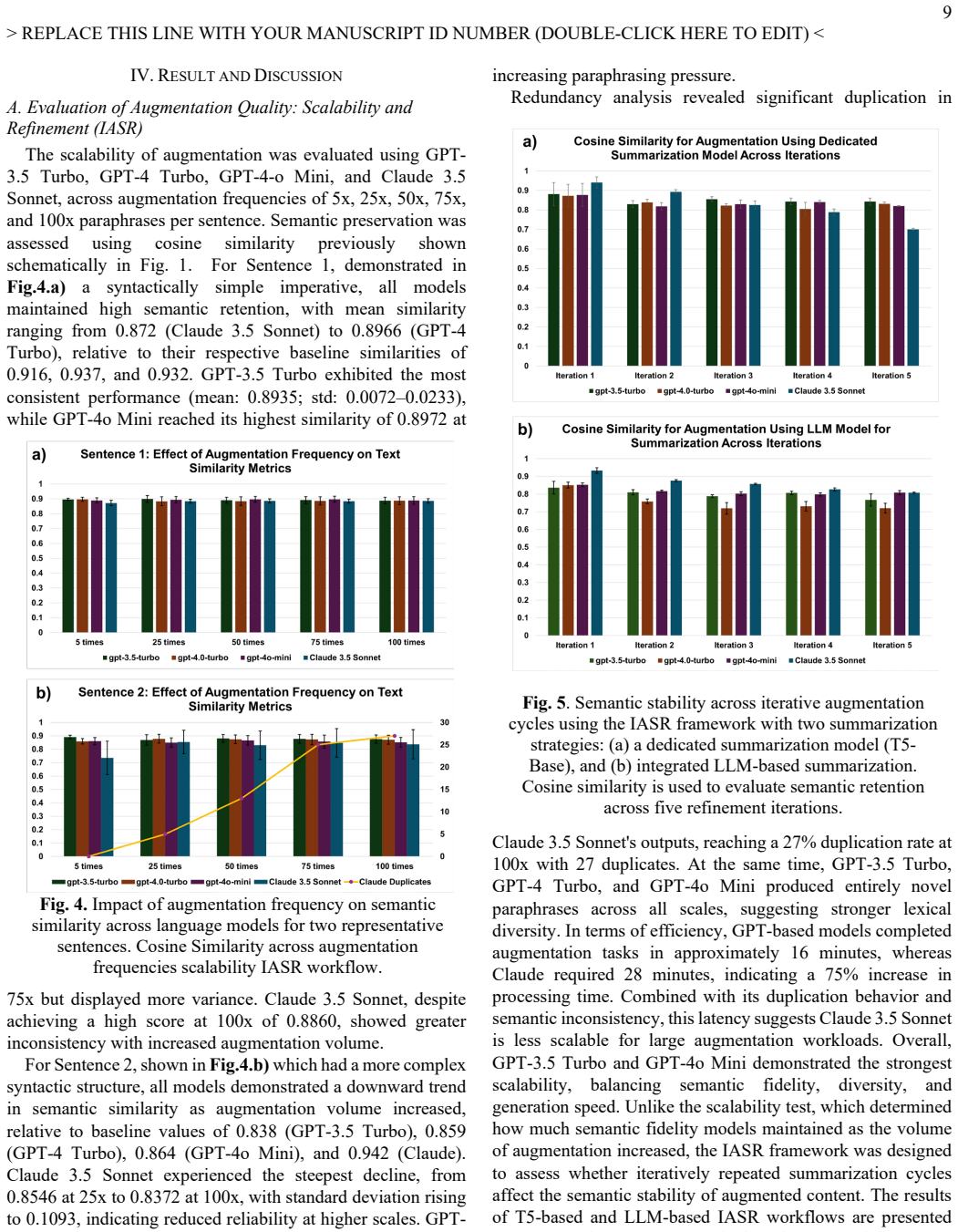
The load-bearing mechanism is a cosine-similarity measurement over sentence embeddings, $\cos\theta = \frac{u \cdot v}{\|u\| \|v\|}$, where $u$ is the embedding of the original response and $v$ is the embedding of the augmented text, computed with a BERT-based sentence encoder. Around that measurement the paper builds two diagnostics: Scalability Analysis, which varies the number of paraphrases per sentence and tracks mean similarity and standard deviation, and IASR, which cycles through paraphrase, summarization by T5-Base or by the generating LLM itself, and re-augmentation across five iterations to expose cumulative semantic drift. These diagnostics are used to select the augmentation model, and the selected model feeds a downstream pipeline of BERTopic clustering plus GPT few-shot labeling in which labeling is described as a post-processing step that names the discovered clusters.
What would settle it
Recompute all five metrics in Table III from the same document-to-cluster assignments before and after applying GPT labeling; if the numbers are identical, the reported gains are an artifact of measuring label text rather than topic structure.
Extended reading notes
Core claim
On the paper's own terms, the central discovery is a complementarity result about two interventions. Data augmentation alone makes topic structure finer but messier: BERTopic on augmented data finds 28 topics with coherence 0.505 but leaves a topic overlap of 0.041. GPT-based few-shot labeling alone removes overlap and pushes coherence to 0.510, but the model can only extract 4 broad topics. The combined pipeline, BERTopic with GPT labeling on GPT-3.5 Turbo augmented data, produces 20 well-separated topics with coherence 0.526, intra-topic similarity 0.518, inter-topic distance 0.650, and zero overlap. The paper interprets this as evidence that augmentation supplies the lexical coverage that sparse data lacks, while GPT labeling supplies the semantic structuring that raw clustering misses, and that the two effects are complementary rather than redundant.
Load-bearing premise
The headline comparison assumes that adding GPT-generated labels to already-formed BERTopic clusters can change the reported coherence, diversity, overlap, and intra/inter-topic distance metrics, even though labeling is described as a post-processing step that does not reassign documents or reshape clusters.
Editorial extensions
If this is right
- Augmentation quality is model-dependent, and static similarity is not enough: the two diagnostics reveal that Claude 3.5 Sonnet drifts sharply at high volume and under external summarization, so results should be checked before selecting an augmentation model.
- Topic count alone is not a reliable success metric: augmentation alone produced 28 but overlapping topics, while GPT labeling alone produced 4 clean but broad topics; downstream structure metrics are needed.
- A practical recipe for sparse survey text is to augment each response three times with a high-fidelity LLM, cluster with BERTopic, and apply GPT few-shot labeling, which on this corpus yields 20 separated topics.
- The two evaluation frameworks are model-agnostic and can be rerun on any future LLM to compare semantic fidelity, diversity, and speed before deployment.
Reading between the lines
- Because GPT labeling is described as post-processing that assigns names to existing BERTopic clusters, the reported changes in coherence, overlap, and other cluster-level metrics between BERTopic-only and BERTopic+GPT rows are the part of the paper most worth probing; recomputing the five Table III metrics on fixed cluster assignments before and after labeling would settle whether the gains come f
- The two diagnostics transfer naturally to other sparse-text settings, such as clinical notes, incident reports, and customer feedback, where the paper's future-work list already points; a useful test is whether the same optimal augmentation multiplier and GPT-3.5 Turbo ranking appear in those domains.
- The 400% topic-count gain is relative to a baseline of 5 topics on this survey; the durable claim is the evaluation method and the complementarity pattern, not a universal expectation of exactly 20 topics.
Editorial analysis
A structured set of objections, weighed in public.
Referee Report
Summary. The paper introduces two evaluation frameworks for LLM-based text augmentation: Scalability Analysis, which measures semantic consistency as augmentation volume increases, and Iterative Augmentation with Summarization Refinement (IASR), which evaluates semantic drift across recursive paraphrasing and summarization cycles. Four LLMs (GPT-3.5 Turbo, GPT-4 Turbo, GPT-4o Mini, Claude 3.5 Sonnet) are compared on these diagnostics, and GPT-3.5 Turbo is selected as the best performer. The selected model is then used to augment open-ended survey responses, and topic modeling is performed with BERTopic with and without GPT few-shot labeling under four ablation configurations. The paper claims a 400% increase in topic granularity, complete elimination of topic overlap, and improved coherence, diversity, and separation for the combined augmentation-plus-GPT-labeling pipeline.
Significance. If the central claims were supported, the IASR/Scalability framework would be a useful and reasonably general diagnostic for LLM-based augmentation, and the code release at the provided GitHub repository is a positive step for reproducibility. The qualitative comparison in Table I and the two-sentence scalability study are also potentially informative. However, the paper's headline results are undermined by internal arithmetic inconsistencies and by an ablation design in which the GPT labeling step, described as post-hoc label assignment, is credited with changing cluster-level metrics. The central quantitative claim is therefore not supported by the paper's own methodology and numbers.
major comments (4)
- [Section III-C, Table III] GPT few-shot learning is described in Section III-C as a post-processing step that assigns names to existing BERTopic clusters. Such a step cannot change cluster assignments, so it cannot change topic count, topic overlap, intra-topic similarity, or inter-topic distance. Table III nevertheless reports that GPT labeling changes the number of topics from 28 to 20 on augmented data (and from 5 to 4 on non-augmented data) and reduces overlap from 0.041 to 0.000. Either the GPT step performs undocumented re-clustering or merging, or the metrics are computed on label text rather than on document/topic structure. Both possibilities invalidate the reported ablation, and this ablation is the entire basis for the '400% granularity and zero overlap' headline claim.
- [Abstract, Conclusion, Fig. 6, Table III] The headline '400% increase in topic granularity' is arithmetically inconsistent with the paper's own numbers: Table III gives 5 baseline topics and 20 final topics, which is a 300% increase (20 is 400% of 5). Fig. 6(a) and the accompanying text report 25 coherent topics for the best configuration, while Table IV lists 20 topics. Because the central quantitative claim shifts between 20, 25, and 400%, the paper's main result is not reproducible from the reported tables.
- [Table V] The paired t-test in Table V is not valid for the stated comparison. The comparison is 'augmented vs non-augmented' but the sets of topics are not paired: Table III shows 5 vs 20 (or 4 vs 20) topics with different cluster structures, so per-topic metric pairs do not exist. Furthermore, Table V's means (e.g., coherence 0.552 for non-augmented) do not match Table III's values (0.469 baseline), and the test does not account for multiple runs or seed variability. The statistical support for the topic-modeling claims therefore cannot be interpreted as reported.
- [Section IV.A, Table II] The selection of GPT-3.5 Turbo as 'best' rests on descriptive statistics with no error bars or significance tests, and some reported numbers are internally inconsistent. Section IV.A reports that Claude 3.5 Sonnet declined to 0.7008 by iteration 5 in T5-based IASR, with a standard deviation of 0.1002, but Table II lists its IASR T5 CV as 2%, which cannot both be true. The efficiency claims also differ: contribution 2 says GPT-3.5 Turbo is '40% faster' than Claude, while Section IV.A says Claude required 'a 75% increase in processing time,' which are different quantifications (42.9% vs 75%) of the same 16-vs-28-minute comparison. The ranking should be supported by repeated runs and consistent reporting.
minor comments (5)
- [Table III] The table header contains a typo: 'Intra-Topic Simialrity' should be 'Intra-Topic Similarity'.
- [Fig. 6] The caption says 'on-augmented condition'; this should be 'non-augmented condition'.
- [References] Reference [59], cited for Jaccard similarity, is Steyvers and Griffiths' probabilistic topic models; the Jaccard index should be cited directly rather than through this reference.
- [Introduction] The n-gram diversity scores for fastText and GloVe (0.096 and 0.097) are presented without a table or details of how they were computed, which limits reproducibility.
- [Page 1 and References] The manuscript contains production-placeholder text at the top of page 1 ('REPLACE THIS LINE WITH YOUR MANUSCRIPT ID NUMBER') and in the reference list for [17] and [18], indicating the draft is not yet in final publication form.
Circularity Check
Headline zero-overlap result is built into the GPT label-assignment procedure; the reported 400% granularity gain is arithmetically and methodologically unsupported.
-
self definitional
[Section III-C ('Application to Topic Modeling and Impact Analysis') and Table III]
"To enhance the quality of topic labels, a GPT-based few-shot learning method was used as a post-processing step. ... Topic overlap, as formulated by the Jaccard similarity [59], was evaluated to assess lexical redundancy among topics. ... BERTopic + GPT on Augmented Data ... Topic Overlap 0"
The GPT step is explicitly a post-processing label-assignment step that names existing BERTopic clusters; it does not reassign documents or change cluster geometry. Table III attributes a drop in Topic Overlap from 0.041 to 0.000 and a change in topic count from 28 to 20 to this labeling step. Since Topic Overlap is defined as Jaccard lexical overlap between topics and the GPT labels are unique two-to-five-word phrases, zero lexical overlap follows by construction from the uniqueness of the assigned labels.
-
self definitional
[Section V, Conclusion and Future Work]
"Despite these gains, the augmentation process lacked explicit control mechanisms, relying instead on template-driven prompting and post-hoc filtering via semantic similarity."
The paper's model-comparison and scalability/IASR evaluations use mean cosine similarity between original and augmented text as the measure of semantic fidelity. This conclusion states that the augmentation process relied on post-hoc filtering via semantic similarity. Filtering generated texts by closeness to the original and then reporting the cosine similarity of the surviving texts as the model's semantic-preservation score makes the reported fidelity an artifact of the filter rather than an independent measurement. The selection of GPT-3.5 Turbo as the best-balance model is therefore at least partly forced by the same similarity criterion used to construct the evaluated sample.
full rationale
The core augmentation-quality comparison (Scalability and IASR) is not inherently circular: cosine similarity is a standard external metric, and comparing four LLMs on it is a legitimate empirical evaluation. No self-citation chain is load-bearing in this paper. The circularity is concentrated in the downstream topic-modeling claim. Section III-C describes GPT few-shot labeling as a post-processing step that only assigns names to existing BERTopic clusters; Table III nevertheless credits this step with changing topic count and overlap. Zero overlap is guaranteed when unique labels are compared by Jaccard similarity, so the abstract's 'complete elimination of topic overlaps' is definitional, not a discovered property. In addition, the conclusion's admission of post-hoc filtering by semantic similarity means the augmentation-fidelity metrics may be partly self-confirming. The paper also contains independent non-circular inconsistencies: 5 to 20 topics is a 300% increase, not 400%, and Fig. 6 reports 25 topics where Table III reports 20; these are arithmetic or reporting errors rather than circularity. Overall, the central '400% granularity + zero overlap' result is partially built into the procedure, so the score is 6 rather than 0; the augmentation evaluation frameworks themselves retain independent empirical content.
Assumptions & free parameters
free parameters (5)
- Augmentation scale levels =
5x, 25x, 50x, 75x, 100x
- IASR iteration count =
5
- Augmentation factor for topic modeling =
3x
- Semantic similarity filtering threshold =
Not specified
- BERTopic hyperparameters =
Not specified
assumptions (5)
- domain assumption Cosine similarity between sentence embeddings is a valid measure of semantic preservation across paraphrases.
- domain assumption Two hand-picked responses are representative of the survey corpus for scalability analysis.
- domain assumption GPT-generated topic labels, applied post hoc, can alter topic coherence, diversity, and inter-topic distance.
- domain assumption Topics from different BERTopic runs can be paired for a paired t-test.
- domain assumption Paraphrasing open-ended survey responses preserves or improves latent topic structure.
Cite this review
Pith. "Pith review of Iterative Augmentation with Summarization Refinement (IASR) Evaluation for Unstructured Survey data Modeling and Analysis." pith.science (2026). https://pith.science/paper/46XSRMTT
@misc{pith2026250712126,
  author       = {Pith},
  title        = {Pith review of: Iterative Augmentation with Summarization Refinement (IASR) Evaluation for Unstructured Survey data Modeling and Analysis},
  year         = {2026},
  howpublished = {\url{https://pith.science/paper/46XSRMTT}},
  note         = {Machine review of arXiv:2507.12126}
}
read the original abstract
Text data augmentation is a widely used strategy for mitigating data sparsity in natural language processing (NLP), particularly in low-resource settings where limited samples hinder effective semantic modeling. While augmentation can improve input diversity and downstream interpretability, existing techniques often lack mechanisms to ensure semantic preservation during large-scale or iterative generation, leading to redundancy and instability. This work introduces a principled evaluation framework for large language model (LLM) based text augmentation, comprising two components: (1) Scalability Analysis, which measures semantic consistency as augmentation volume increases, and (2) Iterative Augmentation with Summarization Refinement (IASR), which evaluates semantic drift across recursive paraphrasing cycles. Empirical evaluations across state-of-the-art LLMs show that GPT-3.5 Turbo achieved the best balance of semantic fidelity, diversity, and generation efficiency. Applied to a real-world topic modeling task using BERTopic with GPT-enhanced few-shot labeling, the proposed approach results in a 400% increase in topic granularity and complete elimination of topic overlaps. These findings validated the utility of the proposed frameworks for structured evaluation of LLM-based augmentation in practical NLP pipelines.
Figures


Figures from the paper (1 more)

Reference graph
Works this paper leans on
-
[1]
This work introduces two novel evaluation frameworks for LLM-based text augmentation: Scalability Analysis, which quantifies semantic preservation across increasing augmentation volumes, and Iterative Augmentation with Summarization Refinement (IASR), which evaluate s semantic stability through successive iterations
-
[2]
A systematic comparison of four state -of-the-art LLMs for text augmentation reveals GPT-3.5 Turbo as providing the optimal balance between semantic preservation of 0.855 similarity and computational efficiency, requiring only 16 minutes to generate 100 augmentations per sentence, 40% faster than Claude 3.5 Sonnet, which took 28 minutes for the same task
-
[3]
A hybrid pipeline that combines LLM -driven augmentation with BERTopic and few -shot GPT topic labeling, achieving a 400% increase in topic granularity, with coherence of 0.526 preserved and topic overlap eliminated. This study systematically benchmarks four state -of-the-art large language models using the proposed evaluation methodologies to assess the ...
-
[4]
Blei DM, Lafferty JD. Topic models. InText mining 2009 Jun 15 (pp. 101- 124). Chapman and Hall/CRC
work page 2009
-
[5]
Q. Wang and B. Ma, "Enhancing BERTopic with Pre-Clustered Knowledge: Reducing Feature Sparsity in Short Text Topic Modeling," Journal of Data Analysis and Information Processing, vol. 12, no. 4, pp. 597-611, 2024
work page 2024
-
[6]
Natural language processing: state of the art, current trends and challenges,
D. Khurana, A. Koli, K. Khatter, and S. Singh, "Natural language processing: state of the art, current trends and challenges," Multimedia Tools and Applications, vol. 82, no. 3, pp. 3713- 3744, 2023/01/01 2023, doi: 10.1007/s11042-022-13428-4
-
[7]
A survey on sentiment analysis methods, applications, and challenges,
M. Wankhade, A. C. S. Rao, and C. Kulkarni, "A survey on sentiment analysis methods, applications, and challenges," Artificial Intelligence Review, vol. 55, no. 7, pp. 5731- 5780, 2022/10/01 2022, doi: 10.1007/s10462- 022- 10144-1
doi:10.1007/s10462- 2022
-
[8]
A complete process of text classification system using state‐of‐the‐art NLP models
Dogra V, Verma S, Kavita, Chatterjee P, Shafi J, Choi J, Ijaz MF. A complete process of text classification system using state‐of‐the‐art NLP models. Computational Intelligence and Neuroscience. 2022;2022(1):1883698
work page 2022
Show all 63 references
-
[9]
Topic Modeling for Small Data using Generative LLMs
C. van Wanrooij, O. K. Manhar, and J. Yang, "Topic Modeling for Small Data using Generative LLMs."
-
[10]
An empirical survey of data augmentation for limited data learning in NLP,
J. Chen, D. Tam, C. Raffel, M. Bansal, and D. Yang, "An empirical survey of data augmentation for limited data learning in NLP," Transactions of the Association for Computational Linguistics, vol. 11, pp. 191-211, 2023
2023
-
[11]
Building the Bridge: Topic Modeling for Comparative Research,
F. Lind, E. Jakob -Moritz, E. Olga, H. Tobias, G. Sebastian, and H. G. and Boomgaarden, "Building the Bridge: Topic Modeling for Comparative Research," Communication Methods and Measures, vol. 16, no. 2, pp. 96- 114, 2022/04/03 2022, doi: 10.1080/19312458.2021.1965973
2022
-
[12]
Latent dirichlet allocation,
D. M. Blei, A. Y. Ng, and M. I. Jordan, "Latent dirichlet allocation," Journal of machine Learning research, vol. 3, no. Jan, pp. 993-1022, 2003
2003
-
[13]
Topic modeling for the social sciences,
D. Ramage, E. Rosen, J. Chuang, C. D. Manning, and D. A. McFarland, "Topic modeling for the social sciences," in NIPS 2009 workshop on applications for topic models: text and beyond, 2009, vol. 5, no. 27, pp. 1-4
2009
-
[14]
Fasttext. zip: Compressing text classification models,
A. Joulin, E. Grave, P. Bojanowski, M. Douze, H. Jégou, and T. Mikolov, "Fasttext. zip: Compressing text classification models," arXiv preprint arXiv:1612.03651, 2016
2016 arXiv
-
[15]
Glove: Global vectors for word representation,
J. Pennington, R. Socher, and C. D. Manning, "Glove: Global vectors for word representation," in Proceedings of the 2014 conference on empirical methods in natural language processing (EMNLP), 2014, pp. 1532-1543
2014
-
[16]
Text data augmentation and pre-trained Language Model for enhancing text classification of low-resource languages,
A. Ziyaden, A. Yelenov, F. Hajiyev, S. Rustamov, and A. Pak, "Text data augmentation and pre-trained Language Model for enhancing text classification of low-resource languages," PeerJ Computer Science, vol. 10, p. e1974, 2024
2024
-
[17]
Data expansion using back translation and paraphrasing for hate speech detection,
D. R. Beddiar, M. S. Jahan, and M. Oussalah, "Data expansion using back translation and paraphrasing for hate speech detection," Online Social Networks and Media, vol. 24, p. 100153, 2021/07/01/ 2021, doi: https://doi.org/10.1016/j.osnem.2021.100153
2021
-
[18]
Eda: Easy data augmentation techniques for boosting performance on text classification tasks,
J. Wei and K. Zou, "Eda: Easy data augmentation techniques for boosting performance on text classification tasks," arXiv preprint arXiv:1901.11196, 2019
1901 arXiv
-
[19]
ChatGPT to Replace Crowdsourcing of Paraphrases for Intent Classification: Higher Diversity and Comparable Model Robustness,
J. Cegin, J. Simko, and P. Brusilovsky, "ChatGPT to Replace Crowdsourcing of Paraphrases for Intent Classification: Higher Diversity and Comparable Model Robustness," Singapore, December 2023: Association for Computational Linguistics, in Proceedings of th e 2023 Conference on...
2023 doi
-
[21]
Semantic Drift in Multilingual Representations,
L. Beinborn and R. Choenni, "Semantic Drift in Multilingual Representations," Computational Linguistics, vol. 46, no. 3, pp. 571-603, 2020, doi: 10.1162/coli_a_00382
2020 doi
-
[22]
GPT-4o mini: advancing cost -efficient intelligence
OpenAI, "GPT-4o mini: advancing cost -efficient intelligence." [Online]. Available: https://openai.com/index/gpt- 4o-mini-advancing-cost-efficient- intelligence/
-
[23]
Claude 3.5 Sonnet
C. Sonnet, "Claude 3.5 Sonnet." [Online]. Available: https://www.anthropic.com/news/claude-3-5-sonnet
-
[24]
Identifying Citizen-Related Issues from Social Media Using LLM -Based Data Augmentation,
V. G. dos Santos, G. L. Santos, T. Lynn, and B. Benatallah, "Identifying Citizen-Related Issues from Social Media Using LLM -Based Data Augmentation," Cham, 2024: Springer Nature Switzerland, in Advanced Information Systems Engineering, pp. 531-546
2024
-
[25]
Exploring ChatGPT- Based Augmentation Strategies for Contrastive Aspect- Based Sentiment Analysis,
L. Xu, H. Xie, S. J. Qin, F. L. Wang, and X. Tao, "Exploring ChatGPT- Based Augmentation Strategies for Contrastive Aspect- Based Sentiment Analysis," IEEE Intelligent Systems, vol. 40, no. 1, pp. 69- 76, 2025, doi: 10.1109/MIS.2024.3508432
2025
-
[26]
Evaluating large language models for health -related text classification tasks with public social media data,
Y. Guo, A. Ovadje, M. A. Al -Garadi, and A. Sarker, "Evaluating large language models for health -related text classification tasks with public social media data," Journal of the American Medical Informatics Association, vol. 31, no. 10, pp. 2181-2189, 2024, doi: 10.1093/jamia/ocae210
2024 doi
-
[27]
ChatGPT Label: Comparing the Quality of Human-Generated and LLM -Generated Annotations in Low -Resource Language NLP Tasks,
A. H. Nasution and A. Onan, "ChatGPT Label: Comparing the Quality of Human-Generated and LLM -Generated Annotations in Low -Resource Language NLP Tasks," IEEE Access, vol. 12, pp. 71876- 71900, 2024, doi: 10.1109/ACCESS.2024.3402809
2024
-
[28]
Leveraging Large Language Models for Code -Mixed Data Augmentation in Sentiment Analysis,
L. Zeng, "Leveraging Large Language Models for Code -Mixed Data Augmentation in Sentiment Analysis," arXiv preprint arXiv:2411.00691, 2024
2024
-
[29]
primarily measure surface-level lexical overlap, failing to capture semantic equivalence when paraphrased expressions retain the same meaning. A m ore robust evaluation using contextual embeddings, such as cosine similarity with Sentence-BERT [30], offers better semantic align...
-
[30]
Sentence- bert: Sentence embeddings using siamese bert-networks,
N. Reimers and I. Gurevych, "Sentence- bert: Sentence embeddings using siamese bert-networks," arXiv preprint arXiv:1908.10084, 2019. 4 > REPLACE THIS LINE WITH YOUR MANUSCRIPT ID NUMBER (DOUBLE-CLICK HERE TO EDIT) <
1908 arXiv
-
[31]
Auggpt: Leveraging chatgpt for text data augmentation
Dai H, Liu Z, Liao W, Huang X, Cao Y, Wu Z, Zhao L, Xu S, Zeng F, Liu W, Liu N. Auggpt: Leveraging chatgpt for text data augmentation. IEEE Transactions on Big Data. 2025 Jan 30
2025
-
[32]
LLM -powered data augmentation for enhanced cross -lingual performance,
C. Whitehouse, M. Choudhury, and A. F. Aji, "LLM -powered data augmentation for enhanced cross -lingual performance," arXiv preprint arXiv:2305.14288, 2023
2023 arXiv
-
[33]
Bleu: a method for automatic evaluation of machine translation,
K. Papineni, S. Roukos, T. Ward, and W. -J. Zhu, "Bleu: a method for automatic evaluation of machine translation," in Proceedings of the 40th annual meeting of the Association for Computational Linguistics, 2002, pp. 311-318
2002
-
[34]
Rouge: A package for automatic evaluation of summaries,
C.-Y. Lin, "Rouge: A package for automatic evaluation of summaries," in Text summarization branches out, 2004, pp. 74-81
2004
-
[35]
Synthetic and natural noise both break neural machine translation,
Y. Belinkov and Y. Bisk, "Synthetic and natural noise both break neural machine translation," arXiv preprint arXiv:1711.02173, 2017
2017 arXiv
-
[36]
Statistical Uncertainty in Word Embeddings: GloVe- V,
A. Vallebueno, C. Handan -Nader, C. D. Manning, and D. E. Ho, "Statistical Uncertainty in Word Embeddings: GloVe- V," Miami, Florida, USA, November 2024: Association for Computational Linguistics, in Proceedings of the 2024 Conference on Empirical Methods in Natural Language P...
2024 doi
-
[37]
Summit: Iterative text summarization via chatgpt,
H. Zhang, X. Liu, and J. Zhang, "Summit: Iterative text summarization via chatgpt," arXiv preprint arXiv:2305.14835, 2023
2023 arXiv
-
[38]
Prompt chaining or stepwise prompt? refinement in text summarization,
S. Sun, R. Yuan, Z. Cao, W. Li, and P. Liu, "Prompt chaining or stepwise prompt? refinement in text summarization," in Findings of the Association for Computational Linguistics ACL 2024, 2024, pp. 7551-7558
2024
-
[39]
Text data augmentation for deep learning,
C. Shorten, T. M. Khoshgoftaar, and B. Furht, "Text data augmentation for deep learning," Journal of big Data, vol. 8, no. 1, p. 101, 2021
2021
-
[40]
Bert: Pre-training of deep bidirectional transformers for language understanding,
J. Devlin, M.-W. Chang, K. Lee, and K. Toutanova, "Bert: Pre-training of deep bidirectional transformers for language understanding," in Proceedings of the 2019 conference of the North American chapter of the association for computational linguistics: human language technologi...
2019
-
[41]
WordNet: a lexical database for English,
G. A. Miller, "WordNet: a lexical database for English," Communications of the ACM, vol. 38, no. 11, pp. 39-41, 1995
1995
-
[42]
Efficient estimation of word representations in vector space,
T. Mikolov, "Efficient estimation of word representations in vector space," arXiv preprint arXiv:1301.3781, vol. 3781, 2013
2013 arXiv
-
[43]
From word to sense embeddings: A survey on vector representations of meaning,
J. Camacho -Collados and M. T. Pilehvar, "From word to sense embeddings: A survey on vector representations of meaning," Journal of Artificial Intelligence Research, vol. 63, pp. 743-788, 2018
2018
-
[44]
Generating natural language adversarial examples,
M. Alzantot, Y. Sharma, A. Elgohary, B.-J. Ho, M. Srivastava, and K.-W. Chang, "Generating natural language adversarial examples," arXiv preprint arXiv:1804.07998, 2018
2018 arXiv
-
[45]
Training language models to follow instructions with human feedback
Ouyang L, Wu J, Jiang X, Almeida D, Wainwright C, Mishkin P, Zhang C, Agarwal S, Slama K, Ray A, Schulman J. Training language models to follow instructions with human feedback. Advances in neural information processing systems. 2022 Dec 6;35:27730-44
2022
-
[46]
Improving neural machine translation models with monolingual data,
R. Sennrich, B. Haddow, and A. Birch, "Improving neural machine translation models with monolingual data," arXiv preprint arXiv:1511.06709, 2015
2015 arXiv
-
[47]
Improving language understanding by generative pre-training,
A. Radford, K. Narasimhan, T. Salimans, and I. Sutskever, "Improving language understanding by generative pre-training," 2018
2018
-
[48]
Exploring the limits of transfer learning with a unified text- to-text transformer
Raffel C, Shazeer N, Roberts A, Lee K, Narang S, Matena M, Zhou Y, Li W, Liu PJ. Exploring the limits of transfer learning with a unified text- to-text transformer. Journal of machine learning research. 2020;21(140):1-67
2020
-
[49]
Paraphrase the following text:
highlights the connection between dataset size and topic coherence, illustrating how sparsity reduces interpretability. While some research, such as [50], brought pseudo- document simulations to facilitate topic discovery, these are found on statistical synthesis rather than s...
-
[50]
Promptagator: Few- shot dense retrieval from 8 examples
Dai Z, Zhao VY, Ma J, Luan Y, Ni J, Lu J, Bakalov A, Guu K, Hall KB, Chang MW. Promptagator: Few- shot dense retrieval from 8 examples. arXiv preprint arXiv:2209.11755. 2022 Sep 23
2022 arXiv
-
[51]
Data augmentation using llms: Data perspectives, learning paradigms and challenges
Ding B, Qin C, Zhao R, Luo T, Li X, Chen G, Xia W, Hu J, Tuan LA, Joty S. Data augmentation using llms: Data perspectives, learning paradigms and challenges. InFindings of the Association for Computational Linguistics ACL 2024 2024 Aug (pp. 1679-1705)
2024
-
[52]
Optimizing semantic coherence in topic models,
D. Mimno, H. Wallach, E. Talley, M. Leenders, and A. McCallum, "Optimizing semantic coherence in topic models," in Proceedings of the 2011 conference on empirical methods in natural language processing, 2011, pp. 262- 272
2011
-
[53]
BERTopic: Neural topic modeling with a class -based TF-IDF procedure,
M. Grootendorst, "BERTopic: Neural topic modeling with a class -based TF-IDF procedure," arXiv preprint arXiv:2203.05794, 2022
2022 arXiv
-
[54]
Full- text or abstract? examining topic coherence scores using latent dirichlet allocation,
S. Syed and M. Spruit, "Full- text or abstract? examining topic coherence scores using latent dirichlet allocation," in 2017 IEEE International conference on data science and advanced analytics (DSAA), 2017: Ieee, pp. 165-174
2017
-
[55]
A joint model of conversational discourse and latent topics on microblogs,
J. Li, Y. Song, Z. Wei, and K.-F. Wong, "A joint model of conversational discourse and latent topics on microblogs," Computational Linguistics, vol. 44, no. 4, pp. 719-754, 2018
2018
-
[56]
Few -Shot Data Synthesis for Open Domain Multi- Hop Question Answering,
M. Chen, X. Chen, and W. -t. Yih, "Few -Shot Data Synthesis for Open Domain Multi- Hop Question Answering," arXiv e- prints, p. arXiv: 2305.13691, 2023
2023 arXiv
-
[57]
Minilm: Deep self-attention distillation for task -agnostic compression of pre -trained transformers,
W. Wang, F. Wei, L. Dong, H. Bao, N. Yang, and M. Zhou, "Minilm: Deep self-attention distillation for task -agnostic compression of pre -trained transformers," Advances in neural information processing systems, vol. 33, pp. 5776-5788, 2020
2020
-
[58]
Claude 3.5 Sonnet vs GPT-4o,
A. Kirkovska, "Claude 3.5 Sonnet vs GPT-4o," ed. vellum: vellum, 2024
2024
-
[59]
GPT-4o Mini vs. Claude 3.5 Sonnet: A Detailed Comparison for Developers,
L. Lam, "GPT-4o Mini vs. Claude 3.5 Sonnet: A Detailed Comparison for Developers," ed. helicone, 2025
2025
-
[60]
Claude 3.5 Sonnet vs. GPT -4o and GPT -4o mini — key differences,
K. Luzniak, "Claude 3.5 Sonnet vs. GPT -4o and GPT -4o mini — key differences," ed, 2024
2024
-
[61]
Cosine similarity and its applications in the domains of artificial intelligence,
D. Oniani, "Cosine similarity and its applications in the domains of artificial intelligence," 2020
2020
-
[62]
A comprehensive survey of text classification techniques and their research applications: Observational and experimental insights,
K. Taha, P. D. Yoo, C. Yeun, D. Homouz, and A. Taha, "A comprehensive survey of text classification techniques and their research applications: Observational and experimental insights," Computer Science Review, vol. 54, p. 100664, 2024/11/01/2024, doi: https://doi.org/10.1016/...
2024
-
[63]
Scaling up all pairs similarity search,
R. J. Bayardo, Y. Ma, and R. Srikant, "Scaling up all pairs similarity search," in Proceedings of the 16th international conference on World Wide Web, 2007, pp. 131-140
2007
-
[64]
Probabilistic topic models,
M. Steyvers and T. Griffiths, "Probabilistic topic models," in Handbook of latent semantic analysis: Psychology Press, 2007, pp. 439-460. Payal Bhattad received the BE degree in Information Technology from Yeshwantrao Chavan College of Engineering, Nagpur, India, in 2016 and t...
2007
Reviewed August 6, 2026 · model on record in the stance chip above.
Discussion (0). Sign in to comment.