REVIEW 3 major objections 5 minor 39 references
ReasonCast: Towards Explainable Time Series Forecasting with Reasoning
T0 review · 3 major / 5 minor · reviewed 2026-08-04 · deepseek-v4-flash
Pith's one-line read ReasonCast trains one LLM to forecast and explain a time series in a single pass.
desk verdict The UxG framing and ReasonTS-Bench are genuinely useful, but the main forecast-accuracy claim is undercut by a missing fine-tuned-no-reasoning control. read the letter →
The pith
A machine-rendered reading of the paper's core claim, the machinery that carries it, and where it could break.
The reading
What carries the argument
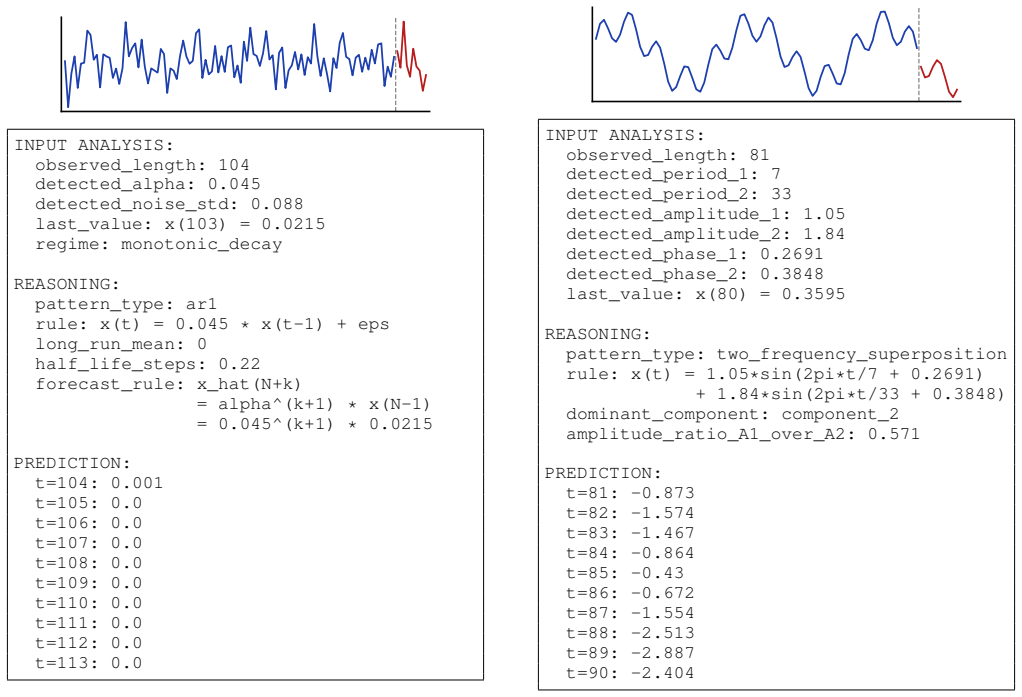
The load-bearing identity is the factorization p(forecast, reasoning | input) = p(reasoning | input) · p(forecast | reasoning, input), realized as a single autoregressive LLM pass: first an input-analysis block, then a reasoning block that states the detected pattern and parameters, then a numeric prediction block. The benchmark supplies verifiable ground-truth reasoning for five primitives (periodicity, trend, temporal dependence, multi-periodicity, structural break) plus no-pattern sets, and four metrics score forecast and reasoning jointly.
What would settle it
Find a real-world time-series window whose embedding falls outside the five-primitive region (or an explicit composition of primitives), run ReasonCast on it, and show the model either routes it to the wrong pattern or forecasts worse than a simple linear extrapolation; that would break the sufficiency premise on which the benchmark's transferability rests.
Extended reading notes
Core claim
The paper's central claim is that understanding and generation can be fused: a single LLM, fine-tuned with ReasonCast, emits a structured reasoning chain and the numeric forecast conditioned on it in one autoregressive pass, so the explanation causally guides the prediction rather than justifying it post hoc. On ReasonTS-Bench, this fused model beats both task-separated LLMs and specialized TS forecasters in forecast error while scoring high on three reasoning metrics: fidelity (estimated parameters match ground truth), consistency (the forecast obeys the model's own stated rule), and sensitivity (the reasoning tracks a counterfactual change in one generative parameter).
Load-bearing premise
The five primitives are sufficient to cover the structure of real-world time series, so performance and reasoning quality measured on ReasonTS-Bench transfer to real data; the benchmark's own evidence for this is a visual overlap in an embedding plot, not a coverage guarantee.
Editorial extensions
If this is right
- A single LLM can be trained to both forecast and explain in one coherent output, outperforming task-separated models on forecast accuracy.
- Reasoning-first ordering is essential; swapping the order degrades fidelity and consistency, showing the reasoning grounds the forecast rather than merely accompanying it.
- Joint training on five primitives beats five single-pattern specialists, so routing between patterns is learned rather than externally selected.
- The model can flag unfamiliar inputs as no-pattern and extrapolate the recent trend, transferring to held-out out-of-distribution processes better than baselines.
- Reasoning metrics (fidelity, consistency, sensitivity) can be computed automatically from ground-truth generative parameters and counterfactual pairs, enabling joint evaluation.
Reading between the lines
- If the five primitives are truly compositional, the same recipe should extend to chains that explain compositions (e.g., trend plus changepoint plus noise), which the paper names as future work but does not evaluate; testing on such compositions is a natural next step.
- The counterfactual sensitivity metric could be turned into a training signal—encouraging the model to shift exactly the intervened field—rather than only an evaluation probe, potentially tightening causal grounding further.
- The no-pattern fallback suggests a calibration use: the model's routed pattern confidence could double as an uncertainty estimate for the forecast, letting users know when the forecast is extrapolation rather than pattern-based.
- Because the benchmark is synthetic, a natural extension is to generate reasoning targets from real datasets via fitted parametric models (e.g., fitted AR or seasonal decompositions) and test whether the same recipe improves explainability on natural series.
Editorial analysis
A structured set of objections, weighed in public.
Referee Report
Summary. The paper proposes a fourth task axis for time-series models, Understanding×Generation (U×G), in which a single model produces both a natural-language reasoning chain and a numeric forecast in one autoregressive pass, following the factorization pθ(o_gen, o_rsn | X) = pθ(o_rsn | X) · pθ(o_gen | o_rsn, X). The authors introduce ReasonTS-Bench, a synthetic benchmark built on five primitives (Sine, Trend, AR(1), Multi-freq, Changepoint), plus Unknown and OOD-novel sets, with closed-form ground-truth reasoning chains and four metrics: Error, Fidelity, Consistency, and Sensitivity. They present ReasonCast, a fine-tuning recipe applied to several LLM backbones, and report that it improves both forecast error and reasoning metrics over few-shot LLM baselines and specialized TS models. Ablations address output order, reasoning-content corruption, explicit vs. implicit routing, joint vs. separate training, and counterfactual sensitivity. A short qualitative application to four real-world datasets is included.
Significance. The benchmark is a useful contribution: it is the first TS benchmark we know of that pairs forecasts with step-verifiable reasoning chains and scores them jointly, and the recipe demonstrates that a single LLM can be trained to emit a structured reasoning chain and a forecast in one coherent output. The controlled synthetic setup allows clean ablations of order, content, routing, and counterfactual behavior, and the paper includes reproducibility-friendly details: code link, dataset sizes, generative parameter ranges, and per-field tolerances. If the central comparison is made fair, the paper would provide a solid foundation for studying explainable TS forecasting. The external-validity claims are weaker: the sufficiency of the five primitives for real-world coverage rests on a t-SNE visualization and a qualitative figure, and the 'causal reasoning' claim is stated more strongly than the counterfactual metric supports.
major comments (3)
- [Section 5.1, Tables 5 and 6; Appendix F.1] The main comparison confounds the reasoning recipe with fine-tuning. The 'w/o ReasonCast' LLM rows in Table 5 are explicitly few-shot (caption: 'The Axis 3 rows give each backbone few-shot examples'), while the 'w/ ReasonCast' rows are fully fine-tuned. Appendix F.1 states that each LLM is evaluated both few-shot and fine-tuned, and it describes a Numeric-only SFT control trained to emit only the PREDICTION block, but no fine-tuned no-reasoning results and no Numeric-only SFT numbers appear in Tables 5 or 6 or elsewhere. The order and content ablations (Tables 7 and 11) compare models that both emit reasoning, so they do not isolate the contribution of reasoning relative to fine-tuning. This is load-bearing for the headline claim that ReasonCast 'outperforms ... LLMs on prediction accuracy.' Please report the missing matched controls.
- [Section 4, Appendix B.4, Eq. (7)-(8), Table 8] The claim of 'verifiable, causal reasoning' (Abstract, Conclusion) is stronger than the Sensitivity/Stability metric establishes. Because the ground-truth reasoning fields are equal to the generative parameters by construction, a model that learns to re-estimate parameters from the input will pass Sensitivity and Stability without implementing any distinct causal mechanism; the probe demonstrates input-tracking, not necessarily causal structure. Please either rephrase the claim to 'intervention-tracking' or add an additional test that separates parameter re-estimation from causal grounding, e.g., intervening on the reasoning field while holding the input fixed.
- [Section 3.1, Figure 2; Section 6] The sufficiency claim for the five primitives ('These five primitives are sufficient and widely used, forming the basis of TS decomposition') is supported only by a t-SNE plot of four real datasets and a qualitative Figure 6. t-SNE overlap is not a coverage guarantee, and no quantitative measure (e.g., fitting the primitives to real windows and reporting fit error or a coverage statistic) is given. Since the benchmark's transferability to real-world data is part of the paper's motivation, either add a quantitative coverage analysis or soften the claim to describe ReasonTS-Bench as a controlled synthetic testbed. The Conclusion's own limitation paragraph supports the softer reading.
minor comments (5)
- [Table 12] The column header 'w/o ReasonCast / w/ ReasonCast / No-pattern / Implicit / Explicit' is visually ambiguous. Please clarify which columns correspond to the routing variants and which rows are 'no-pattern' fallback.
- [Figure 2] Please report the t-SNE settings (perplexity, number of windows, embedding dimension, whether the real windows were normalized) and include a quantitative overlap measure if space permits.
- [Table 16] The entry 'Sep: 19.7x' is unclear; presumably 'Separation: 19.7×'. Please spell out or define.
- [Appendix F.2] The main-text tables use 200 test samples per pattern while Appendix C reports 1,000; Appendix G notes this discrepancy for one table but it is easy to miss. Please state the sample count in every table caption.
- [References] Several references carry 2026 dates and arXiv identifiers, and the manuscript's own arXiv number is 2608.01875. Please verify that these are correct and add access dates if applicable.
Circularity Check
No significant circularity; the central coupling claim is supported by independent ablations, and the benchmark's synthetic labeling is by design rather than a derivation.
full rationale
ReasonCast's derivation chain is not circular. Equation (1) is an identity of conditional probability, not a reduction of the claimed result to its inputs. The benchmark's ground-truth reasoning fields are, by construction, the generative parameters that also produce the forecast targets, so Fidelity and Error are correlated; however, the paper does not rely on that correlation as the sole evidence. The order ablation (Table 7), the reasoning-content ablation (Table 11), and the counterfactual probe (Tables 8 and 21) provide independent tests that the reasoning steers the forecast rather than merely accompanying it. The 'sufficiency of five primitives' claim is supported by external citations (Wold 1938; Cleveland et al. 1990) and a t-SNE plot, not by a self-citation. The FinSTaR citation is the authors' own prior work but appears only in related work and is not load-bearing for ReasonCast's claims. The missing Numeric-only SFT control and the few-shot-versus-fine-tuned comparison in Table 5 are experimental confounds that bear on correctness, not circularity, so they do not raise the circularity score. The paper's stated Limitations section honestly notes the synthetic and univariate scope, which is a scope limitation rather than a circular step.
Assumptions & free parameters
free parameters (3)
- Consistency tolerance tau =
0.1
- Per-field tolerances (af, rf) =
see Table 18
- Generative parameter ranges =
e.g., P in [4,50], A in [0.5,5]
assumptions (4)
- domain assumption The five primitives (periodicity, trend, AR(1), multi-periodicity, structural break) are sufficient and widely used as a basis for time series decomposition
- ad hoc to paper Real-world series lie within the primitive region, as suggested by t-SNE overlap in Figure 2
- ad hoc to paper Counterfactual sensitivity implies causal reasoning
- domain assumption An LLM can recover the generative parameters from tokenized numeric series with sufficient precision
invented entities (1)
-
UxG task axis
independent evidence
Cite this review
Pith. "Pith review of ReasonCast: Towards Explainable Time Series Forecasting with Reasoning." pith.science (2026). https://pith.science/paper/474LN6TF
@misc{pith2026260801875,
  author       = {Pith},
  title        = {Pith review of: ReasonCast: Towards Explainable Time Series Forecasting with Reasoning},
  year         = {2026},
  howpublished = {\url{https://pith.science/paper/474LN6TF}},
  note         = {Machine review of arXiv:2608.01875}
}
read the original abstract
Most time series (TS) models are specialized for a single task, either understanding (i.e., returning text answers about a TS) or generation (i.e., returning a numeric forecast). Only recently have unified models begun to handle the two within a single architecture. Even these models, however, produce the two outputs as task-separated paths and cannot predict a series and explain why that prediction arises within a single coherent response. In this paper, we argue for a task-fused model that jointly produces 1) prediction (generation) and 2) selfexplanation (understanding), thereby integrating 1) numerical TS forecasting and 2) interpretable text reasoning within a single response. To enable the systematic study of this capability, we present both a benchmark and a recipe that jointly address the two tasks. The benchmark, ReasonTS-Bench, identifies five fundamental patterns underlying TS and enables the joint evaluation of both tasks. ReasonCast, our recipe for finetuning any LLM to perform both tasks jointly, yields a model that generates a reasoning chain and a forecast together in a single autoregressive pass. Extensive experiments show that ReasonCast outperforms both LLMs and TS models on prediction accuracy while producing verifiable, causal reasoning. Code is available at: https://github.com/seunghan96/reasoncast.
Figures


Figures from the paper (11 more)



Reference graph
Works this paper leans on
-
[1]
Abdin, M.; Aneja, J.; Awadalla, H.; Awadallah, A.; Awan, A. A.; Bach, N.; et al. 2024. Phi-3 Technical Report: A Highly Capable Language Model Locally on Your Phone. arXiv preprint arXiv:2404.14219
arXiv 2024
-
[2]
Aksu, T.; Woo, G.; Liu, J.; Liu, X.; Liu, C.; Savarese, S.; Xiong, C.; and Sahoo, D. 2024. GIFT-Eval : A Benchmark for General Time Series Forecasting Model Evaluation. arXiv preprint arXiv:2410.10393
arXiv 2024
-
[3]
F.; Stella, L.; Turkmen, C.; Zhang, X.; Mercado, P.; Shen, H.; Shchur, O.; Rangapuram, S
Ansari, A. F.; Stella, L.; Turkmen, C.; Zhang, X.; Mercado, P.; Shen, H.; Shchur, O.; Rangapuram, S. S.; Arango, S. P.; Kapoor, S.; et al. 2024. Chronos: Learning the Language of Time Series. Transactions on Machine Learning Research (TMLR)
2024
-
[4]
L.; Proctor, J
Brunton, S. L.; Proctor, J. L.; and Kutz, J. N. 2016. Discovering Governing Equations from Data by Sparse Identification of Nonlinear Dynamical Systems. Proceedings of the National Academy of Sciences, 113(15): 3932--3937
2016
-
[5]
Chen, J.; Feng, A.; Zhao, Z.; Garza, J.; Nurbek, G.; Qin, C.; Maatouk, A.; Tassiulas, L.; Gao, Y.; and Ying, R. 2025 a . MTBench : A Multimodal Time Series Benchmark for Temporal Reasoning and Question Answering. arXiv preprint arXiv:2503.16858
arXiv 2025
-
[6]
J.; Sun, J.; and Liu, C
Chen, M.; Shen, L.; Li, Z.; Wang, X. J.; Sun, J.; and Liu, C. 2025 b . VisionTS : Visual Masked Autoencoders Are Free-Lunch Zero-Shot Time Series Forecasters. In International Conference on Machine Learning (ICML)
2025
- [7]
-
[8]
B.; Cleveland, W
Cleveland, R. B.; Cleveland, W. S.; McRae, J. E.; and Terpenning, I. 1990. STL : A Seasonal-Trend Decomposition Procedure Based on Loess. Journal of Official Statistics, 6(1): 3--73
1990
Show all 39 references
-
[9]
Cobbe, K.; et al. 2021. Training Verifiers to Solve Math Word Problems. arXiv preprint arXiv:2110.14168
2021 arXiv
-
[10]
Das, A.; Kong, W.; Sen, R.; and Zhou, Y. 2024. A Decoder-Only Foundation Model for Time-Series Forecasting. In International Conference on Machine Learning (ICML)
2024
-
[11]
G.; et al
Gemma Team ; Riviere, M.; Pathak, S.; Sessa, P. G.; et al. 2024. Gemma 2: Improving Open Language Models at a Practical Size. arXiv preprint arXiv:2408.00118
2024 arXiv
-
[12]
I.; Hyndman, R
Godahewa, R.; Bergmeir, C.; Webb, G. I.; Hyndman, R. J.; and Montero-Manso, P. 2021. Monash Time Series Forecasting Archive. In Advances in Neural Information Processing Systems (NeurIPS) Datasets and Benchmarks Track
2021
-
[13]
Grattafiori, A.; Dubey, A.; Jauhri, A.; Pandey, A.; et al. 2024. The Llama 3 Herd of Models. arXiv preprint arXiv:2407.21783
2024 arXiv
-
[14]
H.; et al
Guan, T.; Meng, Z.; Li, D.; Wang, S.; Yang, C.-H. H.; et al. 2026 a . TimeOmni-1 : Incentivizing Complex Reasoning with Time Series in Large Language Models. In International Conference on Learning Representations (ICLR)
2026
-
[15]
Guan, T.; Pan, S.; Barthelemy, J.; Li, Z.; Cai, Y.; Alippi, C.; Jin, M.; and Pan, S. 2026 b . TimeOmni-VL : Unified Models for Time Series Understanding and Generation. In International Conference on Machine Learning (ICML)
2026
-
[16]
C.; Ansari, A
He, Z.; Han, B.; Zhang, X.; Zhang, S.; Lin, H.; Zhu, Q.; Fang, H.; Maddix, D. C.; Ansari, A. F.; Chandrayan, A.; Pradhan, A.; Wang, B.; and Reimherr, M. 2026. SenTSR-Bench : Thinking with Injected Knowledge for Time-Series Reasoning. In International Conference on Artificial I...
2026
-
[17]
Hendrycks, D.; et al. 2021. Measuring Mathematical Problem Solving with the MATH Dataset. In Advances in Neural Information Processing Systems (NeurIPS) Datasets and Benchmarks Track
2021
-
[18]
J.; Shen, Y.; Wallis, P.; Allen-Zhu, Z.; Li, Y.; Wang, S.; Wang, L.; and Chen, W
Hu, E. J.; Shen, Y.; Wallis, P.; Allen-Zhu, Z.; Li, Y.; Wang, S.; Wang, L.; and Chen, W. 2022. LoRA: Low-Rank Adaptation of Large Language Models. In International Conference on Learning Representations (ICLR)
2022
-
[19]
Y.; Shi, X.; Chen, P.-Y.; Liang, Y.; Li, Y.-F.; Pan, S.; and Wen, Q
Jin, M.; Wang, S.; Ma, L.; Chu, Z.; Zhang, J. Y.; Shi, X.; Chen, P.-Y.; Liang, Y.; Li, Y.-F.; Pan, S.; and Wen, Q. 2024. Time-LLM: Time Series Forecasting by Reprogramming Large Language Models. In International Conference on Learning Representations (ICLR)
2024
-
[20]
Kong, Y.; Yang, Y.; Hwang, Y.; Du, W.; Zohren, S.; Wang, Z.; Jin, M.; and Wen, Q. 2025. Time-MQA : Time Series Multi-Task Question Answering with Context Enhancement. In Proceedings of the 63rd Annual Meeting of the Association for Computational Linguistics (ACL), 29736--29753
2025
-
[21]
Y.; Kang, D.; Choi, H.; Lee, S.; and Ahn, W
Lee, S.; Seo, J.; Lee, J.; Yoo, S.; Kim, M.; Lim, T. Y.; Kang, D.; Choi, H.; Lee, S.; and Ahn, W. 2026. FinSTaR : Towards Financial Reasoning with Time Series Reasoning Models. arXiv preprint arXiv:2605.03460
2026 arXiv
-
[22]
Lin, J.; Wang, Y.; Wu, J.; Luo, H.; Pei, Z.; and Wang, J. 2026. Thoth : Mid-Training Bridges LLMs to Time Series Understanding. arXiv preprint arXiv:2603.01042
2026
-
[23]
Liu, Y.; Hu, T.; Zhang, H.; Wu, H.; Wang, S.; Ma, L.; and Long, M. 2024. iTransformer: Inverted Transformers Are Effective for Time Series Forecasting. In International Conference on Learning Representations (ICLR)
2024
-
[24]
S.; and Yang, B
Lu, J.; Chen, P.; Wu, X.; Shu, Y.; Guo, C.; Jensen, C. S.; and Yang, B. 2026. PATRA : Pattern-Aware Alignment and Balanced Reasoning for Time Series Question Answering. In International Conference on Machine Learning (ICML)
2026
-
[25]
H.; Sinthong, P.; and Kalagnanam, J
Nie, Y.; Nguyen, N. H.; Sinthong, P.; and Kalagnanam, J. 2023. A Time Series is Worth 64 Words: Long-term Forecasting with Transformers. In International Conference on Learning Representations (ICLR). ArXiv:2211.14730
2023 arXiv
-
[26]
Qin, J.; Li, C.; Cui, J.; Wang, L.; Liu, Z.; and Liao, Q. 2025. Bridging Time and Linguistics: LLMs as Time Series Analyzer through Symbolization and Segmentation. In Advances in Neural Information Processing Systems (NeurIPS)
2025
-
[27]
S.; Sheng, Z.; and Yang, B
Qiu, X.; Hu, J.; Zhou, L.; Wu, X.; Du, J.; Zhang, B.; Guo, C.; Zhou, A.; Jensen, C. S.; Sheng, Z.; and Yang, B. 2024. TFB : Towards Comprehensive and Fair Benchmarking of Time Series Forecasting Methods. Proceedings of the VLDB Endowment
2024
-
[28]
Schmidt, M.; and Lipson, H. 2009. Distilling Free-Form Natural Laws from Experimental Data. Science, 324(5923): 81--85
2009
-
[29]
Shi, X.; Wang, S.; Nie, Y.; Li, D.; Ye, Z.; Wen, Q.; and Jin, M. 2025. Time-MoE : Billion-Scale Time Series Foundation Models with Mixture of Experts. In International Conference on Learning Representations (ICLR)
2025
-
[30]
Suzgun, M.; et al. 2023. Challenging BIG-Bench Tasks and Whether Chain-of-Thought Can Solve Them. In Findings of the Association for Computational Linguistics (ACL), 13003--13051
2023
-
[31]
Wang, C.; Qi, Q.; Wang, J.; Sun, H.; Zhuang, Z.; Wu, J.; Zhang, L.; and Liao, J. 2025. ChatTime : A Unified Multimodal Time Series Foundation Model Bridging Numerical and Textual Data. Proceedings of the AAAI Conference on Artificial Intelligence, 39(12): 12694--12702
2025
-
[32]
Wang, Y.; Wu, H.; Dong, J.; Liu, Y.; Qiu, Y.; Zhang, H.; Wang, J.; and Long, M. 2024. TimeXer: Empowering Transformers for Time Series Forecasting with Exogenous Variables. In Advances in Neural Information Processing Systems (NeurIPS)
2024
-
[33]
Wold, H. 1938. A Study in the Analysis of Stationary Time Series. Uppsala: Almqvist & Wiksell
1938
-
[34]
Woo, G.; Liu, C.; Kumar, A.; Xiong, C.; Savarese, S.; and Sahoo, D. 2024. Unified Training of Universal Time Series Forecasting Transformers. In International Conference on Machine Learning (ICML)
2024
-
[35]
Wu, H.; Hu, T.; Liu, Y.; Zhou, H.; Wang, J.; and Long, M. 2023. TimesNet: Temporal 2D-Variation Modeling for General Time Series Analysis. In International Conference on Learning Representations (ICLR)
2023
-
[36]
Xie, Z.; Li, Z.; He, X.; Xu, L.; Wen, X.; Zhang, T.; Chen, J.; Shi, R.; and Pei, D. 2025. ChatTS : Aligning Time Series with LLMs via Synthetic Data for Enhanced Understanding and Reasoning. Proceedings of the VLDB Endowment, 18(8): 2385--2398
2025
-
[37]
Yang, A.; Yang, B.; Zhang, B.; Hui, B.; Zheng, B.; Yu, B.; Li, C.; Liu, D.; et al. 2024. Qwen2.5 Technical Report. arXiv preprint arXiv:2412.15115
2024 arXiv
-
[38]
Zeng, A.; Chen, M.; Zhang, L.; and Xu, Q. 2023. Are Transformers Effective for Time Series Forecasting? In Proceedings of the AAAI Conference on Artificial Intelligence
2023
-
[39]
Zhang, X.; Gao, T.; Cheng, M.; Pan, B.; Guo, Z.; Liu, Y.; Tao, X.; and Liu, Q. 2025. AlphaCast : A Human Wisdom- LLM Intelligence Co-Reasoning Framework for Interactive Time Series Forecasting. arXiv preprint arXiv:2511.08947
2025 arXiv
Reviewed August 4, 2026 · model on record in the stance chip above.
Discussion (0). Sign in to comment.