REVIEW 3 major objections 5 minor 45 references
Microscopic constitutive theory of stress overshoot, yielding, and strain hardening in amorphous materials
T0 review · 3 major / 5 minor · reviewed 2026-08-02 · deepseek-v4-flash
Pith's one-line read This paper claims that the full stress–strain curve of an amorphous solid—linear loading, stress overshoot, yielding, flow, and strain hardening—follows from a single constitutive equation built on nonaffine elasticity and structural relaxa
desk verdict A readable, useful three-term constitutive law that tracks a lot of data, but its yield peak is essentially installed by an imported exponential coordination-decay ansatz, so the 'microscopic' story is not as supported as the fits suggest. read the letter →
The pith
A machine-rendered reading of the paper's core claim, the machinery that carries it, and where it could break.
The reading
What carries the argument
The central object is the strain-dependent coordination number nb(γ)=n0/2(1+e^{-Aγ}), imported from earlier work, which describes how mechanical connectivity is lost as strain grows. It enters the elastic free energy as Fel = (1/2)K[nb(γ)-n_c]γ², where n_c is the isostatic (marginal-stability) coordination, so the elastic stress acquires a maximum when connectivity loss outruns strain. A generalized Maxwell viscous stress with stretched-exponential relaxation, σ_visc=ηε̇(1-e^{-(ε/(ε̇τ_v))^β}), supplies the dissipative branch, and an inverse-Langevin chain-stretch term adds strain hardening. Together these three terms form the constitutive law whose yield strain is set by A=Tg/T+√3/(2(1+ν)ε̇τ
What would settle it
Measure the yield strain εy as a function of temperature and strain rate for one material over a wide range; if εy does not track 1/A = 1/(Tg/T + 1/(γ̇τc)) with a single τc, or if the shape of the overshoot deviates systematically from the predicted exponential form, the central mechanism is falsified. A cleaner check: at fixed strain rate, the theory predicts a specific shift of the overshoot with temperature; a dataset where yield strain decreases as temperature rises (as A decreases) would support it, while a non-monotonic dependence would contradict it.
Extended reading notes
Core claim
At its core, the paper claims that stress overshoot is not primarily a plastic or damage event but an elastic instability: as strain grows, the mean number of mechanically active neighbors per atom falls, the elastic modulus softens, and the stress–strain curve reaches a maximum at a yield strain of order 1/A, where A combines Tg/T with a strain-rate term 1/(γ̇τc). The same instability, opposed by a growing viscous stress, produces the overshoot-and-drop shape seen in experiments. For polymers, finite chain extensibility adds hardening at large strain. The authors show fits to data for metallic glass, PC, PMMA, and epoxy using mostly independently estimated parameters, with τc as the main ad
Load-bearing premise
The load-bearing premise is the assumed exponential decay of mechanical coordination with strain, nb(γ)=n0/2(1+e^{-Aγ}); the yield-strain value εy≈1/A and the overshoot height follow directly from this functional form, which is imported from earlier work rather than derived from the relaxation dynamics in this paper.
Editorial extensions
If this is right
- If overshoot is an elastic instability from connectivity loss, the yield strain should scale as εy≈1/A across temperatures and strain rates; the fits provide a direct test of this prediction.
- The same timescale τc and stretching exponent β extracted from linear relaxation measurements feed the nonlinear response without additional dynamical input.
- Metallic glasses need only the elastic plus viscous terms, while hardening is a polymer-specific chain-extensibility effect.
- The model predicts a viscosity that decreases as a power law with strain rate (shear thinning), with distinct exponents for metallic versus polymeric glasses.
- Because the elastic term vanishes at large strain, the theory naturally recovers steady viscous flow in the large-strain limit.
Reading between the lines
- A direct extension would test the model on start-up shear of colloidal glasses, where strain rate and packing fraction are independently controllable, to see whether εy≈1/A holds without adjustable τc.
- If the exponential connectivity-loss law is replaced by cooperative dynamics, such as shear-transformation-zone activation, the predicted overshoot position and height would change; comparing the two functional forms against low-temperature or high-rate data could discriminate between them.
- The framework implies that apparent yield stress is not a material constant but a rate- and temperature-dependent outcome of the elastic-viscous competition, which could guide design of tougher amorphous polymers by tuning τc or the connectivity-decay rate.
- The success of the model hinges on the borrowed exponential form of nb(γ); a first-principles derivation of that law from cage-breaking kinetics would be the natural next step.
Signed reviews
Editorial analysis
A structured set of objections, weighed in public.
Referee Report
Summary. The paper proposes a closed-form constitutive model for amorphous solids in which the total stress is a sum of a nonaffine elastic term, a stretched-exponential viscous term, and (for polymers) a Langevin-based strain-hardening term. The elastic term uses a strain-dependent coordination number nb(γ) that decays exponentially with strain, which produces a stress maximum interpreted as yielding/overshoot. The authors fit the model to experimental stress–strain curves for a metallic glass, polycarbonate, PMMA, and epoxy over a range of strain rates and report good agreement. The central claim is that stress overshoot originates from the competition between a nonaffine elastic instability, induced by strain-driven loss of mechanical connectivity, and viscous dissipation, and that a single microscopic framework captures elasticity, yielding, flow, and hardening.
Significance. If established, the framework would provide a rare unified, analytically tractable description of nonlinear deformation in amorphous solids, connecting relaxation dynamics to the entire stress–strain curve. The paper has clear strengths: explicit equations, recovery of expected limits (with the caveat noted below), a demonstrated independent extraction of β for the metallic glass, and comparisons against data for four material classes spanning many strain-rate decades. However, the central mechanistic conclusion is not yet independently supported: the overshoot is generated by an imported exponential coordination-decay law, and the validation relies on per-material, per-rate fitting parameters. The paper would be significant if the coordination-decay law were derived or directly verified, and if the independent-input claim for polymers were substantiated.
major comments (3)
- [§2, Eq. (7) and text after Eq. (12)] Eq. (7) with β<1 produces a non-analytic viscous stress: for small ε, σvisc(ε) ≈ η εdot^{1−β} τv^{−β} ε^β. Since β<1, the tangent modulus dσvisc/dε diverges as ε→0. Therefore Eq. (10) does not reduce to linear elasticity as claimed; the total stress has a cusp at the origin. This affects the interpretation of the fitted E and the stated limiting behavior. Please repair the viscous term (e.g., regularize it) or explicitly justify that the fitting range avoids the singular regime and that the claim is only asymptotic for β=1.
- [§2, Eqs. (1), (11), (12)] The stress overshoot is produced by the assumed exponential coordination-decay law nb(γ)=n0/2[1+e^{−Aγ}], imported from Ref. [36]. This functional form is not derived from microscopic dynamics in the present paper, nor is nb(γ) measured or simulated. Because the yield strain is estimated as εy≈1/A and A contains the fitted structural relaxation time τc, the predicted overshoot position and height are largely controlled by this assumed form and by the fitted τc. A direct test of nb(γ) under strain, a microscopic derivation of this law, or a clear statement that the overshoot mechanism is an assumption rather than an established prediction is needed to support the central claim.
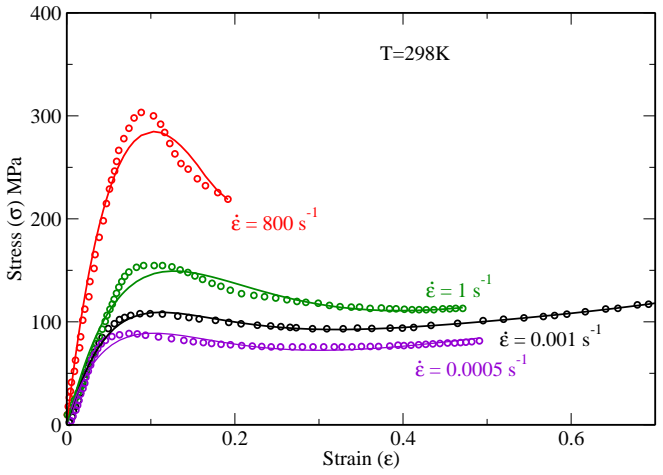
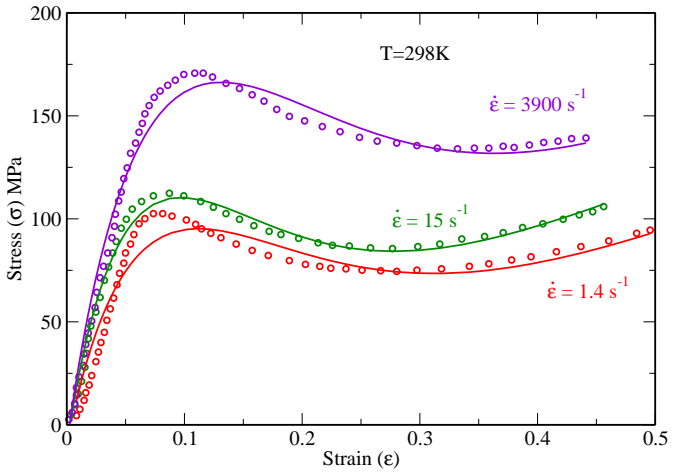
- [§3, Table 1 and Fig. 1] The abstract and §3 state that the stretched-exponential exponent β is obtained independently from relaxation measurements and provides the primary dynamical input. Fig. 1 documents this only for the metallic glass. For PC, PMMA, and epoxy, β=0.85 (and 0.80 for one PC rate) is used without showing corresponding relaxation data or citing independent measurements. Please provide the relaxation fits for the polymers or explicitly identify β as a fit parameter; otherwise the claim of independent dynamical input is overstated.
minor comments (5)
- [§2, Eq. (4)] The matrix for the strain tensor appears garbled: the entries read 'ε0 0; 0−νε0; 0 0−νε'. The intended structure (ε on the diagonal, with lateral contraction −νε) should be typeset clearly.
- [§2, Eqs. (5)–(6)] The absolute-value notation ε≡|ε|, σ≡|σ| is introduced after Eq. (5), but Eq. (6) and Eq. (12) use ε in exponential and prefactor without consistently indicating that these are magnitudes. Please make the convention explicit throughout.
- [§3, Fig. 1 and text] The text says β changes only slightly 'at and above the glass transition temperature.' Since Tg=625 K and the two temperatures are 643 K and 623 K, one measurement is above and one is below Tg. Please rephrase.
- [Table 1 caption] η is described both as a fitting parameter and as 'extracted from the linear viscous-flow region of the stress–strain curves.' Clarify whether η is fitted or directly read off the data, since the distinction affects the count of free parameters.
- [§2, Eq. (11)] The parameter A is introduced twice: first in the text as A=Δ/kBT+1/(γdot τc) and then in Eq. (11) in uniaxial form. It would help to define a single symbol and consistently state its relation to γdot versus εdot.
Circularity Check
Yield overshoot position and height are controlled by an imported exponential coordination-decay law (Eq. 1) and by the per-curve fitted τc; εy≈1/A is therefore partly a fit, not an independent microscopic prediction.
-
fitted input called prediction
[Section 2, Eqs. (11)–(12); Section 3, Table 1]
"To simplify the notation, we define the dimensionless parameter A= Tg/T + sqrt(3)/(2(1+ν) ε̇ τc) ... Equation (12) naturally predicts an elastic instability ... the characteristic yield strain is estimated from the condition ∂σel/∂ε=0, which gives, to leading order, εy ≃ 1/A. ... Table 1: Fitting parameters used to describe the stress-strain response ... τc provides the main adjustable timescale controlling the onset of the elastic instability."
A contains τc, and τc is listed in Table 1 as a fitting parameter and described as 'the main adjustable timescale controlling the onset of the elastic instability.' Since εy≈1/A by construction, the overshoot position is set by the fitted τc together with the assumed exponential decay of nb(γ). The same curves are then presented as validation of the microscopic mechanism, so the 'prediction' of the overshoot reduces, at least in part, to the fitted input.
-
self citation load bearing
[Section 2, Eq. (1) and preceding paragraph]
"The evolution of the coordination number can be described by a shear strain- and rate-dependent form using the relation for the strain-dependent mean number of mechanically-active bonds n_b derived in [36]: n_b(γ)=n0_b/2(1+e^{−Aγ}), where A=Δ/kBT+1/(γ̇τc) ... Substituting nb(γ) into the free energy of deformation F_el=1/2 K[n_b(γ)−n_c_b]γ^2 ... and differentiating with respect to shear strain γ yields a nonlinear stress-strain relation, σel(γ)= ... (1)."
The central claim that overshoot arises from 'strain-driven loss of mechanical connectivity' is carried entirely by the assumed exponential decay of nb(γ), which is imported from Ref. [36] rather than derived or measured in this paper. Because the elastic stress in Eq. (1) has a maximum only through this exponential-decay factor multiplying γ, the mechanistic explanation is not independently established here; the load-bearing premise is a citation to prior work by the same group.
full rationale
The paper is not wholly circular: it compares against external experimental data, obtains β for the metallic glass from independent relaxation measurements (Fig. 1), and combines several physically motivated contributions (nonaffine elasticity, viscous stretching-exponential relaxation, Langevin hardening). However, the key advertised prediction—the presence and position of the stress overshoot—is not independent. The overshoot is a mathematical consequence of the assumed exponential coordination-decay law nb(γ)=n0/2(1+e^{-Aγ}) imported from Ref. [36] (Zaccone, Schall, Terentjev, with a present author), and the yield strain is εy≈1/A with A containing the per-curve fitted τc. Thus the agreement in Figs. 2–5 demonstrates that the chosen functional form with an adjustable timescale can be matched to data, but it does not independently verify the microscopic connectivity-loss mechanism. This is partial circularity: the central prediction is partly built from its own fitted inputs and self-cited premise.
Assumptions & free parameters
free parameters (7)
- τc (structural relaxation time) =
3.3e-5 to 16.5 s (Table 1)
- τv (viscoelastic relaxation time) =
1.3e-5 to 136 s (Table 1)
- η (viscosity) =
2.2e4 to 1.5e11 Pa s (Table 1)
- E (elastic modulus) =
0.64 to 1.67 GPa (MG: 8.1-12.5 GPa)
- E_R (hardening modulus) =
1.3 to 3.9 MPa
- β (stretching exponent) =
0.76/0.75 for MG; 0.85 (0.80 for one PC rate) for polymers
- λm (finite extensibility limit) =
1.82
assumptions (6)
- domain assumption Strain-dependent coordination nb(γ)=n0/2[1+e^{-Aγ}]
- domain assumption Nonaffine elastic free energy Fel = 1/2 K [nb - nc] γ^2 with K = 2/(5π)(κφ/R0)
- domain assumption Viscous stress follows stretched exponential σvisc = ε̇η[1-e^{-(ε/(ε̇τv))^β}]
- domain assumption Strain hardening follows Arruda-Boyce inverse Langevin with λm=1.82
- domain assumption Stretched-exponential β measured near Tg transfers to compression at lower/higher rates and other materials
- standard math Continuum mechanics identities γ=√(2e:e) and σvM=√3Gγ; for uniaxial compression γ=2(1+ν)/√3 ε
Cite this review
Pith. "Pith review of Microscopic constitutive theory of stress overshoot, yielding, and strain hardening in amorphous materials." pith.science (2026). https://pith.science/paper/47FUPT7Z
@misc{pith2026260713734,
  author       = {Pith},
  title        = {Pith review of: Microscopic constitutive theory of stress overshoot, yielding, and strain hardening in amorphous materials},
  year         = {2026},
  howpublished = {\url{https://pith.science/paper/47FUPT7Z}},
  note         = {Machine review of arXiv:2607.13734}
}
read the original abstract
We develop a microscopic constitutive theory for the nonlinear deformation of metallic and polymer glasses based on nonaffine elasticity coupled to irreversible many-body relaxation. The theory predicts the full stress--strain response, from linear elasticity through stress overshoot and yielding to steady plastic flow. We show that stress overshoot originates from the competition between a nonaffine elastic instability induced by strain-driven loss of mechanical connectivity at the atomic/molecular level, and viscous dissipation associated with structural relaxation. For polymer glasses, finite chain extensibility naturally accounts for strain hardening at large deformation. The stretched-exponential relaxation exponent is obtained independently from stress or modulus relaxation measurements and provides the primary dynamical input to the theory. Using a small set of physically meaningful parameters, the model quantitatively reproduces experimental stress--strain curves for metallic glasses, polycarbonate, PMMA, and epoxy resins over a broad range of strain rates. These results establish a unified microscopic framework linking relaxation dynamics, yielding, plastic flow, and strain hardening in amorphous solids.
Figures


Figures from the paper (3 more)

Reference graph
Works this paper leans on
-
[36]
A. Zaccone, P. Schall, E. M. Terentjev, Microscopic origin of nonlinear nonaffine deformation in bulk metallic glasses, Phys. Rev. B 90 (2014) 140203(R).doi:10.1103/PhysRevB.90.140203
-
[1]
J. D. Ferry, H. S. Myers, Viscoelastic properties of polymers, Journal of The Electrochemical Society 108 (7) (1961) 142C–143C
1961
-
[2]
C. R. Siviour, J. L. Jordan, High strain rate mechanics of polymers: a review, Journal of Dynamic Behavior of Materials 2 (1) (2016) 15–32
2016
-
[3]
J. Choi, J. M. Kim, K. S. Cho, A solid-based approach for modeling sim- ple yield-stress fluids: Rheological transitions, overshoot and relaxation, arXiv preprint arXiv:2604.03467 (2026)
arXiv 2026
-
[4]
R. W. Hertzberg, R. P. Vinci, J. L. Hertzberg, Deformation and fracture mechanics of engineering materials, John Wiley & Sons, 2020
2020
-
[5]
J. L. Jordan, J. R. Foley, C. R. Siviour, Mechanical properties of epon 826/dea epoxy, Mechanics of Time-Dependent Materials 12 (3) (2008) 249–272
2008
-
[6]
L. L. Nelson, G. S. Grest, P. D. Olmsted, Shear banding in simulations of polymer melts, arXiv preprint arXiv:2604.03424 (2026)
arXiv 2026
-
[7]
R. S. Hoy, M. O. Robbins, Strain hardening in polymer glasses: limita- tions of network models, Physical review letters 99 (11) (2007) 117801
2007
Show all 45 references
-
[8]
H.E.Meijer, L.E.Govaert, Multi-scaleanalysisofmechanicalproperties of amorphous polymer systems, Macromolecular Chemistry and Physics 204 (2) (2003) 274–288. 21
2003
-
[9]
J. Hem, C. Crauste-Thibierge, T. C. Merlette, F. Clément, D. R. Long, S. Ciliberto, Microscopic dynamics in the strain hardening regime of glassy polymers, Macromolecules 55 (20) (2022) 9168–9185
2022
-
[10]
W. H. Wang, The elastic properties, elastic models and elastic perspec- tives of metallic glasses, Progress in Materials Science 57 (3) (2012) 487–656
2012
-
[11]
M. L. Falk, J. S. Langer, Dynamics of viscoplastic deformation in amor- phous solids, Physical Review E 57 (6) (1998) 7192
1998
-
[12]
R. S. Hoy, M. O. Robbins, Strain hardening of polymer glasses: En- tanglements, energetics, and plasticity, Physical Review E—Statistical, Nonlinear, and Soft Matter Physics 77 (3) (2008) 031801
2008
-
[13]
H. E. Meijer, L. E. Govaert, Mechanical performance of polymer sys- tems: The relation between structure and properties, Progress in poly- mer science 30 (8-9) (2005) 915–938
2005
-
[14]
Van Melick, L
H. Van Melick, L. Govaert, H. Meijer, On the origin of strain hardening in glassy polymers, Polymer 44 (8) (2003) 2493–2502
2003
-
[15]
R. N. Haward, The physics of glassy polymers, Springer Science & Busi- ness Media, 2012
2012
-
[16]
J. Lu, G. Ravichandran, W. L. Johnson, Deformation behavior of the zr41. 2ti13. 8cu12. 5ni10be22. 5 bulk metallic glass over a wide range of strain-rates and temperatures, Acta materialia 51 (12) (2003) 3429– 3443. 22
2003
-
[17]
Koumakis, M
N. Koumakis, M. Laurati, S. U. Egelhaaf, J. F. Brady, G. Petekidis, Yielding of hard-sphere glasses during start-up shear, Phys. Rev. Lett. 108 (2012) 098303.doi:10.1103/PhysRevLett.108.098303
2012 doi
-
[18]
Orowan, Zur Kristallplastizität
E. Orowan, Zur Kristallplastizität. I: Tieftemperaturplastizität und Beckersche formel, Zeitschrift für Physik 89 (9) (1934) 605–613
1934
-
[19]
Polanyi, Lattice distortion which originates plastic flow, Z
M. Polanyi, Lattice distortion which originates plastic flow, Z. Phys 89 (9-10) (1934) 660–662
1934
-
[20]
G. I. Taylor, The mechanism of plastic deformation of crystals. part i.—theoretical, Proceedings of the Royal Society of London. Series A, Containing Papers of a Mathematical and Physical Character 145 (855) (1934) 362–387
1934
-
[21]
Argon, H
A. Argon, H. Kuo, Plastic flow in a disordered bubble raft (an analog of a metallic glass), Materials science and Engineering 39 (1) (1979) 101–109
1979
-
[22]
M. L. Falk, J. S. Langer, Deformation and failure of amorphous, solidlike materials, Annu. Rev. Condens. Matter Phys. 2 (1) (2011) 353–373
2011
-
[23]
J. D. Eshelby, The determination of the elastic field of an ellipsoidal inclusion, and related problems, Proceedings of the Royal Society A 241 (1957) 376–396
1957
-
[24]
Picard, A
G. Picard, A. Ajdari, F. Lequeux, L. Bocquet, Elastic consequences of a single plastic event: A step towards the microscopic modeling of the flow of yield stress fluids, Eur. Phys. J. E 15 (2004) 371–381. 23
2004
-
[25]
Nicolas, E
A. Nicolas, E. E. Ferrero, K. Martens, J.-L. Barrat, Deformation and flow of amorphous solids: Insights from elastoplastic models, Rev. Mod. Phys. 90 (2018) 045006
2018
-
[26]
J. Dong, H. Peng, H. Wang, Y. Tong, Y. Wang, W. Dmowski, T. Egami, B. Sun, W. Wang, H. Bai, Non-affine atomic rearrangement of glasses through stress-induced structural anisotropy, Nature Physics 19 (12) (2023) 1896–1903
2023
-
[27]
H. Wang, W. Dmowski, Y. Tong, Z. Wang, Y. Yokoyama, J. Ketkaew, J. Schroers, T. Egami, Nonaffine strains control ductility of metal- lic glasses, Phys. Rev. Lett. 128 (2022) 155501.doi:10.1103/ PhysRevLett.128.155501
2022
-
[28]
Zaccone, E
A. Zaccone, E. Scossa-Romano, Approximate analytical description of the nonaffine response of amorphous solids, Phys. Rev. B 83 (2011) 184205.doi:10.1103/PhysRevB.83.184205
2011 doi
-
[29]
Laurati, P
M. Laurati, P. Maßhoff, K. J. Mutch, S. U. Egelhaaf, A. Zaccone, Long- lived neighbors determine the rheological response of glasses, Physical Review Letters 118 (1) (2017) 018002
2017
-
[30]
Koumakis, M
N. Koumakis, M. Laurati, S. Egelhaaf, J. Brady, G. Petekidis, Yield- ing of hard-sphere glasses during start-up shear, Physical review letters 108 (9) (2012) 098303
2012
-
[31]
Koumakis, M
N. Koumakis, M. Laurati, A. R. Jacob, K. J. Mutch, A. Abdellali, A. Schofield, S. U. Egelhaaf, J. F. Brady, G. Petekidis, Start-up shear of 24 concentrated colloidal hard spheres: Stresses, dynamics, and structure, Journal of Rheology 60 (4) (2016) 603–623
2016
-
[32]
M. Born, K. Huang, Dynamical theory of crystal lattices, Oxford uni- versity press, 1996
1996
-
[33]
Zaccone, E
A. Zaccone, E. M. Terentjev, Disorder-assisted melting and the glass transition inamorphous solids, Phys. Rev. Lett.110 (2013)178002.doi: 10.1103/PhysRevLett.110.178002
2013 doi
-
[34]
Zaccone, Theory of Disordered Solids, Springer, Cham, 2023
A. Zaccone, Theory of Disordered Solids, Springer, Cham, 2023
2023
-
[35]
Hansen, I
J.-P. Hansen, I. R. McDonald, D. Henderson, Theory of simple liquids (1988)
1988
-
[37]
E. M. Arruda, M. C. Boyce, Evolution of plastic anisotropy in amor- phous polymers during finite straining, International Journal of Plastic- ity 9 (6) (1993) 697–720
1993
-
[38]
B. Cui, J. Yang, J. Qiao, M. Jiang, L. Dai, Y.-J. Wang, A. Zaccone, Atomic theory of viscoelastic response and memory effects in metallic glasses, Phys. Rev. B 96 (2017) 094203.doi:10.1103/PhysRevB.96. 094203
2017 doi
-
[39]
Klages, G
R. Klages, G. Radons, I. M. Sokolov, Anomalous transport, Wiley On- line Library, 2008. 25
2008
-
[40]
M. Kroeger, Simple, admissible, and accurate approximants of the in- verse langevin and brillouin functions, relevant for strong polymer de- formations and flows, Journal of Non-Newtonian Fluid Mechanics 223 (2015) 77–87
2015
-
[41]
Nichetti, A
D. Nichetti, A. Zaccone, Microscopic nonaffine deformation theory of LAOS in polymers, arXiv preprint arXiv:2605.21021 (2026)
2026 arXiv
-
[42]
Anand, N
L. Anand, N. Ames, On modeling the micro-indentation response of an amorphous polymer, International journal of plasticity 22 (6) (2006) 1123–1170
2006
-
[43]
A. D. Mulliken, M. C. Boyce, Mechanics of the rate-dependent elastic– plastic deformation of glassy polymers from low to high strain rates, International journal of solids and structures 43 (5) (2006) 1331–1356
2006
-
[44]
Peker, W
A. Peker, W. L. Johnson, A highly processable metallic glass: Zr41. 2ti13. 8cu12. 5ni10. 0be22. 5, Applied Physics Letters 63 (17) (1993) 2342–2344
1993
-
[45]
Jordan, J
J. Jordan, J. Spowart, M. Kendall, B. Woodworth, C. Siviour, Mechan- ics of particulate composites with glassy polymer binders in compres- sion, Philosophical Transactions of the Royal Society A: Mathematical, Physical and Engineering Sciences 372 (2015) (2014). 26
2015
Reviewed August 2, 2026 · model on record in the stance chip above.
Discussion (0). Continue with ORCID to comment.