REVIEW 4 major objections 5 minor 39 references
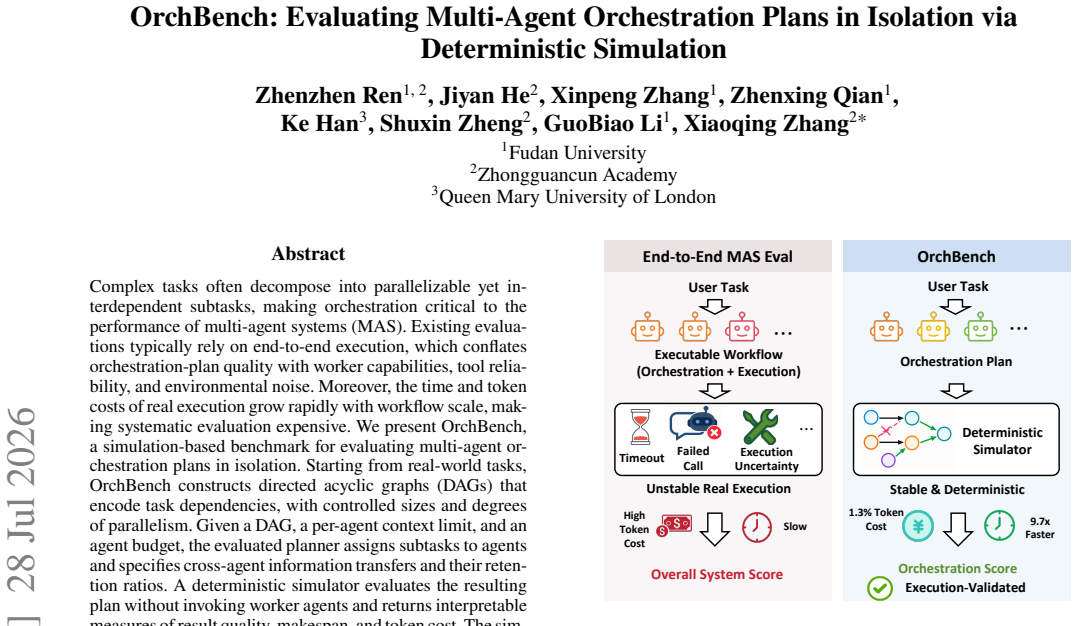
This paper claims that orchestration plans for multi-agent systems can be scored by deterministic simulation alone, with simulated scores tracking real execution quality at r=0.816 while using about 1.3% of the tokens and 10.3% of the time.
Reviewed by Pith at T0; open to challenge. T0 means a machine referee read the full paper against a public rubric. the ladder, T0–T4 →
T0 review · deepseek-v4-flash
2026-08-01 01:48 UTC pith:47T6EJWZ
load-bearing objection A genuinely useful simulation-based orchestration benchmark, honestly reported, but the headline validation is thin (six models, leave-one-out r drops to 0.421) and the 'coverage beats agent count' finding is partly built into the simulator rather than independently discovered. the 4 major comments →
OrchBench: Evaluating Multi-Agent Orchestration Plans in Isolation via Deterministic Simulation
The pith
A machine-rendered reading of the paper's core claim, the machinery that carries it, and where it could break.
Core claim
The paper constructs a benchmark in which real-world tasks are converted into directed acyclic graphs of subtasks with token, time, and compression-sensitivity metadata. A planner must assign each subtask to an agent and declare cross-agent information transfers with retention ratios; a deterministic simulator then replays the workflow—dependency resolution, agent scheduling, context acquisition and compression, execution, state updates—and outputs final quality, makespan, and token cost. The central claim is that this simulated evaluation captures the orchestration-relevant part of real execution: across real tool-based runs, simulated scores and real task quality correlate with Pearson r=0
What carries the argument
The load-bearing object is the deterministic simulator, in particular its quality-propagation rule: each subtask's output quality is the geometric mean of the retained qualities of its parent results, raised to a compression-sensitivity exponent and clipped to [qmin,1]; a missing cross-agent transfer multiplies the parent's contribution by a fixed penalty factor. Context compression reduces token count and quality according to retention ratio and the subtask's fragility class. This rule is what lets the benchmark translate a plan into a quality number without invoking workers, and it is also the part of the pipeline that must be faithful for the benchmark's rankings to transfer to real execu
Load-bearing premise
The simulation's quality equation—geometric mean of parent qualities, with missing transfers discounted by a fixed factor and hand-set compression exponents—is assumed to mirror how real information loss compounds into final task quality; the paper validates this only at the level of whole-model aggregates on six models, not at the level of individual subtasks.
What would settle it
Gather per-subtask output-quality ratings from real agent executions on a sample of OrchBench DAGs and compare them node-by-node with the simulator's q_v values. If node-level agreement is weak despite the aggregate r=0.816, the geometric-mean propagation rule is not the actual mechanism and the benchmark's rankings could fail on out-of-distribution plans.
If this is right
- Orchestration plan quality can be measured in isolation, so researchers can compare planners under identical conditions without worker, tool, or environment noise.
- Simulated scores predict real execution quality well enough for early screening: r=0.816 overall, positive in all leave-one-model-out checks (r=0.421–0.949).
- Evaluation cost drops by orders of magnitude—1.3% of tokens and 10.3% of wall-clock time on the validation set, with up to 389× token and 110× time reductions on individual tasks.
- At scale, missing information transfers, not agent count, dominate quality degradation; the benefit of additional agents saturates and can turn negative once the working state fits a single context window.
- Simulator-guided handoff repair improves real workflow scores (3.754 to 4.150 out of 5 on the refinement test), supporting use of the simulator as a diagnostic tool.
Where Pith is reading between the lines
- A natural next step beyond this paper would be to search over orchestration plans against the deterministic simulator before executing anything, turning orchestration into an optimizable planning problem rather than a one-shot model judgement.
- The 'coverage matters more than agent count' result is correlational within the simulator; a stronger test would hold transfer coverage fixed and vary agent count in real executions to confirm the causal direction it implies.
- The quality-propagation rule is a strong hypothesis about information loss; collecting per-subtask real output-quality ratings would let future work test whether the geometric mean is the right composition law or whether a minimum or additive rule fits real degradation better.
- Because the final score averages quality, speed efficiency, and token efficiency with equal weights, the reported model rankings are sensitive to those weights; a weight-sensitivity analysis would show how much of the headline ordering reflects the benchmark's objective rather than orchestration skill.
Editorial analysis
A structured set of objections, weighed in public.
Referee Report
Summary. The paper introduces OrchBench, a deterministic-simulation benchmark for evaluating multi-agent orchestration plans without invoking worker agents. Given a task DAG, a context limit, and an agent budget, a planner produces an assignment and a set of cross-agent information transfers; the simulator (Algorithm 1) propagates quality through Eq. (3), applies context compression, and returns quality, makespan, and token cost. The paper reports a model-level Pearson correlation of r=0.816 between simulated scores and Claude Code executions on MultiAgentBench, claims large token/time savings, and uses the simulator to argue that transfer coverage matters more than agent count and that parallelism yields diminishing returns as coordination failures accumulate.
Significance. The problem is timely and the proposed isolation of orchestration from worker execution is potentially valuable. The simulator is explicit and deterministic, the metric definitions are mostly clear, and the paper includes honest sensitivity analyses and failure-case discussions. If the simulator were validated at the level of individual plans, OrchBench could become a useful low-cost screening tool for orchestration research. However, the current validation evidence is too thin to establish the central claim that simulated scores can stand in for real execution quality.
major comments (4)
- [Benchmark Validation (Tables 2-3)] The central validation is a Pearson r=0.816 over six model-level averages (Table 2; p=0.047). Table 3 shows leave-one-out r ranging from 0.421 (removing Doubao-Mini) to 0.949; removing that single model makes the correlation non-significant (p=0.500). Because OrchBench claims to evaluate individual orchestration plans, the relevant validity evidence is plan-level, but no plan-level correlation is reported anywhere: Table 1 and Table 2 both aggregate runs per model. Model-level averaging can inflate a correlation by suppressing within-model plan variance and can hide systematic failures on specific plans. Please provide per-plan/per-task simulation-to-real correlations, with many more than six comparison points, and report scatter and pairwise plan-ranking accuracy.
- [Deterministic Simulation, Eq. (3); Algorithm 1 (lines 15-17)] The quality model in Eq. (3) sets q_v = clip(geometric mean of available parent qualities)^{e^{s_v}}, and Algorithm 1 (lines 15-17) applies lambda=0.5 to every missing transfer. Consequently, any plan with more missing transfers has lower Q by construction. This makes the headline result in Table 5 ('coverage matters more than agent count') partly a mechanical consequence of the simulator, not an independently validated empirical finding. To support the claim, the paper needs (i) real-execution evidence that missing transfers and compression losses propagate approximately multiplicatively, and (ii) a sensitivity analysis over the functional form and over gamma, not only over lambda (Table 20). The compression-sensitivity classes (robust/balanced/fragile) are also hand-defined; their mapping to e^{gamma} with gamma in {0.35,0.85,1.25} should be justified or estimated.
- [Outcome alignment (Table 2); Eq. (6)-(7)] The r=0.816 correlation is for Score = (Q + E_time + E_token)/3 (Eq. 7). Table 2 reports r=-0.264 for time and r=-0.607 for token usage, and Appendix D-II states that time and token consumption are framework-dependent and cannot be reliably predicted. Since the aggregate score contains two components that are negatively or weakly correlated with real outcomes, the positive final-score correlation may be driven almost entirely by Q. Please report the correlation of each component separately and explicitly state whether E_time and E_token are intended as predictive or only as diagnostic. As written, the final score can mislead users into thinking the simulator predicts all three dimensions.
- [Simulator-guided refinement (Table 9)] Table 9 reports that simulator-guided refinement raises mean real-execution score from 3.754 to 4.150 on 20 tasks. No standard errors, confidence intervals, or paired significance tests are given, and the refinement inserts only one handoff selected from simulation. Because this table is used to support the claim that simulator-guided diagnosis improves real execution, it needs a proper paired test with per-task breakdown; the current evidence is anecdotal.
minor comments (5)
- [Figure 3] The exact correlation coefficients are embedded in a heatmap with upper and lower triangles. Please provide a table with the exact values and explain in the caption that the upper/lower triangles report Pearson/Spearman coefficients.
- [Table 1] With six models, many p-values are not corrected for multiple comparisons. Treat the structural-alignment correlations as descriptive and state this explicitly.
- [Section G (Other Settings)] The mapping from token budgets to the context limit L is described only in the appendix. A one-sentence summary in the main text would help readers understand the context-pressure mechanism.
- [Eq. (2)-(3)] The compression-sensitivity class (robust/balanced/fragile) is introduced in the problem formulation but is not operationalized until Appendix G. Define it near Eq. (2) with a small example.
- [Algorithm 1] 'ZeroScore' is returned for invalid plans but is not defined. Clarify whether all metrics are zero or only the final score.
Circularity Check
The headline finding that transfer coverage matters more than agent count is largely built into Eq. (3) and Algorithm 1; the sim-to-real validation itself is not circular.
specific steps
-
self definitional
[Methodology / Deterministic Simulation, Eq. (3) and Algorithm 1; Abstract and Results, Table 5]
"For a non-root task, let equv denote the quality of parent u’s package available to v. Let ¯q denote the geometric mean of the available parent qualities. The result quality of v is qv = clip[qmin,1] (¯qesv ) (Eq. 3). ... [Algorithm 1:] record a missing-transfer event; multiply u’s contribution quality by λ."
Q is the macro-average of terminal q_w (Eq. 5), and every missing transfer multiplies the parent contribution by λ=0.5 before the geometric mean. Thus lower transfer coverage mechanically lowers simulated Q. The paper's main 'finding'—'preserving task-critical information is more important than simply increasing the number of agents' (Abstract)—is then read off these simulated scores: Table 5 reports Coverage–Q correlations of 0.614–0.952 with near-zero Agents–Q. Those correlation values substantially restate the scoring rule rather than an independent empirical regularity. Agent count can still enter through context compression, so the result is not fully forced, but the headline claim is largely encoded in the simulator's definition.
full rationale
The benchmark's external-validity claim is not circular: simulated scores are compared with real Claude Code execution quality (r=0.816, Table 2), which is independent evidence, and no parameter is fit to that real target on the face of the paper. Self-citations are not load-bearing here; no uniqueness theorem or prior ansatz by the same authors is used to justify the simulator. The circularity is localized to the paper's advertised 'discovery' that transfer coverage matters more than agent count. Because the simulator's quality equation (Eq. 3) takes the geometric mean of retained parent qualities and Algorithm 1 penalizes missing transfers by λ=0.5, plans with more missing transfers are assigned lower Q by construction; the Coverage–Q correlation in Table 5 is therefore largely a restatement of the benchmark definition. The honest limitation is that this is a moderate, partial circularity rather than a fully forced result, since agent count, context compression, speed, and token cost are modeled separately and do feed into the aggregate score. The fragility of the sim-to-real validation (six model-level points; leave-one-out r drops to 0.421) is a correctness-risk observation, not an additional circularity.
Axiom & Free-Parameter Ledger
free parameters (5)
- Missing-transfer penalty λ =
0.5
- Compression quality exponents γ =
{0.35, 0.85, 1.25}
- Compression event cost and handoff/startup accounting =
2.5% package size per compression; handoff max(1,ceil(x/5000)); 1200 tokens startup per agent
- Context-limit mapping policy =
smallest window in {16k,32k,64k,128k} from max(1.35*90th pct, 2*95th pct, amortized estimate)
- Final score weights =
equal weights on Q, E_time, E_token
axioms (6)
- domain assumption Subtask result quality is the geometric mean of available parent retained qualities, exponentiated by compression sensitivity (Eq. 3).
- domain assumption Compressing a package to fraction e preserves quality e^{s_v} with per-class exponents (Eq. 2).
- domain assumption LLM-judge-generated DAGs are valid decompositions of real-world seed tasks.
- domain assumption Real MultiAgentBench execution scores are an appropriate ground truth for orchestration quality.
- domain assumption Worker capability does not affect orchestration-quality evaluation.
- domain assumption Missing transfers incur only a quality penalty λ and no time/token/context cost in the default setting.
invented entities (1)
-
compression-sensitivity class (robust/balanced/fragile)
no independent evidence
read the original abstract
Complex tasks often decompose into parallelizable yet interdependent subtasks, making orchestration critical to the performance of multi-agent systems (MAS). Existing evaluations typically rely on end-to-end execution, which conflates orchestration-plan quality with worker capabilities, tool reliability, and environmental noise. Moreover, the time and token costs of real execution grow rapidly with workflow scale, making systematic evaluation expensive. We present OrchBench, a simulation-based benchmark for evaluating multi-agent orchestration plans in isolation. Starting from real-world tasks, OrchBench constructs directed acyclic graphs (DAGs) that encode task dependencies, with controlled sizes and degrees of parallelism. Given a DAG, a per-agent context limit, and an agent budget, the evaluated planner assigns subtasks to agents and specifies cross-agent information transfers and their retention ratios. A deterministic simulator evaluates the resulting plan without invoking worker agents and returns interpretable measures of result quality, makespan, and token cost. The simulated scores produced by OrchBench correlate strongly with quality scores from Claude Code executions, achieving a Pearson correlation of \(r=0.816\), while requiring only \(1.3\%\) of the tokens and \(10.3\%\) of the wall-clock time. Across diverse planners and workflow scales, we find that preserving task-critical information is more important than simply increasing the number of agents, and the benefits of parallelism diminish as coordination failures accumulate. These results establish OrchBench as an efficient and interpretable benchmark for comparing and diagnosing multi-agent orchestration plans.
Figures


Reference graph
Works this paper leans on
-
[9]
Do not drift into another task
Stay faithful to the original seed. Do not drift into another task
-
[11]
Avoid duplicate, meaningless, or purely count-padding subtasks
-
[19]
Each subtask must be executable, not a placeholder
-
[20]
Flag obvious duplication, over-splitting, under-splitting, or meaningless 9subtasks
-
[21]
Check whether dependency edges are semantically natural and whether edges 11are missing or wrongly connected
-
[39]
accepted
parallelism_plausibility: parallel branches are meaningful and have plausible integration. 13 14All numeric scores are quality scores where 100 is best and 0 is worst. 15For missing_subtasks, 100 means no obvious missing core stage/subtask type; 0 means severe missing core workflow stages. 16Do not invert any rule percentage: hard-rule percentages are als...
-
[41]
Multiple nodes may be expanded in one round
Expand nodes that are too coarse, information-dense, or important for 5parallel scheduling. Multiple nodes may be expanded in one round
-
[51]
Do not repeat mechanical structural checks, but reject if the structural 6verifier reports hard issues
-
[61]
have a clear final deliverable or final answer
-
[62]
The revised graph must remain an acyclic DAG with exactly one terminal 7delivery task
-
[72]
naturally decompose into a multi-stage workflow
-
[81]
coverage: the DAG covers the original goal at an appropriate level of detail
-
[83]
require at least two action types, such as evidence collection, 9code or data processing, writing, verification, or review
-
[92]
dependency_correctness: prerequisite edges and stage order are plausible
-
[94]
Do not copy hidden answers, expected outputs, SQL, rubrics, or numeric 10answers from the source dataset into task descriptions
-
[103]
redundancy: the DAG is not filled with duplicate or near-duplicate subtasks
-
[104]
have dependencies expressible as a DAG
-
[114]
missing_subtasks: no obvious core stages are absent
-
[115]
accepted
not mainly depend on private content, inaccessible environments, or an 12empty/overly short prompt. 13 14Output only JSON: 15{ 16"accepted": true, 17"reason": "short reason", 18"suggested_workflow": ["stage 1", "stage 2", "stage 3"], 19"risk": "low | medium | high" 20} Refinement Prompt Refinement prompt 1Continue refining the following task DAG. 2 3Rules:
-
[121]
agent_pools define named pools; total count must not exceed max_agents
-
[125]
Check whether compression classes match task semantics
-
[126]
Never exceed the final target
Hit the round target exactly when possible. Never exceed the final target. 13If the final target has already been reached, keep the node count fixed 14and only repair dependencies, task boundaries, stages, and metadata
-
[132]
rules are matched in order; assigned tasks are not overwritten
-
[136]
Check whether token counts and time costs are plausible
-
[143]
match may use stage, stages, stage_regex, stage_contains, task_ids, or all
-
[147]
If the graph has not reached the target count but is structurally and 15semantically sound, it may be accepted with targeted refinement suggestions
-
[154]
strategy may be round_robin, dependency_grouping, load_balance, or single
-
[157]
Preserve and update input tokens, execution tokens, result tokens, 16time cost, and compression class
-
[165]
Missing transfers are recorded and penalized 18through quality loss
If parent and child are assigned to different agents, you must add explicit 17transfers or transfer_rules. Missing transfers are recorded and penalized 18through quality loss
-
[168]
If the target count is reached and k99 is outside the requested bucket, 17reject and suggest dependency or boundary repairs
-
[178]
If a target parallelism bucket is specified , move k99 toward the target 18range without merely increasing layer width
-
[189]
accepted
High parallelism is part of the requested benchmark specification; do not 19reject a wide DAG merely because it is wide . 20 21Output only JSON: 22{ 23"accepted": true, 24"issues": [], 25"warnings": [], 26"redundant_tasks": [], 27"suggested_refinements": [] 28} Planner Evaluation Prompt Planner evaluation prompt 1You are a dynamic workflow orchestrator. O...
-
[196]
cross_agent_only=true means 20transfer only when parent and child are on different agents
transfer_rules expand over dependency edges . cross_agent_only=true means 20transfer only when parent and child are on different agents
-
[199]
Judge feedback is an acceptance signal and targeted guidance, not a planner
-
[217]
Higher compression ratios preserve 22quality but cost more communication tokens
compression must be explicitly set. Higher compression ratios preserve 22quality but cost more communication tokens. Choose the ratios yourself
-
[238]
25 26Output JSON with agent_pools, rules, default, and transfer_rules
Use stage or regex rules to express a dynamic workflow; still cover the 24key cross-agent dependency transfers. 25 26Output JSON with agent_pools, rules, default, and transfer_rules. II. DAG Validation Prompt The LLM judge evaluates semantic validity that is difficult to capture with deterministic rules. The judge does not re- ceivethefullJSONforlargeDAGs...
-
[2010]
When expanding parallel work packages, preserve branch structure 21and avoid serializing independent work packages
-
[2026]
Mas-orchestra: Understanding and improving multi- agentreasoningthroughholisticorchestrationandcontrolled benchmarks.arXiv preprint arXiv:2601.14652. Kim, S.; Moon, S.; Tabrizi, R.; Lee, N.; Mahoney, M. W.; Keutzer, K.; and Gholami, A. 2023. An llm compiler for parallel function calling.arXiv preprint arXiv:2312.04511. Koh, J. Y.; Lo, R.; Jang, L.; Duvvur...
Pith/arXiv arXiv 2023
-
[2211]
Do not output a patch or markdown
Output the complete revised JSON graph. Do not output a patch or markdown. Semantic Judge Prompt Semantic judge prompt 1Review whether the following task DAG is suitable as an orchestration 2benchmark problem. 3 4Check:
discussion (0)
Sign in with ORCID, Apple, or X to comment. Anyone can read and Pith papers without signing in.