REVIEW 4 major objections 6 minor 4 cited by
Dark Matter in Multi-Singlet Extensions of the Standard Model
T0 review · 4 major / 6 minor · reviewed 2026-08-15 · deepseek-v4-flash
Pith's one-line read Adding a second singlet with its own Z2 symmetry opens a light dark-matter window that the one-singlet model closes.
desk verdict A solid two-singlet DM scan with a genuinely new light-heavy window; the three-singlet stability claim is softer than the abstract suggests. read the letter →
The pith
A machine-rendered reading of the paper's core claim, the machinery that carries it, and where it could break.
The reading
What carries the argument
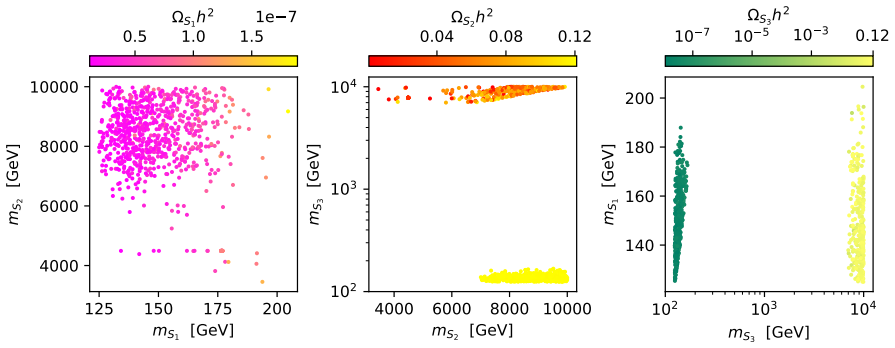
The mechanism carrying the argument is the relic-fraction-weighted direct-detection cross section, $\sigma_{\rm SI}(S_r N\to S_r N)\,\Omega_{S_r}/\Omega_{\rm DM}$, together with the unbroken $\mathbb{Z}_2^{(1)}\times\mathbb{Z}_2^{(2)}$ symmetries that make both singlets stable dark matter candidates. Because a state with a tiny relic share is allowed a much larger Higgs portal coupling, the light state can live at $m_{S_1}\in[124.8,230.0]$ GeV while the heavy state supplies most of the relic density; the small inter-dark coupling $\lambda_{12}$ controls heavy-to-light annihilation and sets that share. In the single-$\mathbb{Z}_2$ variant, rotation to mass eigenstates redefines the couplings so that only one effective coupling enters direct detection while all three portal couplings contribute to the relic density.
What would settle it
A full uniform scan of the three-singlet parameter space that finds an allowed region outside the two scanned hierarchies, or a next direct-detection limit that drops below $\sigma_{\rm SI}(S_1N\to S_1N)\,\Omega_{S_1}/\Omega_{\rm DM}\sim10^{-47}\,{\rm cm}^2$ for $m_{S_1}$ between 125 and 230 GeV, would falsify the paper's central picture.
Extended reading notes
Core claim
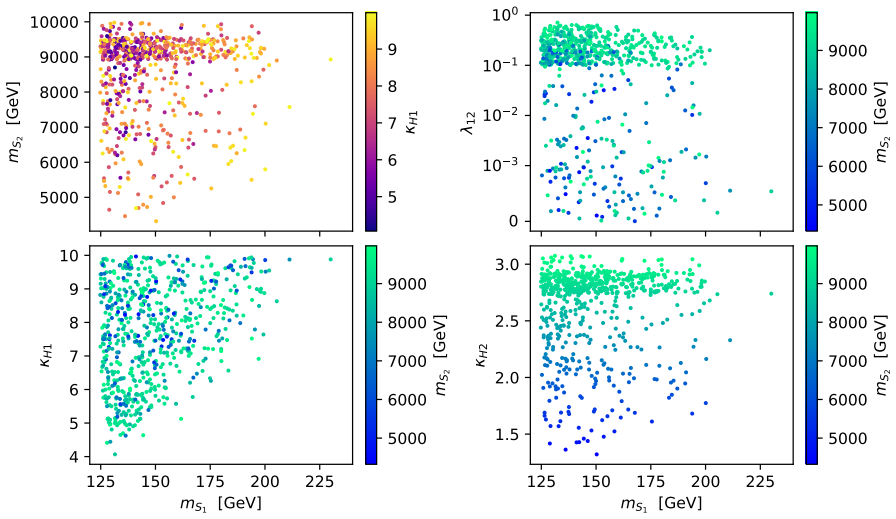
The paper's central claim is that increasing the number of real singlet fields, each protected by its own unbroken $\mathbb{Z}_2$ symmetry, opens parameter space that the single-singlet model closes. In the two-singlet model the allowed region contains a new one-light-one-heavy configuration: $m_{S_1}\in[124.8,230.0]$ GeV with $\Omega_{S_1}h^2\sim10^{-7}$ and $m_{S_2}\in[4321.0,9977.0]$ GeV with $\Omega_{S_2}h^2\simeq\Omega_{\rm DM}h^2$. Direct detection is evaded because the bound applies to $\sigma_{\rm SI}(S_1N\to S_1N)\,\Omega_{S_1}/\Omega_{\rm DM}$, and the tiny relic fraction compensates for the large portal coupling $\kappa_{H1}\in[4.066,9.986]$. In the three-singlet model the same logic allows two heavy states to share the relic density, weakening the usual mass and coupling bounds, and the paper argues that further singlets will only loosen these constraints. When two singlets are odd under one shared $\mathbb{Z}_2$, mixing among dark scalars leaves only one coupling controlling direct detection, so the lightest state can populate the entire range from half the Higgs mass to the TeV scale.
Load-bearing premise
The broad conclusion that adding more singlets will not change this picture dramatically rests on the assumption that no new depletion channels open in unscanned regions of the three-singlet parameter space, because the scans cover only two-light-one-heavy and one-light-two-heavy hierarchies.
Editorial extensions
If this is right
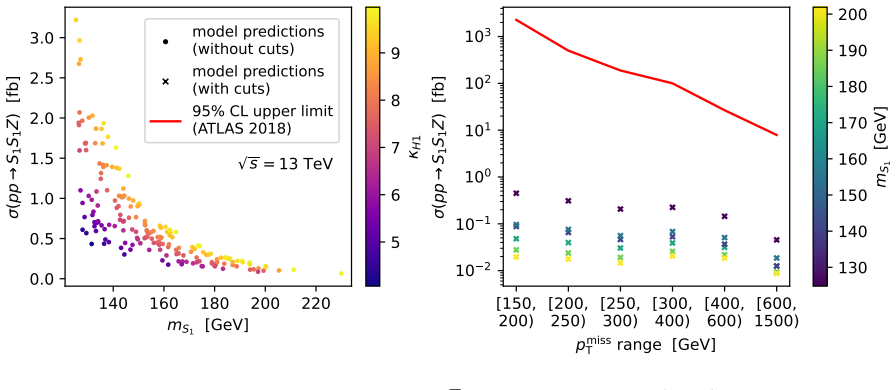
- The light state in the two-singlet window, with $m_{S_1}\approx125\text{--}230$ GeV and $\kappa_{H1}\gtrsim5$, has LHC production cross sections that mono-Higgs searches already approach within about one order of magnitude; the HL-LHC should be able to probe or exclude it.
- The heavy state $S_2$, carrying almost all the relic density, sits at masses 4.3--10 TeV where its spin-independent cross section falls within the LZ 2024 uncertainty band; the next direct-detection exposure will likely test the whole new window.
- In the three-singlet one-light-two-heavy case, two heavy states each carry part of the relic density, so the direct-detection bound on each is weakened by its fraction; this produces allowed points with heavier masses and larger portal couplings than the two-singlet model permits.
- Adding further singlets with independent $\mathbb{Z}_2$ symmetries should continue the trend: the lightest state can stay near the Higgs mass with a negligible relic fraction, while the remaining states share the observed abundance.
- In the one-$\mathbb{Z}_2$ variant, the mass eigenstates mix and only one effective portal coupling enters direct detection, so a DM candidate at any mass from $m_h/2$ to the TeV scale is allowed in principle and accessible to mono-$X$ searches.
Reading between the lines
- The relic-fraction suppression used here is not specific to singlet scalars; any multi-component dark matter model with a light state that annihilates efficiently could open sub-TeV windows, so the mechanism provides a general template for evading direct-detection limits.
- If LZ or its successor excludes the predicted $\sigma\times$fraction band, the two-singlet window would be closed unless the light state is even lighter or even more depleted; that outcome would push these models toward the resonant $m_h/2$ region.
- The three-singlet conclusion about stability across $N$ is only as strong as the scanned hierarchies; a uniform scan, or a dedicated all-light search, would be a direct test of whether the picture really stabilizes.
- For the single-$\mathbb{Z}_2$ two-singlet model, the combination of invisible Higgs width and mono-Higgs measurements could constrain the mixing angle $\alpha$, providing a complementary handle beyond direct detection.
Signed reviews
Editorial analysis
A structured set of objections, weighed in public.
Referee Report
Summary. The paper studies real scalar singlet extensions of the Standard Model with unbroken Z2 symmetries, using micrOMEGAs for relic-density and direct-detection constraints and MadGraph for LHC mono-X cross sections. It first revisits the one-singlet model, then analyzes two real singlets with independent Z2 symmetries, two real singlets with a single common Z2, and three real singlets with three independent Z2 symmetries. The main claimed results are: (i) in the one-singlet model, DM is excluded below about 3.5 TeV except near the Higgs resonance; (ii) adding a second independently-odd singlet opens a new allowed window with a light state mS1 in [124.8, 230.0] GeV carrying a tiny relic fraction Omega_S1 h^2 ~ 10^-7 and a heavy state mS2 in [4321, 9977] GeV carrying essentially all of the relic density; (iii) a three-singlet configuration with one light and two heavy states further relaxes direct-detection constraints because the two heavy states share the relic density; and (iv) the same-Z2 two-singlet model allows the DM mass to span a much wider range because the DD coupling and the relic-density-controlling couplings are independent after mass-diagonalization. The paper also evaluates LHC mono-jet, mono-Higgs, mono-Z, and di-jet b-bbar signatures for benchmark points.
Significance. If the central two-singlet result holds, it identifies a genuinely interesting phenomenology: a two-component scalar DM model with a light LHC-accessible state that evades direct detection through its small relic-density fraction. The treatment of the direct-detection bound for subdominant components, sigma_SI x Omega_Sr/Omega_DM, is the correct standard scaling, and the paper uses current constraints including LZ 2024. The use of public tools (micrOMEGAs 6.0/6.1, MadGraph5_aMC@NLO) and the explicit benchmarking against ATLAS mono-X analyses are strengths. The significance is tempered, however, by the fact that the paper's most general claims, in particular the abstract's statement that adding more independent-Z2 singlets will not change the picture dramatically, rest on a restricted three-singlet scan and on an under-documented scan of the same-Z2 model. The robust, well-supported part is the two-singlet new mass window; the N-singlet extrapolation needs either additional scans or a softened claim.
major comments (4)
- [Sec. 3.1 and abstract; Sec. 5 conclusion] The statement that adding more independent-Z2 singlets 'will not change this picture dramatically' is not supported by the scans presented. Section 3.1 restricts the three-singlet scan to two hierarchies, mS3<mS1<mS2 and mS1<mS2<mS3, with the justification that no new (co-)annihilation channels open. That justification is insufficient: the newly found one-light-two-heavy allowed region is itself produced without any new depletion channel. It arises, as the text around Eq. (3.7) states, because the direct-detection exclusion for each heavy state is scaled by the relic-density fraction Omega_Sr/Omega_DM. The same fraction-weighting mechanism implies that an unscanned all-heavy hierarchy, with three states above roughly 1 TeV each carrying Omega ~ 1/3, could further relax the DD tension and shift the allowed masses downward relative to the one-singlet lower bound; an all-light hierarchy with multiple small relic fractions is likewise not excluded by the stated argument. The manuscript itself concedes after Eq. (3.7) that 'there are no obvious physical reasons to expect the new allowed regions would arise,' which is a self-acknowledged limitation, not a proof of stability. To support the abstract's N-singlet claim, the authors should scan the all-heavy and all-light hierarchies, and ideally a four-singlet one-light-three-heavy case, or alternatively restrict the claim to the two scanned hierarchies. The final sentence of Sec. 5, 'Adding more singlets would make the bounds on masses and portal couplings increasingly loose,' is in tension with the abstract's 'not dramatically' phrasing and should be reconciled.
- [Sec. 2.2, Eqs. (2.9)-(2.20), Figs. 9-10] The abstract's claim that adding singlets all odd under the same Z2 allows the DM mass to span the entire range from half the Higgs mass to the TeV scale is not verifiable from the material presented. The text argues that one can make the DD-relevant coupling kappa_H1 small while kappa_H2 and kappa_H12 are large enough to set the relic density, but the effectiveness of kappa_H2 and kappa_H12 depends crucially on the mass splitting between chi2 and chi1: coannihilation requires the states to be close in mass, while a large splitting suppresses the heavier state's abundance and its contribution to depletion. The mass spectrum, the values or ranges of m_chi2, and the scan ranges for the couplings in Eqs. (2.13)-(2.20) are not stated. Without this information, the 'entire mass range' conclusion and the representative plots in Figs. 9-10 cannot be independently assessed.
- [Sec. 2.1.2, 'exhaustive' scan claim] The text states that the two-singlet parameter space was scanned 'exhaustively and uniformly,' but no scan ranges, step sizes, number of points, or acceptance criteria are given. Since the new mass window mS1 in [124.8, 230.0] GeV and the allowed ranges for kappa_H1, kappa_H2, and lambda_12 are central quantitative results, the absence of a documented scan procedure makes the claim that the entire allowed parameter space was identified difficult to verify. Please provide the scan setup or clarify the sampling method.
- [Sec. 3.1 and Sec. 5, consistency of conclusions] There is an internal tension between the abstract's claim that adding more singlets 'will not change this picture dramatically' and the Sec. 5 statement that 'adding more singlets would make the bounds on masses and portal couplings increasingly loose.' If the bounds become increasingly loose with N, then the picture does change quantitatively with N. The authors should either quantify the expected scaling or explicitly distinguish qualitative stability from quantitative loosening.
minor comments (6)
- [Table 3] The 'NE' column for sqrt(s)=14 TeV appears to use L=450 fb^-1 rather than L=3000 fb^-1: for mS1=124.8 GeV, 3.270 fb x 3000 fb^-1 = 9810, not 1471. The same pattern is repeated for the other rows. Please correct the entries and re-check any statements that depend on them.
- [Sec. 2.2 and Figs. 9-10] The barred couplings kappa_H1, kappa_H2, and kappa_H12 used in Figs. 9 and 10 are never explicitly defined in relation to the unbarred couplings in Eqs. (2.18)-(2.20). Please define the notation.
- [Abstract and Sec. 1] The abstract states that one-singlet DM masses below about 3.5 TeV are excluded, while Sec. 1 says masses above about 4 TeV are allowed with large coupling. These numbers are not contradictory in principle, but the text should state the exact boundary and the coupling dependence to avoid confusion.
- [Figs. 15-17 captions] The captions of Figs. 15-17 contain thesis-style headings and repeated text (e.g., '4.5. Searches for the Lighter DM Particle at the LHC') that do not belong in journal figure captions. The captions should be cleaned and the 'ggh' versus 'gggh' terminology checked.
- [Acknowledgments] There is a typo: 'RS, MG and TT are are partially supported' should read 'are partially supported.'
- [Eq. (2.3) and related kinetic terms] The kinetic terms are written as (1/2)(partial_mu S1) partial^mu S1; the notation should be (1/2)(partial_mu S1)(partial^mu S1) for clarity. This appears in several Lagrangian displays.
Circularity Check
No significant circularity: the paper's predictions are parameter-scan results checked against external constraints, not quantities derived from their own fitted inputs.
full rationale
The derivation chain in this paper is self-contained with respect to the central claims. The new two-singlet mass window (mS1 in [124.8, 230.0] GeV with Omega_S1 h^2 ~ 10^-7, mS2 in [4321.0, 9977.0] GeV) is obtained by scanning the Lagrangian parameters with micrOMEGAs and confronting the computed relic densities and DD cross sections with external experimental bounds from Planck and LUX-ZEPLIN. No parameter is fitted to the quantity that is later presented as a prediction: the small Omega_S1 fraction is computed from the freeze-out dynamics, and the DD suppression for S1 is the standard rate scaling sigma_SI x Omega_S1/Omega_DM, not a reverse-engineered input. The three-singlet scan is restricted to two mass hierarchies, and the paper explicitly acknowledges this: 'although our scans were performed for particular regions of the parameter space there are no obvious physical reasons to expect the new allowed regions would arise.' That is an honest limitation of coverage, not circular reasoning. The claim that adding more singlets will not change the picture dramatically is an extrapolation from the scanned regions and could be vulnerable to unscanned hierarchies, but that is a correctness or robustness concern, not a circularity. Self-citations appear only in non-load-bearing contexts (e.g., Refs. [13] and [15] for related singlet phenomenology), and no uniqueness theorem or ansatz is imported from the authors' own prior work to force the conclusions. The benchmark LHC cross sections are likewise computed from model parameters and compared with model-independent ATLAS limits. Overall, the paper derives its results from external constraints and standard Boltzmann/DD calculations rather than from definitions or fitted parameters that already contain the answer.
Assumptions & free parameters
free parameters (6)
- mS1 (light DM mass in two-singlet model) =
124.8-230.0 GeV in the new allowed region
- mS2 (heavy DM mass in two-singlet model) =
4321.0-9977.0 GeV
- kappa_H1 (portal coupling of S1) =
4.066-9.986
- kappa_H2 (portal coupling of S2) =
1.321-3.074
- lambda_12 (inter-dark coupling) =
2.940e-6 to 0.7093
- Three-singlet residual parameters (mS3, kappa_H3, lambda_23, lambda_31) =
not fully specified in the paper
assumptions (5)
- domain assumption Dark matter candidates are produced by thermal freeze-out in a standard cosmology.
- domain assumption The Z2 symmetries remain unbroken, so the singlets are stable and do not mix with the Higgs.
- domain assumption The direct detection cross section for each DM component scales with its relic density fraction Omega_Sr/Omega_DM.
- ad hoc to paper For the three-singlet model, scanning only the two-light-one-heavy and one-light-two-heavy regions suffices.
- domain assumption Quartic couplings are bounded by 4 pi and by tree-level perturbative unitarity from Ref. [14].
invented entities (1)
-
Real scalar singlet dark matter fields S1, S2, S3
Cite this review
Pith. "Pith review of Dark Matter in Multi-Singlet Extensions of the Standard Model." pith.science (2026). https://pith.science/paper/4AE3PP26
@misc{pith2026250507753,
  author       = {Pith},
  title        = {Pith review of: Dark Matter in Multi-Singlet Extensions of the Standard Model},
  year         = {2026},
  howpublished = {\url{https://pith.science/paper/4AE3PP26}},
  note         = {Machine review of arXiv:2505.07753}
}
abstract
We study the simplest extensions of the Standard Model (SM) that provide Dark Matter (DM) candidates, built with the addition of real singlets and new $\mathcal{Z}_2$ symmetries. In this type of models the interactions between SM particles are not altered except for the new interactions stemming from the portal couplings that link the SM Higgs with the DM candidates. In the extension with just one singlet, DM masses below about 3.5 TeV are already excluded by the combination of relic density and direct detection (DD) constraints, except in the resonant case where the DM mass is close to half the Higgs mass, making them undetectable at the LHC. Adding just one more real singlet with an independent $\mathcal{Z}_2$ symmetry opens up a new mass window for one of the DM candidates and decreases the lower bound on the mass of the other. Adding more singlets with independent $\mathcal{Z}_2$ symmetries will not change this picture dramatically. If instead we add new singlets all odd under the same $\mathcal{Z}_2$ symmetry, the allowed mass region for the DM candidate (i.e., the lightest dark sector scalar) will span the entire mass range from half the Higgs mass to the TeV scale. In principle, such light particles could be probed at the LHC in mono-$X$ searches. Although they are still out of reach with the current LHC DM searches, there are good chances to probe the models in some final states at the High-Luminosity (HL-LHC) stage of the LHC.
Figures


Figures from the paper (17 more)




Forward citations
Cited by 4 Pith papers
-
Perturbative unitarity for models with singlet and doublet scalars
Arbitrary scalar extensions with doublets, neutral singlets, and charged singlets now have complete analytic perturbative-unitarity bounds, automated by the BounDS Mathematica notebook.
-
Gamma-Rays and Gravitational Waves from Inelastic Higgs Portal Dark Matter
An inelastic complex-scalar Higgs portal dark matter model can evade direct detection, explain the Galactic Center gamma-ray excess, and produce a first-order electroweak phase transition with a gravitational wave sig...
-
Fate of the scalar quartic couplings in the inert models
In the inert singlet and triplet models, the Higgs quartic coupling can hit a Landau pole at one loop and a fixed point at two loops, while in the inert doublet model the lambda4 and lambda5 couplings suppress that fi...
-
BSM: Extended Scalar Sectors
An updated review chapter on extended scalar sectors, their constraints, dark matter and CP violation links, and future collider searches.
Reference graph
Works this paper leans on
-
[1]
F. Zwicky. Die Rotverschiebung von extragalaktischen Nebeln. Helv. Phys. Acta, 6:110–127,
-
[2]
Higgs-field portal into hidden sectors
Brian Patt and Frank Wilczek. Higgs-field portal into hidden sectors. hep-ph/0605188. 25
-
[3]
Ya. b. Zeldovich. Survey of Modern Cosmology. Adv. Astron. Astrophys., 3:241–379, 1965. doi: 10.1016/b978-1-4831-9921-4.50011-9
-
[4]
Particle dark matter: Evidence, candi- dates and constraints
Gianfranco Bertone, Dan Hooper, and Joseph Silk. Particle dark matter: Evidence, candi- dates and constraints. Phys. Rept., 405:279–390, 2005. doi: 10.1016/j.physrep.2004.08.031
-
[5]
Jonathan L. Feng. Dark Matter Candidates from Particle Physics and Methods of Detection. Ann. Rev. Astron. Astrophys. , 48:495–545, 2010. doi: 10.1146/ annurev-astro-082708-101659
work page 2010
-
[6]
Marco Cirelli, Alessandro Strumia, and Jure Zupan. Dark Matter. hep-ph 2406.01705 , 6 2024
arXiv 2024
-
[7]
Vanda Silveira and A. Zee. SCALAR PHANTOMS. Phys. Lett., 161B:136–140, 1985. doi: 10.1016/0370-2693(85)90624-0
-
[8]
C. P. Burgess, Maxim Pospelov, and Tonnis ter Veldhuis. The Minimal model of nonbaryonic dark matter: A Singlet scalar. Nucl. Phys. B , 619:709–728, 2001. doi: 10.1016/S0550-3213(01)00513-2
Show all 49 references
-
[9]
Ramsey-Musolf, and Gabe Shaughnessy
Vernon Barger, Paul Langacker, Mathew McCaskey, Michael J. Ramsey-Musolf, and Gabe Shaughnessy. LHC Phenomenology of an Extended Standard Model with a Real Scalar Singlet. Phys. Rev. D , 77:035005, 2008. doi: 10.1103/PhysRevD.77.035005
2008 doi
-
[10]
The Real singlet scalar dark matter model
Wan-Lei Guo and Yue-Liang Wu. The Real singlet scalar dark matter model. JHEP, 10: 083, 2010. doi: 10.1007/JHEP10(2010)083
2010 doi
-
[11]
Aghanim et al
N. Aghanim et al. Planck 2018 results. VI. Cosmological parameters. Astron. Astrophys., 641:A6, 2020. doi: 10.1051/0004-6361/201833910. [Erratum: Astron.Astrophys. 652, C4 (2021)]
2021 doi
-
[12]
Complex Singlet Extension of the Standard Model
Vernon Barger, Paul Langacker, Mathew McCaskey, Michael Ramsey-Musolf, and Gabe Shaughnessy. Complex Singlet Extension of the Standard Model. Phys. Rev. D, 79:015018,
-
[13]
Raul Costa, Margarete M¨ uhlleitner, Marco O. P. Sampaio, and Rui Santos. Singlet Ex- tensions of the Standard Model at LHC Run 2: Benchmarks and Comparison with the NMSSM. JHEP, 06:034, 2016. doi: 10.1007/JHEP06(2016)034
2016 doi
-
[14]
Two-real-scalar-singlet extension of the SM: LHC phenomenology and benchmark scenarios
Tania Robens, Tim Stefaniak, and Jonas Wittbrodt. Two-real-scalar-singlet extension of the SM: LHC phenomenology and benchmark scenarios. Eur. Phys. J. C , 80(2):151, 2020. doi: 10.1140/epjc/s10052-020-7655-x
2020 doi
-
[15]
Freeze-in as a complementary process to freeze-out
Rodrigo Capucha, Karim Elyaouti, Margarete M¨ uhlleitner, Johann Plotnikov, and Rui Santos. Freeze-in as a complementary process to freeze-out. JHEP, 09:113, 2024. doi: 10.1007/JHEP09(2024)113
2024 doi
-
[16]
Combination of searches for invisible decays of the Higgs boson using 139 fb−1 of proton-proton collision data at s=13 TeV collected with the ATLAS experiment
Georges Aad et al. Combination of searches for invisible decays of the Higgs boson using 139 fb−1 of proton-proton collision data at s=13 TeV collected with the ATLAS experiment. Phys. Lett. B , 842:137963, 2023. doi: 10.1016/j.physletb.2023.137963
2023
-
[17]
Peskin and Tatsu Takeuchi
Michael E. Peskin and Tatsu Takeuchi. Estimation of oblique electroweak corrections.Phys. Rev. D, 46:381–409, 1992. doi: 10.1103/PhysRevD.46.381. 26
1992 doi
-
[18]
Vacuum Stability Conditions From Copositivity Criteria
Kristjan Kannike. Vacuum Stability Conditions From Copositivity Criteria. Eur. Phys. J. C, 72:2093, 2012. doi: 10.1140/epjc/s10052-012-2093-z
2012 doi
-
[19]
Vacuum Stability of a General Scalar Potential of a Few Fields
Kristjan Kannike. Vacuum Stability of a General Scalar Potential of a Few Fields. Eur. Phys. J. C, 76(6):324, 2016. doi: 10.1140/epjc/s10052-016-4160-3. [Erratum: Eur.Phys.J.C 78, 355 (2018)]
2018 doi
-
[20]
Alguero, G
G. Alguero, G. Belanger, F. Boudjema, S. Chakraborti, A. Goudelis, S. Kraml, A. Mjallal, and A. Pukhov. micrOMEGAs 6.0: N-component dark matter. Comput. Phys. Commun. , 299:109133, 2024. doi: 10.1016/j.cpc.2024.109133
2024
-
[21]
Combination of searches for invisible Higgs boson decays with the ATLAS experiment
Morad Aaboud et al. Combination of searches for invisible Higgs boson decays with the ATLAS experiment. Phys. Rev. Lett. , 122(23):231801, 2019. doi: 10.1103/PhysRevLett. 122.231801
2019 doi
-
[22]
Search for invisible decays of a Higgs boson produced through vector boson fusion in proton-proton collisions at√s = 13 TeV
Albert M Sirunyan et al. Search for invisible decays of a Higgs boson produced through vector boson fusion in proton-proton collisions at√s = 13 TeV. Phys. Lett. B, 793:520–551,
-
[23]
Model-independent constraints on dark matter annihilation in dwarf spheroidal galaxies
Kimberly Boddy, Jason Kumar, Danny Marfatia, and Pearl Sandick. Model-independent constraints on dark matter annihilation in dwarf spheroidal galaxies. Phys. Rev. D , 97(9): 095031, 2018. doi: 10.1103/PhysRevD.97.095031
2018 doi
-
[24]
Boddy, Stephen Hill, Jason Kumar, Pearl Sandick, and Barmak Shams Es Haghi
Kimberly K. Boddy, Stephen Hill, Jason Kumar, Pearl Sandick, and Barmak Shams Es Haghi. MADHAT: Model-Agnostic Dark Halo Analysis Tool. Comput. Phys. Com- mun., 261:107815, 2021. doi: 10.1016/j.cpc.2020.107815
2021
-
[25]
Boddy, Jason Kumar, Andrew B
Kimberly K. Boddy, Jason Kumar, Andrew B. Pace, Jack Runburg, and Louis E. Stri- gari. Effective J-factors for Milky Way dwarf spheroidal galaxies with velocity-dependent annihilation. Phys. Rev. D , 102(2):023029, 2020. doi: 10.1103/PhysRevD.102.023029
2020 doi
-
[26]
Aprile et al
E. Aprile et al. Dark Matter Search Results from a One Ton-Year Exposure of XENON1T. Phys. Rev. Lett., 121(11):111302, 2018. doi: 10.1103/PhysRevLett.121.111302
2018 doi
-
[27]
Agnes et al
P. Agnes et al. Low-Mass Dark Matter Search with the DarkSide-50 Experiment. Phys. Rev. Lett., 121(8):081307, 2018. doi: 10.1103/PhysRevLett.121.081307
2018 doi
-
[28]
Amole et al
C. Amole et al. Dark Matter Search Results from the Complete Exposure of the PICO-60 C3F8 Bubble Chamber. Phys. Rev. D , 100(2):022001, 2019. doi: 10.1103/PhysRevD.100. 022001
2019 doi
-
[29]
A. H. Abdelhameed et al. First results from the CRESST-III low-mass dark matter program. Phys. Rev. D , 100(10):102002, 2019. doi: 10.1103/PhysRevD.100.102002
2019 doi
-
[30]
Dark Matter Search Results from the PandaX-4T Commissioning Run
Yue Meng et al. Dark Matter Search Results from the PandaX-4T Commissioning Run. Phys. Rev. Lett., 127(26):261802, 2021. doi: 10.1103/PhysRevLett.127.261802
2021 doi
-
[31]
Aalbers et al
J. Aalbers et al. First Dark Matter Search Results from the LUX-ZEPLIN (LZ) Experiment. Phys. Rev. Lett., 131(4):041002, 2023. doi: 10.1103/PhysRevLett.131.041002
2023 doi
-
[32]
Supersymmetric dark matter
Gerard Jungman, Marc Kamionkowski, and Kim Griest. Supersymmetric dark matter. Phys. Rept., 267:195–373, 1996. doi: 10.1016/0370-1573(95)00058-5. 27
1996 doi
-
[33]
Effective Theories for Dark Matter Nucleon Scattering
Junji Hisano, Ryo Nagai, and Natsumi Nagata. Effective Theories for Dark Matter Nucleon Scattering. JHEP, 05:037, 2015. doi: 10.1007/JHEP05(2015)037
2015 doi
-
[34]
The Theory of Direct Dark Matter Detection: A Guide to Computa- tions
Eugenio Del Nobile. The Theory of Direct Dark Matter Detection: A Guide to Computa- tions. 4 2021. doi: 10.1007/978-3-030-95228-0
2021 doi
-
[35]
New Dark Matter Search Results from the LUX-ZEPLIN (LZ) Ex- periment
Scott Haselschwardt. New Dark Matter Search Results from the LUX-ZEPLIN (LZ) Ex- periment. TeV Particle Astrophysics (TeVPA) 2024, Chicago, 8 2024. Presented on behalf of the LZ Collaboration on August 26, 2024. url: https://indico.uchicago.edu/event/ 427/contributions/1325/
2024
-
[36]
Mad- Graph 5 : Going Beyond
Johan Alwall, Michel Herquet, Fabio Maltoni, Olivier Mattelaer, and Tim Stelzer. Mad- Graph 5 : Going Beyond. JHEP, 06:128, 2011. doi: 10.1007/JHEP06(2011)128
2011 doi
-
[37]
Alwall, R
J. Alwall, R. Frederix, S. Frixione, V. Hirschi, F. Maltoni, O. Mattelaer, H. S. Shao, T. Stelzer, P. Torrielli, and M. Zaro. The automated computation of tree-level and next-to- leading order differential cross sections, and their matching to parton shower simulations. JHEP, ...
2014 doi
-
[38]
Status and prospects of the HL-LHC project
Markus Zerlauth and Oliver Br¨ uning. Status and prospects of the HL-LHC project. PoS, EPS-HEP2023:615, 2024. doi: 10.22323/1.449.0615
2024 doi
-
[39]
Search for new phenomena in events with an energetic jet and missing transverse momentum in pp collisions at √s =13 TeV with the ATLAS detector
Georges Aad et al. Search for new phenomena in events with an energetic jet and missing transverse momentum in pp collisions at √s =13 TeV with the ATLAS detector. Phys. Rev. D, 103(11):112006, 2021. doi: 10.1103/PhysRevD.103.112006
2021 doi
-
[40]
Search for dark matter produced in association with a Standard Model Higgs boson decaying into b-quarks using the full Run 2 dataset from the ATLAS detector
Georges Aad et al. Search for dark matter produced in association with a Standard Model Higgs boson decaying into b-quarks using the full Run 2 dataset from the ATLAS detector. JHEP, 11:209, 2021. doi: 10.1007/JHEP11(2021)209
2021 doi
-
[41]
Aaboud et al
M. Aaboud et al. Search for dark matter in events with a hadronically decaying vector boson and missing transverse momentum in pp collisions at√s = 13 TeV with the ATLAS detector. JHEP, 10:180, 2018. doi: 10.1007/JHEP10(2018)180
2018 doi
-
[42]
Search for new particles in events with energetic jets and large missing transverse momentum in proton-proton collisions at √s = 13 TeV
Armen Tumasyan et al. Search for new particles in events with energetic jets and large missing transverse momentum in proton-proton collisions at √s = 13 TeV. JHEP, 11:153,
-
[43]
Search for dark matter particles produced in association with a Higgs boson in proton-proton collisions at √s = 13 TeV
Albert M Sirunyan et al. Search for dark matter particles produced in association with a Higgs boson in proton-proton collisions at √s = 13 TeV. JHEP, 03:025, 2020. doi: 10.1007/JHEP03(2020)025
2020 doi
-
[44]
Search for dark matter produced in association with a leptonically decaying Z boson in proton-proton collisions at √s = 13 TeV
Albert M Sirunyan et al. Search for dark matter produced in association with a leptonically decaying Z boson in proton-proton collisions at √s = 13 TeV. Eur. Phys. J. C , 81(1):13,
-
[49]
[Erratum: Eur.Phys.J.C 81, 333 (2021)]
doi: 10.1140/epjc/s10052-020-08739-5. [Erratum: Eur.Phys.J.C 81, 333 (2021)]. 28
2021 doi
-
[1933]
doi: 10.1007/s10714-008-0707-4
-
[2009]
doi: 10.1103/PhysRevD.79.015018
-
[2019]
doi: 10.1016/j.physletb.2019.04.025
2019 doi
-
[2021]
doi: 10.1007/JHEP11(2021)153
2021 doi
Reviewed August 15, 2026 · model on record in the stance chip above.
Discussion (0). Continue with ORCID to comment.