REVIEW 3 major objections 5 minor 47 references
Approximate Borderline Sampling using Granular-Ball for Classification Tasks
T0 review · 3 major / 5 minor · reviewed 2026-08-07 · deepseek-v4-flash
Pith's one-line read GBABS is a granular-ball sampling method that targets borderline samples, removes class noise during ball generation, and claims linear-time compression with higher classifier accuracy than existing GB-based and representative baselines.
desk verdict A genuine new GB-based borderline sampler with a real design flaw: its noise detector deletes clean boundary points, so the noise-robustness story needs rework, but the paper deserves peer review. read the letter →
The pith
A machine-rendered reading of the paper's core claim, the machinery that carries it, and where it could break.
The reading
What carries the argument
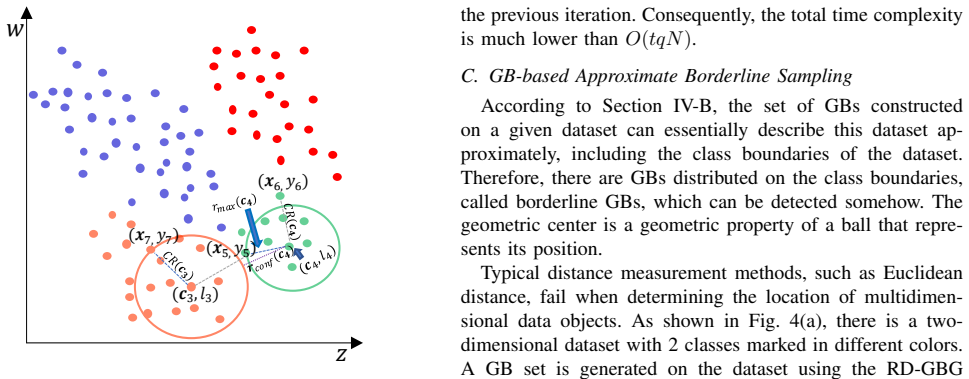
The carrying mechanism is restricted diffusion-based granular-ball generation (RD-GBG) paired with dimension-wise borderline detection. A granular ball is a ball with center $c$, radius $r$, label $l$, and the sample set $O$ it covers; RD-GBG makes every ball pure by expanding from a local-density center until the $\omega$-th nearest neighbor is homogeneous and the $(\omega+1)$-th is heterogeneous, then caps the radius at the conflict radius $r_{\mathrm{conf}}(c)$ if the ball would overlap an earlier one. This builds a non-overlapping cover of the data whose boundaries match the class structure, avoiding the blurred or shrunken boundaries that overlapping balls cause. For sampling, the centers of all balls are ordered along each feature; a center is borderline if a left or right neighbor in any dimension belongs to a different class, and the samples adjacent to those centers in the corresponding dimension are collected. Local-density center detection, which counts heterogeneous neighbors $h(c,l)$ among the $\rho$ nearest neighbors, acts as the built-in noise filter: it labels candidate centers or their nearest neighbors as class noise and returns low-density samples to the undivided set.
What would settle it
Take a synthetic two-class dataset with known injected label flips, run RD-GBG with a fixed $\rho$, and compare the samples flagged as class noise under the $h(c,l)=\rho$ rule against the ground-truth flips. If precision on the flips is no better than random selection, or if most flagged samples are actually boundary points, the claimed noise robustness without a purity threshold collapses.
Extended reading notes
Core claim
On its own terms, the paper claims that a granular-ball sampling method can do two things existing general samplers do not: keep the samples that carry class-boundary information and remove class noise from the training set, with no purity threshold to tune. The method first runs RD-GBG, which grows pure, non-overlapping granular balls from local-density centers by restricted diffusion: each ball expands until it meets a heterogeneous sample or a previously generated ball, and if the locally consistent radius $\mathrm{CR}(c)$ would collide with an existing ball, the radius is truncated to the restricted maximum consistent radius $r_{\max}(c)$. Then GBABS projects the ball centers onto each feature dimension and marks as borderline any ball whose left or right neighbor in that dimension has a different label; the samples just across those boundaries form the sampled set. On 13 datasets with injected class noise from 5% to 40%, the authors report that classifiers trained on GBABS samples beat GB-based GGBS, simple random sampling, and the unsampled data, and that the advantage grows as noise rises. The paper also reports lower sampling ratios than GGBS and stable behavior as the density tolerance $\rho$ ranges from 3 to 19, which it reads as evidence that no optimal purity threshold is required.
Load-bearing premise
The load-bearing premise is that a fixed rule on nearest-neighbor counts can tell genuine class noise from useful borderline points: if all $\rho$ nearest neighbors are foreign the center is noise, if exactly one is foreign that neighbor is noise, and otherwise the center is a low-density sample, with no theoretical or held-out justification for those cutoffs.
Editorial extensions
If this is right
- GBABS should keep classifiers accurate under class noise: the reported average accuracy at 40% noise is higher for GBABS than for GGBS, SRS, or the full dataset on every tested classifier.
- GBABS should compress more aggressively than GGBS on almost all datasets, and the gap widens as noise increases, because noise removal and borderline-only sampling both cut samples.
- On imbalanced data, GBABS should rank at or near the top in G-mean among eight sampling methods, particularly on noisy imbalanced datasets, because it undersamples the majority more aggressively near boundaries.
- The density tolerance $\rho$ should be an insensitive hyperparameter: sampling ratio and decision-tree accuracy stay roughly flat for $\rho$ from 3 to 19.
- The total runtime should stay roughly linear in the number of samples, $O(tqN + p m \log m)$, so the method scales to large datasets.
Reading between the lines
- A natural extension is to lift RD-GBG's local-density center detection out of sampling and use it as a standalone label-noise filter, since it requires only class-specific nearest-neighbor counts.
- The boundary-focused selection could also serve as a preprocessing step for active learning or large-scale support-vector training, where only points near the decision surface matter.
- At high noise ratios on small datasets, pure borderline undersampling may remove too many minority samples; pairing GBABS with a constrained oversampling step is a testable extension that its own G-mean rankings hint at.
- One direct check of the method's geometric claim is to compare the samples GBABS selects with the support vectors of a support-vector machine trained on the same data; high overlap would confirm that the ball centers approximate the true decision boundary.
Editorial analysis
A structured set of objections, weighed in public.
Referee Report
Summary. The paper proposes a two-stage sampling method for classification: RD-GBG, a restricted-diffusion granular-ball generation algorithm that avoids ball overlap and includes a local-density center detection rule for noise elimination, and GBABS, a granular-ball-based approximate borderline sampling method that selects samples near class boundaries. The authors claim that this is the first general sampling method that simultaneously performs borderline sampling and improves class-noise robustness, with linear time complexity and no need for an optimal purity threshold. Experiments on 13 datasets, with added class noise at 5%–40%, compare GBABS against GGBS, IGBS, SRS, SMOTE variants, and Tomek Links across five classifiers.
Significance. If the algorithm performs as claimed, it would be a practically useful contribution: it provides a general, compression-oriented sampling method that targets borderline points, and it comes with publicly available source code and a fairly broad experimental comparison. The RD-GBG overlap-avoidance mechanism is a reasonable idea, and the empirical evaluation spans multiple classifiers, datasets, and noise levels. However, the central noise-detection rule has a problematic behavior that undermines the boundary-preservation claim, and several experimental claims are stronger than the reported results support.
major comments (3)
- [Section IV-B1, Eq. (2) and Fig. 2] The local-density center detection rule deletes the nearest heterogeneous neighbor as class noise when h(c,l)=1. In a clean dataset, a nearest heterogeneous neighbor is typically a legitimate class-boundary point, not a mislabeled sample. The paper's own illustrative example in Fig. 2 is explicitly a noise-free dataset, yet for center (c3,l3) the nearest point (x1,y1) is removed as class noise. This behavior contradicts the paper's claim that the method preserves the class boundary while detecting noise, and it is load-bearing for both the borderline-sampling contribution and the noise-robustness claim. Please either revise the rule so that it can distinguish true label noise from genuine boundary structure, or provide direct evidence (e.g., on clean data with known boundaries) that this deletion does not degrade boundary fidelity.
- [Section V-C, Table II and Section V-D, Table IV] The claim that GBABS-based DT 'consistently achieves higher testingAccuracy' than plain DT is contradicted by Table II: plain DT has higher accuracy on S5 (0.8728 vs. 0.8709), S11 (0.9998 vs. 0.9994), and S12 (0.9750 vs. 0.9693). Similarly, Table IV shows GBABS-LightGBM at 5% and 10% noise (0.8660 and 0.8166) is worse than both GGBS-LightGBM (0.8690 and 0.8219) and plain LightGBM (0.8685 and 0.8222). The paper states only that GBABS 'generally performs better,' but the discussion in V-C and V-D conveys a stronger uniform superiority. Please analyze the datasets and settings where the method underperforms, and temper the claims accordingly.
- [Section IV-B3 and Section IV-C] The time-complexity claim that the total cost is O(tqN + p m log m) and 'still linear' is not justified as stated. The number of iterations t and the number of classes q are not bounded by constants in Algorithm 1; in the worst case t can be as large as O(N) and q as large as O(N). The text merely says the total is 'much lower than O(tqN),' which is not a formal bound. Please provide a rigorous worst-case analysis or clearly state the assumptions under which the method is linear in practice, supported by measured runtimes.
minor comments (5)
- [Section V-A1 and Section III-B] GGBS and IGBS are introduced in Section III-B as proposed in reference [23], but Section V-A1 cites [27] for these baselines; please correct the citation to avoid ambiguity.
- [Section V-A3] There is a typo in 'Accuray' that should be 'Accuracy'.
- [Section V-B] In the discussion of Fig. 6(a), the text says that for datasets with unclear class boundaries such as S3 the sampling ratio of GBABS is slightly higher than that of GGBS, but the figure appears to show GBABS with a lower ratio for S3; please verify the figure labels or the text.
- [Section VI] The conclusion states that 'the time complexity of the GBABS is not ideal when facing high-dimensional feature spaces,' which appears to contradict the earlier claim that the total complexity is linear; please reconcile these statements.
- [Algorithm 2, line 5] There is a typo in the notation: 'based on(c_j, l_i),(c_k, l_k)' should probably be 'based on(c_j, l_j),(c_k, l_k)'.
Circularity Check
No significant circularity: GBABS is validated by external benchmarks and the heuristic detection rules are assumptions, not reductions to the method's own outputs.
full rationale
The paper's central derivation is an algorithm construction, not a mathematical derivation from fitted constants. RD-GBG's local-density center detection (Section IV-B1) defines class noise via the rule h(c,l)=rho or h(c,l)=1; this is a heuristic assumption with rho as a tunable tolerance, and the sensitivity analysis (Section V-F) shows that the final accuracy is stable in rho. The 'without an optimal purity threshold' claim is therefore an empirical insensitivity claim, not a conclusion that follows from the definition. The borderline sampling step (Algorithm 2) is defined as collecting adjacent heterogeneous GBs, but the experimental evaluation compares against SRS, SMOTE, borderline-SMOTE, SMOTENC, and Tomek Links on 13 datasets and 5 classifiers, so the reported improvements do not reduce to the definition or to a fitted parameter. GGBS and IGBS are prior works by the same research group, but they are used as baselines, not as justifications for the soundness of the new method, and independent external baselines and public code provide corroboration. No uniqueness theorem is imported from the authors' prior work, and no equation is shown to equal an input by construction. The local-density heuristic could be criticized as arbitrary, but arbitrariness is a correctness or robustness concern, not circularity.
Assumptions & free parameters
free parameters (2)
- Density tolerance rho =
Not reported in main experiments; sensitivity range 3-19
- Random seed
assumptions (5)
- domain assumption A granular ball with center c and radius r can represent the local data distribution well enough for sampling decisions.
- ad hoc to paper A sample whose rho nearest neighbors are all heterogeneous is class noise; a sample with 1 < h(c,l) < rho heterogeneous neighbors is low-density and should not seed a ball.
- ad hoc to paper The nearest heterogeneous sample or previously generated ball defines the correct stopping boundary for a pure ball; Euclidean distance is the appropriate metric.
- ad hoc to paper Centers that have heterogeneous neighbors along any feature dimension are exactly the borderline centers that matter for classification.
- ad hoc to paper The number of RD-GBG iterations t is small enough that O(tqN) is effectively linear.
Cite this review
Pith. "Pith review of Approximate Borderline Sampling using Granular-Ball for Classification Tasks." pith.science (2026). https://pith.science/paper/4AJKRFRB
@misc{pith2026250602366,
  author       = {Pith},
  title        = {Pith review of: Approximate Borderline Sampling using Granular-Ball for Classification Tasks},
  year         = {2026},
  howpublished = {\url{https://pith.science/paper/4AJKRFRB}},
  note         = {Machine review of arXiv:2506.02366}
}
read the original abstract
Data sampling enhances classifier efficiency and robustness through data compression and quality improvement. Recently, the sampling method based on granular-ball (GB) has shown promising performance in generality and noisy classification tasks. However, some limitations remain, including the absence of borderline sampling strategies and issues with class boundary blurring or shrinking due to overlap between GBs. In this paper, an approximate borderline sampling method using GBs is proposed for classification tasks. First, a restricted diffusion-based GB generation (RD-GBG) method is proposed, which prevents GB overlaps by constrained expansion, preserving precise geometric representation of GBs via redefined ones. Second, based on the concept of heterogeneous nearest neighbor, a GB-based approximate borderline sampling (GBABS) method is proposed, which is the first general sampling method capable of both borderline sampling and improving the quality of class noise datasets. Additionally, since RD-GBG incorporates noise detection and GBABS focuses on borderline samples, GBABS performs outstandingly on class noise datasets without the need for an optimal purity threshold. Experimental results demonstrate that the proposed methods outperform the GB-based sampling method and several representative sampling methods. Our source code is publicly available at https://github.com/CherylTse/GBABS.
Figures


Figures from the paper (7 more)


Reference graph
Works this paper leans on
-
[1]
Adversarial robustness of streaming algorithms through impor- tance sampling,
V . Braverman, A. Hassidim, Y . Matias, M. Schain, S. Silwal, and S. Zhou, “Adversarial robustness of streaming algorithms through impor- tance sampling,”Advances in Neural Information Processing Systems, vol. 34, pp. 3544–3557, 2021
work page 2021
-
[2]
Distilling effective supervision from severe label noise,
Z. Zhang, H. Zhang, S. O. Arik, H. Lee, and T. Pfister, “Distilling effective supervision from severe label noise,” inProceedings of the IEEE/CVF Conference on Computer Vision and Pattern Recognition, 2020, pp. 9294–9303
work page 2020
-
[3]
A comparison of synthetic oversampling meth- ods for multi-class text classification. arxiv 2020,
A. Glazkova, “A comparison of synthetic oversampling meth- ods for multi-class text classification. arxiv 2020,”arXiv preprint arXiv:2008.04636
arXiv 2020
-
[4]
Coreset sampling from open-set for fine-grained self-supervised learning,
S. Kim, S. Bae, and S.-Y . Yun, “Coreset sampling from open-set for fine-grained self-supervised learning,” inProceedings of the IEEE/CVF Conference on Computer Vision and Pattern Recognition, 2023, pp. 7537–7547
work page 2023
-
[5]
Pointasnl: Robust point clouds processing using nonlocal neural networks with adaptive sampling,
X. Yan, C. Zheng, Z. Li, S. Wang, and S. Cui, “Pointasnl: Robust point clouds processing using nonlocal neural networks with adaptive sampling,” inProceedings of the IEEE/CVF conference on computer vision and pattern recognition, 2020, pp. 5589–5598
work page 2020
-
[6]
Attention-based point cloud edge sampling,
C. Wu, J. Zheng, J. Pfrommer, and J. Beyerer, “Attention-based point cloud edge sampling,” inProceedings of the IEEE/CVF Conference on Computer Vision and Pattern Recognition, 2023, pp. 5333–5343
work page 2023
-
[7]
Diffusion-based voice conversion with fast maximum likelihood sam- pling scheme,
V . Popov, I. V ovk, V . Gogoryan, T. Sadekova, M. Kudinov, and J. Wei, “Diffusion-based voice conversion with fast maximum likelihood sam- pling scheme,”arXiv preprint arXiv:2109.13821, 2021
arXiv 2021
-
[8]
Unsupervised sampling promoting for stochastic human trajectory prediction,
G. Chen, Z. Chen, S. Fan, and K. Zhang, “Unsupervised sampling promoting for stochastic human trajectory prediction,” inProceedings of the IEEE/CVF Conference on Computer Vision and Pattern Recognition, 2023, pp. 17 874–17 884
work page 2023
Show all 47 references
-
[9]
Model-based synthetic sampling for imbal- anced data,
C.-L. Liu and P.-Y . Hsieh, “Model-based synthetic sampling for imbal- anced data,”IEEE Transactions on Knowledge and Data Engineering, vol. 32, no. 8, pp. 1543–1556, 2020
2020
-
[10]
A robust oversampling approach for class imbalance problem with small disjuncts,
Y . Sun, L. Cai, B. Liao, W. Zhu, and J. Xu, “A robust oversampling approach for class imbalance problem with small disjuncts,”IEEE Transactions on Knowledge and Data Engineering, vol. 35, no. 6, pp. 5550–5562, 2023
2023
-
[11]
A review of methods for imbalanced multi-label classification,
A. N. Tarekegn, M. Giacobini, and K. Michalak, “A review of methods for imbalanced multi-label classification,”Pattern Recognition, vol. 118, p. 107965, 2021
2021
-
[12]
Borderline-smote: a new over- sampling method in imbalanced data sets learning,
H. Han, W.-Y . Wang, and B.-H. Mao, “Borderline-smote: a new over- sampling method in imbalanced data sets learning,” inInternational conference on intelligent computing. Springer, 2005, pp. 878–887
2005
-
[13]
Deepsmote: Fusing deep learning and smote for imbalanced data,
D. Dablain, B. Krawczyk, and N. V . Chawla, “Deepsmote: Fusing deep learning and smote for imbalanced data,”IEEE Transactions on Neural Networks and Learning Systems, 2022
2022
-
[14]
Adasyn- random forest based intrusion detection model,
Z. Chen, L. Zhou, and W. Yu, “Adasyn- random forest based intrusion detection model,” inProceedings of the 2021 4th International Confer- ence on Signal Processing and Machine Learning, 2021, pp. 152–159
2021
-
[15]
Abnormal samples oversampling for anomaly detection based on uniform scale strategy and closed area,
A. Shangguan, G. Xie, L. Mu, R. Fei, and X. Hei, “Abnormal samples oversampling for anomaly detection based on uniform scale strategy and closed area,”IEEE Transactions on Knowledge and Data Engineering, vol. 35, no. 12, pp. 11 999–12 011, 2023
2023
-
[16]
Two modifications of cnn,
I. TOMEK, “Two modifications of cnn,”IEEE Transactions on Systems, Man, and Cybernetics, vol. SMC-6, no. 11, pp. 769–772, 1976
1976
-
[17]
Random sampling with a reservoir,
J. S. Vitter, “Random sampling with a reservoir,”ACM Transactions on Mathematical Software (TOMS), vol. 11, no. 1, pp. 37–57, 1985
1985
-
[18]
P. S. Levy and S. Lemeshow,Sampling of populations: methods and applications. John Wiley & Sons, 2013
2013
-
[19]
R. A. Johnson and G. K. Bhattacharyya,Statistics: principles and methods. John Wiley & Sons, 2019
2019
-
[20]
Random forests,
L. Breiman, “Random forests,”Machine learning, vol. 45, pp. 5–32, 2001
2001
-
[21]
Fuzzy sets and information granularity,
L. A. Zadeh, “Fuzzy sets and information granularity,”Fuzzy sets, fuzzy logic, and fuzzy systems: selected papers, pp. 433–448, 1979
1979
-
[22]
Granular ball computing classifiers for efficient, scalable and robust learning,
S. Xia, Y . Liu, X. Ding, G. Wang, H. Yu, and Y . Luo, “Granular ball computing classifiers for efficient, scalable and robust learning,” Information Sciences, vol. 483, pp. 136–152, 2019
2019
-
[23]
Granular ball sampling for noisy label classification or imbalanced classification,
S. Xia, S. Zheng, G. Wang, X. Gao, and B. Wang, “Granular ball sampling for noisy label classification or imbalanced classification,” IEEE Transactions on Neural Networks and Learning Systems, vol. 34, no. 4, pp. 2144–2155, 2023
2023
-
[24]
k-times markov sampling for svmc,
B. Zou, C. Xu, Y . Lu, Y . Y . Tang, J. Xu, and X. You, “k-times markov sampling for svmc,”IEEE Transactions on Neural Networks and Learning Systems, vol. 29, no. 4, pp. 1328–1341, 2018
2018
-
[25]
Reduction of training data for support vector machine: a survey,
P. Birzhandi, K. T. Kim, and H. Y . Youn, “Reduction of training data for support vector machine: a survey,”Soft Computing, vol. 26, no. 8, pp. 3729–3742, 2022
2022
-
[26]
A method to improve support vector machine based on distance to hyperplane,
S.-y. Xia, Z.-y. Xiong, Y .-g. Luo, and L.-m. Dong, “A method to improve support vector machine based on distance to hyperplane,”Optik, vol. 126, no. 20, pp. 2405–2410, 2015
2015
-
[27]
An efficient and adaptive granular-ball generation method in classification problem,
S. Xia, X. Dai, G. Wang, X. Gao, and E. Giem, “An efficient and adaptive granular-ball generation method in classification problem,” IEEE Transactions on Neural Networks and Learning Systems, vol. 35, no. 4, pp. 5319–5331, 2024
2024
-
[28]
3wc- gbnrs++: A novel three-way classifier with granular-ball neighborhood rough sets based on uncertainty,
J. Yang, Z. Liu, S. Xia, G. Wang, Q. Zhang, S. Li, and T. Xu, “3wc- gbnrs++: A novel three-way classifier with granular-ball neighborhood rough sets based on uncertainty,”IEEE Transactions on Fuzzy Systems, vol. 32, no. 8, pp. 4376–4387, 2024
2024
-
[29]
A fast granular-ball-based density peaks clustering algorithm for large-scale data,
D. Cheng, Y . Li, S. Xia, G. Wang, J. Huang, and S. Zhang, “A fast granular-ball-based density peaks clustering algorithm for large-scale data,”IEEE Transactions on Neural Networks and Learning Systems, pp. 1–14, 2023
2023
-
[30]
An efficient spectral clustering algorithm based on granular-ball,
J. Xie, W. Kong, S. Xia, G. Wang, and X. Gao, “An efficient spectral clustering algorithm based on granular-ball,”IEEE Transactions on Knowledge and Data Engineering, vol. 35, no. 9, pp. 9743–9753, 2023
2023
-
[31]
W-gbc: An adaptive weighted clustering method based on granular-ball structure,
J. Xie, C. Hua, S. Xia, Y . Cheng, G. Wang, and X. Gao, “W-gbc: An adaptive weighted clustering method based on granular-ball structure,” in 2024 IEEE 40th International Conference on Data Engineering (ICDE), 2024, pp. 914–925
2024
-
[32]
Granular-ball fuzzy set and its implement in svm,
S. Xia, X. Lian, G. Wang, X. Gao, Q. Hu, and Y . Shao, “Granular-ball fuzzy set and its implement in svm,”IEEE Transactions on Knowledge and Data Engineering, vol. 36, no. 11, pp. 6293–6304, 2024
2024
-
[33]
Incremental learning based on granular ball rough sets for classifica- tion in dynamic mixed-type decision system,
Q. Zhang, C. Wu, S. Xia, F. Zhao, M. Gao, Y . Cheng, and G. Wang, “Incremental learning based on granular ball rough sets for classifica- tion in dynamic mixed-type decision system,”IEEE Transactions on Knowledge and Data Engineering, vol. 35, no. 9, pp. 9319–9332, 2023
2023
-
[34]
Open continual feature selection via granular-ball knowledge transfer,
X. Cao, X. Yang, S. Xia, G. Wang, and T. Li, “Open continual feature selection via granular-ball knowledge transfer,”IEEE Transactions on Knowledge and Data Engineering, pp. 1–14, 2024
2024
-
[35]
Gbnrs: A novel rough set algorithm for fast adaptive attribute reduction in classification,
S. Xia, H. Zhang, W. Li, G. Wang, E. Giem, and Z. Chen, “Gbnrs: A novel rough set algorithm for fast adaptive attribute reduction in classification,”IEEE Transactions on Knowledge and Data Engineering, vol. 34, no. 3, pp. 1231–1242, 2022
2022
-
[36]
Grrs: Accurate and efficient neighborhood rough set for feature selection,
S. Xia, S. Wu, X. Chen, G. Wang, X. Gao, Q. Zhang, E. Giem, and Z. Chen, “Grrs: Accurate and efficient neighborhood rough set for feature selection,”IEEE Transactions on Knowledge and Data Engineering, vol. 35, no. 9, pp. 9281–9294, 2023
2023
-
[37]
Graph- based representation for image based on granular-ball,
X. Shuyin, D. Dawei, Y . Long, Z. Li, L. Danf, W. Guoyet al., “Graph- based representation for image based on granular-ball,”arXiv preprint arXiv:2303.02388, 2023
2023 arXiv
-
[38]
Gbg++: A fast and stable granular ball generation method for clas- sification,
Q. Xie, Q. Zhang, S. Xia, F. Zhao, C. Wu, G. Wang, and W. Ding, “Gbg++: A fast and stable granular ball generation method for clas- sification,”IEEE Transactions on Emerging Topics in Computational Intelligence, vol. 8, no. 2, pp. 2022–2036, 2024
2022
-
[39]
Smote: synthetic minority over-sampling technique,
N. V . Chawla, K. W. Bowyer, L. O. Hall, and W. P. Kegelmeyer, “Smote: synthetic minority over-sampling technique,”Journal of artificial intel- ligence research, vol. 16, pp. 321–357, 2002
2002
-
[40]
Nearest neighbor pattern classification,
T. Cover and P. Hart, “Nearest neighbor pattern classification,”IEEE transactions on information theory, vol. 13, no. 1, pp. 21–27, 1967
1967
-
[41]
Clas- sification and regression trees,
L. Breiman, J. H. Friedman, R. A. Olshen, and C. J. Stone, “Clas- sification and regression trees,”Journal of the American Statistical Association, vol. 79, no. 387, pp. 861–881, 1984
1984
-
[42]
Lightgbm: A highly efficient gradient boosting decision tree,
G. Ke, Q. Meng, T. Finley, T. Wang, W. Chen, W. Ma, Q. Ye, and T.- Y . Liu, “Lightgbm: A highly efficient gradient boosting decision tree,” Advances in neural information processing systems, vol. 30, 2017
2017
-
[43]
Xgboost: A scalable tree boosting system,
T. Chen and C. Guestrin, “Xgboost: A scalable tree boosting system,” inProceedings of the 22nd acm sigkdd international conference on knowledge discovery and data mining, 2016, pp. 785–794
2016
-
[44]
C. J. M. C. L. Blake. Uci repository of machine learning databases. 2022, 11 15. [Online]. Available: https://archive.ics.uci.edu/ml/datasets.php
2022
-
[45]
Keel data-mining software tool: Data set repository, integration of algorithms and experi- mental analysis framework,
J. Derrac, S. Garcia, L. Sanchez, and F. Herrera, “Keel data-mining software tool: Data set repository, integration of algorithms and experi- mental analysis framework,”J. Mult. Valued Logic Soft Comput, vol. 17, pp. 255–287, 2015
2015
-
[46]
The use of machine learning methods in classification of pumpkin seeds (cucurbita pepo l.),
M. Koklu, S. Sarigil, and O. Ozbek, “The use of machine learning methods in classification of pumpkin seeds (cucurbita pepo l.),”Genetic Resources and Crop Evolution, vol. 68, no. 7, pp. 2713–2726, 2021
2021
-
[47]
Speed up kernel discriminant analysis,
D. Cai, X. He, and J. Han, “Speed up kernel discriminant analysis,”The VLDB Journal, vol. 20, pp. 21–33, 2011
2011
Reviewed August 7, 2026 · model on record in the stance chip above.
Discussion (0). Sign in to comment.