Periodic Radio Technosignature Search toward 3I/ATLAS with FAST
Pith reviewed 2026-07-03 05:27 UTC · model grok-4.3
The pith
No credible periodic radio technosignature above 0.146 W was detected from the interstellar object 3I/ATLAS using the FAST telescope.
A machine-rendered reading of the paper's core claim, the machinery that carries it, and where it could break.
Core claim
The search finds no credible artificial periodic radio technosignature above 0.146 W from the direction of 3I/ATLAS. The application of canonical polyadic decomposition to factorize the multibeam data tensor into time, frequency, and beam components allows selection of candidates via periodogram and autocorrelation, but none prove artificial.
What carries the argument
Canonical polyadic decomposition (CPD) applied to the multibeam dynamic spectra, which factorizes the data tensor into separable components with time, frequency, and beam signatures to separate potential signals from RFI.
If this is right
- Sets an upper limit on the power of any periodic radio technosignatures from 3I/ATLAS.
- Expands the types of signals considered in technosignature searches for this object.
- Shows that CPD can be used effectively for multibeam periodic technosignature searches.
Where Pith is reading between the lines
- This method could be applied to searches for other interstellar objects or exoplanets.
- If periodic signals are common in artificial transmissions, future searches should prioritize this approach.
- The non-detection constrains models of potential extraterrestrial technology on interstellar objects.
Load-bearing premise
Any artificial technosignature from 3I/ATLAS would be periodic, sufficiently strong above 0.146 W, and distinguishable from radio-frequency interference using the CPD factor signatures.
What would settle it
Detection of a periodic signal with beam signature matching the center beam and power above 0.146 W that cannot be explained by natural sources or RFI would falsify the non-detection claim.
Figures
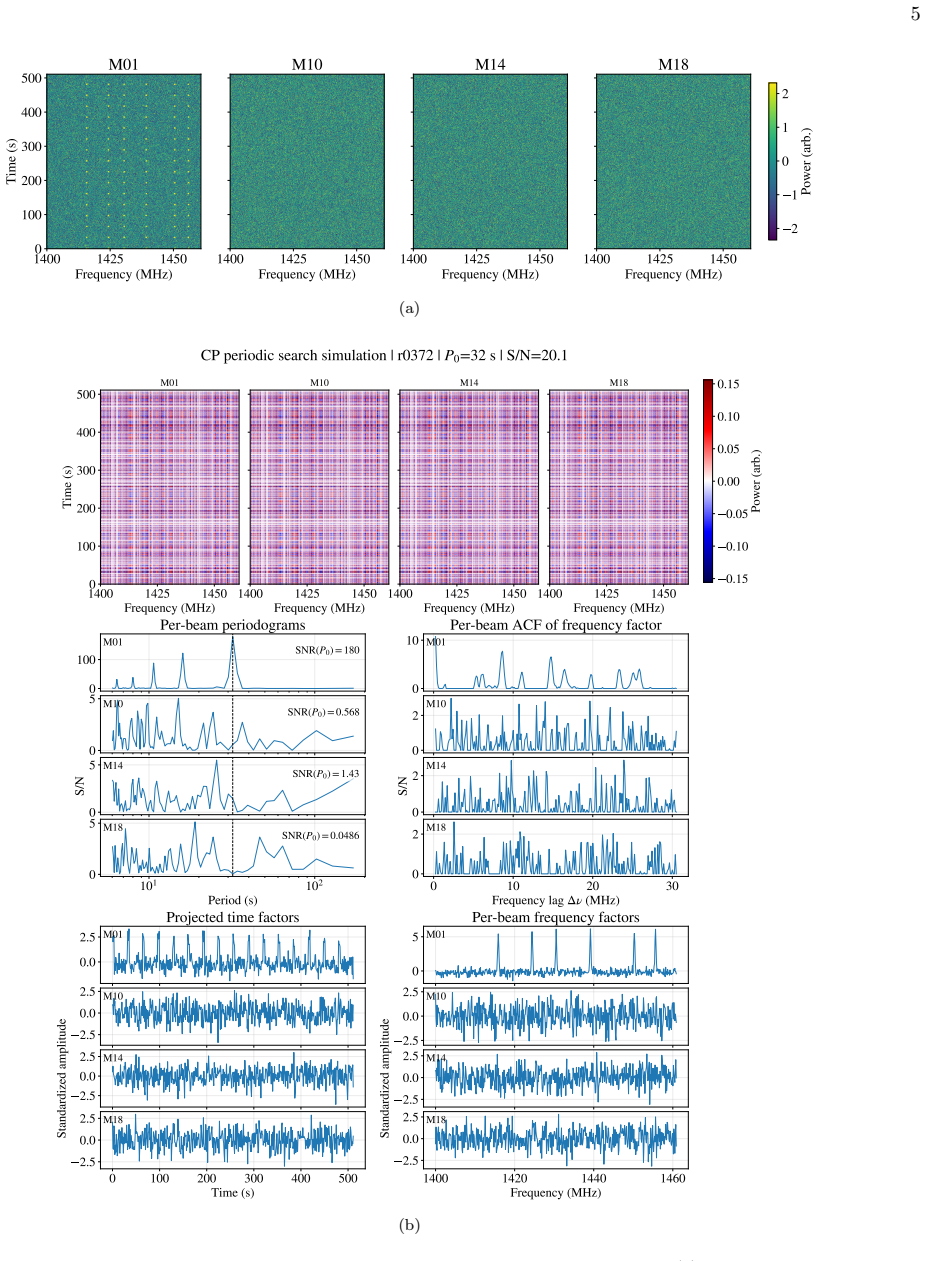
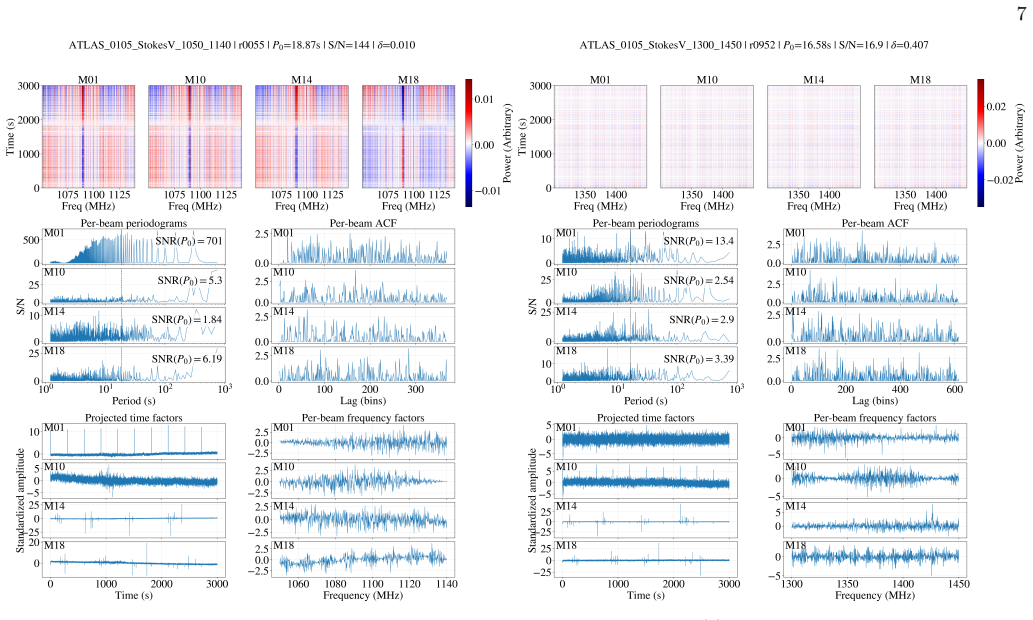
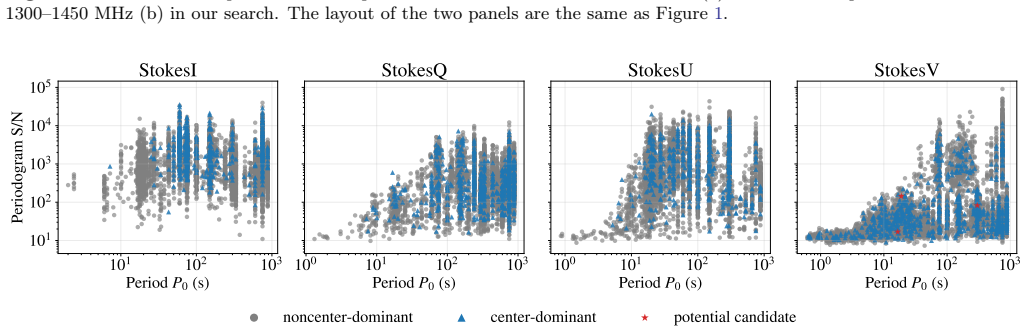
read the original abstract
3I/ATLAS, the third confirmed interstellar object discovered in the Solar System, provides a unique opportunity for targeted technosignature searches. We report a periodic radio technosignature search toward 3I/ATLAS using the Five-hundred-meter Aperture Spherical Telescope (FAST) L-band multibeam receiver. To search for periodically modulated signals and distinguish center-beam-dominated candidates from multibeam radio-frequency interference, we apply canonical polyadic decomposition (CPD) to the multibeam dynamic spectra. CPD factorizes the multibeam data tensor into a set of separable components, with associated time, frequency, and beam signatures. Candidate components are then selected through periodogram and autocorrelation diagnostics. We find no credible artificial periodic radio technosignature above 0.146 W is detected from the direction of 3I/ATLAS. This search expands the range of signal types explored for this target by including periodic modulated signal, and illustrates that CPD is a promising framework for multibeam periodic technosignature searches.
Editorial analysis
A structured set of objections, weighed in public.
Referee Report
Summary. The manuscript reports a targeted search for periodic radio technosignatures from the interstellar object 3I/ATLAS using FAST L-band multibeam observations. The authors apply canonical polyadic decomposition (CPD) to factorize the multibeam dynamic spectra into time, frequency, and beam components, followed by periodogram and autocorrelation diagnostics to select candidates. They report a null result: no credible artificial periodic radio technosignature is detected above a power threshold of 0.146 W.
Significance. If the null result and power threshold hold after verification, the work provides a new constraint on periodic modulated signals from this interstellar object and demonstrates CPD as a framework for multibeam RFI rejection in technosignature searches. The methodological approach is a strength, as it directly addresses beam-dependent signal separation without introducing free parameters or circular reductions.
major comments (1)
- [Methods (power threshold calculation and CPD diagnostics)] The derivation and validation of the 0.146 W power threshold (stated in the abstract) is load-bearing for the central null-result claim. The manuscript must provide explicit details on how this limit incorporates selection effects, CPD factor signature diagnostics, and any assumptions about signal periodicity and strength; without this, it is not possible to confirm the threshold is robust against false negatives or RFI leakage.
minor comments (2)
- [Abstract] The abstract would benefit from including basic observation parameters such as total integration time, frequency coverage, and beam configuration to allow readers to contextualize the sensitivity.
- [Methods] Notation for the CPD factors (time/frequency/beam) should be defined consistently when first introduced to improve readability for readers unfamiliar with tensor methods.
Simulated Author's Rebuttal
We thank the referee for their detailed review and constructive suggestion. We address the major comment point by point below.
read point-by-point responses
-
Referee: The derivation and validation of the 0.146 W power threshold (stated in the abstract) is load-bearing for the central null-result claim. The manuscript must provide explicit details on how this limit incorporates selection effects, CPD factor signature diagnostics, and any assumptions about signal periodicity and strength; without this, it is not possible to confirm the threshold is robust against false negatives or RFI leakage.
Authors: We acknowledge that the current manuscript does not provide sufficient explicit details on the derivation of the 0.146 W power threshold. In the revised manuscript, we will include a new subsection under Methods that fully describes the calculation process. This will cover: (1) how the threshold accounts for selection effects arising from the CPD factorization and subsequent periodogram/autocorrelation diagnostics; (2) the specific diagnostics used for CPD factor signatures; (3) assumptions regarding signal periodicity (e.g., the searched period range and modulation characteristics) and strength; and (4) validation procedures such as signal injection tests to evaluate robustness against false negatives and potential RFI leakage. This addition will strengthen the null-result claim. revision: yes
Circularity Check
No circularity in derivation chain
full rationale
The paper reports a null detection of periodic technosignatures from observational FAST telescope data via canonical polyadic decomposition of multibeam dynamic spectra, followed by periodogram and autocorrelation selection. No load-bearing equations, fitted parameters renamed as predictions, or self-citation chains appear in the provided text; the claimed upper limit of 0.146 W is a direct outcome of applying the described analysis pipeline to the data tensor. The derivation is self-contained against external benchmarks (telescope observations) with no reduction of the central claim to its own inputs by construction.
Axiom & Free-Parameter Ledger
Reference graph
Works this paper leans on
-
[2]
Carroll, J. D., & Chang, J.-J. 1970, title Analysis of individual differences in multidimensional scaling via an N-way generalization of “Eckart-Young” decomposition, Psychometrika, 35, 283, 10.1007/BF02310791
-
[14]
Kolda, T. G., & Bader, B. W. 2009, title Tensor Decompositions and Applications, SIAM Review, 51, 455, 10.1137/07070111X
-
[15]
2019, title TensorLy: Tensor Learning in Python, Journal of Machine Learning Research, 20, 1
Kossaifi, J., Panagakis, Y., Anandkumar, A., & Pantic, M. 2019, title TensorLy: Tensor Learning in Python, Journal of Machine Learning Research, 20, 1. http://jmlr.org/papers/v20/18-277.html
2019
-
[16]
Kruskal, J. B. 1989, Rank, decomposition, and uniqueness for 3-way and n-way arrays (NLD: North-Holland Publishing Co.), 7–18
1989
-
[22]
J., Smirnov , O
Pisano , D. J., Smirnov , O. M., Ivchenko , M., et al. 2025, title Further MeerKAT observations of 1665/1667 MHz OH in absorption and emission, and a technosignature search in 3I/ATLAS , The Astronomer's Telegram, 17499, 1
2025
-
[30]
2025, pyTensorlab 2025.12,
Vervliet, N., Hendrikx, S., Widdershoven, R., et al. 2025, pyTensorlab 2025.12,
2025
-
[32]
The Search for Extraterrestrial Intelligence (SETI). , keywords =. doi:10.1146/annurev.astro.39.1.511 , adsurl =
-
[33]
, year = 1959, month = sep, volume =
Searching for Interstellar Communications. , year = 1959, month = sep, volume =. doi:10.1038/184844a0 , adsurl =
-
[34]
International Journal of Astrobiology , keywords =
Intermittent signals and planetary days in SETI. International Journal of Astrobiology , keywords =. doi:10.1017/S1473550420000038 , archiveprefix =. 2109.06175 , primaryclass =
-
[35]
The Application of Autocorrelation SETI Search Techniques in an ATA Survey
The Application of Autocorrelation SETI Search Techniques in an ATA Survey. , keywords =. doi:10.3847/1538-4357/aaeb98 , archiveprefix =. 1506.00055 , primaryclass =
work page internal anchor Pith review Pith/arXiv arXiv doi:10.3847/1538-4357/aaeb98
-
[36]
Research Notes of the American Astronomical Society , keywords =
Breakthrough Listen Observations of 3I/ATLAS with the Green Bank Telescope at 1─12 GHz. Research Notes of the American Astronomical Society , keywords =. doi:10.3847/2515-5172/ae3083 , archiveprefix =. 2512.19763 , primaryclass =
-
[37]
The Astronomer's Telegram , keywords =
Further MeerKAT observations of 1665/1667 MHz OH in absorption and emission, and a technosignature search in 3I/ATLAS. The Astronomer's Telegram , keywords =
-
[38]
A Search for Radio Technosignatures from Interstellar Object 3I/ATLAS with the Allen Telescope Array
A Search for Radio Technosignatures from Interstellar Object 3I/ATLAS with the Allen Telescope Array. arXiv e-prints , keywords =. doi:10.48550/arXiv.2512.18142 , archiveprefix =. 2512.18142 , primaryclass =
work page internal anchor Pith review Pith/arXiv arXiv doi:10.48550/arxiv.2512.18142
-
[39]
Narrowband Radio Technosignature Search toward 3I/ATLAS with FAST
Narrowband Radio Technosignature Search toward 3I/ATLAS with FAST. arXiv e-prints , keywords =. doi:10.48550/arXiv.2603.19023 , archiveprefix =. 2603.19023 , primaryclass =
work page internal anchor Pith review Pith/arXiv arXiv doi:10.48550/arxiv.2603.19023
-
[40]
Hitchcock, Frank L. , title =. Journal of Mathematics and Physics , volume =. doi:https://doi.org/10.1002/sapm192761164 , url =. https://onlinelibrary.wiley.com/doi/pdf/10.1002/sapm192761164 , year =
-
[41]
and Bader, Brett W
Kolda, Tamara G. and Bader, Brett W. , title =. SIAM Review , volume =. 2009 , doi =
2009
-
[42]
Eckart-Young
Analysis of individual differences in multidimensional scaling via an N-way generalization of “Eckart-Young” decomposition , author =. Psychometrika , volume =. 1970 , doi =
1970
-
[43]
Hillar, Christopher J. and Lim, Lek-Heng , title =. 2013 , issue_date =. doi:10.1145/2512329 , journal =
-
[44]
Kruskal, J. B. , title =. Multiway Data Analysis , pages =. 1989 , isbn =
1989
-
[45]
The Breakthrough Listen Search for Intelligent Life: 1.1-1.9 GHz observations of 692 Nearby Stars
The Breakthrough Listen Search for Intelligent Life: 1.1-1.9 GHz Observations of 692 Nearby Stars. , keywords =. doi:10.3847/1538-4357/aa8d1b , archiveprefix =. 1709.03491 , primaryclass =
work page internal anchor Pith review Pith/arXiv arXiv doi:10.3847/1538-4357/aa8d1b
-
[46]
Dual-backend Multibeam Position-switching Targeted SETI Observations toward Nearby Active Planet-hosting Systems with FAST. , keywords =. doi:10.3847/1538-3881/ae28cc , archiveprefix =. 2509.09654 , primaryclass =
-
[47]
A 4-8 GHz Galactic Center Search for Periodic Technosignatures. , keywords =. doi:10.3847/1538-3881/acccf0 , archiveprefix =. 2305.18527 , primaryclass =
-
[48]
The Five-Hundred-Meter Aperture Spherical Radio Telescope (FAST) Project
The Five-Hundred Aperture Spherical Radio Telescope (fast) Project. International Journal of Modern Physics D , keywords =. doi:10.1142/S0218271811019335 , archiveprefix =. 1105.3794 , primaryclass =
work page internal anchor Pith review Pith/arXiv arXiv doi:10.1142/s0218271811019335
-
[49]
The Five-hundred-meter Aperture Spherical Radio Telescope (FAST) Project
The Five-hundred-meter Aperture Spherical Radio Telescope Project. Radio Science , keywords =. doi:10.1002/2015RS005877 , archiveprefix =. 1612.09372 , primaryclass =
work page internal anchor Pith review Pith/arXiv arXiv doi:10.1002/2015rs005877
-
[50]
Research in Astronomy and Astrophysics , keywords =
The fundamental performance of FAST with 19-beam receiver at L band. Research in Astronomy and Astrophysics , keywords =. doi:10.1088/1674-4527/20/5/64 , archiveprefix =. 2002.01786 , primaryclass =
-
[51]
Astrobiology , year = 2010, month = jun, volume =
Searching for Cost-Optimized Interstellar Beacons. Astrobiology , year = 2010, month = jun, volume =. doi:10.1089/ast.2009.0394 , adsurl =
-
[52]
Commissioning Progress of the FAST
Commissioning progress of the FAST. Science China Physics, Mechanics, and Astronomy , keywords =. doi:10.1007/s11433-018-9376-1 , archiveprefix =. 1903.06324 , primaryclass =
work page internal anchor Pith review Pith/arXiv arXiv doi:10.1007/s11433-018-9376-1 1903
-
[53]
FAST: Its Scientific Achievements and Prospects. The Innovation , keywords =. doi:10.1016/j.xinn.2020.100053 , archiveprefix =. 2011.13542 , primaryclass =
-
[54]
Optimal periodicity searching: revisiting the fast folding algorithm for large-scale pulsar surveys. , keywords =. doi:10.1093/mnras/staa2291 , archiveprefix =. 2004.03701 , primaryclass =
-
[55]
doi:10.1007/978-3-642-39950-3 , adsurl =
Tools of Radio Astronomy. doi:10.1007/978-3-642-39950-3 , adsurl =
-
[56]
doi:10.1007/978-3-319-44431-4 , adsurl =
Interferometry and Synthesis in Radio Astronomy, 3rd Edition. doi:10.1007/978-3-319-44431-4 , adsurl =
-
[57]
Data processing and verification
New continuum and polarization observations of the Cygnus Loop with FAST I. Data processing and verification. Research in Astronomy and Astrophysics , keywords =. doi:10.1088/1674-4527/21/11/282 , adsurl =
-
[58]
Tensor decomposition of EEG signals: A brief review , journal =
Fengyu Cong and Qiu-Hua Lin and Li-Dan Kuang and Xiao-Feng Gong and Piia Astikainen and Tapani Ristaniemi , keywords =. Tensor decomposition of EEG signals: A brief review , journal =. 2015 , issn =. doi:https://doi.org/10.1016/j.jneumeth.2015.03.018 , url =
-
[59]
IEEE Transactions on Signal Processing , keywords =
Tensor Decomposition for Signal Processing and Machine Learning. IEEE Transactions on Signal Processing , keywords =. doi:10.1109/TSP.2017.2690524 , archivePrefix =. 1607.01668 , primaryClass =
-
[60]
Astronomy and Computing , year = 2018, month = oct, volume =
TensorFit a tool to analyse spectral cubes in a tensor mode. Astronomy and Computing , year = 2018, month = oct, volume =. doi:10.1016/j.ascom.2018.10.007 , adsurl =
-
[61]
Journal of Machine Learning Research , year =
Jean Kossaifi and Yannis Panagakis and Anima Anandkumar and Maja Pantic , title =. Journal of Machine Learning Research , year =
-
[62]
2025 , Note =
pyTensorlab 2025.12 , Author =. 2025 , Note =
2025
discussion (0)
Sign in with ORCID, Apple, or X to comment. Anyone can read and Pith papers without signing in.