REVIEW 2 major objections 5 minor 70 references
Repeated conditional-displacement interactions with an auxiliary qubit stabilize cat and squeezed-cat qubits without engineered two-photon reservoirs, while preserving the noise bias and partially correcting single-photon loss.
Reviewed by Pith at T0; open to challenge. T0 means a machine referee read the full paper against a public rubric. the ladder, T0–T4 →
T0 review · grok-4.5
2026-07-10 08:40 UTC pith:4B5UE7W3
load-bearing objection Solid, usable stroboscopic stabilizer for ordinary and squeezed cats that preserves bias and partially corrects loss; the cooling-rate vs size tradeoff is real but already owned by the authors. the 2 major comments →
Stroboscopic Stabilization of Cat Qubits
The pith
A machine-rendered reading of the paper's core claim, the machinery that carries it, and where it could break.
Core claim
A stroboscopic sequence of conditional displacements and auxiliary-qubit rotations, derived from a modular stabilizer of the cat (or squeezed-cat) manifold, implements effective dissipative cooling into that manifold without continuous reservoir engineering; the resulting dynamics preserve the exponential bit-flip / linear phase-flip noise bias and, for nonzero squeezing, render single-photon loss partially correctable.
What carries the argument
The small-Big-small (sBs) unitary obtained by a second-order Trotterization of the modular interaction Hamiltonian whose dark states are the finite-energy cat codewords; after each short interaction the auxiliary qubit is reset, generating the desired dissipative map.
Load-bearing premise
The cooling rate fixed by the modular condition of the Trotterized gate must remain large enough relative to physical error rates that the stabilized states stay close to the intended cat states as their size grows; the paper itself shows this rate vanishes for large effective size.
What would settle it
Measure bit-flip rates of stroboscopically stabilized cats (with and without squeezing) under controlled single-photon loss while increasing the effective cat size; if the rates stop falling exponentially once the modular cooling rate becomes comparable to the loss rate, the central claim fails.
Editorial analysis
A structured set of objections, weighed in public.
Referee Report
Summary. The manuscript proposes stroboscopic dissipative stabilization of ordinary and squeezed cat qubits via repeated interactions with an auxiliary two-level system under a quadratic (conditional-displacement) Hamiltonian, without engineered two-photon reservoir coupling. Starting from a lattice view of the cat code and the finite-energy stabilizer S_Δ (Eqs. 11–16), the authors derive modular jump operators and Trotterized sequences (sBs, ST, BsB; App. C, Eqs. 22–27). They show analytically that single-photon loss is partially correctable for r>0 (Eqs. 28–36), that the noise bias is preserved under oscillator and ancilla errors, and that the choice of stabilizer S versus S^{2} controls attractors and bit-flip performance (phase-space portraits, Figs. 8, 13; comparison to Shitara et al. and Xu et al.). Extensive master-equation numerics (Figs. 1–6, 9–12) extract Γ_Z and Γ_X under loss, dephasing, and ancilla T1/Tφ, and first-order perturbation theory for continuous squeezed-cat bit-flip rates is supplied (App. A).
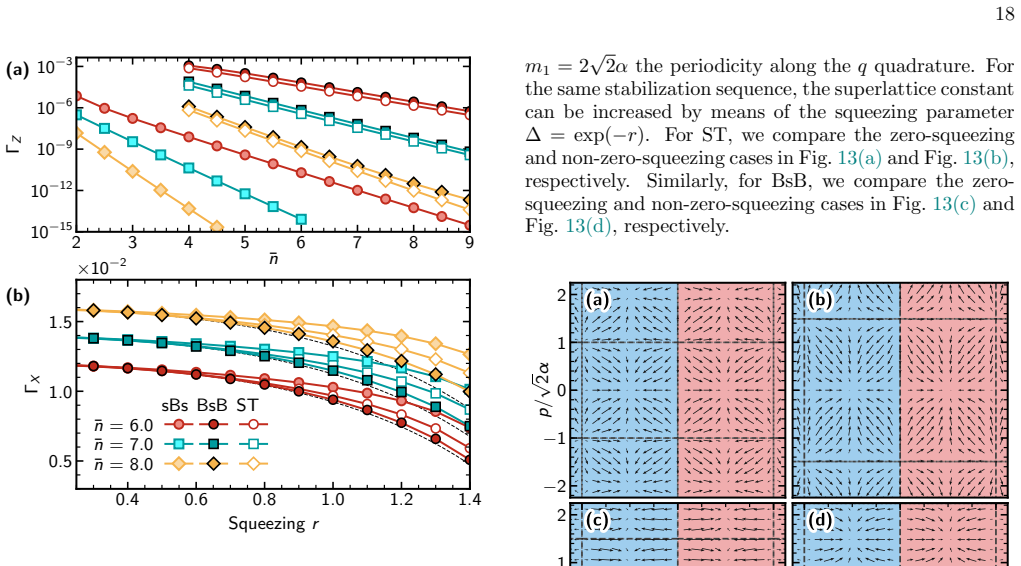
Significance. If the claims hold, the work supplies a platform-agnostic route to biased-noise cat stabilization that avoids nonlinear reservoir engineering and high-frequency flux modulation, with direct relevance to circuit QED and trapped ions. Strengths include an explicit pull-through of â through U_sBs demonstrating partial phase-flip correction, phase-space portraits that cleanly explain the S versus S^{2} attractor structure, systematic comparison of Trotter sequences, and first-order analytic bit-flip rates for the continuous dissipator that match numerics for r≳0.1. The limitation that modular cooling rate vanishes with β_eff (and that Γ_Z therefore ceases to improve exponentially) is already stated by the authors and does not overturn the core claims of bias-preserving stabilization and partial correctability.
major comments (2)
- §V.A.1 and the heuristic Γ_Z ~ |β_eff|^{2} exp(-c|β_eff|^{2}) with c≈3: the paper correctly reports that for large β_eff the modular cooling rate fixed by translational invariance (√(Γδt)=Δπ/m_μ, App. C) vanishes, smaller cats are stabilized, and the exponential improvement of Γ_Z saturates (especially for r≳0.5). This is load-bearing for any reading of the abstract as promising arbitrarily scalable bit-flip suppression. The abstract and conclusions should state the limitation more explicitly (e.g., that exponential suppression is observed only in a finite window of effective size set by the cooling-rate constraint), so that the claim remains commensurate with the numerics.
- App. A / continuous dissipator comparison: first-order perturbation theory for Γ_bit-flip of the continuous squeezed-cat dissipator is accurate for r≳0.1 and is a useful side result, but the stroboscopic protocol itself lacks a comparable analytic expression for Γ_Z. The heuristic fit is acknowledged to fail at larger r. Either a short first-order (or effective-rate) calculation for the stroboscopic manifold, or a clearer statement that the reported Γ_Z are purely numerical, would strengthen the central quantitative claim.
minor comments (5)
- Fig. 1(c) caption and surrounding text: the heuristic coefficient c≈3 is introduced without a derivation or error bar; a brief note that it is empirical would avoid over-interpretation.
- Eq. (5) and the large-α approximation for n-bar: the crossover between the exact and approximate expressions is used throughout the figures; stating the range of α,r where the approximation is used would improve reproducibility.
- §VI.D (trapped ions): the claim that first-order sideband rates are more favorable is plausible, but a short estimate of achievable Γ relative to typical heating/dephasing rates would make the platform argument more concrete.
- Notation: the modular operator q[m] and the two values of μ (S vs S^{2}) are introduced cleanly in App. C but appear earlier; a one-sentence pointer in §IV would help non-GKP readers.
- Typos / typesetting: occasional missing spaces around math (e.g., “r =0 .0” in Fig. 1 legend) and the arXiv id formatting in the header should be cleaned for the final version.
Circularity Check
No significant circularity: sequences are constructed from the modular dissipator via Trotterization; performance claims rest on independent master-equation numerics and shifted-Fock theory, not on fitted or self-definitional reductions.
full rationale
The load-bearing derivation (Secs. III–IV, App. C) starts from the stabilizer Ŝ_Δ of the (squeezed) cat manifold, obtains the modular jump operator d_Δ, replaces the bath by a reset auxiliary qubit, and Trotterizes the resulting unitary to the sBs (and ST/BsB) sequences. Translational invariance fixes the cooling rate √(Γδt)=Δπ/m_μ by construction; this is ordinary reservoir-engineering design, not a circular prediction of the subsequent error rates. Phase-flip asymptotics (App. B) follow from the shifted-Fock representation of the squeezed loss operator under the stated large-β approximation and are compared to independent numerical trajectories. Bit-flip rates for the continuous dissipator (App. A) are first-order perturbation results likewise checked against numerics. All Γ_Z/Γ_X values reported in Figs. 1–6,9,11–12 are extracted by exponential fits to master-equation data under explicit noise channels; no parameter is fitted to a data subset and then re-used as a “prediction.” Self-citations (Hillmann–Quijandría 2023 on continuous squeezed-cat dissipation; Royer et al. GKP sequences) supply background or comparison points and are not load-bearing for the stroboscopic construction or the bias-preservation claims. The paper’s own acknowledged limitation (cooling rate vanishes for large β_eff, so exponential improvement of Γ_Z eventually saturates) is an honest performance bound, not a circularity. Score 1 only for the minor, non-load-bearing self-citations that appear in the literature discussion.
Axiom & Free-Parameter Ledger
free parameters (4)
- κδt (loss channel amplitude per idle interval)
- g_eff/2π = 1 MHz
- heuristic coefficient c ≈ 3 in Γ_Z ~ |β_eff|² exp(−c|β_eff|²)
- Trotter order and sequence choice (sBs vs ST vs BsB)
axioms (6)
- domain assumption Markovian GKSL master equation adequately describes oscillator loss, dephasing, and ancilla decoherence during gates.
- domain assumption Short-time interaction with a reset qubit approximates the modular bath coupling Hint ∝ d_Δ w† + h.c., with modularity enforced by fixing √(Γδt).
- domain assumption Conditional displacements are generated by H_CD = (g_eff/2)(a e^{iφ} + h.c.) σ_z (or ion sideband Hamiltonians) with instantaneous ideal qubit rotations.
- domain assumption In the large-α (or large-β) limit, displaced squeezed states are approximately orthogonal and the shifted Fock basis truncation is valid for phase-flip estimates.
- standard math Suzuki-Trotter decompositions of the modular unitary yield effective cooling into the +1 eigenspace of S_Δ.
- ad hoc to paper The operator S = −D(iπ/(2α)) (and its finite-energy version) annihilates the ideal squeezed-cat manifold in the infinite-squeezing limit.
invented entities (1)
-
Finite-energy cat stabilizer S_Δ and modular jump operator d_Δ
no independent evidence
read the original abstract
Dissipatively stabilized cat qubits provide a promising route toward fault-tolerant quantum computation, exhibiting exponential suppression of bit-flip errors with increasing phase-space separation of the logical states, while incurring only a linear increase in phase-flip errors. Existing implementations rely on engineered two-photon dissipation via nonlinear coupling to a lossy environment, an approach largely confined to superconducting platforms and limited by spurious decay channels and finite dissipation rates. Here, we propose a fundamentally different stabilization paradigm based on repeated interactions with an auxiliary two-level system mediated by a quadratic Hamiltonian, enabling dissipative stabilization without reservoir engineering. Our approach overcomes key limitations of existing schemes and is compatible with a wider class of experimental platforms. Furthermore, it preserves the noise bias and extends to squeezed cat qubits, rendering single-photon loss errors partially correctable.
Figures




Reference graph
Works this paper leans on
-
[1]
The interaction Hamiltonian (21) realizes an exchange of generalized excitations ˆd† ∆ and ˆw† t between the oscilla- tor and the bath. However, as⟨ˆw † t ˆwt′⟩= 0, the reverse process ( ˆd† ∆ ˆwt) is forbidden and the effective dynamics become non-unitary, dissipatively cooling the oscillator into the +1 eigenstate of ˆS∆ at a rate∼Γ, see Ap- pendix C fo...
-
[2]
Channel model We begin by analyzing the error-correcting properties of the protocol by considering the case of ideal stabiliza- tion followed by idle evolution for a timeδtduring which the oscillator is subject to a loss or a dephasing chan- nel with amplitudesκδtorκ ϕδt, respectively, see also Fig. 1(b). We repeat the protocol over multiple cycles until ...
-
[3]
Gate errors One could also simulate conditional displacements im- plemented via the Hamiltonian (38) in the presence of single-photon loss errors. For a durationt CD of the conditional displacement gate, in the regimeκ −tCD ≪ 1, the probability of a photon-loss event is small and can be treated perturbatively. Then, to first order in κ−tCD, a photon-loss ...
-
[4]
Dephasing Qubit dephasing with rateγ ϕ is described by the dis- sipator γϕ 2 D[ˆσz]ˆρ.(41) As the controlled-displacement commutes with the gener- ator of the dissipative evolution, it is sufficient to consider a stochastic error model in which ˆσz is inserted before or after gates during the stabilization circuit. There are three non-equivalent locations...
-
[5]
Decay The case of spontaneous decay of the auxiliary qubit is distinct from the case of dephasing, as the jump oper- ator ˆσ− =|0⟩ ⟨1|does not commute with the controlled displacement Hamiltonian (38). As a result, we need to analyze the evolution d dt ˆρ=−i h ˆHCD,ˆρ i +γ −D[ˆσ−]ˆρ,(42) whereγ − = 1/T1 is the decay time of the auxiliary qubit. Before we ...
work page 2074
-
[6]
−i r Γδt 2 1 ∆ ˆq[mµ] ± √ 2µα ˆσx # (C6) ˆUT = exp
First-order Suzuki-Trotter approximation - Sharpen and Trim sequences First-order approximations can be obtained using the relation exp( ˆA) exp(ˆB)≈exp( ˆA+ ˆB). This leads to the sharpen (S) and trim (T) gates ˆUS = exp −i r Γδt 2 ∆ˆpˆσy ! ×exp " −i r Γδt 2 1 ∆ ˆq[mµ] ± √ 2µα ˆσx # (C6) ˆUT = exp " −i r Γδt 2 1 ∆ ˆq[mµ] ± √ 2µα ˆσx # ×exp −i r Γδt 2 ∆ˆp...
-
[7]
−i r Γδt 2 1 2∆ ˆq[mµ] ± √ 2µα ˆσx # ×exp −i r Γδt 2 ∆ˆpˆσy ! ×exp
Second-order Suzuki-Trotter approximations Second-order approximations are obtained using the relation exp( ˆA+ ˆB)≈exp( ˆA/2) exp(ˆB) exp( ˆA/2). a. small-Big-small sequence The so-called small-Big-small (sBs) sequence follows by replacing ˆA∝ˆpˆσy and ˆB∝ˆqˆσx. Thus, ˆUsBs = exp −i r Γδt 2 ∆ 2 ˆpˆσy ! ×exp " −i r Γδt 2 1 ∆ ˆq[mµ] ± √ 2µα ˆσx # ×exp −i r...
-
[8]
(C5) yield different approximations and, conse- quently, different bit- and phase-flip error rates
Numerical performance Different approaches to implementing the unitary Eq. (C5) yield different approximations and, conse- quently, different bit- and phase-flip error rates. This stems from various factors. First, the ST protocol is only a first-order approximation of Eq. (C5), whereas sBs and BsB are second-order Trotter approximations. Second, the prot...
-
[9]
Estimating error rates We numerically calculate the effective bit- and phase- flip rates by fitting the decaying logical observables, Tr[ ˆJZ ˆρ(t)]∼e−ΓZ t,(E7) Tr[ ˆJX ˆρ(t)]∼e−ΓX t.(E8) To this end, we initialize the system in an ideal state |α, r⟩or|0⟩ C (respectively) before time evolving it for a total timeT=nδt, withnthe total number of correction c...
-
[10]
B. M. Terhal, Quantum error correction for quantum memories, Rev. Mod. Phys.87, 307 (2015)
work page 2015
-
[11]
M. E. Beverland, A. Kubica, and K. M. Svore, Cost of Universality: A Comparative Study of the Overhead of State Distillation and Code Switching with Color Codes, PRX Quantum2, 020341 (2021)
work page 2021
-
[12]
C. Gidney and M. Eker˚ a, How to factor 2048 bit RSA in- tegers in 8 hours using 20 million noisy qubits, Quantum 5, 433 (2021)
work page 2048
-
[13]
P. Aliferis and J. Preskill, Fault-tolerant quantum com- putation against biased noise, Phys. Rev. A78, 052331 (2008)
work page 2008
-
[14]
P. Aliferis, F. Brito, D. P. DiVincenzo, J. Preskill, M. Steffen, and B. M. Terhal, Fault-tolerant computing with biased-noise superconducting qubits: A case study, New J. Phys.11, 013061 (2009)
work page 2009
-
[15]
D. Ruiz, J. Guillaud, A. Leverrier, M. Mirrahimi, and C. Vuillot, LDPC-cat codes for low-overhead quantum 20 computing in 2D, Nat Commun16, 1040 (2025)
work page 2025
-
[16]
Moving beyond the transmon: Noise-protected superconducting quantum circuits
A. Gyenis, A. Di Paolo, J. Koch, A. Blais, A. A. Houck, and D. I. Schuster, Moving beyond the Transmon: Noise- Protected Superconducting Quantum Circuits, PRX Quantum2, 030101 (2021), arXiv:2106.10296
work page internal anchor Pith review Pith/arXiv arXiv 2021
-
[17]
M. Mirrahimi, Z. Leghtas, V. V. Albert, S. Touzard, R. J. Schoelkopf, L. Jiang, and M. H. Devoret, Dynami- cally protected cat-qubits: A new paradigm for universal quantum computation, New J. Phys.16, 045014 (2014)
work page 2014
-
[18]
J. Guillaud and M. Mirrahimi, Repetition Cat Qubits for Fault-Tolerant Quantum Computation, Phys. Rev. X9, 041053 (2019)
work page 2019
-
[19]
Quantum information processing with bosonic qubits in circuit QED
A. Joshi, K. Noh, and Y. Y. Gao, Quantum information processing with bosonic qubits in circuit QED, Quantum Sci. Technol.6, 033001 (2021), arXiv:2008.13471
work page internal anchor Pith review Pith/arXiv arXiv 2021
-
[20]
W. Cai, Y. Ma, W. Wang, C.-L. Zou, and L. Sun, Bosonic quantum error correction codes in supercon- ducting quantum circuits, Fundamental Research1, 50 (2021), arXiv:2010.08699
work page internal anchor Pith review Pith/arXiv arXiv 2021
-
[21]
S. Puri, S. Boutin, and A. Blais, Engineering the quan- tum states of light in a Kerr-nonlinear resonator by two- photon driving, npj Quantum Inf.3, 18 (2017)
work page 2017
-
[22]
K. S. Dubovitskii, Bit-flip errors in dissipative cat qubits: Second-order perturbation theory, Phys. Rev. A111, 012617 (2025), arXiv:2407.17299 [quant-ph]
work page internal anchor Pith review Pith/arXiv arXiv 2025
-
[23]
D. S. Schlegel, F. Minganti, and V. Savona, Quantum error correction using squeezed Schr¨ odinger cat states, Phys. Rev. A106, 022431 (2022), arXiv:2201.02570
work page internal anchor Pith review Pith/arXiv arXiv 2022
-
[24]
X. Pan, J. Schwinger, N.-N. Huang, P. Song, W. Chua, F. Hanamura, A. Joshi, F. Valadares, R. Filip, and Y. Y. Gao, Protecting the Quantum Interference of Cat States by Phase-Space Compression, Phys. Rev. X13, 021004 (2023), arXiv:2212.01271 [quant-ph]
work page internal anchor Pith review Pith/arXiv arXiv 2023
-
[25]
Quantum error correction with dissipatively stabilized squeezed cat qubits
T. Hillmann and F. Quijandr´ ıa, Quantum error cor- rection with dissipatively stabilized squeezed-cat qubits, Phys. Rev. A107, 032423 (2023), arXiv:2210.13359 [quant-ph]
work page internal anchor Pith review Pith/arXiv arXiv 2023
-
[26]
Q. Xu, G. Zheng, Y.-X. Wang, P. Zoller, A. A. Clerk, and L. Jiang, Autonomous quantum error correction and fault-tolerant quantum computation with squeezed cat qubits, npj Quantum Inf9, 1 (2023)
work page 2023
-
[27]
Exploiting Translational Symmetry for Quantum Computing with Squeezed Cat Qubits
T. Shitara, G. Mintzer, Y. Tokunaga, and S. Endo, Ex- ploiting Translational Symmetry for Quantum Comput- ing with Squeezed Cat Qubits (2025), arXiv:2510.00497 [quant-ph]
work page internal anchor Pith review Pith/arXiv arXiv 2025
-
[28]
D. Gottesman, A. Kitaev, and J. Preskill, Encoding a qubit in an oscillator, Phys. Rev. A64, 012310 (2001)
work page 2001
-
[29]
Error correction of a logical grid state qubit by dissipative pumping
B. de Neeve, T.-L. Nguyen, T. Behrle, and J. P. Home, Error correction of a logical grid state qubit by dissipative pumping, Nat. Phys.18, 296 (2022), arXiv:2010.09681 [quant-ph]
work page internal anchor Pith review Pith/arXiv arXiv 2022
-
[30]
Quantum error correction of a qubit encoded in grid states of an oscillator
P. Campagne-Ibarcq, A. Eickbusch, S. Touzard, E. Zalys- Geller, N. E. Frattini, V. V. Sivak, P. Reinhold, S. Puri, S. Shankar, R. J. Schoelkopf, L. Frunzio, M. Mirrahimi, and M. H. Devoret, Quantum error correction of a qubit encoded in grid states of an oscillator, Nature584, 368 (2020), arXiv:1907.12487
work page internal anchor Pith review Pith/arXiv arXiv 2020
-
[31]
Stabilization of Finite-Energy Gottesman-Kitaev-Preskill States
B. Royer, S. Singh, and S. M. Girvin, Stabilization of Finite-Energy Gottesman-Kitaev-Preskill States, Phys. Rev. Lett.125, 260509 (2020), arXiv:2009.07941
work page internal anchor Pith review Pith/arXiv arXiv 2020
-
[32]
V. V. Sivak, A. Eickbusch, B. Royer, S. Singh, I. Tsiout- sios, S. Ganjam, A. Miano, B. L. Brock, A. Z. Ding, L. Frunzio, S. M. Girvin, R. J. Schoelkopf, and M. H. De- voret, Real-time quantum error correction beyond break- even, Nature616, 50 (2023), arXiv:2211.09116 [quant- ph]
work page internal anchor Pith review Pith/arXiv arXiv 2023
-
[33]
Autonomous quantum error correction of Gottesman-Kitaev-Preskill states
D. Lachance-Quirion, M.-A. Lemonde, J. O. Simoneau, L. St-Jean, P. Lemieux, S. Turcotte, W. Wright, A. Lacroix, J. Fr´ echette-Viens, R. Shillito, F. Hopf- mueller, M. Tremblay, N. E. Frattini, J. Camirand Le- myre, and P. St-Jean, Autonomous Quantum Error Cor- rection of Gottesman-Kitaev-Preskill States, Phys. Rev. Lett.132, 150607 (2024), arXiv:2310.114...
work page internal anchor Pith review Pith/arXiv arXiv 2024
-
[34]
S. Singh, B. Royer, and S. M. Girvin, Towards Non- Abelian Quantum Signal Processing: Efficient Control of Hybrid Continuous- and Discrete-Variable Architectures (2025), arXiv:2504.19992 [quant-ph]
work page internal anchor Pith review arXiv 2025
-
[35]
R. Lescanne, M. Villiers, T. Peronnin, A. Sarlette, M. Delbecq, B. Huard, T. Kontos, M. Mirrahimi, and Z. Leghtas, Exponential suppression of bit-flips in a qubit encoded in an oscillator, Nat. Phys.16, 509 (2020)
work page 2020
-
[36]
Enhancing dissipative cat qubit protection by squeezing
R. Rousseau, D. Ruiz, E. Albertinale, P. d’Avezac, D. Banys, U. Blandin, N. Bourdaud, G. Campanaro, G. Cardoso, N. Cottet, C. Cullip, S. Del´ eglise, L. De- vanz, A. Devulder, A. Essig, P. F´ evrier, A. Gicquel, ´E. Gouzien, A. Gras, J. Guillaud, E. G¨ um¨ u¸ s, M. Hall´ en, A. Jacob, P. Magnard, A. Marquet, S. Miklass, T. Per- onnin, S. Polis, F. Rautsch...
work page internal anchor Pith review Pith/arXiv arXiv 2025
-
[37]
A. Hajr, B. Qing, K. Wang, G. Koolstra, Z. Pedramrazi, Z. Kang, L. Chen, L. B. Nguyen, C. J¨ unger, N. Goss, I. Huang, B. Bhandari, N. E. Frattini, S. Puri, J. Dres- sel, A. N. Jordan, D. I. Santiago, and I. Siddiqi, High- Coherence Kerr-Cat Qubit in 2D Architecture, Phys. Rev. X14, 041049 (2024), arXiv:2404.16697 [quant-ph]
work page internal anchor Pith review Pith/arXiv arXiv 2024
-
[38]
Hardware-efficient quantum error correction via concatenated bosonic qubits
H. Putterman, K. Noh, C. T. Hann, G. S. MacCabe, S. Aghaeimeibodi, R. N. Patel, M. Lee, W. M. Jones, H. Moradinejad, R. Rodriguez, N. Mahuli, J. Rose, J. C. Owens, H. Levine, E. Rosenfeld, P. Reinhold, L. Mon- celsi, J. A. Alcid, N. Alidoust, P. Arrangoiz-Arriola, J. Barnett, P. Bienias, H. A. Carson, C. Chen, L. Chen, H. Chinkezian, E. M. Chisholm, M.-H....
work page internal anchor Pith review Pith/arXiv arXiv 2025
-
[39]
C. H. Bennett, D. P. DiVincenzo, J. A. Smolin, and W. K. Wootters, Mixed-state entanglement and quantum error correction, Phys. Rev. A54, 3824 (1996)
work page 1996
-
[40]
E. Knill and R. Laflamme, Theory of quantum error- correcting codes, Phys. Rev. A55, 900 (1997)
work page 1997
-
[41]
Z. Leghtas, S. Touzard, I. M. Pop, A. Kou, B. Vlas- takis, A. Petrenko, K. M. Sliwa, A. Narla, S. Shankar, M. J. Hatridge, M. Reagor, L. Frunzio, R. J. Schoelkopf, M. Mirrahimi, and M. H. Devoret, Confining the state of light to a quantum manifold by engineered two-photon loss, Science347, 853 (2015)
work page 2015
-
[42]
S. Touzard, A. Grimm, Z. Leghtas, S. O. Mundhada, P. Reinhold, C. Axline, M. Reagor, K. Chou, J. Blumoff, K. M. Sliwa, S. Shankar, L. Frunzio, R. J. Schoelkopf, M. Mirrahimi, and M. H. Devoret, Coherent oscilla- tions inside a quantum manifold stabilized by dissipation, Phys. Rev. X8, 021005 (2018)
work page 2018
-
[43]
Quantum control of a cat-qubit with bit-flip times exceeding ten seconds
U. R´ eglade, A. Bocquet, R. Gautier, A. Marquet, E. Al- bertinale, N. Pankratova, M. Hall´ en, F. Rautschke, L.-A. Sellem, P. Rouchon, A. Sarlette, M. Mirrahimi, P. Campagne-Ibarcq, R. Lescanne, S. Jezouin, and Z. Leghtas, Quantum control of a cat-qubit with bit- flip times exceeding ten seconds (2023), arXiv:2307.06617 [quant-ph]
work page internal anchor Pith review Pith/arXiv arXiv 2023
-
[44]
A. L. Grimsmo and S. Puri, Quantum Error Correction with the Gottesman-Kitaev-Preskill Code, PRX Quan- tum2, 020101 (2021)
work page 2021
-
[45]
A. J. Brady, A. Eickbusch, S. Singh, J. Wu, and Q. Zhuang, Advances in bosonic quantum error correc- tion with Gottesman–Kitaev–Preskill Codes: Theory, en- gineering and applications, Progress in Quantum Elec- tronics93, 100496 (2024), arXiv:2308.02913 [quant-ph]
work page internal anchor Pith review Pith/arXiv arXiv 2024
-
[46]
L.-A. Sellem, P. Campagne-Ibarcq, M. Mirrahimi, A. Sar- lette, and P. Rouchon, Exponential convergence of a dissi- pative quantum system towards finite-energy grid states of an oscillator, in2022 IEEE 61st Conf. Decis. Control CDC(2022) pp. 5149–5154, arXiv:2203.16836 [quant- ph]
work page internal anchor Pith review Pith/arXiv arXiv 2022
-
[47]
J. A. Gross, C. M. Caves, G. J. Milburn, and J. Combes, Qubit models of weak continuous measurements: Marko- vian conditional and open-system dynamics, Quantum Sci. Technol.3, 024005 (2018)
work page 2018
-
[48]
Ciccarello, Collision models in quantum optics, Quan- tum Meas
F. Ciccarello, Collision models in quantum optics, Quan- tum Meas. Quantum Metrol.4, 10.1515/qmetro-2017- 0007 (2017)
-
[49]
Y. Liu, S. Singh, K. C. Smith, E. Crane, J. M. Martyn, A. Eickbusch, A. Schuckert, R. D. Li, J. Sinanan-Singh, M. B. Soley, T. Tsunoda, I. L. Chuang, N. Wiebe, and S. M. Girvin, Hybrid Oscillator-Qubit Quantum Proces- sors: Instruction Set Architectures, Abstract Machine Models, and Applications, PRX Quantum7, 010201 (2026)
work page 2026
-
[50]
V. G. Matsos, C. H. Valahu, T. Navickas, A. D. Rao, M. J. Millican, X. C. Kolesnikow, M. J. Biercuk, and T. R. Tan, Robust and Deterministic Preparation of Bosonic Logical States in a Trapped Ion, Phys. Rev. Lett. 133, 050602 (2024)
work page 2024
-
[51]
C. McGarry, T. Chalermpusitarak, K. Schwennicke, F. Scuccimarra, M. J. Millican, V. G. Matsos, C. H. Valahu, P. Nagpal, H.-K. Chan, H. L. Nourse, I. Kassal, and T. R. Tan, Programmable quantum simulation of an- harmonic dynamics (2026), arXiv:2603.04744 [quant-ph]
-
[52]
Fast Universal Control of an Oscillator with Weak Dispersive Coupling to a Qubit
A. Eickbusch, V. Sivak, A. Z. Ding, S. S. Elder, S. R. Jha, J. Venkatraman, B. Royer, S. M. Girvin, R. J. Schoelkopf, and M. H. Devoret, Fast universal control of an oscillator with weak dispersive coupling to a qubit, Nat. Phys. , 1 (2022), arXiv:2111.06414
work page internal anchor Pith review Pith/arXiv arXiv 2022
-
[53]
Encoding qubits in multimode grid states
B. Royer, S. Singh, and S. Girvin, Encoding Qubits in Multimode Grid States, PRX Quantum3, 010335 (2022), arXiv:2201.12337
work page internal anchor Pith review Pith/arXiv arXiv 2022
-
[54]
S. Haroche and J.-M. Raimond,Exploring the Quantum: Atoms, Cavities, and Photons, Oxford Graduate Texts (Oxford University Press, Oxford, 2006)
work page 2006
-
[55]
D. J. Wineland, C. Monroe, W. M. Itano, D. Leibfried, B. E. King, and D. M. Meekhof, Experimental issues in coherent quantum-state manipulation of trapped atomic ions (1998), arXiv:quant-ph/9710025
work page internal anchor Pith review Pith/arXiv arXiv 1998
-
[56]
A. L. Grimsmo, J. Combes, and B. Q. Baragiola, Quantum Computing with Rotation-Symmetric Bosonic Codes, Phys. Rev. X10, 011058 (2020)
work page 2020
-
[57]
T. Hillmann, F. Quijandr´ ıa, A. L. Grimsmo, and G. Ferrini, Performance of Teleportation-Based Error- Correction Circuits for Bosonic Codes with Noisy Measurements, PRX Quantum3, 020334 (2022), arXiv:2108.01009 [quant-ph]
work page internal anchor Pith review Pith/arXiv arXiv 2022
-
[58]
M. H. Michael, M. Silveri, R. T. Brierley, V. V. Albert, J. Salmilehto, L. Jiang, and S. M. Girvin, New Class of Quantum Error-Correcting Codes for a Bosonic Mode, Phys. Rev. X6, 031006 (2016)
work page 2016
-
[59]
Y. Zeng, F. Quijandr´ ıa, C. Gneiting, and F. Nori, Quan- tum Error Correction with Superpositions of Squeezed Fock States, Phys. Rev. Lett.136, 190602 (2026), arXiv:2510.04209
work page internal anchor Pith review Pith/arXiv arXiv 2026
-
[60]
E. N. Bashmakova, S. B. Korolev, and T. Yu. Golubeva, Bosonic quantum error correction using squeezed Fock states, Phys. Rev. A112, 032434 (2025)
work page 2025
-
[61]
N. Gutman, E. Blumenthal, S. Hacohen-Gourgy, A. Orda, and I. Kaminer, Squeezed-vacuum bosonic codes, Advanced Physics Research , e00007 (2026), arXiv:2511.06108 [quant-ph]
work page internal anchor Pith review Pith/arXiv arXiv 2026
-
[62]
P. Leviant, Q. Xu, L. Jiang, and S. Rosenblum, Quan- tum capacity and codes for the bosonic loss-dephasing channel, Quantum6, 821 (2022)
work page 2022
-
[63]
Y. Zeng, Z.-Y. Zhou, E. Rinaldi, C. Gneiting, and F. Nori, Approximate Autonomous Quantum Error Cor- rection with Reinforcement Learning, Phys. Rev. Lett. 131, 050601 (2023)
work page 2023
-
[64]
R. Wang, A. Udupa, T. Hillmann, U. Chabaud, A. Fer- raro, and G. Ferrini, Bosonic quantum error-correcting codes with finite stellar rank (2026), arXiv:2607.06404 [quant-ph]
work page internal anchor Pith review Pith/arXiv arXiv 2026
-
[65]
Building a fault-tolerant quantum computer using concatenated cat codes
C. Chamberland, K. Noh, P. Arrangoiz-Arriola, E. T. Campbell, C. T. Hann, J. Iverson, H. Putterman, T. C. Bohdanowicz, S. T. Flammia, A. Keller, G. Refael, J. Preskill, L. Jiang, A. H. Safavi-Naeini, O. Painter, and F. G. Brand˜ ao, Building a Fault-Tolerant Quantum Computer Using Concatenated Cat Codes, PRX Quan- tum3, 010329 (2022), arXiv:2012.04108
work page internal anchor Pith review Pith/arXiv arXiv 2022
-
[66]
Analog information decoding of bosonic quantum LDPC codes
L. Berent, T. Hillmann, J. Eisert, R. Wille, and J. Roffe, Analog Information Decoding of Bosonic Quantum Low- Density Parity-Check Codes, PRX Quantum5, 020349 (2024), arXiv:2311.01328 [quant-ph]
work page internal anchor Pith review Pith/arXiv arXiv 2024
-
[67]
N. Lambert, E. Gigu` ere, P. Menczel, B. Li, P. Hopf, G. Su´ arez, M. Gali, J. Lishman, R. Gadhvi, R. Agarwal, A. Galicia, N. Shammah, P. Nation, J. R. Johansson, S. Ahmed, S. Cross, A. Pitchford, and F. Nori, QuTiP 22 5: The Quantum Toolbox in Python, Physics Reports QuTiP 5: The Quantum Toolbox in Python,1153, 1 (2026)
work page 2026
-
[68]
J. D. Hunter, Matplotlib: A 2D Graphics Environment, Comput. Sci. Eng.9, 90 (2007)
work page 2007
-
[69]
C. R. Harris and others, Array programming with NumPy, Nature585, 357 (2020)
work page 2020
-
[70]
Virtanen and others, SciPy 1.0: Fundamental algo- rithms for scientific computing in Python, Nat
P. Virtanen and others, SciPy 1.0: Fundamental algo- rithms for scientific computing in Python, Nat. Methods 17, 261 (2020)
work page 2020
discussion (0)
Sign in with ORCID, Apple, or X to comment. Anyone can read and Pith papers without signing in.