REVIEW 5 major objections 5 minor 49 references
Integrating Physics-Based and Data-Driven Approaches for Probabilistic Building Energy Modeling
T0 review · 5 major / 5 minor · reviewed 2026-08-06 · deepseek-v4-flash
Pith's one-line read This paper establishes that residual learning is the best-performing hybrid architecture for probabilistic building temperature forecasting and that conformalized quantile regression effectively calibrates the resulting intervals.
desk verdict A solid empirical benchmark of hybrid probabilistic building energy models; the residual approach's average superiority holds up, but the conformal calibration claim is overextended given the acknowledged distribution shift. read the letter →
The pith
A machine-rendered reading of the paper's core claim, the machinery that carries it, and where it could break.
The reading
What carries the argument
The central object is the residual hybrid formulation, Eq. (2), in which the data-driven quantile model is trained on $\mathbf{y} - f_{EP}(\mathbf{x})$, the gap between measured indoor temperature and the EnergyPlus simulation, instead of on $\mathbf{y}$ directly. This turns the physics model into a prior that already explains most of the thermal dynamics, leaving the learner to model a smaller, smoother residual. The calibration machinery is Conformalized Quantile Regression, whose non-conformity score $\max\{f_{\alpha/2}(\mathbf{x})-y, y-f_{1-\alpha/2}(\mathbf{x})\}$ and empirical-quantile correction $\Delta_q$ widen the raw quantile outputs so that prediction intervals reach nominal coverage.
What would settle it
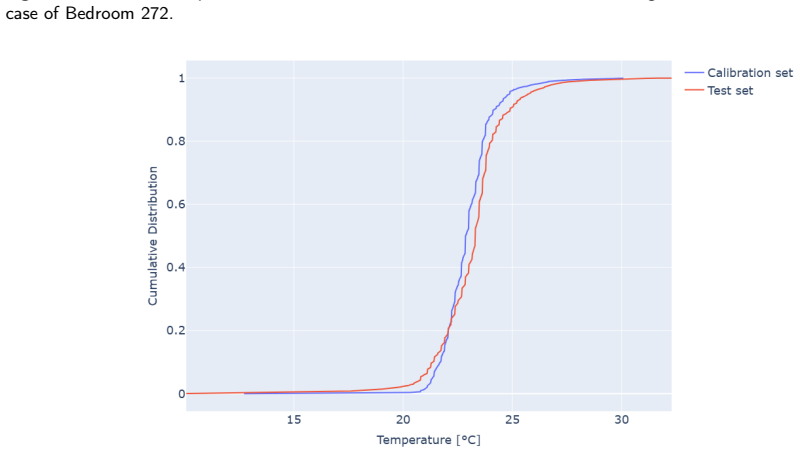
A season-split experiment would settle the calibration claim: calibrate on summer 2020 data only, test on winter 2021, and compare average coverage error with and without conformal correction; the paper's own Figure 12 shows the two distributions differ, so the burden is on showing the correction still achieves near-zero ACE.
Extended reading notes
Core claim
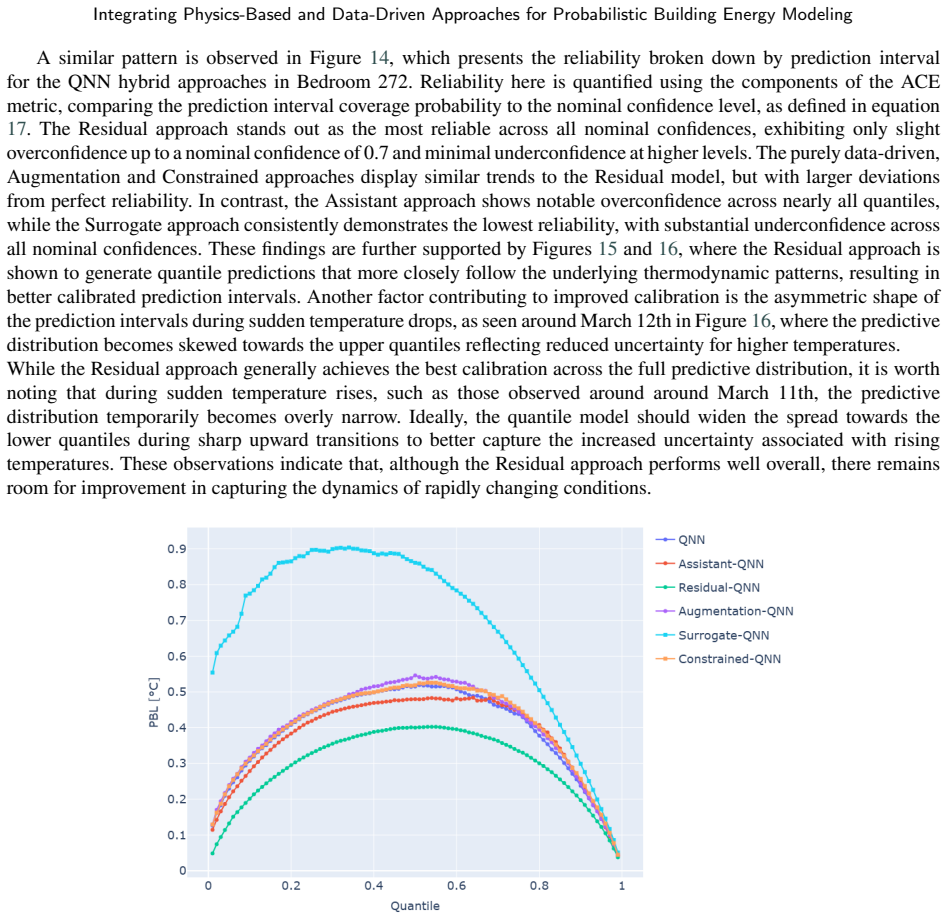
In the terms of the paper, predictive uncertainty in building thermodynamics is treated as primarily aleatoric, and all five hybrid strategies are cast into a quantile-regression framework with 99 quantiles. Across five rooms, the residual approach attains the lowest average pinball loss, with a quantile feedforward network reaching 0.33 against 0.37 for the pure data-driven QNN, and it also yields the best Winkler scores and among the best average coverage errors. In the out-of-distribution window-opening episodes, only the residual model captures the temperature drops, because it inherits the physics simulation's response while the other models do not. The ablation with Conformalized Quantile Regression shows that conformal calibration reduces average coverage error across all hybrid and data-driven QNN models, mainly by widening the prediction intervals.
Load-bearing premise
The conformal calibration step assumes the 20% of the 2020 training year used for calibration is exchangeable with the 2021 test year, an assumption the paper itself notes is partially violated by seasonality and changing occupant behavior.
Editorial extensions
If this is right
- For probabilistic indoor-temperature modeling, a residual hybrid architecture appears preferable to assistant, augmentation, constrained, or surrogate designs, and best with a feedforward neural network as the residual learner.
- The physical-plausibility advantage of residual learning in out-of-distribution conditions suggests that hybrid models can be more trustworthy than pure data-driven models when operating conditions shift.
- Conformalized Quantile Regression is a viable post-training calibration step for building temperature quantiles; its main effect is to widen intervals to correct coverage.
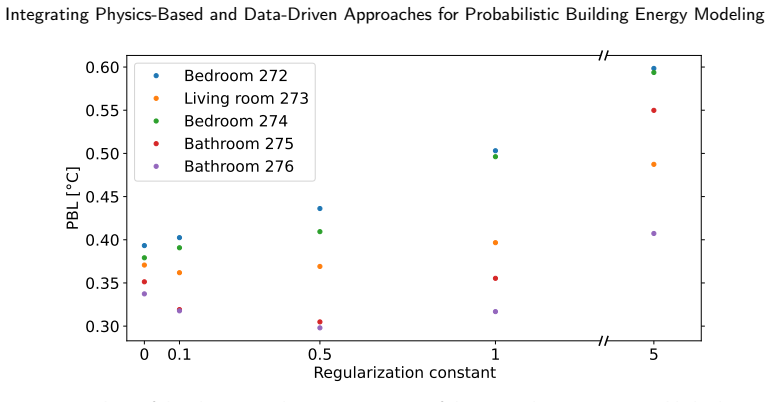
- The constrained approach's benefit is room-dependent: physics regularization helps bathrooms, where sensors are sparse, but adds little for well-sensed bedrooms.
- Surrogate learning, which replaces the physics model entirely, performs worst among hybrids and should be avoided when the physics simulator is available at inference time.
Reading between the lines
- A broader implication the paper leaves implicit is that residual learning may be the most sample-efficient way to inject a physics prior, because the learner only needs to model the residual rather than rediscover the dominant heat dynamics.
- The exchangeability caveat suggests a natural extension: adaptive conformal procedures, or a calibration set spanning all seasons, would likely preserve the reported coverage gains under stronger distribution shift.
- One could test whether the residual advantage persists when the physics model is deliberately miscalibrated, since the residual then contains more structured signal that the learner must absorb.
Editorial analysis
A structured set of objections, weighed in public.
Referee Report
Summary. The paper presents a comparative evaluation of five hybrid physics-based/data-driven approaches (Assistant, Residual, Surrogate, Augmentation, Constrained) for probabilistic indoor temperature prediction in a real building, using quantile regression with three base models (QR, QNN, QRF) and 99 quantiles. A Conformalized Quantile Regression (CQR) calibration ablation is included for the QNN family. The two main findings are: (1) residual learning with a feedforward neural network performs best on average (PBL 0.33 vs 0.37 for the data-driven QNN) and is the only approach with physically intuitive out-of-distribution predictions; (2) CQR is an effective calibration procedure for indoor temperature quantiles. The evaluation is broad in scope (5 rooms, 3 base models, 5 hybrid variants, 3 metrics, conformal ablation, sensitivity analysis) and uses a real-world dataset, but the headline claims are weakened by a lack of statistical uncertainty quantification and by the paper's own acknowledgment that the CQR exchangeability assumption is only partially satisfied.
Significance. If the findings hold, the paper provides a useful benchmark for hybrid probabilistic building energy modeling, identifying residual learning as a promising architecture and demonstrating the practical value of conformal calibration in this domain. The study is methodical and broad in its design: five rooms, three base learners, five hybrid strategies, 99 quantiles, several evaluation metrics, plus a conformal ablation and a sensitivity analysis of the physics-constraint weight. The real-world test set and the explicit discussion of limitations (e.g., the exchangeability violation) are also strengths. However, the central conclusions rely on differences that are not tested for significance and on a calibration claim whose theoretical prerequisite is acknowledged to be violated, so the significance of the results is currently conditional on additional evidence.
major comments (5)
- [Section 4.1, Fig. 5] The headline result that Residual-QNN achieves an average PBL of 0.33 versus 0.37 for the data-driven QNN is reported without any uncertainty quantification, such as confidence intervals, bootstrap errors, or a significance test. With a single test year and a single building, the 0.04 difference may well be within noise. Please provide per-segment error bars, bootstrap intervals, or a statistical test to support the statement of a 'clear relative improvement of approximately 10%'.
- [Section 4.3, Eq. (14)] The second main finding states that CQR is effective, but Section 4.3 itself acknowledges that the exchangeability assumption is 'partially violate[d]' and Figure 12 shows clear empirical differences between the calibration and test distributions. Under such distribution shift, the correction factor Δ_q from Eq. (14) has no formal coverage guarantee; the ACE improvements shown in Figure 10 could therefore reflect this particular shift rather than a general calibration property. The suggested mitigation of using a full-year calibration set is not implemented. Please either implement that mitigation, employ an adaptive conformal method, or restrict the claim to settings where exchangeability approximately holds.
- [Section 4.1, Fig. 8] The claim that the Residual approach is the only model that produces physically intuitive out-of-distribution predictions is based on a single visual example of window-opening periods in Room 272, without any quantitative metric computed over those periods. Please provide quantitative evidence, for instance PBL or ACE restricted to the grey-shaded OOD periods, or a formal OOD evaluation, to support the abstract's strong statement.
- [Section 5] The conclusion states that the Residual approach 'consistently outperforms the others in terms of average pinball loss, average coverage error, and Winkler score.' This is internally inconsistent with Section 4.1, which reports that Constrained-QNN achieves the highest calibration accuracy (lowest ACE) among all models. Only the PBL and WKS claims are supported by the presented results. Please correct this contradiction or weaken the ACE claim.
- [Section 4.3] The conformal ablation is performed only for the QNN base model, yet the abstract makes a general claim about 'quantile predictions in case of indoor temperature modeling.' The effectiveness of CQR for QR and QRF is not demonstrated. Please either extend the ablation to the other base models or narrow the claim to the QNN family.
minor comments (5)
- [Section 4.1] There are label inconsistencies: 'bedroom 273' should be 'living room 273' (the rooms are defined as R273 living room, R272/R274 bedrooms, R275/R276 bathrooms), and 'bathrooms 275 and 275' should read '275 and 276.'
- [Section 3.2] The abbreviation 'QLR' appears where 'QR' is used elsewhere (e.g., in the description of Augmentation-QLR). Please use a single consistent abbreviation for Quantile Regression.
- [Section 3.2] The Constrained-QRF variant is implemented by adding the physics-based simulation as an additional target rather than by adding a physics term to the loss function. This difference should be acknowledged more prominently in the evaluation of the Constrained approach, as it means the 'Constrained' label does not represent the same mechanism across all base models.
- [Section 4.4] The caption of Figure 13 states 'two QNN hybrid approaches,' but the figure appears to show more than two models. Please clarify which models are plotted.
- [Section 5] The sentence 'In case of the Constrained approach, we demonstrate that the increasing proportion of physics-based information is only beneficial for rooms that are harder to model' is not fully supported by the sensitivity analysis in Section 4.2, which tests only the QNN variant; please make this limitation explicit.
Circularity Check
No significant circularity: the results are an out-of-sample empirical benchmark, and the sole self-citation is not load-bearing.
full rationale
The paper is an empirical comparison, not a derivation that reduces to its inputs. The five hybrid architectures are defined by explicit equations (1)-(5), and all reported metrics (PBL, ACE, WKS) are evaluated on the 2021 test year after training and calibration on 2020 data. The Residual approach predicts y - f_EP, but its claimed advantage is measured out-of-sample on 2021, so the result is not equivalent to its training objective by construction. Conformalized Quantile Regression is implemented as a standard external method [39], with non-conformity scores computed on a held-out 20% calibration split and applied to test predictions; the ACE comparison is therefore an empirical claim, not a fitted parameter renamed as a prediction. The only self-citation is [27], which supplies the hybrid taxonomy, but the same taxonomy is re-specified in the equations of Section 2.1 and is not load-bearing for the conclusions. The paper's own caveat in Section 4.3 that seasonality and changing user behavior partially violate the exchangeability assumption, and the ECDF difference in Figure 12, are validity limitations rather than circularity; they do not make the conformal-prediction result true by definition. No equation is shown to equal its own output, and no uniqueness claim or ansatz is imported from the authors' prior work to force the preferred architecture.
Assumptions & free parameters
free parameters (3)
- Physics regularization constant =
0.1
- QNN architecture hyperparameters =
2 layers, 128 neurons
- QRF hyperparameters =
500 trees, min samples split 2, leaf 1
assumptions (4)
- domain assumption The EnergyPlus model, calibrated on 2020 training data, provides a physically reliable simulation of indoor temperatures, including qualitative behavior under conditions not present in training.
- domain assumption The calibration and test sets are approximately exchangeable for Conformalized Quantile Regression.
- domain assumption Uncertainty in indoor temperature prediction is predominantly aleatoric, so quantile regression without explicit epistemic uncertainty modeling is sufficient.
- ad hoc to paper Time-lagged exogenous variables can be ignored for a fair comparison with EnergyPlus.
Cite this review
Pith. "Pith review of Integrating Physics-Based and Data-Driven Approaches for Probabilistic Building Energy Modeling." pith.science (2026). https://pith.science/paper/4DGLBVR2
@misc{pith2026250717526,
  author       = {Pith},
  title        = {Pith review of: Integrating Physics-Based and Data-Driven Approaches for Probabilistic Building Energy Modeling},
  year         = {2026},
  howpublished = {\url{https://pith.science/paper/4DGLBVR2}},
  note         = {Machine review of arXiv:2507.17526}
}
read the original abstract
Building energy modeling is a key tool for optimizing the performance of building energy systems. Historically, a wide spectrum of methods has been explored -- ranging from conventional physics-based models to purely data-driven techniques. Recently, hybrid approaches that combine the strengths of both paradigms have gained attention. These include strategies such as learning surrogates for physics-based models, modeling residuals between simulated and observed data, fine-tuning surrogates with real-world measurements, using physics-based outputs as additional inputs for data-driven models, and integrating the physics-based output into the loss function the data-driven model. Despite this progress, two significant research gaps remain. First, most hybrid methods focus on deterministic modeling, often neglecting the inherent uncertainties caused by factors like weather fluctuations and occupant behavior. Second, there has been little systematic comparison within a probabilistic modeling framework. This study addresses these gaps by evaluating five representative hybrid approaches for probabilistic building energy modeling, focusing on quantile predictions of building thermodynamics in a real-world case study. Our results highlight two main findings. First, the performance of hybrid approaches varies across different building room types, but residual learning with a Feedforward Neural Network performs best on average. Notably, the residual approach is the only model that produces physically intuitive predictions when applied to out-of-distribution test data. Second, Quantile Conformal Prediction is an effective procedure for calibrating quantile predictions in case of indoor temperature modeling.
Figures


Figures from the paper (13 more)






Reference graph
Works this paper leans on
-
[27]
Combining Physics-based and Data-driven Modeling for Building Energy Systems
Krannichfeldt, L.V., Orehounig, K., Fink, O., 2024. Combining physics-based and data-driven modeling for building energy systems. URL: https://arxiv.org/abs/2411.01055, arXiv:2411.01055
work page Pith review arXiv 2024
-
[1]
Ahn, Y., Kim, B.S., 2022. Prediction of building power consumption using transfer learning-based reference building and simulation dataset. Energy and Buildings 258, 111717. URL:https://www.sciencedirect.com/science/article/pii/S037877882101001X, doi:10.1016/j.enbuild.2021.111717
-
[2]
Alden,R.E.,Jones,E.S.,Poore,S.B.,Gong,H.,AlHadi,A.,Ionel,D.M.,2022. DigitalTwinforHVACLoadandEnergyStoragebasedona Hybrid ML Model with CTA-2045 Controls Capability, in: 2022 IEEE Energy Conversion Congress and Exposition (ECCE), pp. 1–5. URL: https://ieeexplore.ieee.org/document/9948141, doi:10.1109/ECCE50734.2022.9948141. iSSN: 2329-3748
-
[3]
Arpogaus, M., Kempf, R., Baur, T., Schubert, G., 2025. Probabilistic indoor temperature forecasting: A new approach using bernstein- polynomial normalizing flows. Energy and Buildings 335, 115527. URL:https://www.sciencedirect.com/science/article/pii/ S0378778825002579, doi:10.1016/j.enbuild.2025.115527
-
[4]
Identifying suitable models for the heat dynamics of buildings
Bacher, P., Madsen, H., 2011. Identifying suitable models for the heat dynamics of buildings. Energy and Buildings 43, 1511–
work page 2011
-
[5]
Pattern Recognition and Machine Learning
Bishop, C.M., . Pattern Recognition and Machine Learning. Information science and statistics, Springer
-
[6]
Borrotti, M., 2024. Quantifying Uncertainty with Conformal Prediction for Heating and Cooling Load Forecasting in Building Performance Simulation. Energies 17, 4348. URL:https://www.mdpi.com/1996-1073/17/17/4348, doi:10.3390/en17174348. Leandro Von Krannichfeldt et al.:Preprint submitted to ... Page 16 of 19 Integrating Physics-Based and Data-Driven Appro...
-
[7]
Probabilistic electric load forecasting through Bayesian Mixture Density Networks
Brusaferri, A., Matteucci, M., Spinelli, S., Vitali, A., 2022. Probabilistic electric load forecasting through Bayesian Mixture Density Networks. Applied Energy 309, 118341. URL: https://www.sciencedirect.com/science/article/pii/S0306261921015907, doi:10.1016/j.apenergy.2021.118341
Show all 49 references
-
[8]
Probabilistic modeling of the indoor climates of residential buildings using EnergyPlus
Buechler, E., Pallin, S., Boudreaux, P., Stockdale, M., 2017. Probabilistic modeling of the indoor climates of residential buildings using EnergyPlus. Journal of Building Physics 41, 225–246. URL:https://journals.sagepub.com/doi/10.1177/1744259117701893, doi:10.1177/1744259117701893
2017 doi
-
[9]
A hybrid-model forecasting framework for reducing the building energy performance gap
Chen, X., Guo, T., Kriegel, M., Geyer, P., . A hybrid-model forecasting framework for reducing the building energy performance gap. Ad- vancedEngineeringInformatics52,101627. URL: https://www.sciencedirect.com/science/article/pii/S1474034622000933, doi:10.1016/j.aei.2022.101627
-
[10]
Physics-informed neural networks for building thermal modeling and demand response control
Chen, Y., Yang, Q., Chen, Z., Yan, C., Zeng, S., Dai, M., 2023. Physics-informed neural networks for building thermal modeling and demand response control. Building and Environment 234, 110149. URL:https://www.sciencedirect.com/science/article/pii/ S0360132323001762, doi:10.10...
2023
-
[11]
Context-Aware Urban Energy Efficiency Optimization Using Hybrid Physical Models, in: Climate Change AI, Climate Change AI
Choi, B., Nutkiewicz, A., Jain, R., 2020. Context-Aware Urban Energy Efficiency Optimization Using Hybrid Physical Models, in: Climate Change AI, Climate Change AI. pp. 1–7. URL:https://www.climatechange.ai/papers/neurips2020/24
2020
-
[12]
Review of data-driven energy modelling techniques for building retrofit
Deb, C., Schlueter, A., 2021. Review of data-driven energy modelling techniques for building retrofit. Renewable and Sustainable Energy Reviews 144, 110990. URL: https://linkinghub.elsevier.com/retrieve/pii/S1364032121002823, doi:10.1016/j. rser.2021.110990
2021
-
[13]
CVXPY: A Python-embedded modeling language for convex optimization
Diamond, S., Boyd, S., 2016. CVXPY: A Python-embedded modeling language for convex optimization. Journal of Machine Learning Research 17, 1–5
2016
-
[14]
Machine Learning & Uncertainty Quantification: Application in Building Energy Consumption, in: 2022 Annual Reliability and Maintainability Symposium (RAMS), pp
Fakour, F., Parhizkar, T., Ramezani, R., Mosleh, A., 2022. Machine Learning & Uncertainty Quantification: Application in Building Energy Consumption, in: 2022 Annual Reliability and Maintainability Symposium (RAMS), pp. 1–7. URL:https://ieeexplore.ieee.org/ document/9893988, d...
2022
-
[15]
Modeling the Thermal Dynamics of Buildings: A Latent- Force-Model-BasedApproach
Ghosh, S., Reece, S., Rogers, A., Roberts, S., Malibari, A., Jennings, N.R., 2015. Modeling the Thermal Dynamics of Buildings: A Latent- Force-Model-BasedApproach. ACMTransactionsonIntelligentSystemsandTechnology6,1–27. URL: https://dl.acm.org/doi/10. 1145/2629674, doi:10.1145/2629674
2015 doi
-
[16]
Adaptive conformal inference under distribution shift
Gibbs, I., Candes, E., 2021. Adaptive conformal inference under distribution shift. Advances in Neural Information Processing Systems 34, 1660–1672
2021
-
[17]
Physics informed neural networks for control oriented thermal modeling of buildings
Gokhale, G., Claessens, B., Develder, C., 2022. Physics informed neural networks for control oriented thermal modeling of buildings. AppliedEnergy314,118852. URL: https://www.sciencedirect.com/science/article/pii/S0306261922002884,doi: 10.1016/ j.apenergy.2022.118852
2022
-
[18]
Uncertainty quantification and sensitivity analysis of energy consumption in substation buildings at the planning stage
Guo, J., Wang, Z., Li, M., Jin, Y., 2023. Uncertainty quantification and sensitivity analysis of energy consumption in substation buildings at the planning stage. Journal of Building Performance Simulation 16, 327–345. URL:https://www.tandfonline.com/doi/full/10. 1080/19401493...
2023
-
[19]
Quantile regression
Hallock, K., Koenker, R., 2001. Quantile regression. Journal of Economic Perspectives 15, 143–156
2001
-
[20]
Bayesian lstm for indoor temperature modeling
Hannula, E., Häkkinen, A., Solonen, A., Uribe, F., de Wiljes, J., Roininen, L., 2025. Bayesian lstm for indoor temperature modeling. URL: https://arxiv.org/abs/2504.03350, arXiv:2504.03350
2025
-
[21]
Gaussian process modeling for measurement and verification of building energy savings
Heo, Y., Zavala, V.M., 2012. Gaussian process modeling for measurement and verification of building energy savings. Energy and Buildings 53,7–18. URL: https://www.sciencedirect.com/science/article/pii/S037877881200312X,doi: 10.1016/j.enbuild.2012. 06.024
2012 doi
-
[22]
Building simulation: Ten challenges
Hong, T., Langevin, J., Sun, K., 2018. Building simulation: Ten challenges. Building Simulation 11, 871–898. URL:https://doi.org/ 10.1007/s12273-018-0444-x, doi:10.1007/s12273-018-0444-x
2018 doi
-
[23]
Hossain, M.M., Zhang, T., Ardakanian, O., 2019. Evaluating the Feasibility of Reusing Pre-trained Thermal Models in the Residential Sector, in: Proceedings of the 1st ACM International Workshop on Urban Building Energy Sensing, Controls, Big Data Analysis, and Visualization, A...
2019
-
[24]
Buildings - Energy System
International Energy Association, 2023. Buildings - Energy System. URL:https://www.iea.org/energy-system/buildings
2023
-
[25]
quantile-forest: A python package for quantile regression forests
Johnson, R.A., 2024. quantile-forest: A python package for quantile regression forests. Journal of Open Source Software 9, 5976. doi:10.21105/joss.05976
2024 doi
-
[26]
Benchmarking HVAC controller performance with a digital twin, in: Energy Proceedings, pp
Khayatian, F., Cai, H., Bojarski, A., Heer, P., Bollinger, A., . Benchmarking HVAC controller performance with a digital twin, in: Energy Proceedings, pp. 1–6. doi:10.46855/energy-proceedings-10382
-
[28]
Distribution-Free Predictive Inference for Regression
Lei, J., G’Sell, M., Rinaldo, A., Tibshirani, R.J., Wasserman, L., 2018. Distribution-Free Predictive Inference for Regression. Journal of the American Statistical Association 113, 1094–1111. URL:https://www.tandfonline.com/doi/full/10.1080/01621459.2017. 1307116, doi:10.1080/...
2018
-
[29]
Energy-saving potential benchmarking method of office buildings based on probabilistic forecast
Liu, C., Li, Y., Chen, H., Xing, L., Zhang, S., 2024. Energy-saving potential benchmarking method of office buildings based on probabilistic forecast. Journal of Building Engineering 95, 110282. URL:https://www.sciencedirect.com/science/article/pii/ S2352710224018503, doi:http...
2024
-
[30]
A review of physics-informed machine learning for building energy modeling
Ma, Z., Jiang, G., Hu, Y., Chen, J., 2025. A review of physics-informed machine learning for building energy modeling. Applied Energy 381, 125169. URL: https://www.sciencedirect.com/science/article/pii/S0306261924025534, doi:https://doi.org/10. 1016/j.apenergy.2024.125169
2025
-
[31]
AhybridapproachtothermalbuildingmodellingusingacombinationofGaussianprocessesandgrey-box models
MassaGray,F.,Schmidt,M.,2018. AhybridapproachtothermalbuildingmodellingusingacombinationofGaussianprocessesandgrey-box models. Energy and Buildings 165, 56–63. URL:https://www.sciencedirect.com/science/article/pii/S0378778817332942, Leandro Von Krannichfeldt et al.:Preprint su...
2018 doi
-
[32]
Quantile regression forests
Meinshausen, N., 2006. Quantile regression forests. J. Mach. Learn. Res. 7, 983–999
2006
-
[33]
Change-point multivariable quantile regression to explore effect of weather variables on building energy consumption and estimate base temperature range
Meng, Q., Xiong, C., Mourshed, M., Wu, M., Ren, X., Wang, W., Li, Y., Song, H., 2020. Change-point multivariable quantile regression to explore effect of weather variables on building energy consumption and estimate base temperature range. Sustainable Cities and Society 53, 10...
2020 doi
-
[34]
Mohebi,P.,Wang,Z.,2024. Chance-constraintmpcapproachtooptimizebuildingenergysystemoperationconsideringpredictionuncertain- ties, in: Proceedings of ASim Conference 2024: 5th Asia Conference of IBPSA, IBPSA-Asia, Osaka, Japan. pp. 1265–1272. URL:https: //publications.ibpsa.org/...
2024
-
[35]
Weighted aggregated ensemble model for energy demand management of buildings
Pachauri, N., Ahn, C.W., 2023. Weighted aggregated ensemble model for energy demand management of buildings. Energy 263, 125853. URL: https://www.sciencedirect.com/science/article/pii/S0360544222027396, doi:10.1016/j.energy.2022.125853
2023
-
[36]
Pytorch: An imperative style, high-performance deep learning library, in: Advances in Neural Information Processing Systems 32
Paszke, A., Gross, S., Massa, F., Lerer, A., Bradbury, J., Chanan, G., Killeen, T., Lin, Z., Gimelshein, N., Antiga, L., Desmaison, A., Kopf, A., Yang, E., DeVito, Z., Raison, M., Tejani, A., Chilamkurthy, S., Steiner, B., Fang, L., Bai, J., Chintala, S., 2019. Pytorch: An imp...
2019
-
[37]
Demand response for residential building heating: Effective Monte Carlo Tree Search control based on physics-informed neural networks
Pavirani, F., Gokhale, G., Claessens, B., Develder, C., 2024. Demand response for residential building heating: Effective Monte Carlo Tree Search control based on physics-informed neural networks. Energy and Buildings 311, 114161. URL:https://www.sciencedirect. com/science/art...
2024
-
[38]
NEST – una plataforma para acelerar la innovación en edificios
Richner, P., Heer, P., Largo, R., Marchesi, E., Zimmermann, M., 2018. NEST – una plataforma para acelerar la innovación en edificios. Informes de la Construcción 69, 222. doi:10.3989/id.55380
2018 doi
-
[39]
Conformalized quantile regression
Romano, Y., Patterson, E., Candes, E., 2019. Conformalized quantile regression. Advances in neural information processing systems 32
2019
-
[40]
Building consumption anomaly detection: A comparative study of two probabilistic approaches
Stjelja, D., Kuzmanovski, V., Kosonen, R., Jokisalo, J., 2024. Building consumption anomaly detection: A comparative study of two probabilistic approaches. Energy and Buildings 313, 114249. URL: https://www.sciencedirect.com/science/article/pii/ S0378778824003657, doi:10.1016/...
2024
-
[41]
Department of Energy, 2017
U.S. Department of Energy, 2017. Energyplus™, version 00. URL:https://www.osti.gov//servlets/purl/1395882
2017
-
[42]
Algorithmic Learning in a Random World
Vovk, V., Gammerman, A., Shafer, G., 2005. Algorithmic Learning in a Random World. Springer-Verlag, New York. URL:http: //link.springer.com/10.1007/b106715, doi:10.1007/b106715
2005 doi
-
[43]
Wan,C.,Xu,Z.,Wang,Y.,Dong,Z.Y.,Wong,K.P.,2014.Ahybridapproachforprobabilisticforecastingofelectricityprice.IEEETransactions on Smart Grid 5, 463–470
2014
-
[44]
Using Bayesian deep learning approaches for uncertainty-aware building energy surrogate models
Westermann, P., Evins, R., 2021. Using Bayesian deep learning approaches for uncertainty-aware building energy surrogate models. Energy and AI 3, 100039. URL:https://www.sciencedirect.com/science/article/pii/S2666546820300392, doi:10.1016/j.egyai. 2020.100039
2021
-
[45]
A decision-theoretic approach to interval estimation
Winkler, R.L., 1972. A decision-theoretic approach to interval estimation. Journal of the American Statistical Association 67, 187–191
1972
-
[46]
Conformal prediction interval for dynamic time-series, in: Meila, M., Zhang, T
Xu, C., Xie, Y., 2021. Conformal prediction interval for dynamic time-series, in: Meila, M., Zhang, T. (Eds.), Proceedings of the 38th InternationalConferenceonMachineLearning,PMLR.pp.11559–11569. URL: https://proceedings.mlr.press/v139/xu21h.html
2021
-
[47]
Xu, X., Hu, Y., Atamturktur, S., Chen, L., Wang, J., 2025. Systematic review on uncertainty quantification in machine learning-based buildingenergymodeling.RenewableandSustainableEnergyReviews218,115817.URL: https://www.sciencedirect.com/science/ article/pii/S1364032125004903,...
2025
-
[48]
Stateoftheartreviewonmodelpredictivecontrol(MPC)inHeatingVentilationandAir-conditioning(HVAC) field
Yao,Y.,Shekhar,D.K.,2021. Stateoftheartreviewonmodelpredictivecontrol(MPC)inHeatingVentilationandAir-conditioning(HVAC) field. Building and Environment 200, 107952. URL: https://linkinghub.elsevier.com/retrieve/pii/S0360132321003565, doi:10.1016/j.buildenv.2021.107952. Leandro...
2021
-
[1522]
URL: https://www.sciencedirect.com/science/article/pii/S0378778811000491, doi:https://doi.org/10.1016/ j.enbuild.2011.02.005
2011
Reviewed August 6, 2026 · model on record in the stance chip above.
Discussion (0). Continue with ORCID to comment.