REVIEW 4 major objections 4 minor 40 references
Apeliotes couples a global weather foundation model with a corrective diffusion downscaler to produce 4-km regional weather fields—including vertical wind profiles and wind power density—in a single pass.
Reviewed by Pith at T0; open to challenge. T0 means a machine referee read the full paper against a public rubric. the ladder, T0–T4 →
T0 review · deepseek-v4-flash
2026-08-01 19:11 UTC pith:4DR4XJXG
load-bearing objection Solid incremental extension of CorrDiff to 22-channel multi-level downscaling, but the evaluation lacks baselines and the abstract's headline error mixes input sources. the 4 major comments →
Apeliotes: A Diffusion-Based Modeling Framework for km-scale Multi-Level Atmospheric Fields
The pith
A machine-rendered reading of the paper's core claim, the machinery that carries it, and where it could break.
Core claim
On its own terms, the central claim is that a generative downscaler can do more than sharpen surface fields: it can reconstruct the entire high-resolution state vector, including vertical structure absent from the coarse input, and do so in a single forward pass. Trained on nine years of paired coarse and 4-km regional data, the model learns cross-scale relationships that let it emit physically consistent derived quantities—notably wind power density, which depends on the cube of wind speed and air density—alongside prognostic variables. The key evidence is the reconstructed vertical wind profile, which tracks the reference across seven pressure levels with average relative error under 3% fo
What carries the argument
The load-bearing component is a two-stage corrective diffusion model (CorrDiff). A deterministic U-Net regression first estimates the mean fine-scale field from the coarse field; a stochastic diffusion model then adds realistic small-scale structure as a residual correction, with sampling producing ensembles. Aurora, a pretrained global weather foundation model, supplies the coarse forecast at inference time. The extension specific to this paper is vertical downscaling: the model is trained on coarse inputs that have only three wind levels and a single thermodynamic level, yet outputs seven vertical levels within that lowest coarse layer, plus derived fields such as wind speed and wind power
Load-bearing premise
The reported skill numbers depend on treating a 4-km WRF simulation as "ground truth"; if that simulation carries systematic biases relative to the real atmosphere, the correlations and error percentages do not carry over to real-world forecast quality.
What would settle it
Run the trained 4-km downscaler over the 2014–2015 validation period and compare its outputs to independent observations—tall-tower wind measurements, radiosonde profiles, or surface stations not used in training—on the same days. If ERA5-driven vertical wind profiles show average relative error materially larger than 3% against those observations, or the Aurora-driven 2-m temperature correlation falls well below 0.99, the central claim of competitive high-resolution forecasting would be falsified as stated.
If this is right
- If the framework works as claimed, km-scale regional forecasts—including vertical wind structure and energy diagnostics—can be produced from any coarse global model output in seconds, which would make real-time wind-energy, aviation, and boundary-layer applications feasible at scale.
- The single-pass, multi-level generation removes the need for hundreds of autoregressive dynamical-downscaling steps: a full forecast day with a 32-member ensemble costs under two minutes on one GPU, versus hours on a cluster for a regional numerical model.
- Because the downscaler is trained once per region on paired reanalysis/simulation data, the same Aurora-plus-diffusion recipe could be transplanted to other regions that lack high-resolution products, as long as a coarse global forecast exists.
- Direct generation of nonlinear diagnostic fields like wind power density as output channels suggests the architecture can be repurposed to emit other application-specific derived variables, such as turbulence metrics or air-quality indices, without changing the framework.
- A caveat within the paper's own results: using Aurora in inference-only mode raises vertical-wind-profile error from under 3% to 9.36%, so end-to-end skill is currently limited by the coarse foundation model's biases rather than by the downscaler itself.
Where Pith is reading between the lines
- Editorial extension: because the paper evaluates against a 4-km WRF simulation rather than observations, the natural next test is to compare Apeliotes outputs to independent tower, radiosonde, or station data; that would separate what the model learned about real weather from what it learned about the reference simulation's climatology.
- Editorial extension: the reported gap between ERA5-driven and Aurora-driven errors implies that fine-tuning Aurora on the target region—which the paper leaves for future work—might reduce the 9.36% error substantially; if so, end-to-end skill would improve without retraining the downscaler.
- Editorial extension: the vertical-downscaling trick—reconstructing seven levels inside one coarse layer—suggests a general route to boundary-layer-resolving output from any coarse model, and could be pushed to sub-kilometer resolution once training data and compute allow.
- Editorial extension: the paper's own stated limitation of multi-day training on 8 GPUs means the constraining resource for wider deployment is likely GPU time and high-quality training targets, not inference speed; reducing training cost would matter more than further inference optimizations.
Editorial analysis
A structured set of objections, weighed in public.
Referee Report
Summary. The paper introduces Apeliotes, a two-stage pipeline for km-scale regional weather downscaling: a pretrained Aurora foundation model produces coarse (~25 km) global forecasts, and a CorrDiff-style residual diffusion model is trained from scratch to downscale those fields to 4 km over the eastern US, generating 22 output channels including multi-level wind components, 2-m temperature, 10-m wind speed, and derived quantities like wind power density. The diffusion model is trained on nine years of paired ERA5–WRF data (2007–2015) and evaluated on holdout years 2014–2015, with ERA5 and Aurora used as alternative input sources. The paper reports deterministic and probabilistic skill metrics (NRMSE, MBE, correlation, CRPS) and vertical-profile errors, and highlights computational speedups relative to dynamical downscaling.
Significance. If the reported performance is corroborated, Apeliotes would be a practically useful system for fast, probabilistic km-scale downscaling that also reconstructs vertical structure absent from global model output. The extension of CorrDiff from 4 output channels to 22, including derived variables, is a useful engineering contribution. The paper also benefits from a clear description of the data pipeline and training setup, and it makes an explicit effort to separate training, validation, and testing years. However, the central claim of 'competitive performance' is not supported by any baseline comparison, and the abstract's headline numbers combine results from two different input configurations in a way that is misleading. The core scientific claims are therefore not yet established at the level required for publication.
major comments (4)
- [Sec. 5.2, Table 3; Intro, Contribution 4] The paper claims Apeliotes is 'competitive with established baseline methods across variables' but never defines or runs a baseline. The reported NRMSE, CRPS, and correlations are absolute measures of agreement with the WRF reference; without comparing to (i) bilinear interpolation of the coarse ERA5/Aurora input to the 4-km grid, or (ii) the deterministic U-Net component alone (the mean field before diffusion), the reader cannot assess whether the generative diffusion step adds skill. This is load-bearing for the central contribution and should be addressed with explicit baseline experiments.
- [Abstract and Sec. 5.3, Fig. 4] The abstract states 'The model predicts vertical wind profile with less than 3% error between truth and predicted fields,' but Sec. 5.3 reports that this <3% value holds only when ERA5 is the input; with Aurora input the average error is 9.36%. Similarly, the abstract's NRMSE values (0.42 for 10-m wind speed, 0.17 for 2-m temperature) correspond to the Aurora-driven configuration in Table 3, while the ERA5-driven values are 0.25 and 0.11. The abstract mixes the two configurations without specifying which numbers refer to which setup, which misrepresents the model's deployed (Aurora-based) performance. Please report each configuration separately or state the configuration for every number.
- [Sec. 5.1 and Sec. 6] The evaluation treats the WRF simulation as 'ground truth.' The authors acknowledge this and argue it is necessary because high-resolution observations are sparse. That is a reasonable approach for a downscaling skill assessment, but the paper's language ('accurate,' 'truth,' 'error between truth and predicted fields') overstates the real-world validity. Since Aurora-driven inputs carry biases from the foundation model, and WRF itself has known biases, the reported skill numbers should be framed as measures of agreement with a particular simulation, not as real-world forecast accuracy. At minimum, add a prominent caveat in the abstract and conclusion, and consider a small observational validation if any station data are available for the region.
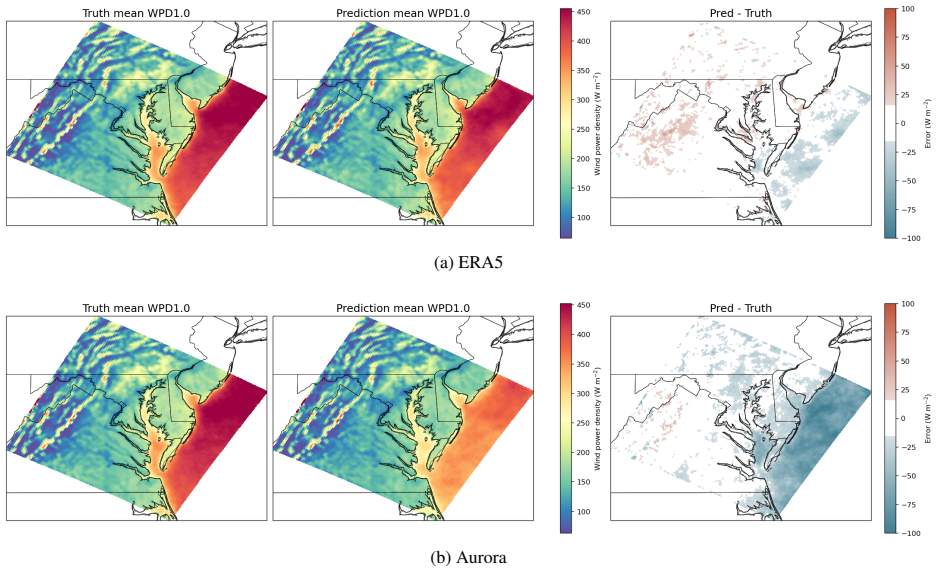
- [Sec. 3.4.1 and Sec. 5.4] Section 3.4.1 states that wind power density (WPD) is generated as a direct multi-level output and that 'the WPD calculation is performed consistently with the atmospheric state variables used during training.' It is unclear whether WPD is a derived quantity computed from the generated U, V, T, and pressure fields or an independently predicted channel that is not guaranteed to be consistent with those fields. If it is independent, the claim of physical consistency is unsupported; if it is derived, the claim that Apeliotes 'directly generates' a new field is misleading. Please clarify the relationship and, if appropriate, report the consistency error between the generated WPD and the WPD computed from the generated state variables.
minor comments (4)
- [Throughout] Occasional typos and capitalization inconsistencies: 'nonlienar' (Sec. 3.4), 'AURORA' vs 'Aurora' (e.g., Sec. 5.3), 'downsampled forecasting' should likely be 'downscaled forecasting' (Sec. 5.4). A careful proofread is needed.
- [Sec. 5.2] The metrics are reported without uncertainty intervals or significance tests. Given that the validation period is only two years, a confidence interval or a breakdown by season would help assess stability.
- [Sec. 5.2 and Table 3] The ensemble size is set to 32 with a citation to the CorrDiff paper, but no sensitivity analysis is provided for this choice. A small experiment varying ensemble size (e.g., 1, 8, 32) would strengthen the probabilistic skill claims.
- [Sec. 5.3, Fig. 4] The vertical profile error is computed as a domain-mean. Reporting the spatial distribution (e.g., a map of level-1 error) and the standard deviation across the domain would clarify where the largest discrepancies occur.
Circularity Check
No significant circularity: Apeliotes is a supervised ERA5-to-WRF downscaling model evaluated on held-out years; the skill metrics follow from fitting but are not circular because the evaluation target is independent of the fitted parameters.
full rationale
The paper's central derivation is a standard supervised learning pipeline: train a CorrDiff-style downscaler on paired coarse ERA5 (or Aurora) inputs and high-resolution WRF targets, then evaluate on held-out 2014–2015 data. The WRF reference is explicitly stated as the evaluation target, and the model is fitted to reproduce it; reporting agreement with that reference is a conventional out-of-sample regression evaluation, not a prediction that reduces to its inputs by construction. The claimed <3% vertical profile error is reported for ERA5 inputs and the paper transparently notes the larger 9.36% error for Aurora inputs. The CorrDiff architecture is adopted from prior work, but that is an implementation choice, not a load-bearing self-cited uniqueness argument. The paper's self-citations (e.g., Golbazi and Archer references for wind-resource applications and WRF evaluation context) are background and do not carry the derivation. No fitted parameter is renamed as a prediction, no result is imported solely from the authors' own prior theorems, and no ansatz is smuggled in via citation. The absence of a comparison to baselines such as bilinear interpolation or the deterministic U-Net is a genuine correctness/robustness limitation, but it is not circularity. Therefore the circularity score is 0.
Axiom & Free-Parameter Ledger
free parameters (3)
- Ensemble size =
32
- Vertical output levels =
7 levels within ERA5 first level
- Normalization statistics =
era5_center, era5_scale, wrf_center, wrf_scale
axioms (3)
- domain assumption WRF 4-km simulation is an accurate representation of the true atmosphere for training and validation
- domain assumption Aurora's coarse forecasts are a valid proxy for ERA5 inputs at inference
- domain assumption CorrDiff residual-diffusion architecture generalizes to 22 output channels
read the original abstract
High-resolution atmospheric data are required to resolve mesoscale and localized meteorological structures, however such datasets remain limited in many regions of the world. Existing high-resolution weather products are typically produced through dynamical downscaling, which is computationally expensive and difficult to scale across locations, variables, and forecast scenarios. These limitations motivate machine-learning-based downscaling systems that can generate multiple weather variables stochastically while producing new high-resolution fields directly. In this paper we present Apeliotes, a framework for high-resolution weather forecasting. Built on the global re-analysis atmospheric data, a pre-trained global weather foundation model, and a regionally trained generative diffusion model, Apeliotes not only provides accurate kilometer-scale weather variables, but also multi-level atmospheric fields which are not directly available in the existing global atmospheric data. Our comprehensive evaluation demonstrates that Apeliotes achieves highly competitive performance. The model predicts vertical wind profile with less than 3\% error between truth and predicted fields, achieving correlations of 0.91 for 10-m wind speed and 0.99 for 2-m temperature, with NRMSE values of 0.42 and 0.17, respectively.
Figures


Reference graph
Works this paper leans on
-
[1]
A foundation model for the earth system.Nature, pages 1–8, 2025
Cristian Bodnar, Wessel P Bruinsma, Ana Lucic, Megan Stanley, Anna Allen, Johannes Brandstetter, Patrick Garvan, Maik Riechert, Jonathan A Weyn, Haiyu Dong, et al. A foundation model for the earth system.Nature, pages 1–8, 2025
2025
-
[2]
Learning skillful medium-range global weather forecasting.Science, 382(6677):1416–1421, 2023
Remi Lam, Alvaro Sanchez-Gonzalez, Matthew Willson, Peter Wirnsberger, Meire Fortunato, Ferran Alet, Suman Ravuri, Timo Ewalds, Zach Eaton-Rosen, Weihua Hu, et al. Learning skillful medium-range global weather forecasting.Science, 382(6677):1416–1421, 2023
2023
-
[3]
Probabilistic weather forecasting with machine learning.Nature, 637(8044):84–90, 2025
Ilan Price, Alvaro Sanchez-Gonzalez, Ferran Alet, Tom R Andersson, Andrew El-Kadi, Dominic Masters, Timo Ewalds, Jacklynn Stott, Shakir Mohamed, Peter Battaglia, et al. Probabilistic weather forecasting with machine learning.Nature, 637(8044):84–90, 2025
2025
-
[4]
A super-resolution framework for downscaling machine learning weather prediction toward 1-km air temperature.npj Climate and Atmospheric Science, 2026
Hyebin Park, Seonyoung Park, Daehyun Kang, and Jeong-Hwan Kim. A super-resolution framework for downscaling machine learning weather prediction toward 1-km air temperature.npj Climate and Atmospheric Science, 2026
2026
-
[5]
Deep learning super- resolution for temperature data downscaling: a comprehensive study using residual networks.Frontiers in Climate, 7:1572428, 2025
Shailesh Kumar Jha, Vivek Gupta, Priyank J Sharma, Anurag Mishra, and Saksham Joshi. Deep learning super- resolution for temperature data downscaling: a comprehensive study using residual networks.Frontiers in Climate, 7:1572428, 2025
2025
-
[6]
Machine-learning down- scaling of gpm satellite precipitation products in mountainous regions: A case study in chongqing.Atmospheric Research, 311:107698, 2024
Yushi Gan, Yuechen Li, Lihong Wang, Long Zhao, Lei Fan, Haichao Xu, and Zhe Yin. Machine-learning down- scaling of gpm satellite precipitation products in mountainous regions: A case study in chongqing.Atmospheric Research, 311:107698, 2024
2024
-
[7]
Residual corrective diffusion modeling for km-scale atmospheric downscaling.Communications Earth & Environment, 6(1):124, 2025
Morteza Mardani, Noah Brenowitz, Yair Cohen, Jaideep Pathak, Chieh-Yu Chen, Cheng-Chin Liu, Arash Vahdat, Mohammad Amin Nabian, Tao Ge, Akshay Subramaniam, et al. Residual corrective diffusion modeling for km-scale atmospheric downscaling.Communications Earth & Environment, 6(1):124, 2025
2025
-
[8]
A review of high impact weather for aviation meteorology.Pure and applied geophysics, 176(5):1869–1921, 2019
Ismail Gultepe, R Sharman, Paul D Williams, Binbin Zhou, G Ellrod, P Minnis, S Trier, S Griffin, Seong S Yum, B Gharabaghi, et al. A review of high impact weather for aviation meteorology.Pure and applied geophysics, 176(5):1869–1921, 2019
1921
-
[9]
Advances in real time smart monitoring of environmental parameters using iot and sensors.Heliyon, 10(7), 2024
T Lakshmi Narayana, C Venkatesh, Ajmeera Kiran, Adarsh Kumar, Surbhi Bhatia Khan, Ahlam Almusharraf, Mohammad Tabrez Quasim, et al. Advances in real time smart monitoring of environmental parameters using iot and sensors.Heliyon, 10(7), 2024
2024
-
[10]
Advances in air quality modeling and forecasting.Global Transitions, 2:261–270, 2020
Alexander Baklanov and Yang Zhang. Advances in air quality modeling and forecasting.Global Transitions, 2:261–270, 2020
2020
-
[11]
The future of forecasting for renewable energy.Wiley Interdisciplinary Reviews: Energy and Environment, 9(2):e365, 2020
Conor Sweeney, Ricardo J Bessa, Jethro Browell, and Pierre Pinson. The future of forecasting for renewable energy.Wiley Interdisciplinary Reviews: Energy and Environment, 9(2):e365, 2020
2020
-
[12]
Understanding, modeling and predicting weather and climate extremes: Challenges and opportunities.Weather and climate extremes, 18:65–74, 2017
Jana Sillmann, Thordis Thorarinsdottir, Noel Keenlyside, Nathalie Schaller, Lisa V Alexander, Gabriele Hegerl, Sonia I Seneviratne, Robert Vautard, Xuebin Zhang, and Francis W Zwiers. Understanding, modeling and predicting weather and climate extremes: Challenges and opportunities.Weather and climate extremes, 18:65–74, 2017
2017
-
[13]
The quiet revolution of numerical weather prediction.Nature, 525(7567):47–55, 2015
Peter Bauer, Alan Thorpe, and Gilbert Brunet. The quiet revolution of numerical weather prediction.Nature, 525(7567):47–55, 2015
2015
-
[14]
End-to-end data-driven weather prediction
Anna Allen, Stratis Markou, Will Tebbutt, James Requeima, Wessel P Bruinsma, Tom R Andersson, Michael Herzog, Nicholas D Lane, Matthew Chantry, J Scott Hosking, et al. End-to-end data-driven weather prediction. Nature, 641(8065):1172–1179, 2025
2025
-
[15]
Enhancing air quality forecasts across the contiguous united states (conus) during wildfires using analog-based post-processing methods.Atmospheric Environment, 316:120165, 2024
Maryam Golbazi, Stefano Alessandrini, Rajesh Kumar, Paddy McCarthy, Patrick C Campbell, Piyush Bhardwaj, Cenlin He, and Jeffery McQueen. Enhancing air quality forecasts across the contiguous united states (conus) during wildfires using analog-based post-processing methods.Atmospheric Environment, 316:120165, 2024
2024
-
[16]
Prithvi wxc: Foundation model for weather and climate.arXiv preprint arXiv:2409.13598, 2024
Johannes Schmude, Sujit Roy, Will Trojak, Johannes Jakubik, Daniel Salles Civitarese, Shraddha Singh, Julian Kuehnert, Kumar Ankur, Aman Gupta, Christopher E Phillips, et al. Prithvi wxc: Foundation model for weather and climate.arXiv preprint arXiv:2409.13598, 2024
Pith/arXiv arXiv 2024
-
[17]
Machine learning emulation of a local-scale uk climate model.arXiv preprint arXiv:2211.16116, 2022
Henry Addison, Elizabeth Kendon, Suman Ravuri, Laurence Aitchison, and Peter AG Watson. Machine learning emulation of a local-scale uk climate model.arXiv preprint arXiv:2211.16116, 2022
Pith/arXiv arXiv 2022
-
[18]
Diffusion models for high-resolution solar forecasts.arXiv preprint arXiv:2302.00170, 2023
Yusuke Hatanaka, Yannik Glaser, Geoff Galgon, Giuseppe Torri, and Peter Sadowski. Diffusion models for high-resolution solar forecasts.arXiv preprint arXiv:2302.00170, 2023. 12
Pith/arXiv arXiv 2023
-
[19]
Jimeng Shi, Azam Shirali, Bowen Jin, Sizhe Zhou, Wei Hu, Rahuul Rangaraj, Shaowen Wang, Jiawei Han, Zhaonan Wang, Upmanu Lall, et al. Deep learning and foundation models for weather prediction: A survey.arXiv preprint arXiv:2501.06907, 2025
Pith/arXiv arXiv 2025
-
[20]
Climax: A foundation model for weather and climate.arXiv preprint arXiv:2301.10343, 2023
Tung Nguyen, Johannes Brandstetter, Ashish Kapoor, Jayesh K Gupta, and Aditya Grover. Climax: A foundation model for weather and climate.arXiv preprint arXiv:2301.10343, 2023
Pith/arXiv arXiv 2023
-
[21]
Dynamical-generative downscaling of climate model ensembles.Proceedings of the National Academy of Sciences, 122(17):e2420288122, 2025
Ignacio Lopez-Gomez, Zhong Yi Wan, Leonardo Zepeda-Núñez, Tapio Schneider, John Anderson, and Fei Sha. Dynamical-generative downscaling of climate model ensembles.Proceedings of the National Academy of Sciences, 122(17):e2420288122, 2025
2025
-
[22]
Conditional diffusion models for downscaling and bias correction of earth system model precipitation.Geoscientific Model Development, 19(4):1791–1808, 2026
Michael Aich, Philipp Hess, Baoxiang Pan, Sebastian Bathiany, Yu Huang, and Niklas Boers. Conditional diffusion models for downscaling and bias correction of earth system model precipitation.Geoscientific Model Development, 19(4):1791–1808, 2026
2026
-
[23]
Thirty years of regional climate modeling: where are we and where are we going next?Journal of Geophysical Research: Atmospheres, 124(11):5696–5723, 2019
Filippo Giorgi. Thirty years of regional climate modeling: where are we and where are we going next?Journal of Geophysical Research: Atmospheres, 124(11):5696–5723, 2019
2019
-
[24]
Satellite observations guided diffusion model for accurate meteorological states at arbitrary resolution
Siwei Tu, Ben Fei, Weidong Yang, Fenghua Ling, Hao Chen, Zili Liu, Kun Chen, Hang Fan, Wanli Ouyang, and Lei Bai. Satellite observations guided diffusion model for accurate meteorological states at arbitrary resolution. In Proceedings of the Computer Vision and Pattern Recognition Conference, pages 28071–28080, 2025
2025
-
[25]
Hersbach, B
H. Hersbach, B. Bell, P. Berrisford, G. Biavati, A. Horányi, J. Muñoz Sabater, J. Nicolas, C. Peubey, R. Radu, I. Rozum, D. Schepers, A. Simmons, C. Soci, D. Dee, and J.-N. Thépaut. Era5 hourly data on single levels from 1940 to present, 2023. Accessed on 13-05-2026
1940
-
[26]
Rasmussen, Aiguo Dai, Changhai Liu, and Kyoko Ikeda
Roy M. Rasmussen, Aiguo Dai, Changhai Liu, and Kyoko Ikeda. CONUS (Continental U.S.) II High Resolution Present and Future Climate Simulation, 2021
2021
-
[27]
Hua Zhang, Yong-Jing Yu, and Zhi-Yuan Liu. Study on the maximum entropy principle applied to the annual wind speed probability distribution: A case study for observations of intertidal zone anemometer towers of rudong in east china sea.Applied energy, 114:931–938, 2014
2014
-
[28]
Evaluation of wind energy potential in province of bushehr, iran.Renewable and Sustainable Energy Reviews, 55:455–466, 2016
Amir Dabbaghiyan, Farivar Fazelpour, Mohhamadreza Dehghan Abnavi, and Marc A Rosen. Evaluation of wind energy potential in province of bushehr, iran.Renewable and Sustainable Energy Reviews, 55:455–466, 2016
2016
-
[29]
Investigation of offshore wind energy potential in hong kong based on weibull distribution function.Applied Energy, 156:362–373, 2015
ZR Shu, QS Li, and PW Chan. Investigation of offshore wind energy potential in hong kong based on weibull distribution function.Applied Energy, 156:362–373, 2015
2015
-
[30]
Elsevier Academic Press, 2006
Peter Victor Hobbs.Atmospheric science: an introductory survey. Elsevier Academic Press, 2006
2006
-
[31]
Surface impacts of large offshore wind farms
Maryam Golbazi, Cristina L Archer, and Stefano Alessandrini. Surface impacts of large offshore wind farms. Environmental Research Letters, 17(6):064021, 2022
2022
-
[32]
Methods to estimate surface roughness length for offshore wind energy
Maryam Golbazi and Cristina L Archer. Methods to estimate surface roughness length for offshore wind energy. Advances in Meteorology, 2019(1):5695481, 2019
2019
-
[33]
Conus (continental us) ii high resolution present and future climate simulation
Roy Rasmussen, Aiguo Dai, Changhai Liu, and Kyoko Ikeda. Conus (continental us) ii high resolution present and future climate simulation. 2021
2021
-
[34]
A sensitivity study of the wrf model in wind simulation for an area of high wind energy.Environmental Modelling & Software, 33:23–34, 2012
David Carvalho, Alfredo Rocha, Moncho Gómez-Gesteira, and Carlos Santos. A sensitivity study of the wrf model in wind simulation for an area of high wind energy.Environmental Modelling & Software, 33:23–34, 2012
2012
-
[35]
Wrf model evaluation for the urban heat island assessment under varying land use/land cover and reference site conditions.Theoretical and Applied Climatology, 126(1):385–400, 2016
Shweta Bhati and Manju Mohan. Wrf model evaluation for the urban heat island assessment under varying land use/land cover and reference site conditions.Theoretical and Applied Climatology, 126(1):385–400, 2016
2016
-
[36]
Large offshore wind farms have minimal direct impacts on air quality
Maryam Golbazi and Cristina L Archer. Large offshore wind farms have minimal direct impacts on air quality. Environmental Research Letters, 19(12):124073, 2024
2024
-
[37]
Maryam Golbazi, Frank Liu, Yin-Hsuen Chen, Timothy W Juliano, and Heather Richter. High-resolution modeling of extreme heat events with socioeconomic consideration: a real-case wrf–les approach.Environmental Science and Pollution Research, 32(36):21666–21680, 2025
2025
-
[38]
An analog ensemble for short-term probabilistic solar power forecast.Applied energy, 157:95–110, 2015
Stefano Alessandrini, Luca Delle Monache, Simone Sperati, and Guido Cervone. An analog ensemble for short-term probabilistic solar power forecast.Applied energy, 157:95–110, 2015
2015
-
[39]
Decomposition of the continuous ranked probability score for ensemble prediction systems
Hans Hersbach. Decomposition of the continuous ranked probability score for ensemble prediction systems. Weather and Forecasting, 15(5):559–570, 2000
2000
-
[40]
Generative data assimilation of sparse weather station observations at kilometer scales.Journal of Advances in Modeling Earth Systems, 17(10):e2024MS004505, 2025
Peter Manshausen, Yair Cohen, Peter Harrington, Jaideep Pathak, Mike Pritchard, Piyush Garg, Morteza Mardani, Karthik Kashinath, Simon Byrne, and Noah Brenowitz. Generative data assimilation of sparse weather station observations at kilometer scales.Journal of Advances in Modeling Earth Systems, 17(10):e2024MS004505, 2025. 13
2025
discussion (0)
Sign in with ORCID, Apple, or X to comment. Anyone can read and Pith papers without signing in.