Equivariant Latent Alignment via Flow Matching under Group Symmetries
Pith reviewed 2026-06-28 23:18 UTC · model grok-4.3
The pith
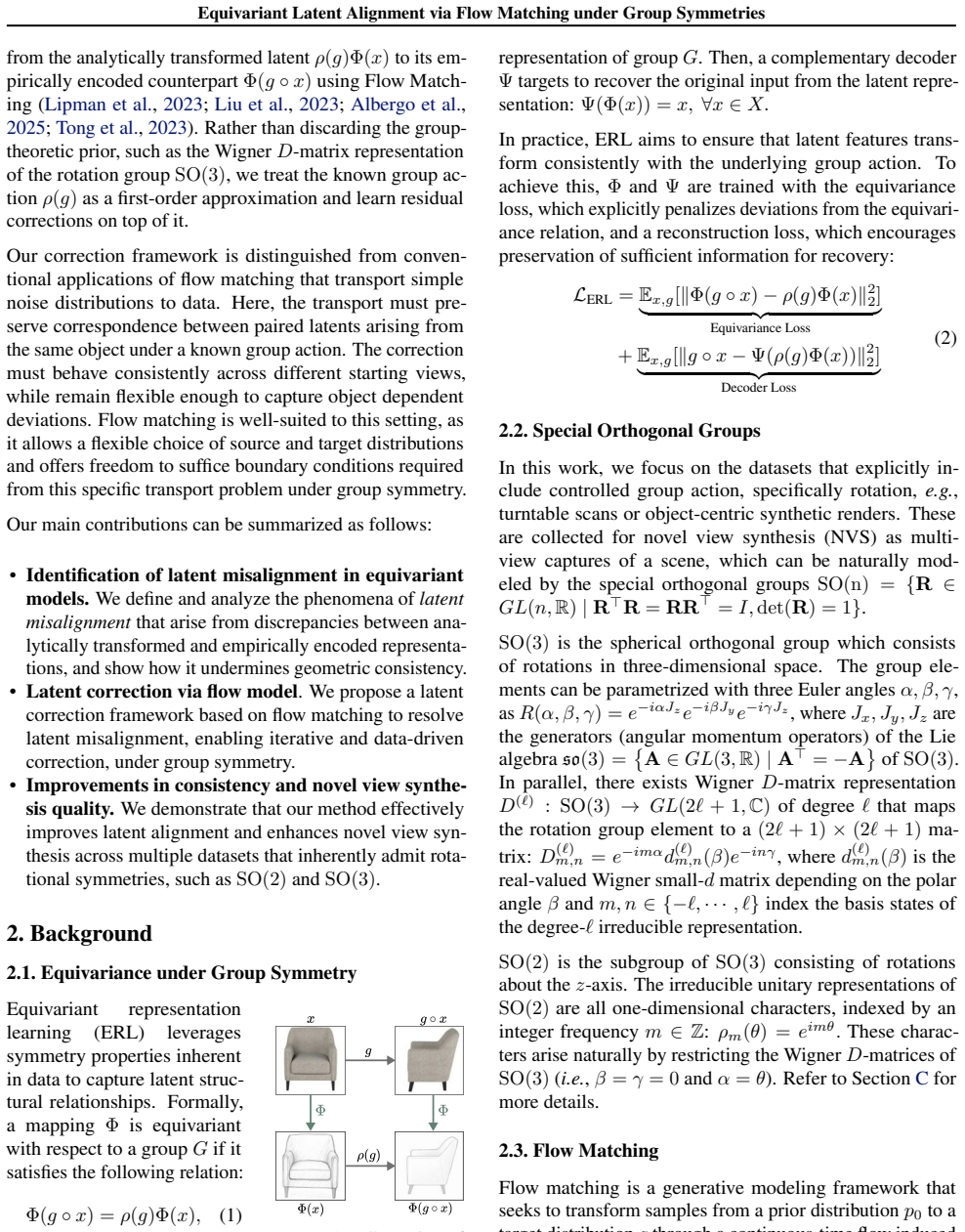
Residual Latent Flow corrects misaligned latents so that equivariant models better obey rotation group actions.
A machine-rendered reading of the paper's core claim, the machinery that carries it, and where it could break.
Core claim
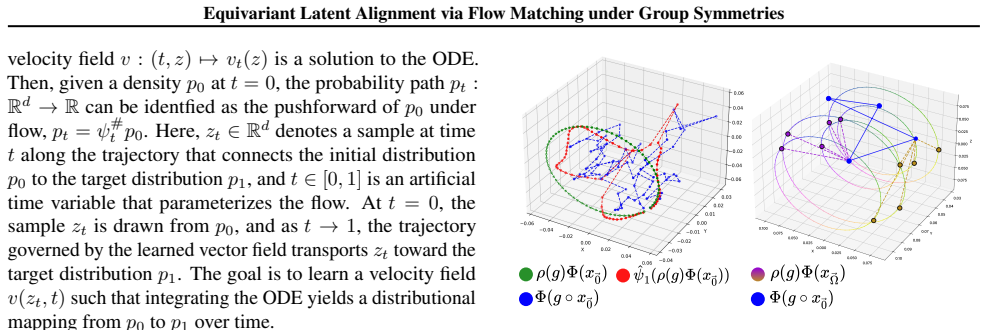
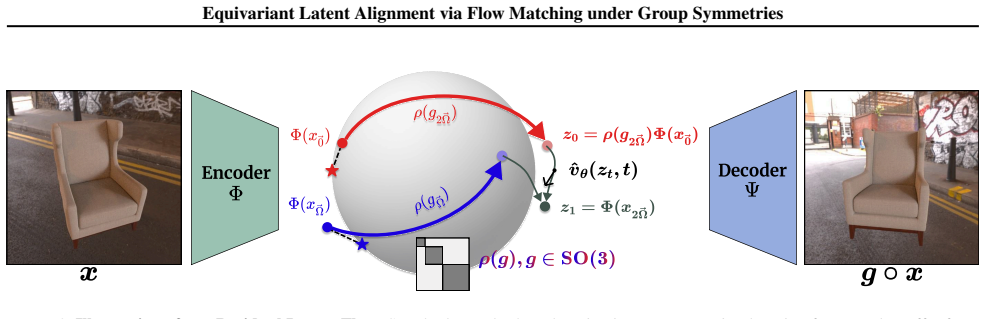
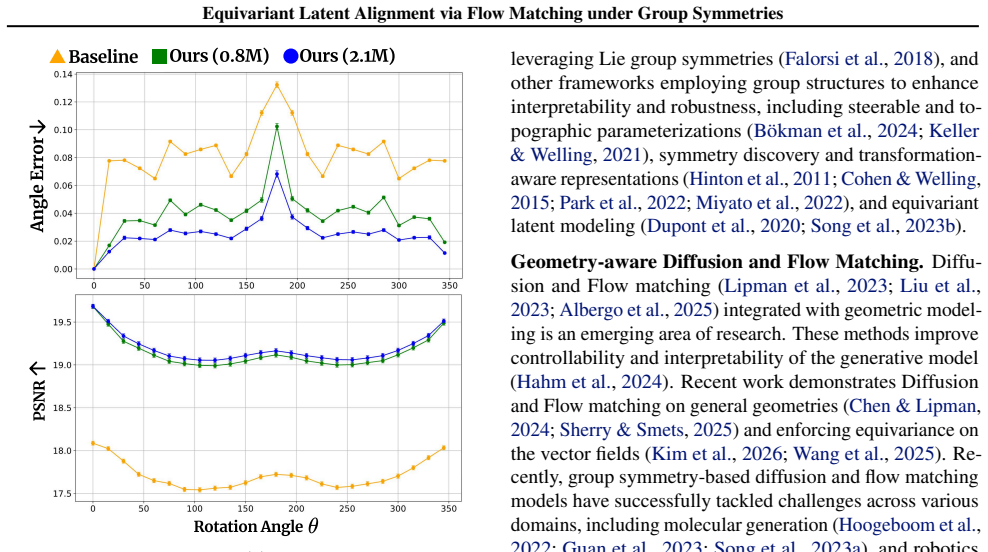
The central claim is that latent misalignment between intended group actions and actual latent transformations is the primary source of inconsistency in existing equivariant models, and that a residual flow trained by flow matching can be applied post hoc to realign the latents without architectural changes to the base model.
What carries the argument
Residual Latent Flow: a flow-based correction network that maps misaligned latents toward the transformations required by the group action.
If this is right
- Equivariant models can retain their original architecture while still satisfying the group symmetry more closely.
- Novel view synthesis benefits directly from the restored equivariance in the latent space.
- The same correction principle applies to any continuous group for which an analytic action on the data is known.
Where Pith is reading between the lines
- The method could be tested on groups other than rotations, such as translations or scalings, to check whether the flow correction generalizes.
- If the residual flow itself can be made equivariant, the overall pipeline would become fully symmetry-preserving by construction.
- The approach suggests a modular separation between learning an equivariant encoder and enforcing exact symmetry compliance in the latent space.
Load-bearing premise
That the dominant performance problem in current equivariant models is precisely this latent misalignment and that a separate flow-matching step can remove it without creating new inconsistencies.
What would settle it
A controlled measurement, before and after Residual Latent Flow, showing that the distance between the actual latent transformation and the group action remains large or that novel-view synthesis metrics do not improve.
Figures
read the original abstract
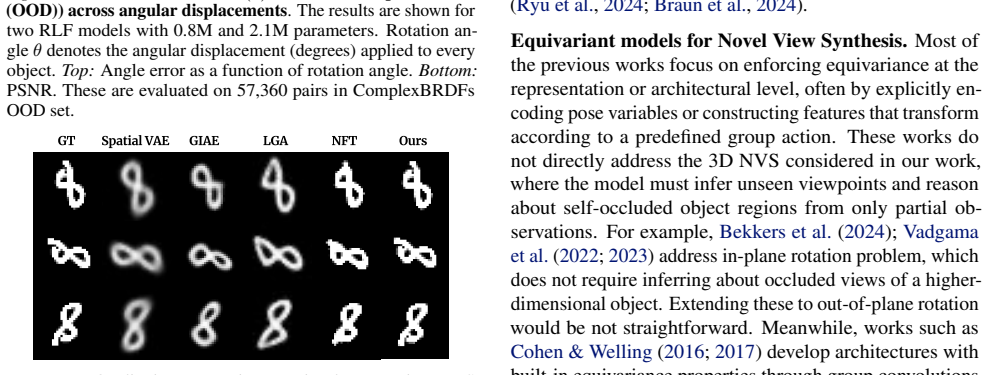
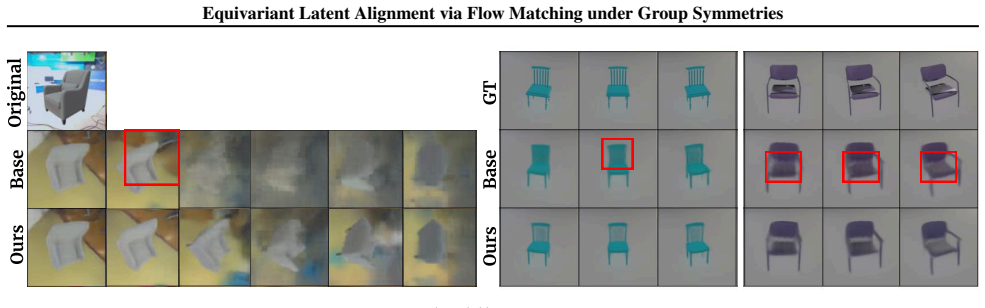
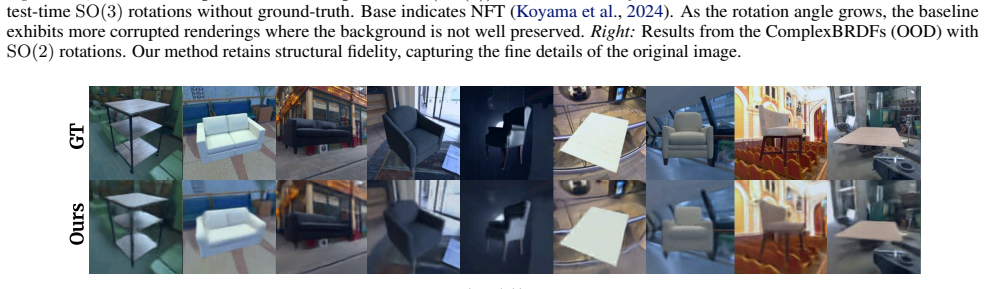
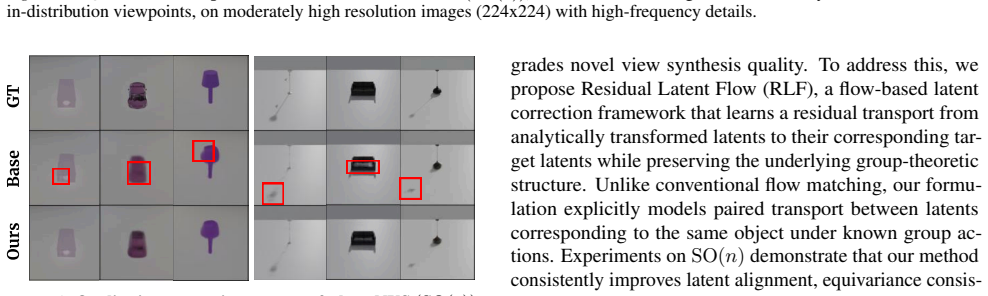
Geometry-aware generative models and novel view synthesis approaches have shown strong potential in visual fidelity and consistency. In parallel, equivariant representation learning has emerged as a powerful framework for constructing latent spaces where analytically known group transformations could act directly, capturing geometric structure in data and enhancing both interpretability and generalization in novel view synthesis. However, we identify that existing approaches often suffer from latent misalignment, a discrepancy between the intended group action and the actually required transformations in the latent space. Consequently, the learned latents often fail to consistently preserve the equivariant relations imposed by the underlying group symmetry. To address this, we propose Residual Latent Flow, a flow-based framework that corrects the misaligned latents, thereby improving compliance with the underlying equivariance relation. Our comprehensive experiments show that our method significantly reduces latent misalignment and improves novel view synthesis quality, under rotation groups SO(n).
Editorial analysis
A structured set of objections, weighed in public.
Referee Report
Summary. The manuscript identifies latent misalignment in equivariant representation learning for geometry-aware generative models and novel view synthesis under group symmetries such as SO(n). It proposes Residual Latent Flow, a flow-matching framework to correct discrepancies between intended group actions and actual latent transformations, thereby improving compliance with equivariance relations. The paper claims that comprehensive experiments demonstrate significant reductions in misalignment and improvements in novel view synthesis quality.
Significance. If the empirical claims hold with proper validation, the approach could offer a modular correction for a common failure mode in equivariant models without requiring changes to base architectures, potentially aiding interpretability and consistency in tasks involving rotations and other symmetries.
major comments (2)
- [Abstract] Abstract: the central empirical claim that the method 'significantly reduces latent misalignment and improves novel view synthesis quality' is unsupported because the text supplies no quantitative metrics, baseline comparisons, definitions of misalignment measures, error bars, or experimental protocols, which is load-bearing for assessing whether the proposed correction works.
- [Methods (implied)] The description of Residual Latent Flow provides no equations, flow-matching objective, or derivation showing how the residual correction enforces the equivariance relation without introducing new inconsistencies or requiring retraining of the base model.
Simulated Author's Rebuttal
We thank the referee for the constructive feedback. We address each major comment below and commit to revisions that strengthen the empirical support and methodological clarity without altering the core contributions.
read point-by-point responses
-
Referee: [Abstract] Abstract: the central empirical claim that the method 'significantly reduces latent misalignment and improves novel view synthesis quality' is unsupported because the text supplies no quantitative metrics, baseline comparisons, definitions of misalignment measures, error bars, or experimental protocols, which is load-bearing for assessing whether the proposed correction works.
Authors: We agree the abstract makes a strong claim without supporting numbers. The full manuscript contains these details in the experiments section, but to make the abstract self-contained we will revise it to include concise quantitative results (e.g., specific misalignment reduction percentages, baseline comparisons, and a brief definition of the misalignment metric) along with a pointer to the experimental protocol. revision: yes
-
Referee: [Methods (implied)] The description of Residual Latent Flow provides no equations, flow-matching objective, or derivation showing how the residual correction enforces the equivariance relation without introducing new inconsistencies or requiring retraining of the base model.
Authors: We acknowledge that the provided manuscript excerpt is high-level. The complete paper includes a methods section with the flow-matching objective and derivation; however, to address the concern directly we will expand this section with explicit equations, the training objective, and a short derivation showing that the residual correction is applied post hoc, preserves the base model parameters, and does not introduce additional inconsistencies with the group action. revision: yes
Circularity Check
No significant circularity identified
full rationale
The abstract and description contain no equations, derivations, self-citations, or load-bearing steps that reduce to fitted inputs or prior self-referential claims. The proposal of Residual Latent Flow as a correction mechanism is presented as an empirical framework without any mathematical chain that collapses by construction. This is the expected honest non-finding for a high-level description lacking explicit derivations.
Axiom & Free-Parameter Ledger
Reference graph
Works this paper leans on
-
[1]
FormB= P i aibir⊤ i (normalizeP i ai = 1)
-
[2]
ReturnA opt =Udiag(1,1, d)V ⊤ (guaranteesdet(A opt) = +1). E. Equivariance Error Metrics forSO(2)andSO(3) E.1. Equivariance Error forSO(2) For SO(2), we estimate the relative rotation angle between Φ(gθ ◦x) and ρ(gθ)Φ(x) in a degree-wise manner. For each degree-ℓblock, we solve ˆδθℓ = arg min δθ ∥Φℓ(gθ ◦x)−R ℓ(δθ) Φℓ(x)∥2 F ,(17) whereR ℓ(θ)denotes the de...
2022
discussion (0)
Sign in with ORCID, Apple, or X to comment. Anyone can read and Pith papers without signing in.