REVIEW 2 major objections 61 references
EGUP effects on the thermodynamic properties of the Kerr-Newman black hole surrounded by quintessence
T0 review · 2 major / 0 minor · reviewed 2026-06-26 · grok-4.3
Pith's one-line read The Extended Generalized Uncertainty Principle alters Hawking temperature, heat capacity, entropy and other thermodynamic quantities of the Kerr-Newman black hole surrounded by quintessence as the universe evolves from early to late stages.
desk verdict Straight substitution of EGUP into standard KNBHQ thermodynamic formulas, with no derivation from the metric or quintessence stress-energy. read the letter →
The pith
A machine-rendered reading of the paper's core claim, the machinery that carries it, and where it could break.
The reading
What carries the argument
Direct substitution of the EGUP (and its GUP/EUP limits) into the thermodynamic identities derived from the Kerr-Newman metric with quintessence term, yielding corrected expressions for temperature, heat capacity and free energy.
What would settle it
A measured black-hole remnant mass or temperature that deviates from the EGUP-corrected formula by more than the observational uncertainty while matching the uncorrected Kerr-Newman-quintessence prediction would falsify the central claim.
Extended reading notes
Core claim
When the EGUP is substituted into the first law and the area law for the Kerr-Newman black hole surrounded by quintessence, the Hawking temperature, heat capacity, Gibbs free energy, entropy and pressure acquire explicit dependence on the EGUP parameters; these modified quantities evolve continuously from the early-universe regime (where GUP dominates) to the late-universe regime (where EUP dominates), and the black hole possesses a remnant mass whose value depends on the quintessence and EGUP parameters.
Load-bearing premise
The EGUP, GUP and EUP can be inserted directly into the thermodynamic relations without additional consistency conditions or back-reaction terms.
Editorial extensions
If this is right
- The heat capacity changes sign at a critical mass that depends on the EGUP deformation parameter, indicating a shift in the stable-to-unstable transition.
- Entropy receives an additive correction linear in the EGUP parameter that grows with the quintessence density.
- Gibbs free energy develops a minimum whose location moves to higher mass when the universe transitions from GUP-dominated to EUP-dominated regimes.
- A nonzero remnant mass remains after complete evaporation, with its value set by the balance between quintessence and EGUP parameters.
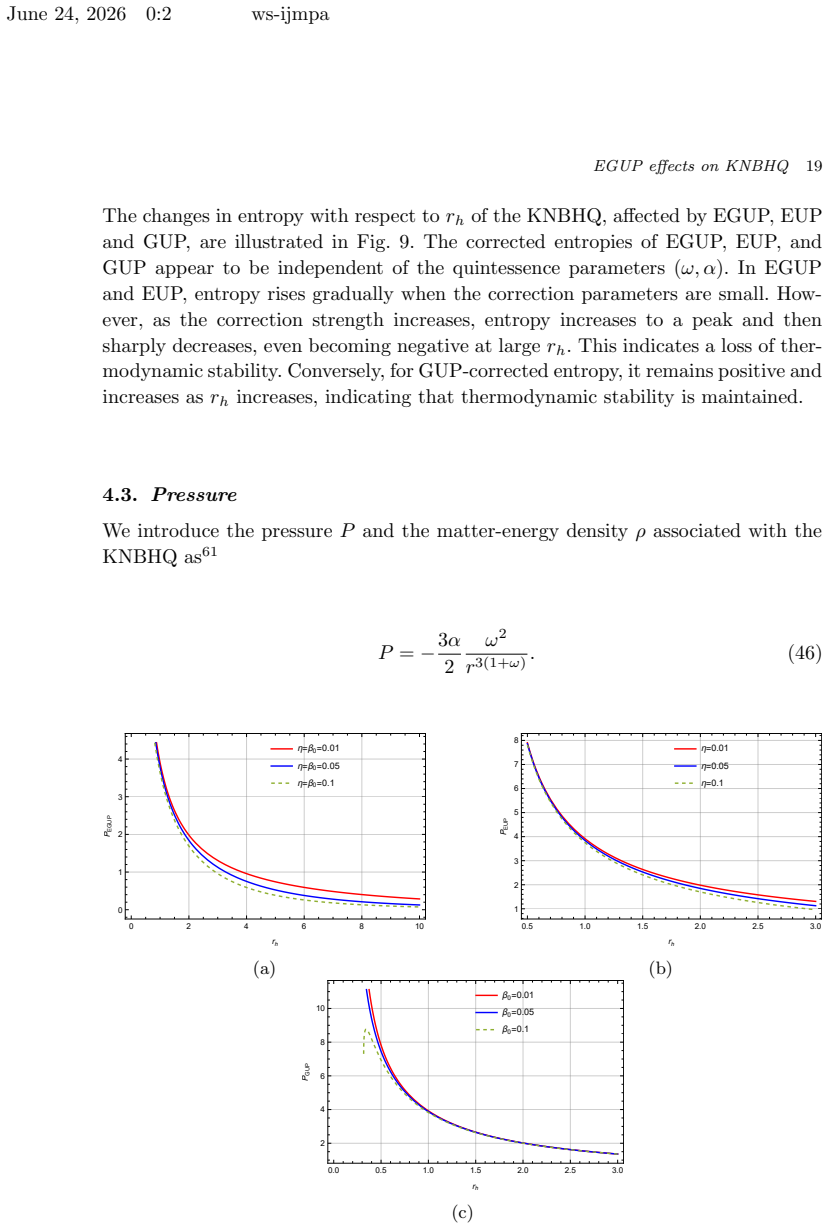
- Pressure derived from the equation of state exhibits a quintessence-driven negative contribution that is modulated by the EGUP correction.
Reading between the lines
- If the EGUP correction survives in a full quantum-gravity treatment, similar modifications would appear in the thermodynamics of other dark-energy-surrounded black holes.
- The continuous interpolation between early- and late-universe regimes suggests a single effective uncertainty principle could describe the entire cosmic history of black-hole evaporation.
- Observational bounds on remnant masses from primordial black holes could directly constrain the EGUP deformation parameter once quintessence density is fixed by cosmology.
Editorial analysis
A structured set of objections, weighed in public.
Referee Report
Summary. The paper investigates the effects of the Extended Generalized Uncertainty Principle (EGUP) on the thermodynamic quantities (Hawking temperature, heat capacity, Gibbs free energy, entropy, pressure) of the Kerr-Newman black hole surrounded by quintessence (KNBHQ). It performs a comparative analysis with the Generalized Uncertainty Principle (GUP, relevant to early universe) and Extended Uncertainty Principle (EUP, relevant to late universe), and additionally studies remnant mass, temperature, and stability under quintessence influence.
Significance. If the EGUP modifications can be shown to follow consistently from the underlying geometry, the comparative analysis across cosmic epochs could offer useful phenomenological insights into quantum-gravity corrections to black-hole thermodynamics in the presence of dark energy. The manuscript does not, however, supply machine-checked derivations, parameter-free results, or falsifiable predictions that would strengthen its impact.
major comments (2)
- [Abstract and main text (method of inserting uncertainty-principle modifications)] The central procedure—direct substitution of EGUP (and GUP/EUP) corrections into the standard expressions for Hawking temperature, heat capacity, entropy, etc.—is not derived from the surface gravity of the KNBHQ metric, from a tunneling calculation, or from modified Einstein equations that incorporate the quintessence stress-energy. This substitution is load-bearing for every claimed variation and for the remnant/stability conclusions.
- [Thermodynamic derivations (throughout)] No back-reaction terms or consistency conditions are supplied to verify that the modified thermodynamic quantities remain compatible with the Kerr-Newman–quintessence spacetime geometry. Without this step the reported evolution from early- to late-universe regimes rests on an unverified assumption.
Simulated Author's Rebuttal
We thank the referee for the constructive comments. We address each major point below and indicate where revisions will be made.
read point-by-point responses
-
Referee: [Abstract and main text (method of inserting uncertainty-principle modifications)] The central procedure—direct substitution of EGUP (and GUP/EUP) corrections into the standard expressions for Hawking temperature, heat capacity, entropy, etc.—is not derived from the surface gravity of the KNBHQ metric, from a tunneling calculation, or from modified Einstein equations that incorporate the quintessence stress-energy. This substitution is load-bearing for every claimed variation and for the remnant/stability conclusions.
Authors: We acknowledge that the modifications are introduced phenomenologically by substituting the EGUP-corrected minimal length and momentum into the standard thermodynamic expressions, following the approach common in the GUP/EUP black-hole literature. This permits direct comparison between early-universe (GUP), late-universe (EUP) and combined (EGUP) regimes on the fixed KNBHQ background. A derivation from modified surface gravity or tunneling is not performed in the present work. In revision we will add an explicit statement of this assumption together with additional references to papers that obtain analogous corrections via tunneling methods. revision: partial
-
Referee: [Thermodynamic derivations (throughout)] No back-reaction terms or consistency conditions are supplied to verify that the modified thermodynamic quantities remain compatible with the Kerr-Newman–quintessence spacetime geometry. Without this step the reported evolution from early- to late-universe regimes rests on an unverified assumption.
Authors: The study treats the Kerr-Newman-quintessence metric as the fixed classical background and applies EGUP corrections only to the thermodynamic quantities extracted from it. Self-consistent back-reaction would require solving the Einstein equations with quantum-gravity corrections, which lies outside the scope of this comparative phenomenological analysis. We will insert a clarifying paragraph in the introduction and conclusions stating the fixed-background assumption and its consistency with prior GUP/EUP studies. revision: partial
Circularity Check
No circularity: EGUP modifications treated as external inputs to standard black-hole thermodynamics
full rationale
The paper applies EGUP/GUP/EUP replacements to Hawking temperature, heat capacity, entropy and related quantities for the Kerr-Newman-quintessence metric. No quoted equation shows a thermodynamic variable defined in terms of itself, a fitted parameter renamed as a prediction, or a load-bearing premise resting solely on self-citation. The uncertainty-principle substitutions are introduced as independent inputs (standard practice in the literature), and the resulting expressions for remnant mass, stability and evolution from early to late universe are computed from those inputs rather than forced by construction. The derivation chain therefore remains self-contained against external benchmarks and receives the default non-circularity finding.
Assumptions & free parameters
Cite this review
Pith. "Pith review of EGUP effects on the thermodynamic properties of the Kerr-Newman black hole surrounded by quintessence." pith.science (2026). https://pith.science/paper/4EOJW73C
@misc{pith2026260623756,
  author       = {Pith},
  title        = {Pith review of: EGUP effects on the thermodynamic properties of the Kerr-Newman black hole surrounded by quintessence},
  year         = {2026},
  howpublished = {\url{https://pith.science/paper/4EOJW73C}},
  note         = {Machine review of arXiv:2606.23756}
}
read the original abstract
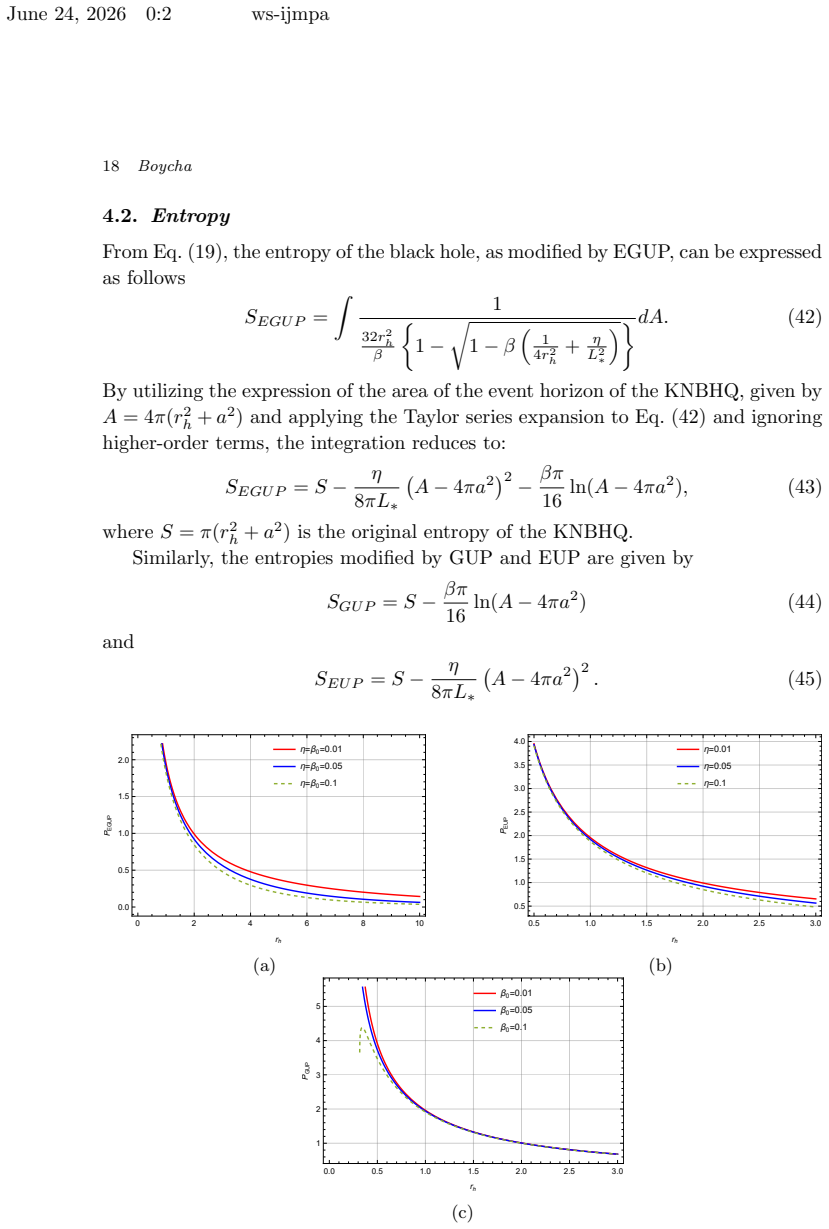
In this paper, we investigate the effects of the Extended Generalized Uncertainty Principle (EGUP) on the thermodynamic quantities of the Kerr-Newman black hole surrounded by quintessence (KNBHQ). Additionally, we conduct a comparative analysis of the outcomes derived from the Generalized Uncertainty Principle (GUP) and the Extended Uncertainty Principle (EUP). The GUP is crucial in the context of the early universe, whereas the EUP is significant in the framework of the later universe. This analysis illustrates the variations in thermodynamic quantities, including Hawking temperature, heat capacity, Gibbs free energy, entropy and pressure of the Kerr-Newman black hole, as they evolve from the early universe to the latter universe under the influence of the dark energy model known as quintessence. The remnant mass, temperature and the stability of the KNBHQ are also studied.
Figures


Figures from the paper (8 more)


Reference graph
Works this paper leans on
-
[1]
Hawking,Phys.Rev.Lett.26, 1344 (1971)
S,W. Hawking,Phys.Rev.Lett.26, 1344 (1971)
1971
-
[2]
Hawking,Commun
S.W. Hawking,Commun. Math. Phys.25, 152 (1972)
1972
-
[3]
Hawking,Sci
S.W. Hawking,Sci. Am.236, 34 (1977)
1977
-
[4]
Bekenstein,Lett
J.D. Bekenstein,Lett. Nuovo Cim.4, 737 (1972)
1972
-
[5]
Bekenstein,Phys
J.D. Bekenstein,Phys. Rev. D7, 2333 (1973)
1973
-
[6]
Bekenstein,Phys
J.D. Bekenstein,Phys. Rev. D9, 3292 (1974)
1974
-
[7]
Hawking,Nature248, 30 (1974)
S.W. Hawking,Nature248, 30 (1974)
1974
-
[8]
Hawking,Commun
S.W. Hawking,Commun. Math. Phys.43, 199 (1975)
1975
Show all 61 references
-
[9]
Geons.Phys
Wheeler, J.A. Geons.Phys. Rev.97, 511 (1955)
1955
-
[10]
Maggiore,Phys
M. Maggiore,Phys. Rev. D49, 5182 (1994)
1994
-
[11]
Maggiore,Phys
M. Maggiore,Phys. Lett. B304, 65 (1993)
1993
-
[12]
Maggiore,Phys
M. Maggiore,Phys. Lett. B319, 83 (1993)
1993
-
[13]
P.Wang, H. Yang, S. Ying,Int. J. Theor. Phys.55, 2633 (2016)
2016
-
[14]
B. Chen, G. Li, X. Zu, J. Tang,J. Mod. Phys.6, 578 (2015)
2015
-
[15]
Keshwarjit, I
A. Keshwarjit, I. Ablu Meitei, T. Ibungochouba Singh, K. YugindroEPJC.79, 692 (2019)
2019
-
[16]
Media, Y
N. Media, Y. Priyobarta, Y. Onika, T. IbungochoubaGen. Relativ. Gravit.57, 80 (2025)
2025
-
[17]
Ibungochouba Singh, Y
T. Ibungochouba Singh, Y. KenedyInt. J. Mod. Phys. A35, 2050018 (2020)
2020
-
[18]
I. Ablu, T. Ibungochouba, S. Gayatri, et. alInt. J. Mod. Phys. A33, 1850070 (2018)
2018
-
[19]
Ibungochouba, I
T. Ibungochouba, I. Ablu, K. YugindroInt. J. Theor. Phys.56, 2640 (2017)
2017
-
[20]
Townsend,Phys
P.K. Townsend,Phys. Rev. D15, 2795 (1977)
1977
-
[21]
Amati, M
D. Amati, M. Ciafaloni,G.Veneziano,Phys. Lett.B216, 41 (1989)
1989
-
[22]
Konishi, G
K. Konishi, G. Paffuti, P. Provero,Phys. Lett. B234, 276 (1990)
1990
-
[23]
Garay,Int
L.J. Garay,Int. J. Mod. Phys. A10, 145 (1995)
1995
-
[24]
Amelino-Camelia,Int
G. Amelino-Camelia,Int. J. Mod. Phys. D11, 35 (2002)
2002
-
[25]
Capozziello, G
S. Capozziello, G. Lambiase, G. Scarpetta,Int. J. Theor. Phys.39, 15 (2000)
2000
-
[26]
Bambi, F.R
C. Bambi, F.R. Urban,Class. Quant. Grav.25, 095006 (2008)
2008
-
[27]
Zhu, J.R
T. Zhu, J.R. Ren, M.F. Li,Phys. Lett. B674, 204 (2009)
2009
-
[28]
Mignemi,Mod
S. Mignemi,Mod. Phys. Lett. A25, 1697 (2010)
2010
-
[29]
Lobos, and R.C
N.J.L.S. Lobos, and R.C. PantigPhysics4, 1318 (2022)
2022
-
[30]
Dabrowski, F
M.P. Dabrowski, F. Wagner,Eur. Phys. J. C79, 716 (2019)
2019
-
[31]
Hamil, M
B. Hamil, M. Merad, T. Birkandan,Int. J. Mod. Phys. A36, 2150018 (2021)
2021
-
[32]
Mureika,Phys
J.R. Mureika,Phys. Lett. B789, 88 (2019)
2019
-
[33]
X. Lu, Y. Xie,Mod. Phys. Lett. A34, 1950152 (2019)
2019
-
[34]
Kumaran, A
Y. Kumaran, A. Ovgun,Chin. Phys. C44, 025101 (2020)
2020
-
[35]
Cheng, Y
H. Cheng, Y. Zhong,Chin. Phys. C45, 105102 (2021)
2021
-
[36]
Hassanabadi, W.S
H. Hassanabadi, W.S. Chung, B.C. Lutfuoglu, E. Maghsoodi,Int. J. Mod. Phys. A 36, 2150036 (2021)
2021
-
[37]
Hamil, B.C
B. Hamil, B.C. LutfuogluEurophys. Lett.134, 50007 (2021)
2021
-
[38]
O. Okcu, E. Aydiner,Europhys. Lett.138, 39002 (2022)
2022
-
[39]
Pantig, P.K
R.C. Pantig, P.K. Yu, E.T. Rodulfo, A. Ovgun,Ann. Phys.436, 168722 (2022)
2022
-
[40]
Hamil, B.C
B. Hamil, B.C. Lutfuoglu, L. Dahbi,Int. J. Mod. Phys. A37, 2250130 (2022)
2022
-
[41]
H. Chen, H. Hassanabadi, B.C. Lutfuoglu, Z.W. Long,arXiv 2022, arXiv:2203.03464
2022
-
[42]
Kempf, G
A. Kempf, G. Mangano, R.B. Mann,Phys. Rev. D52, 1108 (1995)
1995
-
[43]
Bolen and M
B. Bolen and M. Cavaglia,Gen. Relativ. Gravit.37, 1255 (2005)
2005
-
[44]
Coeland, M
E.J. Coeland, M. Sami, and S. TsujikawaInt. J. Mod. Phys. A.15, 1753 (2006)
2006
-
[45]
Peebles and Bharat RatraRev
P.J.E. Peebles and Bharat RatraRev. Mod. Phys.75, 559 (2003)
2003
-
[46]
Riess, L.G
A.G. Riess, L.G. Strolger, J. Tonry, et alAPJ607, 665 (2004). June 24, 2026 0:2 ws-ijmpa EGUP effects on KNBHQ23
2004
-
[47]
Xu and J
Z. Xu and J. WangPhys. Rev. D.95, 064015 (2017)
2017
-
[48]
Priyobarta, T
Y. Priyobarta, T. IbungochoubaJHEP06, 054 (2023)
2023
-
[49]
Media, Y
N. Media, Y. Onika, T. IbungochoubaInt. J. Geom. Methods Mod. Phys.20, 2350217 (2013)
2013
-
[50]
Onika, T
Y. Onika, T. Ibungochouba, I. AbluGen. Relativ. Gravit.54, 77 (2022)
2022
-
[51]
Kenedy, T.S
Y.M. Kenedy, T.S. Ibungochouba and I.M. AbluChin. Phys. Lett.36, 030401 (2019)
2019
-
[52]
Priyobarta, T
Y. Priyobarta, T. Ibungochouba, I. Ablu, A. KeshwarjitInt. J. Mod. Phys. D.31, 2250106 (2022)
2022
-
[53]
Christina, T
S. Christina, T. IbungochoubaGen. Relativ. Gravit.53, 43 (2021)
2021
-
[54]
Xiang and X
L. Xiang and X. WenJournal of High Energy Physics2009, 046 (2009)
2009
-
[55]
A. J. Medved and E. C. Vagenas,Phys. Rev. D70, 124021 (2004)
2004
-
[56]
R. J. Adler, P. Chen and D. I. Santiago,Gen. Rel. Grav.33, 2101 (2001)
2001
-
[57]
Banerjee, S
R. Banerjee, S. Ghosh,Phys.Lett.B688, 224 (2010)
2010
-
[58]
Priyobarta, T
Y. Priyobarta, T. Ibungochouba and S. NiranjanChin. Phys. C48, 115111 (2024)
2024
-
[59]
Kumar, S.G
A. Kumar, S.G. Ghosh and S.D. MaharajPhys. Dark Universe30, 100634 (2020)
2020
-
[60]
A. Sood, A. Kumar, J.K. Singh et al.Eur. Phys. J. C82, 227 (2022)
2022
-
[61]
Kiselev,Class
V.V. Kiselev,Class. Quantum Grav.20, 1187 (2003)
2003
Reviewed June 26, 2026 · model on record in the stance chip above.
Discussion (0). Continue with ORCID to comment.