OverFlowLight: Real-Time Gridlock Prevention and Traffic Signal Optimization for Urban Intersections
Pith reviewed 2026-06-30 12:18 UTC · model grok-4.3
The pith
OverFlowLight prevents gridlock by detecting overflow queues with cameras and radars and inserting dedicated signal phases.
A machine-rendered reading of the paper's core claim, the machinery that carries it, and where it could break.
Core claim
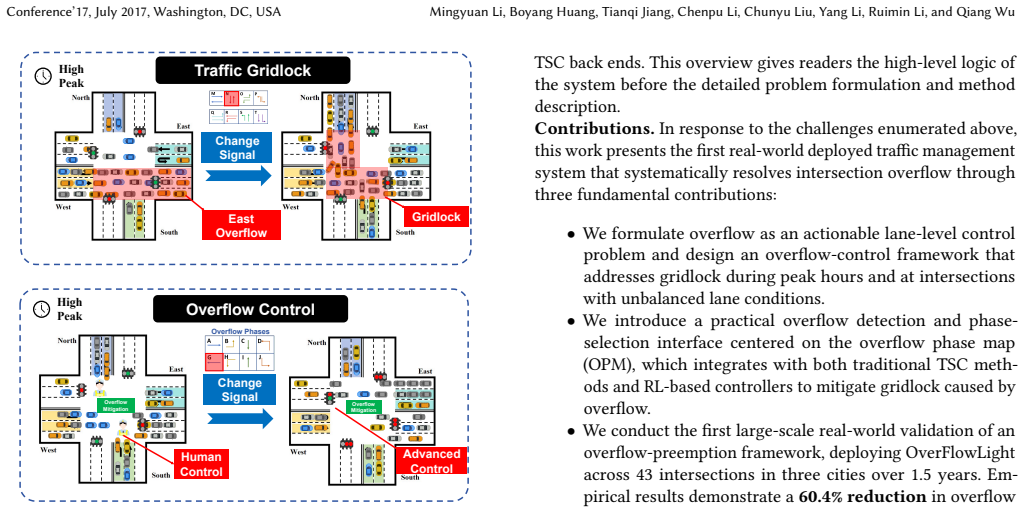
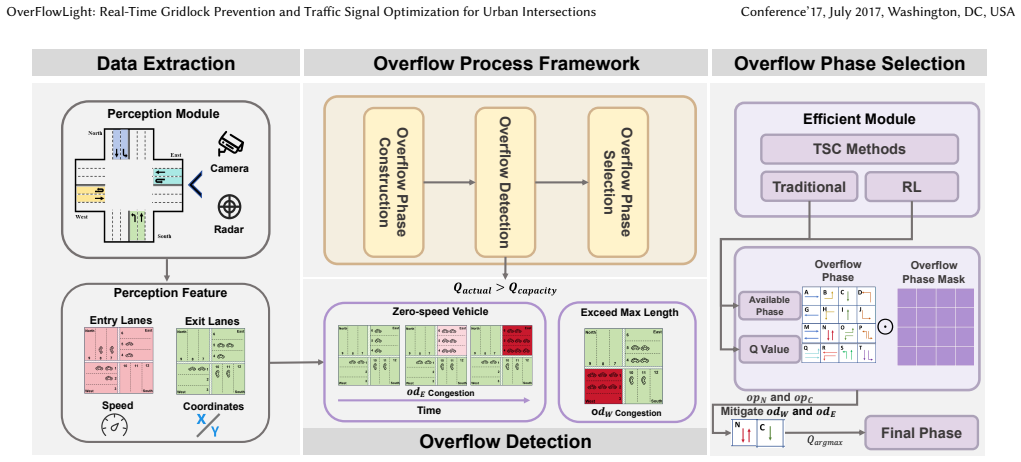
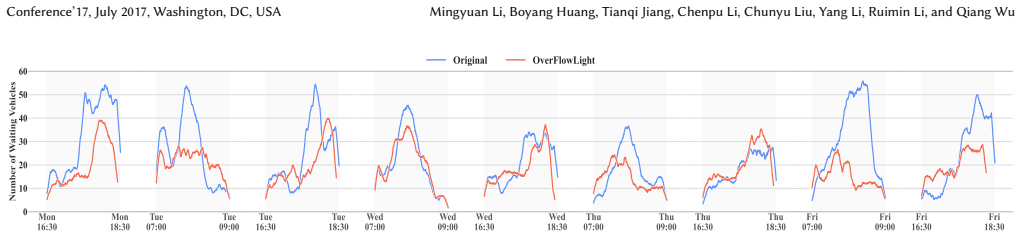
OverFlowLight detects overflow in real-time by leveraging multi-modal sensing from cameras and radars. Upon detection, it dynamically generates and inserts dedicated overflow phases into the signal cycle. This is orchestrated by a hybrid control design that combines rapid rule-based overflow intervention with controller back ends such as reinforcement learning for longer-horizon efficiency. Deployments across 43 intersections demonstrate a 60.4% reduction in overflow incidents and an 18.2% increase in network throughput.
What carries the argument
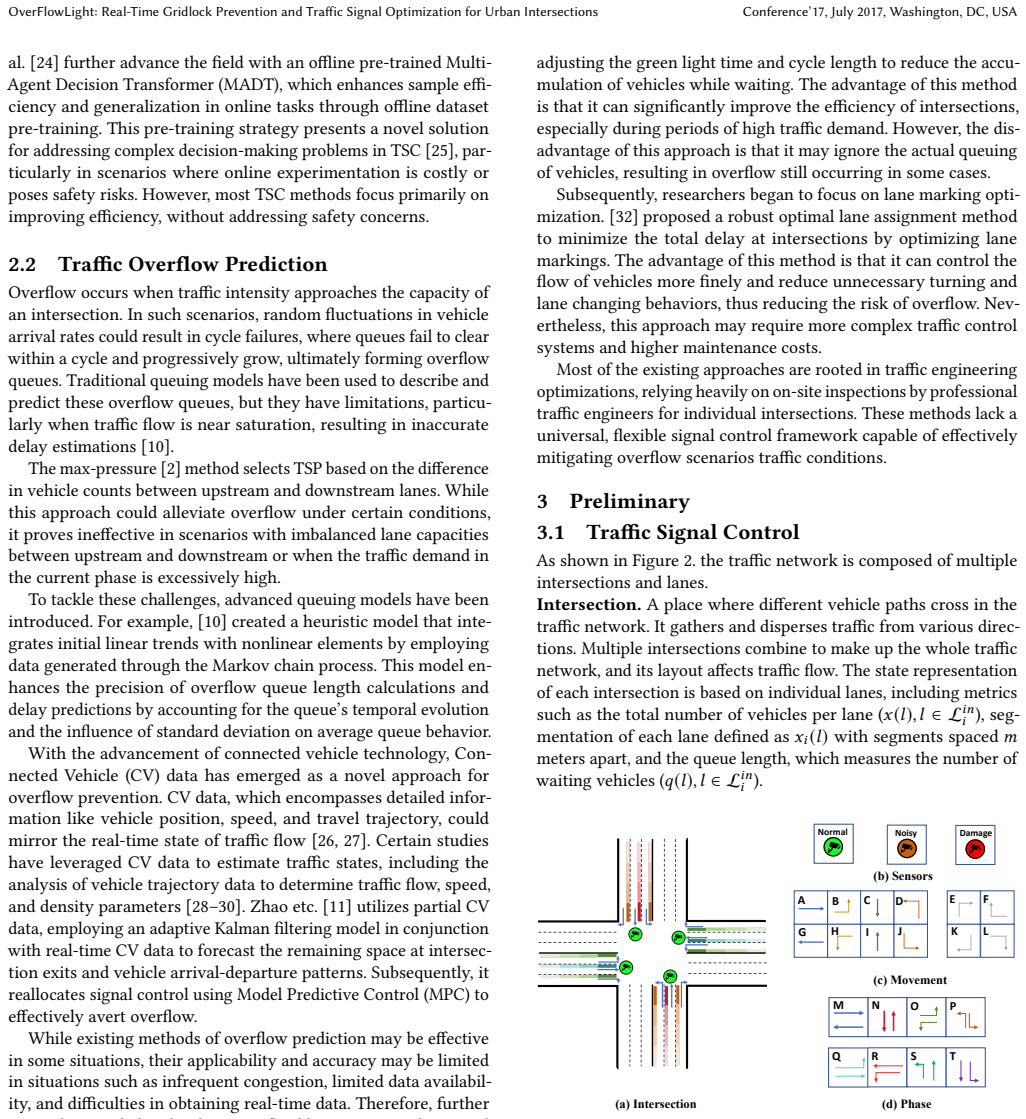
The hybrid control design combining rule-based overflow intervention with reinforcement learning controllers, using multi-modal sensing to trigger dedicated overflow phases.
If this is right
- Reduces overflow incidents by 60.4% compared to baselines.
- Increases network throughput by 18.2%.
- Seamlessly integrates with existing RL-based traffic signal control agents.
- Substantially diminishes the need for manual intervention in signal plans.
Where Pith is reading between the lines
- This method could enable traffic management systems to scale to more intersections without proportional increases in manual oversight.
- Preventing overflow at key points might reduce the frequency of cascading congestion across larger road networks.
Load-bearing premise
The multi-modal sensing from cameras and radars accurately detects overflow in real time without significant false positives or negatives that would miss events or disrupt normal cycles.
What would settle it
Compare overflow incidents and throughput at the 43 intersections before and after deploying OverFlowLight against the same periods with the baseline systems.
Figures
read the original abstract
Queue overflow, a severe consequence of urban traffic congestion, occurs when vehicle queues exceed intersection capacity, obstructing upstream traffic and triggering cascading gridlocks. Prevailing traffic signal control (TSC) algorithms, primarily optimized for throughput, often fail to address overflow during peak hours, exacerbating congestion and creating safety hazards. We propose OverFlowLight, a real-time framework designed to preemptively resolve overflow and enhance overall TSC performance. It first introduces a mechanism to accurately detect overflow in real-time by leveraging multi-modal sensing from cameras and radars. Upon detection, it dynamically generates and inserts dedicated overflow phases into the signal cycle to clear the blocking queues. This is orchestrated by a hybrid control design that combines rapid rule-based overflow intervention with controller back ends such as reinforcement learning (RL) for longer-horizon efficiency. We conducted extensive real-world deployments of OverFlowLight across 43 intersections in three major cities. The framework demonstrates seamless integration with existing RL-based TSC agents, highlighting its modularity and practical applicability. Empirical results show that OverFlowLight reduces overflow incidents by 60.4% and increases network throughput by 18.2% compared to deployed baselines. Furthermore, it substantially diminishes the need for manual intervention common with expert-tuned signal plans. This work presents the first practical, scalable, and data-driven framework for actively preventing traffic gridlock, offering a crucial component for building resilient and efficient urban transportation systems. Our demonstration videos, codes and datasets are available at the anonymous URL, https://anonymous.4open.science/r/OverFlowLight-FBF9.
Editorial analysis
A structured set of objections, weighed in public.
Referee Report
Summary. The paper proposes OverFlowLight, a framework that uses multi-modal (camera + radar) sensing to detect queue overflow at urban intersections in real time, then inserts dedicated overflow phases via a hybrid controller (rule-based intervention plus RL backend) to clear blocking queues and prevent gridlock. It reports results from real-world deployments at 43 intersections across three cities, claiming a 60.4% reduction in overflow incidents and 18.2% increase in network throughput relative to deployed baselines, plus reduced need for manual intervention.
Significance. If the evaluation methodology and detector performance can be substantiated, the work would provide a modular, practical extension to existing TSC systems that directly targets overflow—a failure mode not addressed by standard throughput optimization—demonstrating scalable real-world impact on gridlock prevention.
major comments (2)
- [Results / Deployments] Results / Deployments section: the headline claims of 60.4% reduction in overflow incidents and 18.2% throughput increase are presented without any description of baseline definitions, how overflow incidents were defined and counted, measurement protocols, statistical significance testing, exclusion criteria, or controls for confounding factors across the 43 sites.
- [Overflow Detection] Overflow Detection section: the multi-modal detector is stated to operate 'accurately' but no quantitative evaluation of precision, recall, or false-positive rate on the deployed sites is provided, leaving the attribution of the reported gains to the intervention mechanism itself unsupported.
minor comments (1)
- [Abstract] The reproducibility URL is listed as anonymous; consider adding a permanent DOI or repository link in the camera-ready version.
Simulated Author's Rebuttal
We thank the referee for the constructive feedback. The two major comments identify important gaps in methodological transparency that we will address through revision.
read point-by-point responses
-
Referee: [Results / Deployments] Results / Deployments section: the headline claims of 60.4% reduction in overflow incidents and 18.2% throughput increase are presented without any description of baseline definitions, how overflow incidents were defined and counted, measurement protocols, statistical significance testing, exclusion criteria, or controls for confounding factors across the 43 sites.
Authors: We agree that these details are currently insufficient. The revised manuscript will expand the Results/Deployments section to explicitly define the baselines (pre-deployment signal plans and standard RL controllers at each site), the criteria used to count overflow incidents, the measurement protocols (including time windows and logging intervals), the statistical tests applied, any exclusion criteria for sites or periods, and controls for confounding variables such as weather or special events. These additions will clarify how the reported reductions were obtained. revision: yes
-
Referee: [Overflow Detection] Overflow Detection section: the multi-modal detector is stated to operate 'accurately' but no quantitative evaluation of precision, recall, or false-positive rate on the deployed sites is provided, leaving the attribution of the reported gains to the intervention mechanism itself unsupported.
Authors: We concur that quantitative detector metrics are needed. The revised Overflow Detection section will include precision, recall, and false-positive rates evaluated on labeled data collected from the 43 deployed sites, together with a brief description of the ground-truth annotation process. This will strengthen the connection between detection performance and the observed system-level improvements. revision: yes
Circularity Check
No circularity: empirical claims rest on external real-world measurements
full rationale
The paper reports measured reductions (60.4% overflow incidents, 18.2% throughput) from deployments at 43 intersections against deployed baselines. No equations, fitted parameters presented as predictions, or self-citations appear in the provided text. The hybrid controller and multi-modal detector are described at the level of mechanism and outcome; detection accuracy is asserted but the performance numbers are not derived from or equivalent to any internal definition or fit. The result is therefore self-contained against external benchmarks.
Axiom & Free-Parameter Ledger
Reference graph
Works this paper leans on
-
[1]
Intellilight: A reinforcement learning approach for intelligent traffic light control,
H. Wei, G. Zheng, H. Yao, and Z. Li, “Intellilight: A reinforcement learning approach for intelligent traffic light control, ” inProceedings of the 24th ACM SIGKDD International Conference on Knowledge Discovery & Data Mining, 2018, pp. 2496–2505
2018
-
[2]
Max pressure control of a network of signalized intersections,
P. Varaiya, “Max pressure control of a network of signalized intersections, ”Trans- portation Research Part C: Emerging Technologies, vol. 36, pp. 177–195, 2013
2013
-
[3]
Coordinated deep reinforcement learners for traffic light control,
E. Van der Pol and F. A. Oliehoek, “Coordinated deep reinforcement learners for traffic light control, ” inIn Proceedings of the NIPS’16 Workshop on Learning, Inference and Control of Multi - Agent Systems, Barcelona, Spain, 2016
2016
-
[4]
Colight: Learning network-level cooperation for traffic signal con- trol,
H. Wei, N. Xu, H. Zhang, G. Zheng, X. Zang, C. Chen, W. Zhang, Y. Zhu, K. Xu, and Z. Li, “Colight: Learning network-level cooperation for traffic signal con- trol, ” inProceedings of the 28th ACM International Conference on Information and Knowledge Management, 2019, pp. 1913–1922
2019
-
[5]
Overflow at a traffic light,
F. A. Haight, “Overflow at a traffic light, ”Biometrika, vol. 46, no. 3/4, pp. 420–424, 1959
1959
-
[6]
Overflow queues and delays with random and platooned arrivals at signalized intersections,
R. Akçelik and N. M. Rouphail, “Overflow queues and delays with random and platooned arrivals at signalized intersections, ”Journal of Advanced Transportation, vol. 28, no. 3, pp. 227–251, 1994
1994
-
[7]
Physics of traffic gridlock in a city,
B. S. Kerner, “Physics of traffic gridlock in a city, ”Physical Review E—Statistical, Nonlinear, and Soft Matter Physics, vol. 84, no. 4, p. 045102, 2011
2011
-
[8]
A novel max pressure algorithm based on traffic delay,
H. Liu and V. V. Gayah, “A novel max pressure algorithm based on traffic delay, ” Transportation Research Part C: Emerging Technologies, vol. 143, p. 103803, 2022
2022
-
[9]
Max-pressure traffic controller based on travel times: An experimental analysis,
P. Mercader, W. Uwayid, and J. Haddad, “Max-pressure traffic controller based on travel times: An experimental analysis, ”Transportation Research Part C: Emerging Technologies, vol. 110, pp. 275–290, 2020
2020
-
[10]
Modeling overflow queues on urban signalized intersections,
F. Viti and H. J. van Zuylen, “Modeling overflow queues on urban signalized intersections, ” inIn Proceedings of the 10th World Conference of Transport Research, 7 - 8 July 2004, Istanbul, Turkey, 2004
2004
-
[11]
Signal control for overflow pre- vention at intersections using partial connected vehicle data,
J. Zhao, T. Yao, C. Zhang, and M. A. Shafique, “Signal control for overflow pre- vention at intersections using partial connected vehicle data, ”Transportmetrica A: Transport Science, 2024
2024
-
[12]
Settings for fixed-cycle traffic signals,
A. J. Miller, “Settings for fixed-cycle traffic signals, ”Journal of the Operational Research Society, vol. 14, no. 4, pp. 373–386, 1963
1963
-
[13]
Review of road traffic control strategies,
M. Papageorgiou, C. Diakaki, V. Dinopoulou, A. Kotsialos, and Y. Wang, “Review of road traffic control strategies, ”Proc. IEEE, vol. 91, pp. 2043 – 2067, 2003
2043
-
[14]
Learning phase competition for traffic signal control,
G. Zheng, Y. Xiong, X. Zang, J. Feng, H. Wei, H. Zhang, Y. Li, K. Xu, and Z. Li, “Learning phase competition for traffic signal control, ”Proceedings of the 28th ACM International Conference on Information and Knowledge Management, 2019. [Online]. Available: https://doi.org/10.1145/3357384.3357900
-
[15]
Presslight: Learning max pressure control to coordinate traffic signals in arterial network,
H. Wei, C. Chen, G. Zheng, K. Wu, V. Gayah, K. Xu, and Z. Li, “Presslight: Learning max pressure control to coordinate traffic signals in arterial network, ” inProceedings of the 25th ACM SIGKDD International Conference on Knowledge Discovery & Data Mining, 2019, pp. 1290–1298
2019
-
[16]
Toward a thousand lights: Decentralized deep reinforcement learning for large-scale traffic signal control,
C. Chen, H. Wei, N. Xu, G. Zheng, M. Yang, Y. Xiong, K. Xu, and Z. Li, “Toward a thousand lights: Decentralized deep reinforcement learning for large-scale traffic signal control, ” inProceedings of the AAAI Conference on Artificial Intelligence, vol. 34, no. 04, 2020, pp. 3414–3421
2020
-
[17]
Attention is all you need,
A. Vaswani, N. Shazeer, N. Parmar, J. Uszkoreit, L. Jones, A. N. Gomez, L. u. Kaiser, and I. Polosukhin, “Attention is all you need, ” inAdvances in Neural Information Processing Systems (NIPS), vol. 30, 2017
2017
-
[18]
Dy- namiclight: Dynamically tuning traffic signal duration with drl,
L. Zhang, Q. Wu, J. Shen, L. Lü, B. Du, A. Telikani, J. Wu, and S. Xie, “Dy- namiclight: Dynamically tuning traffic signal duration with drl, ”arXiv preprint arXiv:2211.01025, 2022
-
[19]
Zhang, F
G. Zhang, F. Chang, J. Jin, F. Yang, and H. Huang, “Multi-objective deep reinforce- ment learning approach for adaptive traffic signal control system with concurrent optimization of safety, efficiency, and decarbonization at intersections, ”Accident Analysis & Prevention, vol. 199, p. 107451, 2024
2024
-
[20]
Gplight: Grouped multi-agent reinforcement learning for large-scale traffic signal control
Y. Liu, G. Luo, Q. Yuan, J. Li, L. Jin, B. Chen, and R. Pan, “Gplight: Grouped multi-agent reinforcement learning for large-scale traffic signal control. ” inIJCAI, 2023, pp. 199–207
2023
-
[21]
Traffic signal control for large-scale urban traffic networks: Real-world experiments using vision-based sensors,
J. Park, T. Liu, C. Wang, H. Wang, Q. Wang, and Z.-P. Jiang, “Traffic signal control for large-scale urban traffic networks: Real-world experiments using vision-based sensors, ” in2024 IEEE 18th International Conference on Control & Automation (ICCA). IEEE, 2024, pp. 282–287
2024
-
[22]
Traffic signal control performance evaluation based on demand-supply matching index using trajectory data,
Z. Ma, C. Yu, and W. Ma, “Traffic signal control performance evaluation based on demand-supply matching index using trajectory data, ” inCICTP 2023, 2023, pp. 2941–2950
2023
-
[23]
Transformerlight: A novel sequence modeling based traffic signaling mechanism via gated transformer,
Q. Wu, M. Li, J. Shen, L. Lü, B. Du, and K. Zhang, “Transformerlight: A novel sequence modeling based traffic signaling mechanism via gated transformer, ” in Proceedings of the 29th ACM SIGKDD Conference on Knowledge Discovery and Data Mining, 2023, pp. 2639–2647
2023
-
[24]
Offline pre-trained multi-agent decision transformer,
L. Meng, M. Wen, C. Le, X. Li, D. Xing, W. Zhang, Y. Wen, H. Zhang, J. Wang, Y. Yanget al., “Offline pre-trained multi-agent decision transformer, ”Machine Intelligence Research, vol. 20, no. 2, pp. 233–248, 2023
2023
-
[25]
Mitigating action hysteresis in traffic signal control with traffic predictive reinforcement learning,
X. Han, X. Zhao, L. Zhang, and W. Wang, “Mitigating action hysteresis in traffic signal control with traffic predictive reinforcement learning, ” inProceedings of the 29th ACM SIGKDD Conference on Knowledge Discovery and Data Mining, 2023, pp. 673–684
2023
-
[26]
Real - time prediction of lane - based delay using incremental queue accumulation,
B. Li, W. Cheng, and L. Li, “Real - time prediction of lane - based delay using incremental queue accumulation, ”Journal of Transportation Engineering, Part A: Systems, vol. 145, no. 12, p. 04019051, 2019
2019
-
[27]
Simultaneous optimization of vehicle arrival time and signal timings within a connected vehicle environment,
W. Wu, L. Huang, and R. Du, “Simultaneous optimization of vehicle arrival time and signal timings within a connected vehicle environment, ”Sensors, vol. 20, no. 1, p. 191, 2020
2020
-
[28]
Estimating traffic volumes for signalized intersections using connected vehicle data,
J. Zheng and H. X. Liu, “Estimating traffic volumes for signalized intersections using connected vehicle data, ”Transportation Research Part C: Emerging Tech- nologies, vol. 79, pp. 347–362, 2017
2017
-
[29]
A tensor decomposition method for cycle - based traffic volume estimation using sampled vehicle trajectories,
K. Tang, C. Tan, Y. Cao, J. Yao, and J. Sun, “A tensor decomposition method for cycle - based traffic volume estimation using sampled vehicle trajectories, ” Transportation Research Part C - Emerging Technologies, vol. 118, p. 102739, 2020
2020
-
[30]
Traffic volume estimate based on low penetration connected vehicle data at signalized intersections: A bayesian deduction approach,
Z. Zhang, S. Zhang, L. Mo, M. Guo, F. Liu, and X. Qi, “Traffic volume estimate based on low penetration connected vehicle data at signalized intersections: A bayesian deduction approach, ”IEEE Transactions on Intelligent Transportation Systems, vol. 23, no. 8, pp. 10 596–10 609, 2022
2022
-
[31]
Lane-based optimization of signal timings for isolated junctions,
C. Wong and S. Wong, “Lane-based optimization of signal timings for isolated junctions, ”Transportation Research Part B: Methodological, vol. 37, no. 1, pp. 63–84, 2003
2003
-
[32]
Robust optimal lane allocation for isolated intersections,
C. Yu, W. Ma, H. K. Lo, and X. Yang, “Robust optimal lane allocation for isolated intersections, ”Computer-Aided Civil and Infrastructure Engineering, vol. 32, no. 1, pp. 72–86, 2017
2017
-
[33]
Q-learning,
C. J. Watkins and P. Dayan, “Q-learning, ”Machine learning, vol. 8, pp. 279–292, 1992
1992
-
[34]
Cityflow: A multi-agent reinforcement learning environment for large scale city traffic scenario,
H. Zhang, S. Feng, C. Liu, Y. Ding, Y. Zhu, Z. Zhou, W. Zhang, Y. Yu, H. Jin, and Z. Li, “Cityflow: A multi-agent reinforcement learning environment for large scale city traffic scenario, ” inThe World Wide Web Conference, 2019, pp. 3620–3624
2019
-
[35]
Llmlight: Large language models as traffic signal control agents,
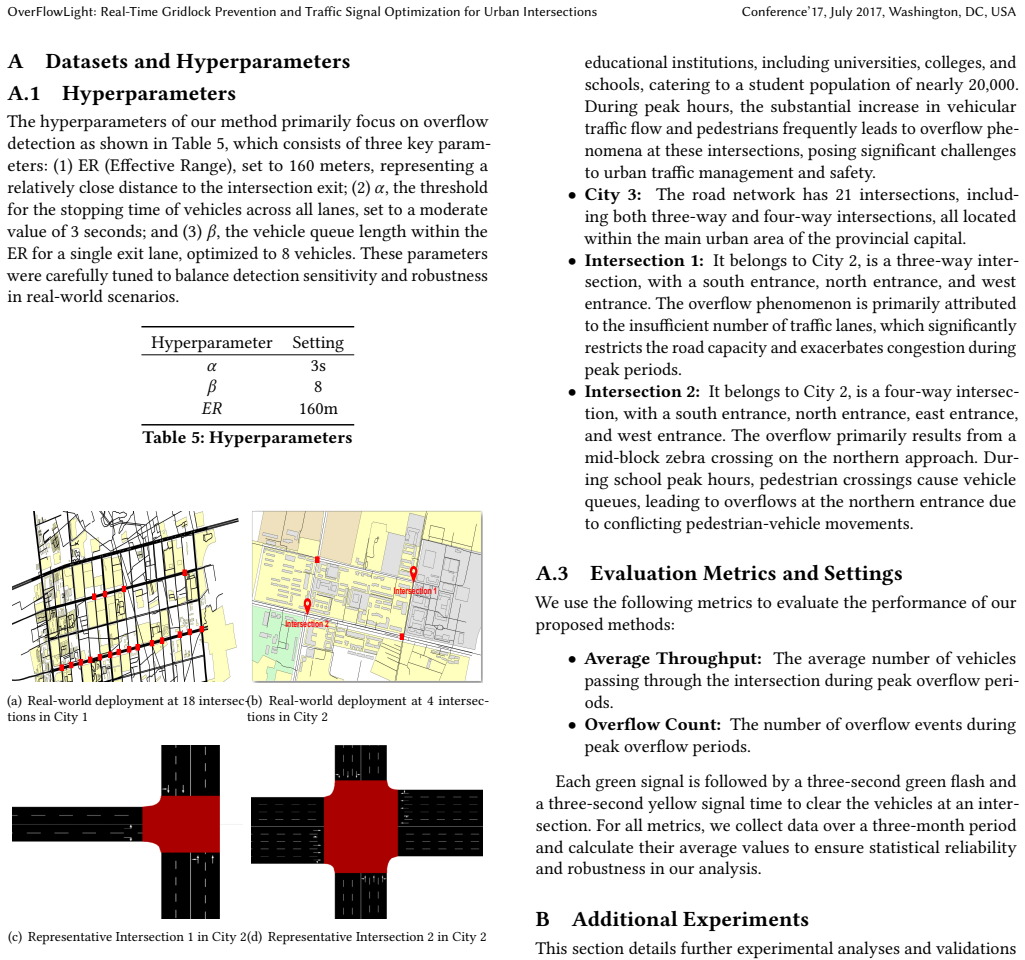
S. Lai, Z. Xu, W. Zhang, H. Liu, and H. Xiong, “Llmlight: Large language models as traffic signal control agents, ”arXiv preprint arXiv:2312.16044, 2023. OverFlowLight: Real-Time Gridlock Prevention and Traffic Signal Optimization for Urban Intersections Conference’17, July 2017, Washington, DC, USA A Datasets and Hyperparameters A.1 Hyperparameters The h...
discussion (0)
Sign in with ORCID, Apple, or X to comment. Anyone can read and Pith papers without signing in.