REVIEW 5 major objections 3 minor 12 references
BALSAM: A Platform for Benchmarking Arabic Large Language Models
T0 review · 5 major / 3 minor · reviewed 2026-08-06 · deepseek-v4-flash
Pith's one-line read LLM-as-a-judge evaluation is reliable for Arabic: the judge correlated with human ratings at 0.824–0.977 across task categories, outperforming agreement between human raters themselves, so the BALSAM leaderboard relies on automated judging.
desk verdict Useful blind Arabic benchmark, but the LLM-judge reliability claim rests on an in-sample 254-question validation and needs held-out evidence before the leaderboard is trusted. read the letter →
The pith
A machine-rendered reading of the paper's core claim, the machinery that carries it, and where it could break.
The reading
What carries the argument
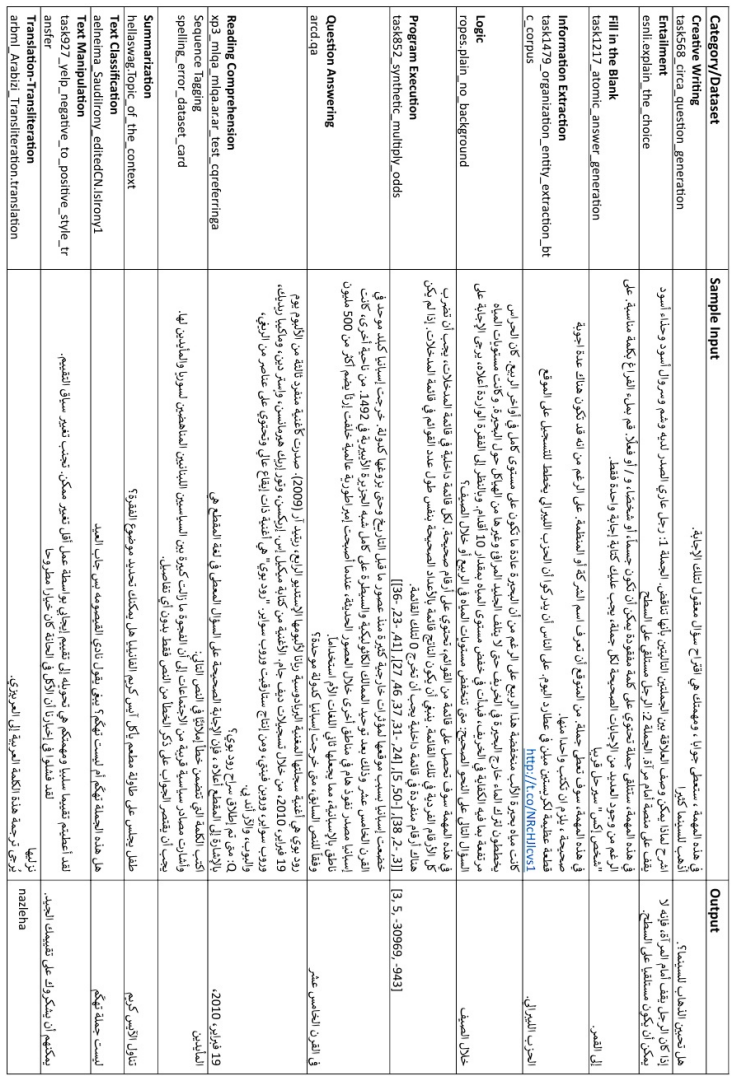
Two components carry the argument. The first is the BALSAM benchmark itself: 78 tasks in 14 categories split over two phases, with blind test sets of only 10–100 examples per task (37,419 test and 15,742 development examples in total), so that contamination-resistant and refreshable evaluation is possible. The second is the LLM-as-a-judge pipeline: a first prompt tells a judge model to extract the bare answer from a generated output, and a second prompt rates that answer 0–3 against the ground truth using a rubric that mirrors the human annotation instructions. The judge is Gemini 2.5 Flash, chosen because it matched the best alternative's correlation with human scores at substantially lower cost. The Pearson correlation between this judge's scores and the averaged human ratings, computed per category and then averaged, is the quantity that decides which evaluation method the leaderboard uses.
What would settle it
Score a fresh random sample of about 500 test questions drawn across all 14 categories with new human raters, then compare their averaged scores with the judge's scores on the same outputs; if the correlation falls below the reported 0.918 or the judge's model ordering on the sample diverges from the raters' ordering, the claim that LLM judging is reliable enough to power the full leaderboard is refuted. A quicker check is to rerun the full test set with a second, independently trained judge model and test whether the 22-model ranking survives the swap.
Extended reading notes
Core claim
The paper's central finding, on its own terms, is that LLM-as-a-judge evaluation agrees with human judgment on Arabic better than any automatic metric tried so far, and better than human raters agree with each other. On a random sample of 254 test questions, about 20 per category, three raters scored the outputs of 22 LLMs on a 0–3 correctness scale, yielding 16,764 judgments and an average inter-rater Pearson correlation of 0.750. The same outputs scored by the LLM judge—an answer-extraction step followed by a rubric-based 0–3 rating against the ground truth—correlated with the average human score at 0.824 to 0.977 across categories, with an average of 0.918; by comparison, ROUGE-LSum averaged 0.111, BLEU 0.134, and BERTScore 0.184, improving only modestly when answers were extracted first. The paper therefore replaces lexical and embedding metrics with LLM judging for the full BALSAM test set, and the resulting ranking is very different from the n-gram one, with GPT-4o, Gemini 2.0 Flash, and DeepSeek V3 at the top and the former ROUGE/BLEU leader, SILMA-9B, in the lower third.
Load-bearing premise
The load-bearing premise is that the 254 human-judged questions—about 20 per category, each scored by three raters—fairly represent all 78 tasks, including the many datasets that started as English translations, so that the judge's measured correlation of 0.918 on that sample transfers to the full 37,419-example test set and to every model ranking built from it.
Editorial extensions
If this is right
- Arabic leaderboards built on BLEU and ROUGE have likely mis-ranked models: under LLM judging on BALSAM, the model that topped the n-gram tables, SILMA-9B, falls to the lower third, while GPT-4o, Gemini 2.0 Flash, and DeepSeek V3 lead.
- Because the judge can rescore the blind test set on demand through the platform, the leaderboard can stay current as new models are released, without waiting for fresh human annotations.
- Category-level judging gives a differentiated picture: Grok-2 leads Logic, Iron Horse leads Program Execution, and the Arabic-tuned Nuha v2 finishes above much larger multilingual models, so model size alone does not predict Arabic capability.
- The benchmark design—many tasks with small blind test sets that can be refreshed—is intended to make data-contamination detectable and to give the Arabic NLP community a common standard for comparing models.
Reading between the lines
- A stress test the paper does not run is judge substitution: if a second, independently trained LLM judge reproduced the same ordering of the 22 models on the full test set, the reliability claim would attach to the method rather than to one particular judge model.
- The n-gram failure mode documented here—exact-match penalties for Arabic morphological variants such as definite articles and clitics—should afflict other morphologically rich languages, so judge-based scoring may prove superior there as well; replicating the human-correlation study in Hebrew, Russian, or Turkish would test that.
- Because the judge is itself a model, its scores may drift as the model is updated or retrained, and a durable leaderboard would need a fixed, human-scored anchor set for periodic recalibration of the judge.
- The result that one LLM judge tracks the average of three human raters better than those raters track each other suggests that single-human evaluation of Arabic generation is quite noisy; aggregate rankings may safely be delegated to automated judging, with human review reserved for error analysis.
Editorial analysis
A structured set of objections, weighed in public.
Referee Report
Summary. The paper introduces BALSAM, a community-driven benchmark for Arabic LLMs that comprises 78 tasks across 14 categories, with 37,419 blind test and 15,742 development examples, together with a centralized evaluation platform and leaderboard. The authors evaluate 22 open and closed models, compare ROUGE-LSum, BLEU, BERTScore, and an LLM-as-a-judge pipeline against human judgments on a 254-question sample, and report that Gemini 2.5 Flash used as a judge correlates strongly with human judgments (0.824–0.977, average 0.918) while lexical and semantic metrics do not. On this basis they switch the full leaderboard to LLM-as-a-judge scoring.
Significance. The resource contribution is substantial: a diverse, QA-checked, blind benchmark with a public platform is genuinely useful for Arabic NLP, and the paper's comparison of automated measures on Arabic is a valuable empirical study. The central claim that LLM-as-a-judge is reliable for Arabic evaluation, if established, would justify replacing lexical metrics in this leaderboard and guide evaluation practice for Arabic more broadly. However, the current evidence for that claim is weakened by in-sample judge selection, a small human-judged sample, an asymmetric scoring pipeline, and the absence of uncertainty quantification. The benchmark's practical value does not depend on that claim, but the paper's headline conclusion does.
major comments (5)
- [§5.2, Table 5 and footnote 4] The reliability evidence for the LLM judge is in-sample: the judge was selected after comparing GPT-4o, GPT-4o mini, and Gemini 2.5 Flash on the same 254-question human sample used to report the correlations in Table 5. Because the model choice is conditioned on this sample, the reported average correlation of 0.918 and per-category values 0.824–0.977 are optimistically biased estimates of how the chosen judge would perform on new data. No held-out human evaluation or cross-validated selection is reported. Please provide a held-out validation set, or at least bootstrap or cross-validation estimates with confidence intervals, before claiming that the judge generalizes to the full 37,419-example leaderboard.
- [§5.2, Tables 3 and 5] The observation that the LLM judge 'correlated better with the average of judges' scores than judges correlated with each other' is not a like-for-like comparison. The average of three human ratings has lower noise than any single human rating, so even a judge whose per-rating reliability is no better than a typical human rater would be expected to correlate more strongly with the mean. The comparison should be re-framed, and the relevant evidence should include correlations between the LLM judge and each individual human judge.
- [§5.2, Table 5] The paper does not state the unit of analysis for the correlations. The tables appear to correlate, per category, 22 model-level averages of human scores with 22 model-level averages of each metric; if so, each correlation is based on only 22 points, each point being an average over 20 questions. With this effective sample size, the reported correlations have wide confidence intervals, and the per-category differences in Table 5 may not be significant. Please state the unit of analysis explicitly and provide confidence intervals or a permutation-based significance test for each correlation.
- [§5.2, Listings 1–2 and Appendix F] The scoring pipelines are asymmetric: human judges rated raw model outputs, while the LLM judge rated answers extracted by Gemini 2.5 Flash from those outputs. The high LLM-judge correlations may therefore reflect the extraction step rather than the quality of judgment itself. To isolate judge reliability, report LLM-judge correlations on raw outputs as well, or have human judges rate the extracted answers, so that both conditions use the same input text.
- [§5.2 and Table 8] The human validation sample is small relative to the test-set composition. For example, Phase 2 Machine Translation has 12,890 test examples but contributes only 20 questions to the human-judged sample, and other large categories such as Question Answering are similarly under-sampled. The per-category correlations, and particularly the average of 0.918, may not transfer to the full item distribution within each category. A stratified human sample or per-task reliability estimates are needed to support the decision to use the judge on the entire test set.
minor comments (3)
- [§5.2] The text says there were '20 questions per category' and reports 254 questions, but the 13 categories in Table 3 imply 260 questions; please clarify whether some categories contributed fewer usable questions or whether the count is otherwise defined.
- [§6] The conclusion states that BALSAM has '37K development and 15K test examples,' which inverts the numbers reported elsewhere in the paper (37,419 test and 15,742 development); please correct this.
- [Table 5] The column labels 'Ext. ROUGE,' 'Ext. BLEU,' and 'Ext. BERT' are not defined in the table caption; please state in the caption that these denote scores computed on LLM-extracted answers.
Circularity Check
Judge reliability rests on in-sample selection: Gemini 2.5 Flash was chosen using the same 254-question human sample on which the headline 0.918 correlation is reported, then applied to the full 37,419-example leaderboard.
-
fitted input called prediction
[Section 5.2, 'LLM-Based Scoring' footnote; Tables 5 and 6]
"We also experimented with GPT-4o and GPT-4o mini as LLM judges. GPT-4 and Gemini showed nearly identical correlation with human scores, both outperforming GPT-4o mini by a sizable margin. Eventually, we selected Gemini 2.5 Flash due to its substantially lower cost."
The choice of Gemini 2.5 Flash as the LLM judge was made by comparing candidate judges' correlation with human scores on the same sample that Section 5.2 uses as evidence ('LLM as a judge was highly correlated with human judgments for all categories, with values ranging between 0.824 and 0.977'). The reported Table 5 correlation (average 0.918) is therefore the selected judge's in-sample performance on the selection set, not an independent validation. The paper then converts this in-sample result into a decision to 'drop ROUGE, BLEU, and BERTScore and rely solely on LLM as a Judge' for the full 37,419-example Table 6 leaderboard.
full rationale
The core circularity is localized to the LLM-as-a-judge validation. The human-annotated sample is real and the correlation is not definitionally 1, so this is not a self-definitional collapse; however, the judge was selected by comparing candidate judges on that very sample, making the headline correlation an in-sample, post-selection statistic. The BALSAM dataset construction, blind test sets, platform, and the negative BLEU/ROUGE/BERTScore findings are independent of this step and give the paper substantial non-circular content. I find no other load-bearing circularity: self-citations (e.g., to El-Sheikh et al. 2024 for translated prompts) support auxiliary data-creation claims, not the central result. Score 4 reflects one statistically forced 'prediction' rather than a derivation that is equivalent to its inputs.
Assumptions & free parameters
free parameters (3)
- LLM judge model =
Gemini 2.5 Flash
- Human-evaluation sample size =
20 questions per category, 3 judges
- Target test-set size per task =
10-100 examples
assumptions (5)
- domain assumption Human judgments on a 0-3 correctness scale are treated as ground truth for evaluation quality.
- domain assumption The correlation measured on a 254-question sample (20 per category, 3 judges) generalizes to the full 37,419-example test set.
- domain assumption The blind test sets have not leaked into the evaluated models or into the judge model.
- domain assumption Translated and GPT-4o-generated examples preserve the intended Arabic task semantics and have correct reference answers.
- standard math Pearson correlation and macro-averaging are appropriate for comparing evaluation measures.
Cite this review
Pith. "Pith review of BALSAM: A Platform for Benchmarking Arabic Large Language Models." pith.science (2026). https://pith.science/paper/4FM2KF5N
@misc{pith2026250722603,
  author       = {Pith},
  title        = {Pith review of: BALSAM: A Platform for Benchmarking Arabic Large Language Models},
  year         = {2026},
  howpublished = {\url{https://pith.science/paper/4FM2KF5N}},
  note         = {Machine review of arXiv:2507.22603}
}
read the original abstract
The impressive advancement of Large Language Models (LLMs) in English has not been matched across all languages. In particular, LLM performance in Arabic lags behind, due to data scarcity, linguistic diversity of Arabic and its dialects, morphological complexity, etc. Progress is further hindered by the quality of Arabic benchmarks, which typically rely on static, publicly available data, lack comprehensive task coverage, or do not provide dedicated platforms with blind test sets. This makes it challenging to measure actual progress and to mitigate data contamination. Here, we aim to bridge these gaps. In particular, we introduce BALSAM, a comprehensive, community-driven benchmark aimed at advancing Arabic LLM development and evaluation. It includes 78 NLP tasks from 14 broad categories, with 52K examples divided into 37K test and 15K development, and a centralized, transparent platform for blind evaluation. We envision BALSAM as a unifying platform that sets standards and promotes collaborative research to advance Arabic LLM capabilities.
Figures

Reference graph
Works this paper leans on
-
[1]
The original prompt given to the generative model
-
[2]
The ground truth answer, representing the ideal or expected output
-
[3]
A framework for few-shot language model evaluation. Dan Hendrycks, Collin Burns, Steven Basart, Andy Zou, Mantas Mazeika, Dawn Song, and Jacob Steinhardt
-
[5]
AceGPT, localizing large language models in Arabic. In Proceedings of the 2024 Conference of the North American Chapter of the Association for Computational Linguistics: Human Language Tech- nologies (Volume 1: Long Papers), pages 8139–8163, Mexico City, Mexico. Association for Computational Linguistics. Amazon Artificial General Intelligence. 2024. The a...
arXiv 2024
-
[10]
The actual output generated by the generative model. Evaluate the generated output by comparing it to the ground truth, considering how well it addresses the original prompt. Scoring Rubric: * Score 0: The automatically generated output is completely wrong, irrelevant, or unrelated to the prompt and ground truth. * Score 1: Poor answer. The output attempt...
-
[11]
`score`: An integer between 0 and 3 based on the rubric above
-
[12]
`explanation`: A brief, concise string explaining *why* you assigned that score, referencing the differences or similarities between the generated output and the ground truth in the context of the prompt. Example Output JSON: { "score": 3, "explanation": "The generated output is accurate and complete, closely matching the ground truth." } [PROMPT] {prompt...
-
[2021]
In International Conference on Learning Representations
Measuring massive multitask language under- standing. In International Conference on Learning Representations. Faris Hijazi, Somayah Alharbi, Abdulaziz AlHus- sein, Harethah Shairah, Reem Alzahrani, Hebah Al- shamlan, George Turkiyyah, and Omar Knio. 2024. ArabLegalEval: A multitask benchmark for assessing Arabic legal knowledge in large language models. ...
work page 2024
Show all 12 references
-
[2022]
arXiv preprint arXiv:2204.05862
Training a helpful and harmless assistant with reinforcement learning from human feedback. arXiv preprint arXiv:2204.05862. Wei-Lin Chiang, Lianmin Zheng, Ying Sheng, Anasta- sios Nikolas Angelopoulos, Tianle Li, Dacheng Li, Banghua Zhu, Hao Zhang, Michael Jordan, Joseph E Gon...
2024 arXiv
-
[2023]
In Findings of the Associa- tion for Computational Linguistics: EMNLP 2023 , pages 1404–1422, Singapore
Dolphin: A challenging and diverse bench- mark for Arabic NLG. In Findings of the Associa- tion for Computational Linguistics: EMNLP 2023 , pages 1404–1422, Singapore. Association for Com- putational Linguistics. R OpenAI. 2023. Gpt-4 technical report. arXiv, pages 2303–08774....
2023 arXiv
-
[2024]
urlhttps://huggingface.co/spaces/inceptionai/AraGen- Leaderboard
Rethinking llm evaluation with 3c3h: Aragen benchmark and leaderboard. urlhttps://huggingface.co/spaces/inceptionai/AraGen- Leaderboard. Abdelrahman El-Sheikh, Ahmed Elmogtaba, Kareem Darwish, Muhammad Elmallah, Ashraf Elneima, and Hassan Sawaf. 2024. Creating arabic llm promp...
2024 arXiv
-
[2025]
In Proceedings of the 31st International Conference on Computational Lin- guistics, pages 4186–4218, Abu Dhabi, UAE
AraDiCE: Benchmarks for dialectal and cul- tural capabilities in LLMs. In Proceedings of the 31st International Conference on Computational Lin- guistics, pages 4186–4218, Abu Dhabi, UAE. Asso- ciation for Computational Linguistics. Niklas Muennighoff, Thomas Wang, Lintang Sut...
2023
Reviewed August 6, 2026 · model on record in the stance chip above.
Discussion (0). Sign in to comment.