REVIEW 3 major objections 4 minor 6 references
A Route Toward the On-Surface Synthesis of Organic Ferromagnetic Quantum Spin Chains
T0 review · 3 major / 4 minor · reviewed 2026-08-11 · deepseek-v4-flash
Pith's one-line read The paper establishes that direct majority–minority coupling of dibenzotriangulene units on Au(111) yields ferromagnetic dimers and trimers, with a quintet ground state and 7 meV intermolecular exchange.
desk verdict A credible and useful demonstration of direct majority-minority ferromagnetic coupling in DBT dimers and trimers, with a 7 meV exchange; the main soft spots are missing error bars and the loosely anchored 23 meV trimer assignment. read the letter →
The pith
A machine-rendered reading of the paper's core claim, the machinery that carries it, and where it could break.
The reading
What carries the argument
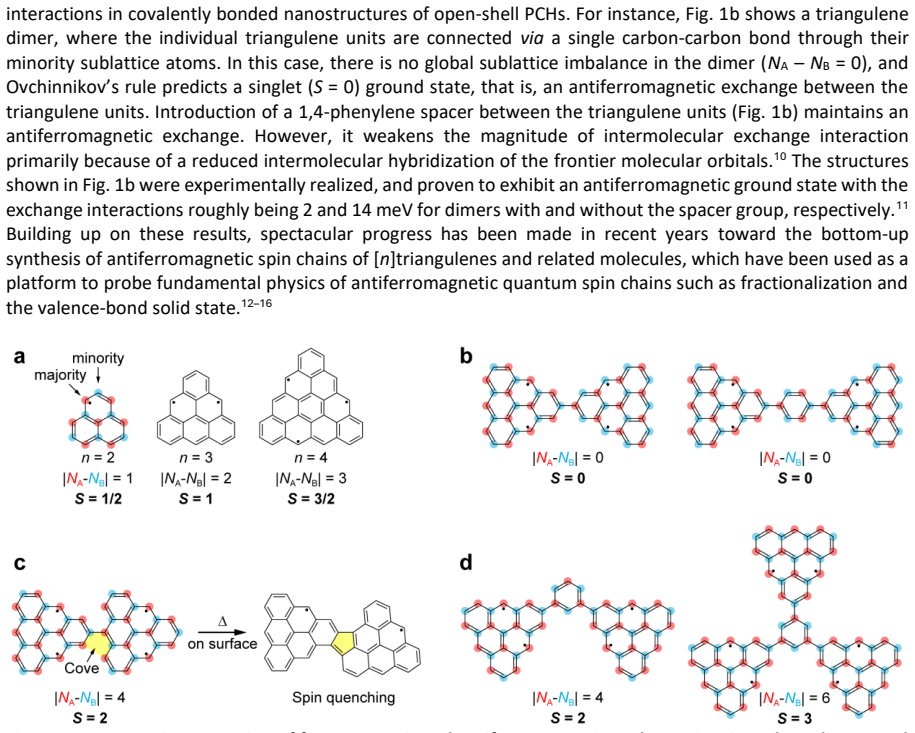
The load-bearing object is the gulf region of the dibenzotriangulene unit: the benzo extension at the coupling site that sterically prevents the cyclodehydrogenative formation of a pentagonal ring between coupled units, which had previously destroyed the bipartite lattice and quenched the spins. The design principle is a direct (spacer-free) carbon–carbon bond connecting the majority sublattice of one DBT to the minority sublattice of the next, which makes the global sublattice imbalance $|N_A-N_B|$ grow with chain length and therefore, by Ovchinnikov's rule $S=|N_A-N_B|/2$, forces a ferromagnetic ground state. The paper combines nearest-neighbour tight-binding and mean-field Hubbard calculations, CASSCF-NEVPT2 many-body calculations, and scanning probe spectroscopy of inelastic spin excitations to assign the ground states and extract exchange energies.
What would settle it
An atomically resolved AFM image of 3k or 5FM showing a pentagonal ring or a different connectivity at the inter-unit bond, or a spin-excitation spectrum whose multiplet ordering and energies are inconsistent with a quintet or septet ground state, would refute the assignment.
Extended reading notes
Core claim
On the paper's own terms, the central discovery is that dibenzotriangulene (DBT), because of its benzo extension, permits direct majority–minority coupling between neighbouring units without the formation of pentagonal rings that break bipartite symmetry and quench the spins. For the majority–minority dimer 3k the ground state is a quintet ($S=2$), consistent with a global sublattice imbalance $|N_A-N_B|=4$, and the spin excitation at 14 meV is assigned to a quintet–triplet transition, giving an effective Heisenberg exchange $J_{\mathrm{eff}}=7$ meV. For the majority–minority trimer 5FM the ground state is a septet ($S=3$), as Ovchinnikov's rule demands. The two other coupling classes, majority–majority (2k) and minority–minority (4k), have no global sublattice imbalance and are antiferromagnetic singlets, with singlet–triplet excitations at 19 meV and 2.5 meV respectively, demonstrating that the sign of the exchange is controlled by the sublattice coupling motif.
Load-bearing premise
The central claim rests on the structural assignment of the ferromagnetic dimers and trimer as majority–minority coupled DBT units with intact gulf regions and no pentagonal ring; if cyclodehydrogenation or a different coupling motif occurred, the sublattice imbalance would disappear and the ferromagnetic ground state would collapse.
Editorial extensions
If this is right
- Ferromagnetic coupling between open-shell polycyclic hydrocarbons can be obtained without a spacer, giving an exchange of about 7 meV, roughly an order of magnitude larger than spacer-based ferromagnetic dimers with exchange below 1 meV.
- The same majority–minority bond motif should extend to longer DBT chains, with the total spin growing by one per added unit, offering a route to organic ferromagnetic quantum spin chains.
- The sublattice coupling motif (majority–majority, majority–minority, minority–minority) deterministically sets the sign of the exchange, giving a design rule for magnetic coupling in nanographenes.
- The S=2 Kondo resonance observed in the ferromagnetic dimer and the spectral-weight distribution in the trimer show that these chains can be probed as spin systems at the single-molecule level.
Reading between the lines
- If the gulf-region protection is a general design rule rather than specific to DBT, other pi-extended triangulene derivatives could be coupled directly to build ferromagnetic chains with different spin sizes and exchange strengths.
- The paper's calculations are for gas-phase molecules, and it notes that surface effects may renormalize the spin excitation energies; the 7 meV value is a surface-measured effective exchange, so the intrinsic molecular exchange could differ.
- A natural next test is to grow longer DBT chains and look for the spin-wave-like excitations expected of a ferromagnetic Heisenberg chain, rather than only dimer and trimer transitions.
- The same precursor chemistry might be combined with insulating surfaces to reduce Kondo screening and reveal the unscreened high-spin multiplets.
Signed reviews
Editorial analysis
A structured set of objections, weighed in public.
Referee Report
Summary. The manuscript reports the on-surface synthesis of dibenzotriangulene (DBT) dimers and trimers on Au(111) and their characterization by STM/AFM and inelastic electron tunneling spectroscopy. Depending on the regioselective coupling of the constituent DBT units, the dimers exhibit antiferromagnetic exchange (majority-majority and minority-minority couplings) or ferromagnetic exchange (majority-minority coupling), with the ferromagnetic dimer 3k showing a quintet ground state and an extracted intermolecular exchange of 7 meV. A majority-minority coupled trimer 5FM is shown to have a septet ground state. The authors argue that the benzo extension creates gulf regions that prevent the pentagonal-ring cyclodehydrogenation that previously quenched spin in direct triangulene couplings, providing a route to organic ferromagnetic quantum spin chains.
Significance. If the structural assignments hold, the paper provides a clear design principle for direct, spacer-free ferromagnetic coupling between organic radicals, with an exchange energy (7 meV) an order of magnitude larger than previous spacer-based ferromagnetic dimers. The combination of STM/AFM structural data, spin-excitation spectroscopy, and CASSCF-NEVPT2 benchmarks is a strength, as is the use of the Heisenberg dimer model to extract J_eff from the measured quintet-triplet gap. The demonstration of a septet trimer, even with the quantitative discrepancy noted below, is a step toward longer ferromagnetic spin chains. The principal risk is that the central ferromagnetism claim depends on the AFM-based exclusion of cyclodehydrogenated isomers, which is not yet quantitatively supported.
major comments (3)
- [Fig. 2f-h and section "On-surface synthesis of dibenzotriangulene dimers"] The quintet and septet ground states claimed for 3k and 5FM depend entirely on the assignment of these structures as intact DBT units coupled through majority-minority sublattice sites with intact gulf regions. The AFM images are the only direct evidence against the alternative cyclodehydrogenated isomer containing a pentagonal ring, which is the exact failure mode previously identified for direct triangulene couplings (refs. 21,22). The gulf-region argument is plausible but is validated only by qualitative inspection. I request that the authors either (i) simulate the AFM constant-height images for both the intact gulf structure and the pentagonal-ring isomer and compare them with experiment, or (ii) compute the electronic spectrum of the pentagonal-ring isomer and show explicitly that it cannot account for the observed 14 meV excitation and the S=2 Kondo signature. Without this, the central ferromagnetism claim rests on an unverified structural assumption.
- [Fig. 5c,d and section "Magnetic excitations in ferromagnetic dibenzotriangulene trimers"] The 23 meV spin excitation observed on the central DBT unit of 5FM is assigned to the second quintet state calculated at 17 meV, a discrepancy of 6 meV that is not discussed. This assignment is used to confirm the septet ground state and the spectral-weight pattern (Fig. 5e). The authors should either provide a quantitative estimate of the surface-induced renormalization for this trimer (e.g., following ref. 26) or perform a state-averaged CASSCF calculation with a larger active space to verify the second-quintet energy. As written, the mismatch leaves the trimer confirmation quantitatively insecure.
- [Fig. 5e and Methods (CASSCF calculations)] The spectral weights shown in Fig. 5e are obtained from an exact diagonalization of a CAS-Hubbard model (CAS(6,6), t = -2.7 eV, U = |t|), whereas the energy levels and the 6 meV and 17 meV assignments come from CASSCF-NEVPT2. The relationship between these two models is not established; in particular, it is not shown that the CAS-Hubbard states at the energies of the first and second quintets have the same spatial character as the CASSCF-NEVPT2 states. The authors should clarify how the spectral-weight calculation relates to the CASSCF-NEVPT2 wavefunctions, or compute the spectral weights directly from the CASSCF states, to justify the spatial assignment of the 23 meV excitation.
minor comments (4)
- [Methods, Eq. (1)] In the mean-field Hubbard Hamiltonian, the second sum contains operators a_i↑^† a_j↑ with an undefined index j; it should be a_i↑^† a_i↑ (i.e., the number operator), or the sum should be written accordingly. Please correct this typo.
- [Abstract and Conclusion] The introduction states that the spacer-based ferromagnetic exchange is "about 1 meV", while the conclusion states "< 1 meV". Please make these two characterizations consistent.
- [Conclusions, item (2)] In the bullet-list comparison of experimental and calculated excitation energies, the calculated quintet-triplet gap for 3k is not given, while the values for 2k (35 meV) and 4k (2.8 meV) are. Please provide the calculated value for 3k to facilitate comparison with the measured 14 meV.
- [Fig. S6 caption] The statistical distribution of the three dimer classes (6 majority-majority, 9 majority-minority, 11 minority-minority out of 26 dimers) is only reported in the Supporting Information. Mentioning this in the main text would strengthen the regioselectivity claim.
Circularity Check
No significant circularity: the spin-state assignments and exchange energies rest on independent measurements and parameter-free multiconfigurational calculations, not on fitted inputs or self-citation chains.
full rationale
The paper's central claims—quintet (septet) ground states for the majority-minority coupled DBT dimer (trimer) and an intermolecular exchange of 7 meV—are supported by independent experimental and theoretical evidence. The inelastic spin excitation steps at 19, 14, and 2.5 meV are measured directly by STS, and the CASSCF-NEVPT2 calculations are parameter-free many-body benchmarks whose active spaces are chosen from natural orbital occupancies rather than fitted to the measured excitation energies. The identification of the 14 meV feature as a quintet-triplet excitation follows from the calculated spin-state ordering combined with the spin selection rule, and the extraction of J_eff = 7 meV uses the Heisenberg dimer model only after checking that 3k is well approximated by that model according to the CASSCF-NEVPT2 spectrum. The structural assignment of 2k, 3k, and 4k by AFM is an independent imaging-based input; if that assignment were wrong, the ferromagnetism claim would fail, but that is a correctness risk, not circular reasoning. The paper does cite prior work by overlapping authors (e.g., refs 11 and 12 on triangulene dimers and spin chains), but these citations are used for context, for the geometry independence of electronic structure, and for comparison of exchange magnitudes; the present paper also provides its own straight-dimer data in the SI. No parameter is fitted to the target spin excitation and then renamed as a prediction, and no uniqueness theorem or ansatz is imported solely through self-citation. The most load-bearing physical premise—that the gulf regions prevent pentagonal-ring formation—is directly addressed by AFM imaging of the intact DBT coupling motifs. Overall, the derivation chain is self-contained against external benchmarks, and any self-citations are minor and not load-bearing; the score is therefore 1 rather than 0 only to acknowledge the presence of a few non-load-bearing self-citations.
Assumptions & free parameters
free parameters (3)
- Hubbard U (MFH) =
4 eV (1.4 t1)
- Nearest-neighbor hopping t1 =
-2.8 eV
- t and U in CAS-Hubbard spectral function =
t = -2.7 eV, U = |t|
assumptions (5)
- domain assumption Ovchinnikov's rule for bipartite lattices (S = |NA - NB|/2)
- domain assumption Inelastic spin excitation selection rule ΔS = 0 or ±1
- domain assumption Heisenberg dimer model H = J_eff S1·S2 for DBT dimers
- domain assumption The C-C bond connecting DBT units is non-rotating (planar dihedral fixed)
- domain assumption Surface renormalization of spin excitation energies is a uniform scaling effect
Cite this review
Pith. "Pith review of A Route Toward the On-Surface Synthesis of Organic Ferromagnetic Quantum Spin Chains." pith.science (2026). https://pith.science/paper/4FQLCR2X
@misc{pith2026241211884,
  author       = {Pith},
  title        = {Pith review of: A Route Toward the On-Surface Synthesis of Organic Ferromagnetic Quantum Spin Chains},
  year         = {2026},
  howpublished = {\url{https://pith.science/paper/4FQLCR2X}},
  note         = {Machine review of arXiv:2412.11884}
}
read the original abstract
Engineering sublattice imbalance is an intuitive way to induce high-spin ground states in bipartite polycyclic conjugated hydrocarbons (PCHs). Such high-spin molecules can be employed as building blocks of quantum spin chains, which are outstanding platforms to study many-body physics and fundamental models in quantum magnetism. Recent reports on the bottom-up synthesis of antiferromagnetic molecular spin chains provided insights into paradigmatic quantum phenomena such as fractionalization. In contrast to antiferromagnetism, demonstration of ferromagnetic coupling between PCHs has been scarce. Previous attempts in this direction were limited by the formation of non-benzenoid rings leading to spin quenching, or the use of spacer motifs that considerably weaken the magnitude of ferromagnetic exchange. Here, we demonstrate the on-surface synthesis of short ferromagnetic spin chains based on dibenzotriangulene (DBT), a PCH with a triplet ground state. Our synthetic strategy centers on achieving a direct (that is, without a spacer motif) majority-minority sublattice coupling between adjacent units. This leads to a global sublattice imbalance in spin chains scaling with the chain length, and therefore a ferromagnetic ground state with a strong intermolecular ferromagnetic exchange. By means of scanning probe measurements and multiconfigurational quantum chemistry calculations, we analyze the electronic and magnetic properties of ferromagnetic dimers and trimers of DBT, and confirm their quintet and septet ground states, respectively, with an intermolecular ferromagnetic exchange of 7 meV. Furthermore, we elucidate the role of sublattice coupling on magnetism through complementary experiments on antiferromagnetic DBT dimers with majority-majority and minority-minority couplings. We expect our proof-of-principle study to provide impetus for the design of purely organic ferromagnetic materials.
Figures
Reference graph
Works this paper leans on
-
[1]
(1) Oteyza, D. G. de; Frederiksen, T. Carbon -Based Nanostructures as a Versatile Platform for Tunable π - Magnetism. J. Phys.: Condens. Matter 2022, 34 (44), 443001. https://doi.org/10.1088/1361-648X/ac8a7f. 10 (2) Ovchinnikov, A. A. Multiplicity of the Ground State of Large Alternant Organic Molecules with Conjugated Bonds. Theoret. Chim. Acta 1978, 47 ...
-
[5]
Colored circles indicate positions at which the spectra shown in panel c have been recorded
(b) STM image of 5FM, obtained with a metal lic (Au) tip. Colored circles indicate positions at which the spectra shown in panel c have been recorded. STM parameters: V = +40 mV, I = 300 pA. (c) dI/dV(V) (top) and d2I/dV2(V) (bottom) spectra obtained on the DBT trimer shown in panel a using a metallic (Au) tip, where no CO vibrational features are present...
work page 2016
-
[1705]
https://doi.org/10.1038/s41467-022- 29371-9. (19) Du, Q.; Su, X.; Liu, Y.; Jiang, Y.; Li, C.; Yan, K.; Ortiz, R.; Frederiksen, T.; Wang, S.; Yu, P. Orbital -Symmetry Effects on Magnetic Exchange in Open -Shell Nanographenes. Nat. Commun. 2023, 14 (1),
-
[3022]
Gapless spin excitations in nanographene-based antiferromagnetic spin-1/2 Heisenberg chains
https://doi.org/10.1039/D2CC00352J. (5) Pavliček, N.; Mistry, A.; Majzik, Z.; Moll, N.; Meyer, G.; Fox, D. J.; Gross, L. Synthesis and Characterization of Triangulene. Nat. Nanotechnol. 2017, 12 (4), 308–311. https://doi.org/10.1038/nnano.2016.305. (6) Mishra, S.; Beyer, D.; Eimre, K.; Liu, J.; Berger, R.; Gröning, O.; Pignedoli, C. A.; Müllen, K.; Fasel,...
work page Pith review arXiv doi:10.48550/arxiv.2408.10045 2017
-
[4802]
11 (20) Turco, E.; Wu, F.; Catarina, G.; Krane, N.; Ma, J.; Fasel, R.; Feng, X.; Ruffieux, P
https://doi.org/10.1038/s41467-023-40542-0. 11 (20) Turco, E.; Wu, F.; Catarina, G.; Krane, N.; Ma, J.; Fasel, R.; Feng, X.; Ruffieux, P. Magnetic Excitations in Ferromagnetically Coupled Spin -1 Nanographenes. Angew. Chem. Int. Ed. 2024, e202412353. https://doi.org/10.1002/anie.202412353. (21) Daugherty, M. C.; Jacobse, P. H.; Jiang, J.; Jornet -Somoza, ...
-
[6076]
(18) Cheng, S.; Xue, Z.; Li, C.; Liu, Y.; Xiang, L.; Ke, Y.; Yan, K.; Wang, S.; Yu, P
https://doi.org/10.1038/s41467-020-19834-2. (18) Cheng, S.; Xue, Z.; Li, C.; Liu, Y.; Xiang, L.; Ke, Y.; Yan, K.; Wang, S.; Yu, P. On-Surface Synthesis of Triangulene Trimers via Dehydration Reaction. Nat. Commun. 2022, 13 (1),
Reviewed August 11, 2026 · model on record in the stance chip above.
Discussion (0). Continue with ORCID to comment.