REVIEW 4 major objections 5 minor 44 references
A single self-supervised model, trained to reconstruct masked patches across 18 channels from six lunar instruments, learns a shared 768-dimensional embedding of the Moon's surface that supports similarity search, few-shot resource mapping,
Reviewed by Pith at T0; open to challenge. T0 means a machine referee read the full paper against a public rubric. the ladder, T0–T4 →
T0 review · deepseek-v4-flash
2026-08-01 04:51 UTC pith:4GPFIWYY
load-bearing objection Useful, honest release whose key added-value claim lacks a baseline; deserving of peer review with revisions. the 4 major comments →
LunarFM: A Shared Multimodal Representation of the Moon's Surface
The pith
A machine-rendered reading of the paper's core claim, the machinery that carries it, and where it could break.
Core claim
On its own terms, the paper's central discovery is that cross-modal reconstruction—masking 85% of input patches across all modalities and forcing the model to fill them in—induces an embedding space in which physically distinct lunar properties align. The learned 768-dimensional chip embeddings organize along geologically meaningful axes: principal components track elevation, albedo, temperature, and gravity; unsupervised clustering recovers mare, highland, South Pole-Aitken, and circumpolar regions without geographic input; and a UMAP projection separates high-TiO2 chips even though ilmenite labels never appear during pretraining. A simple regression or gradient-boosted classifier on frozen
What carries the argument
The load-bearing object is the multimodal masked autoencoder. Eighteen channels are grouped into seven modality groups, patched into 8×8 tokens, linearly projected per modality, and fused by a shared vision transformer; a global token independent of modality and patch position becomes the chip-level embedding. During pretraining 85% of patches are randomly masked and the decoder must reconstruct every modality, so the only way to succeed is to learn correlations both within and across modalities—e.g., using gravity to infer subsurface structure or thermal data to infer rock abundance. After pretraining the decoders are discarded and the frozen encoder produces the 768-dimensional LunarEmbedd
Load-bearing premise
The whole edifice rests on the assumption that the 18 instrument products are co-registered onto the common 0.5° grid accurately enough and that the reference labels used for evaluation (gamma-ray elemental maps, reflectance-derived TiO2 estimates, and a 1:5M geological map) are valid at chip scale—so the correlations the model learns reflect lunar physics rather than alignment artifacts or label noise.
What would settle it
Train the identical pipeline on the same data but with one modality's grid shifted by half a chip (or with labels shuffled across chips); if downstream mineral-mapping correlation and geological classification accuracy do not drop substantially, the reported results are driven by spatial colocation artifacts rather than by physical cross-modal structure.
If this is right
- Frozen LunarFM embeddings support mineral abundance regression (FeO, TiO2, MgO, Al2O3) with spatially coherent maps using a simple random forest.
- With only 10 expert-chosen chips (5 high-TiO2, 5 low), a random forest on embeddings achieves 0.784±0.025 correlation with reference TiO2 maps, versus 0.653±0.267 for random chip selection.
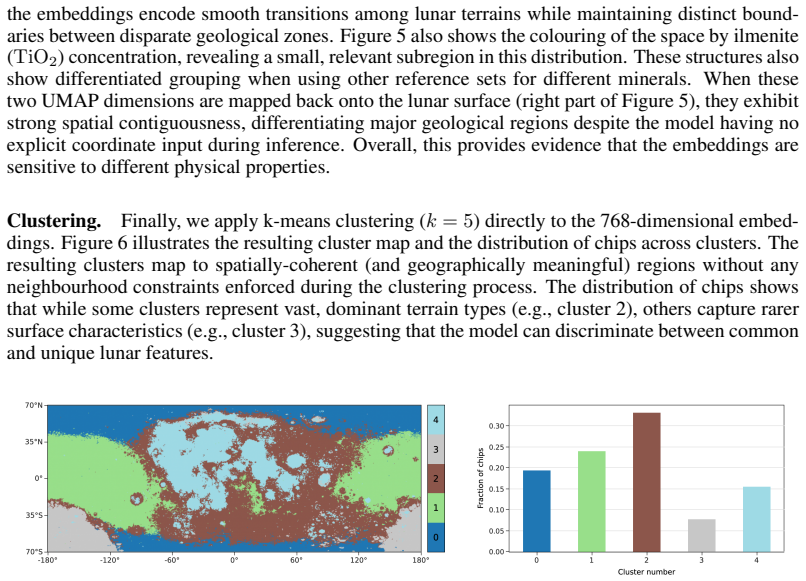
- The embedding space separates geologically meaningful regions (maria, highlands, South Pole-Aitken basin, circumpolar areas) via unsupervised clustering, without coordinate input.
- Band-split geological classification reaches 33.6% top-1 / 60.9% top-3 on a 49-class target, but drops to 19.8% / 14.6% on contiguous longitude/latitude holdouts—quantifying how much harder extrapolation is.
- The released dataset, model weights, and 768-D embeddings allow other teams to build downstream lunar science tools without retraining the base model.
Where Pith is reading between the lines
- Going beyond the paper: the same architecture should transfer to the lunar poles if high-latitude coverage of the input modalities becomes available, since the encoder uses no coordinates; the paper's own limitation section notes the poles are excluded.
- Going beyond the paper: patch-level (rather than chip-level) embeddings from the same encoder are a natural route to sub-kilometer mapping, though cross-modal resolution differences would need handling.
- Going beyond the paper: the sharp drop under contiguous holdouts implies that any deployment to geologically unvisited terrain (e.g., a future landing site) needs explicit out-of-distribution evaluation rather than reliance on band-split scores.
- Going beyond the paper: comparing LunarFM embeddings against single-modality baselines would isolate how much the cross-modal reconstruction, rather than any one instrument, contributes to downstream performance—a benchmark the paper lists as future work.
Editorial analysis
A structured set of objections, weighed in public.
Referee Report
Summary. The paper introduces LunarFM, a self-supervised multimodal masked autoencoder trained on 18 channels from six instruments across three lunar missions, producing a 768-dimensional embedding per 0.5° lunar chip. The authors release a machine-learning-ready dataset (LunarChips), pretrained weights, and an embedding dataset. They evaluate the representation through reconstruction error, PCA/UMAP visualisation, k-means clustering, similarity search, mineral abundance regression, expert-informed few-shot TiO2 mapping, and geological-unit classification using frozen embeddings. The central claim is that a single shared representation supports a range of downstream lunar-science tasks, with the strongest quantitative results being a 0.784±0.025 correlation in few-shot TiO2 mapping and 33.6% top-1 / 60.9% top-3 accuracy on the 49-class USGS geological map under the diagonal band split.
Significance. If the added-value claim is substantiated, LunarFM could be a valuable infrastructure resource for the lunar remote-sensing community: it combines a broad set of physically distinct modalities, uses a non-circular self-supervised objective, and openly provides data, code, and embeddings. The paper is also unusually honest about limitations, explicitly reporting degradation under contiguous spatial holdouts and acknowledging that future work should compare against unimodal and raw-feature baselines. However, the central scientific contribution—that the learned multimodal representation provides benefits beyond raw inputs or spatial proximity—is not yet demonstrated because the paper lacks the baselines it itself identifies as necessary. The quantitative downstream results are therefore ambiguous evidence for cross-modal physical learning.
major comments (4)
- [§4.3.2, §4.3.3, §4.3.4 and §5 (Limitations)] The paper never compares LunarFM embeddings against raw input features, single-modality embeddings, or simple spatial baselines (e.g., chip coordinates). The random-forest regression, few-shot TiO2 experiment, and geological classification all rely on the 768-dimensional embeddings, but without a raw-feature or coordinate-only baseline the reported numbers cannot be attributed to the learned representation. The paper itself states in Section 5 that future work should 'reference against unimodal and raw-feature approaches to quantify what multimodal pretraining specifically contributes'; this is not future work but a necessary control for the central claim. Please add at least a raw-feature baseline (e.g., the same random forest/GBM trained on the 18 raw, normalised channels) and a coordinate-only baseline for the mineral regression and geological classification.
- [§4.3.3 and Figure 9] The expert-informed few-shot experiment does not control for spatial autocorrelation of the TiO2 target. The WAC-derived TiO2 map is a smooth field, and the expert-selected positive/negative chips are likely far apart spatially, so a model using any spatially coherent input—or even just latitude/longitude—might achieve high correlation by proximity interpolation. To support the claim that embeddings capture physical structure, the authors should quantify the autocorrelation length of the target labels relative to the split geometry and compare against a baseline trained only on chip coordinates. Without this, the 0.784±0.025 correlation is ambiguous evidence for the value of the multimodal representation.
- [§3.2 / Appendix A.2 and §4.3.2] The downstream labels have spatial resolutions far coarser than the 0.5° chips. The Lunar Prospector GRS elemental maps and WAC TiO2 product have footprints/smoothing on scales larger than a chip, and the USGS geological map is at 1:5M scale. The paper acknowledges this in the Figure 8 caption but never quantifies how label noise or spatial smoothing affects the reported regression and classification metrics. Without a quantitative analysis of label uncertainty, the numerical results (e.g., MAE values, 33.6% top-1 accuracy) could reflect label artefacts rather than geophysical signal. Please include an estimate of the effective spatial support of each label product and a sensitivity analysis (e.g., predicting upsampled coarse labels from embeddings).
- [§4.3.4 and Figure 11] The geological classification results under contiguous longitude/latitude holdouts (19.8%/14.6% top-1, 7.1%/5.0% macro-F1) are much lower than under the band split. While the paper is explicit about this degradation, it also shows that the representation does not generalise well to geologically distinct regions. The band-split result of 33.6% top-1 needs a baseline to be interpretable: a majority-class baseline, a raw-feature baseline, and ideally a metric like balanced accuracy or a comparison to inter-annotator agreement of the USGS map itself. The macro-F1 of 23.7% under the band split is low, and the paper should discuss whether this is meaningful given the class imbalance and the subjectivity of the labels.
minor comments (5)
- [General] The title in the PDF header appears as 'SHAREDMULTIMODALREPRESENTA-TION' with a spacing/hyphenation issue; please fix in the camera-ready version.
- [Abstract] In the abstract, 'H2O and OH' should be formatted with subscripts; also check for duplicate spaces in the text.
- [§4.3.3] The phrase '10× lower variability' is correct (std 0.267 vs 0.025), but it would be clearer to report the actual standard deviations in the text as well as in the figure.
- [§4.3.2] The random forest hyperparameters (number of trees, depth, etc.) are not reported. Please provide them in the appendix for reproducibility, as the model has only one hyperparameter (the embedding dimension) described elsewhere.
- [Appendix A.2] The 'Crater annotations' dataset is listed but no crater-related downstream experiment is presented in the main text. Either add a small experiment or explicitly state that this dataset is released for community use but not evaluated here.
Circularity Check
No significant circularity: self-supervised pretraining and downstream evaluations are structurally independent.
full rationale
LunarFM's representation is learned with a masked-autoencoder objective that reconstructs the 18 input channels, and no downstream labels are used during pretraining. The reconstruction objective is not defined in terms of any downstream target, so the core representation learning step is not circular. The downstream experiments use external labels—Lunar Prospector GRS element maps, WAC-derived TiO2, and USGS geology—that are not fed into the pretraining loss. In the few-shot experiment, the Diaz & Keszthelyi high-TiO2 delineation is used only to select 5 positive and 5 negative sample locations; the regression target is the independently produced WAC TiO2 map, and the random forest must generalize from 10 embeddings to the whole Moon, so the prediction does not reduce to the fitted labels. One LunarFM author also co-authored the cited delineation, but that work is an externally published descriptive model and the experimental result is not forced by the citation. The paper's Section 5 explicitly flags the absence of unimodal/raw-feature baselines and notes the coarse resolution of some labels; these are attribution and validation limitations, not evidence of circularity. No step in the paper's derivation chain was found to be equivalent to its inputs by construction.
Axiom & Free-Parameter Ledger
free parameters (4)
- Model hyperparameters: embedding dim 768, patch 8×8, masking 85%, lr 1e-4, batch 32, ~500k steps, 109.8M params =
768 / 8×8 / 0.85 / 1e-4 / 32 / 5e5 steps
- Few-shot selection protocol: 5 positive chips from Diaz & Keszthelyi high-TiO2 delineation, 5 negative chips from low Ti =
10 chips
- Random forest training subset size for mineral regression =
20,000 chips
- Number of clusters k in k-means analysis =
5
axioms (5)
- standard math MultiMAE masked-autoencoder self-supervision (with ViT encoder/decoder) yields representations transferable to downstream lunar tasks.
- domain assumption The six instrument products are correctly georeferenced and co-registered to the common spherical grid, so learned cross-modal correlations are physical.
- domain assumption Downstream labels (Lunar Prospector GRS elemental maps, WAC-derived TiO2, USGS 1:5M geological units) are valid targets at the 0.5° chip scale.
- domain assumption The diagonal band-wise split sufficiently mitigates spatial leakage for the reported band-split numbers to be meaningful.
- domain assumption NaN pixels set to zero and excluded from the reconstruction loss still permit learning from partially-missing modalities.
invented entities (1)
-
Modality-independent global token (768-d chip embedding)
no independent evidence
read the original abstract
The renewed global focus on lunar exploration, driven by the prospect of in-situ resource utilization and a sustained human presence on the Moon, has created growing demand for accurate, large-scale characterization of the lunar surface. Although vast quantities of orbital remote-sensing data have been collected, scientific analysis and resource mapping remain fragmented by heterogeneous multiinstrument observations, sparse labels, and bespoke task-specific modelling workflows. Here we introduce LunarFM, a multimodal foundation model that learns a general representation of the lunar surface from diverse orbital measurements. LunarFM assimilates observations from six instruments across three lunar missions, mapping 18 input channels to a shared embedding space. We demonstrate that this embedding space supports a diverse range of downstream applications, including similarity search, few-shot resource mapping, mineral abundance regression, and geological unit classification, enabling efficient scientific investigation and resource-oriented analysis. We provide a machine-learning-ready dataset of co-registered multimodal observations spanning latitudes from 70{\deg}S to 70{\deg}N, a pretrained multimodal masked autoencoder, and a companion embedding dataset providing a joint 768-dimensional representation of lunar surface properties. All code and data are available at https://lunarfm.trillium.tech/
Figures




Reference graph
Works this paper leans on
-
[1]
51st Lunar and Planetary Science Conference , year=
Release of the digital unified global geologic map of the moon at 1: 5,000,000 , author=. 51st Lunar and Planetary Science Conference , year=
-
[2]
arXiv preprint arXiv:2607.03644 , year=
Moonstone: A Multimodal Foundation Model and Benchmark for Lunar Remote Sensing , author=. arXiv preprint arXiv:2607.03644 , year=
-
[3]
Authorea Preprints , year=
A Domain-Specific Vision Foundation Model for Mars: Self-Supervised Learning for Planetary-Scale Science Discovery , author=. Authorea Preprints , year=
-
[4]
Proceedings of the IEEE/CVF Conference on Computer Vision and Pattern Recognition , pages=
LLaVA-LE: Large Language-and-Vision Assistant for Lunar Exploration , author=. Proceedings of the IEEE/CVF Conference on Computer Vision and Pattern Recognition , pages=
-
[5]
Proceedings of the IEEE/CVF Conference on Computer Vision and Pattern Recognition , pages=
MOMO: Mars Orbital Model Foundation Model for Mars Orbital Applications , author=. Proceedings of the IEEE/CVF Conference on Computer Vision and Pattern Recognition , pages=
-
[6]
Prettyman, T. H. and Hagerty, J. J. and Elphic, R. C. and Feldman, W. C. and Lawrence, D. J. and McKinney, G. W. and Vaniman, D. T. , journal =. 2006 , doi =
2006
-
[7]
Jakubik, Johannes and Yang, Felix and Blumenstiel, Benedikt and Scheurer, Erik and Sedona, Rocco and Maurogiovanni, Stefano and Bosmans, Jente and Dionelis, Nikolaos and Marsocci, Valerio and Kopp, Niklas and Ramachandran, Rahul and Fraccaro, Paolo and Brunschwiler, Thomas and Gabriele, Cavallaro and Bernabe-Moreno, Juan and Longépé, Nicolas , journal=
-
[8]
Planetary and Space Science , volume=
Anand, M and Crawford, Ian A and Balat-Pichelin, M and Abanades, S and Van Westrenen, W and P. Planetary and Space Science , volume=. 2012 , publisher=
2012
-
[9]
Proceedings of the IEEE/CVF conference on computer vision and pattern recognition , pages=
He, Kaiming and Chen, Xinlei and Xie, Saining and Li, Yanghao and Doll. Proceedings of the IEEE/CVF conference on computer vision and pattern recognition , pages=
-
[10]
Tseng, Gabriel and Fuller, Anthony and Reil, Marlena and Herzog, Henry and Beukema, Patrick and Bastani, Favyen and Green, James R and Shelhamer, Evan and Kerner, Hannah and Rolnick, David , booktitle=
-
[11]
2011 , publisher=
Neish, CD and Bussey, DBJ and Spudis, P and Marshall, W and Thomson, BJ and Patterson, GW and Carter, LM , journal=. 2011 , publisher=
2011
-
[12]
Astruc, Guillaume and Gonthier, Nicolas and Mallet, Clement and Landrieu, Loic , booktitle=
-
[13]
2022 , organization=
Bachmann, Roman and Mizrahi, David and Atanov, Andrei and Zamir, Amir , booktitle=. 2022 , organization=
2022
-
[14]
Prettyman, T. H. and Hagerty, J. J. and Elphic, R. C. and Feldman, W. C. and Lawrence, D. J. and McKinney, G. W. and Vaniman, D. T. , title =. Journal of Geophysical Research: Planets , volume =. doi:https://doi.org/10.1029/2005JE002656 , url =. https://agupubs.onlinelibrary.wiley.com/doi/pdf/10.1029/2005JE002656 , abstract =
-
[15]
2025 , publisher=
Diaz, Abigail Calzada and Keszthelyi, Laszlo , journal=. 2025 , publisher=
2025
-
[16]
2009 , publisher=
Pieters, Carle M and Goswami, JN and Clark, RN and Annadurai, M and Boardman, J and Buratti, B and Combe, J-P and Dyar, MD and Green, R and Head, JW and others , journal=. 2009 , publisher=
2009
-
[17]
and Asphaug, Erik and Korycansky, Don and Landis, David and Sollitt, Luke , journal=
Colaprete, Anthony and Schultz, Peter and Heldmann, Jennifer and Wooden, Diane and Shirley, Mark and Ennico, Kimberly and Hermalyn, Brendan and Marshall, William and Ricco, Antonio and Elphic, Richard C and Goldstein, David and Summy, Dustin and Bart, Gwendolyn D. and Asphaug, Erik and Korycansky, Don and Landis, David and Sollitt, Luke , journal=. 2010 ,...
2010
-
[18]
doi:10.48550/arXiv.2010.11929 , note =
Dosovitskiy, Alexey and Beyer, Lucas and Kolesnikov, Alexander and Weissenborn, Dirk and Zhai, Xiaohua and Unterthiner, Thomas and Dehghani, Mostafa and Minderer, Matthias and Heigold, Georg and Gelly, Sylvain and Uszkoreit, Jakob and Houlsby, Neil , year = 2021, publisher =. doi:10.48550/arXiv.2010.11929 , note =
-
[19]
Zhu, Xiao Xiang and Tuia, Devis and Mou, Lichao and Xia, Gui-Song and Zhang, Liangpei and Xu, Feng and Fraundorfer, Friedrich , year = 2017, journal =
2017
-
[20]
Wang, Yi and Albrecht, Conrad M and Braham, Nassim Ait Ali and Mou, Lichao and Zhu, Xiao Xiang , year = 2022, journal =
2022
-
[21]
doi:10.48550/arXiv.2103.00020 , note =
Radford, Alec and Kim, Jong Wook and Hallacy, Chris and Ramesh, Aditya and Goh, Gabriel and Agarwal, Sandhini and Sastry, Girish and Askell, Amanda and Mishkin, Pamela and Clark, Jack and Krueger, Gretchen and Sutskever, Ilya , year = 2021, publisher =. doi:10.48550/arXiv.2103.00020 , note =
-
[22]
and Lo, Wan-Yen and Dollar, Piotr and Girshick, Ross , year = 2023, pages =
Kirillov, Alexander and Mintun, Eric and Ravi, Nikhila and Mao, Hanzi and Rolland, Chloe and Gustafson, Laura and Xiao, Tete and Whitehead, Spencer and Berg, Alexander C. and Lo, Wan-Yen and Dollar, Piotr and Girshick, Ross , year = 2023, pages =
2023
-
[23]
doi:10.48550/arXiv.2208.10442 , note =
Wang, Wenhui and Bao, Hangbo and Dong, Li and Bjorck, Johan and Peng, Zhiliang and Liu, Qiang and Aggarwal, Kriti and Mohammed, Owais Khan and Singhal, Saksham and Som, Subhojit and Wei, Furu , year = 2022, publisher =. doi:10.48550/arXiv.2208.10442 , note =
-
[24]
Zheng, Sixiao and Lu, Jiachen and Zhao, Hengshuang and Zhu, Xiatian and Luo, Zekun and Wang, Yabiao and Fu, Yanwei and Feng, Jianfeng and Xiang, Tao and Torr, Philip H. S. and Zhang, Li , year = 2021, publisher =. doi:10.48550/arXiv.2012.15840 , note =
-
[25]
and Braham, Nassim Ait Ali and Mou, Lichao and Zhu, Xiao Xiang , year = 2022, journal =
Wang, Yi and Albrecht, Conrad M. and Braham, Nassim Ait Ali and Mou, Lichao and Zhu, Xiao Xiang , year = 2022, journal =. doi:10.1109/MGRS.2022.3198244 , issn =
arXiv 2022
-
[26]
doi:10.1109/TGRS.2023.3276853 , issn =
Tao, Chao and Qi, Ji and Guo, Mingning and Zhu, Qing and Li, Haifeng , year = 2023, journal =. doi:10.1109/TGRS.2023.3276853 , issn =
arXiv 2023
-
[27]
doi:10.48550/arXiv.2312.10115 , note =
Guo, Xin and Lao, Jiangwei and Dang, Bo and Zhang, Yingying and Yu, Lei and Ru, Lixiang and Zhong, Liheng and Huang, Ziyuan and Wu, Kang and Hu, Dingxiang and He, Huimei and Wang, Jian and Chen, Jingdong and Yang, Ming and Zhang, Yongjun and Li, Yansheng , year = 2024, publisher =. doi:10.48550/arXiv.2312.10115 , note =
-
[28]
Girshick, Ross , year = 2015, publisher =. Fast. doi:10.48550/arXiv.1504.08083 , note =
-
[29]
Zhiping Yu and Chenyang Liu and Liqin Liu and Zhenwei Shi and Zhengxia Zou , year=. 2405.13570 , archivePrefix=
-
[30]
Anthony Fuller and Koreen Millard and James R. Green , year=. 2311.00566 , archivePrefix=
-
[31]
Zhitong Xiong and Yi Wang and Fahong Zhang and Adam J. Stewart and Joëlle Hanna and Damian Borth and Ioannis Papoutsis and Bertrand Le Saux and Gustau Camps-Valls and Xiao Xiang Zhu , year=. 2403.15356 , archivePrefix=
-
[32]
Guillaume Astruc and Nicolas Gonthier and Clement Mallet and Loic Landrieu , year=. 2404.08351 , archivePrefix=
-
[33]
Johannes Jakubik and Felix Yang and Benedikt Blumenstiel and Erik Scheurer and Rocco Sedona and Stefano Maurogiovanni and Jente Bosmans and Nikolaos Dionelis and Valerio Marsocci and Niklas Kopp and Rahul Ramachandran and Paolo Fraccaro and Thomas Brunschwiler and Gabriele Cavallaro and Juan Bernabe-Moreno and Nicolas Longépé , year = 2025, archiveprefix =
2025
-
[34]
doi:10.48550/arXiv.2211.05778 , note =
Wang, Wenhai and Dai, Jifeng and Chen, Zhe and Huang, Zhenhang and Li, Zhiqi and Zhu, Xizhou and Hu, Xiaowei and Lu, Tong and Lu, Lewei and Li, Hongsheng and Wang, Xiaogang and Qiao, Yu , year = 2023, publisher =. doi:10.48550/arXiv.2211.05778 , note =
-
[35]
2017 , publisher=
Sato, Hiroyuki and Robinson, Mark S and Lawrence, Samuel J and Denevi, Brett W and Hapke, Bruce and Jolliff, Bradley L and Hiesinger, Harald , journal=. 2017 , publisher=
2017
-
[36]
Tom Sander and Moritz Tenthoff and Kay Wohlfarth and Christian Wöhler , year=. 2505.05644 , archivePrefix=
-
[37]
Device , volume=
Cuervo-Ortiz, Juli. Device , volume=. 2025 , publisher=
2025
-
[38]
2020 , publisher=
Sargeant, HM and Abernethy, FAJ and Barber, SJ and Wright, IP and Anand, M and Sheridan, S and Morse, A , journal=. 2020 , publisher=
2020
-
[39]
2023 , volume=
Hedrick, Gabrielle , booktitle=. 2023 , volume=
2023
-
[40]
Robbins, Stuart J. , title =. Journal of Geophysical Research: Planets , volume =. doi:https://doi.org/10.1029/2018JE005592 , url =. https://agupubs.onlinelibrary.wiley.com/doi/pdf/10.1029/2018JE005592 , abstract =
-
[41]
2023 , publisher=
Speyerer, Emerson J and Robinson, Mark S and Boyd, Aaron and Silva, Victor H and Lawrence, Samuel , journal=. 2023 , publisher=
2023
-
[42]
Powell, T. M. and Horvath, T. and Robles, V. Lopez and Williams, J.-P. and Hayne, P. O. and Gallinger, C. L. and Greenhagen, B. T. and McDougall, D. S. and Paige, D. A. , title =. Journal of Geophysical Research: Planets , volume =. doi:https://doi.org/10.1029/2022JE007532 , url =. https://agupubs.onlinelibrary.wiley.com/doi/pdf/10.1029/2022JE007532 , note =
-
[43]
Goossens, S. and Sabaka, T. J. and Wieczorek, M. A. and Neumann, G. A. and Mazarico, E. and Lemoine, F. G. and Nicholas, J. B. and Smith, D. E. and Zuber, M. T. , title =. Journal of Geophysical Research: Planets , volume =. doi:https://doi.org/10.1029/2019JE006086 , url =. https://agupubs.onlinelibrary.wiley.com/doi/pdf/10.1029/2019JE006086 , note =
-
[44]
Space Science Reviews , volume=
The lunar reconnaissance orbiter miniature radio frequency (Mini-RF) technology demonstration , author=. Space Science Reviews , volume=. 2010 , publisher=
2010
discussion (0)
Sign in with ORCID, Apple, or X to comment. Anyone can read and Pith papers without signing in.