REVIEW 5 major objections 5 minor 1 cited by
Visual-Oriented Fine-Grained Knowledge Editing for MultiModal Large Language Models
T0 review · 5 major / 5 minor · reviewed 2026-08-12 · deepseek-v4-flash
Pith's one-line read Replacing a text-only edit router with one that also sees the image lets multimodal LLMs update one entity in a multi-entity scene without disturbing the rest, and the paper measures a near-doubling of fine-grained specificity on two…
desk verdict Useful benchmark and a sound idea, but the Specificity metric is under-specified and the headline numbers can't be interpreted as reported. read the letter →
The pith
A machine-rendered reading of the paper's core claim, the machinery that carries it, and where it could break.
The reading
What carries the argument
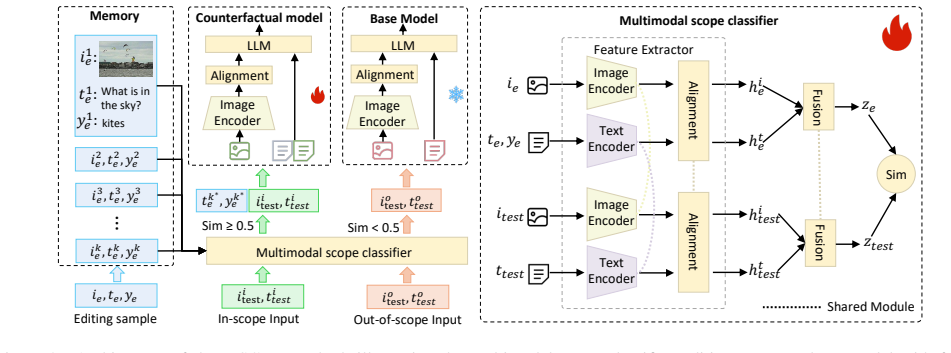
The load-bearing component is the Multimodal Scope Classifier. It maps the image and text of both the query and each stored edit example into a shared CLIP feature space, aligns the two modalities, fuses them with dot-product attention so the text highlights the relevant parts of the image, and returns a cosine similarity between the query's fused representation and the edit example's fused representation. Inputs with similarity below 0.5 go to the frozen base model; inputs at or above 0.5 go to the counterfactual model, which is conditioned on the stored edit example. The classifier is trained as a binary classifier with cross-entropy loss on in-scope and out-of-scope pairs, and it can also accept text-only inputs by setting the image to null.
What would settle it
Take a random subset of FGVEdit specificity pairs, have several human annotators decide whether a change in the edit answer would affect the target question's answer, then recompute Specificity from the human labels; if the MSCKE versus SERAC gap (29.68 points on BLIP-2 OPT and 19.35 on MiniGPT-4) shrinks or reverses, the reported improvement is an artifact of the GPT-4o-mini labels.
Extended reading notes
Core claim
The paper's central claim is that in multimodal knowledge editing, the question of which inputs are in scope must be decided by both the image and the text, and that a text-only scope classifier cannot reliably separate questions about the edited entity from questions about other entities in the same image. Concretely, MSCKE stores edit examples in memory, uses a multimodal scope classifier (CLIP encoders, an alignment projection, dot-product attention fusion, and a similarity threshold of 0.5) to route inputs either to the frozen base model or to a counterfactual model, and thereby achieves Specificity of 61.60 on BLIP-2 OPT and 57.20 on MiniGPT-4, versus 31.92 and 37.85 for SERAC. When the counterfactual model is replaced by MEND, Specificity rises further to 68.38 and 71.98. Reliability, locality, and generality stay at or near the level of the strongest baselines, with locality reaching 100 on both base models.
Load-bearing premise
The Specificity metric is computed from GPT-4o-mini's entailment judgments about which questions are in or out of the visual editing scope, and there is no human validation or agreement statistic reported, so the benchmark's labels are the load-bearing premise for the reported gains.
Editorial extensions
If this is right
- On the FGVEdit benchmark, MSCKE reduces over-editing: text-only baselines disturb answers to out-of-visual-scope questions, while MSCKE keeps locality at 100 on both BLIP-2 OPT and MiniGPT-4.
- The multimodal scope classifier transfers across base models and counterfactual editors without retraining, performing nearly identically to a classifier retrained per setting.
- Because the classifier handles text-only inputs, the same editing framework covers both text knowledge edits and visual fine-grained edits.
- The classifier adds little overhead: it uses far less inference time and memory than the base or counterfactual models, so the precision gain does not come at high compute cost.
- Specificity, the new metric, shows that standard reliability, locality, and generality scores miss a failure mode where edited knowledge leaks to unrelated entities in the same image.
Reading between the lines
- Inference: if visual routing is the key mechanism, replacing the coarse similarity threshold with entity localization (for example, attention maps or detection boxes) could make MSCKE robust on denser scenes and on entities that look alike.
- Inference: the Specificity gains should be re-measured with human-validated entailment labels; the current labels come from a single GPT-4o-mini call, and a disagreement study would show how much of the reported gap is a labeling artifact.
- Inference: the router design suggests a cheap deployment path for continual updates in MLLMs: keep the frozen base model, maintain a growing memory of edits, and swap only the lightweight classifier and counterfactual model when the base model changes.
- A testable extension is to train the classifier on hard out-of-visual-scope pairs where text alone is ambiguous and see whether Specificity improves further on a held-out split.
Editorial analysis
A structured set of objections, weighed in public.
Referee Report
Summary. The paper introduces a 'visual-oriented fine-grained' knowledge editing task for multimodal large language models, in which an edit targets a specific entity within an image containing multiple interacting entities. It presents the FGVEdit benchmark, built from VQAv2 by using GPT-4o-mini entailment judgments to partition questions into in-scope and out-of-scope sets relative to the first question for each image. The proposed MSCKE method extends SERAC by replacing its text-only scope classifier with a multimodal classifier that fuses CLIP image and text features, routing in-scope inputs to a counterfactual model and out-of-scope inputs to a frozen base model. Experiments on BLIP-2 OPT and MiniGPT-4 report improvements on a new Specificity metric over text-only baselines, along with analyses of classifier design and transferability.
Significance. If the evaluation were made rigorous, the task definition would be a reasonable extension of knowledge editing beyond treating images as single entities, and the multimodal scope classifier is a natural adaptation of memory-based editing that could be practically useful. The reported transferability of the classifier across counterfactual models and base MLLMs is a valuable property. However, the central quantitative evidence is currently not verifiable: the Specificity metric's in-scope target labels are unspecified, the evaluation labels are also used to train the classifier, and no variance or significance information is reported.
major comments (5)
- [Section 4.1, Eq. (13) and Section 4.2] The in-visual-scope target labels y'_in used in Eq. (13) are never defined or documented. Section 4.2 describes only how questions are partitioned into hard in-visual-scope and hard out-of-visual-scope using GPT-4o-mini entailment judgments; it does not state how the edited answers y'_in are produced for those in-scope questions. If y'_in is taken to be the original VQAv2 ground-truth answer, the metric would penalize a correctly edited model (e.g., one that answers 'kite' after the edit instead of 'stuffed elephant'), making the reported Specificity gains meaningless. If y'_in is generated by GPT-4o-mini, that generation step is undocumented and unvalidated. Similarly, the edit target y_e for the first question (the editing sample) is not specified; the paper says the first question serves as the editing sample but does not state what the new answer is or how it is obtained. The authors must specify the generation protocol for both y_e and y'_in, and ideally release the evaluation data so that the headline numbers in Tables 1 and 3 can be independently verified.
- [Section 3.3 and Section 4.2] The scope classifier is trained with the same GPT-4o-mini-generated in/out-of-scope labels that are later used to compute the Specificity metric in Section 4.1. This creates a circularity: the classifier is trained to reproduce the very labels used to measure its success, so the reported classification improvements and the resulting Specificity gains could be an artifact of training to match the evaluator. The authors should provide a human-validated held-out set for evaluation, or at minimum report inter-annotator agreement between GPT-4o-mini and human annotators for the entailment judgments and for any generated target answers.
- [Section 5.2, Table 1] The claim that MSCKE 'outperforms existing methods' is not supported on the headline Specificity metric: MEND achieves 65.85 on BLIP-2 OPT and 67.39 on MiniGPT-4, both higher than MSCKE's 61.60 and 57.20. The paper should either restrict the claim to 'outperforms text-only editing methods' or explain why MEND is not the primary comparison. As written, the abstract and introduction overstate the results relative to the table.
- [Section 5.2, Table 1] No error bars, variance, or significance tests are reported for any metric. Since the differences between MSCKE-MEND and MEND are modest (e.g., 68.38 vs 65.85 on BLIP-2 OPT) and the evaluation is performed on a single train/test split of the FGVEdit dataset, it is unclear whether the reported improvements are stable. The authors should report means and standard deviations over multiple runs or provide statistical significance tests for the key comparisons.
- [Section 3.3, Eqs. (1)-(2)] The selection rule k* = arg min_k fcls(...) is inconsistent with treating ρ as a similarity in [0,1] where values ≥ 0.5 are in-scope. If fcls outputs a similarity, the most similar editing example should be selected by arg max; if fcls outputs a distance, then the threshold and the loss in Eq. (11) need to be reinterpreted. As written, the algorithm is not implementable as stated. This appears to be an easily corrected error, but it must be fixed for the method description to be coherent.
minor comments (5)
- [Section 3.3, text after Eq. (11)] The sentence describing the training data says 'the dataset provides both in-scope inputs (i^k_in, t^k_in) and out-of-scope inputs (i^k_in, t^k_in)'; the second pair should be (i^k_out, t^k_out).
- [Table 3] The heading 'Locolity' should be 'Locality'.
- [Table 3 caption] The caption says results are presented as 'transferred/retrained' but does not explain what the slash denotes; please clarify the notation in the caption.
- [Section 4.1, Eqs. (16)-(17)] The Locality metric is defined on text-only inputs t_l while the rest of the paper emphasizes multimodal inputs; this choice should be stated explicitly. For Generality, the comparison in Eq. (17) is to f_{θ_e}(i_e, t_e) rather than to the target y_e; this is only meaningful when reliability holds, so it would be clearer to define M_gen against y_e.
- [Section 4.2] The paper says 'we manually construct two prompts'; the classification is performed by GPT-4o-mini, not by human annotators, so this phrasing is misleading and should be changed to something like 'we use two prompts to query GPT-4o-mini'.
Circularity Check
Specificity's out-of-scope component reduces by construction to the scope classifier's own training objective, so part of the headline gain is the fitted classifier relabeled as an editing metric.
-
fitted input called prediction
[Section 3.3 Training (Eqs. 9-11), Section 4.1 Eq. (14), with routing Eq. (3); labels from Section 4.2]
"The final output of the model is: ytest = ( fbase(itest, ttest), ρ < 0.5, fcfr(te, ye, itest, ttest), ρ ≥ 0.5 ) (Eq. 3) ... M v_out = E(tout,yout)∼Dv_out [Ifθe (ie,tout)=fθ(ie,tout)] (Eq. 14) ... we train the classifier with a binary cross-entropy loss on a multimodal dataset ... For each editing sample, the dataset provides both in-scope inputs (ik_in, tk_in) and out-of-scope inputs (ik_in, tk_in)."
By Eq. (3), any input with ρ<0.5 is routed to the frozen base model, so fθe(ie,tout)=fθ(ie,tout) automatically whenever the scope classifier labels the sample out-of-scope. Therefore Eq. (14)'s M^v_out indicator is 1 exactly when the classifier makes the correct out-of-scope decision; it is not an independent measure of the knowledge edit. The same classifier is trained with the binary cross-entropy loss of Eq. (11) on in/out-of-scope labels constructed in Section 4.2 by GPT-4o-mini entailment judgments, which also define D^v_out. Thus the out-of-scope half of the reported Specificity improvement (e.g., 61.60 vs 31.92 for BLIP-2 OPT) is a fitted classifier's accuracy on its own training distribution, renamed as a knowledge-editing metric. The reduction is Eq.
full rationale
The central circular element is confined to the new Specificity metric, not the whole paper. The out-of-scope component M^v_out is, by the paper's own routing equation, identical to the scope classifier's out-of-scope accuracy; since that classifier is trained with binary cross-entropy on the same GPT-4o-mini-generated in/out-of-scope labels that define the benchmark, the Specificity comparison partly measures how well the method reproduces its own training signal. This is a genuine partial circularity in the headline claim. The paper's other results—Reliability, Locality, Generality, transferability, and the classifier ablation—are not forced by this construction, and the comparison against SERAC's text-only classifier is a real behavioral measurement. Separately, and compounding the problem, the in-scope target y'_in in Eq. (13) is never defined or documented, so the in-scope component of Specificity is not interpretable; this is a missing-definition issue rather than a circularity, but it further weakens the empirical claim. No load-bearing self-citation or uniqueness-imported-from-authors pattern is present. Overall the central Specificity claim partially reduces to a fitted classifier relabeled as an editing metric, warranting a score of 6.
Assumptions & free parameters
free parameters (1)
- scope threshold rho=0.5 =
0.5
assumptions (4)
- domain assumption GPT-4o-mini's entailment classifications (Yes/No/Maybe) correctly determine visual editing scope.
- domain assumption CLIP image-text features are sufficient to capture fine-grained entity-level similarity in images with multiple interacting entities.
- domain assumption The first VQA question and its answer form a valid knowledge editing target.
- domain assumption Counterfactual model can be trained to answer in-scope queries from memory.
Cite this review
Pith. "Pith review of Visual-Oriented Fine-Grained Knowledge Editing for MultiModal Large Language Models." pith.science (2026). https://pith.science/paper/4H23ZHCO
@misc{pith2026241112790,
  author       = {Pith},
  title        = {Pith review of: Visual-Oriented Fine-Grained Knowledge Editing for MultiModal Large Language Models},
  year         = {2026},
  howpublished = {\url{https://pith.science/paper/4H23ZHCO}},
  note         = {Machine review of arXiv:2411.12790}
}
read the original abstract
Knowledge editing aims to efficiently and cost-effectively correct inaccuracies and update outdated information. Recently, there has been growing interest in extending knowledge editing from Large Language Models (LLMs) to Multimodal Large Language Models (MLLMs), which integrate both textual and visual information, introducing additional editing complexities. Existing multimodal knowledge editing works primarily focus on text-oriented, coarse-grained scenarios, failing to address the unique challenges posed by multimodal contexts. In this paper, we propose a visual-oriented, fine-grained multimodal knowledge editing task that targets precise editing in images with multiple interacting entities. We introduce the Fine-Grained Visual Knowledge Editing (FGVEdit) benchmark to evaluate this task. Moreover, we propose a Multimodal Scope Classifier-based Knowledge Editor (MSCKE) framework. MSCKE leverages a multimodal scope classifier that integrates both visual and textual information to accurately identify and update knowledge related to specific entities within images. This approach ensures precise editing while preserving irrelevant information, overcoming the limitations of traditional text-only editing methods. Extensive experiments on the FGVEdit benchmark demonstrate that MSCKE outperforms existing methods, showcasing its effectiveness in solving the complex challenges of multimodal knowledge editing.
Figures


Figures from the paper (1 more)

Forward citations
Cited by 1 Pith paper
-
ClinKD: Cross-Modal Clinical Knowledge Distiller For Multi-Task Medical Images
ClinKD combines a modified rotary position embedding, confidence-weighted pseudo-label distillation, and CLIP-based answer selection, reporting state-of-the-art scores on Med-GRIT and LLaVA-Med-QA benchmarks.
Reference graph
Works this paper leans on
-
[1]
Josh Achiam, Steven Adler, Sandhini Agarwal, Lama Ah- mad, Ilge Akkaya, Florencia Leoni Aleman, Diogo Almeida, Janko Altenschmidt, Sam Altman, Shyamal Anadkat, et al. Gpt-4 technical report. arXiv preprint arXiv:2303.08774 ,
-
[2]
Flamingo: a visual language model for few-shot learning
Jean-Baptiste Alayrac, Jeff Donahue, Pauline Luc, Antoine Miech, Iain Barr, Yana Hasson, Karel Lenc, Arthur Mensch, Katherine Millican, Malcolm Reynolds, et al. Flamingo: a visual language model for few-shot learning. NIPS, 2022. 1, 2
work page 2022
-
[3]
Lan- guage models are few-shot learners
Tom B Brown, Benjamin Mann, Nick Ryder, Melanie Sub- biah, Jared Kaplan, Prafulla Dhariwal, Arvind Neelakantan, Pranav Shyam, Girish Sastry, Amanda Askell, et al. Lan- guage models are few-shot learners. In NIPS, 2020. 2
work page 2020
-
[4]
Can we edit multimodal large language models? In EMNLP, 2023
Siyuan Cheng, Bozhong Tian, Qingbin Liu, Xi Chen, Yongheng Wang, Huajun Chen, and Ningyu Zhang. Can we edit multimodal large language models? In EMNLP, 2023. 1, 3, 6
work page 2023
-
[5]
Knowledge neurons in pretrained transform- ers
Damai Dai, Li Dong, Yaru Hao, Zhifang Sui, Baobao Chang, and Furu Wei. Knowledge neurons in pretrained transform- ers. In ACL, 2022. 2
work page 2022
-
[6]
Editing factual knowledge in language models
N De Cao, W Aziz, and I Titov. Editing factual knowledge in language models. In EMNLP, 2021. 1, 2
work page 2021
-
[7]
Calibrating factual knowledge in pretrained language models
Qingxiu Dong, Damai Dai, Yifan Song, Jingjing Xu, Zhifang Sui, and Lei Li. Calibrating factual knowledge in pretrained language models. In EMNLP, 2022. 2
work page 2022
-
[8]
Making the v in vqa matter: Elevating the role of image understanding in visual question answer- ing
Yash Goyal, Tejas Khot, Douglas Summers-Stay, Dhruv Ba- tra, and Devi Parikh. Making the v in vqa matter: Elevating the role of image understanding in visual question answer- ing. In CVPR, 2017. 5
work page 2017
Show all 33 references
-
[9]
Kebench: A benchmark on knowl- edge editing for large vision-language models
Han Huang, Haitian Zhong, Qiang Liu, Shu Wu, Liang Wang, and Tieniu Tan. Kebench: A benchmark on knowl- edge editing for large vision-language models. arXiv preprint arXiv:2403.07350, 2024. 1, 3, 7
2024 arXiv
-
[10]
Transformer-patcher: One mistake worth one neuron
Zeyu Huang, Yikang Shen, Xiaofeng Zhang, Jie Zhou, Wenge Rong, and Zhang Xiong. Transformer-patcher: One mistake worth one neuron. In ICLR, 2023. 2
2023
-
[11]
Dai, Jakob Uszkoreit, Quoc Le, and Slav Petrov
Tom Kwiatkowski, Jennimaria Palomaki, Olivia Redfield, Michael Collins, Ankur Parikh, Chris Alberti, Danielle Ep- stein, Illia Polosukhin, Jacob Devlin, Kenton Lee, Kristina Toutanova, Llion Jones, Matthew Kelcey, Ming-Wei Chang, Andrew M. Dai, Jakob Uszkoreit, Quoc Le, and Sl...
2019
-
[12]
Mind the gap: Assessing temporal general- ization in neural language models
Angeliki Lazaridou, Adhi Kuncoro, Elena Gribovskaya, De- vang Agrawal, Adam Liska, Tayfun Terzi, Mai Gimenez, Cyprien de Masson d’Autume, Tomas Kocisky, Sebastian Ruder, et al. Mind the gap: Assessing temporal general- ization in neural language models. NIPS, 34:29348–29363,
-
[13]
Blip-2: Bootstrapping language-image pre-training with frozen image encoders and large language models
Junnan Li, Dongxu Li, Silvio Savarese, and Steven Hoi. Blip-2: Bootstrapping language-image pre-training with frozen image encoders and large language models. In In- ternational conference on machine learning , pages 19730– 19742. PMLR, 2023. 1, 6
2023
-
[14]
Mike: A new benchmark for fine-grained multimodal entity knowledge editing
Jiaqi Li, Miaozeng Du, Chuanyi Zhang, Yongrui Chen, Nan Hu, Guilin Qi, Haiyun Jiang, Siyuan Cheng, and Bozhong Tian. Mike: A new benchmark for fine-grained multimodal entity knowledge editing. arXiv preprint arXiv:2402.14835,
-
[15]
Visual instruction tuning
Haotian Liu, Chunyuan Li, Qingyang Wu, and Yong Jae Lee. Visual instruction tuning. NIPS, 2024. 1
2024
-
[16]
Memory-assisted prompt editing to improve gpt-3 af- ter deployment
Aman Madaan, Niket Tandon, Peter Clark, and Yiming Yang. Memory-assisted prompt editing to improve gpt-3 af- ter deployment. In EMNLP, 2022. 1, 2
2022
-
[17]
Locating and editing factual associations in gpt
Kevin Meng, David Bau, Alex Andonian, and Yonatan Be- linkov. Locating and editing factual associations in gpt. NIPS, 2022. 2
2022
-
[18]
Mass-editing memory in a trans- former
Kevin Meng, Arnab Sen Sharma, Alex J Andonian, Yonatan Belinkov, and David Bau. Mass-editing memory in a trans- former. In ICLR, 2023. 2
2023
-
[19]
Fast model editing at scale
Eric Mitchell, Charles Lin, Antoine Bosselut, Chelsea Finn, and Christopher D Manning. Fast model editing at scale. In ICLR, 2022. 1, 2, 7
2022
-
[20]
Memory-based model editing at scale
Eric Mitchell, Charles Lin, Antoine Bosselut, Christopher D Manning, and Chelsea Finn. Memory-based model editing at scale. In ICML, 2022. 1, 2, 3, 6, 7
2022
-
[21]
Learn- ing transferable visual models from natural language super- vision
Alec Radford, Jong Wook Kim, Chris Hallacy, Aditya Ramesh, Gabriel Goh, Sandhini Agarwal, Girish Sastry, Amanda Askell, Pamela Mishkin, Jack Clark, et al. Learn- ing transferable visual models from natural language super- vision. In ICML, 2021. 2, 4 9
2021
-
[22]
Editable neural net- works
Anton Sinitsin, Vsevolod Plokhotnyuk, Dmitry Pyrkin, Sergei Popov, and Artem Babenko. Editable neural net- works. In ICLR, 2019. 1
2019
-
[23]
Llama: Open and efficient foundation language models
Hugo Touvron, Thibaut Lavril, Gautier Izacard, Xavier Martinet, Marie-Anne Lachaux, Timoth´ee Lacroix, Baptiste Rozi`ere, Naman Goyal, Eric Hambro, Faisal Azhar, et al. Llama: Open and efficient foundation language models. arXiv preprint arXiv:2302.13971, 2023. 2
2023 arXiv
-
[24]
Multimodal few-shot learning with frozen language models
Maria Tsimpoukelli, Jacob L Menick, Serkan Cabi, SM Es- lami, Oriol Vinyals, and Felix Hill. Multimodal few-shot learning with frozen language models. NIPS, 2021. 1
2021
-
[25]
Easyedit: An easy-to-use knowledge editing framework for large language models.arXiv preprint arXiv:2308.07269, 2023
Peng Wang, Ningyu Zhang, Xin Xie, Yunzhi Yao, Bozhong Tian, Mengru Wang, Zekun Xi, Siyuan Cheng, Kangwei Liu, Guozhou Zheng, et al. Easyedit: An easy-to-use knowledge editing framework for large language models.arXiv preprint arXiv:2308.07269, 2023. 7
2023 arXiv
-
[26]
Mm-react: Prompting chatgpt for multimodal reasoning and action
Zhengyuan Yang, Linjie Li, Jianfeng Wang, Kevin Lin, Ehsan Azarnasab, Faisal Ahmed, Zicheng Liu, Ce Liu, Michael Zeng, and Lijuan Wang. Mm-react: Prompting chatgpt for multimodal reasoning and action. arXiv preprint arXiv:2303.11381, 2023. 1
2023 arXiv
-
[27]
Editing large language models: Problems, methods, and op- portunities
Yunzhi Yao, Peng Wang, Bozhong Tian, Siyuan Cheng, Zhoubo Li, Shumin Deng, Huajun Chen, and Ningyu Zhang. Editing large language models: Problems, methods, and op- portunities. In EMNLP, 2023. 1
2023
-
[28]
A survey on multimodal large language models
Shukang Yin, Chaoyou Fu, Sirui Zhao, Ke Li, Xing Sun, Tong Xu, and Enhong Chen. A survey on multimodal large language models. arXiv preprint arXiv:2306.13549 , 2023. 1, 2
2023 arXiv
-
[29]
Mc- mke: A fine-grained multimodal knowledge editing bench- mark emphasizing modality consistency
Junzhe Zhang, Huixuan Zhang, Xunjian Yin, Baizhou Huang, Xu Zhang, Xinyu Hu, and Xiaojun Wan. Mc- mke: A fine-grained multimodal knowledge editing bench- mark emphasizing modality consistency. arXiv preprint arXiv:2406.13219, 2024. 1, 3
2024 arXiv
-
[30]
A comprehensive study of knowledge editing for large language models.arXiv preprint arXiv:2401.01286, 2024
Ningyu Zhang, Yunzhi Yao, Bozhong Tian, Peng Wang, Shumin Deng, Mengru Wang, Zekun Xi, Shengyu Mao, Jin- tian Zhang, Yuansheng Ni, et al. A comprehensive study of knowledge editing for large language models.arXiv preprint arXiv:2401.01286, 2024. 1
2024 arXiv
-
[31]
Can we edit factual knowl- edge by in-context learning? In EMNLP, 2023
Ce Zheng, Lei Li, Qingxiu Dong, Yuxuan Fan, Zhiyong Wu, Jingjing Xu, and Baobao Chang. Can we edit factual knowl- edge by in-context learning? In EMNLP, 2023. 1, 2, 6
2023
-
[32]
Modify- ing memories in transformer models
Chen Zhu, Daliang Li, Felix Yu, Manzil Zaheer, Sanjiv Ku- mar, Srinadh Bhojanapalli, and Ankit Singh Rawat. Modify- ing memories in transformer models. In ICML, 2021. 1
2021
-
[33]
MiniGPT-4: Enhancing vision-language understanding with advanced large language models
Deyao Zhu, Jun Chen, Xiaoqian Shen, Xiang Li, and Mo- hamed Elhoseiny. MiniGPT-4: Enhancing vision-language understanding with advanced large language models. In ICLR, 2024. 1, 6 10
2024
Reviewed August 12, 2026 · model on record in the stance chip above.
Discussion (0). Continue with ORCID to comment.